Tag Archive | jesus

15 verser om lag och nåd du inte visste fanns i Bibeln – och 15 som du TRODDE fanns

15 Verser om lag och nåd du inte visste fanns i Bibeln

 1) Rom. 3:25  honom som Gud har ställt fram såsom ett försoningsmedel genom tro, i hans blod. Så ville Gud — då han i sin skonsamhet hade haft fördrag med de synder som FÖRUT hade blivit begångna — nu visa att han dock var rättfärdig.

2) Jak. 2:24 I sen alltså att det är av GÄRNINGAR som en människa bliver rättfärdig, och ICKE AV TRO ALLENAST

3) Fil. 2:12 Därför, mina älskade, såsom I alltid förut haven varit lydiga, så mån I också nu med fruktan och bävan arbeta på eder frälsning, och det icke allenast såsom I gjorden, då jag var närvarande, utan ännu mycket mer nu, då jag är frånvarande.

4) Rom 2:13 Ty de, som hör lagen, är inte rättfärdiga inför Gud, utan de som GÖR lagen, de skall bli rättfärdiggjorda.

5) 1 John 3:6 Var och en som förblir i honom syndar inte. Var och en som syndar har inte sett honom och inte lärt känna honom.

6) Matt 5:19 Därför, den som upphäver ett av de minsta bland dessa bud och lär människorna så, han skall räknas för en av de minsta i himmelriket; men den som håller dem och lär människorna så, han skall räknas för stor i himmelriket.

7) Titus 2:12. (Nåd) Den lär oss att AVSÄGA OSS all ogudaktighet och världsliga begär och att leva anständigt, rättfärdigt och gudfruktigt i denna världen

8 ) Apg 5:32 Vi är hans vittnen till detta, och likaså den Helige Ande, som Gud har gett dem som LYDER HONOM

9) Jakob 4:6 Men större är den nåd han ger, därför säger den: Gud står emot de högmodiga, men de ÖDMJUKA ger han nåd

10) John 15:10. OM ni håller mina bud, förblir ni i min kärlek, så som jag har hållit min Faders bud och förblir i hans kärlek.

11) 1 Kor 7:19 Omskärelsen betyder inget och förhuden betyder inget. VAD SOM BETYDER NÅGOT ÄR ATT MAN HÅLLER GUDS BUD.

12) Rom. 3:31 Gör vi då lagen om intet med tron? Nej, inte alls! Utan VI UPPRÄTTHÅLLER LAGEN

13) Jak. 2:21 Blev inte Abraham, vår far, GENOM GÄRNINGARNA RÄTTFÄRDIGAD, då han offrade sin son Isak på altaret?

14) Hebr. 10:29 Hur mycket hårdare straff tror ni då inte att den förtjänar som förtrampar Guds Son och håller för orent förbundets blod, genom vilket han är helgad, och som smädar nådens Ande?

15) Rom 8:1 Så finns nu ingen fördömelse för dem som är i Kristus Jesus, de som inte vandrar efter köttet, utan efter Anden. 

15 verser/påståenden som du trodde fanns i Bibeln

1) Människan har ärvt Adams synd och är född med en syndfull natur

2) En sann kristen kan aldrig förlora sin frälsning

3) Gud älskar oss villkorlöst

4) Vi kan tillgodogöra oss Jesus rättfärdighet så Gud kan inte se vår synd utan endast Jesu blod

5) När vi omvänder oss så är alla våra synder förlåtna; dåtida, nutida och framtida

6) Döm INGEN! Under inga omständigheter.

7) TRO ALLENA är vad som frälser oss, och gärningar har ingenting med frälsning att göra

8 ) Vi är inte längre under Lagen, så att lyda de Tio budorden är inte längre nödvändigt, även om det är bra för oss att lyda dem så att vi inte får reducerade gåvor i himlen

9) Alla syndar vi ständigt i tanke, ord och gärning

10) Guds nåd är gratis, villkorslös och kan inte gå förlorad

11) Om du kunde sluta synda skulle du inte behöva Jesus

12) Fariseéernas problem var att de fokuserade för mycket på Lagen och lydde den för mycket

13) Jesus betalade för våra synder på korset, tog vår synd på sig och blev syndig, varför han drabbades av Guds vrede

14) Han gjorde en grov synd? Då var han inte sant frälst från början

15) Kristna upprycks före den stora vedermödan

John Burke säger i princip att vi kan tjäna två herrar och att vi kan ha vår synd och vår frälsning samtidigt

Nyhet  i Dagen från 31 mars som jag vill belysa,  gällande församlingsplanteringskonferens och John Burke, pastor i Gateway Community Church i Austin. Det handlar om läran att vi kan tjäna två herrar och att vi inte behöver göra oss av med vår synd för att vara frälsta. Dagen skriver:

”Det är okomplicerat men svårt att plantera församlingar i en ny okänd kultur”, menarJohn Burke. Han föreläste hos nätverket Stockholm 2020 och gav också tio goda råd för ett församlingsbygge. Nätverket Stockholm 2020:s andra konferens har fördubblats sitt deltagarantal, från förra årets 60 till årets 120. I år handlar det om John Burkes erfarenheter av att plantera församling. Han och Craig Whitney, som leder ”Emerging Leadership Inititative”, ELI (initiativ för växande ledarskap), är huvudtalare. Ska människor som inte är vana att gå i en kyrka känna sig hemma i en församling, måste murar rivas och broar byggas, förklarar Burke:

– Det måste börja med nåd. Men själva ordet är det få som begriper idag, så vi säger i stället ”kom som du är” eller ”inga perfekta människor tillåtna”. Ingen blir hjälpt av att höra hur fel man lever. Alla vet ändå att man lever under fördömelse även om få tillstår det, förklarar Burke. Vad människor behöver är att förstå att det finns frihet från fördömelse genom Kristus. Människor beöver höra detta med ord som de förstår.

Inga perfekta människor tillåtna?! Man kan gissa sig till att Burke kanske försöker skoja till det lite här, men vi kan ändå förstå vad det är han försöker förmedla och det är ganska skrämmande. Burke verkar anse att synd är HELT NORMALT bland kristna och inte ens något som vi borde haka upp oss på eftersom vi ändå alltid kommer att fortsätta att synda. Så ingen blir hjälpt av att höra hur fel man lever? Vi borde alltså inte säga till våra medsystrar och medbröder som lever i uppenbar synd att de måste OMVÄNDA sig och lämna synden bakom sig för att kunna komma in i Guds rike? Vi ska klappa alla medhårs och säga ”Allt är väl med din själ” trots att de är på väg till helvetet? Lyder vi Burke kan vi få blod på våra händer eftersom vi uppmuntrar människor indirekt att inte göra något åt sin synd. Vi kan bli medskyldiga till att de går för evigt förlorade.

Burke talar helt emot vad Bibeln säger. Bibeln är full av varningar till kristna att de måste OMVÄNDA sig för att få evigt liv. Vi kan absolut inte komma till himlen ”som vi är” om detta innebär att vi har synd i våra liv. Ingenting oheligt kan komma in i gudsriket och synd gör oss oheliga.

Om du menar att du inte är befriad från synden utan endast undan STRAFFET från synden då har du lurat dig själv. Gud kräver att vi lever heligt och rättfärdigt. Matt 1:21 säger att Jesus ska frälsa folket FRÅN deras synder. Inte frälsa dem I dears synder.  Enligt Titus 2 innebär nåden att vi kan avhålla oss från synd. Inte att vi kan ha kvar vår synd och att nåden täcker upp för den.

Titus 11. Ty Guds nåd har uppenbarats till frälsning för alla människor. 12. Den lär oss att AVSÄGA OSS all ogudaktighet och världsliga begär och att leva anständigt, rättfärdigt och gudfruktigt i denna världen

1 Pet 4:1 Då nu Kristus har lidit i köttet för oss, så skall ni väpna er med samma sinnelag, ty den som lider i köttet har brutit med synden, 2. för att han under den återstående tiden i köttet inte längre skall leva efter människors begär utan efter Guds vilja.

Rom 6:14 Ty synden skall inte härska över er, eftersom ni inte är under lagen, utan under nåden.

Rom 6:6 för vi vet detta, att vår gamla människa är korsfäst med honom, för att syndens kropp skall bli tillintetgjord, så att vi inte mer skall tjäna synden.

1 John 3:4. Var och en som gör synd bryter också mot lagen, ty synd är brott mot lagen. 5. och ni vet att han uppenbarades för att han skulle ta bort våra synder, och synd finns inte i honom. 6. Var och en som förblir i honom syndar inte. Var och en som syndar har inte sett honom och inte lärt känna honom. 7. Kära barn, låt ingen bedra er. Den som gör rätt är rättfärdig, liksom han är rättfärdig. 8. Den som gör synd är av djävulen, ty djävulen har syndat från begynnelsen. Och därför uppenbarades Guds Son, för att han skulle göra om intet djävulens gärningar. 9. Var och en som är född av Gud gör inte synd, ty Guds säd förblir i honom. Och han kan inte synda, eftersom han är född av Gud. 10. På detta känns Guds barn och djävulens barn igen: Var och en som inte gör rättfärdighet är inte av Gud, och inte heller den som inte älskar sin broder.

Jesus had the same kind of flesh as us, and FLESH is not sinful in itself

The greek word sarx (sárks) means flesh, body, human nature, materiality; kindred

We can read in Strong’s lexicon: sárks is not always evil in Scripture. Indeed, it is used positively in relation to sexual intercourse in marriage (Eph 5:31) – as well as for the sinless human body of Jesus (Jn 1:14; 1 Jn 4:2,3). Indeed, flesh (what is physical) is necessary for the body to live out the faith the Lord works in (Gal 2:20).]

We are tempted in our flesh but since Jesus too was tempted (for example when he had an encounter with Satan in the desert) we can’t suggest that flesh in itself is sinful.  The only time in the Bible (KJV) where we can read about “sinful flesh” is in the below verse, and the reason why it says that Jesus came in the likeness of “sinful flesh” is because it’s our flesh which we could potentially use to sin. Flesh is not sinful in itself but we can use it to sin by application. Christians don’t walk “according” to the flesh but walk “in” the flesh, and we do have options. Also Jesus had the option to walk according to his flesh or not, and as we know; he chose to NOT walk after his flesh. God is the author of our flesh (Exodus 4:11, Isaiah 44:2, Jer. 1:5) and our flesh is made out of dirt (Gen. 2:7, Gen. 3:19).  If we give heed for temptation and choose to sin, then we have “sinful flesh“. Jesus was made in the likeness of men in the flesh (Philippians 2:7) and “flesh” is at times is synonymous with men (Gen. 6:12, Matt. 16:17).

Romans 8:3 For what the law could not do, in that it was weak through the flesh, God sending his own Son in the likeness of sinful flesh, and for sin, condemned sin in the flesh:

We would better watch out for false doctrines that might sneak into our Bible translations and/or churches. The idea that flesh is sinful in itself is nothing but GNOSTICISM, and this was considered heresy among all the old church fathers the first 300 years AD. It was Augustine, a former gnostic, who introduced a number of gnostic doctrines into the Church, and both Calvin and Luther continued to spread some of those ideas. That’s why some of us still believe in some false doctrines, such as the idea that we are born with a sinful nature, that flesh is sinful in itself, that we constantly sin in thoughts, words and deeds, infant baptism, once saved always saved, and that we’re saved by faith alone. 

Nowhere in the Bible does it say that we are born with a sinful nature (not even in Romans 5). We die physically due to Adam (we can’t reach the tree of life due to him, and the ground is cursed due to him) but we die spiritually when WE sin.  Sinning is something we DO, and it can’t be inherited. If we were able to inherit sin, then also Jesus would have inherited it, because also Mary had male ancestors. Some suggest that Jesus was born by a virgin in order to avoid “the sinful nature”, but according to Isaiah the virgin birth was supposed to be a SIGN. Nowhere in the Bible does it say that Jesus was born by a virgin in order to avoid some kind of mysterious genes which could cause us to get sinful bodies.

Jes. 7:14Therefore the Lord himself shall give you a sign; Behold, a virgin shall conceive, and bear a son, and shall call his name Immanuel

If all people apart from Jesus would be born in sin, this would DIMINISH what Jesus did for us because he wouldn’t have had the same sort of “disability” as the rest of us. We could then rightfully defend our sin with, ”It’s not that strange that Jesus managed to live a life free of sin unlike us, because he was not born with a sinful nature like the rest of us poor victims”.  Jesus was not given a single advantage over us! He did not come to this earth as some kind of a superman with an immunity to sin, or with a reduced ability to sin. He was tempted like us in all points but chose to not give in for sin:

Hebr. 4:15For we have not an high priest which cannot be touched with the feeling of our infirmities; but was in all points tempted like as we are, yet without sin.

Our flesh can absolutely be used as a tool for sin, but most of us believe that Jesus managed to live a completely sinless life for our sake:

Matt. 5: 29And if thy right eye offend thee, pluck it out, and cast it from thee: for it is profitable for thee that one of thy members should perish, and not that thy whole body should be cast into hell. 30And if thy right hand offend thee, cut it off, and cast it from thee: for it is profitable for thee that one of thy members should perish, and not that thy whole body should be cast into hell.

Examples where the Greek word sarx (flesh) is used

We can see below that when the works of the flesh are listed, it’s obvious that you have to be an adult in order to be guilty of such sins, and you also have to be an adult in order to choose to live after the spirit and not after the flesh. Babies are not evil and they don’t have sinful bodies!

John 3:3Jesus answered and said unto him, Verily, verily, I say unto thee, Except a man be born again, he cannot see the kingdom of God. 4Nicodemus saith unto him, How can a man be born when he is old? can he enter the second time into his mother’s womb, and be born? 5Jesus answered, Verily, verily, I say unto thee, Except a man be born of water and of the Spirit, he cannot enter into the kingdom of God. 6That which is born of the flesh is flesh; and that which is born of the Spirit is spirit. 7Marvel not that I said unto thee, Ye must be born again.

Matthew 19:5And said, For this cause shall a man leave father and mother, and shall cleave to his wife: and they twain shall be one flesh6Wherefore they are no more twain, but one flesh. What therefore God hath joined together, let not man put asunder.

Matthew 24:22And except those days should be shortened, there should no flesh be saved: but for the elect’s sake those days shall be shortened.

Matthew 26: 41Watch and pray, that ye enter not into temptation: the spirit indeed is willing, but the flesh is weak

Luke 3: 5Every valley shall be filled, and every mountain and hill shall be brought low; and the crooked shall be made straight, and the rough ways shall be made smooth;6And all flesh shall see the salvation of God.

John 6: 51I am the living bread which came down from heaven: if any man eat of this bread, he shall live for ever: and the bread that I will give is my flesh, which I will give for the life of the world. 52The Jews therefore strove among themselves, saying, How can this man give us his flesh to eat? 53Then Jesus said unto them, Verily, verily, I say unto you, Except ye eat the flesh of the Son of man, and drink his blood, ye have no life in you54Whoso eateth my flesh, and drinketh my blood, hath eternal life; and I will raise him up at the last day. 55For my flesh is meat indeed, and my blood is drink indeed. 56He that eateth my flesh, and drinketh my blood, dwelleth in me, and I in him. 57As the living Father hath sent me, and I live by the Father: so he that eateth me, even he shall live by me. 58This is that bread which came down from heaven: not as your fathers did eat manna, and are dead: he that eateth of this bread shall live for ever.— 63It is the spirit that quickeneth; the flesh profiteth nothing: the words that I speak unto you, they are spirit, and they are life.

Acts 2:26Therefore did my heart rejoice, and my tongue was glad; moreover also my flesh shall rest in hope: 27Because thou wilt not leave my soul in hell, neither wilt thou suffer thine Holy One to see corruption.— 31He seeing this before spake of the resurrection of Christ, that his soul was not left in hell, neither his flesh did see corruption.

Romans 7: 4Wherefore, my brethren, ye also are become dead to the law by the body of Christ; that ye should be married to another, even to him who is raised from the dead, that we should bring forth fruit unto God. 5For when we were in the flesh, the motions of sins, which were by the law, did work in our members to bring forth fruit unto death. 6But now we are delivered from the law, that being dead wherein we were held; that we should serve in newness of spirit, and not in the oldness of the letter.

Romans 3: 19Now we know that what things soever the law saith, it saith to them who are under the law: that every mouth may be stopped, and all the world may become guilty before God. 20Therefore by the deeds of the law there shall no flesh be justified in his sight: for by the law is the knowledge of sin. (circumcision and the jewish ceremonial law is in focus)

Romans 8:2For the law of the Spirit of life in Christ Jesus hath made me free from the law of sin and death. 3For what the law could not do, in that it was weak through the flesh, God sending his own Son in the likeness of sinful flesh, and for sin, condemned sin in the flesh4That the righteousness of the law might be fulfilled in us, who walk not after the flesh, but after the Spirit. 5For they that are after the flesh do mind the things of the flesh; but they that are after the Spirit the things of the Spirit6For to be carnally minded is death; but to be spiritually minded is life and peace. 7Because the carnal mind is enmity against God: for it is not subject to the law of God, neither indeed can be. 8So then they that are in the flesh cannot please God. 9But ye are not in the flesh, but in the Spirit, if so be that the Spirit of God dwell in you. Now if any man have not the Spirit of Christ, he is none of his. 10And if Christ be in you, the body is dead because of sin; but the Spirit is life because of righteousness. 11But if the Spirit of him that raised up Jesus from the dead dwell in you, he that raised up Christ from the dead shall also quicken your mortal bodies by his Spirit that dwelleth in you. 12Therefore, brethren, we are debtors, not to the flesh, to live after the flesh. 13For if ye live after the flesh, ye shall die: but if ye through the Spirit do mortify the deeds of the body, ye shall live.

Hebr. 2:14Forasmuch then as the children are partakers of flesh and blood, he also himself likewise took part of the same; that through death he might destroy him that had the power of death, that is, the devil; 15And deliver them who through fear of death were all their lifetime subject to bondage. 16For verily he took not on him the nature of angels; but he took on him the seed of Abraham.

Galatians 3:2This only would I learn of you, Received ye the Spirit by the works of the law, or by the hearing of faith? 3Are ye so foolish? having begun in the Spirit, are ye now made perfect by the flesh(circumcision and the jewish ceremonial law is in focus)

Galatians 2:  19For I through the law am dead to the law, that I might live unto God. 20I am crucified with Christ: nevertheless I live; yet not I, but Christ liveth in me: and the life which I now live in the flesh I live by the faith of the Son of God, who loved me, and gave himself for me.

1 Corinthians 1:28And base things of the world, and things which are despised, hath God chosen, yea, and things which are not, to bring to nought things that are: 29That no flesh should glory in his presence.

1 Corinthians 15:39All flesh is not the same flesh: but there is one kind of flesh of men, another flesh of beasts, another of fishes, and another of birds. 40There are also celestial bodies, and bodies terrestrial: but the glory of the celestial is one, and the glory of the terrestrial is another.— 45And so it is written, The first man Adam was made a living soul; the last Adam was made a quickening spirit. 46Howbeit that was not first which is spiritual, but that which is natural; and afterward that which is spiritual. 47The first man is of the earth, earthy; the second man is the Lord from heaven. 48As is the earthy, such are they also that are earthy: and as is the heavenly, such are they also that are heavenly. 49And as we have borne the image of the earthy, we shall also bear the image of the heavenly. 50Now this I say, brethren, that flesh and blood cannot inherit the kingdom of God; neither doth corruption inherit incorruption.

2 Corinthians 7: 5For, when we were come into Macedonia, our flesh had no rest, but we were troubled on every side; without were fightings, within were fears.

2 Corinthians 101Now I Paul myself beseech you by the meekness and gentleness of Christ, who in presence am base among you, but being absent am bold toward you: 2But I beseech you, that I may not be bold when I am present with that confidence, wherewith I think to be bold against some, which think of us as if we walked according to the flesh3For though we walk in the flesh, we do not war after the flesh4(For the weapons of our warfare are not carnal, but mighty through God to the pulling down of strong holds;) 5Casting down imaginations, and every high thing that exalteth itself against the knowledge of God, and bringing into captivity every thought to the obedience of Christ;

Galatians 5: 16This I say then, Walk in the Spirit, and ye shall not fulfil the lust of the flesh17For the flesh lusteth against the Spirit, and the Spirit against the flesh: and these are contrary the one to the other: so that ye cannot do the things that ye would. 18But if ye be led of the Spirit, ye are not under the law. 19Now the works of the flesh are manifest, which are these; Adultery, fornication, uncleanness, lasciviousness, 20Idolatry, witchcraft, hatred, variance, emulations, wrath, strife, seditions, heresies, 21Envyings, murders, drunkenness, revellings, and such like: of the which I tell you before, as I have also told you in time past, that they which do such things shall not inherit the kingdom of God. 22But the fruit of the Spirit is love, joy, peace, longsuffering, gentleness, goodness, faith,

Philippians 1:22But if I live in the flesh, this is the fruit of my labour: yet what I shall choose I wot not. 23For I am in a strait betwixt two, having a desire to depart, and to be with Christ; which is far better: 24Nevertheless to abide in the flesh is more needful for you.

Philippians 3:3For we are the circumcision, which worship God in the spirit, and rejoice in Christ Jesus, and have no confidence in the flesh4Though I might also have confidence in the flesh. If any other man thinketh that he hath whereof he might trust in the flesh, I more: 5Circumcised the eighth day, of the stock of Israel, of the tribe of Benjamin, an Hebrew of the Hebrews; as touching the law, a Pharisee;

Philemon 116Not now as a servant, but above a servant, a brother beloved, specially to me, but how much more unto thee, both in the flesh, and in the Lord?

1 Timothy 3:16And without controversy great is the mystery of godliness: God was manifest in the flesh, justified in the Spirit, seen of angels, preached unto the Gentiles, believed on in the world, received up into glory.

1 Peter 3: 18For Christ also hath once suffered for sins, the just for the unjust, that he might bring us to God, being put to death in the flesh, but quickened by the Spirit:

1 Peter 4:1Forasmuch then as Christ hath suffered for us in the flesh, arm yourselves likewise with the same mind: for he that hath suffered in the flesh hath ceased from sin; 2That he no longer should live the rest of his time in the flesh to the lusts of men, but to the will of God. 3For the time past of our life may suffice us to have wrought the will of the Gentiles, when we walked in lasciviousness, lusts, excess of wine, revellings, banquetings, and abominable idolatries: 4Wherein they think it strange that ye run not with them to the same excess of riot, speaking evil of you: 5Who shall give account to him that is ready to judge the quick and the dead. 6For for this cause was the gospel preached also to them that are dead, that they might be judged according to men in the flesh, but live according to God in the spirit.

1 John 4:2Hereby know ye the Spirit of God: Every spirit that confesseth that Jesus Christ is come in the flesh is of God: 3And every spirit that confesseth not that Jesus Christ is come in the flesh is not of God: and this is that spirit of antichrist, whereof ye have heard that it should come; and even now already is it in the world

2 John 1: 7For many deceivers are entered into the world, who confess not that Jesus Christ is come in the flesh. This is a deceiver and an antichrist.

Jesus lärljungar blev kallade men verkar ha återvänt som fiskare

Fiskarna (männen, inte djuren) lämnade onekligen allt och följde Jesus med en gång, men det verkar som åtminstone några utav dem återgick till sina sysslor och kanske ångrade sig? Jag kan inte bevisa det, men om detta inte är vad som egentligen hände så har vi en bibelmotsägning. Jag ska förklara…

I Matteus 4 så kan vi läsa om den första kallelsen till de fyra fiskarna att följa Jesus och bli hans lärljungar. Vi kan även läsa om kallelsen i Markus 1, Lukas 5 och Johannes 21.

I Lukas 4:38-39 så kan vi läsa att Petrus svärmor blev helad INNAN kallelsen av de fyra fiskarna men i berättelsen i Matteus och Markus så inträffar helandet EFTER kallelsen.

Vi kan också läsa om väldigt olika omständigheter kring kallelsen i de olika evangelierna.  I en berättelse så är Jesus nästan pressad ner i vattnet pga den stora folkmängden, och i en annan berättelse så verkar han gå en ensam promenad utmed strandkanten samtidigt som han kallar alla fiskarna på en gång – såsom i Lukas evangelium – med inga människor runtomkring sig. Men i Matteus och Markus så kallar han dem två i taget. I Matteus så kan vi inte läsa att fiskarna fick massor med fisk, men i Lukas så får de så mycket fisk att näten börjar spricka.

Så enda sättet att få ihop dessa olika versioner verkar vara att fiskarna omedelbart följde Jesus (eftersom det står så) MEN att de vid ett senare tillfälle återvände till sina gamla sysslor. Åtminstone några av dem, och framför allt Peter. Det är förstås ingen motsättning att välja att följa Jesus men att ändå ha kvar fiskeriet som medel att få in fisk, men det är just KALLELSEN att följa Jesus och bli hans lärljunge som verkar ha skett vid mer än ett tillfälle trots att det borde ha räckt med en. Detta skulle kunna förklara varför Petrus sa till Jesus (efter miraklet med den enorma mängden fisk i näten) “Gå bort ifrån mig, Herre; jag är en syndig människa”. Det finns få andra förklaringar till en sådan kommentar vid det tillfället. Att se näten fulla med fisk borde inte vara något att känna sig syndig över. Såvida han inte kände med sig att han blivit kallad tidigare men återvänt till sitt gamla liv…

Matteus

Kallelsen först:

Matteus 4: 18Då han nu vandrade utmed Galileiska sjön, fick han se två bröder, Simon, som kallas Petrus, och Andreas, hans broder, kasta ut nät i sjön, ty de voro fiskare.19Och han sade till dem: »Följen mig så skall jag göra eder till människofiskare.»20Strax lämnade de näten och följde honom. 21När han hade gått därifrån ett stycke längre fram, fick han se två andra bröder, Jakob, Sebedeus’ son, och Johannes, hans broder, där de jämte sin fader Sebedeus sutto i båten och ordnade sina nät; och han kallade dem till sig.22Och strax lämnade de båten och sin fader och följde honom.

Petrus svärmor efteråt:

Matteus 8:5När han därefter kom in i Kapernaum, trädde en hövitsman fram till honom och bad honom— 14När Jesus sedan kom in i Petrus’ hus, fick han se hans svärmoder ligga sjuk i feber. 15Då rörde han vid hennes hand, och febern lämnade henne; och hon stod upp och betjänade honom.

Lukas

Petrus svärmor först:

Lukas 4:38Men han stod upp och gick ut ur synagogan och kom in i Simons hus. Och Simons svärmoder var ansatt av en svår feber, och de bådo honom för henne. 39Då trädde han fram och lutade sig över henne och näpste febern, och den lämnade henne; och strax stod hon upp och betjänade dem.

Kallelsen efteråt:

Lukas 5: Då nu en gång folket, för att höra Guds ord, trängde sig inpå honom där han stod vid Gennesarets sjö2fick han se två båtar ligga vid sjöstranden; men de som fiskade hade gått i land och höllo på att skölja sina nät. 3Då steg han i en av båtarna, den som tillhörde Simon, och bad honom lägga ut något litet från land. Sedan satte han sig ned och undervisade folket från båten. 4Och när han hade slutat att tala, sade han till Simon: »Lägg ut på djupet; och kasten där ut edra nät till fångst.» 5Då svarade Simon och sade: »Mästare, vi hava arbetat hela natten och fått intet; men på ditt ord vill jag kasta ut näten.»  6Och när de hade gjort så, fingo de en stor hop fiskar i sina nät; och näten gingo sönder. 7Då vinkade de åt sina kamrater i den andra båten, att dessa skulle komma och hjälpa dem. Och de kommo och fyllde upp båda båtarna, så att de begynte sjunka. 8När Simon Petrus såg detta, föll han ned för Jesu knän och sade: »Gå bort ifrån mig, Herre; jag är en syndig människa.» 9Ty för detta fiskafänges skull hade han och alla som voro med honom betagits av häpnad, 10jämväl Jakob och Johannes, Sebedeus’ söner, som deltogo med Simon i fisket. Men Jesus sade till Simon: »Frukta icke; härefter skall du fånga människor.» 11Och de förde båtarna i land och lämnade alltsammans och följde honom.

Markus

Kallelsen först:

Markus 1: 16När han nu gick fram utmed Galileiska sjön, fick han se Simon och Simons broder Andreas kasta ut nät i sjön, ty de voro fiskare.17Och Jesus sade till dem: »Följen mig, så skall jag göra eder till människofiskare.» 18Strax lämnade de näten och följde honom. 19När han hade gått litet längre fram, fick han se Jakob, Sebedeus’ son, och Johannes, hans broder, där de sutto i båten, också de, och ordnade sina nät.  20Och strax kallade han dem till sig; och de lämnade sin fader Sebedeus med legodrängarna kvar i båten och följde honom. 21Sedan begåvo de sig in i Kapernaum; och strax, på sabbaten, gick han in i synagogan och undervisade.

Petrus svärmor efteråt:

Markus 1: 29Och strax då de hade kommit ut ur synagogan, begåvo de sig med Jakob och Johannes till Simons och Andreas’ hus.  30Men Simons svärmoder låg sjuk i feber, och de talade strax med honom om henne.31Då gick han fram och tog henne vid handen och reste upp henne; och febern lämnade henne, och hon betjänade dem.

Johannes variant

Johannes 1: 38Då vände sig Jesus om, och när han såg att de följde honom, frågade han dem: »Vad viljen I?» De svarade honom: »Rabbi» (det betyder mästare) »var bor du?»  39Han sade till dem: »Kommen och sen.» Då gingo de med honom och sågo var han bodde; och de stannade den dagen hos honom. — Detta skedde vid den tionde timmen. 40En av de två som hade hört var Johannes sade, och som hade följt Jesus, varAndreas, Simon Petrus’ broder. 41Denne träffade först sin broder Simon och sade till honom: »Vi hava funnit Messias» (det betyder detsamma som Kristus). 42Och han förde honom till Jesus. Då såg Jesus på honom och sade: »Du är Simon, Johannes’ son; du skall heta Cefas» (det betyder detsamma som Petrus). 43Dagen därefter ville Jesus gå därifrån till Galileen, och han träffade då Filippus. Och Jesus sade till honom: »Följ mig.»

Johannes 211Därefter uppenbarade sig Jesus åter för lärjungarna, vid Tiberias’ sjö; och vid den uppenbarelsen gick så till: 2Simon Petrus och Tomas, som kallades Didymus, och Natanael, han som var från Kana i Galileen, och Sebedeus’ söner voro tillsammans, och med dem två andra av hans lärjungar. 3Simon Petrus sade då till dem: »Jag vill gå åstad och fiska.» De sade till honom: »Vi gå också med dig.» Så begåvo de sig åstad och stego i båten. Men den natten fingo de intet.  4När det sedan hade blivit morgon, stod Jesus där på stranden; dock visste lärjungarna icke att det var Jesus.  5Och Jesus sade till dem: »Mina barn, haven I något att äta?» De svarade honom: »Nej.»   6Han sade till dem: »Kasten ut nätet på högra sidan om båten, så skolen I få.» Då kastade de ut; och nu fingo de en så stor hop fiskar, att de icke förmådde draga upp nätet.  7Den lärjunge som Jesus älskade sade då till Petrus: »Det är Herren.» När Simon Petrus hörde att det var Herren, tog han på sig sin överklädnad — ty han var oklädd — och gav sig i sjön.  8Men de andra lärjungarna kommo med båten och drogo efter sig nätet med fiskarna; de voro nämligen icke längre från land än vid pass två hundra alnar.  9När de sedan hade stigit i land, sågo de glöd ligga där och fisk, som låg därpå, och bröd.  10Jesus sade till dem: »Tagen hit av de fiskar som I nu fingen.»  11Då steg Simon Petrus i båten och drog nätet upp på land, och det var fullt av stora fiskar, ett hundra femtiotre stycken. Och fastän de voro så många, hade nätet icke gått sönder. 12Därefter sade Jesus till dem: »Kommen hit och äten.» Och ingen av lärjungarna dristade sig att fråga honom vem han var, ty de förstodo att det var Herren.13Jesus gick då fram och tog brödet och gav dem, likaledes ock av fiskarna.  14Detta var nu tredje gången som Jesus uppenbarade sig för sina lärjungar, sedan han hade uppstått från de döda.—22Jesus svarade honom: »Om jag vill att han skall leva kvar, till dess jag kommer, vad kommer det dig vid? Följ du mig.»

Inte heller jag dömer dig, säger Jesus till kvinnan, men detta gäller endast STENINGEN

Förmodligen så uppmärksammar de flesta kristna att Jesus inte bara sa “Inte heller jag dömer dig” till kvinnan som ertappats med otrohet i Joh. 8:11, utan han sade även “synda inte härefter”. På svenska är tyvärr ordet “härefter” inte särskilt heltäckande eftersom det inte särskilt starkt visar att kvinnan faktiskt syndat. På grekiska blir effekten tydligare eftersom det grekiska ordet “méketi” snarare betyder “inte längre” och i King James Bible är det översatt med “sin no more”. Kvinnan var helt klart en syndare. När Jesus säger “Inte heller jag dömer dig” så uppfattar en del det som att Jesus förlåter henne oavsett om hon omvänt sig eller ej, men det skulle ju betyda att Jesus ger stöd till att vi kan tjäna Gud och Mammon och ändå vara frälsta.

Men Bibeln har ju lärt oss att vi inte kan tjäna två herrar och att vi är slavar under den vi lyder, så hur skulle en kvinna som lever i oomvänd otrohet kunna vara frälst? (Och det har ingenting med GT eller NT att göra för även gamla testamentet lär att orättfärdighet separerar oss från Gud.) När Jesus säger att inte heller han dömer kvinnan så syftar han endast på idén med STENINGEN. Fariséernas fråga gällde ju om inte Mose lag skulle följas i detta fall, men pga Jesus lysande svar (och Jesus står över lagen) så väljer fariséerna att lämna platsen och visar genom detta att de inte dömer kvinnan till stening trots allt. Inte heller Jesus gör det. Men Jesus INTE “Inte heller jag anklagar dig vad gäller den synd du gjort dig skyldig till i ditt liv för jag anser att du kan vara frälst samtidigt som du lever i synd”. Självklart säger inte Jesus något liknande. Jesus dömer henne inte enligt MOSE LAG, i 3 Mos. 20:10 och 5 Mos. 22:22, till straffet “stening”, MEN han säger inte att hon inte är skyldig inför Gud för den synd hon faktiskt är skyldig till. Det är bara själva “steningen” som Jesus säger nej till. Kvinnan måste stå inför Guds domstol som alla andra en dag.

Inte heller säger Jesus “döm aldrig någonsin” eller “alla människor syndar ständigt (ja, förutom han själv förstås) så det finns ingen skillnad mellan den här kvinnan och andra”. Bibeln säger på ett annat håll att när vi dömer så ska vi döma rättvist, så visst för vi döma. Om vi aldrig fick döma skulle vi heller aldrig kunna tillrättavisa någon. Vad gäller synden så måste vi inte synda, och det finns alltid ett alternativ att inte göra det.

Jesus svar till fariséerna var väl uttänkt, eftersom han i princip inte kunde säga vare sig ja eller nej utan att hamna i knipa hos fariséerna och allmänheten. Skulle han säga “nej” till att lyda Mose lag så anklagar förstås fariséerna honom för att bryta den gudomliga lagen och ser bevis för att han INTE kan vara Messias, och skulle han säga “ja” till att lyda Mose lag så går han emot den romerska överheten som har ensamrätt på att bevilja dödsstraff, och han kan då ses som politisk rebell.

Jag vill gärna tro att kvinnan gladde sig åt mötet med Jesus och att hon insåg att han verkligen hade auktoritet från Fadern, likaså att hon syndat och att hon då beslöt sig för att omvända sig och börja leva i ljuset. Detta beslut kan ha inträffat efter mötet, och Gud är alltid trofast. Ber vi om förlåtelse för våra synder och omvänder oss från hjärtat, oavsett hur djup vår synd är, så förlåter Gud. Men detta är alltjämt villkoret! Omvändelse först och sedan förlåtelse genom Guds barmhärtighet och nåd. Inte tvärt om! Gud skulle aldrig tänka tanken att förklara oss RENADE om vi inte i sanning var renade och vi kan inte bli renade såvida inte synden är helt försvunnnen från våra liv. Den kan inte försvinna såvida vi inte först ber om förlåtelse och omvänder oss. Först då kan vi bli renade i Jesu blod. Och detta är inte “att frälsa sig själv” eller “frälst pga gärningar”.

Vi vill ibland gärna tänka oss Jesus som den som gör vägen till sitt rike VÄLDIGT bred, och att han ser mellan fingrarna vad gäller synden, men Jesus kompromissade aldrig vad gäller synden. Han sa:

Matt 7:21. Inte skall var och en komma in i himmelriket, som säger till mig: Herre, Herre, utan den som gör min Faders vilja, som är i himlen.

John 14:21Den som har mina bud och håller dem, han är den som älskar mig. Den som älskar mig, han skall bli älskad av min Fader, och jag skall älska honom, och skall uppenbara mig för honom. 22.Judas, inte Iskariot, sade då till honom: Herre, hur kommer det sig att du vill uppenbara dig för oss och inte för världen? 23. Jesus svarade och sade till honom: Om någon älskar mig, skall han hålla mitt ord. Och min Fader skall älska honom, och vi skall komma till honom och ta vår boning hos honom. 24. Men den som inte älskar mig, han håller inte mina ord. Och det ord ni hör är inte mitt, utan Faderns, som har sänt mig.

Matteus 5:30
Och om din högra hand är dig till förförelse, så hugg av den och kasta den ifrån dig; ty det är bättre för dig att en av dina lemmar fördärvas, än att hela din kropp kommer till Gehenna

Matteus 18:8
Om nu din hand eller din fot är dig till förförelse, så hugg av den och kasta den ifrån dig. Det är bättre för dig att ingå i livet lytt eller halt, än att hava båda händerna eller båda fötterna i behåll och kastas i den eviga elden.

Sammanhanget i Johannes 8

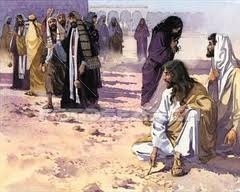
1. Jesus gick till Oljeberget. 2. Tidigt på morgonen kom han åter till templet, och allt folket kom till honom. Och han satte sig ner och undervisade dem.3. Då förde de skriftlärda och fariséerna till honom en kvinna, som var ertappad med hor. Och när de hade fört fram henne, 4. sade de till honom: Mästare, denna kvinna har på bar gärning blivit ertappad med hor.5. Och Mose har befallt oss i lagen, att sådana skall stenas. Men vad säger du? 6. Detta sade de för att fresta honom, för att de skulle ha något att anklaga honom för. Då böjde Jesus sig ner och skrev med fingret på jorden. 7. När de nu stod fast vid sin fråga, reste han sig upp och sade till dem: Den av er som är utan synd kastar första stenen på henne. 8. Och han böjde sig åter ner och skrev på jorden. 9. När de hörde detta kände de sig överbevisade av samvetet, och gick ut, den ene efter den andre, de äldste först ända till de sista, och Jesus blev lämnad ensam med kvinnan, som stod kvar där. 10. När Jesus reste sig upp och inte såg någon utom kvinnan, sade han till henne: Kvinna, var är dina åklagare? Har ingen dömt dig? 11. Hon sade: Herre, ingen. Då sade Jesus: Inte heller jag dömer dig. Gå och synda inte härefter (sin no more, KJV).12. Åter talade Jesus till dem, och sade: Jag är världens ljus. Den som följer mig skall inte vandra i mörkret utan skall ha livets ljus. 

Fariséen och publikanen – Skillnaden är att publikanen omvände sig

Fariséen och publikanen som gick till helgedomen för att be

En del missförstår Jesus liknelse i Lukas 18:9-14 och förstår den som att Jesus varnar människor för att fokusera för mycket på att lyda Guds lag eftersom det kan få dem att bli högmodiga och självgoda, och de menar också att SYNDARE å andra sidan kan vara frälsta (i sin synd) eftersom publikanen i liknelsen ju var en syndare och deklarerades som rättfärdig av Jesus själv. De säger alltså antingen öppet eller mellan raderna att det finns risker med att lyda Guds lag för mycket och även att synd inte alltid separerar oss från Gud eftersom det var publikanen och inte fariséen som gick hem rättfärdig.

Vad de missar är att publikanen till skillnad mot fariséen ERKÄNDE sin synd, OMVÄNDE sig och bad en renhjärtad bön till Gud. DÄRFÖR blev han renad från sina synder och förklarades som RÄTTFÄRDIG. Gud skulle aldrig ljuga och deklarera att en oomvänd syndare är “rättfärdig” om så inte är fallet. Ingenting oheligt ska komma in i hans rike, och synd smutsar ner oss och separerar oss alltid från Gud. Fariséen i liknelsen var orättfärdig eftersom han inte ansåg att han hade synd i sitt liv och därmed inte heller ansåg att det fanns någonting att ursäkta eller omvända sig från. Det är sant att man inte behöver ursäkta sig om man inte har gjort sig skyldig till någon synd, men om så inte är fallet så är man i fara när man inte gör någonting åt sin orenhet. Denna farisé var en hycklare.

Tvärt emot vad många tror så var inte fariséernas problem att de lydde lagen för mycket, utan för att de lydde lagen för litet. De var säkert duktiga på den ceremoniella delen av lagen, men de brast flera gånger vad gäller den mycket viktigare delen; den moraliska delen av lagen. Med “den moraliska delen” menar jag Tio Guds bud, vilka även de dubbla kärleksbuden är byggda på. Dessa bud kom inte med Mose utan de har funnits sedan tidernas begynnelse. Även under Adam och Evas tid var det förbjudet att mörda, stjäla, ljuga, etc. Dessa bud ska finnas i våra hjärtan och vi är aldrig befriade från att följa dem. Jesus säger:

Matt. 5:19Därför, den som upphäver ett av de minsta bland dessa bud och LÄR MÄNNISKORNA SÅ, han skall räknas för en av de MINSTA i himmelriket; men den som håller dem och LÄR människorna så, han skall räknas för stor i himmelriket.20Ty jag säger eder, att om eder rättfärdighet icke övergår de skriftlärdes och fariséernas, så skolen I icke komma in i himmelriket.

Jesus säger alltså inte att vi bör slappna av vad gäller hans bud för att vår TRO är nog, eller att det inte längre är så noga med buden eftersom vi lever under nåden och inte under lagen, eller att Jesu blod alltid täcker upp för våra synder oavsett omständigheter, eller att vi riskerar att bli som självgoda fariséer om vi fokuserar för mycket på buden. Han säger tvärt om att om VÅR (inte Jesus) rättfärdighet inte övergår fariséernas så kommer vi inte in i hans rike. Vidare så är det farligt att lära andra människor att det inte längre är så noga med att lyda Guds bud eftersom det skulle innebära att vi blir MINST i himmelriket om vi överhuvudtaget kommer ditin. Det kan hända att det finns kristna som verkligen lever efter budorden samtidigt som de tyvärr lär andra människor att det finns stor frihet vad gäller buden och att det inte längre är ett krav att lyda budorden eftersom det endast innebär reducerade gåvor i himlen. De riskerar då att få en lägre plats i Guds rike om de till andra lär ut att det är “tro allenast utan gärningar” som gör oss frälsta och/eller att vi kan behålla vår frälsning trots att vi har synd i våra liv.

1 Petrusbrevet 4:18 Och om den rättfärdige med knapp nöd bliver frälst, »huru skall det då gå den ogudaktige och syndaren?

Men om vi håller oss nära Gud så klarar vi att lyda buden. Bibeln säger att hans bud INTE är tunga, och att vårt ok är lätt. Tack och lov känner många kristna att det är en självklarhet att vara Gud trogna, men vi måste se upp så att vi även lär ut hela sanningen till andra. Det är viktigt att predika OMVÄNDELSE och vikten att inte tjäna två herrar eftersom vi blir slavar under den vi lyder.

Liknelsen om fariséen och publikanen

Matt. 18:9Ytterligare framställde han denna liknelse för somliga som förtröstade på sig själva och menade sig vara rättfärdiga, under det att de föraktade andra:10»Två män gingo upp i helgedomen för att bedja; den ene var en farisé och den andre en publikan. 11Fariséen trädde fram och bad så för sig själv: ‘Jag tackar dig, Gud, för att jag icke är såsom andra människor, rövare, orättrådiga, äktenskapsbrytare, ej heller såsom denne publikan.12Jag fastar två gånger i veckan; jag giver tionde av allt vad jag förvärvar.’ 13Men publikanen stod långt borta och ville icke ens lyfta sina ögon upp mot himmelen, utan slog sig för sitt bröst och sade: ‘Gud, misskunda dig över mig syndare.’ — 14Jag säger eder: Denne gick hem igen rättfärdig mer an den andre. Ty var och en som upphöjer sig, han skall bliva förödmjukad, men den som ödmjukar sig, han skall bliva upphöjd.»

Hur dömer Gud dem som inte haft chansen att höra talas om Jesus och Bibeln?

Rom. 5:13. Ty synden var i världen innan lagen kom, men synden tillräknas inte där det inte finns någon lag.

Jakob 4:17. Den som därför vet att göra det som är gott och inte gör det, för honom är det synd.

Det finns ett förhållande när en människa AV NATUREN gör det lagen säger, och lagen kan vara skriven i människors hjärtan. Även om man är född i djungeln bortom all civilisation så kan en männska agera utifrån sitt samvete och det normala är att samvetet säger att det är fel att mörda, stjäla, ljuga eller behandla andra illa på andra sätt. Tyvärr så kan en människa även härda sitt hjärta så att hon till slut får ett väldigt rymligt samvete.

Rom 2:12 alla de som utan lag hava syndat skola ock utan lag förgås, och alla de som med lag hava syndat skola genom lag bliva dömda. 13Ty icke lagens hörare äro rättfärdiga inför Gud, men lagens görare skola förklaras rättfärdiga.4Ty då hedningarna, som icke hava lag, AV NATUREN GÖRA VAD LAGEN INNEHÅLLER, så äro dessa, utan att hava lag, sig själv en lag, 15då de ju sålunda visa att LAGENS VERK ÄRO SKRIVNA I DERAS HJÄRTAN. Därom utgöra också DERAS EGNA SAMVETEN ett vittnesbörd, så ock, i den inbördes umgängelsen, DERAS TANKAR, NÄR DESSA ANKLAGA ELLER OCK FÖRSVARA DEM.16Ja, så skall det befinnas vara på den dag då Gud, enligt det evangelium jag förkunnar, genom Kristus Jesus dömer över vad som är fördolt hos människorna.

Romarbrevet är skrivet av Paulus till de kristna i Rom, så det han skriver om Guds ord och om varningar syftar inte endast på icke-kristna människor som en del påstår, utan det gäller alla människor. Vi vet att Guds domar kommer att vara fullständigt rättvisa och Gud dömer oss efter vad vi vet, vad vi inte vet och vad vi gör för att få mer kunskap och komma nära vår skapare. Vi har fått olika mängder pund att förvalta och Gud är väl medveten om vår bakgrund och vilka möjligheter vi har att finna honom och den plan han har för våra liv. I Romarbrevet framkommer att det inte finns någon ursäkt för att vända skaparen ryggen eftersom sanningen finns runtomkring oss – exempelvis genom allt som Gud skapat som inte kan ha dykt upp av sig självt. Finns en skapare är det också troligt att den skaparen har synpunkter på hur vi lever våra liv, och vårt SAMVETE har getts till oss för att kunna lyda lagen i våra hjärtan. Här syftas förstås på de som är vuxna nog att vara medvetna om lagen, naturen, jaget, andra männskor, etc.

Rom.1: 18Ty Guds vrede uppenbarar sig från himmelen över all ogudaktighet och orättfärdighet hos människor som i orättfärdighet UNDERTRYCKA SANNINGEN.19Vad man kan känna om Gud är nämligen UPPENBART bland dem; Gud har ju uppenbarat det för dem.20Ty hans osynliga väsen, hans eviga makt och gudomshärlighet hava ända ifrån världens skapelse varit SYNLIGA, i det att de kunna förstås genom hans verk. SÅ ÄRO DE DÅ UTAN URSÄKT.21Ty fastän de hade lärt känna Gud, prisade och tackade de honom dock icke såsom Gud, utan förföllo till fåfängliga tankar; och så blevo deras oförståndiga hjärtan förmörkade.22När de berömde sig av att vara visa, blevo de dårar23och bytte bort den oförgänglige Gudens härlighet mot beläten, som voro avbilder av förgängliga människor, ja ock av fåglar och fyrfotadjur och krälande djur.24Därför prisgav Gud dem i deras hjärtans begärelser åt orenhet, så att de med varandra skändade sina kroppar.25De hade ju bytt bort Guds sanning mot lögn och tagit sig för att dyrka och tjäna det skapade framför Skaparen, honom som är högtlovad i evighet, amen. 26Fördenskull gav Gud dem till pris åt skamliga lustar: deras kvinnor utbytte det naturliga umgänget mot ett onaturligt;27sammalunda övergåvo ock männen det naturliga umgänget med kvinnan och upptändes i lusta till varandra och bedrevo styggelse, man med man. Så fingo de på sig själva uppbära sin villas tillbörliga lön.28Och eftersom de icke hade aktat det något värt att taga vara på sin kunskap om Gud, gav Gud dem till pris åt ett ovärdigt sinnelag, till att bedriva otillbörliga ting.29Så hava de blivit uppfyllda av allt slags orättfärdighet, ondska, girighet, elakhet; de äro fulla av avund, mordlust, trätlystnad, svek, vrångsinthet;30de äro örontasslare, förtalare, styggelser för Gud, våldsverkare, övermodiga, stortaliga, illfundiga, olydiga mot sina föräldrar,31oförståndiga, trolösa, utan kärlek till sina egna, utan barmhärtighet mot andra.32Och fastän de väl veta vad Gud har stadgat såsom rätt, att nämligen de som handla så förtjäna döden, är det dem icke nog att själva så göra, de giva ock sitt bifall åt andra som handla likaså. 

Speaking in tongues can edify both you and others and we are encouraged to use them

The Bible says that when we speak in tongues then NO MAN UNDERSTANDS and that we in the spirit speak MYSTERIES not unto men but unto GOD. This should settle the whole argument about tongues always being understood, because the Bible says they are not understood (unless they are interpreted).

1 Cor. 14:2For he that speaketh in an unknown tongue SPEAKETH NOT UNTO MEN; BUT UNTO GOD: for NO MAN UNDERSTANDETH HIM; howbeit in the spirit HE SPEAK MYSTERIES.

1 Cor. 14: 16 Else when thou shalt bless with the spirit, how shall he that occupieth the room of the unlearned say Amen at thy giving of thanks, seeing he understandeth not what thou sayest?

Nowhere in the Bible does it say speaking in tongues was ever used for spreading the gospel. Here is what Acts says about the very first encounter of the tongues:

Acts 2:1And when the day of Pentecost was fully come, they were all with one accord in one place. 2And suddenly there came a sound from heaven as of a rushing mighty wind, and it filled all the house where they were sitting. 3And there appeared unto them cloven tongues like as of fire, and it sat upon each of them. 4And they were all filled with the Holy Ghost, and began to speak with other tongues, as the Spirit gave them utterance.–-6Now when this was noised abroad, the multitude came together, and were confounded, because that every man heard them speak in his own language. 7And they were all amazed and marvelled, saying one to another, Behold, are not all these which speak Galilaeans? 8And how hear we every man in our own tongue, wherein we were born? 9Parthians, and Medes, and Elamites, and the dwellers in Mesopotamia, and in Judaea, and Cappadocia, in Pontus, and Asia, 10Phrygia, and Pamphylia, in Egypt, and in the parts of Libya about Cyrene, and strangers of Rome, Jews and proselytes, 11Cretes and Arabians, we do hear them speak in our tongues the wonderful works of God. 12And they were all amazed, and were in doubt, saying one to another, What meaneth this?13Others mocking said, These men are full of new wine. 14But Peter, standing up with the eleven, lifted up his voice, and said unto them, Ye men of Judaea, and all ye that dwell at Jerusalem, be this known unto you, and hearken to my words: 15For these are not drunken, as ye suppose, seeing it is but the third hour of the day. 16But this is that which was spoken by the prophet Joel; 17And it shall come to pass IN THE LAST DAYS, saith God, I will pour out of my Spirit UPON ALL FLESH: and your sons and your daughters shall prophesy, and your young men shall see visions, and your old men shall dream dreams: 18And on my servants and on my handmaidens I will pour out in those days of my Spirit; and they shall prophesy: 19And I will shew wonders in heaven above, and signs in the earth beneath; blood, and fire, and vapour of smoke: 20The sun shall be turned into darkness, and the moon into blood, before the great and notable day of the Lord come

Notice that is says THE LAST DAYS, and surely we are living in that last days even more today than 2,000 years ago?

We can read above that every man heard them speak in his own language” but does it say that every man understood ALL languages spoken by ALL disciples? No, it doesn’t say that. If a Cretan man heard his own language spoken by a disciple, is it certain that he also understood Arabic and other foreign languages spoken by OTHER disciples? It doesn’t sound likely that ALL those men who were present had knowledge enough to understand 10-20 languages. One can easily assume that for a Cretan person most other languages must have sounded like total gibberish to him – but we know that at least ONE disciple spoke in such a way that this Cretan person understood since “every man heard them speak in his own language”. It doesn’t say each person understood ALL languages spoken. The case could also be that the tongues that were spoken were already “interpreted” into worldly languages. (I’ve heard myself speaking in French and Finnish, and actually also in Swedish but when I did not use my own words.)

Acts 10:44While Peter yet spake these words, the Holy Ghost fell on all them which heard the word. 45And they of the circumcision which believed were astonished, as many as came with Peter, because that on the Gentiles also was poured out the gift of the Holy Ghost. 46For they heard them speak with tongues, and magnify God. Then answered Peter, 47Can any man forbid water, that these should not be baptized, which have received the Holy Ghost as well as we? 48And he commanded them to be baptized in the name of the Lord. Then prayed they him to tarry certain days.

Above we can read that these particular jews understood that the Gentiles in question had received the Holy Ghost for the reason that they spoke in tongues and magnified God. This was a SIGN to these people. Below we can read again that speaking in tongues, among other things, is one of the signs for a believer:

Mark 16:17And these signs shall follow them that believe; In my name shall they cast out devils; they shall speak with new tongues; 18They shall take up serpents; and if they drink any deadly thing, it shall not hurt them; they shall lay hands on the sick, and they shall recover.

Since Paul gives instruction about tongues within the christian church, it’s evident that tongues should be used among christians – and of course only if someone can interpret them. Speaking in tongues is naturally controllable just like any other language. You decide when to speak and when not to.

It’s in the book of Corinthians where we can read the most details about tongues (see further below)

The book of Corinthians tells us that the reason for speaking in tongues is that IT CAN EDIFY BOTH YOU AND (if you have the gift of interpreting) ALSO OTHERS. It is a BETTER deal if you can edify the church, but if you don’t have the gift if interpreting SPEAK TO YOURSELF AT HOME SO YOU CAN BE EDIFIED.

1 Cor. 14:4He that speaketh in an unknown tongue EDIFIETH HIMSELF; but he that prophesieth edifieth the church. 

1 Cor. 14:28 But if there be no interpreter, let him keep silence in the church; and LET HIM SPEAK TO HIMSELF, AND TO GOD

So speaking in tongues is not only for other ears, particularly not when we can read:

he that speaketh in an unknown tongue SPEAKETH NOT UNTO MEN; BUT UNTO GOD”

If, according to Paul, you don’t even speak to men but to GOD, then of course speaking in tongues is not only for others to hear. IF they are interpreted, then they could be for others to hear, if done in proper order. It’s not certain that a person who can speak in tongues also has the gift of interpretation, but he should be EAGER to get also this gift so even MORE people can be edified.

1 Cor 11:30Have all the gifts of healing? do all speak with tongues? do all interpret? 31But COVET EARNESTLY the best gifts: and yet shew I unto you a more excellent way.

1 Cor 14:1 Follow after charity, and DESIRE SPIRITUAL GIFTS, but rather that ye may prophesy. 2For he that speaketh in an unknown tongue SPEAKETH NOT UNTO MEN; BUT UNTO GOD: for NO MAN UNDERSTANDETH HIM; howbeit in the spirit HE SPEAK MYSTERIES.

We are to speak in both ways; 1) spirit (tongues) and 2) mind (our own understanding):

1 Cor. 14:19 I will pray with the spirit, and I will pray with the understanding ALSO: I will sing with the spirit, and I will sing with the understanding also.

If you’re honest; are you really eager to speak in both ways as Paul says you should? Take notice of that not ONCE does Paul discourage people to speak in tongues in any way but he ENCOURAGES them, and that is what I feel all pastors and evangelists should do. It’s just the disorder that Paul warns about. If tongues were supposed to cease shortly after the generation he was addressing, why are we not able to read information about this anywhere? It would have been so easy to add a little note about this to warn people about upcoming “fake” tongues or similar IF that were true. The question that needs to be answered by those who believe speaking tongues has ceased is this: Why haven’t they ceased? I can only see two reasons to why christians in MANY MILLIONS continue to speak in tongues (if they have indeed ceased)

1) The tongues spoken today are not real tongues but from Satan, so the people who speak in tongues are demon possessed.

2) Those who speak in tongues today make them up, i.e. those who use them are LYING since the speaking in tongues is fake.

Both these options result in that those who speak in tongues are not saved unless you believe that people who are demon possessed or unrepentant liars will be saved. So this means that the cessationists believe speaking in tongues is a sign for that they are UNBELIEVERS – contrary to what Mark 16:17 says.

Paul encouraged tongues and spent a considerable amount of time and words in the book of Corinthians to give instructions about them. It certainly doesn’t seem he believed they would shortly cease and that all those instructions were in vain. IF they would shortly cease, he should have spent some time to WARN about upcoming fake tongues, but he doesn’t say one word about it. Paul gives two cases where PUBLIC speaking of tongues is inappropriate:

1) Unbelievers would think you’re crazy if they ONLY hear gibberish from you

2) No one would understand you and thus it wouldn’t really benefit others. The case could be that you actually prayed for others BUT the thing is that they would still not UNDERSTAND that, so it would be totally useless if you stood up in church and spoke in tongues. Praying for others or yourself using other tongues is fine, but just not out loud in a church for obvious reasons.

Maybe the corinthians believed “the more tongues the better” since they really believed that tongues are from the Holy Spirit, but it still doesn’t mean it’s appropriate to babble them in any way you want. There must be a proper order. So Paul’s friendly instructions should not be viewed as rebuke, but just a help to sort out misunderstandings and to enable a better order in church. Public speaking in tongues would be a total waste of time if there is no interpreter.

1) The term “oudies” in 1 Cor. 14 rules out tongues being a known language.

2) The phrase “face to face” is a Judaic idiom expressing personal interaction with the presence of God and is the same Greek as the LXX in Moses “face to face” with God. This means that tongues will cease when we meet God face to face so clearly not NOW.

3) “The perfect” cannot be the Bible because the canon wasn’t even finished.

4) Tongues as a sign to unbelievers is only ONE of the uses of the gift. Acts 10 and 19 say that the sign is to believers, just as Mark 16:17.

5) Why is there a gift called “interpretor” if all tongues are languages that can be understood? Why are we asked to pray for the gift of interpretation of tongues? 

Rom. 8:26Likewise the Spirit also helpeth our infirmities: for we know not what we should pray for as we ought: but the Spirit itself maketh intercession for us with groanings which cannot be uttered.

It’s true that speaking in tongues is a free GIFT, but this doesn’t mean it’s wise to do nothing and wait for this gift to be handed to you. It’s called “free” because you can’t work for it, and it’s not given to those who have reached a higher level on the “holiness scale”. However, we are told to DESIRE this free gift and be EAGER to get it. If you’re not even seeking this gift or consider it valuable in your life, then there is a risk you’re quenching the power of the holy spirit. You’re risking to miss out on a wonderful and powerful gift.

1 Thess. 5:19Quench not the Spirit20Despise not prophesyings. 21Prove all things; hold fast that which is good.

Examples from real life

Do you obey the below instructions to the fullest?:

Matthew 6:6″But thou, when thou prayest, enter into thy closet, and when thou hast shut thy door, pray to thy Father which is in secret; and thy Father which seeth in secret shall reward thee openly.”

Do we always obey this exactly as it says? Of course we don’t. We check the context and try to understand the reasoning behind the words. Surely we sometimes get together with other christians and pray together with them and NOT in our closets? Paul wants order in church and gave this as a reason for his instructions about tongues. Let’s not add to his words.

Let’s take a private setting as in a Thursday night prayer meeting in church OR in someone’s home. Suppose 10 christians are present and the leader asks them to start off with prayers and thanksgiving to God. Everyone begins to pray quietly, and there is usually a person who is leading the prayers and speaks out loud (naturally so that all can understand) whereas the others might say “amen” or just continue in their own private prayers. Well, what if a few of these christians prefer to speak in tongues in his/her prayers? Only believers are present, and no one is standing up demanding other people’s attention. If you wouldn’t be upset if you heard Spanish beside you in a prayer meeting, why would you be upset about tongues that you happen to overhear? You weren’t supposed to listen anyway, and Paul’s instructions concerned PUBLIC speech. If you still feel this violates Paul’s instructions, then aren’t you also violating the instructions in Matt 6:6? You are supposed to pray SECRETLY inside your closet and you should shut the door, and not to be in a public prayer meeting praying together with others.

What if Charlie asked the others to pray for him? The others wouldn’t say that they preferred not to because it would violate Matt 6:6, but they would pray for Charlie who asked for it. Maybe one person would take the lead and pray so that Charlie can hear and understand, and maybe the rest would pray quietly at the same time – some in their own language and some in tongues. Charlie has no reason to be upset about other people praying for him in whatever way they like. The same people might later on return home and continue to pray for this person, and he won’t be able to hear, understand or say Amen to those prayers either. Again, the prayers are NOT for anyone to listen to but they are prayers from one person to GOD. When someone wants another person to understand, then naturally a foreign tongue is NOT a good idea since other people cannot say Amen.

Tongues in churches today

Ja. 5:13 Is any among you afflicted? let him pray. Is any merry? let him sing psalms.14 Is any sick among you? let him call for the elders of the church; and let them pray over him, anointing him with oil in the name of the Lord:15 And the prayer of faith shall save the sick, and the Lord shall raise him up; and if he have committed sins, they shall be forgiven him.16 Confess your faults one to another, and PRAY ONE FOR ANOTHER, THAT YE MAY BE HEALED. The effectual fervent prayer of a righteous man availeth much.17 Elias was a man subject to like passions as we are, and he prayed earnestly that it might not rain: and it rained not on the earth by the space of three years and six months.18 And he prayed again, and the heaven gave rain, and the earth brought forth her fruit.

People seem to be so freaked out about tongues that they decide to turn their backs on tongues altogether. Doesn’t this mean that Satan is the winner with this type of reasoning? Speaking in tongues is a very useful weapon against the darkness, so it’s a shame that we let Satan fool us by making us flee from this wonderful gift which could edify us. He would then have disarmed us of a weapon which could be used against him.

WHERE in the Bible can we read that pastors should discourage church members to speak in tongues and/or neglect to inform them about the benefit of them? Paul is definitely encouraging tongues. He said “I would like every one of you to speak in tongues”. Since Paul is highlighting the benefit of tongues I wouldn’t be comfortable in a church where the pastor doesn’t do his job to encourage them. The best way to avoid the misuse of tongues is not to avoid tongues all together, but to obey Paul’s instruction about them.   Speaking in tongues is supposed to be a sign that will accompany those who believe, so it’s rather essential. I therefore feel it’s a duty of a pastor to encourage the spiritual gifts such as driving out demons, healing people, speaking in tongues, etc.

Maybe there are people who get mightily upset if they are in a church where the pastor might be overheard speaking a few words in tongues quietly to himself when he walks from the pulpit (where he just had a sermon) back to his seat. They might jump up and say:

– “See?!! I heard him speak in tongues! That’s clearly unbiblical because tongues are supposed to be interpreted if made in public, and this was not the case here so this church must be really BAD!” etc

But what about other churches where the gifts of the spirit are not even in use? Why would THIS not be a cause for concern? Why don’t the same people jump up and say:

– “See?!! I have been to this church for weeks now and not ONCE have I heard a single whisper in tongues from anyone, nor seen anyone speaking in tongues in public (interpreted of course), nor seen any signs for ANY of the gifts of the holy spirit. This is clearly against the Bible so this means this church must be BAD!”, etc.

“Follow after charity, and desire spiritual gifts, but rather that ye may prophesy.” Some people interpret this as in “Forget about tongues, and rather desire to prophesy ONLY” but it doesn’t say that. It says “desire spiritual gifts”. That would include tongues. Of course it’s better to be able to prophesy since MORE people can be edified, but if you don’t have this gift then don’t neglect the desire to at least speak in tongues! Of course one gift is better than no gift at all!

Finally, here is what the book of Corinthians says about tongues

1 Cor. 1:8 For to one is given by the Spirit the word of wisdom; to another the word of knowledge by the same Spirit; 9To another faith by the same Spirit; to another the gifts of healing by the same Spirit; 10To another the working of miracles; to another prophecy; to another discerning of spirits; to another divers kinds of tongues; to another the interpretation of tongues: — 28And God hath set some in the church, first apostles, secondarily prophets, thirdly teachers, after that miracles, then gifts of healings, helps, governments, diversities of tongues. 29Are all apostles? are all prophets? are all teachers? are all workers of miracles? 30Have all the gifts of healing? do all speak with tongues? do all interpret? 31But COVET EARNESTLY the best gifts: and yet shew I unto you a more excellent way.

1 Cor. 13 8Charity never faileth: but whether there be prophecies, they shall fail; whether there be tongues, they shall cease; whether there be knowledge, it shall vanish away. 9For we know in part, and we prophesy in part. 10But when that which is perfect is come, then that which is in part shall be done away11When I was a child, I spake as a child, I understood as a child, I thought as a child: but when I became a man, I put away childish things. 12For now we see through a glass, darkly; but then face to face: now I know in part; but then shall I know even as also I am known. 

1 Cor 14:1 Follow after charity, and DESIRE SPIRITUAL GIFTS, but rather that ye may prophesy. 2For he that speaketh in an unknown tongue SPEAKETH NOT UNTO MEN; BUT UNTO GOD: for NO MAN UNDERSTANDETH HIM; howbeit in the spirit HE SPEAK MYSTERIES. 3But he that prophesieth speaketh unto men to edification, and exhortation, and comfort. 4He that speaketh in an unknown tongue EDIFIETH himself; but he that prophesieth edifieth the church. 5I would that ye all spake with tongues but rather that ye prophesied: for greater is he that prophesieth than he that speaketh with tongues, except he interpret, that the church may receive edifying. 6Now, brethren, if I come unto you speaking with tongues, what shall I profit you, except I shall speak to you either by revelation, or by knowledge, or by prophesying, or by doctrine?— 9So likewise ye, except ye utter by the tongue words easy to be understood, how shall it be known what is spoken? for ye shall speak into the air. 10There are, it may be, so many kinds of voices in the world, and none of them is without signification. 11Therefore if I know not the meaning of the voice, I shall be unto him that speaketh a barbarian, and he that speaketh shall be a barbarian unto me. 12Even so ye, forasmuch as ye are zealous of spiritual gifts, SEEK that ye may excel to the edifying of the church. 13Wherefore let him that speaketh in an unknown tongue PRAY THAT HE MAY INTERPRET14For if I pray in an unknown tongue, my spirit prayeth, but my understanding is unfruitful. 15What is it then? I will pray with the spirit, and I will pray with the understanding ALSO: I will sing with the spirit, and I will sing with the understanding also. 16Else when thou shalt bless with the spirit, how shall he that occupieth the room of the unlearned say Amen at thy giving of thanks, seeing he understandeth not what thou sayest? 17For thou verily givest thanks well, but the other is not edified. 18I thank my God, I speak with tongues more than ye all19Yet in the church I had rather speak five words with my understanding, that by my voice I might teach others also, than ten thousand words in an unknown tongue. —22Wherefore tongues are for a sign, not to them that believe, but to them that believe not: but prophesying serveth not for them that believe not, but for them which believe. 23If therefore the whole church be come together into one place, and all speak with tongues, and there come in those that are unlearned, or unbelievers, will they not say that ye are mad? 24But if all prophesy, and there come in one that believeth not, or one unlearned, he is convinced of all, he is judged of all: 25And thus are the secrets of his heart made manifest; and so falling down on his face he will worship God, and report that God is in you of a truth. 26How is it then, brethren? when ye come together, every one of you hath a psalm, hath a doctrine, hath a tongue, hath a revelation, hath an interpretation. Let all things be done unto edifying. 27If any man speak in an unknown tongue, let it be by two, or at the most by three, and that by course; and let one interpret. 28But if there be no interpreter, let him keep silence in the church; and LET HIM SPEAK TO HIMSELF, AND TO GOD. —39Wherefore, brethren, COVET to prophesy, and FORBID NOT to speak with tongues.

We are no longer under the Law (torah) but we are still under the moral law

The Early Church had a controversy with a group called “the Judaizers” who were teaching justification by works of the law.

And certain men which came down from Judaea taught the brethren, and said, except ye be circumcised after themanner of Moses, ye cannot be saved. (Acts 15:1)

In other words, they taught that Gentiles need to obey the law (the Torah) and perform the works of the law (circumcision) in order to be justified. Since Paul’s ministry was to the Gentiles, he dedicated a large portion of his writings in Romans and Galatians, which were to Gentile Churches, to write against the Judaizers.

You will notice that Paul continually mentioned circumcision when discussing justification by works of the law in both Romans and Galatians.

Therefore we conclude that a man is justified by faith without the deeds of the law. Is he the God of the Jews only? (Those who had the Torah) Is he not also of the Gentiles? (Those who did not have the Torah) Yes, of the Gentiles also. Seeing it is one God, which shall justify the circumcision by faith, and the uncircumcision through faith. (Rom. 3:28-30)

Cometh this blessedness then upon the circumcision only or upon the uncircumcision also? For we say that faith was reckoned to Abraham for righteousness. How was it then reckoned? When he was in the circumcision, or in uncircumcision? Not in circumcision, but in uncircumcision. (Rom. 4:9-10)

Paul is arguing that Abraham was justified before circumcision, before the law of circumcision was given, and therefore the Gentiles too can be justified by faith without the work of the law of circumcision.

For in Christ Jesus neither circumcision availeth any thing, nor uncircumcision, but a new creature. (Gal. 6:15)

For in Jesus Christ neither circumcision availeth anything, nor uncircumcision; but faith which worketh by love. (Gal. 5:6)

Circumcision is nothing and uncircumcision is nothing, but the keeping of the commandments of God (1 Cor. 7:19).

Paul continually and repeated referred to circumcision when discussing justification “by works of the law” and said that circumcision does not “availeth anything” and is “nothing” but what matters is “a new creature” “faith which worketh by love” and “keeping of the commandments”.

It needs to be understood that Paul was not coming against the preaching of repentance in his epistles when he discussed justification by works of the law. In Galatia the Judaizers came and convinced the Gentile Church there that they needed to be circumcised in order to be saved. Paul wrote his epistle to the Galatians to correct this error of the Judaizers. It was not that the Galatians were repenting of their sins and Paul thought, “I better put a stop to this”. Paul certainly would not have any problem with Gentiles repenting of their sins since his God given ministry was to bring the Gentiles to repentance (Acts 26:20). When Paul preached to the Gentiles in Athens, he told them that God was calling all of them to repent (Acts 17:30). Paul said that we needed to be circumcised, not in our flesh, but in our hearts (Rom. 2:28-29). The circumcision of the heart is putting off your sins (Col. 2:11). Paul bemoaned those Gentiles in Corinth who had not repented of their uncleanness and fornication (2 Cor. 12:21). Paul explicitly said that we should not continue in our sins (Rom. 6:1-2) but that we should awake to righteousness and stop sinning (1 Cor. 15:34). Paul even warned the Galatians that if they lived sinful lives, they would not inherit the kingdom of God (Gal. 5:19-21). It was the Apostle Paul who said “after thy hardness and impenitent heart treasurest up unto thyself wrath” (Rom. 2:5), and that “repentance” leads “to salvation” (2 Cor. 7:10). Clearly Paul would not have had any problems with Gentiles repenting of their sins. Rather, Paul was upset that the Gentile Church in Galatia started to believe falsehoods from the Judaizers about how to be saved.

A good example of how Gentiles find the forgiveness of sins is the story of Nineveh. The narrative records that the people believed God (Jonah 3:5) and turned from their sins (Jonah 3:8). When God saw this, He changed His plans and decided not to destroy them as He said He would (Jonah 3:10). These Gentiles did not need to adopt the Jewish customs, obey the Torah, or be circumcised in order to be pardoned. They were saved, or found the mercy of God, through simple repentance from sin and faith in God. Jesus even said that sinners will be condemned if they do not repent the way Nineveh did (Matt. 12:41). Therefore the way that Gentiles were saved through repentance and faith in the Old Testament is the same way that they are saved in the New Testament, according to Jesus. Repenting of sin is required in both the Old and New Testament as Jesus said and therefore repentance is not the works of the law Paul preached against.

We know that Jesus Christ taught repentance (Lk. 13:3) and Paul certainly would not have contradicted Jesus Christ since Paul was an Apostle of Jesus Christ (Eph. 1:1; Col. 1:1). Paul explicitly said that men ought to listen to the wholesome words of Jesus (1 Tim. 6:3). Paul was by no means attacking the preaching of repentance when he wrote against justification by works of the law. Paul was attacking the Judaizers and their false gospel that Gentiles must convert to Judaism, be circumcised, and obey the Torah.

Thanks to Jesse Morell

Is there a difference between sinning and PRACTICING sin? 1 John 3:9

Some people suggest that christians are safe and will not lose their souls as long as they don’t PRACTICE sin – as in “habitually”. They might also suggest that true born-again christians do not practice sin but they do sin occasionally and they can never stop sinning. This is just another attempt to excuse sinning.

How many sins must a person commit to be considered “practicing” sin? One single murder or bank robbery in a life time would not be considered to sin habitually, but we know that one single sin made a huge difference for Adam and Eve. Perhaps being unfaithful every other year wouldn’t be considered practicing sin either? Where do we draw the line? The Bible says that nothing impure shall enter the new Jerusalem:

Rev. 21:27 And there shall in no wise enter into it any thing that defileth, neither whatsoever worketh abomination, or maketh a lie: but they which are written in the Lamb’s book of life.

True repentance (along with our faith) is the only thing that can save us.

The Greek word used for “to commit” is in itself proof that “commit” does not mean “practice”.  In the Greek NT there are two words that are commonly used to express the idea of doing something. The first is “poieo”, the second is “prasso”, according to Blueletter Bible.

4160 poieo, appear. to make or do (in a very wide application)

4238 prasso, to “practice”, i.e. perform repeatedly or habitually (thus differing from poieo which refers to a single act); to execute, accomplish, fare, commit, deeds, do, keep, require, use arts.

When the Apostle John wrote “Whosoever is born of God doth not COMMIT sin” he used the word “poieo” (to make or do sin with the idea of a single act), and if he wanted to communicate the concept of “practicing” sin he could have used “prasso”.

John Wesley says:

“But some men will say, ‘True: whosoever is born of God doth not commit sin habitually.’ Habitually! Whence is that? I read it not. It is not written in the Book. God plainly saith, ‘He doth not commit sin’; and thou addest, habitually! Who art thou that mendest the oracles of God?-that ‘addest to the words of this book’? Beware I beseech thee, lest God “add to thee all the plagues that are written therein’!” / John Wesley’s Fifty Three Sermons “The Marks of the New Birth” April 3, 1741

1 John 3:9 mostly applies to Jesus because he is certainly “born of God” and his seed remains in God (the Father), but in a way it also applies to us who are in the son. Jesus actually had the capacity to sin or else he would not be tempted in all things just like us, like the Bible says he was. He rather chose to live a sinless life for our sake. We too obviously have the capacity to sin, but if we are led by the holy Spirit, we do not sin. The term “seed” above is generally understood to mean “God’s word” and seed is often typical of the Word of God (for example, Luke 8:11; 1 Peter 1:23) but we know that believers are also referred to as “seed” (Rom 9:8; Gal 3:16, 19, 29)

“Whosoever is born of God doth not commit sin; for his seed (the believer) remaineth in him (Jesus): and he (the believer) cannot sin, because he is born of God (which is to abide in Jesus).” 1 John 3:9

This is confirmed in 1 John 3:6

“Whosoever abideth in him sinneth not: whosoever sinneth hath not seen him, neither known him.” 1 John 3:6

It is not impossible for a believer to sin but rather, it is impossible for a believer to sin as long as he abides in Jesus (which is a condition to remain a believer). The chapter does not teach that it is impossible for a christian to sin but that it is possible that he, through God’s grace, avoids it. No believer has to sin (Titus 2:11-12, 1 Cor 10:13) and the Bible does not say that we are off the hook if we only transgress the law just once in a while instead of several times. Repentance is the only cure. If we mix sin and “sorries” on a daily basis, we have not truly repented.

1 John 3:4 Whosoever committeth sin transgresseth also the law: for sin is the transgression of the law.

1 Joh. 3:8 He that committeth sin is of the devil; for the devil sinneth from the beginning. For this purpose the Son of God was manifested, that he might destroy the works of the devil.—10 In this the children of God are manifest, and the children of the devil: whosoever doeth not righteousness is not of God, neither he that loveth not his brother.

We are told to not hate anyone because hating is like being a murderer. If we are to believe that our souls are not in danger as long as we do not habitually sin, does this mean we can perhaps get away with hating one single brother? Of course not, because no murderer has eternal life abiding in him.

1 Joh. 3.15 Whosoever hateth his brother is a murderer: and ye know that no murderer hath eternal life abiding in him.

We can also see that the condition for having confidence toward God is that our heart does not condemn us. If the case is that our conscience tells us that we have acted wickedly (our heart condemns us) then God is merciful and will forgive us IF we confess our sins and truly repent. If we harden our hearts and pursue in the sin we know is wrong, then our souls are in danger. If you have a chance, do read the article about our faith as “filthy rags”.

1 Joh. 3:19 And hereby we know that we are of the truth, and shall assure our hearts before him.20 For if our heart condemn us, God is greater than our heart, and knoweth all things.21 Beloved, if our heart condemn us not, then have we confidence toward God.

Other mentions of “committing”  sin outside of 1 John 3

John 8:34 Jesus answered them, Verily, verily, I say unto you, Whosoever committeth sin is the servant of sin.

1 Corinthians 6:18 Flee fornication. Every sin that a man doeth is without the body; but he that committeth fornication sinneth against his own body.

2 Corinthians 12:21 And lest, when I come again, my God will humble me among you, and that I shall bewail many which have sinned already, and have not repented of the uncleanness and fornication and lasciviousness which they have committed.

James 2:9 But if ye have respect to persons, ye commit sin, and are convinced of the law as transgressors.

James 5:15 And the prayer of faith shall save the sick, and the Lord shall raise him up; and if he have committed sins, they shall be forgiven him.