Läkaren LUKAS skrev inte nödvändigtvis allt i kronologisk ordning – Luk. 1:3

En författare skriver inte nödvändigtvis i kronologisk ordning

Lukas är författare till Lukasevangeliet samt Apostlagärningarna, och var bl. a. Paulus medarbetare och medresenär. Lukas nämns vid några tillfällen i Paulus brev.

Kol. 4:14 Vår älskade Lukas, läkaren, hälsar till er liksom Demas.

2 Tim. 4:11 Lukas är den ende som är hos mig. Ta med dig Markus hit. Han är till hjälp i min tjänst.

Filemon 1:23 Epafras, min medfånge i Kristus Jesus, hälsar till dig, 24 liksom Markus, Aristarkus, Demas och Lukas, mina medarbetare. 25 Herren Jesu Kristi nåd vare med er ande.

Lukas skriver att många innan honom sammanställt händelseskildringar som fått sin uppfyllelse ibland honom och andra, och detta enligt ögonvittnen. Lukas har noga efterforskat allt från början och beslutat sig för att skriva ner det i en viss ordning. Detta för att Teofilus ska veta hur tillförlitlig undervisningen är som han fått. Det som han ivrigt vill förmedla är alltså att undervisningen om Jesus Kristus är att lita på fullt ut. Lukas börjar sin skildring, skriven till Teofilus, såhär:

Luk. 1:1 Många har sammanställt en skildring av de händelser som har fått sin uppfyllelse ibland oss,2 enligt vad de som redan från början var ögonvittnen och ordets tjänare, har meddelat oss.3 Sedan jag noga efterforskat allt från början, har jag beslutat att i rätt ordning skriva ner det för dig, ädle Teofilus, 4 för att du skall veta hur tillförlitlig den undervisning är som du har fått.

1917 års översättning lyder “i följd och ordning” (v. 3), men KJV har en översättning som är närmare grekiskan:

Luke 1:It seemed good to me also, having had perfect understanding of all things from the very first, to write unto thee in order, most excellent Theophilus

“Order” är en översättning från det grekiska adverbet kathexēs (Strong’s 2517). KJV har översatt ordet med: in order (2x), afterward (1x), after (1x) och by order (1x). Det handlar alltså om en slags ordning men vi kan inte säkert veta vilken ordning. Det måste inte nödvändigtvis handla om en kronologisk ordning där Lukas berättar precis alla utvalda händelser om Jesus i en exakt kronologisk ordning utan ett enda undantag. Självfallet vore en slags kronologi den mest logiska “ordningen” men inte in absurdum. Lukas kanske anser att det blir en tydligare ordning om han berättar simultant inträffade händelser en i taget, och det kan också hända att han placerar två korta händelser efter varandra för att göra en poäng trots att en annan händelse kronologiskt sett borde placeras emellan dem. Att tillfälligtvis bryta en kronologisk ordning är förstås något alla evangelisterna kan göra, men jag påstår inte att det sker ofta. Undantag är helt enkelt något vi måste ta i beaktande och inte utesluta. Det vore helt fel att ropa “Motsägelse! Bibeln är inte att lita på!” om några evangelister berättar händelser i något olika ordningar. Till nästan 100% berättar de händelser i samma ordning, men det finns undantag.

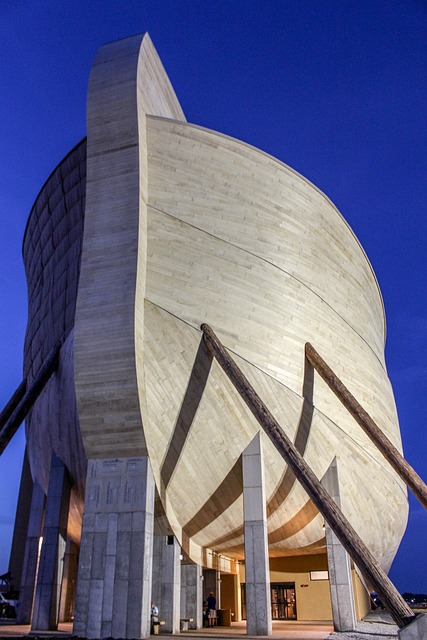
Noa tog ombord sju par av rena fyrfotadjur och ETT PAR av övriga landdjur – ingen motsättning!

Gud bad Noa att ta ombord sju par av de RENA fyrfotadjuren och ett par av övriga landdjur 

I 1 Mos. 6 kan vi läsa en generell uppmaning till Noa att ta ombord ett par av alla inom kategorin “levande varelser”. Alltså inte insekter och växter utan det verkar handla om djur som andas och som har ett blodsystem. Det hebreiska ordet nephesh betyder levande varelse eller själ. Ordet är ofta kombinerat med ett annat hebreiskt ord chay (som betyder liv) till termen “nephesh chayyāh” som kan betyda levande varelser vad gäller djur (1 Mos. 1:20) och “levande själar” vad gäller människan (1 Mos. 2:7).

1 Mos. 2:7 Och Herren Gud formade människan av stoft från jorden och blåste in livsande i hennes näsa. Så blev människan en levande själ.

1 Mos. 9:4 Men kött som har sin själ i sig, nämligen sitt blod, skall ni inte äta,5 och för ert eget blod, som har er själ i sig, skall jag kräva räkenskap. Jag skall utkräva det av alla djur, likaså av människorna. Av var och en som dödar sin broder skall jag utkräva den människans liv.

3 Mos. 17:11 Ty kroppens liv är i blodet, och jag har givit er det till altaret, till att bringa försoning för era själar. Det är blodet som bringar försoning genom själen som är i det. 12 Därför säger jag till Israels barn: Ingen av er skall förtära blod. Främlingen som bor ibland er skall inte heller förtära blod.

5 Mos. 12:23 Men se till att du inte förtär blodet, ty blodet är livet, och du får inte äta livet tillsammans med köttet.

Uppmaningen om vilka djur som skulle med på arken i 1 Mos. 6:17-20 (se nedan) handlar om en kort redogörelse från Guds sida om hur djurens fortlevnad skulle kunna bestå trots den flod som väntar. Det är allt vad Noa behöver veta vid den här tidpunkten – själva grundidén med att ta ombord djur parvis (hanne och hona) så att det ska kunna förekomma djur även i framtiden. I nästkommande kapitel så preciseras uppmaningen då det är dags för Noa att börja lasta arken med djur (som tog en vecka), och Gud förklarar för Noa vad han ska göra med det fåtal djur som kallas för “rena”. Just dessa djur skulle Noa ta ombord i par om sju. Kravet på “renhet” sträcker sig även till de fåglar som Noa ombads ta ombord i sju par. (En del forskare menar att det hebreiska ordet som KJV översätter “sevens” – Strong’s 7651 – skulle kunna handla om sju djur i stället för sju par, men det mest logiska baserat på hebreiskan verkar vara “sju par”.)

1 Mos. 6:17 Se, jag skall låta floden komma med vatten över jorden för att utrota alla varelser under himlen som har livsande. Allt på jorden skall förgås. —19 Av allt levande, av alla varelser, skall du föra in ett par i arken för att de skall överleva tillsammans med dig. Hankön och honkön skall det vara. 20 Av fåglarna efter deras slag, av fyrfotadjuren efter deras slag och av alla kräldjur på marken efter deras slag skall ett par av varje slag gå in till dig för att förbli vid liv. 

1 Mos. 7:2 Av alla RENA fyrfotadjur skall du ta med dig sju par, hanne och hona, men av sådana fyrfotadjur som inte är rena ett par, hanne och hona, 3 likaså av himlens fåglar sju par, hanne och hona, för att en avkomma skall leva vidare över hela jorden.

Verserna visar således inte upp någon motsättning som liberala bibeltolkare gärna vill läsa in, utan Gud får förstås förklara och ge instruktioner på det sätt som han finner bäst. Det kan vara lämpligt att först delge Noa en ren generell förklaring för att få honom att förstå själva tankegången om djuröverlevnaden, för att sedan gå in på detaljer och eventuella undantag när det börjar närma sig tidpunkten. Enligt den bibliska kronologin inträffade denna tidpunkt (djurlastningen) ca 70 år efter Guds första generella instruktion! Det förefaller helt onödigt att gå in på detaljer 70 år innan det är dags för att låta djuren gå ombord. Om jag skulle ge några personer instruktioner angående en händelse som jag vet kommer att inträffa om 70 år, då skulle jag inte heller gå in på onödiga detaljer (som dessutom kan glömmas bort) om jag vet att jag själv kommer att vara närvarande om 70 år och då enkelt skulle kunna delge dem ytterligare detaljer.

Efter att Noa var 500 år så föddes sönerna (1 Mos. 5:32) och vi vet att Shems son Arpaxad föddes två år efter floden då han själv var 100 år (1 Mos. 11:10), vilket skulle tyda på att Shem var 98 när floden kom. Ham sägs vara den yngsta sonen (1 Mos. 9:24) och Jafet förmodligen den äldsta. Noa var 600 år (1 Mos. 7:6) när floden kom, vilket alltså var ca 100 år efter sönernas födelse. När Gud gav Noa instruktioner för arkbyggandet så informerades Noa även om att arken skulle transportera hans tre söner och deras hustrur (1 Mos. 6:14-18) vilket borde betyda att sönerna var gifta vid det laget, och då måste vi i uträkningen lägga till ytterligare lite tid från sönernas födsel – ca 30 år – för att ge tid för mognad och giftermål. (En del har tagit 120 år som tiden för hela arkbyggandet men informationen i 1 Mos. 6:4 handlar inte om en starttid från arkbyggandet.)

Det hebreiska ordet för både “varelser” och “fyrfotadjur” är “behemah” (Strong’s 929), och det syftar på landdäggdjur. Det hebreiska ordet för “kräldjur” är “remes. Djur efter deras “slag” (miyn Strong’s 4327 och bow Strong’s 935) skulle tas ombord, och exakt vilka urdjur/grunddjur dessa var går inte helt klart att fastställa. Däremot kan man ana att det handlar om djurslag som kan få avkomma ihop, och från dessa “urdjur” har vi sedan fått det myller av djurarter som vi kan se idag. Alla djur skulle alltså härstamma från dessa djur, och enligt John Woodmorappe’s “A feasability study” så skulle inte särskilt många djur krävas ombord – ca 16.000 st – och han bevisar i sin studie att det skulle finnas gott om plats för både djur och mat.

“Rena djur” är visserligen inte definierat innan tiden för Mose lag, men eftersom Mose är den som är författare till Moseböckerna så är chansen stor att definitionen är densamma på alla ställen. Enligt 3 Mos. 11 och 5 Mos. 14 så är endast ett fåtal djurtyper “rena”, så det stora flertalet djur är alltså i en annan kategori. Efter floden var det även tillåtet att äta djur, och därför går Mose lag även in på detaljer om vad djur äter för att förenkla matinstruktionerna för israelerna.

Noa behövde inte ta med sig havsdjur eftersom en världsvid flod inte nödvändigtvis skulle hota deras överlevnad. Det är dock fullt möjligt att en del arter faktiskt blev utrotade och i så fall var det något som inte överraskade Gud. Noa behövde heller inte ta med sig insekter eller växter, eftersom de skulle kunna överleva på allehanda flytetyg under flodåret. En del slank förstås med på arken ändå och överlevde på det sättet.

1 Mosebok är flitigt citerad i både GT och NT med bekräftelse på att människor alltid sett händelserna som utspelar sig i 1 Mos. som vår verkliga historia. Vi kan läsa om Noa som en historiskt verklig person i exempelvis Jes. 54:9 och Hes. 14:12-20 samt nedan:

1 Mos. 10:1 Detta är Noas söners, Sems, Hams och Jafets, fortsatta historia. Åt dem föddes söner efter floden.—32 Detta var Noas söners stammar efter deras släktled i deras folk. Från dem har folken utbrett sig på jorden efter floden.

Luk. 17:24 Ty liksom blixten flammar till och lyser från himlens ena ända till den andra, så skall Människosonen vara på sin dag. 25 Men först måste han lida mycket och bli förkastad av detta släkte.26 Som det var på Noas tid, så skall det vara under Människosonens dagar. 27 Folk åt och drack, gifte sig och blev bortgifta, ända till den dag då Noa gick in i arken och floden kom och gjorde slut på dem alla. 

Mat. 24:37 Ty som det var i Noas dagar, så skall det vara vid Människosonens återkomst. 38 Som människorna levde dagarna före floden: de åt och drack, gifte sig och blev bortgifta, ända till den dag då Noa gick in i arken, 39 och de visste ingenting, förrän floden kom och ryckte bort dem alla – så skall Människosonens ankomst vara.

Luk. 3:23 Jesus var omkring trettio år när han började sin gärning. Han var, menade man, son till Josef, son till Eli, 24 son till Mattat, son till Levi, son till Melki, son till Jannai, son till Josef, — 31 son till Melea, son till Menna, son till Mattata, son till Natan, son till David, 32 son till Isai, son till Obed, son till Boas, son till Salma, son till Naheson, 33 son till Amminadab, son till Admin, son till Arni, son till Hesrom, son till Peres, son till Juda, 34 son till Jakob, son till Isak, son till Abraham, son till Tera, son till Nahor, 35 son till Serug, son till Regu, son till Peleg, son till Eber, son till Sela,36 son till Kenan, son till Arpaksad, son till Sem, son till Noa, son till Lemek, 37 son till Metusala, son till Hanok, son till Jered, son till Mahalalel, son till Kenan, 38 son till Enos, son till Set, son till Adam, son till Gud.

1 Pet. 3:19 I Anden gick han bort och utropade ett budskap för andarna i fängelset, 20 för dem som den gången var olydiga när Gud tåligt väntade under Noas dagar, medan arken byggdes. I den blev några få, åtta personer, frälsta genom vatten. 21 Efter denna förebild frälser dopet nu också er. Det innebär inte att kroppen renas från smuts utan är ett rent samvetes bekännelse till Gud genom Jesu Kristi uppståndelse, 

Abraham did not necessarily sin by claiming his wife Sarah was his sister

Sarah – Abraham’s niece, sister and wife

The Hebrew word translated “sister” in for instance Gen. 12:13 is ‘achowth (Strong’s 269), which based on Blue Letter Bible could mean sister (same parents), half-sister (same father), relative (of Israel’s and Judah’s relationship), beloved (bride), of intimate connection or another. It could mean sister either literally or figuratively.

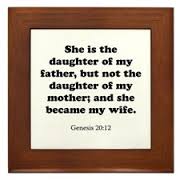
According to Gen. 20:12 Abraham claims that Sarah is the daughter of his father (who is Terah) but not of his mother, which would mean that Sarah was Abraham’s half sister. Yet, in Gen. 11:31 Sarah is also called Terah’s daughter-in-law. This does not have to be a contradiction. The information that Abraham’s mother is not the mother of Sarah is clear from the Bible, but is Terah Sarah’s father or is it is oldest brother Haran as The book of Jasher suggests?

Terah could of course have had Sarah through another wife (even the wife of his son Haran), but if the aim is to be consistent with both Gen. 20:12 and Gen. 11:31, as well as the information in Jasher, then perhaps the simplest solution is that Sarah was the grand-daughter of Terah, i.e. the daughter of Haran, and this has been maintained by for instance Josephus. Sarah could then have been adopted into Terah’s household after the tragic death by fire of her father Haran (see The book of Jasher). As the daughter of Haran, Sarah would be Abraham’s niece. If she was also adopted by Terah, then Sarah would also be Abraham’s sister. When Sarah later married Abraham, she became his wife.
abraham 2

According to The book of Jasher Abraham was 10 years old when Sarah was born and it is quite possible that they at some point in time shared the same household and grew up as brother and sister. Terah and his sons Haran, Nahor and Abraham could have lived close together and we can for instance read in Jasher 12:16 that Terah, out of fear for king Nimrod, blamed his son Haran for being responsible for a certain cover up that angered the king who had wanted Abraham to be killed at birth. In the same way as Sarah could be called Abraham’s sister, also Lot could be called Abraham’s brother despite being Abraham’s nephew. Sarah and Lot were siblings.

Note also that this occurred many years before the Law of Moses was established, where it was prohibited to marry a sibling. Adam and Eve did not have any genetic defects to pass on to their children (which means they could marry each other and have children with no risks involved) but later on in time, through genetic bottle necks like the Ark and the Exodus, genetic defects had accumulated.

Deception?

It is possible to not volunteering with information in order to perhaps gain possessions or wrongful advantages that a person did not previously have. In that case not volunteering with information would be a sin even though no lies were uttered. Abraham did nothing of the sort. He did not withhold information in order to gain something that he did not already have, but he wanted to continue keeping what he already had – a family member. On top of this he offered to PART with ALL of his possessions if he could only keep this family member!

Abraham was actually afraid that the Egyptians would take Sarah away, because he had heard of their evil behavior in advance. Pharaoh is of course an Egyptian, but he would not be the one standing at the city gate to control the goods and the people entering the city. The only way for him to get the news about Sarah would be if someone thought it would be worth while telling him, and the Egyptian guards who were placed to check on the arriving travelers knew they would be getting rewards if they would bring Pharaoh something they knew he would appreciate. Perhaps the Egyptian guards reasoned in this way: 1) If Abraham would only be a brother (or a father) of Sarah, then he would not be an obstacle at all and would not need to be killed, 2) Pharaoh could be presented Sarah who would be a free woman, 3) the Egyptian guards would get great rewards for their discovery, and 4) Abraham would likely be treated really well and receive possessions from Pharaoh in order to smoothly “buy” Sarah over and take her as a wife. However, Abraham did no travel to Egypt to acquire more possessions (apart from food) and he was willing to part with ALL that he had if the Egyptian workers would only forget about Sarah (Jasher 15:11-12). The question that later arose “Why did you say she was your sister?”, could be answered with “Because she is my sister. And who gave you the right to take her due to us being siblings when I urged you not to?”.

A man should be innocent until proven guilty, and if someone wants to charge Abraham of lying, that person has the burden of proof. It is of course an option that Abraham sinned by not trusting God to sort out this problem, but 1) we are not always supposed to sit back and do nothing while God sorts things out, and 2) Abraham presented Sarah as his sister twice in similar occasions – which might suggest that he felt free to repeat his actions due to his realization that he spoke nothing but the truth with no evil intentions in his heart.

Even if we would view Abraham and Sarah’s deed as a sin, it would still not turn Abraham into the monster as some liberal scholars describe him to be. Even king David, a man of God’s own heart, sinned by murder and adultery and did not repent until Nathan made him realize his severe sin. Righteous people can also choose to sin and if they do, the same requirement applies to them – repentance and turning away from sin. Evangelical christians do not believe that a sinful person is a role model, but Abraham was far from being a sinful man. He proved to be an extremely righteous man throughout his entire life. Also a righteous person can choose to sin once and get his spiritual life back by repenting.

Let us check the two stories where Abraham thought it would be best to present Sarah as his “sister” in order to save his life as well as the quality of life for Sarah. He seems to have made just the right choice based on the outcome!
Abraham 1The case with Pharaoh and Sarah

Gen. 11:29 And Abram and Nahor took them wives: the name of Abram’s wife was Sarai; and the name of Nahor’s wife, Milcah, the daughter of Haran, the father of Milcah, and the father of Iscah.30 But Sarai was barren; she had no child.31 And Terah took Abram his son, and Lot the son of Haran his son’s son, and Sarai his daughter in law, his son Abram’s wife; and they went forth with them from Ur of the Chaldees, to go into the land of Canaan; and they came unto Haran, and dwelt there.

If Abraham would present his beautiful wife Sarah as his wife instead of his sister, then there might be a risk that Pharaoh would kill Abraham in order to get hold of Sarah and make her his wife. As a brother Abraham would not pose the same threat. If a brother and a sister would be travelling together, the brother is the one responsible for his sister’s protection. If she does not belong to her Father’s household, then she belongs to her brother’s household and he is the one to negotiate with if someone wants to marry his sister. This would be understood also by Pharaoh even if it was a risk that his way of negotiating might be very harsh. Abraham of course had no intention to present his wife as a sister and try to marry her off, but it is possible that Abraham tried to estimate what kind of behavior he could expect from Pharaoh and decided to go for the safest bet. The problem was Sarah’s extraordinary beauty, so presenting himself as a husband might be the worse option with the greatest risks involved. Maybe Pharaoh would use his power and simply eliminate him entirely to make Sarah available and dependent on another household – like Pharaoh’s household. The best option would be if Pharaoh would not be interested in Sarah at all, but then it was imperative to avoid causing any reports about her beauty. To be on the safer side Abraham even put Sarah in a chest during a critical situation (The book of Jasher), but to no avail since she was discovered and the news about her beauty reached Pharaoh.

It certainly looks like Abraham’s reasoned rather wisely in a delicate situation. The alternative to not travel to Egypt at all would risk their lives through starving, so a travel to Egypt still seemed like a good option despite the risks.

Gen. 12:10 And there was a famine in the land: and Abram went down into Egypt to sojourn there; for the famine was grievous in the land.11 And it came to pass, when he was come near to enter into Egypt, that he said unto Sarai his wife, Behold now, I know that thou art a fair woman to look upon:12 Therefore it shall come to pass, when the Egyptians shall see thee, that they shall say, This is his wife: and they will kill me, but they will save thee alive.13 Say, I pray thee, thou art my sister: that it may be well with me for thy sake; and my soul shall live because of thee.14 And it came to pass, that, when Abram was come into Egypt, the Egyptians beheld the woman that she was very fair.15 The princes also of Pharaoh saw her, and commended her before Pharaoh: and the woman was taken into Pharaoh’s house.16 And he entreated Abram well for her sake: and he had sheep, and oxen, and he asses, and menservants, and maidservants, and she asses, and camels.17 And the Lord plagued Pharaoh and his house with great plagues because of Sarai Abram’s wife.18 And Pharaoh called Abram and said, What is this that thou hast done unto me? why didst thou not tell me that she was thy wife?19 Why saidst thou, She is my sister? so I might have taken her to me to wife: now therefore behold thy wife, take her, and go thy way.20 And Pharaoh commanded his men concerning him: and they sent him away, and his wife, and all that he had.

Here is the same story according to The book of Jasher:

Jasher 9:1 And Haran, the son of Terah, Abram’s oldest brother, took a wife in those days.2 Haran was thirty-nine years old when he took her; and the wife of Haran conceived and bare a son, and he called his name Lot.3 And she conceived again and bare a daughter, and she called her name Milca; and she again conceived and bare a daughter, and she called her name Sarai.4 Haran was forty-two years old when he begat Sarai, which was in the tenth year of the life of Abram; and in those days Abram and his mother and nurse went out from the cave, as the king and his subjects had forgotten the affair of Abram.

Jasher 12:37 And Haran was eighty-two years old when he died in the fire of Casdim. And the king, princes, and inhabitants of the land, seeing that Abram was delivered from the fire, they came and bowed down to Abram.—44 And at that time Nahor and Abram took unto themselves wives, the daughters of their brother Haran; the wife of Nahor was Milca and the name of Abram’s wife was Sarai. And Sarai, wife of Abram, was barren; she had no offspring in those days.

Jasher 15:1 And in that year there was a heavy famine throughout the land of Canaan, and the inhabitants of the land could not remain on account of the famine for it was very grievous.2 And Abram and all belonging to him rose and went down to Egypt on account of the famine, and when they were at the brook Mitzraim they remained there some time to rest from the fatigue of the road.3 And Abram and Sarai were walking at the border of the brook Mitzraim, and Abram beheld his wife Sarai that she was very beautiful.4 And Abram said to his wife Sarai, Since God has created thee with such a beautiful countenance, I am afraid of the Egyptians lest they should slay me and take thee away, for the fear of God is not in these places.5 Surely then thou shalt do this, Say thou art my sister to all that may ask thee, in order that it may be well with me, and that WE may live and not be put to death.6 And Abram commanded the same to all those that came with him to Egypt on account of the famine; also his nephew Lot he commanded, saying, If the Egyptians ask thee concerning Sarai say she is the sister of Abram.7 And yet with all these orders Abram did not put confidence in them, but he took Sarai and placed her in a chest and concealed it amongst their vessels, for Abram was greatly concerned about Sarai on account of the wickedness of the Egyptians.8 And Abram and all belonging to him rose up from the brook Mitzraim and came to Egypt; and they had scarcely entered the gates of the city when the guards stood up to them saying, Give tithe to the king from what you have, and then you may come into the town; and Abram and those that were with him did so.—11 And Abram said, This chest I will not open, but all you demand upon it I will give. And Pharaoh’s officers answered Abram, saying, It is a chest of precious stones, give us the tenth thereof.12 Abram said, All that you desire I will give, but you must not open the chest.13 And the king’s officers pressed Abram, and they reached the chest and opened it with force, and they saw, and behold a beautiful woman was in the chest.14 And when the officers of the king beheld Sarai they were struck with admiration at her beauty, and all the princes and servants of Pharaoh assembled to see Sarai, for she was very beautiful. And the king’s officers ran and told Pharaoh all that they had seen, and they praised Sarai to the king; and Pharaoh ordered her to be brought, and the woman came before the king.15 And Pharaoh beheld Sarai and she pleased him exceedingly, and he was struck with her beauty, and the king rejoiced greatly on her account, and made presents to those who brought him the tidings concerning her.16 And the woman was then brought to Pharaoh’s house, and Abram grieved on account of his wife, and he prayed to the Lord to deliver her from the hands of Pharaoh.17 And Sarai also prayed at that time and said, O Lord God thou didst tell my Lord Abram to go from his land and from his father’s house to the land of Canaan, and thou didst promise to do well with him if he would perform thy commands; now behold we have done that which thou didst command us, and we left our land and our families, and we went to a strange land and to a people whom we have not known before.18 And we came to this land to avoid the famine, and this evil accident has befallen me; now therefore, O Lord God, deliver us and save us from the hand of this oppressor, and do well with me for the sake of thy mercy.19 And the Lord hearkened to the voice of Sarai, and the Lord sent an angel to deliver Sarai from the power of Pharaoh.20 And the king came and sat before Sarai and behold an angel of the Lord was standing over them, and he appeared to Sarai and said to her, Do not fear, for the Lord has heard thy prayer.21 And the king approached Sarai and said to her, What is that man to thee who brought thee hither? and she said, He is my brother.22 And the king said, It is incumbent upon us to make him great, to elevate him and to do unto him all the good which thou shalt command us; and at that time the king sent to Abram silver and gold and precious stones in abundance, together with cattle, men servants and maid servants; and the king ordered Abram to be brought, and he sat in the court of the king’s house, and the king greatly exalted Abram on that night.23 And the king approached to speak to Sarai, and he reached out his hand to touch her, when the angel smote him heavily, and he was terrified and he refrained from reaching to her.24 And when the king came near to Sarai, the angel smote him to the ground, and acted thus to him the whole night, and the king was terrified.25 And the angel on that night smote heavily all the servants of the king, and his whole household, on account of Sarai, and there was a great lamentation that night amongst the people of Pharaoh’s house.26 And Pharaoh, seeing the evil that befell him, said, Surely on account of this woman has this thing happened to me, and he removed himself at some distance from her and spoke pleasing words to her.27 And the king said to Sarai, Tell me I pray thee concerning the man with whom thou camest here; and Sarai said, This man is my husband, and I said to thee that he was my brother for I was afraid, lest thou shouldst put him to death through wickedness.28 And the king kept away from Sarai, and the plagues of the angel of the Lord ceased from him and his household; and Pharaoh knew that he was smitten on account of Sarai, and the king was greatly astonished at this.29 And in the morning the king called for Abram and said to him, What is this thou hast done to me? Why didst thou say, She is my sister, owing to which I took her unto me for a wife, and this heavy plague has therefore come upon me and my household.30 Now therefore here is thy wife, take her and go from our land lest we all die on her account. And Pharaoh took more cattle, men servants and maid servants, and silver and gold, to give to Abram, and he returned unto him Sarai his wife.31 And the king took a maiden whom he begat by his concubines, and he gave her to Sarai for a handmaid.32 And the king said to his daughter, It is better for thee my daughter to be a handmaid in this man’s house than to be mistress in my house, after we have beheld the evil that befell us on account of this woman.33 And Abram arose, and he and all belonging to him went away from Egypt; and Pharaoh ordered some of his men to accompany him and all that went with him.34 And Abram returned to the land of Canaan, to the place where he had made the altar, where he at first had pitched his tent.

If you react on the information that innocent people seemed to have died due to the curse that surrounded Sarah, the truth is that we are all going to die one day. Based on the Bible and The book of Jasher, the people close to Pharaoh and Abimelech were considered evil but even if they were righteous physical death still awaits every single one of us. It is eternal spiritual death which would be a disaster, but it seems like what had befallen Pharaoh and his household could almost be seen as a wake up call for them. It is hard to know if this disaster caused some of them to repent, but the story eventually ends with Pharaoh letting Abraham and Sarah go – with many new valuable possessions. However, Abraham and Sarah did not travel to Egypt to get possessions but rather to acquire food. They were likely given much food along with their many gifts – and even a handmaid (Hagar) for Sarah.

Considering the circumstances, the story ended rather well but Abraham and Sarah influenced the outcome by praying to their Lord who heard them. Naturally also Pharaoh and his people had the chance to do the same, and to live righteous lives just like Abraham and Sarah. Maybe we would react in a similar way? If I were a Swedish Jew in nazi Germany I would not volunteer with the information that I was a Jew but rather present myself as a Swede. If on the other hand a nazi officer would ask me directly if I was a Jew, believed in God, etc, then it would certainly be a lie to deny it. The same would apply if Abraham or Sarah would deny the truth.

The case with king Abimelech and Sarah

A similar story occurred in relation to Abimelech. Also this story ended well “Abimelech said, Behold, my land is before thee: dwell where it pleaseth thee”.

Gen. 20:1 And Abraham journeyed from thence toward the south country, and dwelled between Kadesh and Shur, and sojourned in Gerar.2 And Abraham said of Sarah his wife, She is my sister: and Abimelech king of Gerar sent, and took Sarah.3 But God came to Abimelech in a dream by night, and said to him, Behold, thou art but a dead man, for the woman which thou hast taken; for she is a man’s wife.4 But Abimelech had not come near her: and he said, Lord, wilt thou slay also a righteous nation?5 Said he not unto me, She is my sister? and she, even she herself said, He is my brother: in the integrity of my heart and innocency of my hands have I done this.6 And God said unto him in a dream, Yea, I know that thou didst this in the integrity of thy heart; for I also withheld thee from sinning against me: therefore suffered I thee not to touch her.7 Now therefore restore the man his wife; for he is a prophet, and he shall pray for thee, and thou shalt live: and if thou restore her not, know thou that thou shalt surely die, thou, and all that are thine.8 Therefore Abimelech rose early in the morning, and called all his servants, and told all these things in their ears: and the men were sore afraid.9 Then Abimelech called Abraham, and said unto him, What hast thou done unto us? and what have I offended thee, that thou hast brought on me and on my kingdom a great sin? thou hast done deeds unto me that ought not to be done.10 And Abimelech said unto Abraham, What sawest thou, that thou hast done this thing?11 And Abraham said, Because I thought, Surely the fear of God is not in this place; and they will slay me for my wife’s sake.12 And yet indeed she is my sister; she is the daughter of my father, but not the daughter of my mother; and she became my wife.13 And it came to pass, when God caused me to wander from my father’s house, that I said unto her, This is thy kindness which thou shalt shew unto me; at every place whither we shall come, say of me, He is my brother.14 And Abimelech took sheep, and oxen, and menservants, and womenservants, and gave them unto Abraham, and restored him Sarah his wife.15 And Abimelech said, Behold, my land is before thee: dwell where it pleaseth thee.16 And unto Sarah he said, Behold, I have given thy brother a thousand pieces of silver: behold, he is to thee a covering of the eyes, unto all that are with thee, and with all other: thus she was reproved.17 So Abraham prayed unto God: and God healed Abimelech, and his wife, and his maidservants; and they bare children.18 For the Lord had fast closed up all the wombs of the house of Abimelech, because of Sarah Abraham’s wife.

The same story according to Jasher.:

Jasher 20 1 And at that time Abraham journeyed from the plain of Mamre, and he went to the land of the Philistines, and he dwelt in Gerar; it was in the twenty-fifth year of Abraham’s being in the land of Canaan, and the hundredth year of the life of Abraham, that he came to Gerar in the land of the Philistines.2 And when they entered the land he said to Sarah his wife, Say thou art my sister, to any one that shall ask thee, in order that we may escape the evil of the inhabitants of the land.3 And as Abraham was dwelling in the land of the Philistines, the servants of Abimelech, king of the Philistines, saw that Sarah was exceedingly beautiful, and they asked Abraham concerning her, and he said, She is my sister.4 And the servants of Abimelech went to Abimelech, saying, A man from the land of Canaan is come to dwell in the land, and he has a sister that is exceeding fair.5 And Abimelech heard the words of his servants who praised Sarah to him, and Abimelech sent his officers, and they brought Sarah to the king.6 And Sarah came to the house of Abimelech, and the king saw that Sarah was beautiful, and she pleased him exceedingly.7 And he approached her and said to her, What is that man to thee with whom thou didst come to our land? and Sarah answered and said He is my brother, and we came from the land of Canaan to dwell wherever we could find a place.8 And Abimelech said to Sarah, Behold my land is before thee, place thy brother in any part of this land that pleases thee, and it will be our duty to exalt and elevate him above all the people of the land since he is thy brother.9 And Abimelech sent for Abraham, and Abraham came to Abimelech.10 And Abimelech said to Abraham, Behold I have given orders that thou shalt be honored as thou desirest on account of thy sister Sarah.11 And Abraham went forth from the king, and the king’s present followed him.12 As at evening time, before men lie down to rest, the king was sitting upon his throne, and a deep sleep fell upon him, and he lay upon the throne and slept till morning.13 And he dreamed that an angel of the Lord came to him with a drawn sword in his hand, and the angel stood over Abimelech, and wished to slay him with the sword, and the king was terrified in his dream, and said to the angel, In what have I sinned against thee that thou comest to slay me with thy sword?14 And the angel answered and said to Abimelech, Behold thou diest on account of the woman which thou didst yesternight bring to thy house, for she is a married woman, the wife of Abraham who came to thy house; now therefore return that man his wife, for she is his wife; and shouldst thou not return her, know that thou wilt surely die, thou and all belonging to thee.15 And on that night there was a great outcry in the land of the Philistines, and the inhabitants of the land saw the figure of a man standing with a drawn sword in his hand, and he smote the inhabitants of the land with the sword, yea he continued to smite them.16 And the angel of the Lord smote the whole land of the Philistines on that night, and there was a great confusion on that night and on the following morning.17 And every womb was closed, and all their issues, and the hand of the Lord was upon them on account of Sarah, wife of Abraham, whom Abimelech had taken.18 And in the morning Abimelech rose with terror and confusion and with a great dread, and he sent and had his servants called in, and he related his dream to them, and the people were greatly afraid.19 And one man standing amongst the servants of the king answered the king, saying, O sovereign king, restore this woman to her husband, for he is her husband, for the like happened to the king of Egypt when this man came to Egypt.20 And he said concerning his wife, She is my sister, for such is his manner of doing when he cometh to dwell in the land in which he is a stranger.21 And Pharaoh sent and took this woman for a wife and the Lord brought upon him grievous plagues until he returned the woman to her husband.22 Now therefore, O sovereign king, know what happened yesternight to the whole land, for there was a very great consternation and great pain and lamentation, and we know that it was on account of the woman which thou didst take.23 Now, therefore, restore this woman to her husband, lest it should befall us as it did to Pharaoh king of Egypt and his subjects, and that we may not die; and Abimelech hastened and called and had Sarah called for, and she came before him, and he had Abraham called for, and he came before him.24 And Abimelech said to them, What is this work you have been doing in saying you are brother and sister, and I took this woman for a wife?25 And Abraham said, Because I thought I should suffer death on account of my wife; and Abimelech took flocks and herds, and men servants and maid servants, and a thousand pieces of silver, and he gave them to Abraham, and he returned Sarah to him.26 And Abimelech said to Abraham, Behold the whole land is before thee, dwell in it wherever thou shalt choose.27 And Abraham and Sarah, his wife, went forth from the king’s presence with honor and respect, and they dwelt in the land, even in Gerar.28 And all the inhabitants of the land of the Philistines and the king’s servants were still in pain, through the plague which the angel had inflicted upon them the whole night on account of Sarah.29 And Abimelech sent for Abraham, saying, Pray now for thy servants to the Lord thy God, that he may put away this mortality from amongst us.30 And Abraham prayed on account of Abimelech and his subjects, and the Lord heard the prayer of Abraham, and he healed Abimelech and all his subjects.

TVÅ olika skapelseberättelser i 1 Mos. 1 och 1 Mos. 2? Inte alls!

six daysEn överblick i 1 Mos. 1 och detaljerat i 1 Mos. 2

Om Gud skapat hela världen så vore det ett stöd för oss människor om han även återgav när och hur det gick till – och för att vi ska kunna tro på det vore det även bra om beskrivningen inte motsade vad vi säkert vet om vår historia. Vidare vore det en trygghet om händelsen kunde beskrivas av en person som levde så nära inpå skapelsen som möjligt i stället för flera hundra eller tusen år senare.

Bibeln ligger därför bra till på alla sätt om man jämför med andra heliga skrifter, även om man självfallet inte kan “bevisa” något om vårt tidiga ursprung. Vi kan heller bevisa genom upphittade bibelmanuskript att Moseböckerna är de äldsta av alla de skrifter som innehåller händelser från våra tidigaste år (tvärtom så har ännu äldre texter hittats) men vi bör inte göra misstaget att sätta maximumåldrar på det bibelmaterial som vi (hittills) hittat! Det kan nämligen hända att vi i framtiden kommer att hitta manuskript som är lika gamla eller äldre än de hittills äldsta texterna som klarat sig till eftervärlden. Även om det aldrig skulle inträffa så kan vi ändå inte tvärsäkert veta om det finns urgamla skrifter som ännu inte dykt upp till ytan, eller om de omöjligt kan dyka upp eftersom de pga sin ålder förmultnat till oigenkännlighet. M a o kan det vara bra med lite öppenhet i frågan om den äldsta skriften eftersom vi inte säkert kan veta. Vi kan inte begära att de allra äldsta skrifterna lydigt ska låta sig finnas så att vi kan placera dem i rätt kronologisk ordning.

I det första kapitlet i Bibeln (1 Mos. 1) så finner vi en ypperlig beskrivning för hur Gud skapade himmel och jord, samt i vilken exakt ordning det skedde. Det handlar om en övergripande berättelse från början till slut, utan att gå in på händelser som inträffat exempelvis dag 6, för det skulle vara ett sticksspår från den skapelsekedja som författaren verkar vilja åstadkomma. I 1 Mos. 1:2 däremot, när berättelsen om hela skapelsekedjan redan är avklarad, så zoomar författaren in på en del viktiga detaljer som kan vara värdefulla för oss att känna till – och det verkar vara från Adam och Evas perspektiv i Edens lustgård. De händelserna är inte nödvändigtvis i kronologisk ordning (vi känner redan den kronologiska ordningen) utan återgivna beroende på vad författaren vill förmedla gällande Adam och Eva. De träd och växter som beskrivs handlar om de i Adam och Evas närhet i Eden, och i v. 15 läser vi att Adam var tänkt att “odla och bevara” växter. Rent generellt verkar vegetationen på jorden klara sig själv men vissa växter behöver alltså odlas och bevaras.
1 Mos. 1:1 begynnelsen skapade Gud himmel och jord.2 Jorden var öde och tom, och mörker var över djupet. Och Guds Ande svävade över vattnet.3 Gud sade: “Varde ljus!” Och det blev ljus. 4 Gud såg att ljuset var gott, och han skilde ljuset från mörkret. 5 Gud kallade ljuset dag, och mörkret kallade han natt. Och det blev afton och det blev morgon. Det var den första dagen.—-31 Gud såg på allt som han hade gjort, och se, det var mycket gott. Och det blev afton och det blev morgon. Det var den sjätte dagen.

1 Mos. 1:2 summerar först det som redan beskrivits i föregående kapitel och förklarar att Gud vilade på sjunde dagen när allting var fullbordat (inklusive jordens hela härskara). Sedan fortsätter historien i v. 4 som alltså verkar vara ett slags stopp (medan ett liknande stopp verkar ske i 1 Mos. 5:1 med tanke på den likartade frasen). Efter stoppet vid v. 4 zoomar författaren in på annat som kan vara intressant för oss att känna till och detta är alltså det fortsatta fokuset. Såsom exakt hur de första människorna skapades, hur de fick sina själar, var de levde, vilka förhållningsorder de hade, etc. Bäst vore förstås att läsa kapitlen i originalskrift för att inte missförstå verbformer.

1 Mos. 1:2 Så fullbordades himlen och jorden med hela sin härskara. På sjunde dagen hade Gud fullbordat sitt skapelseverk. Han vilade på sjunde dagen från hela det verk som han hade gjort.3 Gud välsignade den sjunde dagen och helgade den, ty på den dagen vilade han från allt sitt verk som han hade skapat och gjort.

4 Detta är himlens och jordens fortsatta historia sedan de skapats, då när Herren Gud hade gjort jord och himmel.5 Det växte ännu ingen buske på jorden och ingen ört hade ännu skjutit upp ur marken. TyHerren Gud hade inte låtit det regna på jorden och det fanns ingen människa som kunde bruka den. 6 Men en dimma steg upp från jorden och vattnade hela marken. 7 Och Herren Gud formade människan av stoft från jorden och blåste in livsande i hennes näsa. Så blev människan en levande själ.8 Herren Gud planterade en lustgård i Eden, österut, och satte där människan som han hade format.

19 Herren Gud hade format alla markens djur och alla himlens fåglar av jord. Han förde fram dem till mannen för att se vad han skulle kalla dem. Så som mannen kallade varje levande varelse, så skulle den heta.

Andra kapitlet nämner heller ingenting om det första ljuset, jorden, vattnet, solen, månen, stjärnor och planeter eftersom kapitlet inte handlar om detta utan om Adam och Eva i Eden. Hur stjärnor och planeter skapades har vi redan lärt oss från första kapitlet.

Författaren får givetvis beskriva skapelsen i vilken ordning han vill, och den ordning som han valde (först en övergripande historia för att sedan gå in på en del detaljer) verkar vara det mest logiska, rakaste och som undviker de flesta missförstånden. Att skapelsen tog 6 vanliga dagar vet vi också från 2 Mos. 20.

2 Mos. 20:8 Tänk på sabbatsdagen så att du helgar den. 9 Sex dagar skall du arbeta och uträtta alla dina sysslor. 10 Men den sjunde dagen är Herrens, din Guds, sabbat. Då skall du inte utföra något arbete, inte heller din son eller din dotter, din tjänare eller tjänarinna eller din boskap, och inte heller främlingen som bor hos dig inom dina portar. 11 Ty på sex dagar gjorde Herren himlen och jorden och havet och allt som är i dem, men på sjunde dagen vilade han. Därför har Herren välsignat sabbatsdagen och helgat den.

Inte heller Jesus ansåg att berättelserna var motsägande eftersom han exempelvis kombinerar två verser i kapitlen – 1 Mos. 1:27 (a), och 1 Mos. 2:24 (b).

Matt. 19: 4 Han svarade: “Har ni inte läst att Skaparen från begynnelsen gjorde dem till man och kvinna [a] 5 och sade: Därför skall en man lämna sin far och mor och hålla sig till sin hustru, och de två skall vara ett kött? [b]

Vi kan också jämföra med Paulus motivering gällande den ideala undervisningsordningen (ett ämne jag inte kan täcka här) och det är för att mannen skapades först och kvinnan efteråt. Det var kvinnan som blev bedragen och inte mannen. Liksom Jesus så ansåg alltså Paulus att skapelseberättelserna handlar om vår verkliga historia.

1 Tim. 2:12 Jag tillåter inte att en kvinna undervisar eller gör sig till herre över mannen, utan hon skall leva i stillhet, 13 eftersom Adam skapades först och sedan Eva. 14 Och det var inte Adam som blev bedragen, utan kvinnan blev bedragen och gjorde sig skyldig till överträdelse.

Ovan kan vara bra att tänka på med tanke på den tidigare så populära JEDP-läran som uppfanns av liberala bibeltolkare.

Zipporah: “A bloody husband thou art, because of the circumcision” – Ex. 4:24-26

“Then Zipporah took a sharp stone, and cut off the foreskin of her son, and cast it at his feet, and said, Surely a bloody husband art thou to me” (Ex. 4:25)

What is this all about? The textual context is a great help and also a corresponding passage in The book of Jasher – which is Jewish secular history, not claimed to be the inspired word of God but the text can nevertheless provide some light.

Exodus 4:19 And the Lord said unto Moses in Midian, Go, return into Egypt: for all the men are dead which sought thy life.20 And Moses took his wife and his sons, and set them upon an ass, and he returned to the land of Egypt: and Moses took the rod of God in his hand.22 And thou shalt say unto Pharaoh, Thus saith the Lord, Israel is my son, even my firstborn:23 And I say unto thee, Let my son go, that he may serve me: and if thou refuse to let him go, behold, I will slay thy son, even thy firstborn.

There seems to be a link between God’s speech about Israel being the firstborn son (in a figurative sense) and the verses which immediately follow (see below) – about Moses’ first born son. We have to remember that an important covenant had been established between God and Israel, through Abraham, Isaac and Jacob, and a covenant is supposed to be respected by both parties. God had promised the patriarchs and their offspring protection and the land of Canaan under the condition that they stayed faithful to him. The law of Moses was still in the future at this point in history, but in order to reach to that stage faithfulness from Moses and the Israelites was required. A circumcision was an outward sign of being a follower of the one true God and a crystal clear divine commandment which was not optional. Moses was of course well aware of this commandment from God, yet he still neglected to obey him apparently due to fear of man – his father-in-law. That is like saying “I respect you God and you have done so much for me and my people, showing us miracles, etc, but there are limits for how much I can obey you. I prefer to obey my father-in-law in this matter so that I can be on a good standing with him. That is more important than having a good relationship with you or being able to save the people of Israel”. Here is the rest of the story:

24 And it came to pass by the way in the inn, that the Lord met him, and sought to kill him.25 Then Zipporah took a sharp stone, and cut off the foreskin of her son, and cast it at his feet, and said, Surely a bloody husband art thou to me.26 So he let him go: then she said, A bloody husband thou art, because of the circumcision. 27 And the Lord said to Aaron, Go into the wilderness to meet Moses. And he went, and met him in the mount of God, and kissed him.28 And Moses told Aaron all the words of the Lord who had sent him, and all the signs which he had commanded him.29 And Moses and Aaron went and gathered together all the elders of the children of Israel:30 And Aaron spake all the words which the Lord had spoken unto Moses, and did the signs in the sight of the people.31 And the people believed: and when they heard that the Lord had visited the children of Israel, and that he had looked upon their affliction, then they bowed their heads and worshipped.

If Moses and the Israel would be faithful to God and stay away from sin (like murdering, stealing, lying, adultery, witchcraft, etc), it would mean that Israel would indeed be a “peculiar” people who would be able to show other people that they (the Israelites) were a morally upright people who lived for the Lord. God is just but he also requires obedience from his people. If the Israelites were just like anyone else, God’s reputation would consequently also be attacked and other people would see no reason to seek the God of Israel nor improve their pagan life styles. Therefore it is not a light matter to choose to disobey God despite having seen divine miracles and despite knowing that breaking the covenant would risk the safety of his own family and many other Israelite families.

Ex. 19:5 Now therefore, if ye will obey my voice indeed, and keep my covenant, then ye shall be a peculiar treasure unto me above all people: for all the earth is mine:

Below we can read the same story from the book of Jasher’s point of view. God really wanted to save his people from their Egyptian yoke. He was “jealous of his people and his inheritance”.

Jasher 78:8 And Zipporah walked in the ways of the daughters of Jacob, she was nothing short of the righteousness of Sarah, Rebecca, Rachel and Leah.9 And Zipporah conceived and bare a son and he called his name Gershom, for he said, I was a stranger in a foreign land; but he circumcised not his foreskin, at the command of Reuel his father-in-law.10 And she conceived again and bare a son, but circumcised his foreskin, and called his name Eliezer, for Moses said, Because the God of my fathers was my help, and delivered me from the sword of Pharaoh.11 And Pharaoh king of Egypt greatly increased the labor of the children of Israel in those days, and continued to make his yoke heavier upon the children of Israel.–16 And the Lord was jealous of his people and his inheritance, and heard their voice, and he resolved to take them out of the affliction of Egypt, to give them the land of Canaan for a possession.

Jasher 79:5 And the Lord said unto Moses, Go, return to Egypt, for all those men who sought thy life are dead, and thou shalt speak unto Pharaoh to send forth the children of Israel from his land.6 And the Lord showed him to do signs and wonders in Egypt before the eyes of Pharaoh and the eyes of his subjects, in order that they might believe that the Lord had sent him.7 And Moses hearkened to all that the Lord had commanded him, and he returned to his father-in-law and told him the thing, and Reuel said to him, Go in peace.8 And Moses rose up to go to Egypt, and he took his wife and sons with him, and he was at an inn in the road, and an angel of God came down, and sought an occasion against him.9 And he wished to kill him on account of his first born son, because he had not circumcised him, and had transgressed the covenant which the Lord had made with Abraham.10 For Moses had hearkened to the words of his father-in-law which he had spoken to him, not to circumcise his first born son, therefore he circumcised him not.11 And Zipporah saw the angel of the Lord seeking an occasion against Moses, and she knew that this thing was owing to his not having circumcised her son Gershom.12 And Zipporah hastened and took of the sharp rock stones that were there, and she circumcised her son, and delivered her husband and her son from the hand of the angel of the Lord.

“The Angel of the Lord” is not a created angel, but as you can see in this article it seems to be none other than a form of God and likely therefore a form av Jesus (who was with his Father from the beginning). Zipporah knew that the angel of God visited them due to Moses’ neglect to obey God when it comes to their first-born son’s circumcision, and maybe this was also according to the plans of the angel. If it was a tangible reaction that the angel was after, he certainly got one when their son Gershom eventually was circumcised – and Moses was thereafter delivered from the hand of the angel of the Lord. If a person neglects to obey God when it comes to simple matters due to fear of man, he might not be ready for greater matters like saving his people from Egypt. The presence of the angel of the Lord sorted it out, and he continued to hold his protective hand over Moses, his family and Israel.

Att hjälpa en kristen broder att omvända sig, eller att normalisera synd – Tommy Dahlman

När en broder syndar så blir han inte hjälpt av fagert tal om att det är fullständigt normalt för kristna att synda – och suspekt om man inte gör det

Det är nu ingen hemlighet att en omtyckt kristen broder (Tommy Dahlman) åtalats i tingsrätten pga grovt rattfylleri vilket inträffat den 30/12 2015 (drygt 1 promille blodalkoholhalt), och att han förekommer sedan tidigare 14 gånger i belastningsregistret för fortkörningar samt för en grov olovlig körning som resulterade i 20.000 kr i dagsböter. Jag är (fortfarande) ett stort fan av Tommy som verkar ha sunda åsikter, tar goda initiativ för att sprida Kristi budskap, bloggar bra, rakryggat vägrar att ansluta sig till den hetsjakt mot allt som stavas Sverigedemokrater, etc, så det är klart att den här historien är tragisk att höra.

Han är säkert tilltufsad tillräckligt som det är och behöver inte attacker mot sin person i sociala medier, MEN jag skulle vilja säga några saker om ÄMNET. Inte om fylleri eller kristna som dricker alkohol utan kristna människors reaktioner när en broder/syster syndat. Hur uttrycker vi oss egentligen? Är vi till hjälp eller stjälp?

Jag har läst lite bland kommentatorsfälten på sociala medier och jag har nästan bara sett stor uppmuntran och välsignelser. Jag tror heller inte Tommy behöver information från hundratals FB-vänner om att han syndat, för jag tror han begriper det redan. Inte heller skulle han bli hjälpt av att sågas vid fotknölarna inför allmänheten på Facebook. Det finns andra sätt, men frågan är om inte många av de “mest vänliga” kommentarerna faktiskt är värre än kritik eftersom de är så lömska till sin karaktär? De är störande på det sättet att de faktiskt UPPMUNTRAR en kristen broder att FORTSÄTTA med sin synd eftersom synd är så fruktansvärt NORMALT och VARDAGLIGT även bland kristna. “Det är ju därför Jesus dog för oss – för att vi inte kan sluta synda”, menar en del. Möjligen så förväntas man tycka det är trist med den här envetna synden och man ska bekänna den, men synden är starkt sammanflätad med våra liv i alla fall. Så går i alla fall visan när man bläddrar ner för kommentatorsfälten. “Ingen är utan synd” och “Vem vill kasta den första stenen?” repeteras om och om igen. Men man löser inte problemet genom att leta efter förmildrande omständigheter och komma med glada tillrop om att “alla gör vi fel ibland”, utan man klargör att det handlar om haveri. Samt även att man kan bli totalt renad och få hjälp med att lämna den gamla människan bakom sig.

AXPLOCK från kommentarer i sociala medier

Det vanligaste heja-ropet som jag noterade i sociala meder var helt klart att man inte ska döma. Det är en otroligt vanlig kommentar när man vill “trösta” syndare och tysta ner eventuella personer som vill uttrycka att det som hänt handlar om en synd. Bibeln säger dock inte att vi aldrig får döma. Ja, den stora Domen på Domens dag är förstås Guds sak att utverka, men även vi människor kan “döma” i betydelsen av att bedöma baserat på det vi absolut vet säkert beroende på vad vi exempelvis sett eller hört med våra egna ögon/öron. Däremot lär inte Bibeln att vi ska gå runt och FÖRDÖMA människor till höger och vänster inför allmänheten även om vi har alldeles rätt i våra åsikter. Det finns olika sätt att “döma/bedöma”, och ett bra sätt är att en nära vän tar upp den känsliga saken med syndaren – i kärlek och mellan fyra ögon. Behandligen beror ju alldeles på omständigheter, situation och person. Skulle det handla om en person som vid upprepade tillfällen gjort sig skyldig till pedofili så kanske man dömer på ett bra mycket hårdare sätt än om man gjort sig skyldig till ett rattfylleri. En församlingsledare/pastor döms vidare på ett annat sätt pga ansvaret, etc.

Johannes 7:24 Döm inte efter skenet, utan fäll en rätt dom!

Matt. 7:5 Du hycklare, ta först bort bjälken ur ditt eget öga! DÅ KOMMER DU ATT SE SÅ KLART ATT DU KAN TA UT FLISAN UR DIN BRODERS ÖGA. 

1 Kor. 5:12 Hur kan det vara min sak att döma dem som står utanför? ÄR DET INTE DEM SOM STÅR INNANFÖR NI SKALL DÖMA? 13 Dem som står utanför skall Gud döma. Driv ut ifrån er den som är ond!

Här nedan är ett axplock ur kommentarerna gällande just den här händelsen om broderns rattfylla, och något som är ofta förekommande bland kommentarerna är uttryck om att personen “drabbats” eller “råkat ut för” rattfylla, som om händelsen plötsligt ramlat ner över honom från en klar himmel. Ser du något bekymmer gällande nedanstående kommentarer till en person som syndat? Får han med hjälp genom dessa ord från sina kristna medmänniskor att vända sig bort från synd? Är inte risken större att han minns dessa “du-kan-vara-frälst-i- din- synd” kommentarer i tider av frestelser?

  • “Döm inte, så ska ni inte bli dömda.”
  • “Den som är utan synd, kastar första stenen.”
  • “Alla hamnar vi i våra svackor.”
  • “Alla kan vi göra misstag, ingen är felfri”
  • “Att falla och misslyckas kan alla göra. Det har jag gjort också, förstås.”
  • “Sitt inte på era självgoda höga hästar här.”
  • “Döm inte andra bara för att de syndar på ett annat sätt än du själv…”
  • “Ingen blev ju skadad. Det är definitivt något att tacka Gud för.”
  • “Alla kristna är också syndare. Det är liksom därför vi behöver Jesus.”
  • “Vi är alla människor, beroende av Guds nåd, för våra synder. Det finns endast en som klarade av livet med dess prövningar, och det är Jesus Kristus.”
  • “Att döma andra är också synd”
  • “Alla kan göra felsteg”
  • Herrens nåd är var morgon ny
  • “Det är väldigt lätt att förhastat kasta fördömande text över en broder eller syster som råkat ut för t.ex. Rattfylla—“
  • “Som om nått larv som fortkörning skulle vara något att tjafsa om. Väldigt lätt gjort.”
  • “Är du själv syndfri, felfri och fullkomlig i ALLA avseenden?”
  • “Alla faller vi för olika sätt att hantera vårt mående! Herren ser och förlåter. ALLT tog han med sig på korset, enl. skriften.”
  • VI får inte döma och peka finger. VI vet inte något om vad Tommy drack.
  • “Vad vi kan göra i vår tid är att samlas i kollektiv bön för den stackare som drabbats av dessa plågor.”

Om människor med “göra felsteg”, “falla” eller “misslyckas” egentligen menar “syndar” så är det bäst att de säger just det. Om de förklarar “det var inte så jag menade” så är det bättre att de säger vad de menar. Mest tragiskt blir det om pastorer klämkäckt minimerar synden på ovan sätt. Exempel:“Jag predikar också om synd och förlåtelse, ständigt medveten om mina egna synder och att också jag ständigt är i behov av Guds nåd.” Men en sådan predikant ser inte hur han normaliserar synd i en kristens liv och hur han triviliserar den och gör den rumsren. Lösningen blir då inte sann omvändelse och att börja leva ett nytt rent liv utan synd. Nej, lösningen blir då att ducka och gömma sig bakom Jesus så att Gud Fader inte ser vår synd utan endast Jesu blod. Men Guds nåd är inget man kan dra över sig när det passar så att den kan bli en hjälp när man fortsätter att leva ett liv som man kombinerar med synd, eller en hjälp så att man kan fortsätta tjäna två herrar. Guds nåd handlar i stället om en hjälp att sluta synda här och nu (Titus 2:11-12), och Jesus dog inte för oss så att vi sedan lugnt skulle kunna fortsätta att synda utan risk för straff. Att bara tomt “erkänna” sin synd samtidigt som man fortsätter att varva helighet och synd är inte en sann omvändelse. Är vi kristna verkligen inte bättre än agnostiker och ateister i vårt levnadssätt? Kan aldrig den helige Ande vara en fullkomlig segrare i våra liv? Vi borde sluta dunka varandra i ryggen och lova varandra att allting är frid och fröjd, samt att Gud älskar oss precis som de syndare vi är och alltid kommer att vara.

Vi serveras också enstaka verser som lästa i ett vacuum kanske låter som om vi kan fortsätta att varva synd med frälsning bara vi bekänner vår synd. Men vad blir då skillnaden mot agnostiker/ateister som kanske också bekänner sin synd/omoral?:

“Om vi bekänner våra synder, är han trofast och rättfärdig, så att han förlåter oss våra synder och renar oss från all orättfärdighet.” (1 Joh 1:9)

Läser vi dock hela sammanhangen förstår vi att Johannes menar att vi lever i en lögn om vi tror att vi kan fortsätta att synda utan att riskera andlig död. Ja, vi får förlåtelse om vi bekänner våra synder, men det handlar om i det fall vi OMVÄNDER oss och börjar VANDRA I LJUSET. Fortsätter vi att vandra i mörkret så gäller inte löftet.

1 Joh. 1:Om vi säger att vi har gemenskap med honom och vandrar i mörkret, så ljuger vi och handlar inte efter sanningen. Men om vi vandrar i ljuset, liksom han är i ljuset, så har vi gemenskap med varandra, och Jesu, hans Sons, blod renar oss från all synd.

En av skribenterna insåg ändå en del av problemet:

“Problemet för förkunnare som blir påkomna med synd är att det blir nog svårt i fortsättningen att predika om exempelvis helgelse med någon större trovärdighet. Folk kommer nog automatiskt att associera till predikantens egen svaghet för det han predikar för eller mot. För varje synd man blir påkommen med så begränsar man nog sin egen trovärdighet och användbarhet. Detta är en djävulens fälla för att minska vår trovärdighet och användbarhet.”

sinner viktiga verser som gäller synd

En del av nedan verser kan låta allvarliga, men synd är allvarlig om den hela tiden har ett fäste. Andra verser är uppmuntrande eftersom de pekar på en väg bort från synden. Det glädjande är förstås att sann omvändelse leder till en komplett rening och upprättelse oavsett omfattningen på synden. Det går alltså att komma undan de allvarliga påföljderna som verserna talar om. Och våra böner hjälper, så jag är glad för alla som ber och fortsätter att be. Loppet är inte kört!

Jak. 5:19 Mina bröder, om någon bland er kommer bort från sanningen och någon för honom tillbaka,20 så skall denne veta att den som återför en syndare från hans villoväg frälser hans själ från döden och överskyler många synder.

1 Kor. 6:Vet ni inte att inga orättfärdiga skall få ärva Guds rike? Bedra inte er själva! Varken otuktiga eller avgudadyrkare, varken äktenskapsbrytare eller de som utövar homosexualitet eller de som låter sig utnyttjas för sådant, 10 varken tjuvar eller giriga, varken drinkare, förtalare eller utsugare skall ärva Guds rike. 11 Sådana var en del av er. Men ni har tvättats rena, ni har blivit helgade, ni har förklarats rättfärdiga i Herren Jesu Kristi namn och i vår Guds Ande.

Luk. 17:3 Var på er vakt! Om din broder syndar, så tillrättavisa honom, och om han ångrar sig, så förlåt honom.

1 Joh 5:16 Om någon ser sin broder begå en synd som inte är till döds, skall han be, och Gud skall ge liv åt honom

Matt. 18:15 Om din broder har begått en synd, så gå och ställ honom till svars enskilt, mellan fyra ögon. Om han lyssnar på dig, har du vunnit din broder. 16 Men om han inte lyssnar, ta då med dig en eller två andra, för att varje sak må avgöras efter två eller tre vittnens ord. 17 Lyssnar han inte till dem, så säg det till församlingen. Lyssnar han inte heller till församlingen, då skall han vara för dig som en hedning och publikan.

1 Tim. 5:1 Gå inte hårt fram mot en äldre man. När du förmanar honom, så tala som till en far. Förmana yngre män som bröder, 2 äldre kvinnor som mödrar och yngre kvinnor som systrar, i all renhet.

Galaterbrevet 6:1 Bröder, om ni kommer på någon med att begå en överträdelse, då skall ni som är andliga människor i mildhet upprätta en sådan. Men se till att inte du också blir frestad. Bär varandras bördor, så uppfyller ni Kristi lag.

2 Tess. 3:14 Om någon inte rättar sig efter det vi säger i detta brev, ge noga akt på honom och ha inte något med honom att göra, så att han får skämmas. 15 Men betrakta honom inte som en fiende, utan tillrättavisa honom som en broder.

Om äldste och församlingsledare:

1 Tim 5: 19 Ta inte upp en anklagelse mot någon av de ÄLDSTE, om det inte finns två eller tre vittnen. 20 Dem som syndar inför alla skall du tillrättavisa inför alla, så att även de andra tar varning.

1 Tim. 3:2 En församlingsledare skall vara oklanderlig, en enda kvinnas man, nykter, förståndig, aktad, gästfri och EN GOD LÄRARE. 3 Han får inte missbruka vin eller vara våldsam utan skall vara VÄNLIG, fridsam och fri från penningbegär. Han skall också ha GOTT ANSEENDE bland dem som står utanför, så att han inte får dåligt rykte och fastnar i djävulens snara. (samt Titus 1:7-14)

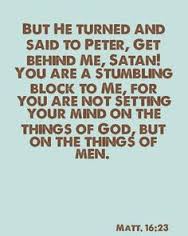
Varför kallade Jesus Petrus för SATAN i Matt. 16:23?

peter satanPetrus är Satan?

Jesus kom till världen för att dö för oss. Det finns ingen förlåtelse utan blod.

Joh. 10:11 Jag är den gode herden. Den gode herden ger sitt liv för fåren. 15 liksom Fadern känner mig och jag känner Fadern, och jag ger mitt liv för fåren. 16 Jag har också andra får, som inte hör till den här fållan. Dem måste jag också leda, och de kommer att lyssna till min röst. Så skall det bli en hjord och en herde. 17 Fadern älskar mig därför att jag ger mitt liv för att sedan ta det tillbaka. 18 Ingen tar det ifrån mig, utan jag ger det av fri vilja. Jag har makt att ge det, och jag har makt att ta det tillbaka. Det budet har jag fått av min Fader.”

Hebr. 9:22 Så renas enligt lagen nästan allt med blod, och utan att blod utgjuts ges ingen förlåtelse.

Det var självfallet ingen lätt uppgift att utföra även om Jesus var helt inriktad på att gå igenom detta utdragna och plågsamma uppdrag för att rädda mänskligheten.

Luk. 22: 40 När han kom till platsen, sade han till dem: “Be att ni inte kommer i frestelse.” 41 Och han gick ett stycke ifrån dem, ungefär ett stenkast, och föll på knä och bad: 42 “Fader, om du vill, så tag denna kalk ifrån mig! Men ske inte min vilja utan din.” 43 Då visade sig en ängel från himlen och gav honom kraft.44 Han kom i svår ångest och bad allt ivrigare, och hans svett blev som blodsdroppar, som föll ner på jorden. 45 När han reste sig från bönen och kom till lärjungarna, fann han att de hade somnat av bedrövelse. 46 Då sade han till dem: “Varför sover ni? Stig upp och be att ni inte kommer i frestelse.”

När man vet vilka påfrestningar man står inför gällande något som man helt enkelt måste gå igenom så blir man verkligen inte hjälpt av att någon försöker få en på andra tankar. I stället skulle man bli mer hjälpt av en uppmuntran att faktiskt utföra det svåra uppdraget i kombination med t .ex. löften om förböner. Petrus som älskade Jesus ansåg förmodligen att Jesus tal om att han skulle lida och dö inte alls borde realiseras eftersom Jesus var helt oskyldig och inte förtjänade ett sådant fruktansvärt öde. Det kan givetvis handla om ren välvilja från hans sida när han då försökte bromsa Jesus från att utföra denna handling som Jesus kom till jorden för att utföra. Petrus drog Jesus åt sidan och sa “Detta skall aldrig hända dig”, och även om det kanske är ett tal som kanske Jesus fysiska kropp skulle vilja höra och lyda (då skulle han ju slippa lida) så var det ingenting som Jesus själv ville höra talas om. Det kanske låter hyggligt med en tröstande klapp på axeln och ett fagert tal om att det finns en bekvämare väg att gå, men eftersom Jesus inte kunde (ville) välja en sådan bekväm väg så var ett sådant tal bara onödigt frestande och en påminnelse om Satans list.

“Matt. 16:21 Från den tiden började Jesus förklara för sina lärjungar att han måste gå till Jerusalem och lida mycket genom de äldste och översteprästerna och de skriftlärda och att han måste dödas och på tredje dagen uppväckas. 22 Då tog Petrus honom åt sidan och började motsäga honom: “Gud är nådig mot dig, Herre. Detta skall aldrig hända dig.23 Men Jesus vände sig om och sade till Petrus:”Gå bort ifrån mig, Satan! Du vill få mig på fall. Vad du tänker är inte Guds tankar utan människotankar.”

Det är ju Satan som mest av allt önskat att Jesus aldrig skulle ha valt döden och låta sitt blod täcka världens synder, vilket innebär att Petrus ord och behandling av Jesus – när han tog honom åt sidan för att försöka övertala honom om att avstå – faktiskt resulterade i att han gick Satans ärenden.

Någon kanske reagerar på att Petrus fick en onödigt hårt reprimand av Jesus om han handlade i god tro, men om det är Satan som yttrar sig (även genom en människa) så bör Jesus näpsa honom. Jesus förklarade också för Petrus varför han gjorde så genom “Vad du tänker är inte Guds tankar utan människotankar”, och inget hindrar förstås att Jesus gjorde en längre utläggning till Petrus om han fortfarande inte skulle förstå på vilket sätt han frestat Jesus och gjort plågan värre för honom. Allt som Jesus sagt står inte med i Bibeln.

Biblegateway antyder att “Gud är nådig mot dig” innebär att Petrus tillbakavisar talet om korset med 1 Petr 1:18 som jämförelse.

1 Pet. 1:18 I veten ju att det icke är med förgängliga ting, med silver eller guld, som I haven blivit »lösköpta» från den vandel I förden i fåfänglighet, efter fädernas sätt

Petrus kallades även symboliskt för Kefas vid något tillfälle av Jesus, men även andra män kan heta Kefas. Läs gärna om hur Petrus förmodas vara en annan Kefas i denna artikel.

Robert Cummings – from being a praised actor to being hooked on Methamphetamine

robert cummings 2For what is a man profited, if he shall gain the whole world, and lose his own soul? or what shall a man give in exchange for his soul? (Matt. 16:26)

Was not Robert Cummings the most handsome American actor of all in the 1940’s – back in the days when films did not contain any swear words or nudity? At least based on his appearance in Alfred Hitchcock’s film Saboteur from 1942, where he actually looked his very best wearing simple clothes, and where he is unshaven and has uncombed hair. Little did he know when he filmed Saboteur, that he would end up in a straight-jacket 1965 – when he was taken away from his luxurious home in Hollywood into a Psychiatric hospital as a consequence of his heavy methamphetamine addiction and altered behavior.*) Meth was a legal drug at the time and unfortunately he discovered it early, maybe even as early as 1954 albeit sporadically, which is  the year when he incidentally starred in his second film with Hitchcock – Dial M for murder.

It is really tragic that he and many other actors and artists did not even know that the vitalizing “vitamin injections” from Dr Max Jacobson in New York contained meth. Had he known the true content/meaning of the drug and that he would eventually lose everything due to those miraculous injections – his wonderful Hollywood home, his previous connection with his family (he remarried), his profession as a well paid actor in the Hollywood elite, his fortune, his reputation and the possibility to a drug free joyful life – he would probably have rejected the drug from the very start. Instead he eventually became completely trapped and from then on he made sure to make the drug a part of his every day life – even if he made a couple of sincere attempts to stop with the help of drug clinics (based on an interview 1987). Sadly his life story with vitamin injections and drugs is not unique among Hollywood stars of his era and I use him just as an example.

Ja. 4:7 Submit yourselves therefore to God. Resist the devil, and he will flee from you.

How sad it is when someone forgets what is the most important aspect of life – livingFlesh and fantasy with and for God during his brief stay on planet earth. A lingering depression can sometimes make a person seek God, but it is unfortunate if you must go so far and lose everything before you will eventually start turning to the only one who can save you – our Creator God – where you can find a new life in Jesus Christ. I have no means of knowing if Robert eventually did become a born again christian perhaps during the final days of his life, but his mother (a minister) was definitely interested in the Bible and tried to influence her son. He seems to have had a keen interest in astrology and numerology throughout his life.


Robert eventually ended up living all alone in a retirement home with only his pension to live on, suffering from Parkinson’s disease. His final years are of course not the whole sum of his life, and he is rather remembered by his acting performances, TV shows and his love for aviation. It is hard to combine a Hollywood life with a life with Christ, due to being surrounded by worldly temptations and a pressure to always make a top-notch performance in order to not be a forgotten name and soon be out of work.

Our time in this temporary world is very brief

Ja. 4:14 Whereas ye know not what shall be on the morrow. For what is your life? It is even a vapour, that appeareth for a little time, and then vanisheth away.

1 Pet. 1:24 For all flesh is as grass, and all the glory of man as the flower of grass. The grass withereth, and the flower thereof falleth away:

Ja. 1:10 But the rich, in that he is made low: because as the flower of the grass he shall pass away.

1 Chron. 29:15 For we are strangers before thee, and sojourners, as were all our fathers: our days on the earth are as a shadow, and there is none abiding.

Eccl. 1:4 One generation passeth away, and another generation cometh: but the earth abideth for ever.

Eccl. 6:12 For who knoweth what is good for man in this life, all the days of his vain life which he spendeth as a shadow? for who can tell a man what shall be after him under the sun?

Is. 38:12 Mine age is departed, and is removed from me as a shepherd’s tent: I have cut off like a weaver my life: he will cut me off with pining sickness: from day even to night wilt thou make an end of me.

Is. 40:6 The voice said, Cry. And he said, What shall I cry? All flesh is grass, and all the goodliness thereof is as the flower of the field:7 The grass withereth, the flower fadeth: because the spirit of the Lord bloweth upon it: surely the people is grass.The grass withereth, the flower fadeth: but the word of our God shall stand for ever.

Ps. 78:39 For he remembered that they were but flesh; a wind that passeth away, and cometh not again.

Ps. 144:4 Man is like to vanity: his days are as a shadow that passeth away.

Ps. 102: 3 For my days are consumed like smoke, and my bones are burned as an hearth.

Ps. 39:Lord, make me to know mine end, and the measure of my days, what it is: that I may know how frail I am.5 Behold, thou hast made my days as an handbreadth; and mine age is as nothing before thee: verily every man at his best state is altogether vanity. Selah.—11 When thou with rebukes dost correct man for iniquity, thou makest his beauty to consume away like a moth: surely every man is vanity. Selah.

Job. 7:7 Is there not an appointed time to man upon earth? are not his days also like the days of an hireling?

Job 14:1 Man that is born of a woman is of few days and full of trouble.2 He cometh forth like a flower, and is cut down: he fleeth also as a shadow, and continueth not.

Eph. 5:11 And have no fellowship with the unfruitful works of darkness, but rather reprove them.12 For it is a shame even to speak of those things which are done of them in secret.13 But all things that are reproved are made manifest by the light: for whatsoever doth make manifest is light.14 Wherefore he saith, Awake thou that sleepest, and arise from the dead, and Christ shall give thee light.15 See then that ye walk circumspectly, not as fools, but as wise,16 Redeeming the time, because the days are evil.17 Wherefore be ye not unwise, but understanding what the will of the Lord is.18 And be not drunk with wine, wherein is excess; but be filled with the Spirit;19 Speaking to yourselves in psalms and hymns and spiritual songs, singing and making melody in your heart to the Lord;

However, our short time of suffering is nothing compared to what is ahead of us, if we are the children of God:

Rom. 8:18 For I reckon that the sufferings of this present time are not worthy to be compared with the glory which shall be revealed in us.

Rev. 21:4 And God shall wipe away all tears from their eyes; and there shall be no more death, neither sorrow, nor crying, neither shall there be any more pain: for the former things are passed away.

Phil. 4:6 Be careful for nothing; but in every thing by prayer and supplication with thanksgiving let your requests be made known unto God.And the peace of God, which passeth all understanding, shall keep your hearts and minds through Christ Jesus.

Ps. 90:For all our days are passed away in thy wrath: we spend our years as a tale that is told.—12 So teach us to number our days, that we may apply our hearts unto wisdom.

Ps. 147:3 He healeth the broken in heart, and bindeth up their wounds.

Prov. 1:7 The fear of the Lord is the beginning of knowledge: but fools despise wisdom and instruction.

Ja. 1:2 My brethren, count it all joy when ye fall into divers temptations;Knowing this, that the trying of your faith worketh patience.But let patience have her perfect work, that ye may be perfect and entire, wanting nothing.If any of you lack wisdom, let him ask of God, that giveth to all men liberally, and upbraideth not; and it shall be given him.But let him ask in faith, nothing wavering. For he that wavereth is like a wave of the sea driven with the wind and tossed.7 For let not that man think that he shall receive any thing of the Lord.8 A double minded man is unstable in all his ways.9 Let the brother of low degree rejoice in that he is exalted:10 But the rich, in that he is made low: because as the flower of the grass he shall pass away.11 For the sun is no sooner risen with a burning heat, but it withereth the grass, and the flower thereof falleth, and the grace of the fashion of it perisheth: so also shall the rich man fade away in his ways.12 Blessed is the man that endureth temptation: for when he is tried, he shall receive the crown of life, which the Lord hath promised to them that love him.13 Let no man say when he is tempted, I am tempted of God: for God cannot be tempted with evil, neither tempteth he any man:14 But every man is tempted, when he is drawn away of his own lust, and enticed.

2 Cor. 1:3 Blessed be God, even the Father of our Lord Jesus Christ, the Father of mercies, and the God of all comfort;Who comforteth us in all our tribulation, that we may be able to comfort them which are in any trouble, by the comfort wherewith we ourselves are comforted of God.5 For as the sufferings of Christ abound in us, so our consolation also aboundeth by Christ.6 And whether we be afflicted, it is for your consolation and salvation, which is effectual in the enduring of the same sufferings which we also suffer: or whether we be comforted, it is for your consolation and salvation.7 And our hope of you is stedfast, knowing, that as ye are partakers of the sufferings, so shall ye be also of the consolation.

robert cummings 1

I can add that I found his book with focus on health in my book shelf – “Stay young and vital” and I reread some of it. I had forgotten that he had written a dedication to a friend on the front page (Milton Berle), and also that he had used a large number of Bible verses throughout his book to make various point. I like that he encouraged his readers to pray, not only dinner prayers. This was 1960 and before his life really came crumbling down.

*) Lertzman, R & Birnes, W (2015) Dr Feelgood

10 common calvinist proof text arguments debunked, like John 6, Acts 13:48 and John 10:28-29

Calvinism is a confusing set of doctrines based on the five points of Calvinism in TULIP. Calvinists are famous for complicating the Bible, for reading Bible verses in a vacuum and for reading the Bible through the filter of some proof text verses with their own preferable interpretation.

Their unfortunate theology frequently leads to contradictions such as Jesus not dying for everyone and God causing people to sin, which they often disregard by stating “God’s ways are higher than your ways” or “who are you to argue against God?“. The very first church fathers (up until close to the advent of Augustine) did not teach anything close to Calvinism which is semi-gnostic in nature. Calvinism is therefore based on the tradition of men rather than on the Bible and the understanding of the very first apostles/saints (see Jude 3).

Col. 2:8 Beware lest anyone cheat you through philosophy and empty deceit, according to the tradition of men, according to the basic principles of the world, and not according to Christ.

If God’s will always happens and if he chooses people for salvation/damnation from the beginning of the world, then it follows that he forced wicked non-elect sinners into this world – who will end up in hell despite totally obeying God at all times. This applies IF you want to be consistent with Calvinism, which so far no Calvinist has ever succeeded to be. Hard core Calvinists are seldom interested in getting rid of their contradictions (such as painting a very dark picture of our Lord) which could easily come true if they only adopted the more Biblical “free will” alternative which does not in any way threaten God’s sovereignty. It is sad to see how they instead prefer to stick with their reformed teachers who make them believe that Jesus did not love everyone and did not die for the whole world.

Here are 10 of some common proof text verses (more details in the links)

1) John 6:39-44 argument about God drawing people, forcing them to be saved

Calvinists just love v. 44 and prefer not to let the other verses destroy their preferred understanding of this particular verse, which on the surface seems to say exactly what they want it to say – if you only ignore the rest of the verses. How would the outcome be if we read this verse in a vacuum?:

Matt. 6:6 But thou, when thou prayest, enter into thy closet, and when thou hast shut thy door, pray to thy Father which is in secret; and thy Father which seeth in secret shall reward thee openly.

Jesus draws ALL men in John 12:32, but even if we cannot come to him unless he draws us and enables us all to be saved, we must still meet the requirements for salvation which boil down to believe. Calvinists also love to quote v. 39, but not v. 40 which includes a condition for salvation – “— every one which SEETH the Son, and BELIEVETH on him, may have everlasting life: and I will raise him up at the last day”.

What is the point with all conditions listed in John 6, such as the requirements to learn, eat, drink, believe, see and come to him? Why not simplify it and say “whomsoever I choose and force to believe in me will be saved” if that is what John really wants to emphasize? In v. 66 we can read about some of his disciples who went back and walked no more with him, and in v. 70 we can read about a person who Jesus chose but who was still lost – Judas. In John 1:6-7 we can read that Jesus came so that “ALL through him might believe”. Why then do not all believe? Because they have chosen to not meet the requirements listed above. God created us TO SEEK HIM and FIND HIM:

Acts 17:26 And hath made of one blood all nations of men for to dwell on all the face of the earth, and hath determined the times before appointed, and the bounds of their habitation;27 THAT THEY SHOULD SEEK THE LORD, if haply they might feel after him, and FIND HIM, THOUGH HE BE NOT FAR FROM EVERY ONE OF US: 28 For in him we live, and move, and have our being; as certain also of your own poets have said, For we are also his offspring.29 Forasmuch then as we are the offspring of God, WE OUGHT NOT to think that the Godhead is like unto gold, or silver, or stone, graven by art and man’s device.30 And the times of this ignorance God winked at; but now COMMANDETH ALL MEN EVERY WHERE TO REPENT:31 Because he hath appointed a day, in the which he will judge the world in righteousness by that man whom he hath ordained; whereof HE HATH GIVEN ASSURANCE UNTO ALL MEN, in that he hath raised him from the dead.

No man can come except the Father draws him, John 6:44?

2) Rom. 8:29-30 argument where God predestines/forces certain individuals to be saved whereas he damns the rest

V. 28 makes it clear that the promises are linked only to those who LOVE GOD. We must have this information in mind when we proceed to v. 29 so that we know to whom the promises are meant. The body of Christ is foreknown and predestined to enter the kingdom of God and reach glorification. There WILL be a body of Christ (the church) entering heaven, and it consists of people who choose to love God. If anyone wants to be part of the body of Christ and the wonderful promises tied to it, he must love God above everything else and endure to the end. (See more under Eph. 2 below.) “Predestination” and “elect” are two Biblical words, but nowhere in the Bible will we see individuals chosen for salvation.

Whom he did predestinate, them he also called and justified and glorified – Rom. 8:29-30

3) Rom. 9 argument where absolutely everything turns out exactly as God wants since no one can resist his will – and where it is not even possible to talk back to God at any time

Calvinists absolutely adore Rom. 9 despite their interpretation that most people are born desperately doomed, but since they do not pay attention to the context they totally misunderstand what Paul is trying to get the Jews to understand. His point is that it is God’s prerogative to arrange the salvation plan in any way he wants, including making the salvation offer opened also for the gentiles – and as we have learned – based on faith rather than being born Jewish, or being “first” as God’s chosen people who were given the law of Moses. That is why he makes the comparison with Jacob and Esau (the first-born), which certainly does not tell us anything about God choosing individuals for salvation. God will show mercy on whomever he will show mercy, but it does not say that he does this unconditionally. This becomes even more clear when we realize that Paul is quoting scriptures, where God was having a dialogue with Moses during Exodus. Furthermore, in Rom. 11 we can read about the branches: “because of unbelief they were broken off”. 

Also Romans 9 shows man’s free will

Mercy on whom I will have mercy:

“I will have mercy on who I will have mercy”, but not unconditionally – Rom. 9:15

Jacob and Esau:

God did not hate Esau before he was born – Romans 9:13

In Jeremiah 18 we can read about the clay (a picture of Israel) being marred in the potter’s hands. Clearly no potter wants his clay marred, forcing him to start over again with the hope that it will turn better the next time. The chapter makes it clear that Israel has the opportunity to repent and to become obedient, and if they do God will not treat them harshly as he threatens to do. Rom. 9 does not say that God  is the one “fitting” individuals for destruction. If people are prepared for destruction, it is their own doing due to their way of living. Why would God have to “endure with much longsuffering” if people always obeyed him? There is a wonderful place prepared for the vessels of mercy, and anyone can reach that place. 2 Tim. 2:21 tells us that MAN is expected to PURGE HIMSELF from the vessels of dishonor, and if he does he will be a vessel unto HONOR. Needless to say that Calvinists do not appreciate that verse, and similar verses, at all.

The potter and the clay:

The potter acts depending on the clay – we have a free will – Romans 9

Pharaoh is said in the Bible to have hardened his own heart. If someone has the opportunity to do the right thing and obey the only true God and still chooses to disobey him, it is possible to phrase it as though “God hardened his heart”, because if God had not provided this particular opportunity to choose the right thing, Pharao could not have been expected to choose it. By presenting Pharaoh with this option, likely knowing he would not choose the right thing, “God hardened his heart”. Or Pharaoh hardened his heart, whatever you prefer since it boils down to the same thing. Since Pharaoh’s heart was hardened, it shows that it was not completely hard before this point. Yet, Calvinists often teach that the non-elects’ hearts are as hard as they could be. The Bible says that it is certainly possible for man to harden his heart – naturally against God’s will:

Ex. 9:17 AS YET EXALTEST THOU THYSELF AGAINST MY PEOPLE; THAT THOU WILT NOT LET THEM GO?

Ex 9:34 And when Pharaoh saw that the rain and the hail and the thunders were ceased, he sinned yet more, and hardened his heart, he and his servants. (Here we can read that Pharao SINNED by hardening his heart, so if we want to believe God is the one hardening it, then GOD is the one who forced Pharao to sin.)

Jer. 4:4 Circumcise yourselves to the LORD, and take away the foreskins of your heart,ye men of Judah and inhabitants of Jerusalem: lest my fury come forth like fire, and burn that none can quench it, because of the evil of your doings.

Hebr. 3:7 Wherefore as the Holy Ghost saith, To day if ye will hear his voice, 8 HARDEN NOT YOUR HEARTS, as in the provocation, in the day of temptation in the wilderness

Rom. 1:28 And even as they did not like to retain God in their knowledge, God GAVE THEM OVER TO A REPROBATE MIND, to do those things which are not convenient;—

Pharaoh’s heart:

JOSEPH was sold as slave by his BROTHERS – God meant EVIL for GOOD? – Gen. 50:20

4) Phil. 2:13 argument that God is the one making you do all the stuff that you do

If God is the one making us do good things, and actually also bad things since nothing happens against his will (if Calvinism is true), then naturally God alone must be blamed if we lack fruit in our lives. Apparently he did not place the “will” in us to show good fruit, and who can resist his will? So if we sin, we can certainly say “God made me do it”. Still, Paul is telling the Philippians how they should and should not do things, indicating that they might make mistakes. He even indicates that he himself might labor “in vain”, which would not make sense if God is the one making him do the things he does.

Phil. 2:12Wherefore, my beloved, as ye have always obeyed, not as in my presence only, but now much more in my absence, WORK OUT YOUR OWN SALVATION WITH FEAR AND TREMBLING.

14Do all things without murmurings and disputings:15THAT ye may be blameless and harmless, the sons of God, without rebuke, in the midst of a crooked and perverse nation, among whom ye shine as lights in the world;16Holding forth the word of life; that I may rejoice in the day of Christ, that I have not run in vain, neither laboured in vain.

If we draw near to God, he will draw near to us, and the holy Spirit will fill us with an improved strength to live holy lives and bear good fruit.

God works in you both to WILL and to DO as per Phil 2:13?

5) John. 10:28-29 argument about Jesus choosing his sheep and forcing them to stay with him

These two verses are popular, but seldom are they combined with the previous v. 27 which identifies WHO the sheep are in v. 28-29. They are the ones who HEAR his voice and FOLLOW him, wich are requirements. No MAN is able to pluck them out of Jesus’ hands, but the verses do not say that men cannot leave on their own accord – without being plucked out by someone else. We do not lose our free will when we decide to follow Jesus, and we are still able to choose to obey or disobey.

Jesus sheep: I give them eternal life and they shall never perish? – John 10:28

6) Eph. 4:30 argument that we are sealed until the day of redemption and once saved always saved

The verse does not say that we are sealed/saved until the day of redemption but we are sealed UNTO or FOR the day of redemption. On the day of redemption only those with the seal will be saved, and God can provide us with this type of seal provided that we do our part of the deal. Up until the time of redemption a seal can certainly be broken. To be sealed is to be marked, and if we have the holy Spirit and are led by him, we are certainly a unique group of people and sealed/marked and separate from the world. During the old testament it was the circumcision that was the seal (for men) demonstrating that a man belonged to God, but neither this seal indicated that the sealed/marked person could not choose to wander away from God. We do not lose our free will (to obey or disobey) only because we are marked with the seal.

Sealed UNTO the day of redemption, but a seal can be broken Eph. 4:30

7) Eph. 2:1-2 argument that individuals are chosen for salvation/damnation before they are even born

Ephesians 1-2 speaks about a corporate election. The body of Christ (the church) will be going to heaven, which was planned and known from the beginning of the world. Jesus knew that he would not die in vain, and that there would be a group of people who would choose to believe in him and endure to the end. Anyone is free to join this body of Christ which is predestined to go to heaven. Compare it with a bus that is going to a certain destination with a number of passengers  – which are those who choose to turn up, show their tickets and remain on the bus. Something that is frequently mentioned is that the wonderful promises are connected to those who are IN HIM. It is THROUGH HIM that we can reach the kingdom of God, so we must make sure to be IN CHRIST – or else the promises are not for us. To be “elect” is to be precious/special. Israel was also “elect” (and certain angels were as well) but this does not mean that all Israel will be saved. A ”guarantee receipt” can be a great value for you because it entitles you (if it has not expired) to certain rights, but if you throw it away or if you lose it, then it will not do you much good despite all the promises that are listed on it. Moreover, it is a very bad idea to be dead in trespasses and sins. Sins separate us from God and make us spiritually dead. And people are not born as children of wrath.

It’s a choice to be CHILDREN OF WRATH – Ephesians 2

8) Acts 4:26-28 argument that Judas was predestined to sin by betraying Jesus

There is no darkness in God. The Bible is clear that he does not tempt anyone, much less causes people to sin. If God has forced Judas to betray Jesus, Judas really should be awarded a place in paradise – as a thanks for obeying God to 100%. Yet we know that it would have been better if he had not been born. Judas SINNED by betraying Jesus.

Matt. 26:24 The Son of Man indeed goes just as it is written of Him, but woe to that man by whom the Son of Man is betrayed! It would have been good for that man if he had not been born.

Jesus death was predetermined but it was not necessary to cause Judas or anyone else to be involved in this plan. There was no shortage of people who wanted to betray and kill Jesus, so God did not have to influence anyone to do it. Jesus death was prophesied about, but prophesies normally entail something that is known (not predestined) to take place in the future. The one prophesying is not causing the prophesied events to take place. God can naturally cause things to take place if he wants, like he did with the global flood, the return of the son in the last days, etc, but those unique exceptions hardly mean that he causes all things to line up as he wants. Had Judas never betrayed Jesus, this event would not have been prophesied about unless we are talking about a false prophesy which is not from God. It was not GOD who placed the desire to harm Jesus inside Judas but SATAN.

Joh. 13:And supper being ended, the devil having now put into the heart of Judas Iscariot, Simon’s son, to betray him 

Acts 2:23 Him, being delivered by the determinate counsel and FOREKNOWLEDGE of God, YE have taken, and BY WICKED HANDS have crucified and slain? 

Judas was not predestined to betray Jesus, Acts 4:28

9) Acts 13:48 argument that God ordains (forces) individuals to believe in him, whereas the rest have no chance to do the same since God has not provided them with this opportunity

This verse alone does not mention the criteria for God’s choice to ordain individuals, unlike many other verses which clarify that it’s our FAITH that is the criteria. Neither does this verse suggest that God’s appointing is the CAUSE for people’s faith. According to Adam Clarke, the original Greek word ”includes no idea of preordination or predestination of any kind” (“Commentary on Acts 13:48”). The original Greek word simply means “disposed” (to set in position), and therefore the verse could be translated “as many as were disposed (or who set themselves in such a disposition) to eternal life believed”.  Their disposition to receive the gospel is contrasted with the disposition of the Jews just two verse before, and the Jews had chosen another path. So those who judge themselves unworthy of everlasting life did not believe, but those who disposed themselves to eternal life believed, and whether they believed or not depended on whether their heart rejected or accepted the Gospel which was preached to them.

Acts 13:46 Then Paul and Barnabas waxed bold, and said, It was necessary that the word of God should first have been spoken to you: but SEEING YE PUT IT FROM YOU, AND JUDGE YOURSELVES UNWORTHY of everlasting life, lo, we turn to the Gentiles.

As many as were ordained to eternal life believed, but they were not FORCED Acts 13:48

10) Eph 2:8-9 argument where faith is a gift offered to only a few lucky people, leaving the rest for damnation

If we are not able to have faith unless God enables us to have this faith, and if God chooses to prevent people from ever getting faith, then it follows that God alone must be blamed if we do not believe in him. Or do non-elect have the choice to have faith in him? If no, then they are innocent victims in the hands of a cruel God who created them for the sole reason to send them to hell – for not believing in him, which he himself prevented them from doing. Not much within Calvinism makes sense.

We are saved by grace (God’s kindness) but through FAITH – which is a requirement for salvation. The Bible also says that if we love God – which we do if we truly have faith in him – then we OBEY him. Eph. 2-8-9 does not say that faith is a gift but that SALVATION is a gift, and this is certainly true since we cannot cleanse and save ourselves. It is also true that we do not earn our salvation by anything we do (or believe), and that we are not saved by either works alone or faith alone (as Jam. 2:24 states). If we dare to continue to v. 10, we can read that we are created to good works that God has prepared that we should WALK in. What happens if we choose not to walk in those good works? Still saved no matter what?

FAITH is not the gift of God in Eph. 2:8-9, but SALVATION is

I might return with 10 more common proof text arguments

Hur ser det ut i den nya HIMLEN enligt Bibeln – i det nya Jerusalem?

Nya Jerusalem

Om Adam och Eva fortsatt att leva rättfärdigt, i enlighet med Guds vilja, så hade de kunnat leva i evighet i Edens lustgård. De var dock tvungna att lämna lustgården för att på så sätt hindras att nå livets träd och så leva för evigt – i en värld som plötsligt var påverkad av synd och bedrövelse. Att leva i evighet i en syndfull värld är inte optimalt (snarare något fruktansvärt) men Gud lät sin ende son dö för oss för att vi ska kunna få evigt liv – dock inte i den här världen. Syndens lön är döden, men Guds gåva är evigt liv i Kristus Jesus, vår Herre (Rom. 6:23).

Hur ser himmelriket ut? Vi får en del tips från Bibeln.

1 Kor. 2:9 Men vi känner, som Skriften säger, vad ögat inte har sett och örat inte hört och människohjärtat inte kunnat ana, vad Gud har berett åt dem som älskar honom.

Joh. 14:2 I min Faders hus finns många rum. Om det inte vore så, skulle jag då ha sagt er att jag går bort för att bereda plats åt er?

Paulus var nära döden under hans första missionsresa i Lystra, och det kan mycket väl vara så att han refererar till den händelsen i sitt andra brev till korinthierna 14 år efteråt. Om den första himlen är det område där fåglarna befinner sig (atmosfären som kan delas in i flera olika sfärer) och den andra himlen är området ovanför det (rymden), så kan man tänka sig ytterligare en himladimension som kallas “den tredje himlen” – paradiset. Paulus verkar sakna ord för hur det är i Paradiset och hur våra sinnen kommer att uppfatta det vi hör och ser:

Apg 14:19 Från Antiokia och Ikonium kom det nu några judar. De lyckades få med sig folket, och man stenade Paulus och släpade ut honom ur staden i tron att han var död. 20 Men när lärjungarna samlades omkring honom, reste han sig och gick in i staden.

2 Kor. 12:1 Jag måste berömma mig, om än till ingen nytta, och jag kommer då till syner och uppenbarelser från Herren. 2 Jag vet om en man i Kristus som för fjorton år sedan blev uppryckt ända till tredje himlen – om han var i kroppen eller utanför kroppen vet jag inte, Gud vet det. – 3 Jag vet att den mannen – om han var i kroppen eller utanför kroppen vet jag inte, Gud vet det – 4 att han blev uppryckt till paradiset och hörde ord som ingen människa kan uttala eller får uttala.Av den mannen vill jag berömma mig, men av mig själv vill jag inte berömma mig utom av min svaghet.—10 Så gläder jag mig över svaghet, misshandel och nöd, över förföljelser och ångest, eftersom det sker för Kristus. Ty när jag är svag, då är jag stark.

5 Mos. 4:39 Därför skall du i dag veta och lägga på hjärtat att Herren är Gud uppe i himlen och nere på jorden: Det finns ingen annan.

Fil. 1:21 Ty för mig är livet Kristus och döden en vinst. 22 Men om livet här på jorden innebär att mitt arbete bär frukt, då vet jag inte vad jag skall välja. 23 Jag dras åt båda hållen. Jag skulle vilja bryta upp och vara hos Kristus, det vore mycket bättre. 24 Men för er skull är det nödvändigt att jag får leva kvar.

För att få komma till paradiset måste vi först dö och få en andlig kropp. Det kommer att finnas skillnader i “glans” gällande de uppståndna:

1 Kor. 15:35 Nu kan någon fråga: Hur uppstår de döda? Vad för slags kropp har de när de kommer? 36 Du oförståndige! Vad du sår får inte liv om det inte dör. 37 Och vad du sår har inte den gestalt som skall bli till, utan är ett naket korn, kanske av vete eller av något annat slag. 38 Men Gud ger det en sådan gestalt som han har velat, och åt varje frö dess egen gestalt. 39 Inte allt kött är av samma slag. Det är skillnad mellan människors, husdjurs, fåglars och fiskars kött. 40 Det finns också himmelska kroppar och jordiska kroppar. Men de himmelska kropparnas glans är av ett slag, de jordiska kropparnas glans av ett annat slag. 41 Solen har sin glans, månen en annan och stjärnorna ännu en annan. Den ena stjärnan skiljer sig från den andra i glans.42 Så är det också med de dödas uppståndelse. Det som sås förgängligt uppstår oförgängligt.43 Det som sås i vanära uppstår i härlighet. Det som sås i svaghet uppstår i kraft. 44 Det sås en jordisk kropp, det uppstår en andlig kropp. Om det finns en jordisk kropp, finns det också en andlig kropp. 45 Så står det skrivet: Den första människan, Adam, blev en levande varelse. Den siste Adam blev en livgivande ande. 46 Men det andliga är inte det första utan det jordiska. Därefter kommer det andliga. 47 Den första människan var av jord, jordisk. Den andra människan kom från himlen. 48 Som den jordiska människan var, så är också de jordiska. Och som den himmelska människan är, så är också de himmelska. 49 Och liksom vi har burit den jordiska människans bild, skall vi också bära den himmelska människans bild.50 Men det säger jag er, bröder, att kött och blod inte kan ärva Guds rike. Inte heller ärver det förgängliga det oförgängliga. 51 Se, jag säger er en hemlighet: Vi skall inte alla insomna, men vi skall alla förvandlas, 52 i ett nu, på ett ögonblick, vid den sista basunens ljud. Ty basunen skall ljuda och de döda skall uppstå odödliga, och vi skall förvandlas. 53 Ty detta förgängliga måste kläs i oförgänglighet och detta dödliga kläs i odödlighet. 54 Men när detta förgängliga har klätts i oförgänglighet och detta dödliga klätts i odödlighet, då skall det ord fullbordas som står skrivet: Döden är uppslukad och segern vunnen. 

Matt. 22:30 Ty vid uppståndelsen gifter man sig inte och blir inte bortgift, utan man är som änglarna i himlen.

Livet på jorden kan verka full av umbäranden, speciellt för en del människor, men då får vi tänka på att den här tidens lidanden väger lätt i jämförelse med vad som väntar. En blivande mamma anser ofta att en plågsam förlossning ändå är värt besväret för det som hon vet kommer efteråt – ett barn! Ändå varar vare sig mamman eller barnet i evighet utan som högst kan vi förvänta oss ca 100 år på jorden. Många väljer att gå igenom flera års studier trots uppoffranden och behov av studielån för att kunna få ett bra arbete och därmed leva ett bättre liv när snålåren till slut är till ända. Temporär vedermöda anses vara värt besväret i längden om målet för vår strävan kan uppnås. Ett temporärt jordeliv är som ett kortvarigt morgondagg i jämförelse med evigheten i Paradiset:

Rom. 8:18 Jag hävdar att den här tidens lidanden väger lätt i jämförelse med den härlighet som kommer att uppenbaras och bli vår. 19 Ty skapelsen väntar ivrigt på att Guds barn skall uppenbaras.

1 Pet. 1:3 Välsignad är vår Herre Jesu Kristi Gud och Fader. I sin stora barmhärtighet har han genom Jesu Kristi uppståndelse från de döda fött oss på nytt till ett levande hopp, 4 till ett arv som aldrig kan förstöras, fläckas eller vissna och som är förvarat åt er i himlen. 5 Med Guds makt blir ni genom tron bevarade till den frälsning som finns beredd och skall uppenbaras i den sista tiden.6 Gläd er därför, om ni nu en kort tid måste utstå prövningar av olika slag. Äktheten i er tro är långt värdefullare än guld som är förgängligt, fastän det håller provet i eld, och den tron skall visa sig bli till lov, pris och ära, när Jesus Kristus uppenbarar sig. 8 Honom älskar ni utan att ha sett honom, och fastän ni ännu inte ser honom, tror ni på honom och jublar över honom i obeskrivlig, himmelsk glädje, 9 då ni nu är på väg att vinna målet för er tro, era själars frälsning.— 24 Ty allt kött är som gräset och all dess härlighet som blomman i gräset. Gräset vissnar bort och blomman faller av,25 men Herrens ord förblir i evighet.

Matt. 13:43 Då skall de rättfärdiga lysa som solen, i sin Faders rike. Hör, du som har öron att höra med!

Rövaren på korset fick som bekant träda in i paradiset direkt efter sin död ihop med Jesus:

Luk. 23:39 En av brottslingarna som var upphängda där skymfade honom och sade: “Är inte du Messias? Hjälp då dig själv och oss!” 42 Och han sade: “Jesus, tänk på mig, när du kommer till ditt rike.43 Jesus svarade: “Amen säger jag dig: I dag skall du vara med mig i paradiset.

Gud kommer att döma oss efter våra samveten (Rom. 2), och en del människor verkar ha lättare att söka Gud om de går igenom en del umbäranden. T ex om man är fattig i anden, sörjer,  blir hånad, förföljd eller förtalad för Jesu skull. Ett komfortabelt liv kan ibland leda till att man inte anser sig ha ett behov av Gud. Det är ett vinnande koncept att vara ödmjuk, barmhärtig, renhjärtad, hungra/törsta efter rättfärdighet samt skapa frid:

Matt. 5:3 Saliga är de som är fattiga i anden,  dem tillhör himmelriket.4 Saliga är de som sörjer, de skall bli tröstade.5 Saliga är de ödmjuka, de skall ärva jorden.6 Saliga är de som hungrar och törstar efter rättfärdighet, de skall bli mättade.7 Saliga är de barmhärtiga, de skall få barmhärtighet.8 Saliga är de renhjärtade, de skall se Gud.9 Saliga är de som skapar frid, de skall kallas Guds barn.10 Saliga är de som blir förföljda för rättfärdighetens skull, dem tillhör himmelriket.11 Saliga är ni, när människor hånar och förföljer er, ljuger och säger allt ont om er för min skull. 12 Gläd er och jubla, ty er lön är stor i himlen. På samma sätt förföljde man profeterna före er.

Luk. 16:25 Men Abraham svarade: Mitt barn, kom ihåg att du fick ut ditt goda medan du levde, under det att Lasarus fick ut det onda. Nu får han tröst och du plåga. 

I Jesaja kan vi läsa om telningen från Isais rot som ska döma allt folk med rättfärdighet. Det verka alltså handla om den sista tiden och fridsriket. Djur och människor lever tillsammas i fullständig harmoni:

Jes. 11:3 Han skall ha sin glädje i Herrens fruktan. Han skall inte döma efter vad ögonen ser eller utöva lag efter vad öronen hör,4 utan med rättfärdighet skall han döma de fattiga, med rättvisa skaffa rätt åt de ödmjuka på jorden. Han skall slå jorden med sin muns stav, med sina läppars andedräkt döda de ogudaktiga.5 Rättfärdighet skall vara bältet runt hans midja, trofasthet bältet om hans höfter.Vargar skall bo tillsammans med lamm, leoparder ligga bland killingar. Kalvar och unga lejon och gödboskap skall vara tillsammans, och en liten pojke skall valla dem.7 Kor och björnar skall gå och beta, deras ungar skall ligga tillsammans, och lejon skall äta halm som oxar.8 Ett spädbarn skall leka vid huggormens hål, ett avvant barn räcka ut handen mot giftormens öga.9 Ingen skall göra något ont eller förstöra något på hela mitt heliga berg, ty landet skall vara fullt av Herrens kunskap, liksom vattnet täcker havet.

Det är i Bibelns sista bok Uppenbarelseboken som vi kan se flest detaljer om den nya himlen och det nya Jerusalem. Upp. 7 talar om de människor som klarat sig från den stora nöden/vedermödan och som tvättat sina kläder i Lammets blod:

Upp. 7:9 Därefter såg jag, och se: en stor skara som ingen kunde räkna, av alla folkslag och stammar och länder och språk. De stod inför tronen och inför Lammet, klädda i vita kläder och med palmblad i händerna.  14 Jag svarade: “Min herre, du vet det.” Då sade han till mig: “Dessa är de som kommer ur den stora nöden, och de har tvättat sina kläder och gjort dem vita i Lammets blod.15 Därför står de inför Guds tron och tjänar honom dag och natt i hans tempel, och han som sitter på tronen skall slå upp sitt tabernakel över dem. 16 De skall aldrig mer hungra eller törsta, inte heller skall solen eller någon annan hetta träffa dem. 17 Ty Lammet som står mitt för tronen skall vara deras herde och leda dem till livets vattenkällor, och Gud skall torka bort alla tårar från deras ögon.”

Den första himlen och den första jorden ska försvinna, och en ny himmel och jord ska komma. Det nya Jerusalem ska kommer ner från himlen. Återigen kommer Gud själv, precis som i Adam och Evas dagar, bo mitt bland folket:

Upp 21:1 Och jag såg en ny himmel och en ny jord. Ty den första himlen och den första jorden hade försvunnit, och havet fanns inte mer. 2 Och jag såg den heliga staden, det nya Jerusalem, komma ner från himlen, från Gud, redo som en brud, som är smyckad för sin brudgum. 3 Och jag hörde en stark röst från tronen säga: “Se, nu står Guds tabernakel bland människorna, och han skall bo hos dem och de skall vara hans folk, och Gud själv skall vara hos dem. 4 Och han skall torka alla tårar från deras ögon. Döden skall inte finnas mer och ingen sorg och ingen gråt och ingen plåga. Ty det som förr var är borta.”5 Han som satt på tronen sade: “Se, jag gör allting nytt.” Och han sade: “Skriv, ty dessa ord är trovärdiga och sanna.” 6 Han sade också till mig: “Det har skett. Jag är A och O, begynnelsen och änden. Åt den som törstar skall jag ge att dricka fritt och för intet ur källan med livets vatten. 7 Den som segrar skall få detta i arv, och jag skall vara hans Gud, och han skall vara min son. 8 Men de fega, de otroende och de skändliga, mördarna, de otuktiga, trollkarlarna, avgudadyrkarna och alla lögnare skall få sin del i sjön som brinner av eld och svavel. Detta är den andra döden.”9 En av de sju änglarna med de sju skålarna, som var fyllda med de sju sista plågorna, kom och talade till mig och sade: “Kom, jag skall visa dig bruden, Lammets hustru.” 10 Och han förde mig i anden upp på ett stort och högt berg och visade mig den heliga staden Jerusalem, som kom ner från himlen, från Gud, 11 och som ägde Guds härlighet. Dess strålglans var som den dyrbaraste ädelsten, som en kristallklar jaspis. 12 Staden hade en stor och hög mur med tolv portar och över portarna tolv änglar och namn inskrivna: namnen på Israels barns tolv stammar. 13 I öster fanns tre portar, i norr tre portar, i söder tre portar och i väster tre portar.14 Stadsmuren hade tolv grundstenar, och på dem stod tolv namn, namnen på Lammets tolv apostlar.15 Och han som talade till mig hade en mätstång av guld för att mäta staden och dess portar och dess mur. 16 Staden bildade en fyrkant och var lika lång som den var bred. Och han mätte upp den med mätstången till tolv tusen stadier. Dess längd, bredd och höjd var lika. 17 Han mätte också upp dess mur till etthundrafyrtiofyra alnar efter människors mått, som också är änglars. 18 Muren var byggd av jaspis, och staden bestod av rent guld som liknade rent glas.19 Grundstenarna till stadsmuren var prydda med alla slags ädelstenar. Den första var en jaspis, den andra en safir, den tredje en kalcedon, den fjärde en smaragd, 20 den femte en sardonyx, den sjätte en karneol, den sjunde en krysolit, den åttonde en beryll, den nionde en topas, den tionde en krysopras, den elfte en hyacint och den tolfte en ametist. 21 De tolv portarna bestod av tolv pärlor, och varje särskild port var en enda pärla. Och stadens gata var av rent guld som genomskinligt glas.22 Något tempel såg jag inte i staden, ty Herren Gud, den Allsmäktige, och Lammet är dess tempel. 23 Staden behöver inte ljus från sol eller måne, ty Guds härlighet lyser upp den, och dess ljus är Lammet. 24 Och folken skall vandra i dess ljus, och jordens kungar skall föra in sin härlighet i den. 25 Stadens portar skall aldrig stängas om dagen – natt skall inte finnas där –26 och folkens härlighet och ära skall föras in i staden. 27 Aldrig någonsin skall något orent komma in i den, och inte heller någon som handlar skändligt och lögnaktigt, utan endast de som är skrivna i livets bok som tillhör Lammet.

Livets träd kommer att få en särskilt plats i Guds rike och den ger frukt varje månad. Trädets blad ger läkedom åt folket, som aldrig kommer att dö. Det kommer inte att finnas någon natt och inte ens någon sol – eftersom Gud kommer att lysa på invånarna.

Upp. 22:1 Och han visade mig en flod med livets vatten, klar som kristall. Den går ut från Guds och Lammets tron. 2 Mitt på stadens gata, på båda sidor om floden, står livets träd som bär frukt tolv gånger, varje månad bär det frukt, och trädets blad ger läkedom åt folken. 3 Och ingen förbannelse skall finnas mer. Guds och Lammets tron skall stå i staden, och hans tjänare skall tjäna honom. 4 De skall se hans ansikte, och hans namn skall stå skrivet på deras pannor.5 Någon natt skall inte finnas mer, och de behöver inte någon lampas sken eller solens ljus. Ty Herren Gud skall lysa över dem, och de skall regera som kungar i evigheternas evigheter.6 Och han sade till mig: “Dessa ord är trovärdiga och sanna, och Herren, profeternas andars Gud, har sänt sin ängel för att visa sina tjänare vad som snart måste ske.”—10 Och han sade till mig: “Försegla inte profetians ord i denna bok. Ty tiden är nära. 11 Den orättfärdige må fortsätta att göra orätt, den orene att orena sig, den rättfärdige må fortsätta att göra vad som är rätt och den helige att helga sig.12 “Se, jag kommer snart och har min lön med mig för att ge var och en efter hans gärningar.13 Jag är A och O, den förste och den siste, begynnelsen och änden. 14 Saliga är de som tvättar sina kläder. De skall få rätt till livets träd och få komma in i staden genom dess portar. 15 Men utanför är hundarna och trollkarlarna, de otuktiga och mördarna, avgudadyrkarna och alla som älskar lögn och far med osanning.

Det finns en del nära-döden-upplevelser att studera på Youtube, och många utav berättarna talar om LJUSET och FRIDEN innan de får höra att tiden inte är inne.