Tag Archive | TULIP

Westminster Confession of Faith 1647, and related contradictions

calvinism 5Westminster Confession of Faith from the year 1647 – which many calvinists adhere to

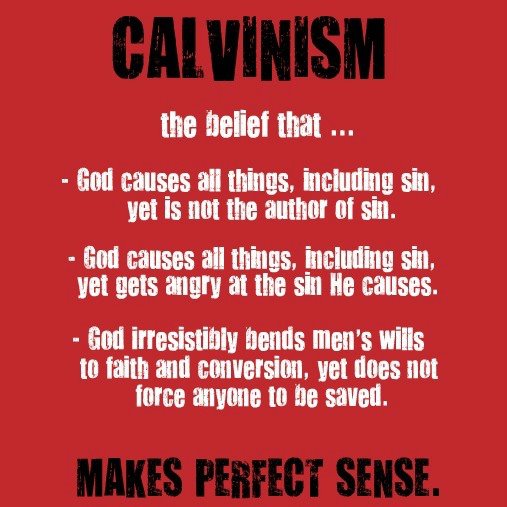
Claiming that “God authors everything but not sin” simply doesn’t make it so – not even if you use fancy words in a document and spread it around throughout a large christian community – because it doesn’t make the obvious contradiction go away. Neither would it make sense to say “I believe in the trinity but I don’t believe that Jesus is God, and not the holy Spirit either for that matter“, or “God predestines every thought and every step of the entire humanity, but we are still responsible for our actions”. It’s one or the other, and you can’t have the cookie and eat it too. If God ordains whatsoever comes to pass and if nothing happens against his will, then this by necessity must include sin! It doesn’t help to blame “second causes” because if you push another person who hits another, then you’re still the cause for the whole chain of actions.

If God ordains whatsoever comes to pass, then this must include also second causes, and if it’s impossible to act against God’s will, then also sin must be according to God’s will. If God is the one who decides who to save based on nothing that we believe or do, and who to give the ability to seek him, believe, repent and obey, then the only outcome is that he didn’t want the rest (the non-elect) to seek him, believe, repent or obey. Many calvinists admit that they believe that God is the author of sin and that he delights in people who sin (since he predestined them to be wicked sinners), but other calvinists protest and argue against their own doctrines. My view is of course that it’s better to avoid adding calvinism into the Bible in the first place, because that will result in 1) no Bible contradictions, 2) no unanswered questions, puzzles or unsolved mysteries, 3) we suddenly understand why Jesus Christ had to die on the cross – because something went WRONG and didn’t go as God planned, and 4) God and Satan can be totally separated (instead of working as a team) leaving God as a righteous and holy God who has no darkness within him and who doesn’t tempt anyone or delights in anyone’s sin.

God from all eternity, did, by the most wise and holy counsel of His own will, freely, and unchangeably ORDAIN WHATSOEVER COMES TO PASS: yet so, as thereby neither is God the author of sin, nor is violence offered to the will of the creatures; nor is the liberty or contingency of second causes taken away, but rather established. (WCF)

Long texts with lots of fluff and fancy words might help the author to hide obvious contradictions for the readers, but if we remove the fluff and make the statement shorter and only keep the necessary outline, the contradictions will be more obvious. It’s of course easier to detect the contradiction if we only stick with the main idea with the statement, which is “God ordains whatever events come to pass, but not in such a way so that God ordains the sinful events that come to pass”.

“The [Calvinist] doctrine is, that God decreed, from eternity, whatsoever comes to pass in time — and that according to his own good pleasure — every particular thing, event, and act. I must insist, according to this [Calvinist doctrine], that he decreed the sin of every sinful man — nay, each particular sin of each particular man, and all the sins of all men, long before the human race was created.”

Hence, the Westminster Confession contains a palpable contradiction namely, that God did cause all things, sin included, yet in such a way that He did not cause sin.” Randolph Foster – Objections to Calvinism 

To reconcile the obvious, the Calvinist simply waves his hand and says God is not the author of sin. Double talk.

The following section is from Daniel Gracely

This sentence is a contradiction because it involves two ideas in which each idea makes it impossible for the other idea to be true. Yet under the Westminster Confessions these two opposing propositions form a ’system’ (or synthesis) that is nevertheless held to be true. Let me give another example of a contradiction to make this clearer. Suppose I packed nothing but one apple and one orange for lunch. I might make the following statement:

“Today I ate the apple before I ate the orange so I wouldn’t get sick, yet not in such a way so that the orange was eaten last, which would have made me sick.”

Me: I feel sick.

You: Apparently you got sick by eating the orange first. Whydidn’t you eat the apple first?

Me: did eat the apple first. Don’t you remember what I said? I ate the apple before I ate the orange so I wouldn’t get sick.”

You: Then why are you sick?

Me: I believe I told you why. I said I didn’t eat the orange last, which is why I feel sick.

YouI’m a little confused—which fruit did you eat first?

MeI’ll repeat myself entirely: “Today I ate the apple before I ate the orange so I wouldn’t get sick, yet not in such a way so that the orange was eaten last, which would have made me sick.”

YouBut you’re sick—is that right?

MeNot at all. I said a bit earlier that “I ate the apple before I ate the orange so I wouldn’t get sick.”

As long as I respond with this “logic” you cannot come to any conclusions about what I said. You cannot know whether I am sick or well, which fruit I ate first, or even if I ate at all. You cannot know what events happened because I affirmed everything, and yet denied everything. Consequently, all the statements you heard are inconclusive. In effect, I used language to say nothing. You could not even determine properly if I was actually describing myself in the above events, since nothing was being said about ‘me.’ I created this confusion by upholding two ideas that were in contradiction to each other, but which I claimed were simultaneously true.

God’s Eternal Decree – to save some and to damn some – despite that both categories are obedient to God calvinism 8

iii. By the decree of God, for the manifestation of His glory, some men and angels are predestinated unto everlasting life, and others foreordained to everlasting death. 

John 1:12  But as many as received Him, to them He gave the right to become children of God, to those who believe in His name

vi. As God hath appointed the elect unto glory, so hath He, by the eternal and most free purpose of His will, foreordained all the means thereunto. Wherefore, they who are elected being fallen in Adam, are redeemed by Christ; are effectually called unto faith in Christ by His Spirit working in due season; are justified, adopted, sanctified, and kept by His power, through faith, unto salvation. Neither are any other redeemed by Christ, effectually called, justified, adopted, sanctified, and saved, but the elect only.

John 3:17 For God sent not his Son into the world to condemn the world; but that the world through him might be saved.18 He that believeth on him is not condemned: but he that believeth not is condemned already, because he hath not believed in the name of the only begotten Son of God.19 And this is the condemnation, that light is come into the world, and men loved darkness rather than light, because their deeds were evil.20 For every one that doeth evil hateth the light, neither cometh to the light, lest his deeds should be reproved.21 But he that doeth truth cometh to the light, that his deeds may be made manifest, that they are wrought in God.

vii. The rest of mankind, God was pleased, according to the unsearchable counsel of His own will, whereby He extendeth or withholdeth mercy, as He pleaseth, for the glory of His sovereign power over His creatures, to pass by, and to ordain them to dishonour and wrath for their sin, to the praise of His glorious justice. 

Eze 33:11  Say to them: ‘As I live,’ says the Lord GOD, ‘I have no pleasure in the death of the wicked, but that the wicked turn from his way and live. Turn, turn from your evil ways! For why should you die, O house of Israel?’

1Ti 2:3-4  For this is good and acceptable in the sight of God our Savior, who desires all men to be saved and to come to the knowledge of the truth.  

viii. The doctrine of this high mystery of predestination is to be handled with special prudence and care, that men, attending the will of God revealed in His Word, and yielding obedience thereunto, may, from the certainty of their effectual vocation, be assured of their eternal election. So shall this doctrine afford matter of praise, reverence, and admiration of God, and of humility, diligence, and abundant consolation, to all that sincerely obey the Gospel.

Deu 29:29  “The secret things belong to the LORD our God, but those things which are revealed belong to us and to our children forever, that we may do all the words of this law.

Calvinist want you to believe that God has revealed the mysteries to them and no one else, and this could be a good ground for boasting.

CALVINISM – the teaching that God is the author of sin and that even babies are sinners

babyCalvinism makes God to be the author of sin, if the calvinist would like to be consistent with his own doctrines. Some in fact do try to be consistent and claim that the most hideous deeds you could ever think of are still predestined by God because “nothing happens against the will of God”. To be consistent they must also believe that 1 month old babies can sin, and even unborn babies!

Thanks to Jesse Morell for the below

Calvinism grieves my heart and it disturbs me to see so many Calvinistic posts on Facebook and Calvinistic materials and preachers being so popular in our day. Scriptural problems I have with Calvinism:

1. Calvinism says that God decreed all sin when the Bible says sin breaks the heart of God and wills holiness and obedience from His subjects.

2. Calvinism says that men are under the wrath of God for the sin of Adam when the Bible says that the son does not bear the iniquity of the father and we will all give an account for our own deeds.

3. Calvinism says that man’s free will was lost by Adam’s original sin when the Bible never says this but instead continues to appeal to man’s free moral agency after Adam’s fall.

4. Calvinism says that all men inherit a sinful nature from Adam when the Bible never even says that Adam’s nature was sinful but instead asserts that God forms our nature in the womb.

5. Calvinism says that all events are the eternal will of God when the Bible represents God as grieved, disappointed, and surprised over many events that have occurred.

6. Calvinism says that God has irresistibly decreed all events from eternity past, when the Bible says that God has canceled and reversed some of His own prophecies and teaches that the future is not yet entirely fixed and settled.

7. Calvinism says that God has given man a moral law which He is incapable of keeping when the Bible says that God is just, never allows us to be tempted above our ability, and only obligates us to love Him with all of our ability.

8. Calvinism says that Jesus Christ came and took our punishment when the Bible says that our punishment is eternal hell.

9. Calvinism says that Jesus Christ came and paid our debt when the Bible says that God forgives us our debt.

10. Calvinism says that Jesus Christ took the punishment of our sins when the Bible says that God forgives us our sins.

11. Calvinism says that Jesus Christ came and took the wrath of God when the Bible says that God still has wrath after the atonement, that sinners are not saved from God’s wrath until conversion, that the atonement was instead a justification of His mercy, and that believers who return to their sins return to the wrath of God.

12. Calvinism says that Jesus Christ became sinful and guilty on the cross when the Bible says He died the just for the unjust and offered Himself without spot or blemish to God.

13. Calvinism says that those for whom Christ died can never perish when the Bible warns that those for whom Christ died can perish.

14. Calvinism says that Christ only died for a few elect when the Bible says that Jesus died for the world and all men.

15. Calvinism says that God wants most sinners to remain in their sins and die and go to hell, to somehow glorify His justice, when the Bible says God wants all men to repent and be saved.

16. Calvinism says that men cannot repent and believe when the Bible commands men to repent and believe and blames them if they do not.

17. Calvinism says that men cannot repent and believe because they are born spiritually dead because of Adam when the Bible says that men are dead or alienated from God because of their own trespasses and sins and says the prodigal son was able to return to the father even though he was dead to the father.

18. Calvinism says that God predestined individuals for heaven or hell when the Bible says that God has chosen to offer salvation to the Jews and the Gentiles, grafting in some and cutting off others based upon their faith or unbelief.

19. Calvinism says that God predestined some for Heaven and most for hell according to the pleasure of His will, when the Bible says that God sent Jesus to die for all, commands all men to repent and believe, is drawing all men unto Himself, is not willing that any should perish, and takes no pleasure in the death of the wicked.

20. Calvinism says that the righteousness of Christ is imputed to believers when the Bible says that our faith is imputed as righteousness.

21. Calvinism says that God doesn’t see believers if they sin, but see’s imputed righteousness instead, when the Bible says God is omniscient and nothing is hide from His eyes.

22. Calvinism says that true believers will persevere unto the end when the Bible exhorts believers to persevere, warns of damnation if they do not, and speaks of some who have departed from the faith.

My list can go on and on but these are just some of the major points.

Do read this article how calvinism can creep into our church unnoticed

ALL doesn’t ALWAYS mean ALL in the Bible, but we don’t get to choose when it doesn’t

alla4It’s absolutely true that the word ALL in the Bible doesn’t always mean ALL as in the entire world and 100% of the population even if it says ALL MEN, but it’s equally true that we don’t get to choose whether or not the word really means ALL ourselves. Sometimes ALL actually means ALL and the entire world and it’s the context that decides which one it is and not our own personal preferences. Maybe this is rather-self-evident but there are some people seem to reason:

“Since I can prove that ALL and ALL MEN do not always mean the whole world or all of the population of the earth, then I get to choose when ALL means ALL myself and I can do this as I see fit”.

They might not be aware of that they are reasoning in this way, but it’s common that especially reformed believers try to refute the verses which say that Jesus died for ALL (which is painfully clear in the Bible), by suggesting that “all doesn’t always mean all“, and this shows that they feel they can save their doctrine of Limited Atonement by narrowing down the word ALL to a certain group of people even though the context itself doesn’t call for this procedure. Yes, sometimes ALL means a certain group of people but not always, and again, we cannot determine this simply by resorting to personal preferences. That would be nothing else but picking and choosing, and you would end up with the invisible rule “ALL means ALL except when it doesn’t fit the reformed doctrine because then it means ALL of a certain group”. 

The saying among reformed believers is that when Jesus died for ALL it means “Jesus died for some of every kind of people from ALL  tribes, languages, people and nations”. And/or that it refers to ALL classes and conditions of people, and to all sorts of human beings without any distinction or exception. That is a convenient understanding if one wants to maintain that TULIP (calvinism) is what the Bible teaches, but if they get to choose this translation of the word ALL,  do I get to do the same whenever I don’t like that ALL means ALL as in every individual? What if I for instance don’t like that ALL people have sinned as Romans 3:23 seems to suggest.

Romans 3:23 For ALL have sinned, and come short of the glory of God

Do I get to interpret the above verse as “some  from all tribes, languages, people and nations have sinned”? No, because then reformed believers might say “NO! It says ALL, and ALL means ALL! Don’t twist the verse and make it say something it doesn’t say! ALL is what it is!” It’s rather unfair that only the reformed believers get to use the “some out of every tribe-idea” but no others.

Rom. 5:12 Wherefore, as by one man sin entered into the world, and DEATH by sin; and so death passed upon all men, FOR that all have sinned

My claim is that babies cannot sin and Rom 5:12 doesn’t say that all people who have ever lived have sinned (which you can read more about in this blog article). We already know that Jesus has not sinned so this means that ALL couldn’t possibly mean the entire world with him included. (Jesus mother Mary was related to Adam and Eve just like the rest of us and she would have given Jesus a piece of her nature as well.) What qualifies “all men” can be read in the context, and Paul is talking about individuals who have become enemies of God (v. 10) but how could babies possibly be enemies of God? Especially babies who are unborn? That is impossible, and Paul’s aim is not to convey that babies can be guilty of sin and rebellion. He is talking about “men”, and that could mean 1) men 2) men and women, or 3) all mankind. We can’t decide to jump to No 3 and suggest it must mean every individual, at the same time as we refuse to do this in other verses which very clearly show that it means exactly that. That, again, is picking and choosing depending on our own preferences. All people who have the ability to sin have chosen to sin, except Jesus.

Romans 5:18 Therefore as by the offence of one judgment came upon all men to condemnation; even so by the righteousness of one the free gift came upon all men unto justification of life.

The above verse is interesting because here reformed readers would like to interpret the first “all men” as ALL individuals who have ever lived (so ALL means ALL), but the second “all men” they prefer to interpret as “SOME men” namely the elect – despite that the verse contains a clear parallel where Adam is compared with Jesus and where the two “all men” MUST be understood in the same way. You can’t understand it one way in the first half of the sentence and in another way in the second half! Moreover, if ALL are automatically condemned through Adam then ALL must be automatically justified through Jesus, but that would lead to universalism which we know is not true. So the condemnation and the justification could not come about automatically, but they are dependant on whether a person disobeys or obeys, as the next verse says:

19 For as by one man‘s disobedience many were made sinners, so by the obedience of one shall many be made righteous.

Reformed believers often read the above verse as though it says  “ALL were made sinners” by one man and “MANY be made righteous“, but it says MANY in BOTH cases.

Examples where ALL couldn’t possibly mean the entire world

If a child comes home to his mother and says “I had my sweater on backwards in school today, and everyone laughed at me”, then his mother  obviously wouldn’t ask her son “Do you mean to tell me that everyone in the entire world laughed at you?” Clearly the mother would understand who “everyone” is in this case, and we usually have no problem at all to understand who ALL and EVERYONE are when we speak to people on a daily basis or when we read the newspaper. Why then is there such a risk for misunderstandings when we read the Bible? Is the Bible not clear enough and is God the author of confusion? There will be a platform for misunderstandings if we insist on reading the Bible through a doctrine-filter that we have made up ourselves, and if we really want to avoid the notion that Jesus died for all as in every individual who has ever lived, then we might subconsciously try to change verses which declare that this is exactly what Jesus has done for us, in a way that suit our own theology. It’s almost like some christians believe they can escape the “horrible” idea that Jesus actually laid down his life for every single person if they can only find examples where ALL doesn’t mean ALL. Anyway, here are some examples where ALL doesn’t mean “every single person”, but it’s also rather obvious by the context so not confusing at all.

Mark 1:And there went out unto him ALL the land of Judaea, and they of Jerusalem, and were ALL baptized of him in the river of Jordan, confessing their sins.

John 8:And early in the morning he came again into the temple, and ALL the people came unto him; and he sat down, and taught them.

Acts 22:15 For thou [Paul] shalt be his witness unto ALL MEN of what thou hast seen and heard.

Matthew 10:22 And ye shall be hated of ALL MEN for my name’s sake: but he that endureth to the end shall be saved.

John 3:26 And they came unto John, and said unto him, Rabbi, he that was with thee beyond Jordan, to whom thou barest witness, behold, the same baptizeth, and ALL MEN come to him.

Matthew 21:26 But if we shall say, Of men; we fear the people; for ALL hold John as a prophet.

2 Corinthians 3:2 Ye are our epistle written in our hearts, known and read of  ALL MEN

Romans 12:17 Recompense to no man evil for evil. Provide things honest in the sight of ALL MEN.18 If it be possible, as much as lieth in you, live peaceably with ALL MEN.

Romans 16:19 For your obedience is come abroad unto ALL MEN. I am glad therefore on your behalf: but yet I would have you wise unto that which is good, and simple concerning evil.

Acts 21:28 Crying out, Men of Israel, help: This is the man, that teacheth ALL MEN EVERY WHERE against the people, and the law, and this place: and further brought Greeks also into the temple, and hath polluted this holy place.

2 Timothy 3:9 But they shall proceed no further: for their folly shall be manifest unto ALL MEN, as their’s also was.

2 Timothy 4:16 At my first answer no man stood with me, but ALL MEN forsook me: I pray God that it may not be laid to their charge.

1 Timothy 2:1 I exhort therefore, that, first of all, supplications, prayers, intercessions, and giving of thanks, be made for ALL MEN

3 John 1:12 Demetrius hath good report of ALL MEN, and of the truth itself: yea, and we also bear record; and ye know that our record is true.

Acts 4:21 So when they had further threatened them, they let them go, finding nothing how they might punish them, because of the people: for ALL MEN glorified God for that which was done.

Acts 2:45 And sold their possessions and goods, and parted them to ALL MEN, as every man had need.

John 11:48 If we let him thus alone, ALL MEN will believe on him: and the Romans shall come and take away both our place and nation.

Examples where ALL must mean ALL – as in every individualalla

There ARE cases where ALL means every single person, and this is also rather clear in the Bible.

Hebrews 12:23 To the general assembly and church of the firstborn, which are written in heaven, and to God the Judge of ALL, and to the spirits of just men made perfect

Acts 17:25 Neither is worshipped with men’s hands, as though he needed any thing, seeing he giveth to ALL life, and breath, and all things 26 And hath made of one blood ALL nations of men for to dwell on all the face of the earth, and hath determined the times before appointed, and the bounds of their habitation

Acts 1:24 And they prayed, and said, Thou, Lord, which knowest the hearts of ALL MEN, shew whether of these two thou hast chosen,

John 2:24 But Jesus did not commit himself unto them, because he knew ALL MEN

1 Corinthians 7:7 For I would that ALL MEN were even as I myself. But every man hath his proper gift of God, one after this manner, and another after that.

Should we be kind and honor ALL MEN (everyone) or just some? Perhaps we should be kind and gentle only to those we like? I vote for that we should be pleasant to ALL men – whoever we might encounter.

1 Peter 2:17 Honour ALL MEN. Love the brotherhood. Fear God. Honour the king.

Hebrews 12:14 Follow peace with ALL MEN, and holiness, without which no man shall see the Lord:

Titus 3:2 To speak evil of no man, to be no brawlers, but gentle, shewing all meekness unto ALL MEN.

Galatians 6:10 As we have therefore opportunity, let us do good unto ALL MEN, especially unto them who are of the household of faith.

2 Timothy 2:24 And the servant of the Lord must not strive; but be gentle unto ALL MEN, apt to teach, patient,

1 Thessalonians 3:12 And the Lord make you to increase and abound in love one toward another, and toward ALL MEN, even as we do toward you

1 Thessalonians 5:14 Now we exhort you, brethren, warn them that are unruly, comfort the feebleminded, support the weak, be patient toward ALL MEN.15 See that none render evil for evil unto any man; but ever follow that which is good, both among yourselves, and to ALL MEN.

So if people agree with me that the Paul and Peter above try to convey that we should be kind and gentle to everyone, then this section can remain under the topic ALL means ALL – as in every individual

Verses which are in dispute by those who don’t accept that Jesus died for everyone (leading to that reformed believers feel they get to use the “died for some out of every tribe-card” for these verses)

Did Jesus die for ALL? The Bible is clear that he did this in numerous ways:

He died for ALL (1 Tim. 2:6).
He died for ALL MEN (Rom. 5:18; 1 Tim. 4:10).
He died for US ALL, for ALL OF US (Isa. 53:6).
He died for the UNGODLY (Rom. 5:6).
He died for CHRIST-DENIERS (2 Peter 2:1).
He died for SINNERS (Rom. 5:8).
He died for EVERY MAN (Heb. 2:9).
He died for MANY (Matthew 20:28).
He died for the WORLD (John 6:33,51; John 1:29 and John 3:16).
He died for the WHOLE WORLD (1 John 2:2).
He died for the WHOLE NATION of Israel (John 11:50-51).
He died for the CHURCH (Eph. 5:25).
He died for His SHEEP (John 10:11).
He died for ME (Gal. 2:20)

Here are some examples where we can read that Jesus died for ALL – or ALL MEN.

James 1:5 If any of you lack wisdom, let him ask of God, that giveth to ALL MEN liberally, and upbraideth not; and it shall be given him.

2 Peter 3:9 The Lord is not slack concerning his promise, as some men count slackness; but is longsuffering to us-ward, not willing that ANY should perish, but that ALL should come to repentance.

Acts 17:30 And the times of this ignorance God winked at; but now commandeth ALL MEN EVERY WHERE to repent:31 Because he hath appointed a day, in the which he will judge the WORLD in righteousness by that man whom he hath ordained; whereof he hath given assurance unto ALL MEN, in that he hath raised him from the dead.

Titus 2:11 For the grace of God that bringeth salvation hath appeared to ALL MEN,

John 1:7 The same came for a witness, to bear witness of the Light, that ALL MEN through him might believe.

1 Timothy 4:10 For therefore we both labour and suffer reproach, because we trust in the living God, who is the Saviour of ALL MEN, specially of those that believe.

1 Timothy 2:4 Who will have ALL MEN to be saved, and to come unto the knowledge of the truth.

Philippians 4:5 Let your moderation be known unto ALL MEN. The Lord is at hand.

Ephesians 3:Unto me, who am less than the least of all saints, is this grace given, that I should preach among the Gentiles the unsearchable riches of Christ;9 And to make ALL MEN see what is the fellowship of the mystery, which from the beginning of the world hath been hid in God, who created all things by Jesus Christ:

John 12:32 And I, if I be lifted up from the earth, will draw ALL MEN unto me.

John 5:22 For the Father judgeth no man, but hath committed all judgment unto the Son:23 That ALL MEN should honour the Son, even as they honour the Father. He that honoureth not the Son honoureth not the Father which hath sent him.alla5

Paul seems to believe that he (Paul) can save some people (naturally through Jesus) if he becomes weak for the weak. If Paul was reformed he would know that he can’t change the outcome of anything for anyone and that all things were written in stone before the foundation of the world.

1 Corinthians 9:22 To the weak became I as weak, that I might gain the weak: I am made all things to all men, that I might by all means save some

We have a big King with a big heart, and Jesus Christ did not shut the door for anyone but died for the whole world. Why then are not all saved? Because some refuse to seek God and come to him to get life. God’s will does not always happen.

John 5:40 And ye will not come to me, that ye might have life.

Response to Tony Miano’s Article at Carm.org about Mark Cahill

Response to Tony Miano’s Article at Carm.org on Mark Cahill (CALVINISM) – Kerrigan Skelly

The unchristian attack by Tony Miano against some innocent christian brothers was so nasty and hypocritical, so I’d like to take the opportunity to display the rebuttal/defense also here on my Blog. Also check the article here by Jesse Morell in the same matter.

I’d also like to warn others from the website http://www.carm.org where the article was found. The website contains lots of truths, but sadly mixed with heresy since the founder Matt Slick promotes calvinism here and there. Calvinism is based on TULIP and you can read more about what TULIP stands for here. TULIP maligns the character of God by directly or indirectly making him the author of sin. I write this warning because I love calvinists and I hope they will turn away from their gnostic teachings and find the one true God whose son died for ALL. We will never know how many people have been absorbed by carm.org and and lost their ways into the false doctrine of calvinism.

From pinpointevangelism:

The unbiblical TULIP (five points of calvinism) stands or falls together

Calvinist theology is usually identified with the five points of Calvinism – TULIP, and this concept derived around the year 1619 due to the happenings in the famous Synod of Dort. John Calvin himself died 1564, so long before the “five points of calvinism” started to be used in this way. While not all calvinists necessarily agree with John Calvin to 100%, most of them (if not all) would agree with the five points of TULIP.

If a person chooses to believe in T in TULIP (Total Depravity) then he MUST believe in the rest of the points/letters in TULIP because TULIP stands or falls together. However, it is possible (and common) to believe only in P (which boils down to “unconditional eternal security” or “once saved always saved”) and not in the other points. There are some believers who still SAY they are 2-point/3-point/4-point calvinists but it’s not possible for obvious reasons. I can also say that I’ve encountered NO calvinists who are consistent with their own teachings. They all frequently express themselves as though man has free will to accept/reject God and that we all have an option to get saved, but this is not what their own theology allows.

The doctrines within Calvinism was originally introduced to church by Augustine (who the Roman Catholic Church views as one of their founding fathers) in the fourth century, and he taught that Christ did not die for all men but for a chosen few whom God had chosen and predestined to become His children. John Calvin revived this teaching and continued to spread this idea, and today this dangerous soul-damaging doctrine continues to spread and deceive people. This is why we must not be silent and let it spread in peace, because we are dealing with people’s SOULS here. TULIP is based on the gnostic idea that we are all born with a sinful nature, but do we get this nature according to God’s will or against his will? Calvinists will not tell us.

  • Total Depravity. Also called “total inability” . This doctrine asserts that every person born into the world is enslaved to  sin and not by nature inclined to seek or love God. (Whose fault is that?). This means, that in order to ENABLE people to seek and find God, God must first “wake him up” from his spiritual death (calvinists wrongly use the term “regenerate”). The ones God chooses to wake up are the same as those who will get saved. This doctrine results in that 1)  GOD is the one CHOOSING whom to wake up. 2) The ones he does not wake up have no chance to get saved which God is aware of 3) God does not want all to be saved because then he would have “woken up” more people 4) Most people will remain in their wicked sinful way of living only because God want them to, 4) It wouldn’t make sense for Jesus to die for people who God never intended to save, but for the elect only.
  • Unconditional election. This doctrine asserts that God has chosen from before the foundation of the world those whom he will save, and this choice is not based on anything the individual does or believes (not merit, faith, etc) because it’s unconditional. Rather, this doctrine means that God’s unconditional election causes individuals TO repent and believe in him, and further that the chosen ones WILL end up in the Kingdom of God. This doctrine results in that 1) God has WITHHELD mercy from all the rest and those individuals WILL end up in hell 2) Repentance and faith are not conditions for salvation since God WITHOUT them will choose to whom he will provide the means of repenting and believing, 3) God could save everyone if he wanted but he wanted to save only some, 4) It wouldn’t make sense for Jesus to die for people who God never intended to save.
  • Limited atonement. This doctrine asserts that Jesus’ only died for a few people (the elect) and his death was CERTAIN to bring about salvation for all those he died for. This  doctrine results in that 1) only the sins of the elect were covered through Jesus’ death and not the sins of the whole world, 2) God never had a goal to save “as many as possible” but only the elect, and that’s why the atonement was limited for the elect only, 3) Those who end up in hell do NOT do so for rejecting Jesus sin offering because his sin offering was never meant for them or intended for them. 4) Most individuals are born doomed (even if we can never know exactly who they are) since the atonement was never meant for them.
  • Irresistible grace. This doctrine asserts that God’s desire/decision to save individuals cannot be resisted, but WILL cause them to obey his calling. This means that when God sovereignly purposes to save someone, that individual WILL be saved. The Holy Spirit causes the chosen individuals to cooperate,  repent and believe. This doctrine results in that 1) God chooses who will end up in heaven or hell and we have nothing to do with this choice, 2) It’s not totally fair to say that individuals are saved through “faith” since the truth is that they are saved by ELECTION, 3) Those who are lost were never offered any grace because IF they were offered grace they wouldn’t be able to reject it,4) It’s not fair to say that individuals end up in hell due to their SINS, since they are only doomed because God never enabled them to believe in him, and he never intended to save them in the first place. This choice was made BEFORE they were born and BEFORE they could think about sinning, so sinning has nothing to do with their destiny.
  • Perseverance of the saints. This doctrine asserts that the “saints” (those individuals who God has chosen to save before the foundation of the world) WILL continue in faith until the end. Those who apparently fall away either never had true faith to begin with or will return. This results in that 1) It’s impossible for an individual to at any time know if he is truly saved and “eternally secure” because if he falls away in the latter part of his life this shows “he was never saved to begin with”. 2) Individuals can safely place the responsibility to avoid sinning on GOD since HE is the one who are to “preserve” those he has chosen to save. 3) Christians might easier fall for temptations because they know they will be preserved to the end anyway, if they are among the elect (which all calvinists believe they are). 4) It can bring a false sense of security and that you can be saved in your sins.

P in TULIP is the most dangerous point since the TRUTH is that we cannot serve two masters and be saved in our sins – and Satan knows it. This doctrine might cause people to easier fall for temptations, and then their SOULS are at risk! This is a good reason to highlight the danger of Calvinism/Gnosticism to the world to prevent more people from being deceived.

When exposed to the contradictions within TULIP (which makes God the author of sin), the ordinary excuses are soon to follow:

1) God’s ways are higher than our ways!

2) Who are YOU to question GOD?

3) It’s impossible for our finite minds to fully understand the infinite mind of GOD!

4) This only seems contradictory to us – NOT to God!

5) The potter always forms the clay to what he wants!

6) I believe in paradoxes – so what? The trinity is a paradox…!

7) The Roman Catholic Church teaches like you do!

Any cult in the world can defend any contradiction at all by using the above excuses, resulting in that anything goes even if it’s totally against the Bible and makes no sense whatsoever.

NONE of the early church fathers taught against free will the first 300 years AD (this can easily be proven), and none of them taught that we are born with a sinful nature or that we are unconditionally eternally secure. ONLY the gnostics taught such unbiblical doctrines. Calvinists have no answer for why ALL the church fathers were “wrong” (and the gnostics actually RIGHT) for so many years until Augustine entered the scene and got it “right”. Most will say that it’s the Bible that is important for us and not the views of the church fathers, councils, etc. While it’s of course true that it’s the BIBLE that should correct us, they must still explain why both the Bible AND the early church fathers taught free will, and they must also explain why they put so much emphasis on the events in the Synod of Dort, and the unfair treatment of Pelagius in councils where he was not even present to defend himself. Suddenly councils are very important….

2 Tim. 4:2-3 Preach the word; be instant in season, out of season; reprove, rebuke, exhort with all longsuffering and doctrine. For the time will come when they will not endure sound doctrine; but after their own lusts shall they heap to themselves teachers, having itching ears.

Bergsjöbloggen och kalvinismen

Detta skrevs som svar på en bloggartikel från BERGSJÖBLOGGEN. 
Min bloggartikel har kraftigt justerats idag 2020-07-31 eftersom Bergsjöbloggen tagits ner av skaparen som inte längre hyser reformerta/kalvinistiska åsikter.

******************

Jag kan börja med att poängtera att jag ingalunda fokuserade enbart på John Kalvins lära i min bloggartikel om TULIP utan fokuserade på just TULIP. 

Läs nedan hur Kalvin menar att ALLT sker enligt Guds vilja, inklusive Adam och Evas fall. T o m DJÄVULEN agerar precis så som Gud planerat enligt Kalvin:

CITAT FRÅN KALVIN 

“God NOT ONLY foresaw the FALL of the first man, and in him the RUIN of his posterity; but also at his own pleasure ARRANGED it” .(John Calvin (Institutes of Christian Religion, Book 3, XXIII)

“The first man fell because the Lord deemed it meet that he should.” (John Calvin, Institutes of Christian Religion, Book 3, Chapter 23, Paragraph 8)

“Creatures are so governed by the secret counsel of God, that nothing happens but what he has knowingly and willingly DECREED” (John Calvin, Institutes of Christian Religion, Book 1, Chapter 16, Paragraph 3)

“We hold that God is the disposer and ruler of all things, –that from the remotest eternity, according to his own wisdom, He decreed what he was to do, and now by his power executes what he decreed. Hence we maintain, that by His providence, not heaven and earth and inanimate creatures only, but also THE COUNSELS AND WILLS OF MEN are so governed as to move exactly in the course which he has destined.” (John Calvin, Institutes of Christian Religion, Book 1, Chapter 16, Paragraph 8)

“thieves and murderers, and other evildoers, are instruments of divine providence, being employed by the Lord himself to execute judgments which HE has resolved to inflict.” (John Calvin, Institutes of Christian Religion, Book 1, Chapter 17, Paragraph 5)

“The devil, and the whole train of the ungodly, are in all directions, held in by the hand of God as with a bridle, so that they can neither conceive any mischief, nor plan what they have conceived, nor how muchsoever they may have planned, move a single finger to perpetrate, unless in so far as he permits, nay unless in so far as HE COMMANDS, that they are not only bound by his fetters but are even forced to do him service” (John Calvin, Institutes of Christian Religion, Book 1, Chapter 17, Paragraph 11)

“But since he foresees future events only by reason of the fact that he decreed that they take place, they vainly raise a quarrel over foreknowledge, then it is clear that all things take place rather by his determination and bidding.“ (John Calvin, Institutes of Christian Religion, Book 3, Chapter 23, Paragraph 6)

Läs mer citat från Kalvin i min tidigare bloggartikel här 

Kalvin trodde att t o m syndafallet var förutbestämt av Gud. Sen kan det naturligtvis vara så att Kalvin precis som alla kalvinister ibland uttryckte sig som om han INTE trodde detta trots allt, men då talar han i så fall emot sin egen lära. Läran är i grunden att INGENTING sker emot Guds vilja och att ALLT sker precis som Gud vill ha det, för annars är inte Gud allsmäktig. 

Poängen med TULIP är att INGENTING sker enligt Guds vilja och detta innebär att människans NATUR (viljan att göra det onda) OCKSÅ är förutbestämd av Gud. Det är precis detta dilemma jag inleder min bloggartikel med, och jag nämnde också att ingen kalvinist kan lösa detta problem utan att slå knut på sig själv. Kalvinister vill på något sätt äta kakan och ha kakan kvar när man försöker skuldbelägga MÄNNISKAN trots den egna lära som säger att det är GUD som orsakat så att människan inte vill komma till ljuset. 

Nu har jag som sagt  inte fokuserat på vad John Kalvin trodde i min artikel utan vad TULIP lär och vad KALVINISTER tror (och det är inte säkert att kalvinister anammar alla John Kalvins läror), MEN som man kan se i citaten ovan så trodde faktiskt Kalvin att t o m syndafallet var förutbestämd av Gud. Reformerta tror inte på fri vilja som andra människor ser på fri vilja. För att människan “av fri vilja” ska komma till ljuset måste Gud först manipulera hennes vilja så att den blir “fri” att kunna söka och finna honom. Låter det som fri vilja? För att vara konsekventa med sin egen lära (TULIP) så måste reformerta tro att det var GUD som såg till att människan föddes ond, och att de inte vill komma till ljuset. Människan har då ingenting med saken att göra och är endast en nickedocka i Guds hand. Vill människan vara kvar i mörkret och göra ont så är detta ENBART för att Gud VILL att hon ska bete sig så, och Gud FÖRUTBESTÄMDE detta (enligt kalvinismen)

Jag har genom åren diskuterat med hur många kalvinister som helst och noterat att de är experter på att dra verser ur sitt sammanhang för att tvinga dessa verser att konformeras med deras egna åsikter. Det första misstaget kalvinisten ofta gör är att anta att frivilja-troende är arminians. Detta avslöjar kalvinistens brist på studier av sina motståndares åsikter. Friviljaren måste då börja med att berätta om sina åsikter eftersom kalvinisten bevisligen missat detta.

Gud skulle aldrig på måfå förhärda att neutralt hjärta och göra det ont, men Gud har vid några tillfällen använt sig av onda människors planer för att åstadkomma någonting gott. Vi kan som bekant läsa att Farao förhärdade sitt hjärta ett flertal gånger innan Gud gjorde det. Ett hårt hjärta kan göras hårdare, och vi kan även läsa om detta i Rom. 1. Ett hårt/förhärdat hjärta är ALLTID emot Guds vilja eftersom Gud mycket hellre hade önskat ett ljust hjärta som är öppet för kunskapen om Gud.

Bibelns Gud skickar inga oskyldiga människor till helvetet, men kalvinismens Gud gör det GARANTERAT. Kalvinismens Gud såg till att människor föddes onda och chanslösa. Deras Gud VILLE att dessa människor skulle välja ondska och mörker och såg endast till att några få uppväcktes från dvalan. De övriga var alltså fördömda från start, och notera att Gud förutbestämde innan världens begynnelse att dessa människor skulle hamna i helvetet! Således bestämdes det och orkestrerades att dessa människor skulle hamna i den eviga elden utan någon som helst anledning, och utan att SYND har någonting med saken att göra. De var ju inte ens födda när beslutet om evig förtappelse gjordes!

Kalvinister verkar ha väldigt lågt intresse för att läsa icke-reformerta böcker, men självklart inte alla.

Om vi är födda med en syndig natur så betyder detta att vi är födda i synd. Människan bad inte själv om att få bli född med en syndig natur. Så om denna idé är sann så har människan utmärkta ursäkter för sin synd på domedagen när Gud frågar henne varför hon syndat. “För att vi är födda med en syndfull natur förstås” kan vi svara. Bebisar som är en månad gamla kan inte ljuga eller synda på något sätt! Framför allt inte ofödda bebisar. Bebisar har ingen syndfull natur och de är oförmögna att synda.

Inte heller lär Westminster Confession of Faith ut att alla människor har möjlighet att vända om till Gud. Nej, återigen är läran att INGENTING sker emot Guds vilja, och att ALLTING är förutbestämt av Gud. Således kan människan aldrig i livet välja en väg som inte Gud vill att hon ska välja. Den kalvinistiska läran är alltså inte att människan frivilligt föll i synd eftersom hon ju inte hade något val! Gud FÖRUTBESTÄMDE ju att vissa skulle födas ej utvalda, och att andra skulle födas utvalda. Jesus dog inte ens för de ej utvalda! Varför skulle han göra det när Gud ju förutbestämt att de ska hamna i helvetet? 

Ett vanligt bedrövligt kalvinistiskt argument är att Gud (trots att han tvingade på människan en syndig natur) är så ödmjukt god att han ändå valde några som skulle bli frälsta trots att han inte behövde det. Gud KAN allså möjliggöra så att ALLA blir frälsta, men väljer i stället att tvinga de flesta människor att vara icke-utvalda, och orsakade därmed att de lever i mörker och oförmögna att söka och finna honom. Tack och lov så är denna monstergud inte Bibelns Gud.

En brottsling har valet att INTE utföra brott. Enligt TULIP så har däremot människor inte detta val. De MÅSTE vandra i mörkret och synda eftersom Gud förutbestämt det och eftersom INGENTING sker emot Guds vilja.

barn3Först förutbestämmer kalvinismens Gud människan att synda, sen blir han förgrymmad över att de syndar och kastar dem i helvetet. Där har du kalvinismen i ett nötskal. Kan en människa i helvetet ångra någonting om kalvinismen är sann? Kan de tänka “Jag borde verkligen ha sökt Gud och levt rätt för då hade jag inte hamnat här”? Nej, de kan inte tänka så eftersom det var GUD som ville att de skulle bli födda som icke-utvalda och helt utan chans att bli frälsta. Gud predestinerade dem till helvetet innan jorden ens fanns! De har absolut ingenting att ångra, utan de har all rätt att förbanna en sådan monstergud som orsakat deras plåga. Återigen; tack och lov är detta inte Bibelns kärleksfulla Gud! Bibelns Gud sänder människor till helvetet för att de SYNDAT av fri vilja trots att de hade valet att INTE synda.

Har människan denna onda natur ENLIGT Guds vilja eller EMOT Guds vilja? Båda svaren utgör problem för kalvinismen. Om man säger att den onda naturen är ENLIGT Guds vilja så är alltså Gud orsaken till vår synd och vi kan klandra honom för allt ont. Säger man att vi har den onda naturen EMOT Guds vilja måste man överge TULIP och kalvinismen eftersom läran är att INGENTING sker emot Guds vilja.

BIBELN säger att vi kan veta om vi är frälsta, men enligt kalvinismen så kan man aldrig veta det förrän på dödsbädden (eftersom man under sitt liv kan ändra kurs och därmed visa att man inte var frälst från första början). Även Kalvin lät väldigt osäker i slutet av sitt liv, och det kan man förstå eftersom han var en mördare, och vi har hittills inte hittat stöd för att han någonsin ångrade detta. Däremot så vet vi att Kalvin skrev sin Institutes när han var en oomvänd mördare. Enligt kalvinismen så kan en människa leva helt rätt och gudfruktigt hela sitt liv, men om han sedan väljer att leva i synd så heter det “han var inte frälst från första början för då skulle han fortsatt på den vägen”. Om samma person omvänder sig så heter det “ja, ett tydligt bevis för att han är en av de utvalda frälsta eftersom han ju omvände sig till slut vilket var väntat”. Man kan alltså aldrig veta.

Människan får inte välja, enligt kalvinismen. Hon är född i mörker endast för att Gud vill det, och hon stannar i mörker endast för att Gud vill det.

Lyssna inte på predikanter som lär ut att Jesus inte dog för alla människor utan endast vissa utvalda, att Gud förutbestämmer att vi ska synda, och att mord, våldsamheter, stöld, lögn, aborter, våldtäkt, små barn som blir lemlästade inträffar endast eftersom Gud vill det. 

Frågan du ska ställa dig är “Är människan fallen ENLIGT Guds vilja eller EMOT Guds vilja?” Kalvinismen lär oss glasklart att INGENTING sker emot Guds vilja , och detta betyder att Kalvinismens Gud är regissör av SYNDEN. Vi kan alltså klandra Gud för att vi syndar. Återigen, goda skäl att fly allting som luktar reformert. Det handlar endast om gnosticism i en ny förpackning. INGEN av de gamla kyrkofäderna lärde någonting som liknade kalvinism de första 300 åren e Kr. Endast gnostikerna.

Vad är TULIP och varför sprids KALVINISM och gnosticism?

Kalvinister tror mer eller mindre öppet på TULIP

Om en person säger sig tro på TULIP, så kan man förstå hans/hennes tro genom att helt enkelt studera vad bokstäverna i TULIP står för. Läs mer om punkterna längre ner. Man skulle kortfattat kunna förklara kalvinism med läran att människan inte har någon egen fri vilja, att Gud förutbestämmer ALLT och att INGENTING sker emot hans vilja. Detta gäller förstås bara om man vill vara konsekvent med TULIP, och det existerar heller ingen kalvinist som kan/vill vara helt konsekvent med sin egen lära. Lyckligtvis!

En del kalvinister skulle protestera direkt och säga “Jo, vi har visst fri vilja men  vi har endast viljan att agera inom vår egen natur!”. Men då måste man fråga sig 1) Vem gav oss denna natur?, och 2) Har vi denna onda natur enligt Guds vilja eller emot Guds vilja? Dessa frågor kan inga kalvinister svara på utan att slå knut på sig själva, men många jag samspråkat med säger öppet att Gud predestinerat även vår synd eftersom de menar att han predestinerat allt, och att han inte vore allsmäktig om minsta lilla inträffade emot hans vilja.

“If there is one single molecule in this universe running around loose, totally free of God’s sovereignty, then we have no guarantee that a single promise of God will ever be fulfilled.” ― R.C. Sproul, Chosen By God: Know God’s Perfect Plan for His Glory and His Children

John Kalvin (1509-1564) startade inte begreppet TULIP som ju kom till ca 50 år efter hans död, men TULIP har ändå sitt ursprung i hans resonemang och teologi. Kalvin var i sin tur tagit många av sina idéer från Augustinus som var en före detta gnostiker. Ingen har fört in så många falska läror till kyrkan som Augustinus, och vi tror än idag på många obibliska läror som härrör från hans tid. Läs mer om Augustinus många nya läror här. Förutom att tro på TULIP säger en del kalvinister att de också tror på lärosatsen i Westminster Confession of Faith från 1647. Även den lärosatsen innehåller en rad motstridigheter gömda bakom mycket ludd och fina ord, såsom att Gud förutbestämt allt, dock inte synd. Jaha, så synd sker alltså emot Guds vilja? Nej, det kan få kalvinister erkänna för då vore han ju inte allsmäktig. Så då borde vi slå fast att Westminster Confession of Faith inte kan vara ett bra rättesnöre? Hur kan Gud förutbestämma allt som sker samtidigt som människan har ansvar för sina handlingar – som ju är förutbestämda av Gud?

“God from all eternity, did, by the most wise and holy counsel of His own will, freely, and unchangeably ordain whatsoever comes to pass: yet so, as thereby neither is God the author of sin, nor is violence offered to the will of the creatures; nor is the liberty or contingency of second causes taken away, but rather established.” (WCF)

Pga internets inflytande så har dessvärre kalvinismen spridit sig alltmer även i Sverige. Alla kalvinister är anhängare av lärorna som finns inbyggda i systemet under benämningen TULIP (se nedan) även om inte alla använder sig utav dessa bokstäver. Kalvinister tror också till högre eller mindre grad på Kalvins läror även om det inte alls är säkert att de köper Kalvins läror rakt av. Om en person säger sig tro på TULIP är det inte fel att “döma honom” som en TULIP-anhängare. Det är förmodligen vad han/hon själv föredrar eftersom det finns ett erkännande om att tro på TULIP. En del vill inte kalla sig kalvinister, men däremot TULIP-anhängare, och det måste man förstås respektera.

1) Bokstäverna och innehållet i TULIP står och faller tillsammans. Det går visserligen att vara endast “P-troende” men då är man å andra sidan ingen kalvinist. Tror man på någon av de andra punkterna måste man tro på alla fem för att vara konsekvent. Detta är solklart när man läser vad de fem punkterna står för. Det finns många som menar sig bara tro på 2, 3 eller 4 men det är inte konsekvent.

2) Det existerar noll kalvinister som är konsekventa med sin egen lära. Det beror på att läran är motstridig i sig själv och resulterar i en Gud som är orsaken till synd och därmed värre än djävulen som ju bara lydigt måste agera såsom Gud tvingat honom till. Inte ens “hyper-kalvinister”  är helt konsekventa med sin lära. Alla kalvinister uttrycker sig i olika grad som om de inte vore kalvinister utan i stället trodde på människans fri vilja och att vi alla (utvalda eller ej) har möjlighet att agera emot Guds vilja. Många gånger kan vi bli förbluffade över att någon välkänd predikant faktiskt är kalvinist eftersom han uttryckt sig på ett motsatt sätt i sina predikningar.

3) De flesta kalvinister menar att de är missförstådda och att andra inte förstått deras läror. I stället är det de som inte förstått vad Guds suveränitet och människans fria vilja egentligen innebär. De får för sig att Gud inte kan vara “allsmäktig” såvida han inte förutbestämt ALLT. De har fått för sig att en allsmäktig/suverän Gud inte kan eller vill skapa människan med fri vilja och utesluter det alternativet som ens möjligt.

4) Kalvinister är experter på att anamma paradoxer, hitta på nya fina telogiska termer, förvränga ord och att ta verser ur sitt sammanhang. Tack vare sofistikerade begrepp och mycket fluff mellan raderna har de lyckats få många anhängare som tycker att systemet låter trovärdigt. Kalvinister besvarar ofta absurda teologiska resultat med “Guds tankar är högre än våra tankar”. Vilka absurda motstridigheter som helst kan lösas med det citatet…

5) I diskussioner med kalvinister får man ofta (inte alltid) kallas man ofta arminianer (arminians) och/eller pelagians om vi inte håller med dem om kalvinismen. Läs mer om detta här och här

6) Kalvinismen har fått en del anhängare för att det låter vackert och prestigelöst att upphöja Guds suveränitet (med den kalvinistiska tolkningen) och exklamera att “Gud är i centrum och inte människan”. Det fokuserar mycket på att det inte ska finnas någon anledning till stolthet eller skrytsamhet, så därför tror de att om vi har minsta finger med i spelet så skulle det svärta ner Guds suveränitet och hans ära – även om det bara handlar om att tacka ja till frälsningen. Om inte Gud gör precis ALLT åt oss (inklusive att tacka ja/nej åt oss, och att omvända oss åt oss, att undvika synd åt oss, etc) så menar de att han inte är allsmäktig. I själva verket är det kalvinismens lära som får vissa människor att vara stolta eftersom de ju tror att de är Guds utvalda – och alla kalvinister anser sig förstås vara utvalda.

7) Det finns en del före-detta kalvinister så det ÄR inte omöjligt att omvända dem, men det är mycket svårt eftersom det finns någon tilldragande i kalvinism som håller människor kvar. Många kalvinister är helt ointresserade av att läsa artiklar och böcker från icke-reformerta, utan i stället söker de bara mer och mer lektyr från kalvinister. De matar sig därmed regelbundet med kalvinism och lär sig detta resonemang, och blir till slut inte ens medvetna att de använder obibliska termer som de ger kalvinistiska tolkningar. Det finns många bra websidor som enkelt löser de problem som kalvinisterna trasslat in sig i.

8) INGEN av de gamla kyrkofäderna lärde ut någonting som ens liknar kalvinism de första 300 åren e.Kr. Samtliga utan undantag lärde ut att människan har en fri vilja och inte alls är född syndig och oförmögen att göra gott. Hade verkligen alla fel så fort den sista aposteln gick ur tiden? De enda som lärde ut något som liknar kalvinism var gnostikerna.

T U L I P

T – Total depravity (eller Total Inability) innebär att alla är födda i synd och att ingen har en grundinställning (pga sin medfödda onda natur) som skulle kunna möjliggöra att de strävar efter att lära känna Gud. INGEN har alltså i grunden en möjlighet att finna Gud eftersom deras natur gör dem ovilliga till detta. Med andra ord är det GUD som måste “uppväcka” människor så att de kan söka honom, finna honom, omvända sig, och tro. Grejen är att han endast uppväcker vissa! Nämligen de som han vill ska räddas, och de som han uppväcker KOMMER att bli frälsta vare sig de vill eller ej. Gud gör dem  villiga och Gud är också den som ger tro – men alltså endast till vissa speciellt utvalda. Dessa utvalda får en säker plats i himlen och de övriga lämnar han ryggen, vilket innebär att de inte har en chans att bli frälsta eftersom de är kvar i sin ouppväckta onda natur som påtvingats dem. De  är därmed förlorade redan vid födseln, och faktiskt redan innan världen skapades eftersom det var då som Gud bestämde alla människors destination.

Kalvinister anser att människan i sin grund är “död” och med detta menar de att vi är helt oförmögna att utföra goda moraliska handlingar såvida inte Gud utvalt oss och uppväckt oss. Trots att “depraved” och “depravity” inte finns med som ord i Bibeln (KJV) är idén med T själva grunden till TULIP trots att Bibeln inte alls lär ut att alla människor är “döda” eller att “död” ens skulle ha en sådan betydelse som kalvinisterna vill ge det ordet. Det hjälper inte att berätta för kalvinister att den förlorade sonen ju var DÖD och FÖRLORAD och ÄNDÅ gjorde ett mycket gott moraliskt val (helt själv) när han ångrade sin synd och återvände till sin Far.

U – Unconditional election innebär att Gud valt vem som ska bli frälst och han baserar inte det på något som vi gör eller tror. Han handplockar människor helt utan motkrav eller villkor från vår sida och man skulle kunna säga att han kastar tärning för att slumpmässigt välja vem som ska hamna i himmel eller helvete. Detta val gjorde han INNAN jordens skapelse och följdaktligen långt innan vi fanns till. De som Gud utväljer KOMMER att bli frälsta så redan när människor föds är deras framtida destination redan förutbestämd och garanterad. De som han inte utväljer till frälsning ratas alltså inte pga någon synd, eftersom de utvaldes till ett liv i evigt helvete innan de ens fanns till och långt innan de kunde synda. Människor är alltså frälsta pga av Guds val, snarare än av tro (även om de som han valt förstås garanterat kommer att tro).

L – Limited atonemement betyder att Jesus inte dog för alla människor utan endast för några få. Det är alltså en begränsad skara som kan bli frälsta men de kommer å andra sidan tveklöst att bli frälsta. Endast de synder som de utvalda gjort sig skyldiga till är täckta genom Jesus död på korset, men inte övrigas synder. För de utvalda har därmed Jesus död stort värde men för de övriga spelar hans död ingen som helst roll eftersom detta syndoffer aldrig var ämnat för dem.

I – Irresistable grace betyder “oemotståndlig nåd” vilket innebär att Guds nåd har en sådan kraft att den drar de utvalda till honom och de kommer att svara JA när han drar och kallar. Den som Gud har bestämt till frälsning kommer garanterat att bli frälst. Den heliga ande kan inte bli motarbetad av de utvalda, och den heliga ande kommer snarare att se till att de utvalda samarbetar och tror. Deras natur manipuleras så att de “frivilligt” kommer till Gud.

P – Perseverance of the saints är samma sak  som “unconditional eternal security” (även om kalvinister protesterar) och betyder att de Gud kallar KOMMER att fortsätta att tro på honom till slutet. Det betyder att om någon tappar sin tro så var han aldrig en utvald från första början. Eller också kommer personen att återvända till sin tro senare om han är utvald. Man kan alltså aldrig veta eller känna sig säker på sin frälsning eftersom man kan leva ett långt liv till synes som en sann kristen, men ändå förlora sin tro i slutet av sina dagar – vilket skulle bevisa att man egentligen aldrig varit utvald och frälst en enda gång.

Varför är inte alla frälsta?

Vanliga kristna icke-kalvinister tror att människor hamnar i helvetet helt rättfärdigt eftersom de är syndare, vägrar att söka Gud vägrar att komma när han kallar, inte ger honom den respekt och tacksamhet han förtjänar, och för att de inte accepterat Jesus offer på korset som kan få deras synder förlåtna. Det är också det som Bibeln lär ut. Kalvinister däremot kan inte stämma in i detta eftersom de ju tvingas tro att människor inte hamnar i helvetet pga någon synd (eftersom de är utvalda till helvetet innan de ens föds) och eftersom de ej uvalda INTE var ämnade att bli frälsta från första början. Men de ej uvalda har ingen som helst anledning att visa respekt och tacksamhet för Gud eftersom han ju skapat dem för att bli framtida invånare i helvetet, och han tvingade på dem en syndfull natur som de inte hade något annat val än att följa. Om de själva hade fått välja så hade de förstås inte valt att få en sådan natur som leder till ett evigt liv i helvetet. Vem vid sina sinnens fulla bruk skulle frivilligt välja en evighet i en brasa? Man kan fråga sig vad vi ska med djävulen till när Gud gör allt jobbet åt honom?

Här nedan följer en liten lista över kalvinistiska (“reformerta”) teologer/predikanter som kanske är kända hos oss svenskar. Det är ingen hemlighet att dessa personer är reformerta och stödjer TULIP och det här är heller ingen “hatlista” av något slag. Jag vill bara att läsare och lyssnare ska vara uppmärksamma på vad predikanter och författare egentligen står för så att de är beredda att avslöja falska läror när de kommer. Om man redan från början vet att en predikant tror på Kalvins läror och/eller TULIP så vet man också vad predikanten utgår ifrån och vilken grundinställning han/hon har. Jag kan säga AMEN till massor av påståenden som nedanstående predikanter gjort, men jag kan även säga AMEN till påståenden från katoliker och framgångsteologer. Jag kan t o m säga AMEN till en rad påståenden från Jehovas vittnen, kristadelfianer och mormoner. Allt de säger är inte goja. Men SE UPP eftersom ju mer sanning en predikant producerar, desto mer slappnar vi av och riskerar att släppa in även villoläror i våra hjärtan.

En varg tillåts sällan predika, men en varg i fårakläder kanske släpps in och därmed kanske också villoläror slinker in och får fäste. Om en predikant medger att han är mormon kanske han inte ens släpps in i en kristen kyrka, men om en person bara säger att han är “kristen och Bibeltroende” kanske han tillåts predika, och framkommer det då att personen ifråga är reformert och TULIP-troende så är det förstås stor risk att han påverkar åhörarna med sina TULIP-doktriner även om han skulle predika 95% sanning och 5% villoläror. Många reformerta är heller inte helt öppna med sina TULIP-åsikter eftersom de vet att det kan stöta på patrull att medge att Jesus inte dött för alla och att Gud är den som förutbestämmer och orsakar att människor syndar. De föredrar att uttrycka sig mycket mer diffust och med mycket ludd för att framstå som mer diplomatiska. Nu kan det förstås vara så att kalvinister är vilseledda själva, men det ändrar inte på sakens natur – att de riskerar att vilseleda andra. Här kommer hur som helst listan…

  • Jonathan Edwards
  • Paul Washer
  • Mark Driscoll
  • John Bunyan
  • R C Sproul
  • Arthur Pink
  • John Piper
  • John MacArthur
  • Alistair Begg
  • Albert Mohler
  • William Carey
  • John Gill
  • Charles Spurgeon
  • James White
  • Louis Berkhoff
  • Albert Mohler
  • J.I. Packer
  • John Owen
  • George Whitefield
  • Cornelius Plantinga
  • Cornelius Van Til
  • Greg Bahnsen
  • B.B. Warfield
  • Louie Giglio
  • Francis Chan
  • Francis Schaeffer

Att vara kalvinist är inte detsamma som att inte vara frälst – Gud dömercalvinism 38

Jag är övertygad om att personerna ovan har lyckats få människor frälsta, men så är fallet även bland andra irrlärare. Vi kan aldrig veta hur mycket nytta och hur mycket skada de orsakat, men det viktiga är att vi är tydliga med var de har FEL i sin lära så att vi kan begränsa eventuell skada. Är det då så farligt med att kalvinismen sprids i Sverige? Ja, så fort det handlar om att själar kan förloras så är det farligt. Jag säger inte att kalvinister aldrig i livet kan vara frälsta (Gud vet, men inte jag), men en lära som smutskastar Gud kan skrämma bort människor från honom – som idén att Gud inte älskar alla människor tillräckligt för att dö för dem, och idén att Gud är den som orsakar att människor mördar, lemlästar, våldtar, stjäl, ljuger och aborterar bort foster. Det finns kalvinister (såsom James White) som på fullt allvar anser att även små barn som våldtas är förutbestämda till detta av Gud. Många kalvinister lär också att vi ständigt syndar i tanke, ord och gärningar och att vi ändå är frälsta, vilket förstås riskerar att hålla människor kvar i sin synd och in i en falsk trygghet trots att de är på väg till helvetet.

Eftersom allting är förutbestämt och redan avgjort så tvingas kalvinister att tro att evangelisation och böner inte påverkar någonting ett endaste dyft, men trots det evangeliserar och ber de  i alla fall (för att Gud av någon anledning bett dem att göra det). Det är hur som helst ingen bra inställning att tro att vi aldrig kan påverka någon utgång med bön eller evangelisation, och att aldrig kunna säga till en medmänniska att Gud älskar henne och vill att hon ska ge sitt liv till honom – eftersom det troliga (enligt kalvinismen) är att Gud inte vill att hon ska bli frälst.

Många kalvinister protesterar säkert vilt när de läser detta eftersom de inte känner igen sig och kanske inte hört sina reformerta favoritpredikanter nämna sådana läror, men tror de på TULIP så är detta vad de faktiskt måste tro för att vara konsekventa.Om man tar bort all “fluff” mellan raderna är det lättare att se vad slutresultatet faktiskt blir. Paul Washer kan vi ibland höra predika om hur viktigt det är att omvända sig (och han är därmed inte konsekvent med sin egen lära eftersom människan inte själv kan välja att omvända sig) men samtidigt säger han också att det inte kan gå ens minuter innan vi måste synda eftersom människan i grunden är så omöjlig. Så vad är det då för vits med omvändelse om vi ständigt syndar?

2 Timotheosbrevet 4:3 Ty det skall komma en tid då människor inte längre skall stå ut med den sunda läran, utan efter sina egna begär skall de samla åt sig mängder av lärare, allteftersom det kliar dem i öronen

Läs gärna mitt inlägg till Bergsjöbloggen här, för att se exempel på hur svårt det är för en kalvinist att vara trogen sin egen lära om TULIP.

Descent into error (about division among christians due to doctrines)

Thanks to blog.savetheperishing.com

This is the true story of a witnessing team’s birth and its subsequent fall into the errors of Calvinism by some of its members. I decided to write this as a warning to others who may be involved with Calvinists who evangelize or who may be on the verge of embracing the doctrine.  Looking back on my experience I am amazed at the subtle shift in behavior, doctrine, interpretation, attitude and mindset of the group due to Calvinism.  Its interesting to see how a doctrine like this can change humble, smart, loving people into prideful, contradictory, unthinking, unloving people.  It wasn’t one thing per se that caused problems nor was it one person but an accumulation of events with many people over a few years.  It took me a several years of prayer and bible study to come to the conclusions I am writing about in these posts.

Way of the Master Radio

One day in 2006 I heard on the radio that Kirk Cameron, the actor, had his own Christian ministry.  I decided to do a google search on him.  The Way of the Master website popped up and I started reading its material and watching the witnessing videos.  They also had a radio show where they record themselves witnessing to others.  I decided to share this with my friends.

What started out as a mere curiosity turned into a full-blown ministry.  Some of my friends and I took Way of the Master classes, read their books, and studied the bible to see if this method of evangelism were true.  It seemed to be so we started witnessing to the lost using this method.

For the first two years it was great.  We would go to the bus stops or the Sprint Center downtown, perhaps to a festival, we had the ministry listed in our church’s bulletin so we could have others join us if they wanted to, we could see God moving in the conversations we had with the lost.

Along the way we had others join our group and 4 of them were Calvinists.  We didn’t have Calvinists in our group before and at the time I was undecided on the doctrine but was leaning away from it.  Months later I started to notice some disturbing trends emerging in the witnessing group.

Shift of Interpretations

I was at my friends house before a bible study and there were four us standing in the kitchen.  We were talking about the lost and then the verse from  1 Corinthians 1:18 came up, “the preaching of the gospel is foolishness to those who are perishing.”   Up to this point we had understood this mean’t the gospel is foolishness to those who have pride and think they are good.  This is the context of Corinthians and was in fact taught this way by Ray Comfort on the Way of the Master Training Course.  In other words, “Why would you preach the gospel to me?  I’m not a sinner!  I’m a good person!  Go preach to a sinner.”  The preaching of the cross is foolishness to someone with… pride.

While I was standing in the kitchen I was amazed to hear the reason why the “preaching of the cross is foolishness” is because sinners are “totally depraved” and unable to believe.  When I objected to that interpretation another verse was used, taken out of context, to further demonstrate how total depravity is true.  While it is true “totally depraved” sinners have pride it is also true Christians have pride, so I can’t say the reason why people have pride is because they are totally depraved.  Besides, the chapter in Corinthians we were discussing has nothing to do with total depravity.  It has to do with the pride of man and how God uses the weak things of the world to confound the wise.

What in the world was going on?

The Gospel Tract Enigma

When we witnessed we mainly gave out million dollar bill tracks.  They look like a real million dollar bill even though there is no such thing as a million dollar bill.  Several times after an evening of witnessing we would either have dinner or meet afterwards for fellowship.  Some questions would arise in the minds of my friends who later became Calvinists.  “Why do certain people take the tracks we give out and others don’t?  Its a mystery they say.  Twenty people don’t take a tract and then a bunch of people do.”  Some concluded this MUST MEAN God is drawing only those people who took the tract.

There are many reasons people don’t take tracts:

1) They think its a political ad because there is a president on it.

2) They think we are selling something and aren’t interested in buying.  This is a normal reaction.  People rarely give away material to people without selling something.

4) People in the back who see people in the front reject the tract also reject it.  “If the person ahead of me didn’t take it than I probably don’t want it either.”

5) Maybe they are upset, or tired, or who knows how many other reasons for avoiding taking a leaflet from a stranger.

There are many reasons for people taking tracts as well:

1) They are curious about what it is.

2) They like political ads.

3) They don’t want to be in an awkward situation where they must reject what someone is freely giving them so they take it.

4) People in front of them grab one so they grab one.

5) God is drawing them.

Calvinists attribute everything that happens to God.  While Calvinists vary in their opinion as to the amount of control God has on His creation many believe natural disasters, and even sin as something God has ordained, so its not a surprise the people in the witnessing group are focusing on why certain people take a gospel tract.

When I mentioned to them the different reasons why people may grab or not grab a tract it went in one ear and out the other.  Suggesting these ideas makes their exciting discovery that God controls everything not so exciting.

Popular Preachers and Popery

My friends in the group spent a great deal of time listening to Calvinist preachers such as Paul Washer, Alestair Begg, John MacArthur, James White, RC Sproul, and John Piper to name a few.  If you spend all your time listening to Calvinists preachers you will eventually be… a Calvinist.  Particularly if you spend more time listening to them than reading the bible for yourself allowing the Holy Spirit to interpret the Word.  Every Calvinist I have known or debated with spend far more time reading reformed titles, or listening to popular reformed preachers than they do reading the bible.

After they do this they believe Calvinism and then later tell me how “God opened my eyes to this truth.”  How deceived they must be to think “God opened my eyes” when in reality they spent more time reading theinterpretations of men rather than the words of God.  They have not learned the “deeper things” of God but rather what someone else thinks the bible says.  How can they possibly say “God opened my eyes” when in fact they are being told what to believe by human fallible preachers?  Are they confusing a preacher as God Himself?  Is this the Catholic church with a magisterium who speaks infallibly for God?  It seems so.

This is called indoctrination and thats what happened to the witnessing group over time.  They were becoming indoctrinated right before my eyes.

I used to be a Catholic and after that I was in the occult for several years.  Its not difficult to be indoctrinated, all you have to do is keep on listening, and believing it little by little until eventually it will take hold.  Before I was a Christian I was on the brink of worshiping the Earth due the shamanistic teachings I was studying.  I had the sudden realization that the next step in my learning was to worship the earth.  It made sense because of what I learned and knew.  Once I realized I was about to do this I stopped myself because deep down I knew it was wrong.  As a side note how would I know it was wrong?  I was “totally” depraved!  Perhaps the concept of total depravity is wrong, but thats another topic for another post.

Listening to the same preachers over and over again amounts to a type of popery similiar to the Catholic church.  Instead of one person as a pope there are several that teach the same things.  These people cannot be questioned because they are “Godly” men who preach hard on sin.  They couldn’t possibly be wrong about this doctrine!  They spend all their time studying this and are smarter than us, they know Greek and use fancy theological terms such as “doctrines of grace.”  Who am I to question them?

Oh what an insult to Christ!  The Holy Spirit, through His Word, is “unable” to teach believers better than men!

Don’t get me wrong, I’m not saying to forsake all preachers…I’m saying their interpretations are not the final word.  If you spend more time listening to other human beings than reading God’s Word you do indeed have a Pope, whether its in the form of one preacher or many.  If someone asks you “What do you believe about election” and your answer is “Read this book by James White” or “Here is an article on this by John Piper” or “Here is a sermon from RC Sproul” or “Here are some commentaries on this” you may possibly have a “pope” in your life telling you what to believe.

An objection to what I just wrote might be “I don’t have time to write a full answer to your questions, its easier to show you what <insert preachers name> believes.”  Yes I know.  You have spent so much time studying the interpretations of others you know what these other preachers believe.  Thats my point!  Do you honestly think you can listen to preachers everyday in podcasts or on the radio and not be influenced by them?  The reason you are listening to them is because you WANT to be influenced by them.  Perhaps its true you don’t have enough time to study.  Maybe your job forces you to drive frequently or you have many family responsibilities.  If thats true, why not listen to the bible on CD instead of a preacher most of the time?  Are you confident enough in the abilities of the Holy Spirit to teach you directly through His Word?

Furthermore if you know words like “monogerism” or  “synergism” or if you automatically think since I am not a Calvinist that makes me an “Arminian” or I’m a “free-willer” you spend way too much time studying the writings of men rather than the word of God.

The extent to which this idea of popery was entrenched in the witnessing group was made evident one day.  Tony Miano, a well known Calvinist who evangelizes, was saying some things to sinners on video which were questionable and confusing.  When someone in the witnessing group was asked to reexamine what Tony said he refused to do it.  He felt examining Tony would make him “sick” because he is after all a “Godly” man who apparently cannot be questioned.  Accusing Tony of teaching questionable doctrines would definitely disrupt the peace among the group and we can’t have that!

This is a far cry from the Bereans who examined what the Apostle Paul had to say to see if what he said was true.

It seems the witnessing group is not so interested in truth after all.

Cont.:

Descent Into Error Part 2 – Mottos to live by?
“Descent Into Error” Part 3 – Judgement Without Discernment
“Descent Into Error” Part 4 – Love waxes cold to the unsaved
“Descent Into Error” Part 5 – The Bible as a spell-casting device

God does not have a secret will

Is God the author of sin? (Thanks to Britt Williams)

Some may be surprised to learn that Calvinism, by implication, actually makes God the Author of sin. Calvinism (also known as Reformed theology) advocates, among other things, an unscriptural and perverted view of the sovereignty of God, election, and the atonement. It asserts God, as sovereign Ruler of the Universe, either directly or indirectly causes all events, including sin?

“Creatures are so governed by the secret counsel of God, that nothing happens but what he has knowingly and willingly DECREED.” 
John Calvin (Institutes of Christian Religion, Book 1, XVI)

“the counsels and wills of men are so governed as to move exactly in the course which he has DESTINED.” 
John Calvin (Institutes of Christian Religion, Book 1, XVI)

“God is the only proper author and fountain; we only are the proper actors”
Jonathan Edwards

“God controls not only natural events, but he also controls all human affairs and decisions”
Vincent Cheung (The Problem of Evil)

Calvinists also attribute the fall of Adam to God’s decree, teaching that God not only foreknew Adam would sin, but orchestrated it as well. John Calvin affirms this belief in the Institutes of Christian Religion

“God not only foresaw the fall of the first man, and in him the ruin of his posterity; but also at his own pleasure ARRANGED it.” 
John Calvin (Institutes of Christian Religion, Book 3, XXIII)

Some Calvinists teach that God is the originating cause of sin but not the proximate cause of sin. However, if Calvinists consistently follow their theology to its logical end, especially the doctrine of God’s sovereignty and predestination, they must attribute to God every act of sin, including murder, rape, sodomy, incest, child molestation, etc. Calvinists affirm the exhaustive foreknowledge of God, but hold to a determinist view of the future. They believe if the future is known then the future must be determined, thereby denying the possibility of libertarian free will and causing all moral choices, including sin.

“Thieves and murderers, and other evildoers, are instruments of divine providence, being employed by the Lord himself to execute judgments which he has resolved to inflict.” 
John Calvin (Institutes of Christian Religion, Book 1, XVII)

“Whatever things are done wrongly and unjustly by man, these very things are the right and just works of God” 
John Calvin (Concerning the Eternal Predestination of God, p.169)

“But where it is a matter of men’s counsels, wills, endeavours, and exertions, there is greater difficulty in seeing how the providence of God rules here too, so that nothing happens but by His assent and that men can deliberately do nothing unless He inspire it” 
John Calvin (Concerning the Eternal Predestination of God, pp.171-172)

“Does God work in the hearts of men, directing their plans and moving their wills this way and that, so that they do nothing but what He has ordained?” 
John Calvin (Concerning the Eternal Predestination of God, p.174)

“For the man who honestly and soberly reflects on these things, there can be no doubt that the will of God is the chief and principal cause of ALL THINGS” 
John Calvin (Concerning the Eternal Predestination of God, p.177)

“Everything is controlled by God?s secret purpose, and nothing can happen except by his knowledge and will” 
John Calvin (The Institutes of Christian Religion, Bk. 1, Ch. 16, Sect. 3)

“Since, therefore, God moves and does all in all, He necessarily moves and does all in Satan and the wicked man” 
Martin Luther (The Bondage of the Will, Sovereign Grace Publishers, p. 87)

Calvinist theologian James White, in a debate with Hank Hannegraaf and George Bryson, was asked,”When a child is raped, is God responsible and did He decree that rape?” To which Mr. White replied…

“Yes, because if not then it’s meaningless and purposeless and though God knew it was going to happen he created without a purpose and God is responsible for the creation of despair. If [God] didn’t [decree child rape] then that rape is an (sic) element of meaningless evil that has no purpose”
James White.

Hence, since ultimately, all moral choices, past, present, and future, are subject to God’s sovereign dictate, all sin can be traced to God Himself. Some Calvinists, usually referred to as “hard determinists” or “hyper-Calvinists”, will readily admit this, while others often deny it or use theological and philosophical gymnastics (i.e., compatibilism) in an attempt to cloak the implications of their theology. As Vincent Cheung, a popular Calvinist apologist boldly declares?

“God controls everything that is and everything that happens. There is not one thing that happens that he has not actively decreed – not even a single thought in the mind of man. Since this is true, it follows that God has decreed the existence of evil, he has not merely permitted it, as if anything can originate and happen apart from his will and power”
Vincent Cheung (The Problem of Evil)

Ironically, Calvinists tend to theoretically believe concepts they deny in practice. If a child molester boldly proclaimed God caused him to molest little children, Calvinists would rightfully conclude he was a deluded liar and demon possessed. However, when the theologian essentially declares the same concept, they applaud him as orthodox. Such reasoning is not only inconsistent but absurd. According to Calvinists, God commands men to abstain from what He has decreed that they do, causes them to do, yea, in what they have absolutely no choice but to do, and then He utterly condemns them for doing it. This is not the God of the Scriptures.

Behold, God will not cast away a perfect man, neither will he help the evil doers Job 8:20

James 1:13-17 clearly challenges the Calvinist concept of God as the Author of sin

Let no man say when he is tempted, I am tempted of God: for God cannot be tempted with evil, neither tempteth he any man: But every man is tempted, when he is drawn away of his own lust, and enticed. Then when lust hath conceived, it bringeth forth sin: and sin, when it is finished, bringeth forth death. Do not err, my beloved brethren. Every good gift and every perfect gift is from above, and cometh down from the Father of lights, with whom is no variableness, neither shadow of turning. James 1:13-17

If God, being holy, is above tempting men to do evil, who can dare believe He would cause them to do evil? And yet some Calvinists insist James 1:13 is misapplied when used metaphysically.

“James is pointing out what the Christian should consider and address in his struggles as a Christian; he is not dealing with metaphysics”
Vincent Cheung (The Author Of Sin)

Mr. Cheung, of course, is merely offering his biased opinion. We must realize that metaphysics can be very subjective, especially when applied through the presuppositions of our theological bents. In my estimation, James 1:13-17 holds significant and profound metaphysical relevance: “God cannot be tempted with evil, neither tempteth he any man”, offers me two ethical absolutes that undermine the doctrine of determinism as taught by Calvinists.

Indeed, God can, through His providence, turn what men meant for evil for good (Gen 50:20). Likewise, He can use the worst of situations to sovereignly chastise, teach, and conform His people to His Son, Jesus Christ (Rom 8:28), but God never initiates, causes, or otherwise induces sin or evil. God is not the Author of sin. Yet, Calvinists teach that God, in His sovereign plan, introduced evil for His glory and did so ultimately to bring about “good”. However, the Scriptures teach such a concept, for God or man, has never been part of true, Apostolic theology. In fact, such carnal reasoning is condemned as dangerous indeed. The Apostle Paul, inspired by God’s Spirit, declared…

And not rather, (as we be slanderously reported, and as some affirm that we say,) Let us do evil, that good may come? whose damnation is just. Romans 3:8

DID GOD CREATE EVIL?

Some Calvinists even assert God created evil. Calvinists often cite Isaiah 45:7 as a proof text for this false and blasphemous doctrine. Notice how the verse reads?

I form the light, and create darkness: I make peace, and create evil: I the LORD do all these things. Isaiah 45:7

The evil spoken of in this verse is obviously not moral evil, but natural evil. The Hebrew word literally means “calamity”, which is physical evil. Notice, the text in Isaiah 45:7 does not read, “I make righteousness and create evil”. No, the evil spoken of here is contrasted with peace because the evil referred to is calamity. Likewise, there are other Scriptural references pointing to God bringing natural evil or calamity on a nation, city, or people as judgment for sin (Neh. 13:18; Jer. 21:10; 25:29; Amos 3:6). God hates evil (Prov 6:16-19; Isa 61:8; Jer 44:4; Am 5:21; 6:8; Heb 1:9; Rev 2:6, 15), therefore, it is illogical to suggest God is the Author of sin.

True, God created everything in the physical or material world. However, God did not create moral evil. Evil is not material, but volitional. It is a moral disposition of free moral agents and involves, by nature, choice. Thus, evil is merely the absence of conformity to God’s law in moral agents.

“…(even) Augustine maintained that evil was only ‘privatio boni’, or an absence of good, much like darkness is an absence of light. An evil thing can only be referred to as a negative form of a good thing, such as discord, injustice, and loss of life or of liberty.”
Wikipedia (Theodicy)

We cannot deny that God created the potential for evil by creating free-moral agents endowed with a free-will who have the ability to resist God and violate His law. Nevertheless, God did not create moral evil or disobedience. Thus, man, as a free moral agent choosing to reject God and disobey His law, is the source of moral evil (Mark 7:21-23).

CAN THE AUTHOR OF SIN BE EXEMPT FROM MORAL RESPONSIBILITY?

Calvinism, with its skewed view of the sovereignty of God, philosophically funnels everything back to God, even sin itself. Hence, “God is the Author of sin” is an inescapable deduction of Reformed theology. However, the next logical step creates increased philosophical and moral tension: if God causes men to sin is He not then responsible and morally culpable? Not surprisingly, with conscience and reason raging, most Calvinists are uncomfortable making God a “sinner”. Waxing irrational, some Calvinists cling to God as Author of sin while unashamedly attempting to blame man?

“Man is a responsible moral agent, though he is also divinely controlled; man is divinely controlled, though he is also a responsible moral agent.”
J.I. Packer

Mr. Packer’s statement is a glaring theological contradiction. How can God justly hold men accountable for sin He has, either directly or indirectly, decreed they commit?

Others employ theological and philosophical smoke and mirrors seeking to obscure, cloak, and explain away the obvious ethical problems such a hypothesis presents. Mr. Cheung, in his article “The Author of Sin”, bluntly states?

“…if God directly causes you to sin, it does make him the “author”of sin (at least in the sense that people usually use the expression), but the “sinner” or “wrong-doer” is still you. Since sin is the transgression of divine law, for God to be a sinner or wrong-doer in this case, he must decree a moral law that forbids himself to be the Author of sin, and then when he acts as the author of sin anyway, he becomes a sinner or wrong-doer.”
Vincent Cheung (The Author Of Sin)

It is absurd to suggest that God can be cosmically behind all sin and yet be expunged from all moral responsibility for sin. Can the turn-coat FBI agent who masterminds a spy ring actually expose, apprehend, indict, testify against, and help convict spies he facilitated without implicating himself? I think not. Neither can the Calvinist God, who unquestionably governs all the affairs of men, hold men who are predestined to reprobation accountable for their sins without making Himself culpable.

That be far from thee to do after this manner, to slay the righteous with the wicked: and that the righteous should be as the wicked, that be far from thee: Shall not the Judge of all the earth do right? Genesis 18:25

Doth God pervert judgment? or doth the Almighty pervert justice? Job 8:3

Yea, surely God will not do wickedly, neither will the Almighty pervert judgment. Job 34:12

And he shall judge the world in righteousness, he shall minister judgment to the people in uprightness.Psalms 9:8

God forbid: for then how shall God judge the world? Romans 3:6

Moreover, how can men be responsible for actions they do not have the will to perform or ultimately the freedom to resist? If the Scriptures teach that law and the knowledge of the law are both prerequisites for culpability, which it does (Lev 4:13-14; Deut 1:39; Rom 3:20, 4:15), how much more the will and ability to obey the command? Granted, though the Bible teaches men can resist specific acts of sin, no man can fully obey God apart from divine grace (Rom 7:18; Phil 2:13; Heb 13:21). However, from a Calvinistic perspective, men have no real choice in the matter. God governs and controls all. Can we, based on Scripture, logically establish moral “responsibility” apart from “respond-ability”? The answer is a resounding “no”. This is a Scriptural and philosophical absolute. Hence, if God is the author of sin, God is accountable for sin.

Calvinists say those who question God do so because His ways violate their carnal concept of justice. All agree that fallen humanity can have unusual ideas about justice, but God reveals Himself as just and defines His justice via the Scriptures. Calvinists often say that if we understood divine justice, it would no longer be divine, or some similar tautology. What strange reasoning. If we can understand God’s Word will it cease to be God’s Word? Surely, God’s people, filled, led, and taught by God’s Spirit, can comprehend, at least to some degree, God’s justice? Without the revelation of true justice, (which is displayed by God and His Word) men could not walk righteously or fulfill God’s plan in the earth.

Furthermore, for the Calvinist, a theological contradiction arises when God shows indignation toward those who, by living in sin, are only fulfilling their divine destiny inaccordance with God’s predetermined decree?

Let no man deceive you with vain words: for because of these things cometh the wrath of God upon the children of disobedience. Ephesians 5:6

It is amazing that Calvinists vehemently deny that God works at cross purposes with Himself. If reprobates disobey God, harden themselves in sin, and ultimately shun the gospel because God sovereignly predetermined they do so in His secret will, why then does God not agree with what He decreed?

IS GOD CONSISTENT WITH HIS OWN LAW?

for thy truth: for thou hast magnified thy word above all thy name. Psalms 138:2

Amazingly, many Calvinists believe God, as Sovereign Ruler of the Universe, cannot be expected to honor the standard of His own law. Is this true? Calvinist apologist, Vincent Cheung, in his blog article entitled “The Author of Sin”, boldly stated?

“Whether or not God is the author of sin, there is no Biblical or rational problem with Him being the author of sin”

Really, Mr. Cheung? If God is responsible for every act of evil then He has broken His own law. Such an assertion, according to the Word of God, is impossible, not because God is above His own law, but because such behavior is contrary to His holy nature.

Know therefore that the LORD thy God, he is God, the faithful God, which keepeth covenant? Deuteronomy 7:9

He is the Rock, his work is perfect: for all his ways are judgment: a God of truth and without iniquity, just and right is he. Deuteronomy 32:4

Which made heaven, and earth, the sea, and all that therein is: which keepeth truth for ever? Psalms 146:6

I propose that God could never violate His own law nor compel others to do so. I base this absolute on several Biblical principles, namely:

1. God is holy. Holiness, as defined by Scripture, is to be conformed to God’s moral law. Granted, there are some areas where God’s moral law applies only to man, nevertheless, to cause men, in any way, to violate His law is against God’s nature (James 1:13).

2. God and His Word are synonymous. If God cannot deny Himself (2 Tim 2:13) how could He breach His own character by violating His Word or causing men to do so?

3. God the Father and Jesus Christ, both being part of the triune Godhead, are the same in essence (Col 2:9). Jesus Christ, the eternal Son, never broke the law of God but fulfilled the law. This being true, it is reasonable to assume God cannot break His own law.

4. God’s Spirit inspires holiness and conformity to moral law (Rom 8:4; Gal 5:16, 22-23). Would the same Spirit who effectually restrains sin in redeemed man in time inspire sin in our holy God in eternity? Again, I think not.

5. God is love (1 Jn 4:8). Love is conformity to moral law (Rom 13:10). Moreover, God’s character is immutable; He cannot change. Therefore, how could God violate His law and be consistent with His revealed nature?

6. God is not the Author of confusion (1 Cor 14:33). Nothing is more disorderly and confusing than sin. Thus, God cannot be the cause of sin.

Therefore, we conclude that God cannot be the Author of sin and remain true to His revealed nature throughout the Scriptures.

This then is the message which we have heard of him, and declare unto you, that God is light, and in him is no darkness at all. 1 John 1:5

Foreknowledge does not constitute predestination. Case in point:

FIRST: David was being pursued by Saul. So, David asked the Lord that, if he goes down to Keilah, will Saul also come down there, and will they deliver David into Saul’s hand? The Lord answered yes.

So, what did David do? “Then David and his men, which were about six hundred, arose and departed out of Keilah, and went whithersoever they could go..” (1 Sam. 23:13).

So what we find here is that God knew WHAT WOULD happen IF David went to Keilah – he would meet Saul there, for God foreknew that Saul would be there, and that those in Keilah would hand him over to Saul. BUT THIS DID NOT HAPPEN. David left the area of Keilah. God knew WHAT WOULD happen, even that which DID NOT happen. God foreknows future contingencies, and is not directing every event by a strict necessity or predetermined decree.

SECOND: God left a matter in David’s own hands. “And the men of David said unto him, Behold the day of which the LORD said unto thee, ‘Behold, I will deliver thine enemy into thine hand, that thou mayest do to him as it shall seem good unto thee….'” (1 Sam. 24:4).

So, what did David do? He spared Paul’s life. But God PERMITTED David to do whatever he wanted to do. David had more than one option before him. God did not tell David what to do, as though it was already predetermined by decree, but allowed David to choose.

God’s will is not always done – Bible verses

Bible verses which show that God’s will can change depending on man’s actions

Man’s free will is even more obvious in the Bible than the trinity (which is VERY obvious) and we can be read about man’s free will from the first page of the Bible to the last. Below are just a few examples. One would think that the obvious FACT that people so often have hardened their hearts against God and rebelled against Him, would be proof enough that God’s will does not always happen, but strangely enough there are people who don’t feel this is clear at all. Believe it or not, but they believe that God predestines/causes/forces/decrees people to rebel against him! If this is true, then we would just be doing God’s will by being wicked and rebellious, and we really should be rewarded for doing His will instead of getting punished for something which is totally out of our control. The word “sovereign” is not in the Bible (KJV) but isn’t our Lord powerful enough to create man with free will? Or is this too difficult for Him? Wouldn’t God be in control even though man has free will? The Bible is a book FULL of examples of people who are NOT obeying God, resulting in God’s wrath against them! If man does not have free will, then GOD is to be blamed for our actions. If we are born “totally depraved” as some think (another unbiblical expression) then whose fault is that? Are we “totally depraved” according to God’s will or against his will? Where did this depravity come from, if not by God? Please close your “reformed” type of books with all kinds of gnostic claims which deceive you, and open up your Bible and see what it says. If I go for a walk with my dog and decide to let it loose for a  while, can we say that the dog has overpowered me and made me lose control over it against my will? Did the dog remove some of my sovereignty? Did I lose control over the situation even though I’m well aware of the likely behavior of my dog, including the tiny risk that it might find a rabbit and chase it?

New Testament

Matt 11:20 Then began he to upbraid the cities wherein most of his mighty works were done, because they repented not:21Woe unto thee, Chorazin! woe unto thee, Bethsaida! for if the mighty works, which were done in you, had been done in Tyre and Sidon, they would have repented long ago in sackcloth and ashes.

Matt 12:41 The men of Nineveh shall rise in judgment with this generation, and shall condemn it: because they repented at the preaching of Jonas; and, behold, a greater than Jonas is here.

Matt 21:32 For John came unto you in the way of righteousness, and ye believed him not: but the publicans and the harlots believed him: and ye, when ye had seen it, repented not afterward, that ye might believe him.

Matt 17:17 Jesus answered and said, O faithless and perverse generation, how long shall I be with you? how long shall I suffer you?  

Matt 15:6 …And you voided the commandment of God by your tradition.

Matt 23:37.O Jerusalem, Jerusalem, thou that killest the prophets, and stonest them which are sent unto thee, how  often would I have gathered thy children together, even as a hen gathereth her chickens under her wings, and ye would not!

Mark 7:13 making the Word of God of no effect through your tradition which you have delivered. And you do many such things.

Mark 3:35 whosoever shall DO THE WILL OF GOD, the same is my brother, and my sister, and mother.

Luke 7:30 But the Pharisees and lawyers rejected the counsel of God for themselves, not having been baptized by him

Jn. 7:17 Jesus said, If any man will do his will

Acts 7:51 Ye stiffnecked and uncircumcised in heart and ears, ye do always resist the Holy Ghost: as your fathers did, so do ye. 

Acts 8 Repent therefore of this thy wickedness, and pray God, if perhaps the thought of thine heart may be forgiven thee. For I perceive that thou art in the gall of bitterness 

Romans 1:18 For the wrath of God is revealed from heaven against all ungodliness and unrighteousness of men, who hold the truth in unrighteousness; 19Because that which may be known of God is manifest in them; for God hath shewed it unto them. 20For the invisible things of him from the creation of the world are clearly seen, being understood by the things that are made, even his eternal power and Godhead; so that they are without excuse 21Because that, when they knew God, they glorified him not as God, neither were thankful; but became vain in their imaginations, and their foolish heart was darkened. 22Professing themselves to be wise, they became fools,—: 25Who changed the truth of God into a lie, and worshipped and served the creature more than the Creator, who is blessed for ever. Amen.  28And even as they did not like to retain God in their knowledge, God gave them over to a reprobate mind, to do those things which are not convenient; 29Being filled with all unrighteousness, fornication, wickedness, covetousness, maliciousness; full of envy, murder, debate, deceit, malignity; whisperers, 30Backbiters, haters of God, despiteful, proud, boasters, inventors of evil things, disobedient to parents, 31Without understanding, covenantbreakers, without natural affection, implacable, unmerciful: 32Who knowing the judgment of God, that they which commit such things are worthy of death, not only do the same, but have pleasure in them that do them.

1 Tim. 5:12 Having damnation, because they have cast off their first faith.

1 Thess 4 brethren, we urge and exhort in the Lord Jesus that you should abound more and more, just as you received from us how you OUGHT to walk and to PLEASE GOD.. Therefore he who rejects this does not REJECT man, but GOD, who has also given us His Holy Spirit.

1 Peter 4:2 That he no longer should live the rest of his time in the flesh to the lusts of men, BUT to the will of God.

2 Cor 5: 19 God was in Christ reconciling the world to Himself, not imputing their trespasses to them, and has committed to us the word of reconciliation. Now then, we are ambassadors for Christ, as though GOD WERE PLEADING through us: we implore you on Christ’s behalf, BE RECONCILED TO GOD.”

1 John 2:7 And the world passeth away, and the lust thereof: but he that doeth the will of God abideth for ever.

Revelation 2:21 And I gave her space to repent of her fornication; and she repented not.22 Behold, I will cast her into a bed, and them that commit adultery with her into great tribulation, except they repent of their deeds.

Old Testament

Zechariah 7: 11 But they refused to hearken, and pulled away the shoulder, and stopped their ears, that they should not hear. 12Yea, they made their hearts as an adamant stone, lest they should hear the law, and the words which the Lord of hosts hath sent in his spirit by the former prophets: therefore came a great wrath from the Lord of hosts. 13Therefore it is come to pass, that as he cried, and they would not hear; so they cried, and I would not hear, saith the Lord of hosts: 

Exodus 13:17 And it came to pass, when Pharaoh had let the people go, that God led them not through the way of the land of the Philistines, although that was near; for God said, Lest peradventure the people repent when they see war, and they return to Egypt

Numbers 14:27 How long shall I bear with this evil congregation, which murmur against me?

Hos. 4:6 My people are destroyed for lack of knowledge: because thou hast rejected knowledge, I will also reject thee, that thou shalt be no priest to me: seeing thou hast forgotten the law of thy God, I will also forget thy children

Isa. 5:Now will I sing to my wellbeloved a song of my beloved touching his vineyard. My wellbeloved hath a vineyard in a very fruitful hill:And he fenced it, and gathered out the stones thereof, and planted it with the choicest vine, and built a tower in the midst of it, and also made a winepress therein: and he looked that it should bring forth grapes, and it brought forth wild grapes.And now, O inhabitants of Jerusalem, and men of Judah, judge, I pray you, betwixt me and my vineyard.What could have been done more to my vineyard, that I have not done in it? wherefore, when I looked that it should bring forth grapes, brought it forth wild grapes?And now go to; I will tell you what I will do to my vineyard: I will take away the hedge thereof, and it shall be eaten up; and break down the wall thereof, and it shall be trodden down:And I will lay it waste: it shall not be pruned, nor digged; but there shall come up briers and thorns: I will also command the clouds that they rain no rain upon it.For the vineyard of the Lord of hosts is the house of Israel, and the men of Judah his pleasant plant: and he looked for judgment, but behold oppression; for righteousness, but behold a cry.

Isa.1:2 I have nourished and brought up children, and they have rebelled against me?

Isa 1:19 If ye be willing and obedient, ye shall eat the good of the land: But if ye refuse and rebel, ye shall be devoured...

Isa.66:3 Regarding those who would not hearken to the Lord, God said “I gave them up unto their own hearts lust: and they walked in their own counsels

Gen. 6:5 it repented the Lord that he had made man on the earth

Exodus 32:14 And the LORD repented of the evil which he thought to do unto his people

1 Samuel 15:11 It repenteth me that I have set up Saul to be king: for he is turned back from following me, and hath not performed my commandments. And it grieved Samuel; and he cried unto the LORD all night.

Lev 26:23 IF YOU WILL NOT be reformed by me by these things, but will walk contrary unto me; THEN will I also walk contrary unto you.”

Jeremiah 8:5Why then is this people of Jerusalem slidden back by a perpetual backsliding? they hold fast deceit, they refuse to return. 6I hearkened and heard, but they spake not aright: no man repented him of his wickedness, saying, What have I done? every one turned to his course, as the horse rusheth into the battle. — 9The wise men are ashamed, they are dismayed and taken: lo, they have rejected the word of the LORD; and what wisdom is in them? 

Jeremiah 15:6 Thou hast forsaken me, saith the LORD, thou art gone backward: therefore will I stretch out my hand against thee, and destroy thee; I am weary with repenting evil that I thought to do unto them.

Jeremiah 26:3 If so be they will hearken, and turn every man from his evil way, that I may repent me of the evil, which I purpose to do unto them because of the evil of their doings.

Jeremiah 32:35 And they built the high places of Baal, which are in the valley of the son of Hinnom, to cause their sons and their daughters to pass through the fire unto Molech;which I commanded them not, neither came it into my mind, that they should do this abomination, to cause Judah to sin.

Jeremiah 42:10 If ye will still abide in this land, then will I build you, and not pull you down, and I will plant you, and not pluck you up: for I repent me of the evil that I have done unto you.

Eze:33:11-16 As surely as I live, says the Sovereign LORD, I take no pleasure in the death of wicked people. I only want them to turn from their wicked ways so they can live. Turn! Turn from your wickedness, O people of Israel! Why should you die? Son of man, give your people this message: The righteous behavior of righteous people will not save them if they turn to sin, nor will the wicked behavior of wicked people destroy them if they repent and turn from their sins. When I tell righteous people that they will live, but then they sin, expecting their past righteousness to save them, then none of their righteous acts will be remembered. I will destroy them for their sins. And suppose I tell some wicked people that they will surely die, but then THEY turn from their sins and do what is just and right. If the wicked restores the pledge, gives back that which he has stolen, walks in the statutes of life, WITHOUT SINNING; he shall surely live, he shall not die. None of their past sins will be brought up again, for they have done what is just and right, and they will surely live.”

Ezekiel 18:30 Therefore I will judge you, O house of Israel, every one according to his ways, saith the Lord GOD. Repent, and turn yourselves from all your transgressions; so iniquity shall not be your ruin.

Ezekiel 36:32 Not for your sakes do I this, saith the Lord GOD, be it known unto you: BE ASHAMED and confounded FOR YOUR OWN WAYS, O house of Israel.

Jonah 3:10 And God saw their works, that they turned from their evil way; andGod repented of the evil, that he had said that he would do unto them; and he did it not.

Ps. 81:11. Yea, they have chosen their own ways

Ps. 7:9 Oh let the wickedness of the wicked come to an end; but establish the just: for the righteous God trieth the hearts and reins. My defence is of God, which saveth the upright in heartGod judgeth the righteous, and God is angry with the wicked every day.

Ps. 78 That they might set their hope in God, and not forget the works of God, but keep his commandments: And might not be as their fathers, a stubborn and rebellious generation; a generation that set not their heart aright, and whose spirit was not stedfast with God. 

Ecclesiastes 7:29 Lo, this only have I found, that God hath made man upright; but they have sought out many inventions. 

Theological Development Through the Scriptures (from PinPoint Evangelism)

Genesis 2:19
Now the Lord God had formed out of the ground all the beasts of the field and all the birds of the air. He brought them to the man to see what he would name them

From this passage, what was God’s reason to bringing the animals to man? It appears by the language used, God didn’t know what Adam would in fact name each animal; this appears to be the point being made.& is correct, then this could not be the actual reason why God performed this act, and the wording of Scripture becomes vague.

Genesis 18:20-21
The  outcry  against  Sodom  and Gomorrah is so great and their sin  so grievous that  I will  go down and see if what they gave done is as bad as the outcry that has reached me.  If not, I will know.

This verse is truly a stumper if absolute foreknowledge is true. God himself states quite openly that he will do something (go down) in order for him to know something. Now did he know it before he went or not?  How can God use the future tense when addressing his knowledge?  To say that God already knew but the wording is just saying that he will also know in the future does violence to language not to mention that it is stating the obvious. God uses language as we do.  To do anything else would be utter folly. How could God faithfully communicate with man if he pulled a Clinton speak.  If God’s word usage is different that ours is, we  have a communication dilemma of the first order. (The analysis of this story provides wonderful insights into God’s nature and will be the subject of another paper altogether.)

Genesis 22:12
“Do not lay a hand on the boy“, he said. “Do not do anything to him.  Now I know that you fear God, because you have not withheld from me your son, your only son.”

Here again God states that he has just learned something.  Some scholars try to get around this by stating that the angel who delivered this message was interjecting his own opinion. Well if this is the case, then Abraham didn’t withhold his only son from the angel.  This is clearly preposterous, but it shows the length that theologians will go to in order not to change their theology.  God tested Abraham to know what he would do.

Exodus 4:8
Then the Lord said, “If they do not believe you or pay attention to the first miraculous sign, they may believe the second. But if they do not believe these two signs or listen to you, take some water from the Nile and pour it on the dry ground.

They MAY believe!  Why is God giving Moses all of these contingencies?  If God knew exactly how the Egyptians were going to react, then these instructions make little sense. Was he trying to give Moses the false belief that He didn’t know exactly how things were going to turn out? Remember that this is God instructing Moses. This sounds like plan A, B and C.

Exodus 13:17-18
When  Pharaoh let the people  go, God did not lead them  on the road through the Philistine country, though that was  shorter.  For God said, “If they face war, they might change their minds and return to Egypt.”

So God led the people around by the desert road toward the Red Sea. This passage seems to let us in on God’s deliberation of how he is going route the nation of Israel.  It clearly says that the reason God didn’t take the most direct route was that the people “might” turn back. Here we see that God knows and inderstands the people’s hearts and their “probable” reaction to a war at this point, but clearly the outcome is not certain. Remember, this is God speaking as it is in quotation marks. God made the people take the long route through the desert because he was not sure of what the outcome would have been had he not.

Exodus 16:4
In this way I will test them and see whether they will follow my instructions.

Why does God test us?  Theologians say that it is for our sakes and not God’s. This is indeed strange.  Do you learn anything in a test, or does that which is already in you become manifest. Clearly the schoolteacher doesn’t expect a student to learn from a test.  A test is to determine what a student already knows.  Now some may say that we cannot relate a school teacher’s knowledge to that of God, and I would indeed  agree.  However, this Scripture appears to correlate the two.  God tested them in order to find something out. Are we going to say that God already knew, but he wanted to stimulate his sense of vision?

Numbers 14:11-12
The Lord said to Moses, “How long will these people that me with contempt?  How long will they refuse to believe in me, in spite of all the miraculous signs I have performed among them?”  I will strike them down with a plague and destroy them, but I will make you into a nation greater and stronger then they.

Here we see God asking questions of Moses that we can confidently conclude that Moses didn’t have the answers to. Clearly God knew that Moses didn’t have the answers.  Why then was God making these comments?  Could it be to show his breaking heart?  Why would God ask these questions when he already knew the answer?  The final point is even more curious.  God states emphatically that he will do something that he knew that he would never do.  God didn’t strike them down with a plague, and he didn’t make Moses’s descendants greater and stronger than Abraham’s.  So, if God knew that these were all false statements, were does these lead us?  Did God mislead, lie to, and manipulate Moses?  If you cling to absolute foreknowledge, you are in fact leveling this charge whether you want to or not.

Numbers 14:30
Not one of you will enter the land I swore with uplifted hand to make your home, except Caleb son of Jephunneh and Joshua son of Nun.

Here again we see God reneging on a promise.  Now if God knew when he made the promise that he would not keep it, then he lied to the people. He gave them a false hope that he knew he would later dash to pieces. God even swore with an uplifted hand to do something that he knew he wouldn’t ever do. Where does this leave us?  If this is true, can we ever trust in a promise of God?  Does believing God require more stupidity than faith?

Deuteronomy 8:2
Remember how the Lord your God led you all the way in the desert these forty years, to humble you and to test you in order to know what was in you heart, whether or not you would keep his commands.

Here again we bring up the whole testing issue.  This appears to be quite plainly stated.  Does our theology call God a liar?  Why did God humble and test the people?  A forty year long test appears to be a bit over the top if God already knew everything.  If God already knew what was in their heart, then I think God owes the people an apology.

Deuteronomy 13:3
The Lord your God is testing you to find out whether you love him with all your heart and with all your soul.

Ditto.
Judges 2:22
I will use them to test Israel and see whether they will keep the way of the Lord and walk in it as their forefathers did.

Judges 3:4
They were left to test the Israelites to see whether they would obey the Lord’s commands, which he had given their forefathers through Moses.

Does anyone think that this passage is talking about literal sight?  While this test does involve observation, it is not for observation purposed only.  For completeness however, the Judges 3 passage has a dual purpose as stated by God.  The first was to train the Israelites for battle (v2), and the second was to “see” what they would do as far as obeying God’s command (v4).

I Samuel 23:10-13
David said, ”O Lord, God of Israel, your servant has heard DEFINITELY that Saul plans to come to Keilah and destroy the town on account of me.  Will the citizens of Keilah surrender me to  him?   Will  Saul come down  as your servant  has  heard?   O Lord, God  of Israel, tell your servant.”   And  the  Lord said,  “He  will.”  Again  David asked,  “Will  the  citizens  of  Keilah surrender me and my men to Saul?” And the Lord said, “They will.”  So David and his men, about six hundred in number, left Keilah and kept moving from place to place. When Saul was told that David had escaped from Keilah, he did not go there.

Now  what  do  we  have  here? David  asks  God two  very  direct  questions  and got two  direct answers.  David asked would the town be destroyed.  God said ‘Yes’.  David also asked would the  people  of the town  give  him over to Saul.   God again  said  ‘Yes’.  However,  none  of his happened.  Didn’t God know what David was going to do?  Was God misleading David?  Upon hearing this, Saul didn’t even go to the town that God said that he would destroy.  Why didn’t David simply throw up his hands and cry, “Woe is me”, when God told him his future?  Why did God tell David how things would be if he in fact knew that they would never be?  How can God say that Saul will go to the town and not be in error when Saul never goes?  Is God lying to David or just “pulling his leg”?  The obvious answer is that if David stayed there, these things would have happened.  David obviously didn’t believe that God’s knowledge of the future was unalterable or he would have just sat there and succumbed to his fate.   No, David knew what God  said would happen if  he  didn’t  change  something.  He also  knew that if  he  did change something, what God said would not happen and would be invalid.  The future is open!

I Kings 20:42
“This  is  what  the  Lord  says:  ‘You  have  set  free  a  man  that  I  had  determined  should  die, therefore, it is your life for his life, your people for his people.’”

God  determined  something  knowing that there was  no  possible way of it happening?   Also, “therefore” is a contingent word, but if God knew absolutely that he would spare the king, then there is no contingency about this or any other act.  God simple determined that he should die, and made up this scenario to justify his actions.  This is clearly a false statement, but what else could this mean?

II Chronicles 32:31
But when the envoys were sent by the rulers of Babylon to ask him about the miraculous sign that had occurred in the land, God left him to test him and to know everything that was in his heart.

Again, wrongo!  God didn’t leave him to know anything!  What kind of radial theology is this! God already knows everything from eternity, from before the foundations of the world!  We need to rewrite the Bible and take out all of this bad theology and these misleading passages.

Jeremiah 3:7
I thought  that  after  she  had  done  all  this  she  would  return  to  me  but  she  did  not,  and  her unfaithful sister Judah saw it.

This passage appears to have God admitting to a mistake in his knowledge. Was God mistaken? What about absolute foreknowledge of all future events, how could this be?  How can God think one thing  about the  future, be incorrect, and still  have  absolute  foreknowledge of all future events?

Jeremiah 3:19
I thought you would call me ‘Father’ and not turn away from following me.  But like a woman unfaithful to her husband, so you have been unfaithful to me, O house of  Israel, declares the Lord.

What!  We have found another passage that needs to be expunged from the Bible!  Clearly the thought of God being mistaken about the future acts of man cannot be true!  Heresy, I say!

Jeremiah 7:31
They have build the high places of Topheth in the Valley of Ben Hinnom to burn their sons and daughters in the fire – something I did not command, nor did it enter my mind.

Jeremiah 19:5
They  have  built the  high  places  of Baal to  burn their  sons in the fire as offerings to Baal  – something I did not command or mention, nor did it enter my mind.

Jeremiah 32:35
They built high places for Baal in the Valley of Ben Hinnom to sacrifice their sons and daughters to Molech, though  I  never commanded,  nor did it enter my mind, that they  should  do  such  a detestable thing and so make Judah sin.

All of these verses state the same thing.  Now I will be serious for a moment. God states that this thought ever entered his mind.  What can this mean except God did not think that man could stoop to  such  a level as to  do this horrendous thing.  Will you accept what God says about himself in his Word, or will you refuse to believe it, instead clinging on to what man’s tradition has told you is an attribute of God? Remember that the only concept of God that is correct is one that can be determined through the Scriptures.   Omniscience is  not  found in the Bible.  God knowing the future is never directly stated.  Some verses may appear on the surface to imply this attribute, but an implied attribute must square with all Scripture.  If it does not, the implication of God’s  character  or essence  is  incorrect.  If your logical  conclusions derived from selected Scriptures do not harmonize with other Scriptures, then you need to reconsider your theology. Do not wave your hands and try to explain away passages with obvious meanings.

Jeremiah 26:2-3
Tell them everything I command you do not omit a word.  Perhaps they will listen and each one will turn from his evil way.

“Perhaps”,  what  kind  of  word is this  for  God to  be  using?   This passage again  alludes to a contingent event, but our theology states that God knows absolutely what the outcome of the event will be.   To a god with  absolute foreknowledge no event is  contingent all events are absolute.  If this is indeed the case, why does God address man with contingent language?   Is God trying to portray an idea that is false? Would the prophet think that with such language that it was vitally important to not omit a word?  In the end, the people did not listen, so why did God have Jeremiah do this, to justify his own actions, to make the guilty guiltier?

Let me make one additional point here.  God  knows absolute reality.  If to God there are no contingent events (a  mandatory conclusion if absolute foreknowledge is true), the absolute eternal truth is that there are no contingent events.  If you believe that your future is contingent, then you must be deceived. It matters not how God knows the future and who determines it.  If God knows the outcome, then that outcome must occur. Therefore the concept of contingency is lunacy. Everything is  fate.  If  you think that the future is  open, then you cannot believe in absolute foreknowledge.  For centuries,  theologians  have been  arguing  if  we  are  free to determine our future or does God decree it.  This is unimportant for the discussion at hand.  If the future is fixed, then regardless of how it was fixed, it is fixed.  Your future has been determined absolutely,  and  you  have no  other choice except to walk those steps.  Your  future  has  been known, and therefore cannot be altered if God knows it unchangeably.

Ezekiel 20:6 & 15
On that day I swore to them that I would bring them out of Egypt into a land I had searched out for them, a land flowing with milk and honey, the most beautiful of all lands. Also with uplifted hand I swore to them in the desert that I should not bring them into the land I had given them – a land flowing with milk and honey, most beautiful of all lands.

These passages reiterate one listed earlier, but they are listed here for more clarity.  Here God stated he searched out an area for the people knowing before the search which area it would be, and that the people would never see it. Strange actions indeed.  He then swore to them with an uplifted hand that he would so something, and then later  raised his hand again and swore the opposite.  Now did God mean it when he swore the first time or just the second?  How could he be sincere the first time if he knew inevitably that he could never do it?  Do we start to have a credibility problem with God?  How do we know when he tells us something that he will indeed do it and not renege?

Ezekiel 22:30
I looked for a man among them who would build up the wall and stand before me in the gap on behalf of the land so I would not have to destroy it, but I found none.

Did God just have some time to burn off so he performed a useless search?  Was God’s heart in the search since before he commenced searching, he knew what the outcome would be?  Was he constrained to search to prove a point?  The question is: Why does God do futile things?

Ezekiel 33:13
If I tell the righteous man that he will surely live, but then he trusts in his righteousness and does evil, none of the righteous things he has done will be remembered, he will die for the evil he has done.

Again, we have more credibility problems with God.  He states emphatically that someone will live when he knows when he gives the statement that it could be false.  Then if someone takes God at his word (that he will live) and lets his guard down, he then risks death.  What kind of message is this?  If God tells you something, don’t believe it?

Psalms 69:28, Exodus 33:32
May they be blotted out of the book of life and not be listed with the righteous. But now, please forgive their sin – but if not, then blot me out of the book you have written.  The Lord replied to Moses, “Whoever has sinned against me I will blot out of my book.”

In the first verse we see that David has a notion that God will write someone’s name in the book of life, and at some later date, that person might be removed. Now if God knows absolutely who is going to be saved before he created the world, then what is the point of a holy eraser?  Where did David get such an idea?  Well one place might have been Moses.  Somehow, Moses had bad theology.  But wait, it appears that God propagated that bad theology.  God didn’t just let Moses’ theology  stand, but he compounded it even further.   The  fruit of  this theology is found in Revelation 3:5 when John the Apostle reiterated this idea thousands of years later.

Revelation 3:5
He who overcomes will, like them, be dressed in white.   I will never blot out his name from the book of life, but will acknowledge his name before my Father and his angels.

The obvious converse of this passage is that non-overcomers will be blotted out.  Interesting!

What is not meant by the denial of absolute foreknowledge

By denying God knows the future free will choices of man, it is not assumed that God doesn’t know certain future events.  Clearly God has prophesied future events that have come to pass.

These events however could be spoken of as certainties previous to the event, because God has the power to do whatever he so wills.  Nothing can stop his plan.  Therefore, if God decided to have  Jesus  born in Bethlehem,  no force in the  universe  could thwart  his  plan.   He therefore knows the future act absolutely because he has determined to cause the event to occur when the time has been fulfilled.  This is how a Calvinist views every event.  However, I believe Scripture shows that this is the exception and not the rule.

The denial of absolute foreknowledge also does not mean that God does not know everything. Clearly Scripture teaches that God has  full and complete knowledge of everything that exists (I John 3:20).  The question therefore is, does the future exist?  If you decide that the future does in fact exist in some manner as related to God, then it is incumbent on the reader to prove such a position.  This position cannot be simply assumed.  If in fact the future does not exist, then it is not incumbent upon God to know it.

Now this is not to say that God couldn’t have created a world in which he did know the future, but that he did not.  One could ask themselves, if in this world God knows all  future free actions, how would a world where he didn’t know differ from it?  How would the Bible be worded differently?