Tag Archive | law

The second amendment was established 1791 when they had no assault weapons

The Second Amendment to the United States Constitution is the part of the United States Bill of Rights that protects the right for American citizens to bear arms, and it was adopted on December 15, 1791, along with the rest of the Bill of Rights. Clearly there were other kind of weapons in use 1791 compared with today (2013). Can we be certain of that the founding fathers would have included also assault weapons in the Second Amendment if such weapons should exist during this time? We can’t be certain of that at all, and we must conclude that they wrote this amendment based on the situation that applied during a certain time over 220 years ago. We can only speculate how they would have phrased themselves today, if they would have written such a document.

Some suggest they also had cannons during this time, but even if they are powerful cannon and cannon balls are hard to maneuver, and nothing that you can carry around in your handbag to protect yourself with.

Americans have good reasons to be proud of their country, but  when it comes to the subject of gun control the rest of the world is likely not impressed when an American says “There is no other country in the world that has something similar as the Second Amendment in their own constitution”. Just as though they expect Europeans to ENVY America’s huge homicide rate which is 20 times higher than other western countries (based on 100.000 inhabitants) – see this article. No, you can have your Second Amendment, but don’t bring it over here! We want to keep our low homicide rate, and we want to continue being free without having to fear criminal gangs with weapons and without risking to end up in areas with anarchy and mafia cartels. The good thing about having a gun control is that criminals have a hard time getting hold of guns, and that is the whole idea. That will lead to that citizens in their turn have no need to protect themselves, and that is the situation for most Europeans.

Sure, the Obama administration might do something very sinister to the American people in the future, and one can only wonder why he is buying and storing up so many weapons and ammunition – see this article . Obama said that as president he would create “a civilian national security force that’s just as powerful, just as strong, just as well-funded” as the U.S. military, to advance his “objectives” for America. This astonishing announcement was made July 2, 2008, to an audience in Colorado Springs, but it was ignored by virtually the entire media – except WND. Nobody bothered to ask Obama specifically what he meant, or how he could possibly assemble and fund such a massive civilian army, or why – and he never spoke of it again.

So, unlike the situation in Europe, there are certainly reasons to fear what your president might do to you in the future, but if he manages to get an entire civilian army to do his errands, including the possibility to direct drones towards American people, then some private guns won’t do much good anyway. America needs to change its entire political system which opens up for corruption and a constant hunt for money to even think about winning a presidential race. A presidential candidate who isn’t rich (or with little support from rich people and organisations) can forget about becoming a president no matter how skilled he is to run the country. The American mainstream media isn’t doing its job to investigate in certain matters and instead they are keeping quiet or cover things up. That’s not the situation in every single country.

This film can make us ponder about the outcome, should the man have another form of weapon in his hands.

Gun control has helped the UK to have one of the lowest homicide rates in the world

guns8

Homicide rates for the USA, and for the UK (info for 2011 not available for the UK)

The homicide rate 2011 for the USA was 5,1 (by any method) and 3,6 (by gun) per 100.000 population (10,3 for ALL gun deaths 2011)

The homicide rate 2009 for the USA was 5,48 (by any method) and 2,98 (by gun) per 100.000 population

The homicide rate 2009 for the entire UK was 1,2 (by any method) and 0,22 (by gun) per 100.000 population (0,25 for ALL gun deaths 2010)

The homicide rate 2009 for Scotland was 1,9 (by any method) and 0,04 (by gun) per 100.000 population

From gunpolicy.org.  Chart with comparison between the USA and the UK here.


I try to not engage too much in American gun laws discussions even though I often see rude comments where some people demonize those with opposing views (those for strict gun control laws) and equate them with “leftists” (I’m not), but when incorrect claims about gun laws in Europe are in focus I’d like to say something. I’m certainly not a fan of all laws in Europe (and they are vastly different from country to country) and we should be able to handle the subject of gun control without talking about politics in general. Where I live ALL are for gun control (left to right) because we all share the same goal to NOT place guns in the hands of criminals, and the only way is to do this is to prohibit ALL to buy guns for protection. This has led to the pleasant fact that we don’t need guns for protection since there is no threat. If you’re a criminal it’s a different matter, because criminals tend to want to harm each other.

Britain – a country with one of the lowest homicide rates in the world

It happens time and again that people against gun control (usually either Americans or criminals) falsely claim that the violent crime rate in the UK has “sky rocketed” ever since the country started to apply gun control, but that is an exaggeration and doesn’t change the fact that the homicide rate in the UK is one of the lowest in the world and VERY much lower than the rate in the USA. It’s also common that the same people are not interested in facts that speak against their desired scenario, so they either continue spreading the incorrect statements as though they haven’t heard, or they go elsewhere in their hunt to find support for their idea that low murder rates are not correlated to strict gun control. When being presented to world-wide statistics that show homicide rates listed per country – indicating that the US homicide rate is enormously high compared to other western countries – they usually say “you can show anything with statistics!” and immediately brush it off. Instead they find youtube clips or Facebook posts with pictures with claims such as “Australia’s homicide rate sky rocketed ever since the gun control laws, bla bla” and choose to trust these figures thoroughly! Then the song isn’t “statistics can show anything” any more.

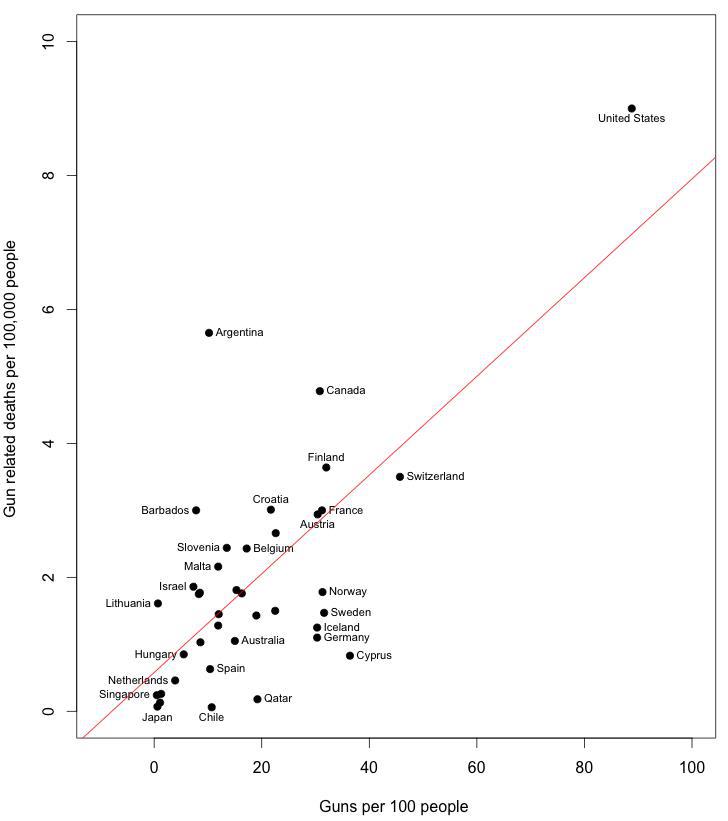
USA compared to other western countries (the most fair way to compare)

Comparing an American state with other American states is of course not an honest way to make a proper analysis, since it’s not impossible to take guns across the boarders or get hold of guns in other ways. Guns used for crimes in NY and other cities can in some cases be traced back to states with more liberal gun laws. In order to appear in a better light when it comes to the comparison with other nations, it’s common that Americans against gun control would like to be compared with countries with even higher homicide rates, and that’s why they must go to infamous countries like Colombia, Venezuela and South Africa to look better. However, a more honest approach is of course to compare with those countries which are closest in culture, wealth, politics, etc. That’s why a comparison with Canada is interesting (but not perfect since it’s possible to take guns across the boarders there too), and other western countries. The below information is from Politifact Virginia, and the text is actually an attempt to HELP the US to appear in a better light! Still, the outcome is devastating for the USA and liberal gun laws.

The U.S. gun homicide rate is 20 times the combined rate of other western nations“. The number is based on a study of the homicide rates of wealthy nations in 2003, conducted by the UCLA School of Public Health. The report, published in 2010, uses data from the World Health Organization to compare gun-related homicide, gun-related suicide and unintentional and undetermined gun deaths for all ages and both sexes. Vital statistics from the U.S. were compared to those from 22 other high-income countries with populations over 1 million people who reported causes of mortality to WHO for 2003. Researchers relied on The World Bank’s definition of a high income  nation. In addition to the U.S., the study included Australia, Austria, Canada, Czech Republic, Finland, France, Germany, Hungary, Iceland, Italy, Japan, Luxembourg, Netherlands, New Zealand, Norway, Portugal, Slovakia, Spain, Sweden, United Kingdom (England and Wales), United Kingdom (Northern Ireland) and United Kingdom (Scotland). The rate of homicides with guns in the U.S. was 4.1 per 100,000 people; the same rate combining the 22 other countries was 0.2 per 100,000 in 2003. The rate of homicides using guns in the U.S. was 19.5 times the rate of the other countries.

Below is an attempt by the writers to change these stats to improve the scenario for the US, and they took the most favorable and updated stats for the US but not so with the other countries with stats mostly from 2009. They also chose to compare with NATO countries, and  by doing so they would also include countries that are NOT considered wealthy but actually rather poor (such as Bulgaria, Albania, Romania, etc) and by doing so of course the stats will improve.  But is it an honest comparison? For instance, in Bulgaria (in the east block of Europe) middle class people can’t afford to have the electricity on all day so it’s not in the same wealth bracket as western countries. Despite the attempt to improve the scenario for the US, the conclusion is still that the homicide rate in the USA TOWERS over other wealthy European nations: 

The most recent gun-related homicide rate for the U.S. was 3.0 per 100,000 compared to an 0.3 for the rest of the NATO nations. If you compare the most recent data on the same group of nations, mostly based on 2009 statistics, the U.S. gun homicide rate is 15 times higher than the other countries. The number fell to 10 times as high when we defined the inexact term of “western nations” as countries belonging to NATO. However, that gun homicide rates in the U.S. tower over those of other wealthy  European nations — holds up.

Wikipedia – Britainguns0

People who are desperate to find statistics that show that gun control doesn’t work search high and low, and lately the crime statistics in Britain have been in focus. Those against gun control certainly can’t use the charts for homicide rates as a basis of their reasoning (since those all speak heavily against them) so they have to look for other columns (not homicide). So they found poor Britain, but is it an honest approach make a fair comparison and judgment?

The UK and the USA actually have very close figures when it comes to “violent crime” rates, with the number for the UK slightly higher. The difference is of course that the UK has a considerably lower homicide rate than the USA, and the difference is HUGE! When studying statistics for Britain or any country, it’s important to understand what is behind the numbers. An affray is considered a violent crime in the UK, while in some other countries it will only be logged as such if a person is physically injured. While the UK ranks above South Africa for all violent crime, South Africans suffer more than 20,000 murders each year – compared with Britain’s 921 in 2007! Some crime cases are not reported at all in certain countries and not only the “poor” ones. For example, I saw an American documentary about a murder in Philadelphia where a man had raped several women and ended up also murdering one. The investigators discovered that the first rape was not reported due to the aim to improve the statistics for this particular police department, and it was very unfortunate since the follow-up rapes in the same area would have been easier to pin down to the rapist a lot sooner, and before he ended up murdering someone. It’s impossible to know how many other such cases there are for the USA and for other countries. That’s why the HOMICIDE RATE (rather than crime rates) is the best crime to compare with since this is the crime that countries are most likely to report. 

Below is what wikipedia says about the gun situation in the UK and since the data shows that gun control has done the UK a lot of good  (having one of the lowest homicide rates in the world is surely good) it’s a risk that pro-gunners will immediately scream that wikipedia is not a trustworthy source. But they think various youtube clips and information in cute Facebook pictures are reliable sources? Wikipedia might not always be correct whenever “opinions” are involved, but more trustworthy when it comes to boring facts with proper sources listed. That’s why it’s interesting reading. Interestingly Northern Ireland is the only part of the UK where owning firearms for protection is allowed, and it’s also the part with the highest homicide rate in the UK.

In the United Kingdom, firearms are tightly controlled by law—The United Kingdom has one of the lowest rates of gun homicides in the world. There were 0.07 recorded intentional homicides committed with a firearm per 100,000 inhabitants in 2010, compared to the 3.0 in the United States (over 40 times higher) and 0.21 in Germany (3 times higher).

Northern Ireland has a very high rate of gun ownership, one of the highest in the world. In contrast England and Wales have considerably lower rates and Scotland has the lowest in the United Kingdom. The gun crime rate rose between 1997 and 2004 but has since slightly receded, while the number of murders from gun crime has largely remained static over the past decade. Northern Ireland: Under the new law, first-time buyers will be required to demonstrate they can be trusted with the firearm. —  Northern Ireland is the only part of the United Kingdom where personal protection is accepted as a legitimate reason to obtain and own a firearm and is the only part of the United Kingdom where handguns and semi-automatic firearms are permitted. Also, carrying a firearm in plain view in a public place is allowed without a permit. However a firearm certificate for a personal protection weapon will only be authorised where the Police Service of Northern Ireland deems there is a ‘verifiable specific risk’ to the life of an individual and that the possession of a firearm is a reasonable, proportionate and necessary measure to protect their life.

A Home Office study published in 2007 reported that gun crime in England and Wales remained a relatively rare event. Firearms (including air guns) were used in 21,521 recorded crimes. It said that injury caused during a firearm offence was rare, with fewer than 3% of offences resulting in a serious or fatal injury.

For 2010/11, police in England and Wales recorded 648 offences as homicide, of which 58 (9%) involved the use of firearms — a rate of 0.1 illegal gun deaths per 100,000 of population. The number of homicides per year committed with firearms in England and Wales remained between 39 and 81 in the nine years to 2010/11, with an average of 58.3 per year. During the same time period, there were three fatal shootings of police officers in England and Wales, and 149 non-fatal shootings, an average of 16.5 per year. The overall homicide rates per 100,000 (regardless of weapon type) reported by the United Nations for 1999 were 4.55 for the U.S. and 1.45 in England and Wales. The homicide rate in England and Wales at the end of the 1990s was below the EU average, but the rates in Northern Ireland and Scotland were above the EU average.

Britain has had few firearms rampage incidents in modern times. During the latter half of the 20th century there were only two incidents in which people holding licensed firearms went on shooting sprees and killed on a large scale

A legislation was introduced in 1997 to prohibit “Small firearms” with a barrel length of less than 30 cm or an overall length of less than 60 cm. Whilst intentional firearm homicides did in fact eventually decline —homicides involving the class of firearms prohibited initially increased in the early years following the legislative change before commencing a downward trend in 2008. With an alternative view, in 2012 the Home Office reported that, “in 2010/11, firearms were involved in 11,227 recorded offences in England and Wales, the seventh consecutive annual fall”. Firearms statistics in England and Wales include airguns and imitation guns, which make up a high proportion of these recorded offences.

Fully automatic (submachine-guns, etc.) are totally prohibited from private ownership and self-loading (semi-automatic) weapons, including shotguns and .22 calibre pistols, are totally banned other than in Northern Ireland. Shotgun possession and use is controlled, and even low-power air rifles and pistols, while permitted, are controlled to some extent. A firearms certificate issued by the police is required for all weapons and ammunition except air weapons of modest power (of muzzle energy not over 12 ft·lbf for rifles, and 6 ft·lbf for pistols).

Any person who has been sentenced to three years or more in prison is automatically banned for life from obtaining a firearms licence.[35] Similarly, persons applying for licences with recent, serious mental health issues will also be refused a certificate. Any person holding a Firearm or Shotgun Certificate must comply with strict conditions regarding such things as safe storage. These storage arrangements are checked by the police before a licence is first granted, and on every renewal of the licence. A local police force may impose additional conditions on possession, over and above those set out by law. The penalty for possession of a prohibited firearm (section 5) without a certificate is a maximum of ten years in prison and an unlimited fine.  

From the 6 April 2007 the sale and transfer of “air weapons” by mail order became an offence (they may still be purchased in person), as well as the sale of primers, and realistic imitation firearms (RIFs).

While the number of crimes involving firearms in England and Wales increased from 13,874 in 1998/99 to 24,070 in 2002/03, they remained relatively static at 24,094 in 2003/04, and fell to 21,521 in 2005/06. The latter includes 3,275 crimes involving imitation firearms and 10,437 involving air weapons, compared to 566 and 8,665 respectively in 1998/99. Only those “firearms” positively identified as being imitations or air weapons (e.g., by being recovered by the police or by being fired) are classed as such, so the actual numbers are likely significantly higher. In 2005/06, 8,978 of the total of 21,521 firearms crimes (42%) were for criminal damage.

Most of the rise in injuries were in the category slight injuries from the non-air weapons. “Slight” in this context means an injury that was not classified as “serious” (i.e., did not require detention in hospital, did not involve fractures, concussion, severe general shock, penetration by a bullet or multiple shot wounds). In 2005/06, 87% of such injuries were defined as “slight,” which includes the use of firearms as a threat only.

In 2008 The Independent reported that there were 42 gun-related deaths in Great Britain, a 20-year low. However, in late 2009 The Telegraph reported that gun crime had doubled in the last 10 years, with an increase in both firearms offences and deaths. A government spokesman said this increase was a result of a change in reporting practices in 2001 and that gun crime had actually fallen since 2005.—A 2006 statistical analysis found no measurable effect detectable from the 1997 firearms legislation.

In the year Apr 2010 to Mar 2011 there were 11,227 recorded offences involving firearms, broken down as follows.

  • Long-barrelled shotgun = 406
  • Sawn-off shotgun = 202
  • Handgun = 3,105
  • Rifle = 74
  • Imitation firearm = 1,610
  • Unidentified firearm = 957
  • Other firearm = 670
  • Air weapons = 4,203

Only those items proven to be “imitations” (which includes BB/soft air types) or air weapons are classed as such, otherwise they are placed by default in the main “live” categories, e.g. an imitation pistol not proven to be such would be counted as a live “handgun.” “Other firearm” includes CS gas (223 crimes), pepper spray (118), and stun guns (149).

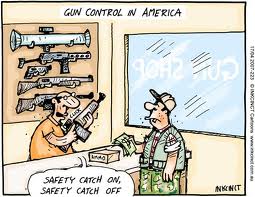
Gun comic 4

Calvinism is man-centered, and elect individuals have reasons to be proud

proudDue to my concern for christians trapped in Calvinism (and others who are at risk), I include the below text parts from Jesse Morell. I believe that the doctrines within Calvinism unfortunately and inevitably encourage christians to remain in their sins, but that doesn’t mean that I believe that all who call themselves calvinists must be major sinners. Still, the doctrines are dangerous (which all gnostic teachings are) and must be exposed in order to save souls. If we love each other, we would like to help each other on the right track. 

Calvinism is totally man centered. “I am saved by nothing I do,” “I cannot be lost by anything I do,” etc. It is all centered on man being saved no matter what. It gives religious sinners eternal security. It itches their ears. There is no choice of total repentance from all sin required, just believing. There is no necessity to labor and run and persevere unto the end. There is no threat of going to hell through sinning. It itches the ears of those who want this man-centered gospel. You don’t have to love God supremely. You don’t have to totally commit yourself to God. You can live in compromise and sin every day in word, thought, and deed, and still be saved. Calvinism doesn’t glorify God, it comforts religious sinners and in doing so it dishonors God. 

Which system really glorifies God? The one which says God is the ultimate cause of sin and that men do not need to stop all their sinning, or the one that says each individual is the cause of their own sin and we must all repent of our sins and live holy lives glorifiying to God? Which doctrine of grace really glorifies God? The one that says grace means being saved while we continue to sin, or grace is the means of being saved from our sin? One of these systems glorifies God while the other system greatly dishonors Him. What of the Westminster Catechism that says no man is able, either of his own power or by any grace received in this life, to perfectly keep the commandments, but does daily break them in word, thought, and deed…? Well, that covers all the bases. I mean, the devil couldn’t do any worse than that. That excuses all sin, of any kind. Calvinism certainly does make “a broad stroke that intentionally misunderstands and maligns Christ.” How man-centered is this theology! Now, the power of man’s sin is even greater than the power of God’s grace! God’s grace cannot overcome man’s sin! Wow, talk about a man-centered sin-excusing theology.

Glorification is the perfection of the body. Sanctification is the perfection of the heart. We are not commanded to be glorified in this life. This is not an obligation. We are not sinful for failing to have glorified bodies. Even Jesus did not have a glorified body until after the resurrection. But we can sanctify ourselves to God. We can set ourselves apart from the service of sin to the service of God.

We are not born with a sinful nature

We are born into a sinful world, but sin itself is a choice of our own will. You are not born a homosexual, drunkard, etc. That is choice. Paul said sinners will be “without excuse” on Judgment Day. They cannot say, like Lady GaGa, “I was born this way.” God forms our nature in the womb and He does not form us as little sinners. We become sinners at the age of accountability, by our own free will. As the Bible says men are sinners “from their youth” which means “juvenile” not infant.

“I will praise thee; for I am fearfully and wonderfully made: marvellous are thy works; and that my soul knoweth right well.” Ps. 139:14. We are not guilty of the sin of Adam: “The soul that sinneth, it shall die. The son shall not bear the iniquity of the father, neither shall the father bear the iniquity of the son: the righteousness of the righteous shall be upon him, and the wickedness of the wicked shall be upon him.” Eze. 18:20 We are commanded to sanctify ourselves: “Sanctify yourselves therefore, and be ye holy: for I am the LORD your God.” Lev. 20:7. This verse is quoted in the New Testament as well. Jesus can forgive us and cleanse us, not from some sin, but from all sin: “If we confess our sins, he is faithful and just to forgive us our sins, and to cleanse us from all unrighteousness.” I Jn. 1:9. Just read the rest of 1 John. He that sins is of the devil. Whosoever has been born of God does not commit sin. Etc. The Word says that the grace of God that brings salvation teaches us to live free from sin in this life. Our fallen bodies do not make us sin, so we don’t need a new body to be free from sin. Romans 6 says Jesus sets us free from sin in this life. Hebrews says Jesus was made in all things liken unto his brethren.

Jesus did not have a sinful nature, so neither did we. Jesus lived a holy and sinless life and Jesus said come and follow me and He is our example to follow. If we sin after our initial conversion, we must repent or perish as Jesus taught his disciples. We never have to sin, as God never allows us to be tempted above our ability (1 Cor. 10:13). To say that we can never life free from all sin in this life is to make the power of sin greater than the power of the cross and greater than the power of God’s grace. Certainly, we still have a free will after conversion so we are still capable of sinning. But with the help of God’s grace, we can choose to overcome and persevere. Men are sinners by choice, as the Bible says all we like sheep have gone astray and turned to our own way. And therefore, we can cease to be sinners by choice. Hence, God’s command for us to repent and His appeals of grace. We cannot have glorified bodies in this life, and so we have not attained physical perfection. That comes after our race is done. But we can have sanctified bodies in this life, as Paul said we can yield our members as instruments of righteousness, present our bodies a living sacrifice, that God can sanctify us wholly spirit soul and body, etc.

Certainly we are not forgiven before we repent, and if we sin God clearly sees it. But when we think upon what Jesus Christ has done to make forgiveness available for us and for everyone, we should love Him and turn from all our sins as a consequence. Once we do that, God forgives us through Christ. Calvary makes us willing to do what creation made us capable of doing. And what the law could not do, the gospel was able to accomplish. Legal motives of self-interest were insufficient to perfect the heart, but the motives presented to us in the gospel of Jesus Christ can cleanse us from all sin. Every day we make the choice to sin or not, and certainly our salvation depends upon our perseverance in holiness, but when we look upon the cross and see how much God has loved this world, we see how worthy He is of our worship and service and we love Him in return with our obedience.

Romans chapter seven

Rom. 7 gives us a description of what occurs when the mind of an unconverted sinner is convicted by the law. Using a literary technique, Paul uses the present tense to tell the narrative. As many stories begin with “once upon a time,” Paul said, “For I was alive without the law once, but when the commandment came, sin revived, and I died” (Rom. 7:9). He then proceeded in his narrative to discuss what happens when an unconverted sinner encounters the law of God. Some suppose Romans chapter seven to be a description of the Christian life, as opposed to a description of an unconverted state. But we know Paul is not referring to his own converted state because he already said that Christians have been made “free from sin” (Rom. 6:18, 22). The man in Romans seven was not “free from sin” and, therefore, he was not a Christian. Paul also said that, “There is now no condemnation to them which are in Christ Jesus, who walk not after the flesh, but after the Spirit” (Rom. 8:1). Yet the man in Romans chapter seven was under condemnation and therefore needed to be saved by Jesus (Rom. 7:24-25).

And Paul said that, “to be carnally minded is death” (Rom. 8:6). But the man in Romans chapter seven said, “I am carnal, sold under sin” (Rom. 7:14). Therefore, the man in Romans chapter seven did not have eternal life. And finally, Paul said that as a converted man he lived with a good and pure conscience that was void of offense (Acts 23:1; Acts 24:16; 2 Tim. 1:3). The man described in Romans chapter seven is deeply disturbed by his conscience (Rom. 7:16). Therefore, the description given in Romans chapter seven was not of the converted life of the Apostle Paul. It is a narration describing what happens when an unconverted sinner’s mind encounters the law of God and is convicted by it.

So it is a sin to inherit a weakness to commit sin? How is that a sin? chosen

  • Jesus died for everyone, but only those who repent and believe are forgiven through it. So if a believer sins, they must repent and ask God for forgiveness.
  •  Forgiveness of future sins is nothing more than a license to sin. God only forgives us of our sins after we have repented of them. And since we are not yet guilty of future sins, we have nothing to be forgiven us. Not only would forgiveness of future sins be unwise, it is also impossible. Sins must be dealt with as they occur. Hence what we read in 1 John 1:8-9. If a believer sins, we must repent or perish.
1. How can David say he was wonderfully made and God’s works are marvelous if God formed him in the womb with a sinful nature?
2. How can it be said that Jesus was made “in all things liken unto his brethren” if we are born with a sinful nature and he wasn’t?
3. How come our sanctification is spoken of in the same tense as our justification?
4. How can inheriting a weakeness to commit sin be a sin itself?
5. If we are forgiven of all future sins at conversion, have you ever asked God to forgive you since your conversion? If you were already forgiven, why do you insult his grace by asking for forgiveness?
6. What would a license to sin consist of, if not forgiveness of unrepented future sins? What is a license but permission to do an action without fear of legal prosecution?
7. If Romans 7 was Paul’s Christian life, how can he say that he lived with a conscience void of offense?

.
We were not capable of sinning before the age of accountability, as Jesus said if you were blind you would have no sin. Infants are not under the wrath of God, as the wrath of God comes upon those who suppress the truth in unrighteousness. Those with knowledge are without excuse, but as infants have no moral knowledge, they are with excuse for their behavior. As they grow, they make free will choices. Hence we are told to teach them, disciple them, etc. If their nature caused their actions, teaching them would be useless and discipline would be cruelty and pointless. Only if their free will makes their choices can teaching and disciple change their behavior.

The perfection that God requires is a perfection that we are capable of. It is purity of motive – a perfection of heart. The Bible commands us to love God and love our neighbor. The Bible speaks of men who were “perfect in heart” which shows it is possible for man in this life. The commandment is directly proportationate to our ability, as we are command to love God “with all” thy ability and love your neighbor “as yourself.” We are not commanded to love with more ability than we have, but with all the ability that we have. So it is not impossible. If it were impossible, God’s law would be unreasonable and unjust. Damnation would be infinite cruelty. But as God is just and as He does punish sinners, this shows that they were capable of avoiding their sin

Which is greater, the power of sin or the power of the cross and the grace of God?

If the power of the cross is greater than the power of sin, why can’t you stop sinning? Does not the cross make you love God? And if you love Him, you will obey Him. When you are tempted, just look at the cross. Put your faith in God and you will overcome sin.  As love is the fulfillment of the law – a complete satisfaction to our moral obligation. Love is perfection. God does not want us to have an imaginary holiness but an actual holiness. The Bible never says that Christ’s works of the law are imputed to us. That is not necessary as we are not justified by works of the law. The “imputed righteousness of Christ” is a cliche and a myth. If you sin, God see’s it. Nothing is hide from His eyes the Bible says. He says, “I know your works, be zealous therefore and repent.” Don’t dream that you are covered by the imputed righteousness of Christ while you continue to sin, thus making his work a license to sin. Rather, repent of your sins and then you will be pardoned by His grace and mercy.

Paul taught that we were not under the law, as in the Torah, but not that we were free from all moral obligation. As Paul said we are obligated to love God and love our neighbor. God is not an anarchist or an antinomian. He does not promote lawlessness. As Paul said, not without law to God but under the law of Christ.

God does not impute our trespasses to us when He forgives us and pardons us. This is conditional upon our repentance and faith. Holiness, in terms of the Christian, is an internal attitude of submission and obedience whereby we are set apart from sin and to the service of God. And Jesus not only saves our souls, He changes our lives. He is not only our justification, He is also our sanctification.  Justification by works of the law is impossible. Obedience cannot atone for past disobedience. Hence, we need gracious justification. God can declare us pardoned. He commands us to repent and believe and when we are converted He pardons all our past trespasses through the atonement of Christ.

“By nature children of wrath” in context is about how we previously lived a sinful lifestyle. The Greek word for nature in that passage can mean that which by long habit has become nature, according to Thayer which is one of the best Greek-English Lexicon available. The Bible also says that the Gentiles which have not the law, do by nature the things contained in the law, which show the work of the law written on their hearts, their conscience bearing witness. Doesn’t sound like they were born totally depraved with a sinful nature. Conscience is part of our nature, and it tells us to obey God.

The Bible is clear that Jesus died for everyone but not everyone is saved because not everyone repents and believes. It is possible for those for whom Christ died to perish. As Paul said you can cause a brother to perish for whom Christ died. And you can deny the Lord who bought you and bring upon yourself swift destruction.

The atonement does not give us a license to sin or make salvation automatic for anyone. Pardon through the atonement is conditional. The Bible says repent, believe, and persevere unto the end. If we fail any of those points, we cannot expect God’s mercy but His wrath. Jesus said He that perseveres unto the end shall be saved. That speaks of salvation in the future tense. There are others passages that speak of it as past and present. I am saved. I am being saved. And I will be saved. The Bible says eternal life is to know God. And it says by this we know that we know Him, if we keep His commandments. He that says I know Him and keeps not His commandments is a liar and the truth is not in Him. So those who are obedient to God have eternal life and those who are disobedient do not. As it is written, He is the author of eternal salvation unto all them that obey Him.

He tasted death for EVERY man it says. He is the propitiation, not only for our sins, but for the sins of the WHOLE world. Just as the serpent was lifted up for WHOSOEVER to be saved through it, so God so loved the world that He gave His only begotten Son that WHOSOEVER believeth in Him would be saved, etc. There is no limited atonement in the foreshadow sacrifices.

People attack biblical holiness and the born again experience as self-righteousness and confuse biblical repentance with justification by works of the law. If a person is living in sin, aka sinning every day in word, thought, and deed, than it should be obviously that they haven’t put their faith in Christ. If they had confidence in His character and trusted Him they would do whatever He asks. As Hebrews 11 says by faith Abraham obeyed. Abraham was justified by an obedient faith, or a faith that resulted in obedience. What sins do you have in your life that you cannot stop? What sins do you have in your life that Christ cannot set you free from? Or really, what sin do you have in your life that you are unwilling to repent of?

Obedience can never atone for disobedience

We could never make up for our sins by obedience and we could never earn or merit salvation. It must come by grace and mercy through Jesus Christ. But it is conditional. We must repent and believe to receive it. I say that we must repent and believe (obedience to the gospel) but that our obedience to the gospel does not merit or earn salvation. “By faith Abraham…obeyed” Hebrews 11:8. Abraham was justified by an obedient faith. There is a difference between conditions and grounds. Our obedience to the gospel is not the grounds of our salvation. It does not merit or earn salvation. Peter said, “repent of this thy wickedness that the thought of your heart might be forgiven thee” and “save yourselves from this untoward generation. Was Peter teaching heresy by telling them to save themselves? Certainly not. Repentance is a condition of forgiveness. We can only save ourselves, through the atonement of Christ, by repenting and believing.

Justification by works of the law is regarding the Torah and merit. It is not about repenting of your sins to be pardoned by grace and mercy. We do not need to obey the law (Torah) to be saved. But we must obey the gospel, which demands that we repent of our sins and trust in Christ. If good works are the evidence of faith, then bad works are the evidence of unbelief. There is no condemnation for those who walk after the spirit and not after the flesh. If you are living in sin, aka walking after the flesh, there is condemnation.  By faith you can live a pure and holy life. By faith you can overcome all sin and be perfect in heart. The same faith that justifies also sanctifies. Under the New Covenant we are not under obligation to the Torah, but only to the moral law of God. The New Testament does not command us to be circumcised, but to love God and love our neighbor.

“But when I saw that they walked not uprightly according to the truth of the gospel, I said unto Peter before them all, If thou, being a Jew, livest after the manner of Gentiles, and not as do the Jews, why compellest thou the Gentiles to live as do the Jews?” Gal. 2:14

“To them that are without law, as without law, (being not without law to God, but under the law to Christ,) that I might gain them that are without law.” 1 Cor. 9:21.

We are not under the law of Moses, but under the law of Christ.

“For the priesthood being changed, there is made of necessity a change also of the law.” Heb. 7:12.

“For the law having a shadow of good things to come, and not the very image of the things” Heb. 10:1.

The external and physical laws of the Old Covenant, like the clean and unclean food, circumcision, etc, were figurative of the internal and moral change that occurs under the New Covenant. Thus, the New Covenant fulfills the Old Covenant. These Old Covenant laws were figurative, but in the New Covenant that which is better has come. Hence,

“This is the covenant that I will make with them after those days, saith the Lord, I will put my laws into their hearts, and in their minds will I write them;” Heb. 10:16.

You can read more from Jesse Morell on his website.

“Any theology that gives man a legitimate excuse for sin and maligns God’s holy character CANNOT, by definition be ‘God centered'”  (Kerrigan Skelly)

SABBATH DAY on Saturday or Sunday doesn’t matter

The Sabbath Day was part of the Israeli Covenant, but we are now living under the New Testament, and it’s faith and baptism that are the major signs for a follower of Jesus.

I think the best explanation for the need of a day of rest is found in Exodus 22. God created the heavens and the earth in six days for a reason, and that’s because he wanted to make it as a foundation for us – as a life pattern when it comes to work and rest. We should take the original creation week as an example to follow in our every day lives. If we didn’t have this work-6-days-and-rest-1-day-pattern, there is a risk we would work and struggle all days alike, especially if we would notice that “everyone else does it so why should I be any different? I don’t want to come across as lazy”.

Exodus 22:Remember the sabbath day, to keep it holy.Six days shalt thou labour, and do all thy work:10 But the seventh day is the sabbath of the Lord thy God: in it thou shalt not do any work, thou, nor thy son, nor thy daughter, thy manservant, nor thy maidservant, nor thy cattle, nor thy stranger that is within thy gates:11 For in six days the Lord made heaven and earth, the sea, and all that in them is, and rested the seventh day: wherefore the Lord blessed the sabbath day, and hallowed it.

The Sabbath was to be a sign between God and the children of Israel in the old testament, and it was very serious to break the law of the Sabbath. The death penalty applied! This might sound harsh for us today, but we must remember that the Israelites were supposed to mirror God’s light also unto the gentiles so if God would look between his fingers when it came to breaking his law all other people would get the message that it’s not a big deal whether to obey the God of Israel or not.

Exodus 12:Seven days shall ye eat unleavened bread; even the first day ye shall put away leaven out of your houses: for whosoever eateth leavened bread from the first day until the seventh day, that soul shall be cut off from Israel.16 And in the first day there shall be an holy convocation, and in the seventh day there shall be an holy convocation to you; no manner of work shall be done in them, save that which every man must eat, that only may be done of you.17 And ye shall observe the feast of unleavened bread; for in this selfsame day have I brought your armies out of the land of Egypt: therefore shall ye observe this day in your generations by an ordinance for ever.

Exodus 31:13 Speak thou also UNTO THE CHILDREN OF ISRAEL, saying, Verily my sabbaths ye shall keep: for it is a sign between me and you throughout your generations; that ye may know that I am the Lord that doth sanctify you. 14 Ye shall keep the sabbath therefore; for it is holy unto you: every one that defileth it shall surely be put to death: for whosoever doeth any work therein, that soul shall be cut off from among his people.15 Six days may work be done; but in the seventh is the sabbath of rest, holy to the Lord: whosoever doeth any work in the sabbath day, he shall surely be put to death.16 Wherefore the children of Israel shall keep the sabbath, to observe the sabbath throughout their generations, for a perpetual covenant.17 IT IS A SIGN BETWEEN ME AND THE CHILDREN OF ISRAEL FOR EVER: for in six days the Lord made heaven and earth, and on the seventh day he rested, and was refreshed.

The Jewish custom was, and still is today, to observe the Sabbath day on Saturday. There are also many references in the book of Acts about the early Christian church meeting together on a Saturday to pray and study the Scriptures, like in Acts 13:13-14, 16:13 and 17:2. Every mention of the Sabbath in the book of Acts are always in connection with Jewish worship on that day. Paul constantly went to the temple to preach (sometimes he was accepted and sometimes he was thrown out) and it was his strategy to try to reach the Jews in their own community where they were to be found. Peter said:

Acts 15:21 For Moses of old time hath in every city them that preach him, being read in the synagogues every sabbath day.

It’s possible that the first christians continued meeting on Saturdays (the Sabbath) the first few years since this is what they did as jews, but some believe the early church began meeting on Sundays soon after Christ rose from the dead in honor of the Lord’s resurrection – which took place on a Sunday (or the first day of the week). Many other divine events also happened on a Sunday. After Jesus’ resurrection whenever he met with his disciples and where the day is identified, it is never on the Sabbath but always the first day of the week!Others see the change to meet up on Sundays as a gradual progression over the course of history. Christian groups that adhere to a Sunday worship feel that the Lord’s command was not specifically for the seventh day but rather one day out of the seven week days (which would also make it the 7th day after six days of work). By focusing on worship on Sunday (what many refer to as “the Lord’s Day”) instead of Saturday, could symbolically represent the acceptance of Christ as Messiah and his broadening blessing and redemption from the Jews to the entire world. That’s not really a sinful reason to highlight Sunday instead of Saturday.

In Russian the word for Sunday is Воскресенье (Voskreseniye) which means“Resurrection”. In other Slavic languages the word means “no work”, for example Polish: Niedziela, Belorussian: Нядзеля, Croatian: Nedjelja, Serbian and Slovenian: Nedelja, Czech: Neděle,Bulgarian: Неделя. The Modern Greek word for Sunday, Κυριακή, derives from Κύριος (Lord) also, due to its liturgical significance as the day commemorating the resurrection of Jesus Christ, i.e.The Lord’s Day. (Wikipedia)

Acts 2:46 tells us that from the start, the church in Jerusalem met every day in the temple (that’s also where the jews were) and gathered to break bread together in private homes:

Acts. 2:46 And they, continuing daily with one accord in the temple, and breaking bread from house to house, did eat their meat with gladness and singleness of heart,47 Praising God, and having favour with all the people. And the Lord added to the church daily such as should be saved.

Paul instructs the churches to meet together on the first day of the week (Sunday) to give offerings. Traditionally Sunday has always been considered as the first day of the week. If they met up to make such collections, why not take the chance to worship during the same occasion since they were all gathered together? If Saturday was considered THE day of worship, wouldn’t it make more sense for Paul to make a collection during this day since the christians were already gathered?:

1 Cor. 16: 1 Now concerning the collection for the saints, as I have given order to the churches of Galatia, even so do ye.Upon the first day of the week let every one of you lay by him in store, as God hath prospered him, that there be no gatherings when I come.

When Paul met with believers in Troas to worship, preach to them and break bread with them, they gathered on the first day of the week:

Acts 20:And upon the first day of the week, when the disciples came together to break bread, Paul preached unto them, ready to depart on the morrow; and continued his speech until midnight.And there were many lights in the upper chamber, where they were gathered together

Jesus explains that the Sabbath is made for man and not man for the sabbath. This could mean that the disciples shouldn’t view the Sabbath day as an obstacle for them but rather arrange their lives in such a way so that they could honor it without having to feel it makes things difficult for them and is a burden in their lives. Today we should approach the day of rest wisely and avoid falling into any ditch. The Apostle John refers to the Lord’s Day (“kuriake hemera“) in Rev. 1:10. “Kuriake“, meaning “Lord’s,” later became the Greek word for Sunday.  Jesus claimed to be the Lord of the Sabbath, and that day fell on the seventh day. The majority of Christians observe Sunday as the Lord’s day:

Mark 2:23 And it came to pass, that he went through the corn fields on the sabbath day; and his disciples began, as they went, to pluck the ears of corn.24 And the Pharisees said unto him, Behold, why do they on the sabbath day that which is not lawful?25 And he said unto them, Have ye never read what David did, when he had need, and was an hungred, he, and they that were with him?26 How he went into the house of God in the days of Abiathar the high priest, and did eat the shewbread, which is not lawful to eat but for the priests, and gave also to them which were with him?27 And he said unto them, The sabbath was made for man, and not man for the sabbath:28 Therefore the Son of man is Lord also of the sabbath.

We are not bound by a certain day
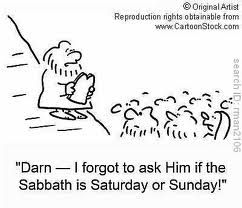
Jesus is the fulfilling of the Old Sabbath and our rest is in Him. We now commit to that rest as we continue in the faith.

Romans 14 shows that there is personal freedom regarding the observance of holy days. Some might suggest that this passage is only about FOOD, but I wouldn’t be too sure about that. Paul starts off warning about “doubtful disputations” and that seems to be the core of his argument. He provides the subject of food as his first example of where disputations might occur, and his point is that we should not judge each concerning minor issues such as meat or fasting but let God be the judge. Paul says in Rom. 14:3 that those who eat meat are not better or worse than those who do not eat meat (so judging is out-of-place), but in 1 Cor 8 he has a slightly different point because there he explains that our conduct can affect other people’s spiritual safety. So we should still think about our behavior so we won’t cause others to fall:

1 Cor. 8:8 But meat commendeth us not to God: for neither, if we eat, are we the better; neither, if we eat not, are we the worse.But take heed lest by any means this liberty of yours become a stumblingblock to them that are weak.10 For if any man see thee which hast knowledge sit at meat in the idol’s temple, shall not the conscience of him which is weak be emboldened to eat those things which are offered to idols;11 And through thy knowledge shall the weak brother perish, for whom Christ died?12 But when ye sin so against the brethren, and wound their weak conscience, ye sin against Christ.13 Wherefore, if meat make my brother to offend, I will eat no flesh while the world standeth, lest I make my brother to offend.

In Rom. 5 Paul proceeds with his second example when it comes to “doubtful disputations” and brings up the way we regard “days”:

Rom. 14:4 Who art thou that judgest another man’s servant? to his own master he standeth or falleth. Yea, he shall be holden up: for God is able to make him stand. One man esteemeth one day above another: another esteemeth every day alike. Let every man be fully persuaded in his own mind.He that regardeth the day, regardeth it unto the Lord; and he that regardeth not the day, to the Lord he doth not regard it. He that eateth, eateth to the Lord, for he giveth God thanks; and he that eateth not, to the Lord he eateth not, and giveth God thanks.

His point is still that we should not judge each other concerning minor issues:

Rom. 14:For to this end Christ both died, and rose, and revived, that he might be Lord both of the dead and living.10 But why dost thou judge thy brother? or why dost thou set at nought thy brother? for we shall all stand before the judgment seat of Christ.

Also in Col. 2 Christians are instructed not to judge each other regarding the Sabbath days. This might suggest the early christians had already been judged for their different observances of Sabbath and festivals.

Col. 2:16 Let no man therefore judge you in meat, or in drink, or in respect of an holyday, or of the new moon, or of the sabbath days:17 Which are a shadow of things to come; but the body is of Christ.

This covers:

• days (weekly Sabbaths, corresponding to “Sabbath days”)
• months (new moons, corresponding to “a new moon”)
• seasons (the 7 feasts, corresponding to “festivals”)
• and years (the sabbatical year and the 50th year of Jubilee)

In Galatians 4, Paul is concerned about Christians who are turning back like slaves to legalistic observances of special days:

Gal. 4:But now, after that ye have known God, or rather are known of God, how turn ye again to the weak and beggarly elements, whereunto ye desire again to be in bondage?10 Ye observe days, and months, and times, and years.11 I am afraid of you, lest I have bestowed upon you labour in vain.

We should be “fully convinced” that whichever day we choose is the right day for us to set aside as a day of worship, and we should not judge or allow anyone to judge us regarding our choice.

How important is Sabbath TODAY?
A person who is born today (2012) will notice when he grows up that SUNDAY is the day when christians normally meet for worship. That’s the case in Scandinavia, the rest of Europe and throughout the whole world – with a few exceptions. So the vast majority of christians. Can we really require that this person must study church history (to find out that we are supposed to celebrate Sabbath on a Saturday) in order to get essential knowledge about Jesus Christ?! This person might not even like to read books, and particularly not about church history and about how jews and christians celebrated the Sabbath 2,000 years ago. One would think that Jesus would have offered us some light in the matter if it was so important to get the days straight, but the main memory we have about Jesus in relation to the Sabbath day is that he broke it. We DO know that it’s important to assemble together with other christians and to live holy! Is it EXTREMELY IMPORTANT that we try to make the christian world start worshiping on Saturdays instead of Sundays, and why? Who is the one getting annoyed when we listen to the exact same sermon on a Sunday instead of Saturday? Paul helped us in his letters by providing us instructions for how to behave in church, but he didn’t mention that there is a particular day that we must meet on.

There are many countries and cities where christians are scarce and that means that there are not that many churches to choose between for worship and fellowship. We can only select among the best churches available. If you insist on that Saturday is THE day to celebrate a Sabbath, then you can of course try to contact the pastor in a church and ask him if he would consider persuading the elders to have church services on Saturdays instead of Sundays. I doubt you will succeed though! And if you have not succeeded, and if there are no other churches available, will you stay home alone? And how Biblical is THAT (to stay away from meetings with other christians)?

When we try to find the best church available in our area, is the question of the Sabbath really that important? Isn’t it more important to investigate what the pastors teach in the church (whenever they do teach), and if the pastors highlight repentance, salvation in Jesus Christ, the blood on the cross, the importance to make other disciples, the spiritual gifts, righteousness, etc? It’s also important to avoid churches which don’t have the Bible as their solid foundation but base their teachings on a person. Of course pastors are bound to color Bible texts with their own understanding (this is what preaching entails), but if they use other scriptures or texts apart from the Bible then we must be on our guard. I’m of course not saying it’s wrong to bring up wise words (or entire sermons) from other christians who have gone before them as long as they are Biblical, but I’m only warning about false prophets who bring in heresy into church and possibly also division.

Society looks completely different today than it did 2,000 years ago. Today it’s common for a family to have both parents working full-time and at a good stretch from home, and that means they might very well be away from home about 11 hours/day (including lunch hour and time for commuting). On top of this they might have to pick up their kids from the daycare center before hurrying home to fix dinner (using groceries that perhaps someone else in the family had time to buy after his/her work or school). For most people they have no option to get an alternative life style since the job that are offered are full-time or no time, and they do need to get a salary to get food on the table and to pay taxes. Needless to say, that when Saturday finally arrives they are very tired and prefer to sleep in late, clean the house, wash clothes, visit parents/relatives and spend some time with the kids. Some also take the chance to go shopping on Saturday, believing Sunday is the day of rest and a day which should not be used for shopping. This mean that they are better prepared in all sorts of way for a worship together with other christians on Sunday, and they might even feel like bringing friends home after the church service because the house is in order after a week’s mess. Had the day of special worship been on a Saturday it could tempt weak christians to stay home from church altogether. Again, Sabbath is made for man and not the other way around. If a village that is blessed to have a church (meaning they have a group of christians in this village), and the church has an arrangement that works very well among them and which isn’t against the Bible in any way, then why not keep it that way?

Can we blame Constantine for that we worship on Sundays?

Constantine is oft blamed for various things, such as the idea that we believe in the trinity due to him, but the change of day was not instituted by him or the pope centuries after the apostles nor was it made to replace the Sabbath day. Some Sabbatarians particularly have the council of Laodicea in mind, held in 364 A.D.  There is much historical evidence to show Sunday worship was a universal practice of all the churches outside the land of Israel by the beginning of the 2nd century. What did take place at that Council was an anti-semitic move to make it illegal for christians to worship on Saturday. There were thousands of christians already worshiping on Sundays. 

“Anti-Judaism played its part in second-century Christian polemic against Jewish Sabbath observance, but it does not follow that it motivated the introduction of Christian Sunday worship. For we have already argued that Sunday worship dates back to the first century, while few second-century writers compare and contrast the Jewish Sabbath and the Christian Sunday. Derogatory discussions of the Jewish Sabbath do not usually refer to the Christian Sunday. If Sunday were a recent substitute for the Jewish Sabbath, we should expect far more discussion of the superiority of Sunday to the Sabbath.” R. J. Bauckham, From Sabbath to Lord’s Day, p. 271, edited by D.A. Carson.

The old church fathers also promoted worship on a Sunday

Philip Schaff (a noted historian) writes in the Schaff- Herzog Encyclopedia of religious knowledge 1891 Ed., vol.4 Article on Sunday.

“Sunday… was adopted by the early Christians as a day of worship.. . Sunday was emphatically the weekly feast of the resurrection of Christ, as the Jewish Sabbath was the feast of creation. It was called the Lords day, and upon it the primitive church assembled to break bread. No regulations for its observance are laid down in the new testament nor, indeed, is its observance even enjoined. Yet Christian feeling led to the universal adoption of the day, in imitation of the apostolic precedence. In the second century its observance was universal.

In other words these meetings were not to replace the Sabbath but held as a whole new day. There is a view that the Sabbath commemorated a finished creation with rest and the first day commemorates a finished redemption and a new work. The Sabbath is then a day of rest and quiet and the first day is a day of worship and praise. Sabbath means rest, not Saturday.The New Testament Church saw Sunday not as the substitute and replacement for the Jewish Sabbath.  Sunday was not seen as a modification or as a new Sabbath, but as a day that stood on its own merits having its own meaning.

The epistle of Ignatius, AD 107

“Be not deceived with strange doctrines, nor with old fables, which are unprofitable. For if we still live according to the Jewish Law, we acknowledge that we have not received grace….If, therefore, those who were brought up in the ancient order of things have come to the possession of a new hope, no longer observing the Sabbath, but living in the observance of the Lord’s Day, on which also our life has sprung up again by Him and By His death.”

Barnabas, 120 AD

“Wherefore, also, we keep the eighth day with joyfulness, the day, also, on which Jesus rose again from the dead”

The writings of Justin Martyr, AD 145-150 Justin’s ‘Apology’ was written at Rome about the year 140, only 44 years after the apostle John received the vision of The Revelation at Patmos. The Schaff-Herzog Encyclopedia of Religious Knowledge says this about Justin’s works:

“In these works Justin professes to present the system of doctrine held by all Christians and seeks to be orthodox on all points. The only difference he knows of as existing between Christians concerned the millennium. Thus Justin is an incontrovertible witness for the unity of the faith in the Church of his day, and the fact that the Gentile type of Christianity prevailed.” Quoted by Canright in The Compete Testimony of the Early Fathers, Fleming H. Revell, 1916, pp. 24-25.

NOTE: At this early date, AD 140, the only major difference among Christians was concerning the millennium. At that time they had no disagreement in keeping Sunday, and as you will see, Justin says that was the day on which all Christians worshipped.

In chapter 67 of his first Apology, entitled, “Weekly Worship of the Christians” writing to the pagan emperor, Justin states:

“…we bless the Maker of all through His Son Jesus Christ, and through the Holy Ghost. And on the day called Sunday, all who live in cities or in the country gather together to one place, and the memoirs of the apostles or the writings of the prophets are read, as long as time permits; then, when the reader has ceased, the president verbally instructs, and exhorts to the imitation of these good things. Then we all rise together and pray, and, as we before said, when our prayer is ended, bread and wine and water are brought…But Sunday is the day on which we all hold our common assembly, because it is the first day on which God, having wrought the change in the darkness and matter, made the world; and Jesus Christ our Savior on the same day rose from the dead.”The Ante-Nicene Fathers, Vol. 1, pp. 185-186 (emphasis added).

Didache, AD 80-90

“And on the day of our lords resurrection, which is the Lord’s day meet more diligently.”

Irenaeus, AD 155-202

“The Mystery of the Lord’s Resurrection may not be celebrated on any other day than the Lord’s Day, and on this alone should we observe the breaking off of the Paschal Feast.”

APOSTOLIC CONSTITUTIONS: Church life in the 2nd Century:

“On the day of the resurrection of the Lord–that is, the Lord’s Day–assemble yourself together without fail, giving thanks to God and praising Him for those mercies God has bestowed upon you through Christ.”

Dionysius, AD 170 Dionysius was Bishop of Corinth, the Church which Paul raised up and to which he gave the command about Sunday collections, in I Corinthians 16:1-2:

We passed this holy Lord’s Day, in which we read your letter, from the constant reading of which we shall be able to draw admonition.Eusebius, Ecclesiastical History, Bk. 4, Chapt. 23 

Clement of Alexandria, AD 194

“He, in fulfillment of the precept, keeps the Lord’s day when he abandons an evil disposition, and assumes that of the Gnostic, glorifying the Lord’s resurrection in himself” Book 7, Chapter 12

Ignatius, the third bishop of Antioch, AD 108:

“If, therefore, those who were brought up in the ancient order of things have come to the possession of a new hope, no longer observing the Sabbath, but living in the observance of the Lord’s Day, on which also our life has sprung up again by Him…Let us therefore no longer keep the Sabbath after the Jewish manner, and rejoice in days of idleness; for “he that does not work, let him not eat.”…let every friend of Christ keep the Lord’s day as a festival, the resurrection-day, the queen and chief of all the days [of the week]” “Epistle of Ignatius to the Magnesians,” The Ante-Nicene Fathers, vol. 1, pp. 62-63

Tertullian of Africa, AD 200: In his Apology, Chapter 16:

“We solemnize the day after Saturday in contradistinction to those who call this day their Sabbath, and devote it to ease and eating, deviating from the old Jewish customs, which they are now very ignorant of.”

Others, with greater regard to good manners, it must be confessed, suppose that the sun is the god of the Christian, because it is a well- known fact that we pray towards the east, or because we make Sunday a day of festivity” The Ante-Nicene Fathers, vol. 3, p. 123).

NOTE: The early church explained why they prayed toward the east. It was because, “as the lightning which lighteneth from the east and is seen even to the west, so shall the coming of the Son of man be:” that by this we might know and understand that He will appear from the east suddenly” Ancient Syriac Documents, The Ante- Nicene Fathers, vol. 8, p. 668.

Pliny’s letter, AD 107 Pliny was governor of Bithynia, in Asia Minor, from AD 106-108. He wrote in AD 107 to Trajan, the emperor, concerning the Christians:

“They were wont to meet together, on a stated day before it was light, and sing among themselves alternately a hymn to Christ as God….When these things were performed, it was their custom to separate and then to come together again to a meal which they ate in common without any disorder.”

All these quotes prove the Church held Sunday as a significant day long before any edict in the 300’s.

Does the Bible really teach that we should worship on Saturdays?
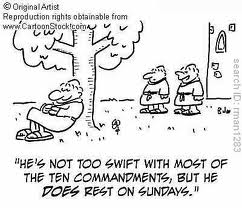
The day of the week to assemble should be the church’s choice, and many churches today have Saturday services as well as Sunday. The NT has no legislation for which day we are to assemble and history shows the early church chose Sunday because of its significance and not because they hated the Sabbath.

We can find 9 of the commandments from Ex.20:3-4 repeated in the New Testament but the 4thone is not. Maybe there is a reason for this. The Bible offers no command that we must assemble on the Sabbath (Saturday) for worship and there was absolutely no warning against Sunday worship.

At the Jerusalem council in Acts 15, dealing with how the Gentiles are to practice their Christianity, it does not mention the Sabbath. Paul states “for I testify again to every man that is circumcised, that he isa debtor to the whole law. (Gal.5:3) This can be substituted with any part of the Mosaic law; diet, clothing or the Sabbath.  James and Hebrews were written to the dispersed Israel, but they never refer to continue keeping the Sabbath day because even Jewish believers were not obligated. Peter exhorts the leadership of the Church not to place the Gentiles under the Law:

Acts 15:10 Now therefore why tempt ye God, to put a yoke upon the neck of the disciples, which neither our fathers nor we were able to bear?11 But we believe that through the grace of the Lord Jesus Christ we shall be saved, even as they

What some have done is use fear and devious manipulation to prove one is under the wrath of God by simply worshipping on a day apart from the Covenant given to Moses!

Acts 15:28 For it seemed good to the Holy Ghost, and to us, to lay upon you no greater burden than these necessary things;29 That ye abstain from meats offered to idols, and from blood, and from things strangled, and from fornication: from which if ye keep yourselves, ye shall do well. Fare ye well.

Note that the Holy Spirit told them NOT to lay upon the Gentiles any greater burden than those essentials. It seems like the Holy Spirit didn’t think Sabbath keeping was essential thing any more. If we are to believe that we need to keep the Sabbath  on Saturdays – just like they did in the OT – then the question is why we should pick and choose among the rules related to this special day, and why we should not also keep these instructions in mind:

-It was to be kept from sunset to sunset (Lev. 23:32)
-No burden was to be carried (Jer. 17:21)
-No fire kindled (Ex. 35:3)
-No Cooking done (Ex. 16:23)
-The penalty for doing any of these things during the Sabbath was DEATH (Numbers 15).

In the New Testament we are provided with lists of SINS that separate us from God and prevent us from entering his kingdom. These lists are often repeated. Nowhere is breaking the Sabbath listed as a sin that causes spiritual death.

If the Sabbath keeping is so important for a disciple of Christ, why didn’t Jesus or his apostles command Sabbath keeping?

We are often asked to find one verse in the Bible that shows the day of worship has been changed from Saturday to Sunday, but this is a moot point because it doesn’t matter what day you worship on.

It’s a choice to be CHILDREN OF WRATH – Ephesians 2

Children of wrath and God’s election in Ephesians 2

There are some who believe that God randomly selects people to be saved and ignore the rest, and they try to use Ephesians 1-2 as support for this theory. The truth is that God wants ALL people to be saved because he IS a merciful God and he wants us to take after HIM when it comes to showing mercy. (We shouldn’t strive to be merciful to SOME and ignore the majority.)

2 Peter 3:The Lord is not slack concerning his promise, as some men count slackness; but is longsuffering to us-ward, not willing that any should perish, but that ALL should come to repentance

Ezekiel 33:11 Say unto them, As I live, saith the Lord GOD, I have no pleasure in the death of the wicked; but that the wicked turn from his way and live: turn ye, turn ye from your evil ways; for why will ye die, O house of Israel?

Luke 6:36 Be ye therefore merciful, as your Father also is merciful.

In Ephesians we can read about a corporate election, and the body of Christ IS indeed chosen to inherit his kingdom. I believe God decided before the world began that true believers shall inherit his kingdom, but the question is if we as individuals would like to join the body of Christ (the Church) or not. IF we so choose, the wonderful promises are also tied to us. “Elect” is about value and can mean precious, and we are indeed precious if we choose to believe in our Savior and live holy and separate. The book of Ephesians concerns what BELIEVERS can look forward to in the future. Pay attention to how many times IN him, THROUGH him, etc, are mentioned in Ephesians 1-2. Being IN HIM is the condition for being one of the elect! Also pay attention to the warnings addressed to christians. Paulus starts out his letter by addressing FAITHFUL CHRISTIANS who therefore are HOLY and very special (elect):

Ephesians 1

When Paul talks about US he refers to both jews and gentiles who believe in Jesus ChristPaul puts a lot of emphasis on trying to get the jews to understand that they are not on the way to heaven just because they are born jews and are his chosen people. It’s through JESUS that we can be saved. It’s through his blood because only his precious blood can cleanse our sins. What God had decided from eternity past is NOT which individuals to provide faith and eventually save, but rather that whoever is IN HIM (“us” v. 4) are ELECT, and chosen to be holy and blameless before God thanks to the blood of Jesus! The condition is therefore that we must be IN HIM in order to reach the state where we have all the mentioned wonderful promises tied to us.  What is foreknown is that those who are IN HIM will through Jesus Christ be taken up as his holy children. Those who are not IN HIM are not forgiven for their sins and redeemed in his blood, resulting in that they are lost. We as believers have redemption through his blood, and that means we are on the safe side. We are therefore adopted as children and can expect an inheritance, but only as long as we’re not getting off the transportation going to heaven. (Let’s not forget that a son can be disinherited though.) Who is Paul addressing when he mentions all the wonderful promises? The saints. To the faithful in Jesus Christ. No one forced them to be saints and faithful, but they chose to be this by themselves. As such, the wonderful promises that Paul talks about, are theirs, provided of course that they continue on that path.

Eph. 1:1 Paul, an apostle of Jesus Christ by the will of God, TO THE SAINTS which are at Ephesus, and TO THE FAITFFUL in Christ Jesus

V. 5 below uses the word “adoption” but this word didn’t mean exactly the same thing 2000 years ago as it does today in our modern world. The Greek word “huiothesia” refers to the standing of someone who is ALREADY a son and Adoption is thus the inheritance or promise that the son can expect to receive as an heir. Huiothesia is not the same as salvation but it is the promise of God received by those who are believers in Christ Jesus (Gal 3:22-27).  The body of Christ is predestined to God’s kingdom and to receive the inheritance, and the question remains who would like to join and who will remain to the end. The body of Christ is heading there, but are YOU? Join the body-of-Christ-bus, but stay on the bus to the end station!

Eph. 1:Blessed be the God and Father of our Lord Jesus Christ, who hath blessed us with all spiritual blessings in heavenly places IN CHRIST:According as he hath chosen us IN HIM before the foundation of the world, that we should be holy and without blame BEFORE HIM in love:Having predestinated us unto the adoption of children by Jesus Christ to himself, according to the good pleasure of his will,To the praise of the glory of his grace, wherein he hath made us accepted IN THE BELOVED.7 IN WHOM we have redemption THROUGH HIS BLOOD, the forgiveness of sins, according to the riches of his grace

The Holy Spirit is like a  deposit for us christians (and all the spiritual gifts will one day pass away when we enter God’s kingdom), but just like in all legal contracts our particular “contract” with God can be broken (just like the old covenant was broken) if either of the party doesn’t follow the agreement. If you take a loan to buy a car and stop paying for this loan, the car will be seized despite that it was once in your possession. It’s also beneficial to keep your “guarantee receipt” because it entitles you (if it hasn’t expired) to certain rights, but if you throw it away or if you lose it, then it won’t do you much good despite all the promises that are listed on it.

Having the Holy Spirit is often likened with being “sealed”. This doesn’t mean anything unbreakable as shown here, but it means that we are “marked” as very special and holy people who can expect a great inheritance. (As long as we remain in Christ of course.) We are separate from all others who do not have this seal, due to their refusal to repent and believe. The sealing occurs AFTER that we believe, and we can read in Acts 5:32 that the Holy Spirit is given to all those who OBEY him, so belief and obedience must come before we get the Holy Spirit.

Acts 5:32 And we are his witnesses of these things; and so is also the Holy Ghost, whom God hath given to them that OBEY him.

We can also read that God works all things after the counsel of his own will. Does this will exclude the possibility that he might want to place conditions for salvation on us? No of course not, because God can do anything he wants and it’s clear that he require US to repent, believe and show good fruit. He is not going to do this for us. The mystery of his will is that he will one day gather all believers together and give them the inheritance – those who are IN CHRIST! And we can read that TRUST plays an important role in order to be one of the elect. God is not “trusting” for us. WE are supposed to trust in him and we can read that Paul says that trust comes AFTER hearing about the gospel of our salvation.

Eph. 1:Having made known unto us the mystery of his will, according to his good pleasure which he hath purposed in himself:10 That in the dispensation of the fulness of times he might gather together in one all things in Christ, both which are in heaven, and which are on earth; even in him:11 In whom also we have obtained an inheritance, being predestinated according to the purpose of him who worketh all things after the counsel of his own will:12 That we should be to the praise of his glory, who first TRUSTED in Christ.13 In whom ye also TRUSTED, after that ye heard the word of truth, the gospel of your salvation: in whom also after that ye BELIEVED, ye were sealed with that holy Spirit of promise,14 Which is the earnest of our inheritance until the redemption of the purchased possession, unto the praise of his glory.

Paul prayed a lot for the Ephesians, indicating that we can absolutely change the outcome of things with our prayers, and in this case Paul prayed for wisdom. Our prayers can influence others to be enlightened and to know what the HOPE is for God’s calling. We can read once again that it’s the SAINTS who get the benefit of the inheritance. We can also read that the CHURCH, which is the body of Christ will ultimately and once for all be under his feet. This is what the beginning of Ephesians is all about. HIS CHURCH – THE BODY OF CHRIST, consisting of BELIEVING SAINTS.

Eph. 1:16 Cease not to give thanks for you, making mention of you in my prayers;17 That the God of our Lord Jesus Christ, the Father of glory, may give unto you the spirit of wisdom and revelation in the knowledge of him:18 The eyes of your understanding being enlightened; that ye may know what is the HOPE of his calling, and what the riches of the glory of his inheritance in the SAINTS,19 And what is the exceeding greatness of his power to us-ward WHO BELIEVE, according to the working of his mighty power,20 Which he wrought in Christ, when he raised him from the dead, and set him at his own right hand in the heavenly places,21 Far above all principality, and power, and might, and dominion, and every name that is named, not only in this world, but also in that which is to come:22 And hath put all things under his feet, and gave him to be the head over all things to the CHURCH,23 Which is his BODY, the fulness of him that filleth all in all.

Ephesians 2

Ephesians 2 starts with Paul telling us that God has quickened us who were dead in trespasses and sins. I can only say that it’s a very bad choice to  be dead in trespasses and sins! When are we spiritually DEAD according to the Bible? That is when we SIN because this separates us from our holy God.

Isaiah 59:2 But your iniquities have separated between you and your God, and your sins have hid his face from you, that he will not hear.

Luke 15:(The prodigal son) 30 But as soon as this thy son was come, which hath devoured thy living with harlots, thou hast killed for him the fatted calf.—32 It was meet that we should make merry, and be glad: for this thy brother was DEAD, and is alive AGAIN; and was LOST, and is found.

Nowhere in the Bible does it suggest that spiritually “dead” people cannot make any good moral decisions or that they are unable to seek God. And nowhere does it say that we are totally depraved (words not even in the Bible), BORN as children of wrath or born with a sinful nature. On the contrary, even evil unbelievers can do much good, as can be seen here. How then do we become quickened/alive from the predicament that our sin has brought us into? We must of course REPENT for our sins and let the blood of Jesus cleanse us so that we can be born again and become righteous! Then we are no longer dead since we are alive in Christ and new persons. He removed all traces of sins on our account and we have left the old man behind. Paul explains that the Ephesians in time PAST walked in sin, but he doesn’t expect them to continue like that. Also note that in order to commit the sins that Paul lists, you must at least be an ADULT first. Babies are not aware of the law and they are unable to:

  • have a need or reason to be “quickened”
  • perform TRESPASSES and SINS and through them be dead
  • walk according to the world
  • walk according to Satan (the prince of the power of the air)
  • be disobedient through following Satan
  • walk in the lusts of their flesh
  • fulfill the desires of their flesh
  • fulfill the desires of their mind

So don’t get confused about the expression “children of wrath” because the description fits only grown ups , and we can be labelled either children of God or children of Satan depending on our life styles. We can also read that the “children of wrath” are also called  “children of disobedience” so it’s clear that in order to fit the bill you must be able to DISOBEY – something that babies cannot do. Does God want people to disobey him? Clearly not! Evidently Eph. 2 doesn’t suggest we are BORN as children of wrath, but it provides details for how we can BECOME children of wrath by the way we live. Even the Ephesians WERE dead due to their choice to sin, but thanks to the blood of Jesus, and through their own repentance of their sins, they were restored. Paul says “hath raised us up together”, but that is a picture of our future with Christ, because he continues the sentence with “in the ages to COME”. We haven’t been elevated yet.

Eph. 2:1 And you hath he quickened, who were dead in trespasses and sins;Wherein in time past ye walked according to the course of this world, according to the prince of the power of the air, the spirit that now worketh in the children of DISOBEDIENCEAmong whom also we all had our conversation in times past in the lusts of our flesh, fulfilling the desires of the flesh and of the mind; and were by nature the children of wrath, even as others.But God, who is rich in mercy, for his great love wherewith he loved us,Even when we WERE dead in sins, hath quickened us together with Christ, (by grace ye are saved;)And hath raised us up together, and made us sit together in heavenly places in Christ Jesus:That in the ages to come he might shew the exceeding riches of his grace in his kindness toward us through Christ Jesus.

And don’t get confused just because it says “by nature”, because 1) it still doesn’t indicate we are BORN that way, 2) we can see below in Rom 2:14 that people can by nature do the things contained in the law, and 3) those who by nature are the children of wrath are those who have made a habit out of sinning and hardened their hearts. (Read more in Romans 1 about how certain men hardened their hearts to the extent that God eventually gave them over to a reprobate mind.) A diligent alcoholic might feel that it’s totally natural for him to get drunk once in a while, and in combination with a refusal to repent his habits might turn him over to become a child of wrath/disobedience. 

Rom. 2:14 For when the Gentiles, which have not the law, do by nature the things contained in the law, these, having not the law, are a law unto themselves:15 Which shew the work of the law written in their hearts, their conscience also bearing witness, and their thoughts the mean while accusing or else excusing one another;)

Eph 2:8-9

Now we have arrived to the famous verses which are likely the most cited verses in the entire Bible. These couple of verses are often used as an attempt to show that we can be saved even if we don’t show any fruit, and even if we SIN. That’s not what the verses are saying though.The gift of God in these sentences is NOT “faith” but that we can be saved. You can read more why the Greek original text makes this clear here. We are either saved by the law OR by grace, and most of us can agree on that we haven’t chosen to obey the law to 100% so the only other option is GRACE (God’s mercy). To suddenly start to make good deeds will never cover for our PAST sins. It’s thanks to the blood of Jesus that we can be cleansed and saved. So does Eph. 2:8-9 suggest that it’s no longer damaging for our souls if we would sin and/or not provide any work? NO! It does not say that! It only informs us that salvation is by grace through FAITH. Nothing we do or believe can ever MERIT salvation, but there are still conditions. We must repent for our sins and believe. Breaking the moral law (the ten commandments) are just as important today as it was during the time of Moses, and as it was during the time of Cain and Abel. Sins always separate us from God whether we live in the old or new testament. Faith without works is dead, and works without faith is also dead.

Eph. 2:For by grace are ye saved THROUGH FAITH; and that not of yourselves: IT is the gift of God: Not of works, lest any man should boast.

Verse 10 is not nearly as popular and it’s rarely cited. This verse tells us that we are supposed to WALK unto good works.  Do you believe that God will accept us the way we are even if we would NOT walk with him and show good works? Hardly!  So this is a warning towards christians. Neither will God do the walking for us, because WE are created to do the walking. However, we can do nothing without Jesus so we have to be IN HIM. 

Eph. 2:10 For we are his workmanship, created in Christ Jesus unto good works, which God hath before ordained that we should walk in them.11 Wherefore remember, that ye being in time past Gentiles in the flesh, who are called Uncircumcision by that which is called the Circumcision in the flesh made by hands12 That at that time ye were without Christ, being aliens from the commonwealth of Israel, and strangers from the covenants of promise, having no hope, and without God in the world:13 But now in Christ Jesus ye who sometimes were far off are made nigh by the blood of Christ.

Paul continues to talk about the good news and what we can accomplish THROUGH Jesus, whether we are jews or gentiles – as long as we are believers. We are united together in one body through the power of the cross. Once again, Ephesians is about the Church and the body of Christ as in God’s family. Are you in or are you out? You decide and you know the conditions.

Eph. 2:14 For he is our peace, who hath made both one, and hath broken down the middle wall of partition between us;15 Having abolished in his flesh the enmity, even the law of commandments contained in ordinances; for to make in himself of twain one new man, so making peace;16 And that he might reconcile both unto God in ONE BODY by the cross, having slain the enmity thereby:17 And came and preached peace to you which were afar off, and to them that were nigh.18 For through him we both have access by one Spirit unto the Father.19 Now therefore ye are no more strangers and foreigners, but fellowcitizens with the saints, and of the household of God;20 And are built upon the foundation of the apostles and prophets, Jesus Christ himself being the chief corner stone;21 In whom all the building fitly framed together groweth unto an holy temple in the Lord:22 In whom ye also are builded together for an habitation of God through the Spirit.

Keep the parable in Matthew 22 in mind where we can read “many are called but few are chosen”. The “chosen” ones are those who freely accepted to go to the party, and who also went.  As opposed to others who were on the guest list and expected to come by the King himself, but who still declined to go. We can place ourselves among the chosen elect if we choose GOD and show it by our actions.

2 Thessalonians 2:10 And with all deceivableness of unrighteousness in them that perish; because they received not the love of the truth, that they might be saved.

Only in union with Christ do we become members of the elect, and God purposed from the creation of the world to form a people through Christ’s redemptive death on the cross. So election is grounded in Christ’s sacrificial death to save us from our sins (and we are only cleansed upon repentance), and election in Christ is primarily corporate (an election of a people). Therefore, election includes individual persons only as they associate themselves with the body of Christ, and there was a similar story for Israel, and those who identified themselves as the children of Abraham by having faith (leading to obedience) just like Abraham. The election to salvation and holiness of the body of Christ is always certain, but the certainty of election for individuals remains conditional on their personal living faith in Jesus Christ and perseverance in union with Him. God’s eternal purpose for the church is that we should be holy and without blame before him, and this refers both to forgiveness of sins and to the church’s purity as the bride of Christ. Fulfillment of this purpose for the corporate church is certain, but the fulfillment of this purpose for individuals is conditional. Christ will “present you holy and unblameable and unreprovable in his sight: IF ye continue in the faith grounded and settled, and be not moved away from the hope of the gospel”. 

At the point of faith, the believer is incorporated into Christ’s elect body by the Holy Spirit and thereby becoming one of the elect. Predestination concerns what will happen to God’s people (all genuine believers in Christ). So the church (of christians) is chosen by God to be his very own vessel, and all who desire to be a part of this elect vessel can do so through a living faith in Christ. As long as they are on the vessel they are among the elect, but if they choose to abandon the vessel, they cease to be part of the elect. because election is always only in union with the captain and his ship. Predestination tells us about the ship’s destination and what God has prepared for those remaining on it. God invites everyone to come aboard the elect ship through faith in Jesus Christ.

See also this article from Jarom.net about the uses for the word ”elect” (eklektos) in the NT (so not the Greek words eklegé, eklegó as per above), where it’s shown to have a meaning of quality, or being precious. If we have chosen to remain IN CHRIST, we are truly precious and of good quality. We are God’s holy and unique people

Arguments for gun control

For a Scandinavian it’s difficult to understand the attitude that many Americans have towards guns and gun control, but if I lived in Colombia, the Middle East, or maybe even in the US where pretty much any non-convicted adult can spontaneously buy one or more guns without much trouble – resulting in loads of guns in circulation also in the hands of criminals – then I too might feel the need to get a  gun to protect myself. But I live in Sweden and I’m only SO happy that we don’t have the same situation in my own country. I would consequently be against any kind of change towards more liberal gun laws where I live because I prefer to keep criminals away from guns. I wish Americans would understand why Europeans would dread to have American gun laws introduced to their countries. We have considerable lower homicide rates, which makes sense since it’s so much easier for a murderer to kill people if he can use firearms instead of knives, bombs (takes time, patience, skills and money to make) or his fists. I can also understand the frustration Americans have if they feel that their politicians play under different rules.

It’s truly wonderful to know that you can go out running alone late at night  without feeling you should be carrying a gun or a knife in your hand – so every change in our current gun laws would be for the WORSE.

Over here it’s hard to get hold of a gun or own a gun unless you can pass certain requirements, so I don’t feel the need to buy a gun myself for protection and I have personally never encountered a single person in my life in this country who has expressed such a need. That is surely a good thing and something we should try to maintain? There are lots of weapons over here though, and that’s because there are lots of hunters and many of them own more than one weapon (rifle). It’s of course tricky to change the laws in the US now when the harm (lots of uncontrolled guns in circulation) is already done, and it would equally be a nightmare to make the gun laws more liberal in Sweden now when we seldom need to fear guns in the wrong hands.

It’s interesting to read the arguments against gun control. I include some below:

– If one or more law-abiding citizens in the Cinema at Aurora, Colorado would have carried a gun for protection, then the damage that James Holmes did would have been reduced

So that is the goal for the nation? To reach a level where there are so many uncontrolled guns in circulation (not to mention that a person can store up 25 shotguns in his home without a single gun seller saying “What?”)  that normal law-abiding people would feel the need to go protected even at the movies, while eating in a restaurant, on the beach, when taking your dog for a walk, etc? If there is a gun control, this could prevent criminals from obtaining guns in the first place, resulting in that we don’t need to carry guns for protection while living our every day lives.

– Criminals would get hold of guns anyway, like on the black market. They don’t stop using guns just because certain laws tell them to stop or for reading a sign that says “Guns prohibited”. They are criminals for Pete’s sake!

This might be the case in America where loads of guns are already in circulation without much control, why there consequently is a large black market for weapons, but this is not the case in countries like Sweden. How could criminals “get hold of guns anyway” if the laws prevent them from buying one, and when they can’t even acquire any from friends who also can’t get hold of guns? Don’t get me wrong because  there ARE guns in the wrong hands also in Sweden but the point is that the cases where guns are used for homicide is relatively low here, and especially compared with the US. I believe this is thanks to our gun control that we have had for generations.

But couldn’t persistent criminals get weapons if they really wanted through other means? Only if they have the right contacts and a great deal of good luck – both are hard to achieve. If they desperately want to cause a lot of damage and lack guns, they might want to use bombs but then they are obligated to have the know-how and to get the ingredients. They must also have the time to make experiments and willing to spend some time in jail if they get caught. This alone will prevent some people from taking such risks, but of course not all. One option is to smuggle in weapons from neighboring countries, but the problem is that it’s just as tough to get hold of guns over there, and there is a risk to get caught.

– Banning guns might create a potential risk for organized crimes, black markets and smuggling

So we should therefore make drug use and prostitution legal? No, we should make it hard for criminals to attain their goals, and if they transgress laws, they do this illegally and they risk charges. Some people think again for this reason. One way to smuggle guns into Sweden would be to transport them over the bridge between Denmark and Sweden, but how would you get hold of guns in Denmark in the first place? They have similar gun laws as in Sweden. We can only pray that no country in Europe will ever apply similar gun laws as in the US, resulting in more illegal weapons crossing our boarders (and if that happens, one could only hope for an extensive border control).

– Woman may have no means of self-defense from rape or other crimes

Women have also died from domestic violence where guns have been in use. Again, if criminals have a hard time obtaining weapons, then it will automatically be harder for them to commit such crimes and women have less need to defend themselves.

– Guns in the possession of citizens are an added protection against government tyranny. Just look at Germany in WWII!

Citizens in Sweden would of course NOTICE  and KNOW if the gun control laws would suddenly be amended to their disadvantage and to the advantage of politicians in rule. (Besides, this risk would be higher if the citizens would be voting for a person instead of a party – that normally must cooperate with yet other parties in order to get a majority rule.) Laws are not changed overnight and not without first publicly announcing them. Everything that concerns hunting, firearms, gun laws, etc is covered in the big hunting magazines, and they will naturally announce all changes which concern the world of hunting and firearms usage.

– The homicide rate is high in the US because it’s a melting post for so many different races and cultures, and not due to a liberal gun control

That is not a good argument unless you believe a certain race is more prone to commit crimes than others. If individuals and their ancestors have lived in the US for generations, then the race issue is no longer valid since they have been assimilated. What might be a factor however is RECENT IMMIGRATION (like the first and second generation of immigrants). You will find a lot of that in Europe where loads of people from a certain country immigrate to a certain country, often placed in the same city or suburb. Statistics sadly show that immigrants from the Middle East and the northern part of Africa commit crime more frequently than the rest of the population. In the last few years Sweden has received a lot of immigrants from Iraq.

– All violent crimes are not reported so the high rate in the US might also depend on this

Yes all crimes are not reported but one crime that is reported to a great deal in all countries is murder, and that’s what makes the statistics for homicide rather interesting. Countries that neglect to report such crimes would be countries that have a high homicide rate to start with. Statistics for homicide with guns would of course be the most interesting ones, but you will more often find statistics and charts where the homicide rate is not divided any further.

You can also kill people with knives, bats, etc. Should we try to ban and control those weapons as well?

It would be hard to control such objects, wouldn’t it? So totally unlike firearms which CAN be restricted and which potentially could kill more people at the same time than a knife ever could. Yes, knives, bats and bombs could also be used to kill people but this is not a factor that applies only for the US. This is a truth for all countries so the statistics are still fair. The homicide rate per country can give us a clue whether a liberal gun control has saved lives or not.

– Guns don’t kill people. People kill people!

Then it’s a good idea to prevent such people from obtaining guns! In that way YOU don’t feel the need to be protected.

– It’s my right as a citizen to own guns for me and my family’s protection. Why does the government prevent me from doing this?

It’s a government’s responsibility to make sure the citizens of a country can live in peace, and if possible (as it is in Sweden) without having to carry guns for protection. If we reach a state where we start to feel insecure due to the awareness that guns can be bought rather freely and therefore abound in the wrong hands all around us, then the government has failed with its mission.

– Anders Breivik in Norway managed to kill LOADS of people even though he was a member in a proper gun club

Yes, and I’ve never said the system is airtight. Most people kill someone they know, and those who are willing to kill strangers for no reason are oftentimes those who kill because of an ideology/evil religion or because they are totally disturbed and simply enjoy killing. Terrorists come to mind, and we also have odd fellows like Anders Breivik. He was a smart guy, he was not poor, not on drugs and he was not in a hurry. Those are not the typical factors in a murderer’s life. He had a license for three weapons; a Glock to be used in the gun club where he was a member, a semiautomatic Ruger rifle to be used in hunting and also a shotgun. The Norwegian police PST got a tip that Breivik bought aluminium powder and sodium nitrate from Poland (to build a bomb) but unfortunately they didn’t make a follow-up on the tip because Breivik had previously not been convicted for any crimes.  The idea was good though (seeking control of suspected substances) and this procedure could prevent future crime. Breivik ended up killing 77 people the year 2011. 8 of them through a bomb explosion in Oslo, and the rest (mostly young teenagers) on a little island outside Oslo. This tragic event will pull down the homicide rate for Norway tremendously. It’s impossible to always be protected against lunatics like Breivik. You would have to carry a gun around the clock and you wouldn’t be safe even then.

– Why is it so bad to be able to buy lots of guns? It is also sad that so many people are obese because of these sheer amount of forks and spoons available to them

This argument totally baffled me when I read it. So if we can’t prevent people from getting forks and spoons, then neither should we try to prevent people from getting guns? Is it possible to ban or control forks and spoons? NO, right? Is it possible to restrict guns through gun control laws and make it difficult for criminals to get hold of guns? YES! So why not doing exactly that? Isn’t the idea to save lives? Can a spoon in the hands of someone kill 10 people in 2 minutes? Can a gun in the hands of someone kill 10 people in 2 minutes? If we know that dangerous people could use guns for dangerous things, isn’t it a good idea to try to prevent such people from obtaining guns since we CAN?

– When the guns are removed from the law-abiding citizen, only criminals will have guns

Not if they are not able to get hold of guns due to severe restrictions and requirements. 

– Guns aren’t evil or the cause of violent situations. Like a hammer drives the nails, guns are the tools of these crazies

Some countries have gun control laws in order to prevent such “tools” ending up in the hands of criminals. It seems like it’s working based on the statistics. 

– Disarming innocent people does not protect innocent people

Over here they don’t disarm people, because they can buy guns for hunting and target shooting if they pass the requirements. The requirements are tough and that will prevent many criminals from getting guns. So the idea is to disarm CRIMINALS and prevent them from getting guns. This will lead to a safe environment for INNOCENT people. Hard to see why this is not a good thing in all people’s lives. This of course works best in countries which have had a history of strict gun control laws for quite some time, so that weapons already in circulation will not be in use in the wrong hands.

– You can prove anything with statistics

Maybe, and I’ve read all kinds of silly statistics for pro-gun lobbyists, usually comparing one American state with another American state, as though this  could apply to the whole world.  But if statistics are fair, they could also reveal the truth and especially if several sources get similar results. The rule shouldn’t be “if statistics work against you, then you don’t need to rely on them because you can prove anything with statistics”. The question is if we can find any statistics for that a liberal gun control reduces the homicide rate compared to other countries, and/or if statistics show that a strict gun control law (as the one in Sweden) reduces the homicide rate compared to other countries. When we look at various statistics and charts, for instance this or this or this or this (the latter is from 2012 and is more specific concerning firearms) then the US is always listed with a very high homicide rate per capita, and European countries much further down. It’s interesting to see that Canada, which is so close in culture and a neighbor country to the US, has a low homicide rate.

– In Switzerland it’s very common to own guns also for protection and they have a low homicide rate, so this shows gun ownership is not related to murder

There are some differences between the US and Switzerland. 1) Switzerland has MUCH STRICTER GUN CONTROL LAWS.  All military weapons (which are long-barreled) must be kept locked up, with their ammunition sealed, stored in a separate place, and strictly accounted for. Hence it is almost impossible to use these weapons for crime without detection. 2) Switzerland (one of the richest countries in the world) has none of the social problems associated with gun crime seen in other industrialized countries, like drugs or urban deprivation. The US is of course also one of the richest countries in the world BUT there are still many areas which are considered poor and where drugs are in much use. 3) In comparison Switzerland is a small country both in square meters and in population, and therefore easier to control. All the neighboring countries have the same strict gun control as is common in western Europe, so there is no great danger of guns smuggled across the boarders. More info:

Up until October 2007, a specified personal retention quantity of government-issued personal ammunition was issued, which was sealed and inspected regularly to ensure that no unauthorized use had taken place. In October 2007, the Swiss Federal Council decided that the distribution of ammunition to soldiers shall stop and that all previously issued ammo shall be returned. By March 2011, more than 99% of the ammo has been received. Only special rapid deployment units and the military police still have ammunition stored at home today.

Gun ownership in Switzerland is not universal; only 32 percent of the general population own guns. By comparison, this figure is 49 percent in the U.S. Handguns are also HIGHLY REGULATED. Even then Switzerland has both the highest handgun ownership and highest handgun murder rate in EUROPE.  The suicide rate in Switzerland is very high. You can buy ammunition at ranges, but there is a regulatory requirement that ammunition sold at ranges must be used there. More here .

Brief comments about the Swedish gun laws (similar in all Scandinavia)

The two reasons for owning guns in Sweden are due to hunting and for target shooting. If citizens one day would want guns for protection then I feel that the government has failed with its mission to produce a safe environment for us to live in. Today we don’t have to live with such fear (unless we have placed ourselves in risk groups, such as being criminals ourselves or by marrying criminals) and a good guess is that it’s due to the strict gun control laws. Many criminals might want to kill a person NOW, and they don’t have patience enough to be a member of a gun club for 6 months before they do it. This alone will prevent some people to kill others in a sudden rage when they are involved in a deep argument.

Over here you’re obligated to have control over your guns at all times (when not in use locked up in certain cabinets, weighing at least 150 kilos) and not lend them to anyone unless a certain license is made for the other person who is also obligated to pass strict gun requirements. There are basically two gun categories, for hunting and for sports (target shooting). All weapons are licensed with a few exceptions and the serial number of the weapon is written on the license.

Hunting; rifles and shotguns – One has to pass the hunter exam that includes a theoretical test concerning animals and hunting, and a practical safety test including  judging distances and a shooting. You would need some sort of written declaration from others that you are a law-abiding person, and you can apply for up to 4 licenses for long guns (rifles or shotguns).

Target weapons – You need to be an active member of a gun club that competes with the weapon you want to buy. For handguns you need to be a member of a gun club for at least 6 months and shoot three “gold series” and a “fast series”. Your club can then certify that you may own a gun for competition only. After 5 years one has to reapply. Owning guns for protection is not allowed and such exceptions are therefore extremely unusual. More info here

Yes, extra protection in form of guns might be needed in certain countries

Again, if I lived in an area or country where there was a high risk for violent crimes and/or robberies, then I too might choose to get a gun. There are many white farm owners in South Africa who feel the need to protect themselves with guns (or they might choose to leave the country) due to the high risk of being attacked. Just the mere fact that criminals KNOW those farmers are protected might prevent them (the criminals) from making any attempts to harm them. So yes, guns might not be a bad idea in such situations. Read more about such cases in South Africa here.

In Scandinavia however it would be a VERY BAD IDEA to make the gun laws more liberal, because that would change our countries from having a SMALL amount of guns in the wrong hands into countries with LOTS of guns in the wrong hands, causing more criminals to make offenses and more people to buy guns to protect themselves, which would lead to even more crimes. An evil circle. Since the homicide rate is low in Sweden it wouldn’t make any sense at all to gamble with the situation and start amending the gun laws. If we do, then an evaluation will likely show an increase of violent gun crimes but then it will be too late to revoke the damage. Instead we would have lots of guns in the hands of criminals and there is a long expiration date for guns. They can be used again and again, and found on the black market, and if we then try to save the situation by making yet another law that guns must be turned in, then criminals will not stand first in line to return them.

In summary, I understand the situation that America is in, but I hope Americans will not reason “Gun control doesn’t seem to work here, and people now have the need to protect themselves, so this means strict gun control won’t work in any country”. I hope they don’t believe that liberal gun laws in our countries would be for the benefit of the citizens or reduce the homicide rate because that is NOT true and the statistics seem to confirm it. If there are countries which have had strict gun laws and therefore a low amount of guns among criminals, resulting in no need for citizens to protect themselves, then it’s good to keep it that way.  America might not have gun laws that I admire, but I admire and envy the country in so many other ways.

James 2 says that we are justified by WORKS and not by faith alone

Ye see then how that by works a man is justified, and not by faith only (James 2:24)

In order to avoid the implications of what this verse is saying – that we are not justified by faith alone – people suggest that we are justified by our works before PEOPLE, whereas we are justified by our faith (alone) before GOD. But does understanding hold up to scrutiny? Let’s see what James 2 is saying about Abraham:

James 2:21Was not Abraham our father justified by WORKS, when he had offered Isaac his son upon the altar22Seest thou how faith wrought with his works, and by works was faith made perfect? 23And the scripture was fulfilled which saith, Abraham believed God, and it was imputed unto him for righteousness: and he was called the Friend of God. 24Ye see then how that BY WORKS a man is justified, and NOT by faith only25Likewise also was not Rahab the harlot justified by works, when she had received the messengers, and had sent them out another way? 26For as the body without the spirit is dead, so FAITH WITHOUT WORKS IS DEAD ALSO.

Here is the incident where Abraham offered up his son Isaac:

Genesis 22:And Abraham rose up early in the morning, and saddled his ass, and took two of his young men with him, and Isaac his son, and clave the wood for the burnt offering, and rose up, and went unto the place of which God had told him.Then on the third day Abraham lifted up his eyes, and saw the place afar off.And Abraham said unto his young men, ABIDE YE HERE WITH THE ASS; and I AND THE LAD WILL GO YONDER and worship, and come again to you.And they came to the place which God had told him of; and Abraham built an altar there, and laid the wood in order, and bound Isaac his son, and laid him on the altar upon the wood.—11 And the angel of the Lord called unto him out of heaven, and said, Abraham, Abraham: and he said, Here am I.12 “Do not lay a hand on the boy“, he said. “Do not do anything to him. NOW I KNOW that you fear God, because you have not withheld from me your son, your only son.”—18 And in thy seed shall all the nations of the earth be blessed; BECAUSE thou hast obeyed my voice.19 So Abraham returned unto his young men, and they rose up and went together to Beersheba; and Abraham dwelt at Beersheba.

If James 2:21-24 is supposed to show that christians are justified by works before people, then James couldn’t have chosen a worse example since there were NO people around to see Abraham nearly sacrificing his son which James described as “Was not Abraham our father justified by works, when he had offered Isaac his son upon the altar?” Abraham was alone when he offered up his son, and not even his servants were around to see it (which is also confirmed by the secular history as per The Book of Jasher). We can read that God says “Now I know” when he beheld Abraham offering his son. Clearly Abraham’s famous work which labelled him “righteous” (the most famous example) was before GOD and not before people. We can get this established also here:

Romans 2:13 For not the hearers of the law are just BEFORE GOD, but the doers of the law shall be justified  

The passage earlier in James 2 says this:

James 2:14What doth it profit, my brethren, though a man say he hath faith, and have not works? can faith save him? 15If a brother or sister be naked, and destitute of daily food, 16And one of you say unto them, Depart in peace, be ye warmed and filled; notwithstanding ye give them not those things which are needful to the body; what doth it profit? 17Even so faith, if it hath not works, is dead, being alone. 18Yea, a man may say, Thou hast faith, and I have works: shew me thy faith without thy works, and I will shew thee my faith by my works. 19Thou believest that there is one God; thou doest well: the devils also believe, and tremble20But wilt thou know, O vain man, that faith without works is dead? 

The context is about WORKS (and not about the constitution of God or angels). James compares faith without works with the faith that demons have, and even though he confirms that demons also have faith they don’t have the right fruit to go with it. Faith without works is dead, and works without faith is dead as well. We can’t merit salvation with our works, but works is still a condition for salvation and therefore needed. If we don’t show good fruit, Jesus promises we will be cut off the vine so it’s something very essential for our salvation. We know that sinning doesn’t mean reduced rewards in heaven, but our SOULS are at stake:

Rom 6:21 What benefit did you reap at that time from the things you are now ashamed of? Those things result in DEATH!

Romans 6:16: Know ye not, that to whom ye yield yourselves servants to obey, his servants ye are to whom ye obey; whether of sin UNTO DEATH, or obedience unto righteousness.

1 Pet 2:11 Dear friends, I urge you, as aliens and strangers in the world, to abstain from sinful desires, which war against your SOUL.

Romans 8: 6For to be carnally minded is DEATH; but to be spiritually minded is life and peace. 7Because the carnal mind is enmity against God: for it is not subject to the law of God, neither indeed can be. 8So then they that are in the flesh cannot please God. —13For if ye live after the flesh, YE SHALL DIE: but if ye through the Spirit do mortify the deeds of the body, YE SHALL LIVE. 

John 3:36 He who believes in the Son has eternal life; but he who does not obey the Son WILL NOT SEE LIFE, but the wrath of God abides on him.

Mark 9:47.And if your eye causes you to sin, pluck it out. It is better for you to enter the kingdom of God with one eye than to have two eyes and be thrown into HELL

Matt. 7:21 Not everyone who says to me Lord, Lord, will enter the kingdom of heaven, but only he who DOES the will of my Father who is in heaven.

1 Peter 4:18 And if it is with difficulty that the righteous is saved, what will become of the godless man and sinner?

1 Cor. 9.“Know ye not that the unrighteous shall not inherit the kingdom of God? Be not deceived…”

Matt. 16:24 Whoever wants to be my disciple must deny themselves and take up theircross and follow me.

Ephesians 2:8-9 doesn’t promise us that we can serve two masters and still be saved

The oft mentioned verses in Eph. 2:8-9 doesn’t speak against the above. We are either saved by the law OR by grace through faith (one or the other), and we know it could not be the former since that option requires 100% obedience at all times which we have not achieved. Thankfully God offers the gift of salvation by faith, but this doesn’t mean that obeying the MORAL law (the ten commandments) is from now on just “optional” to obey, albeit “good” if we manage to obey them. No, we are supposed to have these laws in our hearts and we are not under the law IF we live by the spirit. The ten commandments are just as important to obey today as they have always been (ever since the time of Adam) since iniquities continue to separate us from God. We are free from ceremonial laws but certainly not from the ten commandments. Being cleansed in the blood of Jesus doesn’t mean that we are still saved if we continue to get filthy in the future. See also how Paul on one hand says we are NOT under the law, but on the other hand lists numerous examples of sins which separate us from God.

Gal.5:18 BUT IF YE BE LED OF THE SPIRIT, YE ARE NOT UNDER THE LAW. 19 Now the works of the flesh are manifest, which are these; Adultery, fornication, uncleanness, lasciviousness, 20 Idolatry, witchcraft, hatred, variance, emulations, wrath, strife, seditions, heresies, 21Envyings murders, drunkenness, revellings, and such like: of the which I tell you before, as I have also told you in time past, that they which do such things shall not inherit the kingdom of God. 

1 Corinthians 7:19 Circumcision is nothing, and uncircumcision is nothing, but the keeping of the commandments of God.

Rom.3:30Seeing it is one God, which shall justify the circumcision by faith, and uncircumcision through faith.31Do we then make void the law through faith? God forbid: yea, We ESTABLISH THE LAW.

Justified by the works of the law?

God cannot lie so he cannot justify the wicked (Ex. 23:7; Deut. 25:1; Prov. 17:15; Nah. 1:3). While the law condemns the guilty, God has the authority to forgive and pardon the sinner. Justification by grace is when those who are guilty and deserve punishment are pardoned and forgiven. Justification by works of the law is merited and deserved, while justification by grace is unmerited and undeserved. Jesus used the word justification synonymous with forgiveness (Lk. 18:10-14). God will not set aside the penalty of a sinner who still plans on sinning. God says that it is an “abomination” to “justifieth the wicked”. (Prov. 17:15). God said “I will not justify the wicked” (Ex. 23:7). God is “angry with the wicked every day” (Ps. 7:11).  We  must give up our wickedness if we want to escape the anger of God and the punishment of hell.  “Let the wicked forsake his way, and the unrighteous man his thoughts: and let him return unto the Lord, and he will have mercy upon him; and to our God, for he will abundantly pardon” (Isa. 55:6-7). Those who are described as being “justified” in the Scriptures are also described as being “sanctified” and “washed” (1 Cor. 6:11). Those who will inherit the kingdom of God are “them which are sanctified”. (Acts 20:32)  When a sinner repents he actually becomes a holy saint. Without this repentance or moral transformation, there is no forgiveness or eternal life.

Jesus righteousness is not imputed into us

Are we cleansed in the blood of Christ upon repentance (resulting in our purification), or do we cover up our filth with an injection of the righteous blood of Jesus? If we need to get Jesus righteous blood into our veins, then we are saved by WORKS – namely the works that Jesus did for us when he obeyed the law perfectly. Those who repent and believe are justified by God’s grace through the atonement. Our new clean status will last as long as we keep ourselves clean, because God will not pretend that we are righteous when we in reality mix holy living with unholy living.

We do not earn our salvation by anything we do or believe since we have sinned.Justification by works of the law is when you are pronounced innocent because your record is perfect in the sight of the law. Justification by grace is when you are pronounced forgiven even though you have been guilty of sin in your life. Christ died for us but He did not obey for us.  We are imputed righteous through Christ, but we do not receive the imputed righteousness of Christ. Biblical imputed righteousness is when you are forgiven and treated as if you had always been righteous even though you haven’t been.

Paul quoted Psalms 31:1-2 when he said.

“Even as David also describeth the blessedness of the man, unto whom God imputeth righteousness without works, saying, blessed are they whoses iniquities are forgiven, and whose sins are covered. Blessed is the man to whom the Lord will not impute sin” (Rom. 4:5-8).

To be imputed righteous is when your sins are forgiven and covered, and after that moment we need to continue living in obedient faith. There is no way that God would declare us righteous and forgiven while we continue to practice unrighteousness. Abraham OBEYED God and THEREFORE his faith was credited (imputed) to him as RIGHTEOUSNESS. God did not have to pretend that he was righteous because his heart was upright and obedient in faith. It was his FAITH that was imputed as righteousness (Rom. 4:5), and it doesn’t state that it was Christ’s righteousness that was being imputed.

Bible verses about DOING righteousness and obeying the Lord

To DO and WORK righteousness

This article contains the main Bible verses about the need for “doing righteousness”. We are not able to serve two masters and still be saved.

Matthew 5:20 For I say unto you, That except your righteousness shall EXCEED the righteousness of the scribes and Pharisees, ye shall in no case enter into the kingdom of heaven.

1Jn 3:7 Little children, LET NO MAN DECEIVE YOU: he that DOETH RIGHTEOUSNESS IS RIGHTEOUS, even as he is righteous. 8 He that committeth sin is of the devil; for the devil sinneth from the beginning. For this purpose the Son of God was manifested, that he might destroy the works of the devil. 9 Whosoever is born of God doth not commit sin; for his seed remaineth in him: and he cannot sin, because he is born of God. 10 In this the children of God are manifest, and the children of the devil: WHOSOEVER DOETH NOT RIGHTEOUSNESS IS NOT OF GOD, neither he that loveth not his brother.

1 John 2:1 My little children, these things write I unto you, THAT YE SIN NOT. And IF any man sin, we have an advocate with the Father, Jesus Christ the righteous:2 And he is the propitiation for our sins: and not for ours only, but also for the sins of the whole world.3 And HEREBY WE DO KNOW THAT WE KNOW HIM, IF WE KEEP HIS COMMANDMENTS.4 He that saith, I know him, and KEEPETH NOT HIS COMMANDMENTS, IS A LIAR, and the truth is not in him.5 But WHOSO KEEPETH HIS WORD, in him verily is the love of God perfected: HEREBY KNOW WE THAT WE ARE IN HIM.6 He that saith he abideth in him ought himself also so TO WALK, EVEN AS HE WALKED.

Romans 6:6 Knowing this, that our old man is crucified with him, that the body of sin might be destroyed, that HENCEFORTH WE SHOULD NOT SERVE SIN.— 12 Let not sin therefore reign in your mortal body, THAT YE SHOULD OBEY IT IN THE LUSTS THEREOF.13 NEITHER YIELD YE YOUR MEMBERS AS INSTRUMENTS OF UNRIGHTEOUSNESS  UNTO SIN: but yield yourselves unto God, as those that are alive from the dead, and your members as instruments of righteousness unto God.14 For sin shall not have dominion over you: for ye are not under the law, but under grace.15 What then? shall we sin, because we are not under the law, but under grace? God forbid.16 KNOW YE NOT, THAT TO WHO YE YIELD YOURSELVES SERVANTS TO OBEY, HIS SERVANTS YE ARE TO WHOM YE OBEY; WHETHER OF SIN UNTO DEATH, OR OF OBEDIENCE UNTO RIGHTEOUSNESS?17 But God be thanked, that YE WERE the servants of sin, but ye have obeyed from the heart that form of doctrine which was delivered you.18 Being then made free from sin, ye became the servants of righteousness.19 I speak after the manner of men because of the infirmity of your flesh: for as ye have yielded your members servants to uncleanness and to iniquity unto iniquity; even so now yield your members servants to righteousness unto holiness.20 For when ye were the servants of sin, ye were free from righteousness.21 What fruit had ye then in those things whereof ye are now ashamed? for THE END OF THOSE THINGS IS DEATH.22 But now being made free from sin, and become servants to God, ye have your fruit unto holiness, and the end everlasting life.23 For the wages of sin is death; but the gift of God is eternal life through Jesus Christ our Lord.

Acts 10:34 Then Peter opened his mouth, and said, Of a truth I perceive that God is no respecter of persons:35 But IN EVERY NATION HE THAT FEARETH HIM, AND WORKETH RIGHTEOUSNESS, IS ACCEPTED BY HIM. 

1 Peter 4:18 And if it is with difficulty that the righteous is saved, what will become of the godless man and SINNER?

1 Cor. 6:9 KNOW YE NOT THAT THE UNRIGHTEOUS SHALL NOT INHERIT THE KINGDOM OF GOD? BE NOT DECEIVED: neither fornicators, nor idolaters, nor adulterers, nor effeminate, nor abusers of themselves with mankind,10 Nor thieves, nor covetous, nor drunkards, nor revilers, nor extortioners, shall inherit the kingdom of God.

1 Cor. 9:24 Know ye not that they which run in a race run all, but one receiveth the prize? So RUN, THAT YE MAY OBTAIN.25 And every man that STRIVETH for the mastery is temperate in all things. Now they do it to obtain a corruptible crown; but we an incorruptible.26 I therefore so run, not as uncertainly; so fight I, not as one that beateth the air:27 But I keep under my body, and bring it into subjection: lest that by any means, when I have preached to others, I MYSELF SHOULD BE A CASTAWAY.

1 Cor 15:34 Awake to RIGHTEOUSNESS, and SIN NOT; for some have not the knowledge of God: I speak this to your shame!

2 Cor. 9:10 Now he that ministereth seed to the sower both minister bread for your food, and multiply your seed sown, and increase the fruits of YOUR righteousness 

Matthew 13:41-42: The Son of man shall send forth His angels, and they shall gather out of His kingdom all things that offend, and them which DO INIQUITY. And shall cast them into a furnace of fire: there shall be wailing and gnashing of teeth. Then shall the RIGHTEOUS shine forth as the sun in the kingdom of their Father.

Romans 2:13 For it is not those who hear the law who are righteous in GOD’s SIGHT, but it is those who OBEY THE LAW who will be declared RIGHTEOUS. —18: For the WRATH of God is revealed from heaven against all ungodliness and UNRIGHTEOUSNESS of men

Deuteronomy 25:16: All that DO unrighteously are an abomination unto the Lord thy God.

Deuteronomy 6:25 And it shall be OUR righteousness, if we observe to DO all these commandments before the Lord our God, as he hath commanded us.

Hosea 10:12 Sow to yourselves in righteousness, reap in mercy; break up your fallow ground: for it is time to seek the LORD, till he come and rain righteousnessupon you.

Sins will cause DEATH also for a true believer

Galatians 6:7 BE NOT DECEIVED; God is not mocked: for whatsoever a man SOWETH, that shall he also REAP. 8 For HE THAT SOWETH TO HIS FLESH SHALL OF THE FLESH REAP CORRUPTION. 

Rom 8:6 For to be carnally minded is DEATH; but to be spiritually minded is LIFE and peace.—13 For IF YE LIVE AFTER THE FLESH, YE SHALL DIE: but if ye through the Spirit do mortify the deeds of the body, ye shall LIVE.

Rom. 6:16 Know ye not, that to whom ye yield yourselves servants to obey, his servants ye are to whom ye obey; whether of SIN UNTO DEATH, or of obedience unto righteousness?—21 What fruit had ye then in those things whereof ye are now ashamed? for the end of THOSE THINGS IS DEATH.22 But now being made free from sin, and become servants to God, ye have your fruit unto holiness, and the end everlasting life.

Jam. 1:14 But every man is tempted, when he is drawn away of his own lust, and enticed.15 Then when lust hath conceived, it bringeth forth sin: and sin, when it is finished, bringeth forth DEATH.16 Do not err, my beloved brethren.

Ja. 1:21 Wherefore lay apart all filthiness and superfluity of naughtiness, and receive with meekness the engrafted word, WHICH IS ABLE TO SAVE YOUR SOULS. —26If any man among you seem to be religious, and bridleth not his tongue, but deceiveth his own heart, this man’s religion is vain

Ja. 5:19 Brethren, if any of you do err from the truth, and one convert him;Let him know, that he which converteth the sinner from the error of his way SHALL SAVE A SOUL FROM DEATH, and shall hide a multitude of sins.

1 Pet 2:11 Dear friends, I urge you, as aliens and strangers in the world, to abstain from sinful desires, which war against your SOUL.

Matt. 10:22 And ye shall be hated of all men for my name’s sake: but he that endureth to the END shall be saved.

Rev. 21:27 [the new Jerusalem] And there shall in no wise enter into it anything that defileth, neither whatsoever worketh abomination, or maketh a lie…

Gal. 5:19 Now the works of the flesh are manifest, which are these; Adultery, fornication, uncleanness, lasciviousness, 20Idolatry, witchcraft, hatred, variance, emulations, wrath, strife, seditions, heresies, 21Envyings, murders, drunkenness, revellings, and such like: of the which I tell you before, as I have also told you in time past, that THEY WHICH DO SUCH THINGS SHALL NOT INHERIT THE KINGDOM OF GOD.

John 3:36 He who believes in the Son has eternal life; but HE WHO DOES NOT OBEY THE SON WILL NOT SEE LIFE, but the wrath of God abides on him.

Mark 9:47.And if your eye causes you to sin, pluck it out. It is better for you to enter the kingdom of God with one eye than to have two eyes and be thrown into HELL

Ezekiel 18:20-24 The soul that sinneth, it shall die. The son shall not bear the iniquity of the father, neither shall the father bear the iniquity of the son: the righteousness of the righteous shall be upon him, and the wickedness of the wicked shall be upon him. But if the wicked will turn from all his sins that he hath committed, and keep all my statutes, and do that which is lawful and right, he shall surely live, he shall not die. All his transgressions that he hath committed, they shall not be mentioned unto him: in his righteousness that he hath done he shall live. Have I any pleasure at all that the wicked should die? saith the Lord GOD: and not that he should return from his ways, and live?But when the righteous turneth away from his righteousness, and committeth iniquity, and doeth according to all the abominations that the wicked man doeth, shall he live? All his righteousness that he hath done shall not be mentioned: in his trespass that he hath trespassed, and in his sin that he hath sinned, in them shall he DIE.

Those who OBEY will get eternal life

Hebrews 5:9 And being made perfect, he became the author of eternal salvation unto all them that obey him. 

Acts: For I am not ashamed of the gospel of God, nor of His son Jesus Christ, who gives the HOLY GHOST to ALL who OBEY Him.

John 5:28 Marvel not at this: for the hour is coming, in the which all that are in the graves shall hear his voice,29 And shall come forth; they that have done good, unto the resurrection of life; and they that have done evil, unto the resurrection of damnation

Hebr.12:14 Follow peace with all men, and holiness, without which no man shall see the Lord:

1 Tim 6:12 Fight the good fight of faith, lay hold on eternal life, whereunto thou art also called, and hast professed a good profession before many witnesses.

1 John 21:17And the world passeth away, and the lust thereof: but he that doeth the will of God abideth for ever.

2 Cor 5:9 Wherefore we LABOUR, that, whether present or absent, we may be accepted of Him.

John 12:26 If any man serve me, let him follow me; and where I am, there shall also my servant be: if any man SERVE me, him will my Father honour.

Hebr. 6:11 And we desire that every one of you do shew the same diligence to the full assurance of hope unto the end: 12That ye be not slothful, but followers of them who through faith and patience inherit the promises.

We are expected to stop sinning

1 Cor. 7:19 Circumcision is nothing, and uncircumcision is nothing, but the keeping of the commandments of God.

Romans 8:4 That the righteousness of the law might be fulfilled in us, who walk not after the flesh, but after the Spirit. 5 For they that are after the flesh do mind the things of the flesh; but they that are after the Spirit the things of the Spirit. 6 For to be carnally minded is death; but to be spiritually minded is life and peace.7 Because the carnal mind is enmity against God: for it is not subject to the law of God, neither indeed can be. 8 So then they that are in the flesh cannot please God.9 But ye are not in the flesh, but in the Spirit, if so be that the Spirit of God dwell in you. Now if any man have not the Spirit of Christ, he is none of his. —12 Therefore, brethren, we are debtors, not to the flesh, to live after the flesh. 13 For if ye live after the flesh, ye shall die: but if ye through the Spirit do mortify the deeds of the body, ye shall live. 14 For as many as are led by the Spirit of God, they are the sons of God.

Rom 6:6 Knowing this, that our old man is crucified with him, that the body of sin might be destroyed, that henceforth we should NOT SERVE SIN.

1 Tim. 5:22 Do not share in the sins of others. Keep yourself pure.

1 Pet. 2:1 Wherefore laying aside all malice, and all guile, and hypocrisies, and envies, and all evil speakings

James 1:19 Wherefore, my beloved brethren, let every man be swift to hear, slow to speak, slow to wrath:20 For the wrath of man worketh not the righteousness of God.21 Wherefore lay apart all filthiness and superfluity of naughtiness, and receive with meekness the engrafted word, WHICH IS ABLE TO SAVE YOUR SOULS. 22But be ye DOERS OF THE WORD, and not hearers only, deceiving your own selves. 23 For if any be a hearer of the word, and not a doer, he is like unto a man beholding his natural face in a glass: 24 For he beholdeth himself, and goeth his way, and straightway forgetteth what manner of man he was.25 But whoso looketh into the perfect law of liberty, and continueth therein, he being not a forgetful hearer, but a doer of the work, this man shall be blessed in his deed. 26 If any man among you seem to be religious, and bridleth not his tongue, but deceiveth his own heart, this man’s religion is vain.

Col. 3:5 Mortify therefore your members which are upon the earth; fornication, uncleanness, inordinate affection, evil concupiscence, and covetousness, which is idolatry: 6For which things’ sake the WRATH of God cometh on the children of DISOBEDIENCE: 7In the which ye also walked some time, when ye lived in them. 8But NOW ye also put off all these; anger, wrath, malice, blasphemy, filthy communication out of your mouth. 9Lie not one to another, seeing that ye have put off the old man with his deeds; 10And have put on the new man, which is renewed in knowledge after the image of him that created him:

Eph. 4:29 Let no corrupt communication proceed out of your mouth, but that which is good to the use of edifying, that it may minister grace unto the hearers. 30And grieve not the holy Spirit of God, whereby ye are sealed unto the day of redemption. 31Let all bitterness, and wrath, and anger, and clamour, and evil speaking, be put away from you, with all malice: 

Ja. 4 7Submit yourselves therefore to God. Resist the devil, and he will flee from you. 8Draw nigh to God, and he will draw nigh to you. Cleanse your hands, ye sinners; and purify your hearts, ye double minded. 

Jhn 9:31 Now we know that God heareth not sinners: but if any man be a worshipper of God, and DOETH HIS WILL, him He heareth.

1 Pet. 1:14As obedient children, not fashioning yourselves according to the FORMER lusts in your ignorance: 15But as he which hath called you is holy, so be ye holy in all manner of conversation; 16Because it is written, Be ye holy; for I am holy.

Ezekiel 18:31 Cast away from you all your transgressions, whereby ye have transgressed; and make you a new heart and a new spirit: for why will ye die, O house of Israel?

Ezekiel 33:11 Say unto them, As I live, saith the Lord GOD, I have no pleasure in the death of the wicked; but that the wicked turn from his way and live: TURN ye, turn ye from your evil ways; for WHY will ye die, O house of Israel?

1 King. 8:61 Let your heart therefore be PERFECT with the Lord our God, to walk in his statutes, and to KEEP HIS COMMANDMENTS, as at this day

Mal 2:17 You have wearied the LORD with your words. “How have we wearied him?” you ask. By saying, “All who do evil are good in the eyes of the LORD, and he is pleased with them”

Hosea 4:6 My people are destroyed for lack of knowledge: because thou hast rejected knowledge, I will also reject thee, that thou shalt be no priest to me :seeing thou hast forgotten the law of thy God, I will also forget thy children

Isa. 59:2 But your iniquities have separated between you and your God, and your sins have hid his face from you, that he will not hear.

1 Pet 5: 8Be sober, be vigilant; because your adversary the devil, as a roaring lion, walketh about, seeking whom he may devour: 9Whom resist stedfast in the faith, knowing that the same afflictions are accomplished in your brethren that are in the world.

Heb 12:4Ye have not yet resisted unto blood, striving against sin.

Mark 9: 47And if thine eye offend thee, pluck it out: it is better for thee to enter into the kingdom of God with one eye, than having two eyes to be cast into hell fire:

Gal 5:16 This I say then, Walk in the Spirit, and ye shall not fulfil the lust of the flesh.

1 Cor. 10: 12Wherefore let him that thinketh he standeth take heed lest he fall13There hath no temptation taken you but such as is common to man: but God is faithful, who will not suffer you to be tempted above that ye are able; but will with the temptation also make a way to escape, that ye may be able to bear it14Wherefore, my dearly beloved, flee from idolatry.

Heb 10:26For if we sin wilfully after that we have received the knowledge of the truth, there remaineth no more sacrifice for sins27But a certain fearful looking for of judgment and fiery indignation, which shall devour the adversaries. 28He that despised Moses’ law died without mercy under two or three witnesses: 29Of how much sorer punishment, suppose ye, shall he be thought worthy, who hath TRODDEN UNDER FOOT the Son of God, and hath counted the blood of the covenant, wherewith he was SANCTIFIED, an unholy thing, and hath done despite unto the Spirit of grace?

King David: Psa. 17:3Thou hast proved mine heart; thou hast visited me in the night; thou hast tried me, and shalt find nothing; I am purposed that my mouth shall not transgress

Matt. 16: 24Then said Jesus unto his disciples, If any man will come after me, let him deny himself, and take up his cross, and follow me.

1 John 5:3 For this is the love of God, that we keep his commandments: and his commandments are NOT GRIEVOUS.

Deut. 30:10IF thou shalt hearken unto the voice of the LORD thy God, to keep his commandments and his statutes which are written in this book of the law, and IF thou turn unto the LORD thy God with all thine heart, and with all thy soul. 11For this commandment which I command thee this day, it is not hidden from thee, neither is it far off. —14But the word is VERY NIGH unto thee, in thy mouth, and in thy heart, THAT THOU MAYEST DO IT. 15See, I have set before thee this day life and good, and death and evil; 16In that I command thee this day to love the LORD thy God, to walk in his ways, and TO KEEP HIS COMMANDMENTS and his statutes and his judgments, that thou mayest live and multiply: and the LORD thy God shall bless thee in the land whither thou goest to possess it. 17But IF thine heart turn away, so that thou wilt not hear, but shalt be drawn away, and worship other gods, and serve them; 18I denounce unto you this day, that ye shall surely perish, and that ye shall not prolong your days upon the land, whither thou passest over Jordan to go to possess it. 19I call heaven and earth to record this day against you, that I have set before you life and death, blessing and cursing: therefore choose life, that both thou and thy seed may live: 

The normal life for a christian is to obey

1 John 2:3,4 We know that we have come to know him IF we obey his commands. The man who says, “I know him,” but does not do what he commands is a liar, and the truth is not in him.

1 John 3:6 Whosoever abideth in him sinneth not: whosoever sinneth hath not seen him, neither known him.

1 John 3:9 Whosoever is born of God doth not commit sin

1 John 5:18 We know that whosoever is born of God sinneth not; but he that is begotten of God keepeth himself, and that wicked one toucheth him not.

Luke 8:21He replied, “My mother and brothers are those who hear God’s word and put it into practice.”

Luke 6:46 And why call ye me, Lord, Lord, and DO not the things which I say?”

Matt. 7:21 Not everyone who says to me Lord, Lord, will enter the kingdom of heaven, but only he who does the will of my Father who is in heaven.

John 3:36He that believeth on the Son hath everlasting life: and he that believeth not the Son shall not see life; but the wrath of God abideth on him

John 14:15 If you love me, you will obey what I command.

John 14:21 He that hath my commandments, and keeps them, is he that loveth me; and he that loveth me shall be loved of my Father, and I will love him, and manifest myself to him.—23 Jesus replied, “If anyone loves me, he will obey my teaching. My Father will love him, and we will come to him and make our home with him.”

Jude 21 “keep yourselves in the love of God”

James 2:5Hearken, my beloved brethren, Hath not God chosen the poor of this world rich in faith, and heirs of the kingdom which he hath promised to them that LOVE him?

Matt.19:17 And he said unto him, Why callest thou me good? there is none good but one, that is, God: but if thou wilt enter into life, keep the commandments.

Genesis 4:6And the LORD said unto Cain, Why art thou wroth? and why is thy countenance fallen? 7If thou doest well, shalt thou not be accepted? and if thou doest not well, sin lieth at the door. And unto thee shall be his desire, and thou shalt rule over him.

“Go, sin no more” John 5:14; John 8:11 
Awake to righteousness, and sin not 1 Cor. 15:34
“Little children, sin not” 1 John 2:1
Shall we continue in sin?” Romans 6:1, 2
“Stand in awe, sin not” Ps. 4:4
“He that committeth sin is of the Devil” 1 John 3:8
“Whosoever is born of God doth not sin” 1 John 5:18; 3:9
“Let not sin reign in your bodies” Romans 6:12
“Sin shall not reign” Romans 6:14

What is sin?

1 John 3:4Whosoever committeth sin transgresseth also the law: for sin is the transgression of the law.

James 1:14-16 But each one is tempted when, by his own evil desire, he is dragged away and enticed. Then, after desire has conceived, it gives birth to sin; and sin, when it is full-grown, gives birth to death. Don’t be deceived, my dear brothers.  

James 417Therefore to him that knoweth to do good, and doeth it not, to him it is sin.

James 2:9 But if ye have respect to persons, ye commit sin, and are convinced of the law as transgressors.

Rom 5:13For until the law sin was in the world: but sin is not imputed when there is no law.

Matt 1518But those things which proceed out of the mouth come forth from the heart; and they defile the man.19For out of the heart proceed evil thoughts, murders, adulteries, fornications, thefts, false witness, blasphemies:

Rom. 2:12For as many as have sinned without law shall also perish without law: and as many as have sinned in the law shall be judged by the law; 13(For not the hearers of the law are just before God, but the doers of the law shall be justified14For when the Gentiles, which have not the law, do by nature the things contained in the law, these, having not the law, are a law unto themselves: 15Whichshew the work of the law written in their hearts, their conscience also bearing witness, and their thoughts the mean while accusing or else excusing one another)

List of sins

Gal. 5:19 Now the works of the flesh are manifest, which are these; Adultery, fornication, uncleanness, lasciviousness, 20Idolatry, witchcraft, hatred, variance, emulations, wrath, strife, seditions, heresies, 21Envyings, murders, drunkenness, revellings, and such like: of the which I tell you before, as I have also told you in time past, that they which do such things shall not inherit the kingdom of God.

1 Cor. 6:9Know ye not that the unrighteous shall not inherit the kingdom of God? Be not deceived: neither fornicators, nor idolaters, nor adulterers, nor effeminate, nor abusers of themselves with mankind, 10Nor thieves, nor covetous, nor drunkards, nor revilers, nor extortioners, shall inherit the kingdom of God. 

Eph. 5:3But fornication, and all uncleanness, or covetousness, let it not be once named among you, as becometh saints; 4Neither filthiness, nor foolish talking, nor jesting, which are not convenient: but rather giving of thanks. 5For this ye know, that no whoremonger, nor unclean person, nor covetous man, who is an idolater, hath any inheritance in the kingdom of Christ and of God. 6Let no man deceive you with vain words: for because of these things cometh the wrath of God upon the children of disobedience.

Rev. 3:14-16 I know your deeds, that you are neither cold nor hot. I wish you were either one or the other! So, because you are lukewarm—neither hot nor cold—I am about to spit you out of my mouth.

Rev 21 8But the fearful, and unbelieving, and the abominable, and murderers, and whoremongers, and sorcerers, and idolaters, and all liars, shall have their part in the lake which burneth with fire and brimstone: which is the second death.

2 Tim 3: 2For men shall be lovers of their own selves, covetous, boasters, proud, blasphemers, disobedient to parents, unthankful, unholy, 3Without natural affection, trucebreakers, false accusers, incontinent, fierce, despisers of those that are good, 4Traitors, heady, highminded, lovers of pleasures more than lovers of God; 5Having a form of godliness, but denying the power thereof: from such turn away.

1 Thessalonians 4:3For this is the will of God, even your sanctification, that ye should abstain from fornication: 4That every one of you should know how to possess his vessel in sanctification and honour5Not in the lust of concupiscence, even as the Gentiles which know not God: 6That no man go beyond and defraud his brother in any matter: because that the Lord is the avenger of all such, as we also have forewarned you and testified. 7For God hath not called us unto uncleanness, but unto holiness. 8He therefore that despiseth, despiseth not man, but God, who hath also given unto us his holy Spirit.

Be ye therefore PERFECT, even as your Father which is in heaven is perfect Matt.5:48

Be ye therefore PERFECT, even as your Father which is in heaven is perfect (Matt. 5:48)

The Greek definition of  “perfect” is teleios.

Definition: perfect, (a) complete in all its parts, (b) full grown, of full age, (c) specially of the completeness of Christian character.

We are told to be perfect as our Father in heaven is perfect and that means we CAN since we can trust the word of Jesus. It doesn’t say that God can be perfect for us, or that we should only STRIVE to be perfect but we are told to BE perfect. So to start off  it’s clear that we CAN become perfect but the question is what that means? Evidently it could not mean to have lived a completely sinless life, because Jesus told people who have sinned to be perfect, and they of course couldn’t be required to change their past in order to obey Jesus. The best way to find the meaning of to “be prefect” is to find similar examples of the same word in Greek – see below. When we are cleansed from our sins in the blood of Jesus we are indeed perfect and complete. God looks at us as though we have never sinned and we ARE free of sins thanks to being forgiven. But this does not mean that we are still fine even if we would continue to get filthy, because that will only get us dirty once more and again in need of cleansing. If we live in sin, we are neither perfect or complete. So a christian who sins is not perfect, but a christian who is cleansed and walk in the light is perfect. God doesn’t ask for anything impossible from us. Can we be as merciful as our Father is merciful?  Jesus says we can, and Zacharias and Elisabeth are examples of this:

Luke 6:35But love ye your enemies, and do good, and lend, hoping for nothing again; and your reward shall be great, and ye shall be the children of the Highest: for he is kind unto the unthankful and to the evil.36Be ye therefore merciful, as your Father also is merciful.

Luke 1:There was in the days of Herod, the king of Judaea, a certain priest named Zacharias, of the course of Abia: and his wife was of the daughters of Aaron, and her name was Elisabeth.And they were both righteous before God, walking in all the commandments and ordinances of the Lord blameless.

If you don’t believe we can be either perfect or merciful as our Father, what other verses don’t you trust in the Bible?  Can we argue that the the following commands are impossible to obey?

Luke 17:4 And if he trespass against thee seven times in a day, and seven times in a day turn again to thee, saying, I repent; thou shalt forgive him.

Matt. 28:19Go ye therefore, and teach all nations, baptizing them in the name of the Father, and of the Son, and of the Holy Ghost

The OT shows that people can be perfect as well (read my post about numerous righteous people who lived in the OT):

1 Ki 11:4 For it came to pass, when Solomon was old, that his wives turned away his heart after other gods: and his heart was not PERFECT with the LORD his God, AS WAS THE HEART OF DAVID his father. 

Examples of verses where “teleios” is used:

1 John 4:18There is no fear in love; but PERFECT love casteth out fear: because fear hath torment. He that feareth is not made PERFECT in love.

1 Corinthians 14:20Brethren, be not children in understanding: howbeit in malice be ye children, but in understanding be men.

Philippians 3: 15Let us therefore, as many as be PERFECT, be thus minded: and if in any thing ye be otherwise minded, God shall reveal even this unto you. 16Nevertheless, whereto we have already attained, let us walk by the same rule, let us mind the same thing.

Colossians 4:12Epaphras, who is one of you, a servant of Christ, saluteth you, always labouring fervently for you in prayers, that ye may stand PERFECT and complete in all the will of God.

James 1:4 Let endurance have its PERFECT work, that you may be PERFECT and complete, lacking in nothing.

1 Corinthians 2:6Howbeit we speak wisdom among them that are PERFECT: yet not the wisdom of this world, nor of the princes of this world, that come to nought

Romans 12:2 Don’t be conformed to this world, but be transformed by the renewing of your mind, so that you may prove what is the good, well-pleasing, and PERFECT will of God.

1 Corinthians 13:10But when that which is PERFECT is come, then that which is in part shall be done away.

Ephesians 4:13Till we all come in the unity of the faith, and of the knowledge of the Son of God, unto a PERFECT man, unto the measure of the stature of the fulness of Christ:

Colossians 1:28 whom we proclaim, admonishing every man and teaching every man in all wisdom, that we may present every man PERFECT in Christ Jesus;

James 1:17Every good gift and every PERFECT gift is from above, and cometh down from the Father of lights, with whom is no variableness, neither shadow of turning.

James 1:25But whoso looketh into the PERFECT law of liberty, and continueth therein, he being not a forgetful hearer, but a doer of the work, this man shall be blessed in his deed.

Matthew 19:21 Jesus said to him, “If you want to be PERFECT, go, sell what you have, and give to the poor, and you will have treasure in heaven; and come, follow me.”

James 3:2 For in many things we all stumble. If anyone doesn’t stumble in word, the same is a PERFECT man, able to bridle the whole body also.

Hebrews 9:11 But Christ having come as a high priest of the coming good things, through the greater and more PERFECT tabernacle, not made with hands, that is to say, not of this creation,

Hebrews 5:14But strong meat belongeth to them that are of FULL AGE, even those who by reason of use have their senses exercised to discern both good and evil.

Examples of people who were perfect in the Old Testament

Gen. 6:These are the generations of Noah: Noah was a just man and perfect in his generations, and Noah walked with God.

1 Kings. 15:14 But the high places were not removed: nevertheless Asa’s heart was perfect with the Lord all his days.

Job 1:And the Lord said unto Satan, Hast thou considered my servant Job, that there is none like him in the earth, a perfect and an upright man, one that feareth God, and escheweth evil?

2 Kings 23:25 And like unto him was there no king before him, that turned to the Lord with all his heart, and with all his soul, and with all his might, according to all the law of Moses; neither after him arose there any like him.

Hebrews 11:5 By faith Enoch was translated that he should not see death; and was not found, because God had translated him: for before his translation he had this testimony, that he pleased God.

The idea of the DUAL NATURE is GNOSTIC in origin

The idea of the dual nature was condemned in the first century as the Gnostic heresy.

To say that sin is inevitable is to attribute to Satan power he no longer has. The Bible teaches that the old man is dead.

Rom. 6:6 Knowing this, that our old man is crucified with him, that the body of sin might be destroyed, that henceforth we should not serve sin.

Col. 3:9 Lie not one to another, seeing that ye have put off the old man with his deeds;

2 Cor.  5:17 Therefore if any man be in Christ, he is a new creature: old things are passed away; behold, all things are become new.18 And all things are of God, who hath reconciled us to himself by Jesus Christ, and hath given to us the ministry of reconciliation;

If you are in Christ, the old man has passed away, and all things are new, and ALL THINGS ARE OF GOD. Temptation however does not cease, but even with the temptation we are given assurances by God that He will not allow us to be tempted beyond our ability to withstand.

1Co 10:13 There hath no temptation taken you but such as is common to man: but God is faithful, who will not suffer you to be tempted above that ye are able; but will with the temptation also make a way to escape, that ye may be able to bear it.

The enemy might lie to you and convince you that you cannot be free of his control. You have been taken captive to continue to obey his will.

2Ti 2:24 And the servant of the Lord must not strive; but be gentle unto all men, apt to teach, patient,25 In meekness instructing those that oppose themselves; if God peradventure will give them repentance to the acknowledging of the truth; 26 And that they may recover themselves out of the snare of the devil, who are taken captive by him at his will.

The gnostics believed the flesh was inheritably evil, but the spirit was inheritably good. They taught that regardless what you did in the flesh, your spirit was not affected. They were going to whores, and getting drunken and claiming to be in good with God. To them their spirits were good and could not be corrupted by the flesh. That is what John was talking about in 1 John 2:19. People who sin and then justify it. Notice there are 4 places where John referred to lying or liars:

1) 1Jo 1:5 ¶ This then is the message which we have heard of him, and declare unto you, that God is light, and in him is no darkness at all.6 If we say that we have fellowship with him, and walk in darkness, we lie, and do not the truth:

2) 7 But if we walk in the light, as he is in the light, we have fellowship one with another, and the blood of Jesus Christ his Son cleanseth us from all sin.8 ¶ If we say that we have no sin, we deceive ourselves, and the truth is not in us.

3) 9 If we confess our sins, he is faithful and just to forgive us our sins, and to cleanse us from all unrighteousness. 10 If we say that we have not sinned, we make him a liar, and his word is not in us.

4) He that saith, I know him, and keepeth not his commandments, is a liar, and the truth is not in him.

Here is the Gnostic heresy. They claim to walk with God but continue to walk in darkness by sinning. But then they claim to have no sin because of the dual nature. But by saying they have not sinned they make God out to be a liar. Why? Because he that says he knows God but does not keep His commandments is a liar.

1Jo 3:3 And every man that hath this hope in him purifieth himself, even as he is pure. 4 ¶ Whosoever committeth sin transgresseth also the law: for sin is the transgression of the law. 5 And ye know that he was manifested to take away our sins; and in him is no sin. 6 Whosoever abideth in him sinneth not: whosoever sinneth hath not seen him, neither known him. 7 Little children, let no man deceive you: he that doeth righteousness is righteous, even as he is righteous.He that committeth sin is of the devil; for the devil sinneth from the beginning. For this purpose the Son of God was manifested, that he might destroy the works of the devil.Whosoever is born of God doth not commit sin; for his seed remaineth in him: and he cannot sin, because he is born of God. 10 In this the children of God are manifest, and the children of the devil: whosoever doeth not righteousness is not of God, neither he that loveth not his brother.

This clearly says that anyone who is born of God does not sin any more. Anyone who sins is of the devil, and not of God. And it is not because of a dual nature. Verse 7 equates the righteousness of a believer to the Lord’s righteousness. “he that doeth righteousness is righteous, even as he is righteous”. The second he in that verse refers back to the Him in verses 5 and 6, which is Jesus. Did Jesus have an old man corrupting Him? As to the absolute necessity to cease from sin, the Bible says this:

Heb 12:14 Follow peace with all men, and holiness, without which no man shall see the Lord

As to the ability to do this in this lifetime, (cease from sin), we have this passage in 1 Peter.

1Pe 4:1 ¶ Forasmuch then as Christ hath suffered for us in the flesh, arm yourselves likewise with the same mind: for he that hath suffered in the flesh hath ceased from sin; 2 That he no longer should live the rest of his time in the flesh to the lusts of men, but to the will of God. 3 For the time past of our life may suffice us to have wrought the will of the Gentiles, when we walked in lasciviousness, lusts, excess of wine, revellings, banquetings, and abominable idolatries:

This says ceasing from sin happens in this life before death. Death is nothing more than a cop out for most people who refuse to take on the suffering necessary to cease from sin. Death while you are still in your sins will not suddenly fix you. It will send you to hell.

//Thanks to BRO COPE