Archives

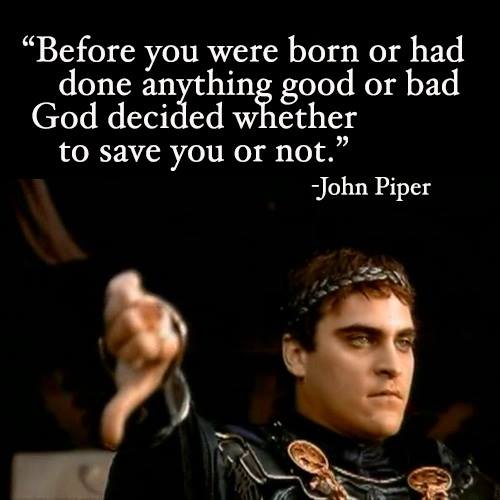
If God only loves SOME – his elect – why cannot also we love SOME people?

Why not loving only SOME people if our God only loves SOME people?

We are told to love one another because God loved us and to be merciful as him, but if the truth is rather that God only loved SOME of us – his elect – then why would it be wrong for us to act in a similar way by loving and being merciful to only a select few?

1 John 4:7 Beloved, let us love one another: for love is of God; and every one that loveth is born of God, and knoweth God—11 Beloved, if God so loved us, we ought also to love one another.

Luke 6:36 Be ye therefore merciful, as your Father also is merciful.

The calvinistic view is that God chose some to be elect and others to be non-elect (ending up to be wicked sinners unwilling to repent) from the creation of the world, and surely it wouldn’t be accurate to say that God “loved” the non-elect since he predestined them to be damned? Some calvinists might insist on that “he maketh his sun to rise on the evil and on the good, and sendeth rain on the just and on the unjust” (Matt. 5:45) means that God pours out his love and blessings also on the non-elect. However, that’s like saying it’s true “love” to invite someone out for a delightful picnic with lots of wonderful treats, just to push the same person off a cliff when the dinner is over. (It’s a better choice to trust the Bible which says that God doesn’t want anyone to perish and whose only son died for everyone.)

The Bible says that “IF God so loved us, we ought to love each other”, but what if he did not love us? Wouldn’t this give us a logical reason to not love everyone? It certainly sounds as though we are only expected to love God if he loves us, and if God fails to do his part (loving us) then we are not bound to do our part either (loving one another). So the point remains the same however you turn it. If it’s “love” for God to show mercy and good intentions only on some people (creating most people for hell), then why would it be wrong for us humans to act in a similar way by being selective about which ones to love?

Calvinists might protest and say that unlike God we don’t know who is elect or non-elect and therefore we should be merciful and loving to everyone, but wouldn’t this at least show that you would not be speaking the truth if you told non-christians that you (or God) love them? There is a huge risk that they might remain non-christians throughout their lives, and if they died as non-believers it would prove (if we want to be consistent with the “God-loves-some-doctrine”) that God in fact did not love them but predestined them to be fuel in the fire. So why would you have concern for their souls and love them if God doesn’t love them? Do you have a greater heart than God?

The Bible tells us that there will be few people who find the narrow way that leads to life (Matt. 7:14), and that means that there is a greater chance that God does not love a person than that he loves him/her (again, if we want to be consistent with this doctrine). The Bible however, tells us repeatedly that God “loves” Israel, despite that some Israelites were later destroyed by God due to being disobedient. Apparently it’s possible to love people who will later perish.

What if we truly behaved just like the calvinistic God – and showed the same kind of “love” and “mercy” as he does – and selected some unfortunate individuals to torture and even kill. We would still not reach the same horrible type of love and mercy as the calvinistic God, because he turns people in to non-elect sinners (with no choice whatsoever) and sends them to suffer for eternity. Note, that they won’t suffer due to their sins, but due to having the nerve to be born as the non-elect wicked sinners as God predestined them to be.

Greater love has no man than the one who lays down his life for his friends says John. 15:13, and there are even agnostic/atheistic soldiers who have done this both for friends and for others despite not really knowing them well at all. Many atheists would gladly die for anyone of their children, regardless if the children were good kids or not. Do agnostics have a greater love than Jesus who apparently didn’t lay down his life for all people even though he could? What if a father treated some of his children really well and left the rest to suffer, and defended his case with “I’m just showing the same type of love as God does”? 

The question is; if God can be selective about the ones he decides to love and be merciful to (by making a certain amount of people elect and much-loved), then why can’t we do the same? Why would it be wrong for us to select certain individuals that we decide to pour out our love on, while turning our backs on the rest? Are we not told to be merciful as God, to be perfect like him, and to love one another just the way God does?

Some verses to study

1 John 3:16 Hereby perceive we the love of God, because he laid down his life for us: and we ought to lay down our lives for the brethren.

John 15:13 Greater love hath no man than this, that a man lay down his life for his friends.

Suffice to say that the loving and merciful God of the Bible is completely different from the made-up calvinistic God, whose “love” is both frightful and harmful.

Mark 12:31 And the second is like, namely this, Thou shalt love thy neighbour as thyself. There is none other commandment greater than these.—33 And to love him with all the heart, and with all the understanding, and with all the soul, and with all the strength, 

Our neighbors might be both believers or unbelievers, but Jesus tells us to love them period.

Ezek. 18:23 Have I any pleasure at all that the wicked should die? saith the Lord God: and not that he should return from his ways, and live?—32 For I have no pleasure in the death of him that dieth, saith the Lord God: wherefore turn yourselves, and live ye.

Matt. 5:48 Be ye therefore perfect, even as your Father which is in heaven is perfect.

John 14:15 If ye love me, keep my commandments.—21 He that hath my commandments, and keepeth them, he it is that loveth me: and he that loveth me shall be loved of my Father, and I will love him, and will manifest myself to him.22 Judas saith unto him, not Iscariot, Lord, how is it that thou wilt manifest thyself unto us, and not unto the world?23 Jesus answered and said unto him, If a man love me, he will keep my words: and my Father will love him, and we will come unto him, and make our abode with him.24 He that loveth me not keepeth not my sayings: and the word which ye hear is not mine, but the Father’s which sent me.

1 John 2:5 But whoso keepeth his word, in him verily is the love of God perfected: hereby know we that we are in him.He that saith he abideth in him ought himself also so to walk, even as he walked.

1 John 3:17 But whoso hath this world’s good, and seeth his brother have need, and shutteth up his bowels of compassion from him, how dwelleth the love of God in him?

1 John 4:7 Beloved, let us love one another: for love is of God; and every one that loveth is born of God, and knoweth God.He that loveth not knoweth not God; for God is love.—11 Beloved, if God so loved us, we ought also to love one another.12 No man hath seen God at any time. If we love one another, God dwelleth in us, and his love is perfected in us.—18 There is no fear in love; but perfect love casteth out fear: because fear hath torment. He that feareth is not made perfect in love.19 We love him, because he first loved us.20 If a man say, I love God, and hateth his brother, he is a liar: for he that loveth not his brother whom he hath seen, how can he love God whom he hath not seen?

Jude 20 But ye, beloved, building up yourselves on your most holy faith, praying in the Holy Ghost,21 Keep yourselves in the love of God, looking for the mercy of our Lord Jesus Christ unto eternal life.

1 King. 10:9 Blessed be the Lord thy God, which delighted in thee, to set thee on the throne of Israel: because the Lord loved Israel for ever, therefore made he thee king, to do judgment and justice.

1 Chron. 28:9 And thou, Solomon my son, know thou the God of thy father, and serve him with a perfect heart and with a willing mind: for the Lord searcheth all hearts, and understandeth all the imaginations of the thoughts: if thou seek him, he will be found of thee; but if thou forsake him, he will cast thee off for ever.

“God has dealt to every man a measure of faith” – concerns spiritual gifts – Rom. 12:3

We are created with the ability to seek and find God

To start with we know from the Bible that God has created us with the ability to SEEK him and FIND him, even though he is not far from any one of us. It’s for this purpose that he has formed us. There is much joy in heaven for each person who repents, because this means that a person has gone from death to life and God doesn’t want anyone to perish.

Acts 17:26 And He has made from one blood every nation of men to dwell on all the face of the earth, and has determined their preappointed times and the boundaries of their dwellings, 27 SO THAT THEY SHOULD SEEK THE LORD, in the hope that they might grope for Him and find Him, though He is not far from each one of us;30 Truly, these timso that they should seek the Lord,es of ignorance God overlooked, but now commands ALL MEN EVERYWHERE to repent, 31 because He has appointed a day on which He will judge the world in righteousness by the Man whom He has ordained. He has given assurance of this TO ALL by raising Him from the dead.” (NKJV)

John 1:8 He was not that Light, but was sent to bear witness of that Light. 9 That was the true Light which gives light to every man coming into the world

Ez. 33:11 Say to them: ‘As I live,’ says the Lord God, ‘I have no pleasure in the death of the wicked, but that the wicked turn from his way and live. Turn, turn from your evil ways! For why should you die, O house of Israel?’

2 Pet. 3:9 The Lord is not slack concerning His promise, as some count slackness, but is longsuffering toward us, not willing that any should perish but that all should come to repentance.

If we preach that “faith is a gift”, there is a risk that people will understand this to mean that God gives “faith” (faith to believe in God) to some and not to others, since all people evidently don’t have faith in God. This logically results in that people who don’t believe in God are innocent victims, because God did not provide them with enough “faith” to repent and believe in him. They would have good reasons to be disappointed with God who prevented them from believing. Therefore it’s best to not express ourselves in a way that can easily be misunderstood. (Nevertheless, calvinists do believe that God predestines some to be saved and others to not be saved so they wouldn’t have any reasons to suggest they are misunderstood.)

Many people get healed thanks to THEIR faith

Some christians erroneously believe that the “gift” spoken about in Eph. 2:8-9 is “faith”, but in reality the Greek shows that it’s “salvation” that is the gift as can be seen here. It’s certainly true that we don’t have to pay for our salvation, or that we can merit salvation by anything we do (or believe), because we would be hopelessly lost without the gift offered to us even though we don’t deserve it in the least. Some christians suggest that Rom. 12:3 indicates that God hands out the gift of faith (the ability to believe in God) to SOME people, leaving the rest in darkness, but if that were the case God alone must be blamed for people’s “choice” to not believe in him since they in reality wouldn’t have any choice in the matter. Rom. 12: 3 actually says that God has dealt to “every man” the measure of faith:

Rom. 12:3For I say, through the grace given unto me, to every man that is among you, not to think of himself more highly than he ought to think; but to think soberly, according as God hath dealt to every man the measure of faith. (KJV)

Note that not all “faith” spoken about in the Bible is in relation to belief in God but it could also be in relation to a person’s faith in one or more of the spiritual gifts, and that is the topic of Rom. 12. Not all christians have a strong faith in that they can be healed (sometimes they get healed anyway), or that they can prophesy, speak in tongues, etc. Fortunately our faith can grow in this area. Here are some examples of where people’s faith plays an important role when it comes to healing (KJV and NKJV):

Mark 5:24 And He said to her, “Daughter, your faith has made you well. Go in peace, and be healed of your affliction.

Acts 14:9 This man heard Paul speaking. Paul, observing him intently and seeing that he had faith to be healed, 10 said with a loud voice, “Stand up straight on your feet!” And he leaped and walked.

Luke 17:.17 And Jesus answering said, Were there not ten cleansed? but where are the nine?18 There are not found that returned to give glory to God, save this stranger.19 And he said unto him, Arise, go thy way: THY FAITH HATH MADE THEE WHOLE.

Matthew 15:28 Then Jesus answered and said unto her, O woman, GREAT IS THY FAITH: be it unto thee even as thou wilt. And her daughter was made whole from that very hour.

Mark. 5:34 And he said unto her, Daughter, THY FAITH HATH MADE THEE WHOLE; go in peace, and be whole of thy plague.

Luke 18:41 Saying, What wilt thou that I shall do unto thee? And he said, Lord, that I may receive my sight.42 And Jesus said unto him, Receive thy sight: THY FAITH HATH SAVED THEE.43 And immediately he received his sight, and followed him, glorifying God: and all the people, when they saw it, gave praise unto God.

Mark 6:4 But Jesus said to them, “A prophet is not without honor except in his own country, among his own relatives, and in his own house.” 5 Now HE COULD DO NO MIGHTY WORK THERE, EXCEPT THAT HE LAID HIS HANDS ON A FEW SICK PEOPLE AND HEALED THEM. 6 And He marveled because of their UNBELIEF. Then He went about the villages in a circuit, teaching. 

Matthew 8:8 The centurion answered and said, Lord, I am not worthy that thou shouldest come under my roof: but speak the word only, and my servant shall be healed. —13 And Jesus said unto the centurion, Go thy way; and AS THOU HAST BELIEVED, SO BE IT DONE UNTO THEE. And his servant was healed in the selfsame hour.

Matt. 17:14 And when they were come to the multitude, there came to him a certain man, kneeling down to him, and saying,15 Lord, have mercy on my son: for he is lunatick, and sore vexed: for ofttimes he falleth into the fire, and oft into the water.16 And I brought him to thy disciples, and they could not cure him.17 Then Jesus answered and said, O FAITHLESS AND PERVERSE GENERATION, how long shall I be with you? how long shall I suffer you? bring him hither to me.18 And Jesus rebuked the devil; and he departed out of him: and the child was cured from that very hour.19 Then came the disciples to Jesus apart, and said, Why could not we cast him out?20 And Jesus said unto them, BECAUSE OF YOUR UNEBELIEF: for verily I say unto you, If ye have faith as a grain of mustard seed, ye shall say unto this mountain, Remove hence to yonder place; and it shall remove; and nothing shall be impossible unto you.21 Howbeit this kind goeth not out but by prayer and fasting.

Also 1 Corinthians 12-14 concerns the spiritual gifts. Paul says “There are diversities of gifts, but the same Spirit“. He says that the Spirit is distributing these gifts to each one has he wills, but he also tells us to COVET EARNESTLY the best gifts. Too many christians are of the opinion that the spiritual gifts have ceased, but some of them still concede that “Sure, if God one day hits me with some of these gifts out of the blue, then who am I to object”? Meaning, they wait for God to take action despite of their disinterest and objections to the spiritual gifts, and by being so reluctant they disobey Paul who tells us to EARNESTLY DESIRE the best gifts. Instead of earnestly desire these gifts, they might choose to discourage others from having this type of desire by telling them that the gifts have passed and are not for today. Flee from a pastor who warns you and discourages you from seeking the gifts. Satan is thrilled each time he can disarm a christian person and make him weaker.

If healing, prophesying and speaking in tongues have ceased, then so have faith, wisdom, knowledge and “discerning of the spirits”, which can be found on the same list. “Faith” is here listed separately, and it could for instance concern the hopes and expectations that we have when we take the time to pray. If we believe that praying is a more or less a waste of time and that God either doesn’t hear our prayers or that everything is predetermined, then it’s a risk that become weak when we pray (if we pray at all). It could also concern our faith in relation to prophesies and dreams – that God is able to express himself through such means (this could be combined with discerning the spirits) – and that we are able to find ourselves in “divine appointments” with other individuals in our daily lives which we should make use of. Another example could be when we are trusting in God for providing financial aid in a difficult situation, and there are numerous testimonies from christians who give account of miracles that they have experienced when they are being provided money precisely when needed in a very urgent situation which they have prayed about. If we have a strong faith in that God is able to lead us in our daily life, we have accomplished much and our faith can grow even further. We will understand the power of prayers and that we can be useful tools for others, just like other people can be used by God to enlighten and encourage us.

1 Cor. 12:8 for to one is given the word of wisdom through the Spirit, to another the word of knowledge through the same Spirit, 9 to another faith by the same Spirit, to another gifts of healings by the same Spirit, 10 to another the working of miracles, to another prophecy, to another discerning of spirits, to another different kinds of tongues, to another the interpretation of tongues. 11 But one and the same Spirit works all these things, distributing to each one individually as He wills.

1 Cor. 12:30 Do all have gifts of healings? Do all speak with tongues? Do all interpret? 31 But EARNESTLY DESIRE the best gifts. And yet I show you a more excellent way.

The context of Romans 12 – having faith in spiritual gifts

Romans 12 shows us how Paul beseeches the christians in Rome, and all of us, to live holy lives in order to be acceptable to God, and to be transformed by the renewing of our mind.

Rom. 12:1 I beseech you therefore, brethren, by the mercies of God, that you present your bodies a living sacrifice, holy, acceptable to God, which is your reasonable service. 2 And do not be conformed to this world, but be transformed by the renewing of your mind, that you may prove what is that good and acceptable and perfect will of God.3 For I say, through the grace given to me, to everyone who is among you, not to think of himself more highly than he ought to think, but to think soberly, as God has dealt to each one a measure of faith.

Right after v. 3, where Paul mentioned “as God has dealt to each one a measure of faith”, he explains further what he means by that:

FOR as we have many members in one body, but all the members do not have the same function, 5 so we, being many, are one body in Christ, and individually members of one another.Having then gifts differing according to the grace that is given to us, let us use them: if prophecy, let us prophesy in proportion to our faith; 7 or ministry, let us use it in our ministering; he who teaches, in teaching; 8 he who exhorts, in exhortation; he who gives, with liberality; he who leads, with diligence; he who shows mercy, with cheerfulness.

As we can see, Paul has spiritual gifts in mind when he speaks about “faith” in v. 3 (the previous verse). He says in v. 4  “let us prophesy in proportion to our faith“, because the truth is that not everyone has the gift of prophesying – often because they don’t even believe in the spiritual gifts . Paul says “Let us use them”, indicating that some of us are not using our gifts even though they are provided to us, and one reason might be lack of boldness. Which gifts we possess are dependent on our willingness to seek the gifts (as we are told) and which gifts the Spirit provides us (God’s grace). Apart from using faith in relation to prophesy, Paul also mentions ministering, teaching exhorting, giving, leading and being merciful. These are all areas where a strong faith is very useful, and the more we see what God can do, the more our faith can grow and we become more bold – fervent in spirit, serving the Lord. Not all of us are for instance teachers, but we can all do something for the Kingdom of God, depending on our personalities, talents, gifts and faith. We are all different members of the same body.

9 Let love be without hypocrisy. Abhor what is evil. Cling to what is good. 10 Be kindly affectionate to one another with brotherly love, in honor giving preference to one another; 11 not lagging in diligence, fervent in spirit, serving the Lord; 12 rejoicing in hope, patient in tribulation, continuing steadfastly in prayer; 13 distributing to the needs of the saints, given to hospitality.14 Bless those who persecute you; bless and do not curse. 15 Rejoice with those who rejoice, and weep with those who weep. 

We will be judged by a righteous God – and he knows what we know…

A person can be healed through faith in his name (either from the one who heals, or the one getting healed, or both). The following verse is both about believing in Jesus, and believing in the power that extends from him  – so that we are able to expect a person getting healed.

Acts 3:16 And His name, through faith in His name, has made this man strong, whom you see and know. Yes, the faith which comes through Him has given him this perfect soundness in the presence of you all.

If we have a strong faith, we can better endure persecutions and tribulations, and we can better learn the power of a prayer. There is a risk that we might habitually pray but still lack faith in that God will respond. It’s like going in to a store and by the counter ask for a certain product, and when the salesperson says “Sure, one moment please” and leaves the counter in order to get what you ask for, you stand there with doubts if this person is actually going to return with your product. “Maybe the product is out of stock, or maybe the salesperson forgot about me or went for lunch?” So you just leave the store without getting the product that you asked for, even though you had the chance and should have endured. We can learn to grow in faith.

2 Thes. 1:3 We are bound to thank God always for you, brethren, as it is fitting, because your faith grows exceedingly, and the love of every one of you all abounds toward each other, 4 so that we ourselves boast of you among the churches of God for your patience and faith in all your persecutions and tribulations that you endure, 5 which is manifest evidence of the righteous judgment of God, that you may be counted worthy of the kingdom of God, for which you also suffer; 6 since it is a righteous thing with God to repay with tribulation those who trouble you,7 and to give you who are troubled rest with us when the Lord Jesus is revealed from heaven with His mighty angels, 8 in flaming fire taking vengeance on those who do not know God, and on those who do not obey the gospel of our Lord Jesus Christ. 9 These shall be punished with everlasting destruction from the presence of the Lord and from the glory of His power, 10 when He comes, in that Day, to be glorified in His saints and to be admired among all those who believe, because our testimony among you was believed.

If God would hand out various amounts of “faith” to us , as an ability to even believe in him, it wouldn’t make sense for Jesus to request us to believe in him if he is aware of that some of us lack the faith to do it.

 John 10:37 If I do not the works of my Father, believe me not.38 But if I do, though ye believe not me, BELIEVE THE WORKS: that ye may know, and believe, that the Father is in me, and I in him.

Matt. 14:28 And Peter answered Him and said, “Lord, if it is You, command me to come to You on the water.”29 So He said, “Come.” And when Peter had come down out of the boat, he walked on the water to go to Jesus. 30 But when he saw that the wind was boisterous, he was afraid; and beginning to sink he cried out, saying, “Lord, save me!”31 And immediately Jesus stretched out His hand and caught him, and said to him, “O you of little faith, why did you doubt?”

It’s not biblically sound to answer Jesus “because you didn’t provide us with enough faith”. What must we do to be saved?

Acts 16:30 And he brought them out and said, “Sirs, what must I DO to be saved?”31 So they said, “BELIEVE on the Lord Jesus Christ, and you will be saved, you and your household.”

Paul and Silas didn’t answer “There is nothing you can do to get saved, apart from hoping that God has given you enough faith to believe in him. Just wait and see“.

We will be judged based on our faith, what we know and learn, if we seek God’s wisdom, our fruit and our conscience:

Rom. 10:14 How then shall they call on Him in whom they have not believed? And how shall they believe in Him of whom they have not heard? And how shall they hear without a preacher?—17 So then faith comes by hearing, and hearing by the word of God.

Rom. 2: 14 for when Gentiles, who do not have the law, by nature do the things in the law, these, although not having the law, are a law to themselves,15 who show the work of the law written in their hearts, their conscience also bearing witness, and between themselves their thoughts accusing or else excusing them) 16 in the day when God will judge the secrets of men by Jesus Christ, according to my gospel.

Luke 10:13 “Woe to you, Chorazin! Woe to you, Bethsaida! For if the mighty works which were done in you had been done in Tyre and Sidon, they would have repented long ago, sitting in sackcloth and ashes.

Being cut off from the VINE due to lack of FRUIT, despite starting out in Jesus – John 15

A branch can start out in the vine (Jesus) and still be cut off at a later stage due to lack of fruit

“Fruit” is often used as another term for “works” – as in showing our faith by doing good deeds towards others. We are not saved by either faith alone or works alone, but the two must go together. The following are some things we learn from John 15:

  • Branches that bear at least some fruit (which is a sign of life) will be pruned, but if branches bear no fruit at all they will be removed and thrown into the fire
  • The branches that were cut off were so because they did not abide by bearing fruit, and they will WITHER which shows they used to be alive and fresh.
  • Jesus declared his disciples “clean” and yet they (along with all of us) were warned to not be cut off the vine due to lack of fruit.
  • Being thrown in the fire is a common term for being thrown into hell, and this happens when people transgress God’s commandments and refuse to repent.
  • We are fervently urged to ABIDE. We are not simply told that we absolutely WILL abide because it’s not possible to lose our salvation. It’s the other way around since we are told to stick with Jesus, or else terrible things will follow.
  • There are many IF:s in the chapter. “IF a man abide not in me…”, “IF ye abide in me….”, “IF ye keep my commandments, ye shall abide in my love….” “IF ye do whatsoever I command you, you are my friends”, etc. Why all these IF:s if we are eternally secure once we are in Jesus?
  • God is GLORIFIED when we bear fruit, so his desire is that we bear fruit so that he can be more glorified. That means that it’s something negative if a branch that used to be in him must be cut off due to being useless.
  • Bearing fruit is a condition for being a disciple of Jesus.
  • We are told to CONTINUE in his love. We are not told that it’s a certainty that we will.
  • We are told that we are friends of Jesus IF we obey his commandments.
  • Jesus gives us a commandment to love one another, just like Jesus has loved us. This shows us that we can heed to this commandment.
  • Jesus also tells us that he has kept his Father’s commandment and therefore he abides in his love, and we are asked to do the very same (obey the commandments so that we can abide in Jesus love).
  • Jesus had even ordained his disciples to bear much fruit, but this naturally doesn’t mean that they had no ability to disobey. Judas (a chosen disciple) had departed earlier, but from history we learn that the other eleven remained with Jesus and showed much good fruit throughout their lives.
  • Certain people “had not had sin” if it weren’t for the fact that they rejected Jesus despite that he had come and spoken to them and shown them amazing works of God that no other man has done. Their refusal to accept Jesus made them guilty as sinners, despite that they were very religious Jews eager to obey the law of Moses.

John 15:1I am the true vine, and my Father is the husbandman.Every branch in me that beareth not fruit he taketh away: and every branch that beareth fruit, he purgeth it, that it may bring forth more fruit.3 Now ye are clean through the word which I have spoken unto you.4 Abide in me, and I in you. As the branch cannot bear fruit of itself, except it abide in the vine; no more can ye, except ye abide in me.5 I am the vine, ye are the branches: He that abideth in me, and I in him, the same bringeth forth much fruit: for without me ye can do nothing.6 If a man abide not in me, he is cast forth as a branch, and is withered; and men gather them, and cast them into the fire, and they are burned.7 If ye abide in me, and my words abide in you, ye shall ask what ye will, and it shall be done unto you.8 Herein is my Father glorified, that ye bear much fruit; so shall ye be my disciples.9 As the Father hath loved me, so have I loved you: continue ye in my love.10; even as I have kept my Father’s commandments, and abide in his love.11 These things have I spoken unto you, that my joy might remain in you, and that your joy might be full.12 This is my commandment, That ye love one another, as I have loved you.13 Greater love hath no man than this, that a man lay down his life for his friends.14 Ye are my friends, if ye do whatsoever I command you.15 Henceforth I call you not servants; for the servant knoweth not what his lord doeth: but I have called you friends; for all things that I have heard of my Father I have made known unto you.16 Ye have not chosen me, but I have chosen you, and ordained you, that ye should go and bring forth fruit, and that your fruit should remain: that whatsoever ye shall ask of the Father in my name, he may give it you.17 These things I command you, that ye love one another. —.22 If I had not come and spoken unto them, they had not had sin: but now they have no cloak for their sin.—24 If I had not done among them the works which none other man did, they had not had sin: but now have they both seen and hated both me and my Father.

While the above chapter shows that we can be cut off from the vine due to lack of fruit, the following chapter shows that we as branches can be cut off from the olive tree due to lack of faith (unbelief).

  • The good olive tree with its roots is a picture of the Jews to whom the gospel was first provided. We are also told about another olive tree (wild by nature) which is a picture of the gentiles. Some of the branches in the good olive tree were broken off when Jews rejected Jesus as the Messiah, and the gentiles could be grafted in – provided they had faith.
  • Paul tells us not to boast about our place in the olive tree, but he also says “IF you boast...” showing that we might choose to be disobedient to God against his will.
  • We are told that we stand in the olive tree by FAITH, so this is a condition for salvation (both for the Jew and the gentile).
  • We are told to not be high-minded , but Paul wants us to live in “fear” (in another letter he says: “work out your own salvation with fear and trembling”) since God has shown that he doesn’t necessarily spare the branches if they don’t cooperate by having faith.
  • We are told to TAKE HEED, which would be a useless warning unless there were a real risk that we could lose our place in the olive tree. We are specifically told that we might not be spared due to unbelief.
  • We are told to keep those who tragically fell in mind, because we too might be cut off if we don’t continue in his kindness.
  • Jews (or anyone) can be grafted in AGAIN (meaning we can go from being in the tree, to not being in the tree, to being in the tree again). The condition is FAITH and that we continue to abide.

Rom. 11:16 For if the firstfruit be holy, the lump is also holy: and if the root be holy, so are the branches.17 And if some of the branches be broken off, and thou, being a wild olive tree, wert grafted in among them, and with them partakest of the root and fatness of the olive tree;18 Boast not against the branches. But if thou boast, thou bearest not the root, but the root thee.19 Thou wilt say then, The branches were broken off, that I might be grafted in.20 Well; because of unbelief they were broken off, and thou standest by faith. Be not highminded, BUT FEAR:21 For if God spared not the natural branches, TAKE HEED LEST HE ALSO SPARE NOT THEE.22 Behold therefore the goodness and severity of God: on them which fell, severity; but toward thee, goodness, IF THOU CONTINUE IN HIS GOODNESS: OTHERWISE THOU ALSO SHALT BE CUT OFF.23 And they also, IF THEY ABIDE NOT STILL IN UNBELIEF, shall be grafted in: for God is able to graft them in again.24 For if thou wert cut out of the olive tree which is wild by nature, and wert grafted contrary to nature into a good olive tree: how much more shall these, which be the natural branches, be grafted into their own olive tree?

In the below parable we can read about a vineyard who belongs to the “well-beloved”, and we are told he is the same as “The Lord of hosts”. He worked hard to produce good grapes, but contrary to his expectations WILD grapes were brought forth. What else could he have done to his vineyard apart from what he has already done? Nothing, and yet things didn’t turn out the way he wanted. The Lord of hosts then proceeded to lay his vineyard to waste.

Isaiah 5:1 Now let me sing to my Well-beloved A song of my Beloved regarding His vineyard: My Well-beloved has a vineyard On a very fruitful hill. 2 He dug it up and cleared out its stones, And planted it with the choicest vine. He built a tower in its midst, And also made a winepress in it; So He EXPECTED IT TO BRING FORTH GOOD GRAPES, BUT IT BROUGHT FORTH WILD GRAPES .3 “And now, O inhabitants of Jerusalem and men of Judah, Judge, please, between Me and My vineyard.4 What more could have been done to My vineyard That I have not done in it? WHY THEN, when I expected it to bring forth good grapes, Did it bring forth wild grapes?5 And now, please let Me tell you what I will do to My vineyard: I will take away its hedge, and it shall be burned; And break down its wall, and it shall be trampled down.6 I will lay it waste; It shall not be pruned or dug, But there shall come up briers and thorns. I will also command the clouds That they rain no rain on it.”7 For the vineyard of the Lord of hosts is the house of Israel, And the men of Judah are His pleasant plant. He looked for justice, but behold, oppression; For righteousness, but behold, a cry for help. (NKJV)

I had planted you a noble vine, a seed of highest quality. How then have you turned before Me Into the degenerate plant of an alien vine?” (NKJV) is the question asked in Jeremiah 2:21. God planted one thing and expected a certain result (a noble vine), and yet he received a totally different result (an alien vine). Things don’t always end up as God desires, and that is due to our free will that he created us with.

Jeremiah 2:19 Thine own wickedness shall correct thee, and thy backslidings shall reprove thee: know therefore and see that it is an evil thing and bitter, that thou hast forsaken the Lord thy God, and that my fear is not in thee, saith the Lord God of hosts.20 For of old time I have broken thy yoke, and burst thy bands; and thou saidst, I will not transgress; when upon every high hill and under every green tree thou wanderest, playing the harlot.21 Yet I had planted thee a noble vine, wholly a right seed: how then art thou turned into the degenerate plant of a strange vine unto me?22 For though thou wash thee with nitre, and take thee much soap, yet thine iniquity is marked before me, saith the Lord God.

Jeremiah 8:12 Were they ashamed when they had committed abomination? nay, they were not at all ashamed, neither could they blush: therefore shall they fall among them that fall: in the time of their visitation they shall be cast down, saith the Lord.13 I will surely consume them, saith the Lord: there shall be no grapes on the vine, nor figs on the fig tree, and the leaf shall fade; and the things that I have given them shall pass away from them.

The Lord of hosts planted a tree and called it “a green olive tree, fair and of goodly fruit”. Yet, he ended up destroying it and branches were broken off. It’s a picture of God’s holy people ending up rebelling against him and provoking him to anger due to their evil deeds.

Jeremiah 11:15 What hath my beloved to do in mine house, seeing she hath wrought lewdness with many, and the holy flesh is passed from thee? when thou doest evil, then thou rejoicest.16 The Lord called thy name, A green olive tree, fair, and of goodly fruit: with the noise of a great tumult he hath kindled fire upon it, and the branches of it are broken.17 For the Lord of hosts, that planted thee, hath pronounced evil against thee, for the evil of the house of Israel and of the house of Judah, which they have done against themselves to provoke me to anger in offering incense unto Baal.

Every man is judged based on his fruit. It’s wise to win souls:

Jeremiah 17:10 I the Lord search the heart, I try the reins, even to give every man according to his ways, and according to the fruit of his doings.

Proverbs 11:30 The fruit of the righteous is a tree of life; and he that winneth souls is wise.

More from the New Testament (apart from John 15 and Romans 11 above)


We have not truly repented if we bring forth bad fruit. John the Baptist refused to baptize Jews who were still stuck in their corruption and sins. Every tree which doesn’t bring forth good fruit is cut down and thrown into the fire.

Matthew 3:8 Bring forth therefore fruits meet for repentance:9 And think not to say within yourselves, We have Abraham to our father: for I say unto you, that God is able of these stones to raise up children unto Abraham.10 And now also the axe is laid unto the root of the trees: therefore every tree which bringeth not forth good fruit is hewn down, and cast into the fire.

Even evil people can give good gifts to their children, but this doesn’t mean they are saved. It does mean that we can all do good. (Seeking God and repenting are two examples of good things that an unsaved person might choose to do.) We are told to enter the narrow gate, meaning the choice is ours. We are told to beware of false prophets, which shows that there is a risk that believers might be deceived. It also shows that people are NOT forced into being “non-elect” or “elect”, because for the non-elect a warning to beware of false prophets would fall into deaf ears, and the elect don’t even need to be warned because they can’t even lose their salvation. False prophets might be dressed in sheep’s clothing but we are still able to know them by their fruit. Are they for instance willing to be corrected by the Bible? Do they often lose their self-control and resort to name callings? Do they subtly encourage people to sin by declaring that we can safely serve two masters and still be saved? Do they show good deeds in their lives? We decide what kinds of trees we want to become, but we are also likened with branches (see above) that can be cut off.

“Not every one that saith unto me, Lord, Lord, shall enter into the kingdom of heaven; but he that DOETH the will of my Father which is in heaven.” Doing wonderful works in God’s name (prophesying, casting out demons, etc) is of course not a sin, but if you add iniquity into the picture you’re a sinner and therefore lost. Naturally everyone can get his/her soul restored by repenting! In the story below, Jesus had never known the people spoken about – probably because they had always been workers of iniquity and lawless.

“Whosoever heareth these sayings of mine, and DOETH them…” shows that not everyone is doing the will of God – but if he is doing the will of God, then that person is wise and is likened to having built his house on a rock. Notice that it’s not God who builds the house on the rock for him, but he does so himself and that is the reason he is considered to be wise – by obeying his Lord, which sadly not all choose to do.

Matthew 7:11 If ye then, being evil, know how to give good gifts unto your children, how much more shall your Father which is in heaven give good things to them that ask him?12 Therefore all things whatsoever ye would that men should do to you, do ye even so to them: for this is the law and the prophets.13 Enter ye in at the strait gate: for wide is the gate, and broad is the way, that leadeth to destruction, and many there be which go in thereat:14 Because strait is the gate, and narrow is the way, which leadeth unto life, and few there be that find it.15 Beware of false prophets, which come to you in sheep’s clothing, but inwardly they are ravening wolves.16 Ye shall know them by their fruits. Do men gather grapes of thorns, or figs of thistles?17 Even so every good tree bringeth forth good fruit; but a corrupt tree bringeth forth evil fruit.18 A good tree cannot bring forth evil fruit, neither can a corrupt tree bring forth good fruit.19 Every tree that bringeth not forth good fruit is hewn down, and cast into the fire.20 Wherefore by their fruits ye shall know them.21 Not every one that saith unto me, Lord, Lord, shall enter into the kingdom of heaven; but he that doeth the will of my Father which is in heaven.22 Many will say to me in that day, Lord, Lord, have we not prophesied in thy name? and in thy name have cast out devils? and in thy name done many wonderful works?23 And then will I profess unto them, I never knew you: depart from me, ye that work INIQUITY.24 Therefore whosoever heareth these sayings of mine, and DOETH them, I will liken him unto a wise man, which built his house upon a rock:

We certainly can’t blame God for placing evil thoughts into our hearts, because then he would be blamed for our iniquities. On judgment day we are to give account for every unnecessary word that we have said, showing that it’s our own responsibility to master our own tongues. We choose if we want to be a good person or an evil person.

Matthew 12:33 Either make the tree good, and his fruit good; or else make the tree corrupt, and his fruit corrupt: for the tree is known by his fruit.34 O generation of vipers, how can ye, being evil, speak good things? for out of the abundance of the heart the mouth speaketh.35 A good man out of the good treasure of the heart bringeth forth good things: and an evil man out of the evil treasure bringeth forth evil things.36 But I say unto you, That every idle word that men shall speak, they shall give account thereof in the day of judgment.37 For by thy words thou shalt be justified, and by thy words thou shalt be condemned.

“Why call ye me, Lord, Lord, and do not the things which I say?”Luke 6:46. Why indeed? We certainly don’t have to disobey God, but if we do it’s our own choice and nothing that we can blame on God.

Luke 6:43 For a good tree bringeth not forth corrupt fruit; neither doth a corrupt tree bring forth good fruit.44 For every tree is known by his own fruit. For of thorns men do not gather figs, nor of a bramble bush gather they grapes.45 A good man out of the good treasure of his heart bringeth forth that which is good; and an evil man out of the evil treasure of his heart bringeth forth that which is evil: for of the abundance of the heart his mouth speaketh.46 And why call ye me, Lord, Lord, and do not the things which I say?

Some people bless God with the same mouth as they curse others – for instance their brothers and sisters. James says to this brothers (indicating it also concerns believers) that it should not have to be in that way.

James 3:9 Therewith bless we God, even the Father; and therewith curse we men, which are made after the similitude of God.10 Out of the same mouth proceedeth blessing and cursing. My brethren, THESE THINGS OUGHT NOT SO TO BE.11 Doth a fountain send forth at the same place sweet water and bitter?12 Can the fig tree, my brethren, bear olive berries? either a vine, figs? so can no fountain both yield salt water and fresh.

Jesus always hopes for that we will bear fruit, and he doesn’t give up until one final day when it’s too late. Then the fig tree will finally be cut down for good:

Luke 13:6 He spake also this parable; A certain man had a fig tree planted in his vineyard; and he came and sought fruit thereon, and found none.7 Then said he unto the dresser of his vineyard, Behold, these three years I come seeking fruit on this fig tree, and find none: cut it down; why cumbereth it the ground?8 And he answering said unto him, Lord, let it alone this year also, till I shall dig about it, and dung it:9 And if it bear fruit, well: and IF NOT, then after that thou shalt cut it down.

Lydia was not chosen to BELIEVE since she was a worshiper already – Acts 16:14

Free download from Freepik

And a certain woman named Lydia, a seller of purple, of the city of Thyatira, WHICH WORSHIPPED GOD, heard us: whose heart the Lord opened, that she attended unto the things which were spoken of Paul (Acts 16:14)

Lydia was never hand-picked to be a believer. God doesn’t work in such a way that he randomly (or for unknown reasons) selects a few lucky people to give faith and salvation while he leaves the rest for damnation, despite being guilty of having prevented them from believing by not enabling them to believe. That would hardly be righteous actions worthy of the God of the Bible. We are saved by FAITH and not by ELECTION. If we refuse to believe, we should not blame God for this failure but only ourselves.

Lydia found Paul and some other christians down by the beach where they were praying. Since she was a worshiper of God already, she was probably intrigued by what she heard and stayed to listen to learn more. That was a good choice since she learned more about the kingdom of God.

13 And on the sabbath we went out of the city by a river side, where prayer was wont to be made; and we sat down, and spake unto the women which resorted thither.14 And a certain woman named Lydia, a seller of purple, of the city of Thyatira, WHICH WORSHIPPED GOD, heard us: whose heart the Lord opened, that she attended unto the things which were spoken of Paul.15 And when she was baptized, and her household, she besought us, saying, If ye have judged me to be faithful to the Lord, come into my house, and abide there. And she constrained us.

It’s true that it says “whose heart the Lord opened”, but we already know God didn’t open hear heart to be able to believe or to be a worshiper of God since she was this already. Her faith was the reason she was compelled to approach them and listen to their message.This was her own decision in the same way that Jesus disciples decided to either stay with him and learn more of his teaching, or to leave altogether (as in John. 6:66) and therefore remain in darkness. The reason that God opened her heart even more was so that she could “attend to the things spoken by Paul” (Young’s literal). So not “to believe” in the first place but to be able to understand Paul’s advice – perhaps about the most fruitful way to live a christian life and to be a useful tool for others. The Holy Ghost can certainly work in us, but we are the ones who must make the decision to repent and seek the Lord before this can begin to happen. We are requested to repent (and be baptized for the remission of sins, which should be made right after repentance) and then we will receive the gift of the Holy Ghost.

Luke 11:13 If ye then, being evil, know how to give good gifts unto your children: how much more shall your heavenly Father give the Holy Spirit to them that ask him?

Acts 2:38 Then Peter said unto them, Repent, and be baptized every one of you in the name of Jesus Christ for the remission of sins, and ye shall receive the gift of the Holy Ghost.

Acts 17:26 And hath made of one blood all nations of men for to dwell on all the face of the earth, and hath determined the times before appointed, and the bounds of their habitation;27 That they should seek the Lord, if haply they might feel after him, and find him, though he be not far from every one of us:28 For in him we live, and move, and have our being; as certain also of your own poets have said, For we are also his offspring.29 Forasmuch then as we are the offspring of God, we ought not to think that the Godhead is like unto gold, or silver, or stone, graven by art and man’s device.30 And the times of this ignorance God winked at; but now commandeth all men every where to repent:

What else does the same chapter say about Lydia and about having faith? – Acts 16

Churches increased in number daily due to the word that Paul and Silas spread. What would have happened if they did not spread the gospel? Would the result be the same?

4 And as they went through the cities, they delivered them the decrees for to keep, that were ordained of the apostles and elders which were at Jerusalem.And so were the churches established in the faith, and increased in number daily.

God wants us to spread the gospel since people might be saved through it. If we are saved by election (maybe from the creation of the world), spreading the gospel doesn’t seem to be important since it won’t make a difference:

9 And a vision appeared to Paul in the night; There stood a man of Macedonia, and prayed him, saying, Come over into Macedonia, and help us.10 And after he had seen the vision, immediately we endeavoured to go into Macedonia, assuredly gathering that the Lord had called us for to preach the gospel unto them.

The Philippian jailer fell down before Paul and Silas, likely knowing they served the one true God who can perform amazing miracles – such as creating earth quakes at the right time and open prison doors. He asked them “what must I DO to be saved?“.

27 And the keeper of the prison awaking out of his sleep, and seeing the prison doors open, he drew out his sword, and would have killed himself, supposing that the prisoners had been fled.28 But Paul cried with a loud voice, saying, Do thyself no harm: for we are all here.29 Then he called for a light, and sprang in, and came trembling, and fell down before Paul and Silas,30 And brought them out, and said, Sirs, what must I DO to be saved?

Paul and Silas did not answer: “Absolutely NOTHING, since you have to hope for that God will possibly open your eyes so that you can believe. IF God works in you in such a way, then you know you’re one of the elect and you’ve been elect from birth and even from the creation of the world. You can’t possibly affect a decision about your destiny that has been made thousands of years ago. You can just relax and wait and see.”

Instead Paul and Silas answered his question with:

31 “—BELIEVE on the Lord Jesus Christ, and thou shalt be saved, and thy house.”

They did not promise automatic salvation for his entire household if only this jailer would take the path leading to salvation, because the same condition applied also to them. “BELIEVE and thou shalt be saved!” Paul and Silas might also have figured out that this jailer likely would take the step to be saved since he had just witnessed a miracle and freely requested to know what he must do to be saved – showing his interest in his heart. If the man of the household gets born again, it’s likely that he will be able to affect his entire household with his new spiritual life, and especially if Paul and Silas evangelized to them too, which they did:

32 And they spake unto him the word of the Lord, and to all that were in his house.

The jailer’s family indeed ended up BELIEVING, so they were not saved only because the man of the household was a believer. Neither did Paul and Silas contradict James (in his letter) where James explained that faith without deeds is dead. Also demons believe and tremble, so “faith” means nothing unless you show your faith with your deeds. Abraham didn’t just sit under a bush and believed without obeying God. No, he showed time and again that he had a strong faith by being obedient to God, even when it came down to offering up his own son.

33 And he took them the same hour of the night, and washed their stripes; and was baptized, he and all his, straightway.34 And when he had brought them into his house, he set meat before them, and rejoiced, believing in God with all his house.

Paul and Silas left prison and stayed in the house of Lydia for a while.

39 And they came and besought them, and brought them out, and desired them to depart out of the city.40 And they went out of the prison, and entered into the house of Lydia: and when they had seen the brethren, they comforted them, and departed.

God will judge us based on our faith and KNOWLEDGE

God knows our hearts …

I believe that we all have a chance to be saved, including those who have never had a chance to hear about Jesus Christ – like the oft-mentioned jungle people. The Bible teaches us that we will be judged based on what we know, and also IF we are striving to get more knowledge about our Creator, his mighty deeds and his eternal power. We are encouraged to believe the truth (and to DO the truth) and to come to the light.

John 3:16 For God so loved the world, that he gave his only begotten Son, that whosoever believeth in him should not perish, but have everlasting life.17 For God sent not his Son into the world to condemn the world; but that the world through him might be saved.18 He that believeth on him is not condemned: but he that believeth not is condemned already, because he hath not believed in the name of the only begotten Son of God.19 And this is the condemnation, that light is come into the world, and men loved darkness rather than light, because their deeds were evil.20 For every one that doeth evil hateth the light, neither cometh to the light, lest his deeds should be reproved.21 But he that doeth truth cometh to the light, that his deeds may be made manifest, that they are wrought in God.

We are not able to choose between believe or believe not unless we have reached a certain mature age, which means that babies and small children are not able to make such a decision. Babies (whether born or unborn), are not able to lose their souls because they are not aware of the law and they have no ability to sin. Hell is for unrepentant sinners, and not for innocent blood.

Deut. 1:39 Moreover your little ones, which ye said should be a prey, and your children, which in that day had no knowledge between good and evil, they shall go in thither, and unto them will I give it, and they shall possess it.

Rom. 9:11 (For the children being not yet born, neither having done any good or evil, that the purpose of God according to election might stand, not of works, but of him that calleth;)

Luke 18:16 But Jesus called them unto him, and said, Suffer little children to come unto me, and forbid them not: for of such is the kingdom of God.

Those who lived during the old testament were not able to believe in a person who had not appeared in the flesh yet (Jesus Christ), but they were of course able to believe in GOD (which Jesus Christ also is) and to get to know his will. In the old testament it was faith in God and living holy lives which could save a person, and just like in the new testament, people were able to REPENT and be restored back to life again. God is merciful!

Is. 18:4 Behold, all souls are mine; as the soul of the father, so also the soul of the son is mine: the soul that sinneth, it shall die.5 But if a man be just, and do that which is lawful and right,—7 And hath not oppressed any, but hath restored to the debtor his pledge, hath spoiled none by violence, hath given his bread to the hungry, and hath covered the naked with a garment;8 He that hath not given forth upon usury, neither hath taken any increase, that hath withdrawn his hand from iniquity, hath executed true judgment between man and man,9 Hath walked in my statutes, and hath kept my judgments, to deal truly; he is just, he shall surely live, saith the Lord God.—18 As for his father, because he cruelly oppressed, spoiled his brother by violence, and did that which is not good among his people, lo, even he shall die in his iniquity.—20 The soul that sinneth, it shall die. The son shall not bear the iniquity of the father, neither shall the father bear the iniquity of the son: the righteousness of the righteous shall be upon him, and the wickedness of the wicked shall be upon him.21 But if the wicked will turn from all his sins that he hath committed, and keep all my statutes, and do that which is lawful and right, he shall surely live, he shall not die.22 All his transgressions that he hath committed, they shall not be mentioned unto him: in his righteousness that he hath done he shall live.23 Have I any pleasure at all that the wicked should die? saith the Lord God: and not that he should return from his ways, and live?24 But when the righteous turneth away from his righteousness, and committeth iniquity, and doeth according to all the abominations that the wicked man doeth, shall he live? All his righteousness that he hath done shall not be mentioned: in his trespass that he hath trespassed, and in his sin that he hath sinned, in them shall he die.—26 When a righteous man turneth away from his righteousness, and committeth iniquity, and dieth in them; for his iniquity that he hath done shall he die.27 Again, when the wicked man turneth away from his wickedness that he hath committed, and doeth that which is lawful and right, he shall save his soul alive.28 Because he considereth, and turneth away from all his transgressions that he hath committed, he shall surely live, he shall not die.29 Yet saith the house of Israel, The way of the Lord is not equal. O house of Israel, are not my ways equal? are not your ways unequal?30 Therefore I will judge you, O house of Israel, every one according to his ways, saith the Lord God. Repent, and turn yourselves from all your transgressions; so iniquity shall not be your ruin.31 Cast away from you all your transgressions, whereby ye have transgressed; and make you a new heart and a new spirit: for why will ye die, O house of Israel?32 For I have no pleasure in the death of him that dieth, saith the Lord God: wherefore turn yourselves, and live ye.

Isaiah continues on the same note a few chapters later:

Is. 33:5 He heard the sound of the trumpet, and took not warning; his blood shall be upon him. But he that taketh warning shall deliver his soul. —8 When I say unto the wicked, O wicked man, thou shalt surely die; if thou dost not speak to warn the wicked from his way, that wicked man shall die in his iniquity; but his blood will I require at thine hand.—10 Therefore, O thou son of man, speak unto the house of Israel; Thus ye speak, saying, If our transgressions and our sins be upon us, and we pine away in them, how should we then live?11 Say unto them, As I live, saith the Lord God, I have no pleasure in the death of the wicked; but that the wicked turn from his way and live: turn ye, turn ye from your evil ways; for why will ye die, O house of Israel?12 Therefore, thou son of man, say unto the children of thy people, The righteousness of the righteous shall not deliver him in the day of his transgression: as for the wickedness of the wicked, he shall not fall thereby in the day that he turneth from his wickedness; neither shall the righteous be able to live for his righteousness in the day that he sinneth.13 When I shall say to the righteous, that he shall surely live; if he trust to his own righteousness, and commit iniquity, all his righteousnesses shall not be remembered; but for his iniquity that he hath committed, he shall die for it.14 Again, when I say unto the wicked, Thou shalt surely die; if he turn from his sin, and do that which is lawful and right;15 If the wicked restore the pledge, give again that he had robbed, walk in the statutes of life, without committing iniquity; he shall surely live, he shall not die.16 None of his sins that he hath committed shall be mentioned unto him: he hath done that which is lawful and right; he shall surely live.17 Yet the children of thy people say, The way of the Lord is not equal: but as for them, their way is not equal.18 When the righteous turneth from his righteousness, and committeth iniquity, he shall even die thereby.19 But if the wicked turn from his wickedness, and do that which is lawful and right, he shall live thereby.-–31 And they come unto thee as the people cometh, and they sit before thee as my people, and they hear thy words, but they will not do them: for with their mouth they shew much love, but their heart goeth after their covetousness.

Our conscience bears witness of what is in our hearts, and we will be judged accordingly

Paul warns us about ungodliness and unrighteousness of men, but in order to act in a wicked way we must first be old enough to be aware of the law and choosing to be disobedient (despite that we could have chosen to be obedient). We will be judged according to our choices and actions, but babies are not able to make any choices whether good or bad. If we repent for our sins, ALL our transgressions will be forgiven and we are completely cleansed!

Romans 1:18 For the wrath of God is revealed from heaven against all ungodliness and unrighteousness of men, who hold the truth in unrighteousness;19 Because that which may be known of God is manifest in them; for God hath shewed it unto them.20 For the invisible things of him from the creation of the world are clearly seen, being understood by the things that are made, even his eternal power and Godhead; so that they are without excuse:21 Because that, when they knew God, they glorified him not as God, neither were thankful; but became vain in their imaginations, and their foolish heart was darkened.22 Professing themselves to be wise, they became fools,23 And changed the glory of the uncorruptible God into an image made like to corruptible man, and to birds, and fourfooted beasts, and creeping things.24 Wherefore God also gave them up to uncleanness through the lusts of their own hearts, to dishonour their own bodies between themselves:25 Who changed the truth of God into a lie, and worshipped and served the creature more than the Creator, who is blessed for ever. Amen.26 For this cause God gave them up unto vile affections: for even their women did change the natural use into that which is against nature:—28 And even as they did not like to retain God in their knowledge, God gave them over to a reprobate mind, to do those things which are not convenient;—:32 Who knowing the judgment of God, that they which commit such things are worthy of death, not only do the same, but have pleasure in them that do them.

It’s possible to by nature DO the things in the law, even if we do not have the law. This is revealed by the law written in our hearts, and what our conscience and thoughts reveal about us.

Romans 2:5  But after thy hardness and impenitent heart treasurest up unto thyself wrath against the day of wrath and revelation of the righteous judgment of God;6 Who will render to every man according to his deeds:7 To them who by patient continuance in well doing seek for glory and honour and immortality, eternal life:8 But unto them that are contentious, and do not obey the truth, but obey unrighteousness, indignation and wrath,9 Tribulation and anguish, upon every soul of man that doeth evil, of the Jew first, and also of the Gentile;10 But glory, honour, and peace, to every man that worketh good, to the Jew first, and also to the Gentile:11 For there is no respect of persons with God.12 For as many as have sinned without law shall also perish without law: and as many as have sinned in the law shall be judged by the law;13 (For not the hearers of the law are just before God, but the doers of the law shall be justified.14 For when the Gentiles, which have not the law, do by nature the things contained in the law, these, having not the law, are a law unto themselves:15 Which shew the work of the law written in their hearts, their conscience also bearing witness, and their thoughts the mean while accusing or else excusing one another😉

We will be judged based on what we know, what we don’t know, and our willingness to get to know God and his ways. If we are blessed with lots of knowledge and abilities, much is also required from us.

Luke 12:47 And that servant, which knew his lord’s will, and prepared not himself, NEITHER DID ACCORDING TO HIS WILL, shall be beaten with many stripes.48 But he that KNEW NOT, and did commit things worthy of stripes, shall be beaten with few stripes. For unto whomsoever much is given, of him shall be much required: and to whom men have committed much, of him they will ask the more.

If we are able to see mighty works of God, God expects more from us.

Matt. 11:21 Woe unto thee, Chorazin! woe unto thee, Bethsaida! for if the mighty works, which were done in you, had been done in Tyre and Sidon, THEY WOULD HAVE REPENTED long ago in sackcloth and ashes.22 But I say unto you, It shall be more tolerable for Tyre and Sidon at the day of judgment, than for you.23 And thou, Capernaum, which art exalted unto heaven, shalt be brought down to hell: for if the mighty works, which have been done in thee, had been done in Sodom, it would have remained until this day.24 But I say unto you, That it shall be more tolerable for the land of Sodom in the day of judgment, than for thee.

The parable about the servants who were given different amounts of talents. It shows us that we might start out in a way that might not seem equal, but we will be judged based on what we do with what we have. Our permanent life is not spent on this planet, but in the afterlife.

Matt. 25:14 For the kingdom of heaven is as a man travelling into a far country, who called his own servants, and delivered unto them his goods.15 And unto one he gave five talents, to another two, and to another one; to every man according to his several ability; and straightway took his journey.16 Then he that had received the five talents went and traded with the same, and made them other five talents.17 And likewise he that had received two, he also gained other two.18 But he that had received one went and digged in the earth, and hid his lord’s money.19 After a long time the lord of those servants cometh, and reckoneth with them.20 And so he that had received five talents came and brought other five talents, saying, Lord, thou deliveredst unto me five talents: behold, I have gained beside them five talents more.21 His lord said unto him, Well done, thou good and faithful servant: thou hast been faithful over a few things, I will make thee ruler over many things: enter thou into the joy of thy lord.22 He also that had received two talents came and said, Lord, thou deliveredst unto me two talents: behold, I have gained two other talents beside them.23 His lord said unto him, Well done, good and faithful servant; thou hast been faithful over a few things, I will make thee ruler over many things: enter thou into the joy of thy lord.24 Then he which had received the one talent came and said, Lord, I knew thee that thou art an hard man, reaping where thou hast not sown, and gathering where thou hast not strawed:25 And I was afraid, and went and hid thy talent in the earth: lo, there thou hast that is thine.26 His lord answered and said unto him, Thou wicked and slothful servant, thou knewest that I reap where I sowed not, and gather where I have not strawed:27 Thou oughtest therefore to have put my money to the exchangers, and then at my coming I should have received mine own with usury.28 Take therefore the talent from him, and give it unto him which hath ten talents.29 For unto every one that hath shall be given, and he shall have abundance: but from him that hath not shall be taken away even that which he hath.30 And cast ye the unprofitable servant into outer darkness: there shall be weeping and gnashing of teeth.

You would have no sin if…

John. 9:39 And Jesus said, For judgment I am come into this world, that they which see not might see; and that they which see might be made blind.40 And some of the Pharisees which were with him heard these words, and said unto him, Are we blind also?41 Jesus said unto them, If ye were blind, ye should have no sin: but now ye say, We see; therefore your sin remaineth.

John 15:22 If I had not come and spoken unto them, they had not had sin: but now they have no cloak for their sin.23 He that hateth me hateth my Father also.24 If I had not done among them the works which none other man did, they had not had sin: but now have they both seen and hated both me and my Father.25 But this cometh to pass, that the word might be fulfilled that is written in their law, They hated me without a cause. 

Not everyone is doing the will of God

John 9:31 Now we know that God heareth not sinners: but if any man be a worshipper of God, and doeth his will, him he heareth.

1 John. 2:17 And the world passeth away, and the lust thereof: but he that doeth the will of God abideth for ever.

1 Cor. 7:6 But if any man thinks he is behaving improperly toward his virgin, if she is past the flower of youth, and thus it must be, let him do what he wishes. He does not sin; let them marry. 37 Nevertheless he who stands steadfast in his heart, having no necessity, but has power over his own will, and has so determined in his heart that he will keep his virgin,[b] does well. 38 So then he who gives her in marriage does well, but he who does not give her in marriage does better. (NKJV)

Matt. 7:21 Not every one that saith unto me, Lord, Lord, shall enter into the kingdom of heaven; but he that doeth the will of my Father which is in heaven.

Do we seek knowledge or do we refuse to fear the Lord?

Prov. 1:7 The fear of the Lord is the beginning of knowledge: but fools despise wisdom and instruction.—22 How long, ye simple ones, will ye love simplicity? and the scorners delight in their scorning, and fools hate knowledge?23 Turn you at my reproof: behold, I will pour out my spirit unto you, I will make known my words unto you.24 Because I have called, and ye refused; I have stretched out my hand, and no man regarded;25 But ye have set at nought all my counsel, and would none of my reproof:26 I also will laugh at your calamity; I will mock when your fear cometh;27 When your fear cometh as desolation, and your destruction cometh as a whirlwind; when distress and anguish cometh upon you.28 Then shall they call upon me, but I will not answer; they shall seek me early, but they shall not find me:29 For that they hated knowledge, and did not choose the fear of the Lord:30 They would none of my counsel: they despised all my reproof.31 Therefore shall they eat of the fruit of their own way, and be filled with their own devices.32 For the turning away of the simple shall slay them, and the prosperity of fools shall destroy them.33 But whoso hearkeneth unto me shall dwell safely, and shall be quiet from fear of evil.

Prov. 2:5 Yea, if thou criest after knowledge, and liftest up thy voice for understanding;6 For the Lord giveth wisdom: out of his mouth cometh knowledge and understanding.

Calvinist Dictionary

Kevin Jackson's avatarWesleyan Arminian

A dictionary to help Arminians better understand Calvinist terminology.
(Don’t take this too seriously, this is meant in good fun)

All: The elect

Altar Call: An insult to God

Arminianism:
Man centered theology

Assurance:
hoping that you’re elect

Augustine:
The first church father.

Calvinism:
The gospel

Call (effectual):
to be irresistibly dragged

Call (general):
God’s justification to condemn the reprobate.

Catholicism: What Arminianism leads to.

Compatiblism:
We are free to do whatever the Potter decrees us to do.

Contradiction:
a mystery

Doctrines of Grace:
Term that helps illustrate how God has given us Calvinists superior insight. Usage example: “I was an Arminian before being illuminated by the Doctrines of Grace.”

Doris Day:
Singer of truth

To Draw:
To drag

Easy believism:
The false idea that you can believe in Jesus Christ and be saved. Can a rotten corpse believe? Nope, neither can you.

Eisegesis
: Any Arminian interpretation…

View original post 506 more words

FREE WILL is in the Bible, as well as CHOOSE

It’s interesting that words such as sovereign, sovereignty, depraved and depravity are not mentioned in the Bible (KJV), but free will, and choose are used several times – in relation to man’s ability to choose between two or more options. These words must not be present in the Bible for them to be true, because the Bible is replete with people who make choices – and often very bad choices against God’s will. We certainly can’t accomplish all the things we want in this world, but free will is often labeled as the ability to make contrary choices.

The lack of a word in the Bible is of course not necessarily evidence for that the concept of this word is non-existent in the Bible, because most christians believe in both monotheism and the trinity without the actual presence of these words. However, if the words themselves are not present in the Bible, then at least the concept of them must be there – just as the case is with monotheism and trinity. Problems start to arise when people change meanings of words, or add ideas into the Bible that simply aren’t there.

God is “sovereign” but certainly not in the way that reformed believers suggest. A sovereign God can do whatever he wants, including creating man with free will.

Matt. 7:21 Not every one that saith unto me, Lord, Lord, shall enter into thekingdom of heaven; but he that doeth the will of my Father which is in heaven.

1 John 2:17 And the world passeth away, and the lust thereof: but he that doeth the will of God abideth for ever.

He who does the will of God the Father? I thought 100% of all people always did his will – in the calvinistic world?

Free will in the Bible

The following verses are mainly about man’s free will offerings, but if all of our offers are based on God’s decree and predestination, why even using expressions such as “and of every one that willingly offered a free will offering unto the Lord” as though there is a free will and an actual choice involved? In the reformed view, are not 100% of all offers based on God’s will alone? So why all these confusing “free will” terms? Isn’t it also strange that words must change meanings in order to fit with a preferred doctrine? It seems like some words have one meaning outside of the Bible, and another meaning inside the Bible – such as the term Free Will. It doesn’t have to be that way.

Leviticus 22:18 Speak unto Aaron, and to his sons, and unto all the children of Israel, and say unto them, Whatsoever he be of the house of Israel, or of the strangers in Israel, that will offer his oblation for all his vows, and for all his freewill offerings, which they will offer unto the Lord for a burnt offering;

Numbers 15:3 And will make an offering by fire unto the Lord, a burnt offering, or a sacrifice in performing a vow, or in a freewill offering, or in your solemn feasts, to make a sweet savour unto the Lord, of the herd or of the flock

Ezra 3:5 And afterward offered the continual burnt offering, both of the new moons, and of all the set feasts of the Lord that were consecrated, and of every one that willingly offered a freewill offering unto the Lord.

Ezra 7:16 And all the silver and gold that thou canst find in all the province of Babylon, with the freewill offering of the people, and of the priests, offering willingly for the house of their God which is in Jerusalem:

Psalm 54:6 I will freely sacrifice unto thee: I will praise thy name, O Lord; for it is good.

Hosea 14:4 I will heal their backsliding, I will love them freely: for mine anger is turned away from him

Revelation 22:17 And the Spirit and the bride say, Come. And let him that heareth say, Come. And let him that is athirst come. And whosoever will, let him take the water of life freely.

“Choose” – Examples where God is asking man to choose between options, and/or indications of that man can choose the wrong path

Deut. 30:10 If thou shalt hearken unto the voice of the Lord thy God, to keep his commandments and his statutes which are written in this book of the law, and if thou turn unto the Lord thy God with all thine heart, and with all thy soul.11 For this commandment which I command thee this day, it is not hidden from thee, neither is it far off.—14 But the word is very nigh unto thee, in thy mouth, and in thy heart, that thou mayest do it.15 See, I have set before thee this day life and good, and death and evil;16 In that I command thee this day to love the Lord thy God, to walk in his ways, and to keep his commandments and his statutes and his judgments, that thou mayest live and multiply: and the Lord thy God shall bless thee in the land whither thou goest to possess it.17 But if thine heart turn away, so that thou wilt not hear, but shalt be drawn away, and worship other gods, and serve them;18 I denounce unto you this day, that ye shall surely perish, and that ye shall not prolong your days upon the land, whither thou passest over Jordan to go to possess it.19 I call heaven and earth to record this day against you, that I have set before you life and death, blessing and cursing: therefore choose life, that both thou and thy seed may live:20 That thou mayest love the Lord thy God, and that thou mayest obey his voice, and that thou mayest cleave unto him: for he is thy life, and the length of thy days: that thou mayest dwell in the land which the Lord sware unto thy fathers, to Abraham, to Isaac, and to Jacob, to give them.

Joshua 24:14 Now therefore fear the Lord, and serve him in sincerity and in truth: and put away the gods which your fathers served on the other side of the flood, and in Egypt; and serve ye the Lord.15 And if it seem evil unto you to serve the Lord, choose you this day whom ye will serve; whether the gods which your fathers served that were on the other side of the flood, or the gods of the Amorites, in whose land ye dwell: but as for me and my house, we will serve the Lord.—19 And Joshua said unto the people, Ye cannot serve the Lord: for he is an holy God; he is a jealous God; he will not forgive your transgressions nor your sins.20 If ye forsake the Lord, and serve strange gods, then he will turn and do you hurt, and consume you, after that he hath done you good.21 And the people said unto Joshua, Nay; but we will serve the Lord.22 And Joshua said unto the people, Ye are witnesses against yourselves that ye have chosen you the Lord, to serve him. And they said, We are witnesses.23 Now therefore put away, said he, the strange gods which are among you, and incline your heart unto the Lord God of Israel.—27 And Joshua said unto all the people, Behold, this stone shall be a witness unto us; for it hath heard all the words of the Lord which he spake unto us: it shall be therefore a witness unto you, lest ye deny your God.

2 Sam. 24:10 And David’s heart smote him after that he had numbered the people. And David said unto the Lord, I have sinned greatly in that I have done: and now, I beseech thee, O Lord, take away the iniquity of thy servant; for I have done very foolishly.11 For when David was up in the morning, the word of the Lord came unto the prophet Gad, David’s seer, saying,12 Go and say unto David, Thus saith the Lord, I offer thee three things; choose thee one of them, that I may do it unto thee.13 So Gad came to David, and told him, and said unto him, Shall seven years of famine come unto thee in thy land? or wilt thou flee three months before thine enemies, while they pursue thee? or that there be three days’ pestilence in thy land? now advise, and see what answer I shall return to him that sent me. (+ 1 Chron. 21:10-11)

Prov. 1:28 Then shall they call upon me, but I will not answer; they shall seek me early, but they shall not find me:29 For that they hated knowledge, and did not choose the fear of the Lord:30 They would none of my counsel: they despised all my reproof.31 Therefore shall they eat of the fruit of their own way, and be filled with their own devices.32 For the turning away of the simple shall slay them, and the prosperity of fools shall destroy them.33 But whoso hearkeneth unto me shall dwell safely, and shall be quiet from fear of evil.

Prov. 3:31 Envy thou not the oppressor, and choose none of his ways.

Is. 41:23 Shew the things that are to come hereafter, that we may know that ye are gods: yea, do good, or do evil, that we may be dismayed, and behold it together.24 Behold, ye are of nothing, and your work of nought: an abomination is he that chooseth you.

Is. 56:4 For thus saith the Lord unto the eunuchs that keep my sabbaths, and choose the things that please me, and take hold of my covenant;5 Even unto them will I give in mine house and within my walls a place and a name better than of sons and of daughters: I will give them an everlasting name, that shall not be cut off.

Is. 65:12 Therefore will I number you to the sword, and ye shall all bow down to the slaughter: because when I called, ye did not answer; when I spake, ye did not hear; but did evil before mine eyes, and did choose that wherein I delighted not.

Is. 66:4 I also will choose their delusions, and will bring their fears upon them; because when I called, none did answer; when I spake, they did not hear: but they did evil before mine eyes, and chose that in which I delighted not.

Ez. 21:18 The word of the Lord came unto me again, saying,19 Also, thou son of man, appoint thee two ways, that the sword of the king of Babylon may come: both twain shall come forth out of one land: and choose thou a place, choose it at the head of the way to the city

Phil. 1: 21 For to me, to live is Christ, and to die is gain. 22 But if I live on in the flesh, this will mean fruit from my labor; yet what I shall choose I cannot tell. 23 For I am hard-pressed between the two, having a desire to depart and be with Christ, which isfar better. 24 Nevertheless to remain in the flesh is more needful for you.25 And being confident of this, I know that I shall remain and continue with you all for your progress and joy of faith, (NKJV)

“Chose” and “chosen” – Examples in past tense, where God is asking man to choose between options, and/or indications of that man can choose the wrong pathcalvinism 4

 Gen. 6:2 That the sons of God saw the daughters of men that they were fair; and they took them wives of all which they chose.

Gen. 13:11 Then Lot chose him all the plain of Jordan; and Lot journeyed east: and they separated themselves the one from the other

Jud. 10:13 Yet ye have forsaken me, and served other gods: wherefore I will deliver you no more.14 Go and cry unto the gods which ye have chosen; let them deliver you in the time of your tribulation

1 Sam. 8:6 But the thing displeased Samuel, when they said, Give us a king to judge us. And Samuel prayed unto the Lord.7 And the Lord said unto Samuel, Hearken unto the voice of the people in all that they say unto thee: for they have not rejected thee, but they have rejected me, that I should not reign over them.8 According to all the works which they have done since the day that I brought them up out of Egypt even unto this day, wherewith they have forsaken me, and served other gods, so do they also unto thee.9 Now therefore hearken unto their voice: howbeit yet protest solemnly unto them, and shew them the manner of the king that shall reign over them.10 And Samuel told all the words of the Lord unto the people that asked of him a king.—18 And ye shall cry out in that day because of your king which ye shall have chosen you; and the Lord will not hear you in that day.19 Nevertheless the people refused to obey the voice of Samuel; and they said, Nay; but we will have a king over us; (1 Sam. 12:13)

Ps. 119:173 Let thine hand help me; for I have chosen thy precepts.

Is. 66:3 He that killeth an ox is as if he slew a man; he that sacrificeth a lamb, as if he cut off a dog’s neck; he that offereth an oblation, as if he offered swine’s blood; he that burneth incense, as if he blessed an idol. Yea, they have chosen their own ways, and their soul delighteth in their abominations. 4 I also will choose their delusions, and will bring their fears upon them; because when I called, none did answer; when I spake, they did not hear: but they did evil before mine eyes, and chose that in which I delighted not.

Jer. 8:1 At that time, saith the Lord, they shall bring out the bones of the kings of Judah, and the bones of his princes, and the bones of the priests, and the bones of the prophets, and the bones of the inhabitants of Jerusalem, out of their graves:—3 And death shall be chosen rather than life by all the residue of them that remain of this evil family, which remain in all the places whither I have driven them, saith the Lord of hosts.—5 Why then is this people of Jerusalem slidden back by a perpetual backsliding? they hold fast deceit, they refuse to return.6 I hearkened and heard, but they spake not aright: no man repented him of his wickedness, saying, What have I done? every one turned to his course, as the horse rusheth into the battle.

Luke 10:41 And Jesus answered and said unto her, Martha, Martha, thou art careful and troubled about many things:42 But one thing is needful: and Mary hath chosen that good part, which shall not be taken away from her.

Luke 14:7 So He told a parable to those who were invited, when He noted how they chose the best places, saying to them: 8 “When you are invited by anyone to a wedding feast, do not sit down in the best place, lest one more honorable than you be invited by him; 9 and he who invited you and him come and say to you, ‘Give place to this man,’ and then you begin with shame to take the lowest place. (NKJV)

Acts 6:5 And the saying pleased the whole multitude: and they chose Stephen, a man full of faith and of the Holy Ghost, and Philip, and Prochorus, and Nicanor, and Timon, and Parmenas, and Nicolas a proselyte of Antioch:

Acts 15:40 And Paul chose Silas, and departed, being recommended by the brethren unto the grace of God.

A Quiz for Your Calvinist Friends

Kevin Jackson's avatarWesleyan Arminian

A little quiz for your Calvinist Friends. Inspired by the ever resourceful JC Thibodaux and by a Calvinist dude named Jay Banks. Enjoy.

Genesis 25:23 The LORD said to [Rebekah], “Two nations are in your womb, and two peoples from within you will be separated; one people will be stronger than the other, and the older will serve the younger.”

Q: What was in Rebekah’s womb?

A. Two nations and two peoples.
B. One elect person and one reprobate person.
C. Don’t even try to refer to the Old Testament for your exegesis of Romans 9. Heretic.

Ezekiel 18:23 Do I take any pleasure in the death of the wicked? declares the Sovereign LORD. Rather, am I not pleased when they turn from their ways and live?

Q: How much pleasure does the Sovereign Lord take in the death of the wicked?

A. No pleasure
B. Much pleasure

View original post 824 more words

QUOTES about EVIL and SIN, from preachers who are CALVINISTS

john piperCalvinists often take refuge behind the curtains of “God’s ways are higher than our ways” and “it’s a mystery!” whenever they are faced with Bible contradictions, but if they would just start accepting the fact that man has free will, and that God’s will doesn’t always happen (which doesn’t reduce his sovereignty) then all their contradictions would disappear at once. In order to be consistent with calvinism, one must believe that even evil happens according to Gods will, whereas freewillers believe that evil is merely allowed by God and always happens against his will.

Plainly it was God’s will that sin should enter this world, otherwise it would not have, for nothing happens except what God has eternally decreed. Moreover, there was more than a simple permission, for God only permits things that fulfill his purpose./-A.W. Pink, The Sovereignty of God, 2009, 162

So when I say that everything that exists — including evil — is ordained by an infinitely holy and all-wise God to make the glory of Christ shine more brightly, I mean that, one way or the other, God sees to it that all things serve to glorify his Son.”/ John Piper, Spectacular Sins: And Their Global Purpose in the Glory of Christ, 44

God is able without blameworthy ‘tempting’ to see to it that a person does what God ordains for him to do even if it involves evil./ John Piper,  Spectacular Sins: And Their Global Purpose in the Glory of Christ, 24

Moral evil we usually refer to as sin: murder, lying, adultery, stealing, all the ways that people fail to love each other. So what we are considering here is that God rules the world in such a way that all calamities and all sin remain in his ultimate control and therefore within his ultimate DESIGN and PURPOSE. / John Piper on his website 1 July 1998

The death of Jesus offers another example of how God’s sovereign will ORDAINS that a SINFUL ACT COME TO PASS  /John Piper on his website 1 July 1998These specific examples (which could be multiplied by many more instances) where God purposefully GOVERNS the sinful choices of people are generalized in several passages. — Therefore I conclude with [Jonathan] Edwards, “God decrees all things, even all sins.” /John Piper

God may hate a thing as it is in itself, and considered simply as evil, and yet . . . it may be his will it should come to pass, considering all consequences. . . . God doesn’t will sin as sin or for the sake of anything evil; though it be his pleasure so to order things, that he permitting, sin will come to pass; for the sake of the great good that by his disposal shall be the consequence. His willing to order things so that evil should come to pass, for the sake of the contrary good, is no argument that he doesn’t hate evil, as evil: and if so, then it is no reason why he may not reasonably forbid evil as evil, and punish it as such. /  The Works of Jonathan Edwards, A.M.: With an Essay on His Genius …, Volym 2

So evil is necessary, in order to the highest happiness of the creature, and the completeness of that communication of God, for which he made the world; because the creature’s happiness consists in the knowledge of God, and the sense of his love. And if the knowledge of him be imperfect, the happiness of the creature must be proportionably imperfect. / The Works of Jonathan Edwards, A.M.: With an Essay on His Genius …, Volym 2

We sin out of a kind of MORAL NECESSITY because we act according to our fallen nature./ R.C. Sproul, What is Reformed Theology?: Understanding the Basics

God wills all things that come to pass…God desired for man to fall into sin. I am not accusing God of sinning; I am suggesting that God created sin. / R.C. Sproul, Jr. Almighty Over All 

If there is one single molecule in this universe running around loose, totally free of God’s sovereignty, then we have no guarantee that a single promise of God will ever be fulfilled. / R.C. Sproul.

I wish very frankly and pointedly to assert that if a man gets drunk and shoots his family, it was the will of God that he should do it…”+ Let it be unequivocally said that this view certainly makes God the cause of sin… / Gordon Clark, Religion, Reason, and Revelation, (Philadelphia, PA: Presbyterian & Reformed), 1961, 221

Sin is one of the ‘whatsoevers’ that have ‘come to pass’, all of which are ‘ordained’…Nothing comes to pass contrary to His decree. Nothing happens by chance.Even moral evil, which He abhors and forbids, occurs by the determinate counsel and foreknowledge of God… man’s inability to explain how God can make things certain, but not compulsory… is no reason to deny that [God] can do it or that he has done it./ W.G.T. Shedd, Calvinism: Pure and Mixed, 32-33, 38-39

Foreordination means God’s sovereign plan, whereby He decides all that is to happen in the entire universe. Nothing in this world happens by chance. God is in back of everything. He decides and causes all things to happen that do happen. He is not sitting on the sidelines wondering and perhaps fearing what is going to happen next. No, He has foreordained everything ‘after the counsel of his will’ (Eph. 1:11): the moving of a finger, the beating of a heart, the laughter of a girl, the mistake of a typist –even sin…Although sin and unbelief are contrary to what God commands…God has included them in his sovereign decree (ordained them, caused them to certainly come to pass) / Edwin. H. Palmer, The Five Points of Calvinism, 24-25

Yes, someone says, but can’t Christians put themselves outside God’s grace? What about those who commit ABOMINABLE SINS? Don’t they nullify the work of redemption in themselves? Don’t they forfeit the love of God? CERTAINLY NOT …. it’s preposterous to think that we can forfeit it [salvation] BY ANYTHING WE DO / John MacArthurThe God Who Loves: He Will Do Whatever It Takes To Draw Us To Him

God controls everything that is and everything that happens. There is not one thing that happens that he has not actively decreed – not even a single thought in the mind of man. Since this is true, it follows that God has decreed the existence of evil, he has not merely permitted it, as if anything can originate and happen apart from his will and power. Since we have shown that no creature can make completely independent decisions, evil could never have started without God’s active decree, and it cannot continue for one moment longer apart from God’s will. God decreed evil ultimately for his own glory, although it is not necessary to know or to state this reason to defend Christianity from the problem evil. / Vincent Cheung – Problem of evil 

Those who see that it is impossible to altogether disassociate God from the origination and continuation of evil nevertheless try to distance God from evil by saying that God merely “permits” evil, and that he does not cause any of it. However, since Scripture itself states that God actively decrees everything, and that nothing can happen apart from his will and power, it makes no sense to say that he merely permits something –nothing happens by God’s mere permission. / Vincent Cheung – Problem of evil 

Here they have recourse to the distinction between will and permission. By this they would maintain that the wicked perish because God permits it, not because he so wills. But why shall we say “permission” unless it is because God so wills? Still, it is not in itself likely that man brought destruction upon himself through himself, by God’s mere permission and without any ordaining. As if God did not establish the condition in which he wills the chief of his creatures to be! I shall not hesitate, then, simply to confess with Augustine that “the will of God is the necessity of things,” and that what he has willed will of necessity come to pass. / John Calvin, Calvin’s Institutes (III, xxiii, 8 & II, iv., 3)

James White (in a debate with Hank Hannegraaf and George Bryson) was asked,”When a child is raped, is God responsible and did He decree that rape?” His reply:

“Yes, because if not then it‟s meaningless and purposeless and though God knew it was going to happen he created without a purpose…and God is responsible for the creation of despair. If [God] didn‟t [decree child rape] then that rape is an (sic) element of meaningless evil that has no purpose.”/ James White.

Charles Spurgeon did not believe that Jesus died for all men, or that God even desired to save all men. His words also show what damage the satisfaction theory has done to us, since Spurgeon and others start with this unbiblical falsehood and try to build their case on it – which leads them in the wrong direction. Can a person be saved who is engaged in the most monstrous, horrible and repulsive iniquity, and worse than diabolical deities could think of perform? That is what Spurgeon call those who believe that Jesus died for all:

Once again, if it was Christ’s intention to save all men, how deplorably has He been disappointed, for we have His own testimony that there is a lake which burneth with fire and brimstone, and into that pit of woe have been cast some of the very persons who, according to the theory of universal redemption, were bought with His blood. That seems to me a conception a thousand times more repulsive than any of those consequences which are said to be associated with the Calvinistic and Christian doctrine of special and particular redemption. To think that my Saviour died for men who were or are in hell, seems a supposition too horrible for me to entertain. To imagine for a moment that He was the Substitute for all the sons of men, and that God, having first punished the Substitute, afterwards punished the sinners themselves, seems to conflict with all my ideas of Divine justice. That Christ should offer an atonement and satisfaction for the sins of all men, and that afterwards some of those very men should be punished for the sins for which Christ had already atoned, appears to me to be the most monstrous iniquity that could ever have been imputed to Saturn, to Janus, to the goddess of the Thugs, or to the most diabolical heathen deities. / Charles H. Spurgeon

Can a person be saved if he/she refuses to believe in the true gospel but rather believes in heresies? If Spurgeon is correct here, only calvinists can be saved:

And what is the heresy of Arminianism but the addition of something to the work of the Redeemer? Every heresy, if brought to the touchstone, will discover itself here. I have my own private opinion that there is no such thing as preaching Christ and Him crucified,unless we preach what nowadays is called Calvinism. It is a nickname to call it Calvinism; Calvinism is the gospel, and nothing else / The Autobiography of Charles H. Spurgeon, Curts and Jennings, Cincinnati – Chicago – St. Louis, 1898, Vol. I., Page 172.

“Some of the sermons on sex were R-rated, and we gave warnings to parents and sometimes saw whole visiting youth groups walk out blushing halfway through the sermon.  On other occasions, people walked out during the sermon and flipped me off on their way out, a trend that has continued.”  /Mark Driscoll (Confessions of a Reformission Rev. p.134)

“Pastor James continues to lead our monthly film and theology class, at which attendance rises to more than two hundred people depending on the film.  He continues to show an occasional unedited R-rated movie to train our people to think critically about the themes preached through film, which is the new cultural form of preaching.”  / Mark Driscoll  (Confessions of a Reformission Rev., p.157)

“This season [at church] was messy and I sinned and cussed a lot, but God somehow drew a straight line with my crooked Philistine stick.” / Mark Driscoll  (Confessions of a Reformission Rev p.130)

I do believe God does cause people to think they are saved just to damn them but to call that grace is crazy. / a Calvinist

Also free-willers can of course be in error about sin, even if it’s not built into their doctrine by necessity the way calvinism is (I’m not claiming that calvinists therefore sin more than others, but I’m talking about the necessary outcome of their doctrines IF they want to be consistent with what they teach):

Paul wrote most of his epistles to correct error in the church. But he doesn’t say that even the most carnal Corinthians are not saved. /Dave Hunt The Berean Call, January 2007, p. 5.)

Some of you are weak and sickly and some of you sleep. Some of you died because God just brought judgment upon you for the way you have conducted yourselves … there are some sins that are so heinous … and God takes them home for that./ Dave Hunt

“For as in Adam all die” concerns physical death and the RESURRECTION -1 Cor. 15:22

1 Cor. 15:22 For as in Adam ALL die, even so in Christ shall ALL be made alive.23 But every man in his own order: Christ the firstfruits; afterward they that are Christ’s at his coming.

The context of 1 Cor. 15:22 makes it clear that the subject is the RESURRECTION. If ALL die in Adam, then the very same ALL will be made alive in Christ. However, ALL people will naturally not be saved as in universalism, and that’s why some people prefer to read this verse as though it says “As in Adam ALL die, even so in Christ SOME shall be made alive”. In reality we shouldn’t change the wordings in this verse but keep it just as it is – but instead understand it right. We die physically due to Adam because he brought the very first sin into this world which resulted in the severe consequence that we can’t reach the tree of life due to him. We are related to Adam, we choose to sin like him (but certainly not of necessity) and we are heading for physical death whether we want to or not – and that actually includes Jesus who is also related to Adam. Jesus has the power of the whole Universe, and we will all one day be resurrected and judged before his throne. All people will therefore have to go through physical death due to Adam, regardless of how they have lived their lives, and the same ALL people will have to go through the resurrection and stand before the judgment seat, regardless how they have lived their lives. Only those who have endured to the end, by living in the light of Jesus, will thereafter inherit the kingdom of God and live eternally with the Lamb. The verse says that we die due to Adam, but it certainly doesn’t say that we have inherited his sin or that we are born in sin. I still believe that all who can sin have chosen to sin – just like Adam. That’s why we die spiritually and physically.

Hebr. 5:9 And being made perfect, he became the author of eternal salvation unto all them that obey him

1 Corinthians concerns the resurrection of the BODY, and Paul gives particular details concerning the fate of the believers – because he wants to give them hope and confirmation about what is going to happen in the future.

1 Cor. 15:15 Yea, and we are found false witnesses of God; because we have testified of God that he raised up Christ: whom he raised not up, if so be that the dead rise not.16 For if the dead rise not, then is not Christ raised:17 And if Christ be not raised, your faith is vain; ye are yet in your sins.18 Then they also which are fallen asleep in Christ are perished.19 If in this life only we have hope in Christ, we are of all men most miserable.20 But now is Christ risen from the dead, and become the firstfruits of them that slept.21 For since by man came death, by man came also the resurrection of the dead.22 For as in Adam all die, even so in Christ shall all be made alive.23 But every man in his own order: Christ the firstfruits; afterward they that are Christ’s at his coming.24 Then cometh the end, when he shall have delivered up the kingdom to God, even the Father; when he shall have put down all rule and all authority and power.

The resurrection applies to both good and evil. We shall ALL be resurrected, but the question is if it’s going to be to eternal life or eternal damnation.

2 Cor. 5:10 For we must all appear before the judgment seat of Christ; that every one may receive the things done in his body, according to that he hath done, whether it be good or bad. Acts 24:15 And have hope toward God, which they themselves also allow, that there shall be a resurrection of the dead, both of the just and unjust. Acts 4:2 Being grieved that they taught the people, and preached through Jesus the resurrection from the dead.

The tree that could have sustained us – if we could reach it We don’t have access to the tree of life, and that’s actually something to be pleased about now when Adam opened up the can of worms, because who would like to live eternally on this particular planet which is so much affected by decay and much pain?

Gen. 3:22 And the Lord God said, Behold, the man is become as one of us, to know good and evil: and now, lest he put forth his hand, and take also of the tree of life, and eat, and live for ever:23 Therefore the Lord God sent him forth from the garden of Eden, to till the ground from whence he was taken.24 So he drove out the man; and he placed at the east of the garden of Eden Cherubims, and a flaming sword which turned every way, to keep the way of the tree of life.

Rev. 2:7 He that hath an ear, let him hear what the Spirit saith unto the churches; To him that overcometh will I give to eat of the tree of life, which is in the midst of the paradise of God.

Rev. 22:1 And he shewed me a pure river of water of life, clear as crystal, proceeding out of the throne of God and of the Lamb.2 In the midst of the street of it, and on either side of the river, was there the tree of life, which bare twelve manner of fruits, and yielded her fruit every month: and the leaves of the tree were for the healing of the nations.—14 Blessed are they that do his commandments, that they may have right to the tree of life, and may enter in through the gates into the city.15 For without are dogs, and sorcerers, and whoremongers, and murderers, and idolaters, and whosoever loveth and maketh a lie.—19 And if any man shall take away from the words of the book of this prophecy, God shall take away his part out of the book of life, and out of the holy city, and from the things which are written in this book.

If Adam was created immortal, which means “not subject to death”, there wouldn’t be a need for the tree of life because Adam would have been kept alive anyway – regardless of if he ate from this tree or not. Nevertheless, God created Adam with the idea and hope that he would never be disobedient. If Adam would have walked on the right path at all times, God would have made sure to always give him access to the tree of life and he would have been able to live forever. There wouldn’t be a need to die physically as long as the world is pure and like a paradise, and one day in the future we can experience a true paradise, as long as we make sure to remain children of God. Adam died spiritually when he sinned by eating of the forbidden fruit, and his cells started to go through an aging process. He died physically many years later, and all in all he lived 930 years.

Is. 59:2 But your iniquities have separated between you and your God, and your sins have hid his face from you, that he will not hear.

Eph. 2:1 And you hath he quickened, who were dead in trespasses and sins;2 Wherein in time past ye WALKED according to the course of this world, according to the prince of the power of the air, the spirit that now worketh in the children of disobedience:

Col. 2:13 And you, being dead in your sins and the uncircumcision of your flesh, hath he quickened together with him, having forgiven you all trespasses

Rom. 5:12 Wherefore, as by one man sin entered into the world, and death by sin; and so death passed upon all men, FOR that all have sinned: Rom. 7:9 For I was alive without the law once: but when the commandment came, sin revived, and I died.

God says that he who sins shall die, and he refers to a spiritual death. It’s certain that we are all going to die physically whether we sin or not, so if God would have wanted to express that ALL people will die spiritually (or that they are born spiritually dead), he wouldn’t have to single out the sinners. Those who choose to sin will die (spiritually) but not the others, and not those who repent for their sins and continue to keep themselves spiritually clean. Note that the salvation hinges on our own righteousness and what we DO. Not as though we can earn salvation by anything we do (or believe), and not as though we don’t need to be cleansed for our previous sins by God (later on in the blood of Jesus), but the fact of the matter is still that our behavior shows if we are children of God or not.

Ez.18:20 The soul that sinneth, it shall die. The son shall not bear the iniquity of the father, neither shall the father bear the iniquity of the son: the righteousness of the righteous shall be upon him, and the wickedness of the wicked shall be upon him.21 But if the wicked will turn from all his sins that he hath committed, and keep all my statutes, and do that which is lawful and right, he shall surely live, he shall not die.22 All his transgressions that he hath committed, they shall not be mentioned unto him: in HIS righteousness that HE hath DONE he shall live.

Read more about Romans 5 here