Tag Archive | bible

God works in you both to WILL and to DO as per Phil 2:13?

For it is God which worketh in you both to will and to do of his good pleasure (Phil 2:13)

Some people rip this sentence out of the context in order to show that God is the one doing everything for you, maneuvering every step you take. They believe that he believes for you, repents for you and even do the good works for you. If God is the one responsible for doing the good works in us, how come we sometimes mess up and end up in sin, and how come we sometimes don’t show any good fruit? Can we then blame God and assume that he simply doesn’t want us to show good fruit at all times, because then he would surely have arranged it that way? If the responsibility is God’s, then he either fails miserably with us at times or he wants us to be sinning. Let’s say that you didn’t become born again until you were 40. Does this mean God didn’t “will” that you became a christian at an earlier point? Are you telling me that God wants people to be sinners for a few years before he intervenes and finally makes them good and fruit bearing christians?

Jesus says in John 15 that we can’t do anything without him and that a branch must be in the vine. He WARNS us about this (most importantly his own believing disciples) and tells them that THEY must make sure to abide in him. He is not going to do this for them. Paul basically says the same thing in Phil 2:13 – that without Jesus you can do nothing. We must be IN HIM in order to accomplish good fruit, so we must seek him and let the Holy Spirit guide us.  Jesus says “IF ye abide in me”, and he also says “Continue ye in my love”, so he is NOT saying that he is the one responsible for doing this but WE are. Read the below and read the many IF:s and warnings:

John 15:4 Abide in me, and I in you. As the branch cannot bear fruit of itself, except it abide in the vine; no more can ye, except ye abide in me.5I am the vine, ye are the branches: He that abideth in me, and I in him, the same bringeth forth much fruit: for without me ye can do nothing. 6If a man abide not in me, he is cast forth as a branch, and is withered; and men gather them, and cast them into the fire, and they are burned7If ye abide in me, and my words abide in you, ye shall ask what ye will, and it shall be done unto you. 8Herein is my Father glorified, that ye bear much fruit; so shall ye be my disciples. 9As the Father hath loved me, so have I loved you: continue ye in my love.

The context of Philippians 2:13

The verse prior to 2:13 says that we should work out our own salvation with fear and trembling:

12Wherefore, my beloved, as ye have always obeyed, not as in my presence only, but now much more in my absence, WORK OUT YOUR OWN SALVATION WITH FEAR AND TREMBLING.

Why the need for fear and trembling if we can sit back and relax while God is the one doing the will and the work for us? Why does it say that WE must work, if God is doing all the work? That is because WE must make sure to abide in Jesus so that he can use us for what he has intended, and WE must be eager to know and to do his will and OBEY.

2Fulfil ye my joy, that ye be likeminded, having the same love, being of one accord, of one mind.3Let nothing be done through strife or vain glory; but in lowliness of mind let each esteem other better than themselves. 4Look not every man on his own things, but every man also on the things of others. 5Let this mind be in you, which was also in Christ Jesus:

14Do all things without murmurings and disputings:15THAT ye may be blameless and harmless, the sons of God, without rebuke, in the midst of a crooked and perverse nation, among whom ye shine as lights in the world;16Holding forth the word of life; that I may rejoice in the day of Christ, that I have not run in vain, neither laboured in vain.

Notice that Paul says there is a risk that he has run in VAIN and labored in VAIN, and this wouldn’t make sense if GOD is the one responsible for doing the good fruit for us. The chapter is filled with Paul’s warnings and suggestions about actions that WE must take in order to be able to stand blameless before God one day. The reason why we can stand blameless before him, is because he is able to cleanse us from our sins which we certainly couldn’t do ourselves. We are also able to continue in that blameless state if we remain clean and obey the holy Spirit, and we are promised that we can stand blameless before him if we “do all things without murmurings and disputings”. Clearly Paul doesn’t expect God to do this for us, but WE must be willing servants and perform the work that God wants us to do. He is not going to force us, and one day we will also be rewarded for our DEEDS if we don’t give up. If God is doing the work for us, then he is the only one that should be rewarded since we are just puppets in his hands, and we could blame our shortcomings on him.

Christmas – once pagan always pagan?

Is it wrong to turn a pagan holiday into a christian celebration where we make a special commemoration of the birth of Jesus Christ? Would it really be better to view the day as an ordinary day, and skip all christmas carols, christmas food and meeting up with family and friends for the special occasion? You might say that it’s only the pagan parts of christmas that you’re against, but in that case the better option would be to avoid whatever christmas ingredients you dislike and celebrate christmas as per your own choice. Many people do just that, and the case is that most people celebrate christmas with Jesus Christ in mind and they truly believe he is the reason for the season. Also non-believers view christmas as a celebration for the birth of Jesus and that is what makes it so special. Every single year they are reminded of JESUS CHRIST. How else would a country where 90% are non-believers be exposed to Jesus Christ to the same extent? They certainly won’t come to church to find out.

There is a whole mixture of christmas traditions, and they differ world-wide, as well as within a country. Some celebrate it in a very secular way, and others with religious symbolism, and there really isn’t a “right way” (but there are many wrong ways) since the Bible doesn’t even mention Jesus’ birthday. The Bible doesn’t mention any other birthdays at all, perhaps with the exception of Herodes’ birthday, and he was a pretty mean guy who had a birthday party where he cut off the head of John the Baptist who was the forerunner to JESUS. Despite of this horrible event, we all imitate Herodes’ practice and celebrate our own birthdays. So the only Biblical mention of a birthday is tied to a very wicked ruler who maybe even invented “birthdays” and/or had a “birthday” party to bring fame to his own big name (I’m only speculating), and yet people today celebrate their own birthdays without giving it second thoughts. Also those who are against christmas celebrate their own birthdays.

Some families mix in traditions into christmas which are questionable, and maybe this is  a bigger problem than the fact that it started out as pagan? We don’t have to take the same route as they though. The fact that certain things are not mentioned in the Bible is of course not a reason in itself to avoid them, or else I could list quite a few traditions which people are involved with which are not mentioned or encouraged to be carried out by christians. Where in the Bible does it say that christians should eat birthday cakes? Or use special wedding rings, celebrate Thanksgiving (with turkey and other traditions), arrange special funeral events, mark oneself with tattoos, etc? Some of those who are against christmas are engaged in all of the above. Tattoos are very much rooted in paganism, and even if some feel they can show that there is no Biblical law against them, they are certainly not encouraged. I can’t find any support for that jews or christians used tattoos.

How it all started in Europe

When Europe started to get christianised, the Germanics used the same word for the celebration of the birth of Jesus, as for their own pagan celebration. Later on during 1000 AD in England and 1100 AD in Germany, “Cristes Mæsse” started to be used which became “Christmas” in English, whereas “wîhe nah” (the holy night) became “Weihnachten” in German. The Scandinavian countries kept the word Jul and never used any references to a “mass”. Noel entered English in the late 14th century and is from the Old French noel or nael, meaning “Christmas season”, itself ultimately from the Latinnatalis (dies), “birth (day)”.

The year 354 AD Liberius established the date for Christmas on December 25th (and a Holiday is considered to start at 18.00 the previous day which could explain why December 24th is celebrated in many countries). According to an old understanding of Genesis, the world was created during the vernal equinox and March 25th was considered as Mary’s Annunciation Day, so the birth of Jesus was calculated to 9 months thereafter – December 25th. The celebration of the birth of Jesus replaced, among other events, the Roman celebration of the sun-god Ra which was held during the winter solstice, but many other types of celebrations were held throughout Europe during the winter solstice. The transmission from the various types of celebrations that people were engaged in, to the new christian celebration, went smoothly since celebrations were already in practice during this time. The return of the light to earth after mid winter has symbolized the light of Jesus. The winter solstice occurs a few days before christmas nowadays due to changes in the calendar. It makes perfect sense for people who had not heard about Jesus to make a special event for the winter solstice.

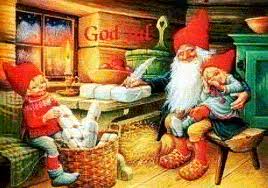
The origin of “Santa Clause” is uncertain as well, and even though we can trace him back to 300 AD and St. Nicholas, each culture has added its own flavor to this man. In the US he is always depicted as a man with a red and white suit, but he can wear other colors in other countries, and he has various assignments. In the 1800’s in Sweden, he was often depicted as a little midget (much like the dwarves in Snow white) who helped the land owners to guard barns and stables and to help feed the animals. He did not come with any presents but HE liked to get a bowl of porridge once in a while, why some had as a tradition to place this dish outside the door for him. The content sometimes disappeared so it could be Jultomten (The Santa Clause) who ate it – or perhaps a fox? For us today it’s possible to celebrate Christmas without this man if he is too much of a problem.

How it all started in Scandinavia

In Sweden and in some other countries in Europe, it’s December 24th which is the big day, and particularly in the evening, but the entire “christmas season” is between December 24th to January 13th when the celebration is officially over. Many choose to get rid of their christmas tree on or around this final day (or a few days before if it’s shedding too many needles), and why the christmas tree is not referred to in Jeremiah 10 can be read here. The modern use of a tree inside the house for christmas is a tradition from Germany in the 1500´s, and candles started to be used in the trees in the 1600´s and 1700´s. Initially christmas trees, at least in Scandinavia, were used only among the more wealthy families.

It’s hard to know where “Jul” first started to be used as a word but the first occasion seems to be from Codes Ambrosianus A of the Gothic calendar, which was written about 500-600 AD. The fragment describes the end of October and the beginning of November, and the month of November is overwritten with “Naubaimbair: fruma Jiuleis” which could be translated as “November, the month before Yule”. At around 730 Ad Beda venerabilis wrote that the Anglosaxians’ calendar has the month “geola” or “giuli” which can correspond to December and/or December and January. December 25th seems to be the first day of the pagan new year which was celebrated. By the time Scandinavia was christianised around 1000 AD, christmas celebrations started to involve mixed elements between pagan, christian, Nordic and Germanic traditions from the time of the vikings and onwards. Most of the present traditions derive from  the 1800’s and 1900’s so they are modern and not tied to any pagan gods.

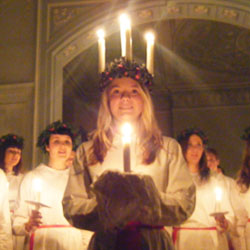
Saint Lucia – Celebrated December 13th in major parts of Scandinavia, with start in Sweden. The most commonly used explanation for the origin of this celebration is that it concerns a young Italian woman from Syracuse on Sicily (Italy) who around 300 AD was forced to marry a man who did not share her faith, and in order to not having to marry him she took her eyes out. Before the new Gregorian Calendar, the Lucia day occurred during the day of the winter solstice but this later changed. Again, it’s common to make extra festivities during a winter solstice. The origin of the Lucia celebrations in Sicily differs entirely from the one in Sweden. The Swedish Lucia tradition actually seems to be separated from the saint altogether, and the name Lucia was tied to the winter solstice  festivities during a later stage. It wasn’t until around the year 1900 when the Lucia tradition was established and commonly celebrated in Sweden. The way it has been celebrated has changed since the year 1900, but in schools today the Lucia and her maids sing Lucia songs and christian christmas songs (and a few others) and that in itself is spectacular. Because “forcing” a religion on someone is usually not acceptable in schools, so religious songs or teachings would normally not pass, BUT since the Lucia tradition is so old and so loved this tradition is an exception. Even if a parent in school would protest, all other parents would overrule the protest, and the tradition continues. This means students will continue to be affected by the glorious gospel about JESUS CHRIST who the Lucia sings about. The Lucia songs can be heard in public places all around the country and on TV, and it’s a great way to evangelize! Children often sing these christian songs to their grandparents or similar, when visiting them in their homes this special day. Lucia on youtube can be viewed here:

With this background in mind, is celebrating christmas wrong?

Maybe it’s harder for me to understand people’s disdain for christmas due to where I live – in a very secular country where people would raise their eyebrows and maybe even be shocked if you would ever say “God bless you” to them. Religion is usually understood as something very private and politicians would therefore never say “God bless you” or “Let’s pray…” during any public circumstances. In the US you might feel that it’s not a big deal to skip christmas altogether and delete it as a Holiday since you will always be surrounded by people, even at work, who do NOT feel you’re odd for being a born again christian.

I am just SO pleased we have christmas celebrations! During the rest of the year (maybe apart from Easter, Pentecost and Christ’s Ascension day) any promotion of christianity seems to be prohibited from the public arena. You wouldn’t hear any songs about Jesus Christ on the radio or TV, unless there is a certain documentary or similar, but during the christmas season suddenly everything is allowed! JESUS CHRIST is promoted big time, and churches don’t pay a dime for this promotion! If you’re in a store, a bus or in a waiting room, you might be hearing christmas music in the background, and the same applies if you zap around among the TV channels. Just imagine; without the need of christians coming together and pay big money for spreading the gospel of Jesus, THIS IS DONE FOR FREE! And it’s done by SECULAR people who are helping out promoting our Savior even if they are not aware of it! For several days in a row you will be listening to christmas songs which keep reminding also atheists of:

A savior is born! In Bethlehem, by a virgin which would be a sign for the Messiah! The baby in the manger is MIGHTY GOD says Isaiah! The LORD OF LORDS! Shepherds came to see him! They were guided from the East by a star, expecting a NEW BORN KING. Angels spoke to them and assured them a Savior is come to earth! Herod was afraid!  This baby would be born just to save people from their sins! People were expecting the Messiah and there he was! Oh Holy night! Peace on earth!

WHY would I vote for deleting christmas as a holiday, now when the gospel of Jesus Christ is spread to so many atheists?

Radio and TV

If religious songs would be played during any other time of the year, people would complain and point out that they shouldn’t have to be forced to listen to religious propaganda and that the radio hosts favor one religion over another, and they will likely be reported. But during the christmas time no one would even think about complaining despite that these songs are so frequent on all radio stations! It’s possible that you in the US have christian radio stations where you could listen to christian songs also the rest of the year, and there must be a few over here too, but if you’re not a christian of course you wouldn’t even look for one. When it comes to christmas, people WILL hear the christian songs whether they like it or not because ALL the radio stations play them – which are the radio stations these people usually listen to!

If we succeeded to persuade the politicians to abolish christmas altogether, it would mean that the radio stations and the TV channels would have no reason to play such christmas songs any more. Then those christians who voted down christmas, might contact the radio stations and offer to pay for “time slots” to play christians songs, but they would be turned down because the radio stations don’t play religious songs. Also TV-channels show many quality programs with christian christmas songs, and they are aired during the peak hours so loads of people can see them. They also make reruns of many programs. If you compare with other type of evangelization I can think of NO greater impact than broadcasting the Gospel right into people’s living rooms (for atheists) during the time when they will likely sit in front of the TV! These atheists might very well enjoy the music and sing along with the christian text. The Bible actually says that faith comes from hearing (the word of God) so this might be a start to peak their interest and a start on their salvation! And again, it doesn’t cost us christians anything! If we would try to make this on our own, it would cost us many millions to arrange a similar gospel campaign. Now, we don’t have to lift a finger, and still secular media will continue to spread the gospel by free will and no one is stopping them! The only ones who might interfere with this tradition and try to silence the christian christmas music might be those christians who oppose Christmas…

Changing dates?

The idea of changing dates for the Christmas holiday would of course not be achievable. I wouldn’t be able to make an impact on the leaders of this country to change Christmas from December 24th to September 24th even if many christians joined me in my efforts, and WHY would I even want to make an effort? It doesn’t matter when we celebrate christmas, but over here December 24th is perfect. It’s getting dark at 15.00 so we don’t have many hours of daylight, why a celebration which contain much Light comes in handy. IF christmas would be eliminated as a Holiday, it would likely result in LESS people who seek Jesus Christ and LESS people who get saved! If the politicians agreed to adhere to the christians’ call to eliminate christmas altogether since it’s pagan, and declared that the holiday would no longer be officially celebrated since it’s pagan and since it’s better to be neutral about religious holidays, then I’m rather sure atheists would take over this holiday and REALLY make it pagan. They might miss the Holiday of light and all the special events, so they might make their own traditions, and getting drunk might be one of the ingredients. Halloween started very recently in this country just from one year to another, so if Christmas was abolished something else will likely take its place.

Christian holidays will one day be abolished for the sake of neutrality

I believe that religious holidays will be abolished in the future anyway since the Antichrist is on his way and he won’t accept any public holidays where Jesus Christ is focused on, but why would we christians try to reach to this point sooner than we need? Jesus is coming soon and we need to spread the gospel! Not silence it! I read that in China also secular chinese people have started to pay attention to the christmas celebration. Particularly the youth and people who live on the coasts. When a lot of people celebrate christmas and tell the world WHY, also others might be affected and seek the Lord.

Even in schools they feel led to explain to their children WHY we celebrate christmas, and some even make a tradition to walk to a nearby church to see a nativity scene. Lately this has been questioned since the school education is supposed to be neutral, and it might start with one single parent who questions this tradition, with the result that school principal feels prone to agree and cancels a tradition which has been going on for many years. In reality there is room within the school laws to teach children about religions by making this type of excursions. Since this country has a christian history, why is it wrong to tell children about the reason for celebrating christmas? Where I live they solved the controversy (to single out christianity among other religions) by placing the nativity scene in the library instead of in the church (even though the church is just beside the library), and they explained the story of Joseph and Mary both from a christian point of view AND from the Islamic point of view! All for the sake of “neutrality”.

You decide over your own traditions

I just feel, that if we dislike certain christmas traditions, like the focus on Santa, too many and too expensive gifts, mistletoe arrangements, etc, then we should just avoid them and keep other traditions and/or start new ones which are more appropriate. Why the desire to eliminate the entire holiday and make it plain just because there are people who focus on the wrong things during this season? If you celebrate your own birthday without letting the wicked man Herodes bother you who is the only Biblical person who is mentioned celebrating a birthday, why is it wrong to select a day to celebrate the birth of Jesus, and why is it wrong to choose a former pagan day for this event? By choosing a former pagan day, you would kill two birds with one stone since you would disarm Satan with his pagan traditions, at the same time as you replaced the wicked traditions with a focus on JESUS CHRIST. Now we don’t have two competing holidays. Plus it’s a bit late to change dates now anyway. This is not about trying to turn the “pagan ship” around because it has already been turned around by people before us. We don’t celebrate December 25th to commemorate the sun-god any more, and even atheists can testify that the idea is to commemorate the birth of Jesus Christ. Seems like the angels,  shepherds and wise men found it natural to  react quite visibly on the birth of  Jesus Christ, and would they really be sinning if they commemorated the birth every year?

What is The Law of Christ?

Paul said,  “Bear one another’s burden, and so fulfill the law of Christ.  (Gal. 6:2)

What is the law of Christ?  The law of Christ is the body of commands and teachings He taught to His disciples and they in turn were to teach every new disciple.  (Matt. 28:20)

Paul equated Christ’s law to God’s law.  (1 Cor. 9:21)

“To them that are without law, as without law, (being not without law to God, but under the law to Christ,) that I might gain them that are without law.”

Paul told the Christians in Galatia to carry each other’s burdens, and in doing so they would fulfill the law of Christ.  (Gal. 6:2)

Paul also said such things as “Let the word of Christ dwell in you richly in all wisdom; teaching and admonishing one another in psalms and hymns and spiritual songs, singing with grace in your hearts to the Lord.”  (Col. 3:16)

What is the word of Christ?  

It has to do with everything Jesus taught and commanded! I have heard people try to get away with what Jesus taught by claiming it belongs to another dispensation in the future; that what Christ taught cannot be applied doctrinally to the Christians in the Church Age.

The word “doctrine” simply means “teaching or instruction.”  It is not some mystical word that is hard to grasp.  Whatever Jesus taught applied to the apostles, to those at that time, and to us!  If one does not abide in the doctrine of Christ, he does not have God.

2 John 1:9 says,
“Whoever transgresses and does not abide in the doctrine of Christ does not have God. He who abides in the doctrine of Christ has both the Father and the Son.”

As one author has well stated,

“It seems strange that men should forbid Jesus the privilege of teaching, during His earthly ministry, and great principles governing man’s relation to God – not only during the few remaining days of His brief earthly ministry, but throughout the age to follow, for which He was even then preparing His disciples.  It seems even stranger that men who so easily reject much of our Lord’s later teaching as ‘not applicable to the present dispensation’ do not hesitate to accept much of His earliest teaching (to Nicodemus, for example) as being fully applicable to the present age.  (One friend, in conversation with the author, even denied that our Lord’s words in John 15 have any bearing on the question of our relation to Christ today, since they were spoken ‘before Calvary’ – a few hours!  What delicate, fragile hairs skilled ‘rightly dividers’ can sometimes neatly split with one swift, sure stroke of their hermeneutical broadaxe!)

It is true that Jesus made reference to certain legal and ceremonial aspects of the Mosaic economy which are not applicable today.  But it is also true that He enunciated cardinal principles governing man’s spiritual relation to God which are as valid today as the moment of utterance.  One of these principles, according to His teaching in the Parable of the Law of Forgiveness, is that true repentance toward God is inseparably associated with our attitude toward our fellow men and cannot exist apart from a charitable, forgiving spirit toward others.

Such true repentance, like sincere faith and the faithful retention of the saving word of the Gospel, is necessary, not merely for a fleeting moment at the occasion of one’s conversion, but continually and habitually, as an essential condition of forgiveness and salvation.  ‘So likewise shall my heavenly Father do also unto you,’ warned Jesus, ‘if ye from your hearts forgive not every one his brother their trespasses.’  It is possible, warned Jesus, that Peter and others who have known the forgiving grace of God might forfeit that forgiveness.  The forgiving grace of God cannot dwell in bitter, unforgiving hearts.  He who refuses to forgive his brother has no real sense of need for the forgiveness of God and no just claim on His gracious forgiveness.  ‘Forgive us our debts, as we forgive our debtors.’”

What does Jesus expect from us? 

Jesus expects us to obey Him.  He was not suggesting it, nor did He say it was for another dispensation.  Jesus said true believers are those who obey Him.  Jesus said if you love Him, keep His commandments (John 14:15).

We are to abide in the doctrine of Christ.  When we abide in the doctrine of Christ, we are fulfilling the law of Christ and it shows that we have both the Father and the Son.   (2 John 1:9)

God’s will is expressed in the Law of Christ. 

The law of Christ is anything Jesus taught in Matthew, Mark, Luke, and John, and is considered the will of the Father.  (Matt. 12:50)

Jesus said whoever hears these sayings (of Jesus), and DOES THEM, is likened to a wise man who built his house on the rock. (Matt. 7:24)

The teachings of Jesus come from the Father. 

Jesus said His teaching were not His own, but came from the Father.  (John 7:16-17)  Everything Jesus taught and commanded came from God. (John 8:28; John 12:49-50; John 14:10; John 14:24; John 14:31)  Jesus obeyed the Father perfectly. Everything Jesus did was the will of God.

Jesus said to His disciples, “Teach them to obey all that I commanded you”.  By teaching others to obey all that Jesus commanded, is teaching the will of God.

The law of Christ is a law of the heart and mind. 

When one starts talking about how we should obey Jesus, immediately the cry is, “You are teaching a works salvation!”  Nothing could be further from the truth.  The Bible never says one can earn his salvation, but what the Bible does say iS to WORK OUT your own salvation (Php. 2:12).  You can’t work out what you don’t have!  On the other hand, all they teach is that one can’t help but sin every single day in thought, word, and deed.  Throughout both Testaments God wants people to forsake wickedness.  Jesus told people to “go and sin no more,” and Paul said, “Awake to righteouness and sin not!”  But on every side we are attacked by Satan’s followers who say you can keep sinning and never die (the same lie from the Garden).  Just listen to this clip ”Today’s Gospel”  of what is being taught out there, and hear how God’s word refutes them!

The secret to living a holy life, free from the bondage of sin, is LOVE.  The purity of your actions is not only from the mind, but from the heart. What is in your heart will fill your mind as well. Jesus called the teachers of the law and Pharisees hypocrites.  They were beautiful on the outside, but inside were full of dead men’s bones.  People, from the outside, can appear as righteous but inside are full of hypocrisy and wickedness. (Matt. 23:28)  It is from out of the heart that proceed evil thoughts, murders, adulteries, fornication, thefts, false witness, blasphemies (Matt. 15:19).  Jesus is not looking just for external actions to be pure, but his desire is for us to be pure in heart and mind as well.

 Will the Holy Spirit be given to those who do not obey Jesus – who claim to continually sin everyday in thought, word, and deed?

Jesus said the Holy Spirit will only be given to those who obey Him.

If you love Me, keep My commandments. And I will pray the Father, and He will give you another Helper, that He may abide with you forever.”  (John 14:15-16)

This is corroborated by Peter.

And we are His witnesses to these things, and so also is the Holy Spirit whom God has given to those who obey Him.”  (Acts 5:32) 

John tells us,

“And he that keepeth his commandments dwelleth in him, and he in him.  And hereby we know that he abideth in us, by the Spirit which he hath given us.” (1 John 3:24)

The Holy Spirit whom God has given abides in those who keep the commandments of Jesus!  For those who claim to sin everyday in thought, word, and deed cannot have the Holy Spirit, for they do not obey God.  They even write off what Jesus said as for another dispensation and therefore it doesn’t apply to them doctrinally!  Why?  Because it will knock down the wall of a false teaching called Unconditional Eternal Security!  When you listen to all these false teachers, and get rid of all the fluff in their sermons, it all boils down to one thing…..you can keep on sinning and you won’t die!  It’s the same lie the Serpent told Eve in the Garden.

The Bible is clear that if you don’t obey and abide in the doctrine of Christ, you do not belong to Christ, nor do you have the Holy Spirit. (2 John 1:9; Rom. 8:9)

Jesus said whoever obeys His commands, he is the one who loves Him.  And He who loves Jesus loves the Father.  Again, if anyone loves Jesus, he will obey His teachings. (John 14:21; John 14:23)

The reverse side is true just as well.  Jesus said those who do not love him do not keep His words. (John 14:24)

Jesus’ love is conditional as long as we continue to obey. 

Jesus’ love is NOT unconditional.  Note the condition in the words of Jesus,

If ye keep my commandments, ye shall abide in my love; even as I have kept my Father’s commandments, and abide in his love.   (John 15:10)

Being friends with Jesus is also conditioned upon our obedience.

“Ye are my friends, if ye do whatsoever I command you.”  (John 15:14)

If we hold to the teachings of Christ, we are the real disciples of His. 

“Then Jesus said to those Jews who believed Him, “If you abide in My word, you are My disciples indeed.  And you shall know the truth, and the truth shall make you free.” (John 8:31-32)

We are assured by Jesus we will never see death if we keep His word.

“Most assuredly, I say to you, if anyone keeps My word he shall never see death.” (John 8:51)

It is obedience to the teachings (keeping His word) that causes the blessings.  Just as blessings were promised for obedience to the law of Moses, so are the blessings promised to us based on our obedience to Christ.

One cannot have salvation without repentance followed with obedience.

The Scripture says,

“And having been perfected, He (Jesus) became the author of eternal salvation to all who obey Him,”  (Heb. 5:9)

It doesn’t say salvation is given to those who sin every day in thought, word, and deed.  God does not want people to sin.  He tells people to forsake their sins and follow Him.  Jesus commanded that all men to repent, but modern man will tell you repentance is not part of the Gospel. It’s a lie.  God wants repentance preached (Luke 5:32; Luke 24:47; Acts 20:21, etc. etc.).

There is a “godly sorrow.”  “For godly sorrow worketh repentance TO SALVATION not to be repented of;”  (2 Cor. 7:10)

Jesus said of the Holy Spirit,

“And when he is come, he will reprove the world of sin, and of righteousness, and of judgment:” (John 16:8)

And as we read above, God gives the Holy Spirit to those who obey Him. (Acts 5:32)  When a person feels the conviction of the Holy Spirit about his sinful condition, he can shrug it off, or he’ll come to God to forgive him of such a sinful life style.  He will want pardon through the mercy of God.  He knows his only hope is through Jesus who provided a way for his salvation and freedom from sin.  He will hate his sin because he can see what it has done to him and where it will send him.  He will not have a desire to do it anymore.  At that point of repentance, he wants to give up sin and not do it again.  Some people may be bothered for weeks under the conviction of the Holy Spirit, some may be a few days, and for some it may be on the very day (process of repentance).  He will not have rest until he comes to that crucial point of “godly sorrow” that leads to salvation.  He has to believe (faith) that God is able to forgive him of all the sins he has committed up to that point in his life, and his heart must be dead set against sinning again, which it would be if he is truly under godly sorrow.  Jesus came to set us free from sin, that it no longer has to have dominion over us.  His repentance will be proven by his deeds (Acts 20:26).  One’s deeds (obedience – NOT disobedience) will prove his repentance!  God will give that person strength if he will obey Him.  He gives the Holy Spirit to those who obey Him.  From there, as he reads the Scriptures (needs to grow in the faith), he will be warned not to go back to the way he once walked.  He can quench the Holy Spirit (1 Thess. 5:19).  The Scripture shows us certain sins will not let one inherit the kingdom of God, but instead lead one to eternal doom (Gal.5:19-21; 1 Cor. 6:9-10; Eph. 5:3-6; Rev. 21:8, etc.).  The Bible doesn’t say we work FOR our salvation, but it does say to WORK OUT our own salvation, and that with fear and trembling! (Php. 2:12).

Salvation is conditional upon the fact that we continue to abide in Jesus.  One who abides in Jesus will not sin.  Remember, Jesus said if you love Him you will obey Him and His teachings.  The Scriptures tell us,

“For this is the love of God, that we keep His commandments.  And His commandments are not burdensome.”  (1 John 5:3)

The Scriptures also say,

“He that saith, I know him, and keepeth not his commandments, is a liar, and the truth is not in him.” (1 John 2:4)”

In flaming fire taking vengeance on them that know not God, and that obey not the gospel of our Lord Jesus Christ:”  (2 Thess. 1:8) 
And you want to claim that you SIN everyday in thought, word and deed? This is simply being disobedient!

Which one is it – believing or obeying? 

Some Scripture passages say salvation is a result of obedience while other texts say salvation is through faith.  Is this a contradiction?  No.  Paul said,

“By whom we have received grace and apostleship, for obedience to the faith among all nations, for his name:  (Rom. 1:5)

“For by grace you have been saved through faith, and that not of yourselves; it is the gift of God,” (Eph. 2:8)

Faith comes first and obedience is the evidence of the faith.  The Gospel is to be obeyed for salvation sake.

“In flaming fire taking vengeance on them that know not God, and that obey not the gospel of our Lord Jesus Christ:”  (2 Thess. 1:8)

Disobedience is manifested in unbelief.

“He that believeth on the Son hath everlasting life: and he that believeth not the Son shall not see life; but the wrath of God abideth on him.” (John 3:36)

“And to whom sware he that they should not enter into his rest, but to them thatbelieved not?  So we see that they could not enter in because of unbelief. (Heb. 3:18-19)

So if you are disobedient, sinning everyday in thought, word, and deed, you are walking in unbelief. Among the sins that will send one into the Lake of Fire, the “unbelieving” is one of them.

“But the fearful, and unbelieving, and the abominable, and murderers, and whoremongers, and sorcerers, and idolaters, and all liars, shall have their part in the lake which burneth with fire and brimstone: which is the second death.”
(Rev. 21:8)

The Bible is clear that a past moment of acceptance of Christ does not guarantee anyone eternal salvation regardless how they live afterward.  If they don’t continue in the faith they will suffer the consequences in Hell for all eternity.

Scriptures say that there will be Christians who will depart from the faith (departing from the faith doesn’t happen to lost people!) (1 Tim. 4:1).  The widows turned from Christ and started following Satan (1 Tim. 5:11-15). Demas is another example. He was a traveling companion of Paul (Col. 4:14; Phm. 1:24). They worked together and endured various troubles and persecutions preaching the kingdom of God. But what happened to Demas? Paul said, “For Demas hath forsaken me, having loved this present world, and is departed unto Thessalonica;…”  (2 Tim. 4:10). Demas, a saved man, fell away and went back to loving this present world.  He loved the world more than God. The god of this world is Satan! (2 Cor. 4:4). Demas got deceived and it affected his behavior. In his unrepentant state, he lost his salvation for he did not endure! (1 John 2:15; James 4:4)

Those who obey Jesus’s commands live in him.  Paul said to examine yourselves to see whether you are in the faith (2 Cor. 13:5).  John corroborates Paul by saying, “And he that keepeth his commandments dwelleth in him, and he in him. And hereby we know that he abideth in us, by the Spirit which he hath given us.” (1 John 3:24)

Those who have a true saving faith in Christ will obey His teachings and commands.  Obedience is natural evidence of saving faith.  Those who are disobedient display their lack of saving faith.  Jesus NEVER asks us to do something we cannot do. If you love Jesus, you will obey Him, and to obey Him is fulfilling the law of Christ.

(Thanks to Sandra)

Jesus, son of the VIRGIN MARY, had brothers and sisters

holy mary

Catholicism is the only major religion where it’s commonly believed that Jesus had no brothers and sisters, but this belief is due to TRADITION rather than scripture.

The Bible tells us that Jesus had at least four brothers and at least two sisters. The brothers names were, James, Joses, Simon and Judas, and one of the sister’s names was Salome.

It’s almost like a curse for women to not be able to have children, and especially during Biblical times, so why would Mary of all women have to go through life without any children (apart from Jesus who died) or grandchildren? That would indicate that she certainly was not BLESSED at all. The Bible nowhere says that Mary had no other children, and normally young women are able to bear children so to assume that Mary was out of luck is to start with an answer and trying to find support for this answer in the Bible.

The absolutely most common interpretations of the Greek word “adelphos” (Strong’s 80) are without a doubt either 1) brother through the blood or 2) spiritual brother. It can also mean kin/cousin but that is unusual, and we are of course not allowed to determine which alternative that is best out of personal preferences but based on the context. IF Jesus indeed had real brothers, how could this  have been stated more clearly, or is this option ruled out because it doesn’t fit our own desires? Why does “blood brother” seem to be EXCLUDED as a valid option in the Roman Catholic Church? Mary retained her virginity throughout her pregnancy, but how can someone give birth to a baby and still retain her virginity?

Anepsios (Strong’s 431) = cousin (or nephew), as in Col. 4:10

Sygenes/syngeneis (Strong’s 4773) = relative (for instance cousin), as in Luke 1:36 and Luke 1:58

Married couples usually share the same bedroom and start a family

Is there anything wrong with Joseph and Mary having more children? That would be perfectly normal for a husband and a wife, and it’s not a sin for a married couple to share the same bedroom. In fact,  it would be abnormal for a married couple to sleep in separate bedrooms for the rest of their lives, and to have no desire to get more children (especially during this time in history). This couple was blessed and not cursed! Paul considered it a good thing to live as a single just like he did, but only if we have the capacity. In all other cases (the majority) he recommend that we get married, and the alternative that we get married and still live in separate bedrooms, is not even considered.

1 Cor 7:Nevertheless, to avoid fornication, let every man have his own wife, and let every woman have her own husband.Let the husband render unto the wife due benevolence: and likewise also the wife unto the husband.5 Defraud ye not one the other, except it be with consent for a time, that ye may give yourselves to fasting and prayer; and come together again, that Satan tempt you not for your incontinency.

From the very beginning God ordained the husband and the wife to be fruitful and multiply. Why would Joseph and Mary, of all people, refuse to obey God when it comes to this?

Genesis 1:28 And God blessed them, and God said unto them, Be fruitful, and multiply, and replenish the earth

Below we can see that Joseph actually “knew” Mary, which means sexual intimacy, but he waited until the first child was born. In this way the prophesy about the virgin birth in Isaiah came true. If someone protests and suggests that “know” doesn’t signify sexual intimacy, he/she will have a hard time explaining Luke 1:34 where we can read about Mary’s puzzlement when she realized she would be having a baby without having “known” a man (same Greek word). Moreover, it wouldn’t make sense for a godly husband to wait with getting to know his wife until after the first child is born. What would be the purpose for this?

Matthew 1:23 Behold, a virgin shall be with child, and shall bring forth a son, and they shall call his name Emmanuel, which being interpreted is, God with us.24 Then Joseph being raised from sleep did as the angel of the Lord had bidden him, and took unto him his wife:25 And KNEW HER NOT TILL SHE HAD BROUGHT FORTH HER FIRSTBORN SON: and he called his name Jesus.

Luke 1:30 And the angel said unto her, Fear not, Mary: for thou hast found favour with God.31 And, behold, thou shalt conceive in thy womb, and bring forth a son, and shalt call his name Jesus.—34 Then said Mary unto the angel, How shall this be, seeing I KNOW NOT A MAN?35 And the angel answered and said unto her, The Holy Ghost shall come upon thee, and the power of the Highest shall overshadow thee: therefore also that holy thing which shall be born of thee shall be called the Son of God.

Det word “know” in Matt. 1:25 is translated from the Greek word ginṓskō (Strong’s 1097) – that can mean to know, especially through personal experience, and also (sexual) intimacy. The word “till” is translated from the Greek word heós (Strong’s 2193) and can mean until, as far as and up until). This is also how the translators of the world have translated this word, and there are no reasons to not trust these Greek scholars.

25 and did not know her TILL she brought forth her son — the first-born, and he called his name Jesus. (Young’s literal)

25 Pero no la conoció HASTA que dio a luz a su hijo primogénito; y le puso por nombre JESÚS. (Reina-Valera 1960)

25 Mais il n’eut pas de relations conjugales avec elle AVANT qu’elle ait mis au monde un fils, auquel il donna le nom de Jésus. (La Bible du Semeur)

25 Und er erkannte sie nicht, BIS sie ihren ersten Sohn gebar; und hieß seinen Namen Jesus. (Luther Bibel 1545)

Two of Mary’s sons are James and Joseph – who are the brothers of Jesus

We can read that Mary was the mother of Jesus’ brothers, and that Jesus was the brother of Mary’s children. This should be clear enough. Matthew 27:56 indicates that Mary was actually the mother of  James and Joseph – who are the brothers of Jesus.

Matthew 13:54 And when he was come into his own country, he taught them in their synagogue, insomuch that they were astonished, and said, Whence hath this man this wisdom, and these mighty works?55 Is not this the carpenter’s son? is not his mother called Mary? and his brethren, James, and Joses, and Simon, and Judas?56 And his sisters, are they not all with us? Whence then hath this man all these things?57 And they were offended in him. But Jesus said unto them, A prophet is not without honour, save in his own country, and in his own HOUSE.

Mark 6:And when the sabbath day was come, he began to teach in the synagogue: and many hearing him were astonished, saying, From whence hath this man these things? and what wisdom is this which is given unto him, that even such mighty works are wrought by his hands?Is not this the carpenter, the son of Mary, the brother of James, and Joses, and of Juda, and Simon? and are not his sisters here with us? And they were offended at him.But Jesus, said unto them, A prophet is not without honour, but in his own country, and among his own kin, and in his own house.

Matthew 27:55 And many women were there beholding afar off, which followed Jesus from Galilee, ministering unto him:56 “Among which was Mary Magdalene, and Mary the mother of James and Joses, and the mother of Zebedee’s children.”

Mark 15:40 “There were also women looking on afar off: among whom was Mary Magdalene, and Mary the mother of James the less and of Joses, and Salome;”

Mark 16:1 “And when the Sabbath was past, Mary Magdalene, and Mary the Mother of James, and Salome, had brought sweet spices, that they might come and anoint Him.”

Mark 3:31 There came then his brethren and his mother, and, standing without, sent unto him, calling him.32 And the multitude sat about him, and they said unto him, Behold, thy mother and thy brethren without seek for thee.33 And he answered them, saying, Who is my mother, or my brethren?34 And he looked round about on them which sat about him, and said, Behold my mother and my brethren!

Here we can see that the disciples (the spiritual family) were distinct from his Brethren and Mother (Blood family). We can read about 1) his mother, 2) his brothers, and 3) his disciples. The disciples are listed by name and they are separate from the brothers. The spiritual brothers of Jesus are those who obey him.

John 2:11 This beginning of miracles did Jesus in Cana of Galilee, and manifested forth his glory; and his disciples believed on him.12 “After this He went down to Capernaum, He, and His Mother, and His Brethren, and His disciples: and they continued there not many days.”

Acts 1:13 And when they were come in, they went up into an upper room, where abode both Peter, and James, and John, and Andrew, Philip, and Thomas, Bartholomew, and Matthew, James the son of Alphaeus, and Simon Zelotes, and Judas the brother of James.14 “These all continued with one accord in prayer and supplication, with the women, and Mary the mother of Jesus, and with his brethren.”

Galatians 1:19 But other of the apostles saw I none, save James the Lord’s brother.

Matthew 12:46 While he yet talked to the people, behold, his mother and his brethren stood without, desiring to speak with him.47 Then one said unto him, Behold, thy mother and thy brethren stand without, desiring to speak with thee.48 But he answered and said unto him that told him, Who is my mother? and who are my brethren?49 And he stretched forth his hand toward his disciples, and said, Behold my mother and my brethren!50 For whosoever shall do the will of my Father which is in heaven, the same is my brother, and sister, and mother.

Not even Jesus’ brothers believed on him at first. It doesn’t sound just as dramatic to say that “Not even his cousins believed on him”, because many people have cousins they have hardly even met.

John 7:His brethren therefore said unto him, Depart hence, and go into Judaea, that thy disciples also may see the works that thou doest.For there is no man that doeth any thing in secret, and he himself seeketh to be known openly. If thou do these things, shew thyself to the world.5 For neither did his brethren believe in him.

Mary was blessed and full of grace, but this doesn’t mean that she lived without a single sin

Mary was not given a free ride to heaven and God is no respecter of persons as in giving aid to certain favored ones to avoid sins. Mary was BLESSED since she was chosen to give birth to Jesus Christ – the Savior of the world, and that is of course a great honor. Below you can find the verses where Mary is considered blessed and with grace, and nowhere will you see that this means that she had always lived a sin free life. She was probably a very godly woman since God chose her for the task of giving birth to Jesus, but it looks like she sinned at least once since she called God her SAVIOR.

Luke 1:48 3106. makarizó bless, pronounce blessed or happy.

Luke 1:42 2127. eulogeó (lit: I speak well of) I bless; pass: I am blessed.

Luke 1:28 5487. charitoó favor, bestow freely on.

Luke 11:27 3107. makarios happy, blessed, to be envied.

Lord,47and my spirit hath rejoiced in God MY SAVIOR48For He hath regarded the low estate of His handmaiden; for behold, from henceforth all generations shall call me blessed.

It’s a sin to worship anyone else than GOD, and there is only ONE mediator between God and man – Jesus who alone was free of sins

Jesus4

Luke 1:45 And blessed is she that believed: for there shall be a performance of those things which were told her from the Lord. 46And Mary said, “My soul doth magnify thee

Rom. 3:23 For all have sinned, and come short of the glory of God

Matthew 19:17 And he said unto him, Why callest thou me good? there is none good but ONE, that is God: but if thou wilt enter into life, keep the commandments.

1 Peter 2:21 For even hereunto were ye called: because Christ also suffered for us, leaving us an example, that ye should follow his steps:22 Who did no sin, neither was guile found in his mouth

Hebr. 4:15 For we have not an high priest which cannot be touched with the feeling of our infirmities; but was in all points tempted like as we are, yet without sin.

Hebr. 7:26 For such an high priest became us, who is holy, harmless, undefiled, separate from sinners, and made higher than the heavens;27 Who needeth not daily, as those high priests, to offer up sacrifice, first for his own sins, and then for the people’s: for this he did once, when he offered up himself.

Hebr. 9:14 How much more shall the blood of Christ, who through the eternal Spirit offered himself without spot to God, purge your conscience from dead works to serve the living God?

John 8:46 Which of you convinceth me of sin? And if I say the truth, why do ye not believe me?

1 John 3:Whosoever is born of God doth not commit sin; for his seed remaineth in him: and he cannot sin, because he is born of God.

2 Cor. 5:21 For he hath made him to be sin [sin offering] for us, who knew no sin; that we might be made the righteousness of God in him.

We are to worship and pray to GOD (through Jesus) and to no one else. By praying to Mary, we are rebelling against God. Him only shall we worship and serve! There is ONE mediator between God and man, and no saints, priests or popes can save us. Much has been made of the information that she is “blessed” in all generations, but she is blessed because she was chosen to give birth to our Savior who enables the whole world to be saved through him.  To interpret this as though she was in a state of sinlessness, or that she can intercede for us  is certainly to add to the Bible.

Luke 4:8 And Jesus answered and said unto him, Get thee behind me, Satan: for it is written, Thou shalt worship the Lord thy God, and him only shalt thou serve.

1 Timothy 2:5 For there is one God, and one mediator between God and men, the man Christ JesusRomans 1:25 Who changed the truth of God into a lie, and worshipped and served the creature more than the Creator, who is blessed for ever. Amen.

John 13:13 And whatsoever ye shall ask in my name, that will I do, that the Father may be glorified in the Son.14 If ye shall ask any thing in my name, I will do it.

John 16:23 And in that day ye shall ask me nothing. Verily, verily, I say unto you, Whatsoever ye shall ask the Father in my name, he will give it you.

John 15:16 Ye have not chosen me, but I have chosen you, and ordained you, that ye should go and bring forth fruit, and that your fruit should remain: that whatsoever ye shall ask of the Father in my name, he may give it you.

Isaiah 42:I am the Lord: that is my name: and my glory will I not give to another, neither my praise to graven images.

Exodus 20:3 hou shalt have no other gods before me. Thou shalt not make unto thee any graven image, or any likeness of any thing that is in heaven above, or that is in the earth beneath, or that is in the water under the earth: Thou shalt not bow down thyself to them, nor serve them: for I the LORD thy God am a jealous God

Matthew 23:9 And call no man your father upon the earth: for one is your Father, which is in heaven.

1 Timothy 4:1-3 Now the Spirit speaketh expressly, that in the latter times some shall depart from the faith, giving heed to seducing spirits, and doctrines of devils; Speaking lies in hypocrisy; having their conscience seared with a hot iron; Forbidding to marry, and commanding to abstain from meats, which God hath created to be received with thanksgiving of them which believe and know the truth.

Matthew 6:7 But when ye pray, use not vain repetitions, as the heathen do: for they think that they shall be heard for their much speaking.

You can read about JESUS as THE ROCK  in this blog article.

Christmas tree is not referred to in Jeremiah 10 in the Bible

JEREMIAH 10 AND THE “PAGAN” CHRISTMAS TREE?

A number or well-meaning readers of the “Origin and Meaning of the Christmas Tree” article have written me with questions or accusations based on Jeremiah 10. These readers state that Jeremiah 10 proves that the Christmas tree is a pagan custom and is forbidden by God. Therefore, they argue, all those who decorate a Christmas tree in their home are sinning in God’s sight. This is quite the serious charge.  Let us briefly examine Jeremiah 10 and the argument based upon it to see if there is any merit to this argument.

What exactly does Jeremiah 10 say? Below is Jeremiah 10:1-10:

This is what the LORD says: “Do not learn the ways of the nations or be terrified by signs in the sky, though the nations are terrified by them. 3 For the customs of the peoples are worthless; they cut a tree out of the forest, and a craftsman shapes it with his chisel. 4 They adorn it with silver and gold; they fasten it with hammer and nails so it will not totter. 5 Like a scarecrow in a melon patch, their idols cannot speak; they must be carried because they cannot walk. Do not fear them; they can do no harm nor can they do any good.” 6 No one is like you, O LORD; you are great, and your name is mighty in power. 7 Who should not revere you, O King of the nations? This is your due. Among all the wise men of the nations and in all their kingdoms, there is no one like you. 8 They are all senseless and foolish; they are taught by worthless wooden idols. 9 Hammered silver is brought from Tarshish and gold from Uphaz. What the craftsman and goldsmith have made is then dressed in blue and purple– all made by skilled workers. 10 But the LORD is the true God; he is the living God, the eternal King. When he is angry, the earth trembles; the nations cannot endure his wrath.

The verses that the concerned readers repeatedly cite are 10:2-4: “Do not learn the ways of the nations . . . For the customs of the peoples are worthless; they cut a tree out of the forest, and a craftsman shapes it with his chisel. 4 They adorn it with silver and gold; they fasten it with hammer and nails so it will not totter.” “Aha!” these readers say. “Jeremiah is talking about the Christmas tree!” But closer examination reveals that he certainly is not!

First, there is the immediate context of this passage. The very next verse, 10:5, goes on to say, “Like a scarecrow in a melon patch, their idols cannot speak; they must be carried because they cannot walk. Do not fear them; they can do no harm nor can they do any good.” This passage and the passages that follow make it crystal clear that the “decorated tree” that Jeremiah was talking about in 10:3-4, was a tree that was cut down and made into an idol, a very common custom in the ancient world. 10:8-10 also confirms this, where the wooden idols are contrasted with the LORD, who is the true and living God. Keil and Delitsch, the well-respected Old Testament commentary, confirms this interpretation that the trees in question were idols that were then worshiped (C. F. Keil and F. Delitsch, Commentary on the Old Testament, “Jeremiah, Lamentations,” vol 8 (Grand Rapids: William B. Eeerdmans Publishing Company, 1980), 196-199).

Second, when we search the rest of the Old Testament, we find many other examples of trees being planted, cut down, or carved into idols. One of the most common examples of a tree idol was the Asherah, mentioned often in the Old Testament. Asherah was a pagan goddess that was worshiped throughout the Mediterranean world. She was considered to be the goddess of the sea, the consort of El, and the mother of Baal. She was always represented as a tree or pole, either planted or erected, then decorated. There are many warnings in the Old Testament about the Asherah tree. For example, in Exodus 34:12-14, we read, “Be careful not to make a treaty with those who live in the land where you are going, or they will be a snare among you. 13 Break down their altars, smash their sacred stones and cut down their Asherah poles. 14 Do not worship any other god, for the LORD, whose name is Jealous, is a jealous God.” From a more thorough study we learn that the Asherah idol was sometimes planted (Deut. 16:21; Micah 5:14), sometimes erected at high places (1 Kings 14:23, 2 Kings 17:10), with altars and incense stands next to them where they would be worshiped (In Judges 6:25, Gideon is commanded by God to “Tear down your father’s altar to Baal and cut down the Asherah pole beside it.” See also Isaiah 17:8 and Jeremiah 17:2). The Asherah, along with other man-made idols, were often decorated with various cloth hangings (2 Kings 23:7), as well as gold and silver.

Isaiah 44:14-19 gives a detailed picture of how a tree was cut down and fashioned into an idol – and the absurdity of it all.

He cut down cedars, or perhaps took a cypress or oak. He let it grow among the trees of the forest, or planted a pine, and the rain made it grow. 15 It is man’s fuel for burning; some of it he takes and warms himself, he kindles a fire and bakes bread. But he also fashions a god and worships it; he makes an idol and bows down to it. 16 Half of the wood he burns in the fire; over it he prepares his meal, he roasts his meat and eats his fill. He also warms himself and says, “Ah! I am warm; I see the fire.” 17 From the rest he makes a god, his idol; he bows down to it and worships. He prays to it and says, “Save me; you are my god.” 18 They know nothing, they understand nothing; their eyes are plastered over so they cannot see, and their minds closed so they cannot understand. 19 No one stops to think, no one has the knowledge or understanding to say, “Half of it I used for fuel; I even baked bread over its coals, I roasted meat and I ate. Shall I make a detestable thing from what is left? Shall I bow down to a block of wood?”

From the foregoing, it is abundantly clear that the “decorated tree” to which Jeremiah 10 refers is an idol, very likely the Asherah. Therefore, it is very superficial Bible interpretation and pure silliness to understand this passage as directly referring to the use of a fir tree for Christmas! If, and I repeat, if those who set up a Christmas tree fall down and worship it as a god or goddess, complete with altars and incense stands, then Jeremiah 10 applies here. Or if someone loves their Christmas tree more than God, then such a thing might also be considered spiritual idolatry. But apart from these exceptions, I think it is abundantly clear that Christians who erect Christmas trees are NOT worshiping them as gods or goddesses, nor are they loving them more than their Savior Jesus Christ. They are simply using the Christmas tree as a fun custom, one that can remind them of Jesus who is the branch of David (Jeremiah 23:5; 33:15), the root of Jesse (Isaiah 11:1). One that can remind them of the tree that led Adam and Eve to sin, but more importantly, the tree on which Christ Jesus died to make atonement for the sins of the whole world (Acts 5:30; Gal. 3:13; 1 Peter 2:24).

Christians should know that they can use a Christmas tree with a good conscience. It is unfortunate and wrong when well-meaning Christians call something sin that is not sin, and enslave the consciences of their fellow believers with imaginary sin! Shame on such Christians! Those who continue to believe that the Christmas tree is pagan and sinful, even after having their conscience correctly informed, should not use them. For it is not right to sin against conscience. This is regrettable, however, since there is absolutely nothing wrong with using a Christmas tree.

Thanks to Richard P. Bucher

through SANDRA HOOPER

Romans 5 does not teach that man is born with a sinful nature – Rom. 5:12

Romans 5 does not teach that man is born sinful, nor that we have inherited Adam’s sin

If man is born with a sinful nature (original sin) one would assume this would be indicated somewhere in the Bible, and preferably in a clear way since this is a MAJOR teaching about the constitution of man that we would not want to miss. If man is born with a sinful nature, that would make us sin whether we want to or not and we would have great excuses on judgment day when we are being asked why we have sinned. “Because of our sinful nature, of course!” we could reply. If Romans 5 is the best place to look for this doctrine, then it is not a very good one because this teaching is nowhere to be found. The fact is that 1) the Bible nowhere teaches that man has inherited Adam’s sin, and 2) none of the old church fathers taught this doctrine the first 300 years AD. Only the gnostics taught it.

Romans 5:12 tells us the reason why death (not sin) spread – because we sinned

The wages of sin is death – not just in our past but this is still a reality today. Spiritual death spread to all men because each and every man sinned himself. If a man would not have sinned, he would not need to die spiritually but he would still die physically just like innocent babies do and just like Jesus Christ did. Physical death is not the result of our sin because physical death was decreed when Adam sinned, and physical death also applies to innocent people like Jesus who have never sinned.

Rom 5:12 Wherefore, as by one man SIN entered into the world, and death by sin; and so DEATH passed upon all men, FOR that all have sinned

SIN entered the WORLD through Adam because he was the first to sin. No one sinned before him. DEATH (not sin) passed upon all men and why? FOR (because) ALL HAVE SINNED! There you have the reason! If death spread to all men because Adam sinned and because sin is something that can be inherited in the DNA, then Paul had a chance to clarify this but he did not. What Adam did still caused a great stir on all mankind because we all die physically due to him (even little babies) because  we cannot reach the tree of life due to him, and the ground is cursed due to him. Romans 5:12 could also have been translated like this:

Therefore, just as through one man sin entered into the world, and death through sin, also in this manner death passed (traversed) into all men, since all have sinned

James says that “sin, when it is finished, brings forth death” (1:15). The specific effect of death James is talking about is a separation from God. We know that the condemnation spoken about in Rom. 5 concerns spiritual death, for those who are justified still die physically. Rom. 5:14 makes the point that even while sin was not imputed because there was no law, death reigned.

What about the “all” have sinned?

Who are included in “all”? Animals? Angels? Jesus? We have to look at the context in order to discern who “all” are. “All” does not always include little babies. “All men” is a translation from the Greek word ἄνθρωπος (anthrópos, Strong’s 444) and could mean  1) men, 2) men and women, or 3) mankind, people, human beings. It may or may not include babies depending on context, just like the usage of the English words. The Bible provides many examples where “all men” could not possibly include babies, and we should therefore not do cherry-picking when it comes to this word but carefully check the context. (There are two words in Greek which mean “man”: anēr, which refers to a specific male individual, and anthrōpos which is the racial/generic term and which has the general idea of mankind.)

Romans 5:18-19 must be read together

If Adam’s sin automatically and universally causes all mankind to receive condemnation for something they did not do or had any choice in, then Christ’s dying on the cross also automatically and universally causes all mankind to be saved – Rom 5:18-19. Clearly this is not the way to understand Rom. 5:18-19. The truth is that all are condemned when they commit sin (V.12) and all are saved when they obey Jesus.

Rom 5:18 Therefore as by the offence of one judgment came upon ALL men to condemnation; EVEN SO by the righteousness of one the free gift came upon ALL men unto justification of life. 19For as by one man’s disobedience MANY were made sinners, so by the obedience of one shall MANY be made righteous.

If ALL are automatically condemned through Adam, then ALL are automatically justified and righteous through Jesus. We all know this could not be the case and it is not proper hermeneutics to read “all” in two different ways in the same sentence – when reading “even so” indicating a valid comparison. Adam’s disobedience does not make everyone born lost anymore than Christ’s death automatically makes everyone being found. If we were all born separated from God because Adam sinned, then we would all be spiritually alive (saved) because Jesus obeyed until death. But we cannot be saved unless we choose to follow Christ. Likewise, we do not die spiritually until we choose to disobey God.

Again, if all die in Adam, then all are saved in Christ. We cannot make one absolute and the other conditional. In other words, IF Romans 5 says SIN (and not death) is passed down from Adam in the unconditional sense, then the same chapter also teaches that the very same entire race of humans are ALL saved unconditionally, because of what Christ did. This would be universalism!

Romans 6:23 For the wages of sin is death; BUT the gift of God is eternal life through Jesus Christ our Lord.

Also this sentence must be read in the same way on both sides of the word “but“. If an individual sins, the wages of that sin is (spiritual) death, BUT for the same individual he is promised eternal life though Jesus IF he repents and believes in him. So IF he sins = death, and if he believes = life.

It says “The wages of sin is death, but the gift of God is eternal life…” To determine which “death” Paul is referring to we can check what he compares it with and see that he opposes it with eternal life. Even if we will get eternal life, we will still die physically. Jesus says in John 11:25 “He who believes in me will live, even though he dies.”

The prodigal son went from life, to death, to life again. He was first alive, dead and alive again.

 What is sin? Transgressing the law!

1 John 3:4 Whosoever committeth sin transgresseth also the law: for sin is the transgression of the law

The Bible tells us that sinning is transgressing the law of God. If that is so, it follows that we must first be able to distinguish right from wrong before we can be condemned for our actions. We must first have a brain and other body parts before we can choose to break the law of God. If we are sinners by conception (or by birth), then we would be sinners before we even had a heart, but the Bible says that it is our heart which might condemn us:

Matt. 15:18-19 But those things which proceed out of the mouth come forth from the heart; and they defile the man. For out of the heart proceed evil thoughts, murders, adulteries, fornications, thefts, false witness, blasphemies:

Hosea 4:8 They eat up the sin of my people, and they set their heart on their iniquity.

Ps. 41:6 And if he come to see me, he speaketh vanity: his heart gathereth iniquity to itself; when he goeth abroad, he telleth it.

Ps. 66:18 If I regard iniquity in my heart, the Lord will not hear me

Is. 32:6 For the vile person will speak villany, and his heart will work iniquity, to practise hypocrisy, and to utter error against the Lord, to make empty the soul of the hungry, and he will cause the drink of the thirsty to fail.

We do not sin by being born or being conceived. Why would being conceived offend God to such a great extent, and even cause him to separate himself from us? Does he not know that we have no choice in the matter and should not be condemned for something our parents did? And what did our parents really do that caused God’s wrath?

Many verses show that man is not born with original sin

Rom. 2:12For as many as have sinned without law shall also perish without law: and as many as have sinned in the law shall be judged by the law; 13(For not the hearers of the law are just before God, but the doers of the law shall be justified. 14For when the Gentiles, which have not the law, do by nature the things contained in the law, these, having not the law, are a law unto themselves: 15Which shew the work of the law written in their hearts, their conscience also bearing witness, and their thoughts the mean while accusing or else excusing one another;) 16In the day when God shall judge the secrets of men by Jesus Christ according to my gospel.

Matthew 5:19 Whoever therefore breaks one of the least of these commandments, and teaches men so, shall be called least in the kingdom of heaven; but whoever does and teaches them, he shall be called great in the kingdom of heaven.

Ezekiel 18:20The soul that sinneth, it shall die. The son shall not bear the iniquity of the father, neither shall the father bear the iniquity of the son: the righteousness of the righteous shall be upon him, and the wickedness of the wicked shall be upon him.

John 15:22 If I had not come and spoken unto them, they had not had sin: but now they have no cloak for their sin

Isaiah 59:2But your iniquities have separated between you and your God, and your sins have hid his face from you, that he will not hear.

Psalm 5:4For thou art not a God that hath pleasure in wickedness: neither shall evil dwell with thee. 5The foolish shall not stand in thy sight: thou hatest all workers of iniquity. 6Thou shalt destroy them that speak leasing: the LORD will abhor the bloody and deceitful man.

Isaiah 7:15 He will be eating curds and honey when he knows enough to reject the
wrong and choose the right,

Romans 9:11 For the children being not yet born, neither having done any good or evil

Romans 7:8But sin, taking occasion by the commandment, wrought in me all manner of concupiscence. For without the law sin was dead. 9For I was alive without the law once: but when the commandment came, sin revived, and I died10And the commandment, which was ordained to life, I found to be unto death.

Deut 1:39 Moreover your little ones and your children, who you say will be victims,
who today have no knowledge of good and evil, they shall go in there; to
them I will give it, and they shall possess it.

Job 31:15 Did not he that made me in the womb make him? and did not one fashion us in the womb?

Ecclesiastes 7:29 Lo, this only have I found, that God hath made man upright, but they have sought out many inventions. 

Deut. 31:29 For I know that after my death ye will utterly corrupt yourselves, and turn aside from the way which I have commanded you.

A question that calvinists cannot answer – because it’s a paradox

CHALLENGE to CALVINISTS to please explain the contradiction of Westminster Confession of Faith 3.1:

A Calvinist writes:  “[God] does not actively work unbelief into the non-elect. All are already under sin. God is not responsible for the sin of Adam, or the fall of mankind. God is not the author of evil. “

Q. Who then *is* the author of evil? Who did work unbelief into the heart of men? If all men are under sin, what was God doing when it happened – did it occur behind his back / outside his sovereign causality? Calvin wrote: (quote): 

“..the will of God is the supreme and primary cause of everything…” (The Institutes of Christian Religion, Book I, Ch. 16, Sect.

 “We also note that we should consider the creation of the world so that we may realise that everything is subject to God and ruled by his will and that when the world has done what it may, nothing happens other than what God decrees.” (Acts: Calvin, The Crossway Classic Commentaries, p.66)

“…the devil and all the ungodly are reined in by God, so that they cannot conceive, plan or carry out any crime, unless God allows it, indeed commands it. They are not only in bondage to him, but are forced to serve him. It is the Lord’s prerogative to enable the enemy’s rage and to control it at will, and it is in his power to decide how far and how long it may last, so that wicked men cannot break free and do exactly what they want….” (The Institutes of Christian Religion, Book I, Ch.17, Sect. 10)

= And again. WCF3.1 says God ordains EVERYTHING that happens.

Q. How then, having asserted this position, can Calvinism claim God is not authoring these things – THAT’S WHAT AUTHORING MEANS – (to conceive a plot, and via third parties cause a narrative to come into being, and then to publish it via secondary agents, for the world to experience it’s reality.) i.e. by the normal definition of the words, Authoring IS ordaining / decreeing / causing / predetermining, by creative design.

I really hope you guys can take this challenge on – because it lies at the heart of Calvinism’s claims of sovereignty. These are not complex questions, and are based on what Calvinism clearly states. I’m not pulling a clever trick on you here, but asking how you reconcile this contradiction: To quote Calvin again:

“First, it must be observed that the will of God is the cause of all things that happen in the world; and yet God is not the author of evil.” (Concerning the Eternal Predestination of God, p.169)

“Whatever things are done wrongly and unjustly by man, these very things are the right and just works of God. This may seem paradoxical at first sight to some….” (Concerning the Eternal Predestination of God, p.169)

Too right it seems paradoxical!….. It IS. Again. My questions have not been answered -I’ve received lots of references to God being “passive” while people go do things that God is not *actively* in control of, whilst simultaneously claiming God is in control of everything.

PROBLEM 1.) If God stands back and lets a man do something that God himself has not actively caused to be, then you are opening up space *outside his sovereign will* by claiming he stands by and lets things happen he did not cause.

PROBLEM 2.) Calvinists seem to also be claiming God IS in fact in TOTAL control of every atom in this universe etc. Thus you cannot claim God is in total control and at the same time shelve the effective causailty onto someone else… This question is normally responded to by Calvinists by stating “you do not understand Calvinism – go back and relearn”. I am – I have – I am taking you at your word and asking questions about it – please dont refer to charts or other material – I need to know how you square this circle personally. Or do you switch your mind off and accept mutually exclusive opposites as compatible truth… ie ‘A = NotA’

Sovereignty = total control / causality (predestination = ordination).
Soveriengty = active causality to salvation
Sovereignty does not = active causality to sin
Sovereignty does not = total control / causality

(Thanks to Stephen Thomas. Also read his long list of verses which show that TULIP is incorrect here)

Speaking in tongues can edify both you and others and we are encouraged to use them

The Bible says that when we speak in tongues then NO MAN UNDERSTANDS and that we in the spirit speak MYSTERIES not unto men but unto GOD. This should settle the whole argument about tongues always being understood, because the Bible says they are not understood (unless they are interpreted).

1 Cor. 14:2For he that speaketh in an unknown tongue SPEAKETH NOT UNTO MEN; BUT UNTO GOD: for NO MAN UNDERSTANDETH HIM; howbeit in the spirit HE SPEAK MYSTERIES.

1 Cor. 14: 16 Else when thou shalt bless with the spirit, how shall he that occupieth the room of the unlearned say Amen at thy giving of thanks, seeing he understandeth not what thou sayest?

Nowhere in the Bible does it say speaking in tongues was ever used for spreading the gospel. Here is what Acts says about the very first encounter of the tongues:

Acts 2:1And when the day of Pentecost was fully come, they were all with one accord in one place. 2And suddenly there came a sound from heaven as of a rushing mighty wind, and it filled all the house where they were sitting. 3And there appeared unto them cloven tongues like as of fire, and it sat upon each of them. 4And they were all filled with the Holy Ghost, and began to speak with other tongues, as the Spirit gave them utterance.–-6Now when this was noised abroad, the multitude came together, and were confounded, because that every man heard them speak in his own language. 7And they were all amazed and marvelled, saying one to another, Behold, are not all these which speak Galilaeans? 8And how hear we every man in our own tongue, wherein we were born? 9Parthians, and Medes, and Elamites, and the dwellers in Mesopotamia, and in Judaea, and Cappadocia, in Pontus, and Asia, 10Phrygia, and Pamphylia, in Egypt, and in the parts of Libya about Cyrene, and strangers of Rome, Jews and proselytes, 11Cretes and Arabians, we do hear them speak in our tongues the wonderful works of God. 12And they were all amazed, and were in doubt, saying one to another, What meaneth this?13Others mocking said, These men are full of new wine. 14But Peter, standing up with the eleven, lifted up his voice, and said unto them, Ye men of Judaea, and all ye that dwell at Jerusalem, be this known unto you, and hearken to my words: 15For these are not drunken, as ye suppose, seeing it is but the third hour of the day. 16But this is that which was spoken by the prophet Joel; 17And it shall come to pass IN THE LAST DAYS, saith God, I will pour out of my Spirit UPON ALL FLESH: and your sons and your daughters shall prophesy, and your young men shall see visions, and your old men shall dream dreams: 18And on my servants and on my handmaidens I will pour out in those days of my Spirit; and they shall prophesy: 19And I will shew wonders in heaven above, and signs in the earth beneath; blood, and fire, and vapour of smoke: 20The sun shall be turned into darkness, and the moon into blood, before the great and notable day of the Lord come

Notice that is says THE LAST DAYS, and surely we are living in that last days even more today than 2,000 years ago?

We can read above that every man heard them speak in his own language” but does it say that every man understood ALL languages spoken by ALL disciples? No, it doesn’t say that. If a Cretan man heard his own language spoken by a disciple, is it certain that he also understood Arabic and other foreign languages spoken by OTHER disciples? It doesn’t sound likely that ALL those men who were present had knowledge enough to understand 10-20 languages. One can easily assume that for a Cretan person most other languages must have sounded like total gibberish to him – but we know that at least ONE disciple spoke in such a way that this Cretan person understood since “every man heard them speak in his own language”. It doesn’t say each person understood ALL languages spoken. The case could also be that the tongues that were spoken were already “interpreted” into worldly languages. (I’ve heard myself speaking in French and Finnish, and actually also in Swedish but when I did not use my own words.)

Acts 10:44While Peter yet spake these words, the Holy Ghost fell on all them which heard the word. 45And they of the circumcision which believed were astonished, as many as came with Peter, because that on the Gentiles also was poured out the gift of the Holy Ghost. 46For they heard them speak with tongues, and magnify God. Then answered Peter, 47Can any man forbid water, that these should not be baptized, which have received the Holy Ghost as well as we? 48And he commanded them to be baptized in the name of the Lord. Then prayed they him to tarry certain days.

Above we can read that these particular jews understood that the Gentiles in question had received the Holy Ghost for the reason that they spoke in tongues and magnified God. This was a SIGN to these people. Below we can read again that speaking in tongues, among other things, is one of the signs for a believer:

Mark 16:17And these signs shall follow them that believe; In my name shall they cast out devils; they shall speak with new tongues; 18They shall take up serpents; and if they drink any deadly thing, it shall not hurt them; they shall lay hands on the sick, and they shall recover.

Since Paul gives instruction about tongues within the christian church, it’s evident that tongues should be used among christians – and of course only if someone can interpret them. Speaking in tongues is naturally controllable just like any other language. You decide when to speak and when not to.

It’s in the book of Corinthians where we can read the most details about tongues (see further below)

The book of Corinthians tells us that the reason for speaking in tongues is that IT CAN EDIFY BOTH YOU AND (if you have the gift of interpreting) ALSO OTHERS. It is a BETTER deal if you can edify the church, but if you don’t have the gift if interpreting SPEAK TO YOURSELF AT HOME SO YOU CAN BE EDIFIED.

1 Cor. 14:4He that speaketh in an unknown tongue EDIFIETH HIMSELF; but he that prophesieth edifieth the church. 

1 Cor. 14:28 But if there be no interpreter, let him keep silence in the church; and LET HIM SPEAK TO HIMSELF, AND TO GOD

So speaking in tongues is not only for other ears, particularly not when we can read:

he that speaketh in an unknown tongue SPEAKETH NOT UNTO MEN; BUT UNTO GOD”

If, according to Paul, you don’t even speak to men but to GOD, then of course speaking in tongues is not only for others to hear. IF they are interpreted, then they could be for others to hear, if done in proper order. It’s not certain that a person who can speak in tongues also has the gift of interpretation, but he should be EAGER to get also this gift so even MORE people can be edified.

1 Cor 11:30Have all the gifts of healing? do all speak with tongues? do all interpret? 31But COVET EARNESTLY the best gifts: and yet shew I unto you a more excellent way.

1 Cor 14:1 Follow after charity, and DESIRE SPIRITUAL GIFTS, but rather that ye may prophesy. 2For he that speaketh in an unknown tongue SPEAKETH NOT UNTO MEN; BUT UNTO GOD: for NO MAN UNDERSTANDETH HIM; howbeit in the spirit HE SPEAK MYSTERIES.

We are to speak in both ways; 1) spirit (tongues) and 2) mind (our own understanding):

1 Cor. 14:19 I will pray with the spirit, and I will pray with the understanding ALSO: I will sing with the spirit, and I will sing with the understanding also.

If you’re honest; are you really eager to speak in both ways as Paul says you should? Take notice of that not ONCE does Paul discourage people to speak in tongues in any way but he ENCOURAGES them, and that is what I feel all pastors and evangelists should do. It’s just the disorder that Paul warns about. If tongues were supposed to cease shortly after the generation he was addressing, why are we not able to read information about this anywhere? It would have been so easy to add a little note about this to warn people about upcoming “fake” tongues or similar IF that were true. The question that needs to be answered by those who believe speaking tongues has ceased is this: Why haven’t they ceased? I can only see two reasons to why christians in MANY MILLIONS continue to speak in tongues (if they have indeed ceased)

1) The tongues spoken today are not real tongues but from Satan, so the people who speak in tongues are demon possessed.

2) Those who speak in tongues today make them up, i.e. those who use them are LYING since the speaking in tongues is fake.

Both these options result in that those who speak in tongues are not saved unless you believe that people who are demon possessed or unrepentant liars will be saved. So this means that the cessationists believe speaking in tongues is a sign for that they are UNBELIEVERS – contrary to what Mark 16:17 says.

Paul encouraged tongues and spent a considerable amount of time and words in the book of Corinthians to give instructions about them. It certainly doesn’t seem he believed they would shortly cease and that all those instructions were in vain. IF they would shortly cease, he should have spent some time to WARN about upcoming fake tongues, but he doesn’t say one word about it. Paul gives two cases where PUBLIC speaking of tongues is inappropriate:

1) Unbelievers would think you’re crazy if they ONLY hear gibberish from you

2) No one would understand you and thus it wouldn’t really benefit others. The case could be that you actually prayed for others BUT the thing is that they would still not UNDERSTAND that, so it would be totally useless if you stood up in church and spoke in tongues. Praying for others or yourself using other tongues is fine, but just not out loud in a church for obvious reasons.

Maybe the corinthians believed “the more tongues the better” since they really believed that tongues are from the Holy Spirit, but it still doesn’t mean it’s appropriate to babble them in any way you want. There must be a proper order. So Paul’s friendly instructions should not be viewed as rebuke, but just a help to sort out misunderstandings and to enable a better order in church. Public speaking in tongues would be a total waste of time if there is no interpreter.

1) The term “oudies” in 1 Cor. 14 rules out tongues being a known language.

2) The phrase “face to face” is a Judaic idiom expressing personal interaction with the presence of God and is the same Greek as the LXX in Moses “face to face” with God. This means that tongues will cease when we meet God face to face so clearly not NOW.

3) “The perfect” cannot be the Bible because the canon wasn’t even finished.

4) Tongues as a sign to unbelievers is only ONE of the uses of the gift. Acts 10 and 19 say that the sign is to believers, just as Mark 16:17.

5) Why is there a gift called “interpretor” if all tongues are languages that can be understood? Why are we asked to pray for the gift of interpretation of tongues? 

Rom. 8:26Likewise the Spirit also helpeth our infirmities: for we know not what we should pray for as we ought: but the Spirit itself maketh intercession for us with groanings which cannot be uttered.

It’s true that speaking in tongues is a free GIFT, but this doesn’t mean it’s wise to do nothing and wait for this gift to be handed to you. It’s called “free” because you can’t work for it, and it’s not given to those who have reached a higher level on the “holiness scale”. However, we are told to DESIRE this free gift and be EAGER to get it. If you’re not even seeking this gift or consider it valuable in your life, then there is a risk you’re quenching the power of the holy spirit. You’re risking to miss out on a wonderful and powerful gift.

1 Thess. 5:19Quench not the Spirit20Despise not prophesyings. 21Prove all things; hold fast that which is good.

Examples from real life

Do you obey the below instructions to the fullest?:

Matthew 6:6″But thou, when thou prayest, enter into thy closet, and when thou hast shut thy door, pray to thy Father which is in secret; and thy Father which seeth in secret shall reward thee openly.”

Do we always obey this exactly as it says? Of course we don’t. We check the context and try to understand the reasoning behind the words. Surely we sometimes get together with other christians and pray together with them and NOT in our closets? Paul wants order in church and gave this as a reason for his instructions about tongues. Let’s not add to his words.

Let’s take a private setting as in a Thursday night prayer meeting in church OR in someone’s home. Suppose 10 christians are present and the leader asks them to start off with prayers and thanksgiving to God. Everyone begins to pray quietly, and there is usually a person who is leading the prayers and speaks out loud (naturally so that all can understand) whereas the others might say “amen” or just continue in their own private prayers. Well, what if a few of these christians prefer to speak in tongues in his/her prayers? Only believers are present, and no one is standing up demanding other people’s attention. If you wouldn’t be upset if you heard Spanish beside you in a prayer meeting, why would you be upset about tongues that you happen to overhear? You weren’t supposed to listen anyway, and Paul’s instructions concerned PUBLIC speech. If you still feel this violates Paul’s instructions, then aren’t you also violating the instructions in Matt 6:6? You are supposed to pray SECRETLY inside your closet and you should shut the door, and not to be in a public prayer meeting praying together with others.

What if Charlie asked the others to pray for him? The others wouldn’t say that they preferred not to because it would violate Matt 6:6, but they would pray for Charlie who asked for it. Maybe one person would take the lead and pray so that Charlie can hear and understand, and maybe the rest would pray quietly at the same time – some in their own language and some in tongues. Charlie has no reason to be upset about other people praying for him in whatever way they like. The same people might later on return home and continue to pray for this person, and he won’t be able to hear, understand or say Amen to those prayers either. Again, the prayers are NOT for anyone to listen to but they are prayers from one person to GOD. When someone wants another person to understand, then naturally a foreign tongue is NOT a good idea since other people cannot say Amen.

Tongues in churches today

Ja. 5:13 Is any among you afflicted? let him pray. Is any merry? let him sing psalms.14 Is any sick among you? let him call for the elders of the church; and let them pray over him, anointing him with oil in the name of the Lord:15 And the prayer of faith shall save the sick, and the Lord shall raise him up; and if he have committed sins, they shall be forgiven him.16 Confess your faults one to another, and PRAY ONE FOR ANOTHER, THAT YE MAY BE HEALED. The effectual fervent prayer of a righteous man availeth much.17 Elias was a man subject to like passions as we are, and he prayed earnestly that it might not rain: and it rained not on the earth by the space of three years and six months.18 And he prayed again, and the heaven gave rain, and the earth brought forth her fruit.

People seem to be so freaked out about tongues that they decide to turn their backs on tongues altogether. Doesn’t this mean that Satan is the winner with this type of reasoning? Speaking in tongues is a very useful weapon against the darkness, so it’s a shame that we let Satan fool us by making us flee from this wonderful gift which could edify us. He would then have disarmed us of a weapon which could be used against him.

WHERE in the Bible can we read that pastors should discourage church members to speak in tongues and/or neglect to inform them about the benefit of them? Paul is definitely encouraging tongues. He said “I would like every one of you to speak in tongues”. Since Paul is highlighting the benefit of tongues I wouldn’t be comfortable in a church where the pastor doesn’t do his job to encourage them. The best way to avoid the misuse of tongues is not to avoid tongues all together, but to obey Paul’s instruction about them.   Speaking in tongues is supposed to be a sign that will accompany those who believe, so it’s rather essential. I therefore feel it’s a duty of a pastor to encourage the spiritual gifts such as driving out demons, healing people, speaking in tongues, etc.

Maybe there are people who get mightily upset if they are in a church where the pastor might be overheard speaking a few words in tongues quietly to himself when he walks from the pulpit (where he just had a sermon) back to his seat. They might jump up and say:

– “See?!! I heard him speak in tongues! That’s clearly unbiblical because tongues are supposed to be interpreted if made in public, and this was not the case here so this church must be really BAD!” etc

But what about other churches where the gifts of the spirit are not even in use? Why would THIS not be a cause for concern? Why don’t the same people jump up and say:

– “See?!! I have been to this church for weeks now and not ONCE have I heard a single whisper in tongues from anyone, nor seen anyone speaking in tongues in public (interpreted of course), nor seen any signs for ANY of the gifts of the holy spirit. This is clearly against the Bible so this means this church must be BAD!”, etc.

“Follow after charity, and desire spiritual gifts, but rather that ye may prophesy.” Some people interpret this as in “Forget about tongues, and rather desire to prophesy ONLY” but it doesn’t say that. It says “desire spiritual gifts”. That would include tongues. Of course it’s better to be able to prophesy since MORE people can be edified, but if you don’t have this gift then don’t neglect the desire to at least speak in tongues! Of course one gift is better than no gift at all!

Finally, here is what the book of Corinthians says about tongues

1 Cor. 1:8 For to one is given by the Spirit the word of wisdom; to another the word of knowledge by the same Spirit; 9To another faith by the same Spirit; to another the gifts of healing by the same Spirit; 10To another the working of miracles; to another prophecy; to another discerning of spirits; to another divers kinds of tongues; to another the interpretation of tongues: — 28And God hath set some in the church, first apostles, secondarily prophets, thirdly teachers, after that miracles, then gifts of healings, helps, governments, diversities of tongues. 29Are all apostles? are all prophets? are all teachers? are all workers of miracles? 30Have all the gifts of healing? do all speak with tongues? do all interpret? 31But COVET EARNESTLY the best gifts: and yet shew I unto you a more excellent way.

1 Cor. 13 8Charity never faileth: but whether there be prophecies, they shall fail; whether there be tongues, they shall cease; whether there be knowledge, it shall vanish away. 9For we know in part, and we prophesy in part. 10But when that which is perfect is come, then that which is in part shall be done away11When I was a child, I spake as a child, I understood as a child, I thought as a child: but when I became a man, I put away childish things. 12For now we see through a glass, darkly; but then face to face: now I know in part; but then shall I know even as also I am known. 

1 Cor 14:1 Follow after charity, and DESIRE SPIRITUAL GIFTS, but rather that ye may prophesy. 2For he that speaketh in an unknown tongue SPEAKETH NOT UNTO MEN; BUT UNTO GOD: for NO MAN UNDERSTANDETH HIM; howbeit in the spirit HE SPEAK MYSTERIES. 3But he that prophesieth speaketh unto men to edification, and exhortation, and comfort. 4He that speaketh in an unknown tongue EDIFIETH himself; but he that prophesieth edifieth the church. 5I would that ye all spake with tongues but rather that ye prophesied: for greater is he that prophesieth than he that speaketh with tongues, except he interpret, that the church may receive edifying. 6Now, brethren, if I come unto you speaking with tongues, what shall I profit you, except I shall speak to you either by revelation, or by knowledge, or by prophesying, or by doctrine?— 9So likewise ye, except ye utter by the tongue words easy to be understood, how shall it be known what is spoken? for ye shall speak into the air. 10There are, it may be, so many kinds of voices in the world, and none of them is without signification. 11Therefore if I know not the meaning of the voice, I shall be unto him that speaketh a barbarian, and he that speaketh shall be a barbarian unto me. 12Even so ye, forasmuch as ye are zealous of spiritual gifts, SEEK that ye may excel to the edifying of the church. 13Wherefore let him that speaketh in an unknown tongue PRAY THAT HE MAY INTERPRET14For if I pray in an unknown tongue, my spirit prayeth, but my understanding is unfruitful. 15What is it then? I will pray with the spirit, and I will pray with the understanding ALSO: I will sing with the spirit, and I will sing with the understanding also. 16Else when thou shalt bless with the spirit, how shall he that occupieth the room of the unlearned say Amen at thy giving of thanks, seeing he understandeth not what thou sayest? 17For thou verily givest thanks well, but the other is not edified. 18I thank my God, I speak with tongues more than ye all19Yet in the church I had rather speak five words with my understanding, that by my voice I might teach others also, than ten thousand words in an unknown tongue. —22Wherefore tongues are for a sign, not to them that believe, but to them that believe not: but prophesying serveth not for them that believe not, but for them which believe. 23If therefore the whole church be come together into one place, and all speak with tongues, and there come in those that are unlearned, or unbelievers, will they not say that ye are mad? 24But if all prophesy, and there come in one that believeth not, or one unlearned, he is convinced of all, he is judged of all: 25And thus are the secrets of his heart made manifest; and so falling down on his face he will worship God, and report that God is in you of a truth. 26How is it then, brethren? when ye come together, every one of you hath a psalm, hath a doctrine, hath a tongue, hath a revelation, hath an interpretation. Let all things be done unto edifying. 27If any man speak in an unknown tongue, let it be by two, or at the most by three, and that by course; and let one interpret. 28But if there be no interpreter, let him keep silence in the church; and LET HIM SPEAK TO HIMSELF, AND TO GOD. —39Wherefore, brethren, COVET to prophesy, and FORBID NOT to speak with tongues.

We are no longer under the Law (torah) but we are still under the moral law

The Early Church had a controversy with a group called “the Judaizers” who were teaching justification by works of the law.

And certain men which came down from Judaea taught the brethren, and said, except ye be circumcised after themanner of Moses, ye cannot be saved. (Acts 15:1)

In other words, they taught that Gentiles need to obey the law (the Torah) and perform the works of the law (circumcision) in order to be justified. Since Paul’s ministry was to the Gentiles, he dedicated a large portion of his writings in Romans and Galatians, which were to Gentile Churches, to write against the Judaizers.

You will notice that Paul continually mentioned circumcision when discussing justification by works of the law in both Romans and Galatians.

Therefore we conclude that a man is justified by faith without the deeds of the law. Is he the God of the Jews only? (Those who had the Torah) Is he not also of the Gentiles? (Those who did not have the Torah) Yes, of the Gentiles also. Seeing it is one God, which shall justify the circumcision by faith, and the uncircumcision through faith. (Rom. 3:28-30)

Cometh this blessedness then upon the circumcision only or upon the uncircumcision also? For we say that faith was reckoned to Abraham for righteousness. How was it then reckoned? When he was in the circumcision, or in uncircumcision? Not in circumcision, but in uncircumcision. (Rom. 4:9-10)

Paul is arguing that Abraham was justified before circumcision, before the law of circumcision was given, and therefore the Gentiles too can be justified by faith without the work of the law of circumcision.

For in Christ Jesus neither circumcision availeth any thing, nor uncircumcision, but a new creature. (Gal. 6:15)

For in Jesus Christ neither circumcision availeth anything, nor uncircumcision; but faith which worketh by love. (Gal. 5:6)

Circumcision is nothing and uncircumcision is nothing, but the keeping of the commandments of God (1 Cor. 7:19).

Paul continually and repeated referred to circumcision when discussing justification “by works of the law” and said that circumcision does not “availeth anything” and is “nothing” but what matters is “a new creature” “faith which worketh by love” and “keeping of the commandments”.

It needs to be understood that Paul was not coming against the preaching of repentance in his epistles when he discussed justification by works of the law. In Galatia the Judaizers came and convinced the Gentile Church there that they needed to be circumcised in order to be saved. Paul wrote his epistle to the Galatians to correct this error of the Judaizers. It was not that the Galatians were repenting of their sins and Paul thought, “I better put a stop to this”. Paul certainly would not have any problem with Gentiles repenting of their sins since his God given ministry was to bring the Gentiles to repentance (Acts 26:20). When Paul preached to the Gentiles in Athens, he told them that God was calling all of them to repent (Acts 17:30). Paul said that we needed to be circumcised, not in our flesh, but in our hearts (Rom. 2:28-29). The circumcision of the heart is putting off your sins (Col. 2:11). Paul bemoaned those Gentiles in Corinth who had not repented of their uncleanness and fornication (2 Cor. 12:21). Paul explicitly said that we should not continue in our sins (Rom. 6:1-2) but that we should awake to righteousness and stop sinning (1 Cor. 15:34). Paul even warned the Galatians that if they lived sinful lives, they would not inherit the kingdom of God (Gal. 5:19-21). It was the Apostle Paul who said “after thy hardness and impenitent heart treasurest up unto thyself wrath” (Rom. 2:5), and that “repentance” leads “to salvation” (2 Cor. 7:10). Clearly Paul would not have had any problems with Gentiles repenting of their sins. Rather, Paul was upset that the Gentile Church in Galatia started to believe falsehoods from the Judaizers about how to be saved.

A good example of how Gentiles find the forgiveness of sins is the story of Nineveh. The narrative records that the people believed God (Jonah 3:5) and turned from their sins (Jonah 3:8). When God saw this, He changed His plans and decided not to destroy them as He said He would (Jonah 3:10). These Gentiles did not need to adopt the Jewish customs, obey the Torah, or be circumcised in order to be pardoned. They were saved, or found the mercy of God, through simple repentance from sin and faith in God. Jesus even said that sinners will be condemned if they do not repent the way Nineveh did (Matt. 12:41). Therefore the way that Gentiles were saved through repentance and faith in the Old Testament is the same way that they are saved in the New Testament, according to Jesus. Repenting of sin is required in both the Old and New Testament as Jesus said and therefore repentance is not the works of the law Paul preached against.

We know that Jesus Christ taught repentance (Lk. 13:3) and Paul certainly would not have contradicted Jesus Christ since Paul was an Apostle of Jesus Christ (Eph. 1:1; Col. 1:1). Paul explicitly said that men ought to listen to the wholesome words of Jesus (1 Tim. 6:3). Paul was by no means attacking the preaching of repentance when he wrote against justification by works of the law. Paul was attacking the Judaizers and their false gospel that Gentiles must convert to Judaism, be circumcised, and obey the Torah.

Thanks to Jesse Morell

Is there a difference between sinning and PRACTICING sin? 1 John 3:9

Some people suggest that christians are safe and will not lose their souls as long as they don’t PRACTICE sin – as in “habitually”. They might also suggest that true born-again christians do not practice sin but they do sin occasionally and they can never stop sinning. This is just another attempt to excuse sinning.

How many sins must a person commit to be considered “practicing” sin? One single murder or bank robbery in a life time would not be considered to sin habitually, but we know that one single sin made a huge difference for Adam and Eve. Perhaps being unfaithful every other year wouldn’t be considered practicing sin either? Where do we draw the line? The Bible says that nothing impure shall enter the new Jerusalem:

Rev. 21:27 And there shall in no wise enter into it any thing that defileth, neither whatsoever worketh abomination, or maketh a lie: but they which are written in the Lamb’s book of life.

True repentance (along with our faith) is the only thing that can save us.

The Greek word used for “to commit” is in itself proof that “commit” does not mean “practice”.  In the Greek NT there are two words that are commonly used to express the idea of doing something. The first is “poieo”, the second is “prasso”, according to Blueletter Bible.

4160 poieo, appear. to make or do (in a very wide application)

4238 prasso, to “practice”, i.e. perform repeatedly or habitually (thus differing from poieo which refers to a single act); to execute, accomplish, fare, commit, deeds, do, keep, require, use arts.

When the Apostle John wrote “Whosoever is born of God doth not COMMIT sin” he used the word “poieo” (to make or do sin with the idea of a single act), and if he wanted to communicate the concept of “practicing” sin he could have used “prasso”.

John Wesley says:

“But some men will say, ‘True: whosoever is born of God doth not commit sin habitually.’ Habitually! Whence is that? I read it not. It is not written in the Book. God plainly saith, ‘He doth not commit sin’; and thou addest, habitually! Who art thou that mendest the oracles of God?-that ‘addest to the words of this book’? Beware I beseech thee, lest God “add to thee all the plagues that are written therein’!” / John Wesley’s Fifty Three Sermons “The Marks of the New Birth” April 3, 1741

1 John 3:9 mostly applies to Jesus because he is certainly “born of God” and his seed remains in God (the Father), but in a way it also applies to us who are in the son. Jesus actually had the capacity to sin or else he would not be tempted in all things just like us, like the Bible says he was. He rather chose to live a sinless life for our sake. We too obviously have the capacity to sin, but if we are led by the holy Spirit, we do not sin. The term “seed” above is generally understood to mean “God’s word” and seed is often typical of the Word of God (for example, Luke 8:11; 1 Peter 1:23) but we know that believers are also referred to as “seed” (Rom 9:8; Gal 3:16, 19, 29)

“Whosoever is born of God doth not commit sin; for his seed (the believer) remaineth in him (Jesus): and he (the believer) cannot sin, because he is born of God (which is to abide in Jesus).” 1 John 3:9

This is confirmed in 1 John 3:6

“Whosoever abideth in him sinneth not: whosoever sinneth hath not seen him, neither known him.” 1 John 3:6

It is not impossible for a believer to sin but rather, it is impossible for a believer to sin as long as he abides in Jesus (which is a condition to remain a believer). The chapter does not teach that it is impossible for a christian to sin but that it is possible that he, through God’s grace, avoids it. No believer has to sin (Titus 2:11-12, 1 Cor 10:13) and the Bible does not say that we are off the hook if we only transgress the law just once in a while instead of several times. Repentance is the only cure. If we mix sin and “sorries” on a daily basis, we have not truly repented.

1 John 3:4 Whosoever committeth sin transgresseth also the law: for sin is the transgression of the law.

1 Joh. 3:8 He that committeth sin is of the devil; for the devil sinneth from the beginning. For this purpose the Son of God was manifested, that he might destroy the works of the devil.—10 In this the children of God are manifest, and the children of the devil: whosoever doeth not righteousness is not of God, neither he that loveth not his brother.

We are told to not hate anyone because hating is like being a murderer. If we are to believe that our souls are not in danger as long as we do not habitually sin, does this mean we can perhaps get away with hating one single brother? Of course not, because no murderer has eternal life abiding in him.

1 Joh. 3.15 Whosoever hateth his brother is a murderer: and ye know that no murderer hath eternal life abiding in him.

We can also see that the condition for having confidence toward God is that our heart does not condemn us. If the case is that our conscience tells us that we have acted wickedly (our heart condemns us) then God is merciful and will forgive us IF we confess our sins and truly repent. If we harden our hearts and pursue in the sin we know is wrong, then our souls are in danger. If you have a chance, do read the article about our faith as “filthy rags”.

1 Joh. 3:19 And hereby we know that we are of the truth, and shall assure our hearts before him.20 For if our heart condemn us, God is greater than our heart, and knoweth all things.21 Beloved, if our heart condemn us not, then have we confidence toward God.

Other mentions of “committing”  sin outside of 1 John 3

John 8:34 Jesus answered them, Verily, verily, I say unto you, Whosoever committeth sin is the servant of sin.

1 Corinthians 6:18 Flee fornication. Every sin that a man doeth is without the body; but he that committeth fornication sinneth against his own body.

2 Corinthians 12:21 And lest, when I come again, my God will humble me among you, and that I shall bewail many which have sinned already, and have not repented of the uncleanness and fornication and lasciviousness which they have committed.

James 2:9 But if ye have respect to persons, ye commit sin, and are convinced of the law as transgressors.

James 5:15 And the prayer of faith shall save the sick, and the Lord shall raise him up; and if he have committed sins, they shall be forgiven him.