Tag Archive | verses

Everything is sin? We can never stop sinning? Youtube film.

Who is righteous according to the Bible?

Are those righteous who have been given another person’s righteousness (Jesus’ righteousness) while they continue in sin albeit feel “sorry” for their sins?

1 John 3:4 Whosoever committeth sin transgresseth also the law: for sin is the transgression of the law.5 And ye know that he was manifested to take away our sins; and in him is no sin.Whosoever abideth in him sinneth not: whosoever sinneth hath not seen him, neither known him.7 Little children, LET NO MAN DECEIVE YOU: HE THAT DOETH RIGHTEOUSNESS IS RIGHTEOUS, EVEN AS HE IS RIGHTEOUS. 8 He that committeth sin is of the devil; for the devil sinneth from the beginning. For this purpose the Son of God was manifested, that he might destroy the works of the devil.Whosoever is born of God doth not commit sin; for his seed remaineth in him: and he cannot sin, because he is born of God.10 In this the children of God are manifest, and the children of the devil: whosoever doeth not righteousness is not of God, neither he that loveth not his brother. (KJV)

Do not be deceived by those who suggest that we can hide behind Jesus so that God the Father does not see our sins but only the blood of Jesus. We cannot fool God – he can see our sins! Sinning continues to separate us from God. It is Satan who says the opposite “Ye shall not surely die” (Gen. 3:4). This simple lie goes around on and on again in our churches where well-meaning pastors claim that God loves us exactly as we are (IN our sins) as long as we believe in Jesus because “once saved always saved”. What do you say about those who claim that we can never stop sinning? Think about this:

“By changing the definition of sin to include many things that God has not called sin, Satan causes believers to be greatly discouraged and they give up trying to get victory over sin. If sin is all inclusive, then it becomes too great to overcome. I’ve had people tell me that feeling desire for a McD’s burger was a sin. In doing this, Satan makes it seem that sin is too wide, all inclusive, and inescapable. That tactic overcomes the young Christian so that they do not press on to perfection. They become convinced that there is no hope of ever being free from something that is so all inclusive”
/ Clarence Bro Cope

Do not listen to those who claim that all we do is like filthy rags before God (a term from Isaiah 64:6 where we can read about people who mix righteousness with sin and believe they are still fine). We can be good servants here and now thanks to the grace of God.

Titus 2:11 For the grace of God that brings salvation has appeared to all men,12 teaching us that, denying ungodliness and worldly lusts, we should live soberly, righteously, and godly IN THE PRESENT AGE (NKJV)

http://www.youtube.com/watch?v=fNiutfq1g1s

Jesus used some harsh and rude comments, so we can do this as well?


Let him know that whoever brings back a sinner from his wandering will save his soul FROM DEATH and will cover a multitude of sins. (Ja. 5:20)

In the Bible, we can see that Jesus on rare occasions used some harsh words for people opposing him, but just about always in relation to Pharisees – religious leaders who viewed themselves as authoritative teachers who set the rules for salvation, and who generally opposed Jesus greatly up to the point of wanting to kill him. Such dangerous self-professed teachers (and hypocritical sinners) probably deserved to be rebuked by Jesus Christ who is God in flesh. Jesus said about them:

Matt. 23:13 For you shut up the kingdom of heaven against men; for you neither go in yourselves, nor do you allow those who are entering to go in. (NKJV)

Dangerous indeed! No wonder why Jesus during a dinner (or two dinners) with Pharisees present, took the chance to explain why they were in deep error and even rebuked them. He made sure to explain why he was against their teachings, by giving examples. If people do not understand why they are being rebuked and given a chance to know exactly how to improve, then a rebuke would be a waste of time. If we truly love people and want them to let go of false teachings, we should also explain where exactly they are in error – just like Jesus.

There are Christians who use such rare occasions (when Jesus used called the Pharisees names) as evidence for that they too can call people derogatory names left and right, as soon as people do not agree with them. The problem is that Christians do not always choose the right occasions the way Jesus did. Just because Jesus a few times described the Pharisees with derogatory names, it is still no free ticket for us to insult people left and right even if they are mistaken about certain doctrines. If the idea is to persuade others about our position, demeaning insults will only push people away, and what will that accomplish?

Jesus did not use derogatory names when he spoke sinners such as the Samaritan woman at the well (John 4:9), the woman about to get stoned (John 8:11), the woman who anointed his feet (Luke 7:37-38), etc. They were all sinners, but it is possible to make people understand the danger of their sin through conversations without calling them names. Sometimes Christians who are given the advice to avoid spreading insults, patronizing remarks and derogatory names, misunderstand the advice to mean “Do not expose false teachings, but rather try to make people feel comfortable in their sin”. That is hardly the same thing. Again, it is possible to expose false teachings and get the message across without spreading insults (which only risk the other person to leave). If the idea is to make people stay and listen, often a more pleasant attitude is more helpful. Once in a while we might meet people who deserve a tougher treatment due to their aggressive ways, but it would be preferable if we made sure to not go down to their level.

Sometimes even sarcasm has a proper place in a conversation, but this too depends on the situation.

1 Kings 18:27 And so it was, at noon, that Elijah mocked them and said, “Cry aloud, for he is a god; either he is meditating, or he is busy, or he is on a journey, or perhaps he is sleeping and must be awakened.” (NKJV)

Which were Jesus rude remarks?

  • About Herod: “Go ye, and tell that fox” (Luke 13:32)
  • To Pharisees: “O generation of vipers” (Matt. 12:34)
  • To Pharisees: “Ye are of your father the devil” (John 8:44)
  • To the scribes and the Pharisees – Matthew’s version: “—woe unto you, scribes and Pharisees, hypocrites!—Ye fools and blind—ye are like unto whited sepulchres, which indeed appear beautiful outward, but are within full of dead men’s bones, and of all uncleanness—within ye are full of hypocrisy and iniquity—Ye serpents, ye generation of vipers” (Matt. 23:13-33)
  •  To the scribes, Pharisees and lawyers – Luke’s version: “Ye fools—hypocrites! for ye are as graves which appear not” (Luke 11:40-46).
  • To Peter (or actually Satan): “Get thee behind me, Satan” (Matt. 16:23, Mark 8:33, Luke 4:8)

John the Baptiste:

  • To Pharisees and Sadducees: “O generation of vipers” (Matt 3:7 and Luke 3:7)

Stephen:

  • To Pharisees: “Ye stiffnecked” (Acts 7:51)

Paul

  • A general agreement about the Cretans: One of themselves, even a prophet of their own, said, the Cretians are alway liars, evil beasts, slow bellies. This witness is true”

If insulting names are used when spoken about large groups of people (like an entire generation or a “people”), the remarks tend to not appear as strong. Within large groups of people there might be exceptions, but the general remark is still true. Jesus naturally expressed strong words about false prophets and sinners without naming anyone.

  • To all faithless: “O faithless and perverse generation” (Matt. 17:17).
  • To his disciples: “O fools, and slow of heart to believe all that the prophets have spoken” (Luke 24:25).

In another conversation with a Pharisee named Simon, Jesus did no say ”woe to you pharisee” but gently explained   what was wrong with Simon’s views. He corrected him in love without using name callings, but also without compromising with the truth. (Luke 36-47).

Paul on Mars Hill in Athens

On March Hill, Paul could have rebuked all those people who believed in false gods, but he used a smarter approach. He managed to get their attention without humiliating them, but still explained to them why they were off the mark and what they should do to be right with God. In this way he did not stir up anger and resentment but made people stay and listen. This approach does not mean that Paul compromised with the truth, nor was he watering down the gospel.

Paul did not start out screaming to the idolaters in front of him “Listen up you filthy sinners! You’re all heretics going to hell, you morons! DO you REALLY believe you will get eternal life when you’re nothing but WICKED, WICKED, WICKED?! LOL LOL LOL! No, you’re going to HELL, do you hear me? You all deserve it!!”, etc. None of that would necessarily be false information, but the point is of course that there are smarter ways to provide the information. Paul started out saying:

Acts 17:23 For as I passed by, and beheld your devotions, I found an altar with this inscription, To The Unknown God. Whom therefore ye ignorantly worship, him declare I unto you.

What a clever way to steer the speech straight to the gospel of God by making a comparison with those inscriptions! Paul also said “Ye men of Athens, I perceive that in all things ye are too superstitious! From then on he laid out his message with the hope that as many as possible would stay and listen. If he would derogatory terms, I suspect people would get angry, stop listening and shout names back at him. That would be a total waste of time, and they would be busy fighting with each other and with Paul rather than letting him share the gospel. Who would this benefit?

GENTLENESS and MEEK CORRECTIONS IN LOVE

Examples from the Bible.

Matthew 18:15Moreover if thy brother shall trespass against thee, go and tell him his fault between thee and him alone: if he shall hear thee, thou hast gained thy brother. 16But if he will not hear thee, then take with thee one or two more, that in the mouth of two or three witnesses every word may be established. 17And if he shall neglect to hear them, tell it unto the church: but if he neglect to hear the church, let him be unto thee as an heathen man and a publican.

2 Tim 2:23 But foolish and unlearned questions avoid, knowing that they do gender strifes. 24And the servant of the Lord must not strive; but be gentle unto all men, apt to teach, patient,25IN MEEKNESS instructing those that oppose themselves; if God peradventure will give them repentance to the acknowledging of the truth; 26And that they may recover themselves out of the snare of the devil, who are taken captive by him at his will.

2 Thess. 3:14 And if any man obey not our word by this epistle, note that man, and have no company with him, that he may be ashamed.15 YET COUNT HIM NOT AS AN ENEMY, but admonish him AS A BROTHER.

Colossians 3:12Put on therefore, as the elect of God, holy and beloved, bowels of mercies, kindness, humbleness of mind, meekness, longsuffering; 13Forbearing one another, and forgiving one another, if any man have a quarrel against any: even as Christ forgave you, so also do ye. 14And above all these things put on charity, which is the bond of perfectness. 15And let the peace of God rule in your hearts, to the which also ye are called in one body; and be ye thankful. 16Let the word of Christ dwell in you richly in all wisdom; teaching and admonishing one another in psalms and hymns and spiritual songs, singing with grace in your hearts to the Lord.

1 Peter 3:15 But sanctify the Lord God in your hearts: and be ready always to give an answer to every man that asketh you a reason of the hope that is in you with meekness and fear

Titus 3:2 To speak evil of no man, to be no brawlers, but gentle, shewing all meekness unto all men.

James 4:11 Speak not evil one of another, brethren. He that speaketh evil of his brother, and judgeth his brother, speaketh evil of the law, and judgeth the law: but if thou judge the law, thou art not a doer of the law, but a judge.

James 3:13 Who is a wise man and endued with knowledge among you? let him shew out of a good conversation his works with meekness of wisdom.—16For where envying and strife is, there is confusion and every evil work. 17But the wisdom that is from above is first pure, then peaceable, gentle, and easy to be intreated, full of mercy and good fruits, without partiality, and without hypocrisy. 18And the fruit of righteousness is sown in peace of them that make peace.

Galatians 6:1 Brethren, if a man be overtaken in a fault, ye which are spiritual, restore such an one in the spirit of meekness; considering thyself, lest thou also be tempted.

Ephesians 4:29 Let no corrupt communication proceed out of your mouth, but that which is good to the use of edifying, that it may minister grace unto the hearers.—31 Let all bitterness, and wrath, and anger, and clamour, and evil speaking, be put away from you, with all malice:32 And be ye kind one to another, tenderhearted, forgiving one another, even as God for Christ’s sake hath forgiven you.

Proverbs 15:1 A soft answer turneth away wrath: but grievous words stir up anger.

Paul’s patiently discussed with people and persuaded them to believe the true gospel

It is seldom enough to persuade people to give up their false theological views by just 10 minutes worth of conversations. Not even a conversation of one or two hours might be enough, but their resistance might not be due to a rebellion from their part but rather due to having been exposed with twisted ideas for a very long time. They likely feel that they are the ones defending the true gospel from being attacked by someone like you. Instead of losing patience and dishing out insults at this point, it is better to reason with them and provide scripture for the truth.

In other situations it might be better to shake off the dust from our feet and walk away – if the person we are talking with clearly does not want to listen, constantly interrupts, attacks you, etc. We are not supposed to throw pearls to swine if there are other people who are more open for the gospel.

Paul patiently reasoned with people, even if they did not get persuaded after 10 minutes. He could be reasoning for days, as long as he at least had some attention regarding what he was saying.

Acts 17:2 And Paul, as his manner was, went in unto them, and three sabbath days reasoned with them out of the scriptures,Opening and alleging, that Christ must needs have suffered, and risen again from the dead; and that this Jesus, whom I preach unto you, is Christ.And some of them believed, and consorted with Paul and Silas; and of the devout Greeks a great multitude, and of the chief women not a few.

Acts 17:16Now while Paul waited for them at Athens, his spirit was stirred in him, when he saw the city wholly given to idolatry.  17Therefore disputed he in the synagogue with the Jews, and with the devout persons, and in the market daily with them that met with him.

Acts 19:8And he went into the synagogue, and spake boldly for the space of three months, disputing and persuading the things concerning the kingdom of God. 9But when divers were hardened, and believed not, but spake evil of that way before the multitude, he departed from them, and separated the disciples, disputing daily in the school of one Tyrannus. 10And this continued by the space of two years; so that all they which dwelt in Asia heard the word of the Lord Jesus, both Jews and Greeks.

Acts. 20:.29 For I know this, that after my departing shall grievous wolves enter in among you, not sparing the flock.30 Also of your own selves shall men arise, speaking perverse things, to draw away disciples after them.31 Therefore watch, and remember, that by the space of three years I ceased not to warn every one night and day with tears.

Acts. 28:23 And when they had appointed him a day, there came many to him into his lodging; to whom he expounded and testified the kingdom of God, persuading them concerning Jesus, both out of the law of Moses, and out of the prophets, from morning till evening24 And some believed the things which were spoken, and some believed not.

15 Bible verses Calvinists misinterpret in relation to God’s SOVEREIGN WILL

Ye stiffnecked and uncircumcised in heart and ears, YE DO ALWAYS RESIST THE HOLY GHOST: as your fathers did, so do ye. Acts 7:51 

15 examples of failed attempts to show that God’s will always happens below, but first this…

The best way to avoid misunderstandings, such as the preposterous idea that God decrees absolutely all things, is to read the context! Anyone can take a Bible verse here and there and build any doctrine at all, but it is a lot safer to read the entire chapter to see the intent of the author. It is particularly important to not build a new doctrine based on poetry or proverbs, since such wordings might be vague and oftentimes should not be taken literally. Also books like Job contains large amount of poetic expressions, such as this example:

Job 1:21 And said, Naked came I out of my mother’s womb, and NAKED SHALL I RETURN THITHER: the Lord gave, and the Lord hath taken away; blessed be the name of the Lord.

We might also be able to find intentional hyperboles or intentional exaggerations to make a point:

Matt. 6:6 But thou, when thou prayest, enter into thy closet, and when thou hast shut thy door, pray to thy Father which is in secret; and thy Father which seeth in secret shall reward thee openly.

It is clear that God’s will does not always come about in this world:

1 John 2:16 For all that is in the world, the lust of the flesh, and the lust of the eyes, and the pride of life, IS NOT OF THE FATHER, but is of the world.17 And the world passeth away, and the lust thereof: but HE THAT DOETH THE WILL OF GOD abideth for ever.

Notice that John writes “he that doeth the will of God abideth for ever”. If all people everywhere and at all times did the will of God, then all people would abide for ever. Clearly all people will not be saved, and that is due to their disobedience – due to acting contrary to God’s will.

This is the filter we should use when reading the Bible:

Ja. 1:13 Let no man say when he is tempted, I am tempted of God: for God cannot be tempted with evil, NEITHER TEMPTETH HE ANY MAN:14 But every man is tempted, when he is drawn away of his own lust, and enticed.15 Then when lust hath conceived, it bringeth forth sin: and sin, when it is finished, bringeth forth death.16 Do not err, my beloved brethren.

God does not tempt anyone, much less causes people to sin. We should never blame man’s sins on God at any time. In order to be consistent with TULIP, Calvinists must disagree with all verses which tell us that sin happens against God’s will. For example, Calvinist R.C. Sproul says:

“If there is one single molecule in this universe running around loose, totally free of God’s sovereignty, then we have no guarantee that a single promise of God will ever be fulfilled.” (R.C. Sproul, Chosen By God: Know God’s Perfect Plan for His Glory and His Children)

“Sovereign” and “sovereignty” are words not included in the Bible (KJV), which means they must be defined. Free-willers do not have a problem with a sovereign God, but they certainly do not agree with the Calvinistic interpretation of this word. Calvinists normally understand this word to mean something like “God decrees ALL THINGS at all times, resulting in that every single action taken by man always turns out exactly as God wants. He can do anything at all and nothing is too difficult for him – except from creating man with free will”.

Some favorite verses by those who prefer blaming God for man’s sin

Example 1:calvinsm 49

Rom. 9:18 Therefore hath he mercy on whom he will have mercy, and whom he will he hardeneth. 19 Thou wilt say then unto me, Why doth he yet find fault? For who hath resisted his will?

My comment: Has it ever happened throughout history that someone has found fault in God and his actions? Yes, right? The Bible is replete with examples of people who refuse to obey him, rebel against him and cause him to be angry. So this verse is not what man cannot do but should not do. If God’s will is to offer salvation also for the gentiles (showing mercy also to them) and make faith the condition for salvation rather than being born a Jew under the Mosaic law, then who is able to resist this decision? No one. Who can resist his will? The context and the rest of the Bible render it impossible to interpret Rom. 9:18 as “Therefore he makes salvation possible for only some individuals, whereas he blocks the rest from ever being able to seek him or find him.” Such an interpretation would make God alone guilty of man’s unbelief, and hell would be a place where innocent and rejected people would end up who had no chance to be saved (since God successfully prevented them from believing in him). Does that sound like the God of the Bible? You can read more about Romans 9 and Pharao’s heart here, here and here.

Example 2:

Eph. 1:5 Having predestinated us unto the adoption of children by Jesus Christ to himself, according to the good pleasure of his will,— 11 IN HIM also we have obtained an inheritance, being predestined according to the purpose of Him who works all things according to the counsel of His will

My comment: The promises in Eph. 1-2 are tied to those who are IN CHRIST, and being IN HIM is an essential foundation and the condition for salvation. From the creation of the world God knew there would be a “body of Christ” (the church, consisting of believers), and a special place is prepared for them in God’s kingdom where this body of Christ is predestined to go. So the “salvation bus” is certainly going there, but who will be the passengers on the bus and who will endure to the very end? That is up to us. If we are in Christ we know that we are heading for God’s kingdom if we remain in the bus. The “us” spoken about in the verse are true believers and therefore “adopted” as God’s children. (This type of adoption should not be compared to what we call “adoption” today, where parents are being promised a baby who they later legally adopt as their legal child.)

Compare also with this verse:

“John 1:12 But as many as received Him, to them He gave the right to become children of God, to those who believe in His name

So the order of even is 1) receive and believe in him, and then 2) become children of God. You can read more about Eph. 2 here.

Example 3:

Hebrews 12:2 Looking unto Jesus the author and finisher of our faith; who for the joy that was set before him endured the cross, despising the shame, and is set down at the right hand of the throne of God.

My comment: We are totally lost without Jesus who is our Savior, so he is rightfully the author and finisher of our faith. He made the wonderful salvation plan possible for us (he died for us on the cross), and he has promised to never cast us out but rather give us a crown of life if we endure to the end. It is Jesus from start to finish. Hebr. 12:2 should not be interpreted as “Jesus causes certain people to have faith and is responsible for guarding their faith to the very end, whereas the rest are doomed from birth since Jesus never died for them or enabled them to get saved”.  Read more here.

Example 4

Isaiah 46:10 Declaring the end from the beginning, and from ancient times the things that are not yet done, saying, My counsel shall stand, and I will do all my pleasure

My comment:

The verses surrounding the above verse are:

“Isaiah 46:9 Remember the former things of old: for I am God, and there is none else; I am God, and there is none like me, 12 Hearken unto me, ye stouthearted, that are far from righteousness”

Also this passage focuses on God’s mighty power, and that there is no one like him. Knowing things in advance is not the same as predestining things in advance. Calvinists make a hen out of a feather when it comes to the word “declaring”, as though this would mean that God predestines all things. According to v. 12 there are apparently people who are stouthearted and far from righteous, which is normally something God does not approve of. It is a silly idea that God would predestine people to be stouthearted. “My councel shall stand, and I will do all my pleasure”. Does this include creating man with free will and making man responsible for his actions, and sometimes even punish man for his sins?

Example 5:

Dan. 4:35 And all the inhabitants of the earth are reputed as nothing: and he doeth according to his will in the army of heaven, and among the inhabitants of the earth: and none can stay his hand, or say unto him, What doest thou?

Comment:

Yes God does according to this will, and since he is our Creator and knows best. It would not make sense to argue with him or suggest that he should not have done things the way he did. Unfortunately, people have indeed complained to God and continued to question his motives (and sometimes his mere existence), so this verse is not about what man cannot do but should not do. Could it be God’s will to punish the fallen angels (who acted contrary to his will), and to create man with free will? Or is this outside his capabilities?

Example 6:

Job 42:2 I know that thou canst do every thing, and that no thought can be withholden from thee.3 Who is he that hideth counsel without knowledge? therefore have I uttered that I understood not; things too wonderful for me, which I knew not.

Comment: The above verses are from KJV, just like the rest of the verses. There are other Bible versions which Calvinists might prefer because of other expressions, but John 42:2 only confirms that God knows everything there is to know.

Example 7:

Lam. 3:37 Who is he that saith, and it cometh to pass, when the Lord commandeth it not?38 Out of the mouth of the most High proceedeth not evil and good?

Comment: This is also about a general statement about God’s magnificent power rather than a teaching that God predestines all of our steps (including sin). We can continue reading in the same context:

“39 Wherefore doth a living man complain, a man for the punishment of his sins?40 Let us search and try our ways, and turn again to the Lord.41 Let us lift up our heart with our hands unto God in the heavens.42 We have transgressed and have rebelled: thou hast not pardoned.43 Thou hast covered with anger, and persecuted us: thou hast slain, thou hast not pitied.”

Here we read about man complaining about the punishments for his sins (apparently it is possible to complain to God after all), and “sins” would be activities against God’s will. The advice to “turn again to the Lord” means that people previously turned their backs on God. The fact that people “transgressed and have rebelled” yet again means that we are able to act contrary to God’s will. Furthermore, we can read about God being “angry” and have “persecuted” people due to their actions (transgressions and rebellion), which is more evidence of man’s free will.

Example 8:

Exodus 4:11 And the Lord said unto him, Who hath made man’s mouth? or who maketh the dumb, or deaf, or the seeing, or the blind? have not I the Lord?

Comment: The context concerns Moses’ reluctance to becoming Israel’s leader due to his (Moses) shortcomings in relation to his ability to public speaking. Moses said: “O my Lord, I am not eloquent, neither heretofore, nor since thou hast spoken unto thy servant: but I am slow of speech, and of a slow tongue.” God can accomplish things despite our shortcomings, and he can even heal people. If he asks us to do something, we can totally trust that he will help us overcome our weaknesses. That seems to be the gist of what God wanted to express when Moses argued against God about his shortcomings. Moses had to be persuaded, and he finally gave in after a conversation with God. God is not suggesting that he is the one who forces people to be deaf, blind, poor, etc, but he rather explains that he is the author of all Creation and he can be trusted.

Example 9:

1 Sam. 2:6 The Lord killeth, and maketh alive: he bringeth down to the grave, and bringeth up.The Lord maketh poor, and maketh rich: he bringeth low, and lifteth up.

Comment: The surrounding verses are these:

6 The Lord killeth, and maketh alive: he bringeth down to the grave, and bringeth up.— 8 He raiseth up the poor out of the dust, and lifteth up the beggar from the dunghill, to set them among princes, and to make them inherit the throne of glory: for the pillars of the earth are the Lord’s, and he hath set the world upon them.9 He will keep the feet of his saints, and the wicked shall be silent in darkness; for by strength shall no man prevail.”

This is a description with poetic expressions describing God’s power and his future judgment of mankind. Depending on how we choose to live our live, based on our situation and opportunities, we will be punished or rewarded. Read what the author says about the poor. Will God always lift up the beggar and set him among princes here on earth? No, this is not a universal promise for the present dimension but for the future.

calvinism 40Example 10:

Isaiah 45: 7 I form the light, and create darkness: I make peace, and create evil: I the Lord do all these things.

Comment: The above is in the KJV, but in the NKJV and in many other Bible versions it is rather “calamity” instead of “evil”. The Hebrew word could mean both, as well as a few other alternatives. God can indeed cause physical calamity just like he did when he caused a global flood to hit the earth. Physical pain or punishments caused by God does not mean that he causes people to sin. There is no darkness in God.

Example 11:

2 Chron. 25:20 But Amaziah would not hear; for it came of God, that he might deliver them into the hand of their enemies, because they sought after the gods of Edom.

Comment: Apparently the reason that “it came of God” that Amaziah would not hear – resulting in that he and his people were delivered into the hand of their enemies – was because they turned to other gods in Edom. There you have the reason. Did God want them to turn to false gods? Hardly. The most important commandment is to have no other gods but God. Compare with Romans 1 where we can read about God giving up people to a reprobate mind due to their ungodly attitudes. At one point Amaziah followed the Lord, but he later turned away.

“27 Now after the time that Amaziah did turn away from following the Lord they made a conspiracy against him in Jerusalem; and he fled to Lachish: but they sent to Lachish after him, and slew him there.”

Example 12

Jer. 10:23 O Lord, I know that the way of man is not in himself: it is not in man that walketh to DIRECT HIS STEPS

The context is this:

“21 For the pastors are become brutish, and have not sought the Lord: therefore they shall not prosper, and all their flocks shall be scattered.Behold, the noise of the report has come, And a great commotion out of the north country, To make the cities of Judah desolate, a den of jackals.—25 Pour out thy fury upon the heathen that know thee not, and upon the families that call not on thy name: for they have eaten up Jacob, and devoured him, and consumed him, and have made his habitation desolate.”

Comment: Notice above that that there are people who have not sought God, like heathens or families that did not call on the name of the Lord. Clearly this is not according to God’s will. A man is not supposed to turn his back on God by not seeking his guidance, and walk on his own ways. If a man does not seek God, he will not be guided on the right path. Read more here.

Example 13

1 Sam. 2:25 If one man sins against another, God will judge him. But if a man sins against the Lord, who will intercede for him?” Nevertheless they did not heed the voice of their father, because the Lord desired to kill them.

Comment: According to Adam Clarke the particle ki, translated “because”, is better translated “therefore” just like it does in many other parts of the Bible. (Young’s literal translation reads “though”.) This means that God wanted to kill the individuals in the story due to their refusal to listen to their father’s voice. This is a more logical translation than rendering the passage as though God wants to kill certain people for no reason, and manipulates them into not listening to their father and then proceeds to take this as an excuse for killing them. That would be circular reasoning and would turn God into an unrighteous criminal. Sadly many Calvinists would rather turn God into a monster than letting go with their precious philosophy of Calvinism.

Example 14 – Psalms

Psalm 115:3 But our God is in the heavens: he hath done whatsoever he hath pleased.

Psalm 135:6 Whatsoever the Lord pleased, that did he in heaven, and in earth, in the seas, and all deep places.

Psalm 33:10 The Lord bringeth the counsel of the heathen to nought: he maketh the devices of the people of none effect.11 The counsel of the Lord standeth for ever, the thoughts of his heart to all generations.

My comment: Psalms often contain poetry which mirrors the reality in many ways, so we must approach the verses with this in mind. Yes, God has always done whatever he has pleases, but naturally this could include creating man with free will. What the context of these psalms has in common is the declaration that God is the great and magnificent Creator, and that false gods (which are no gods) cannot compete with his wonderful powers.

Psalm 33:15 says “He fashioneth their hearts alike; he considereth all their works”, which is a description of how God has originally made man and also judges their work. It does not say that God micromanages every single step that man takes, nor that man does not have a will of his own. If you think “The Lord bringeth the counsel of the heathen to nought” means that God first manipulates the heathens to come up with various evil schemes, and then turns around and “heroically” halts these plans that he himself initiated, then you are mistaken. It is just a poetic description of God’s power which the heathens cannot interfere with. The verse does not say that God either prevents people from sinning, or predestines their sin. During Jesus’ second coming, he will only have to breathe on the son of perdition to destroy him completely (2 Thess. 2:8), so the power of God is indeed great.

Example 15 – Proverbs

Prov. 16:4 The Lord has made all for Himself, Yes, even the wicked for the day of doom. (NKJV)

Prov. 16:33 The lot is cast into the lap; but the whole disposing thereof is of the Lord.

Prov. 21:1 The king’s heart is in the hand of the Lord, as the rivers of water: he turneth it whithersoever he will.

My comment: Also proverbs contains poetry, so we must keep this in mind. Instead of having to ignore loads of verses which show that God is angry with sin and where he desires all men to obey his commandments, it is better to read the more vague proverbs and psalms in context and not superimpose them over clear verses. The first verse just shows God’s right to handle all judgment of mankind, whether people are righteous or unrighteous. Read more about these verses here. Neither of these verses contains promises that God predestines every all things. That would put all the blame on God.

If God’s will always happens, then why does the Bible say the opposite?

Mark 3:35  For whoever does the will of God, he is my brother and sister and mother.

I thought all people did the will of God? Are all people his brothers, sisters and mothers?

Matt. 7:21 Not every one that saith unto me, Lord, Lord, shall enter into the kingdom of heaven; but HE THAT DOETH THE WILL OF MY FATHER which is in heaven.

”He that doeth the will of my Father”? If everyone would always do the will of God then everyone would enter the kingdom of God.

John 9:31 Now we know that God heareth not sinners: but if any man be a worshipper of God, and DOETH HIS WILL, him he heareth.

”If any man—doeth his will”? Jesus separates those who worship God and obey him (doeth his will) with those who are sinners. This suggests that sinners are not doing the will of God, unless sinning is according to his will.

1 Timothy 2:1 Therefore I exhort first of all that supplications, prayers, intercessions, and giving of thanks be made for all men, 2 for kings and all who are in authority, that we may lead a quiet and peaceable life in all godliness and reverence. 3 For this is good and acceptable in the sight of God our Savior, who desires all men to be saved and to come to the knowledge of the truth.

God desires all men to be saved and come to the knowledge of the truth. Has this so far happened?

Heb. 3:7 Wherefore (as the Holy Ghost saith, To day if ye will hear his voice,8 Harden not your hearts, as in the provocation, in the day of temptation in the wilderness:9 When your fathers tempted me, proved me, and saw my works forty years.10 Wherefore I was grieved with that generation, and said, They do alway err in their heart; and they have not known my ways.11 So I sware in my wrath, They shall not enter into my rest.)12 Take heed, brethren, lest there be in any of you an evil heart of unbelief, in departing from the living God.

Clearly people constantly act against the will of God. Today and in the past.

We are still risking GOD’s WRATH if we sin – penal substitution is wrong


Jesus did satisfy God’s wrath

God is not like an unruly child prone to throw tantrums whenever things do not go his way. The idea that his wrath can be “satisfied” by letting someone else take the blame, for whatever caused his anger, does not make much sense. So God the Father would pour out wrath on his son, and then all things suddenly change for the better and we will never risk his wrath again? No, Jesus died as a sin offering for our sins (compare with the animal sacrifice system in the Old Testament which was also in relation to sin offerings). God would not pour out wrath on an innocent person and pretend that this would somehow fix the guilt of mankind. Jesus shed his blood for us to REMOVE our sins (not to literally take our sins on or in himself) but this will not happen automatically but rather when we REPENT for our sins.

1 John 3:5 And ye know that he was manifested TO TAKE AWAY our sins; and in him is no sin.

John 1:29 The next day John seeth Jesus coming unto him, and saith, Behold the Lamb of God, WHICH TAKETH AWAY THE SIN OF THE WORLD.

Hebr. 9:26 For then must he often have suffered since the foundation of the world: but now once in the end of the world hath he appeared TO PUT AWAY SIN by the sacrifice of himself.—28 So Christ was once offered to bear the sins of many; and unto them that look for him shall he appear the second time without sin unto salvation.

Rom. 11:26 And so all Israel shall be saved: as it is written, There shall come out of Sion the Deliverer, and shall turn away ungodliness from Jacob:27 For this is my covenant unto them, when I SHALL TAKE AWAY their sins.

Ps. 103:12 As far as the east is from the west, so far hath he REMOVED our transgressions from us.

Notice the difference between these two descriptions about the atonement of Christ. The first one can lead to serious misunderstandings:

”Jesus paid for our SINS on the cross and died instead of us and in our place. He also took our punishment instead of us and satisfied God’s wrath”

”Jesus died as a sin offering for all mankind (a high price), and by doing so enabled whosoever to be saved on the condition that they believe and repent”

Examples of God’s wrath till active today and in the future

If Jesus truly ”satisfied God’s wrath” or ”took God’s wrath on himself and instead of us”, then none of us would have to risk being affected by God’s wrath ever again – but that is not the case. The Bible tells us that God will show wrath on those who refuse to believe and/or those who do evil and it does not say that Christians are exempted.

Romans 1:18 For the wrath of God is revealed from heaven AGAINST ALL UNGODLINESS AND UNRIGHTEOUSNESS OF MEN, who hold the truth in unrighteousness

Romans 2:5 But after thy hardness and IMPENITENT HEART treasurest up unto thyself wrath against the day of wrath and revelation of the righteous judgment of God

Romans 13:4 For he is the minister of God to thee for good. But IF THOU DO THAT WHICH IS EVIL, be afraid; for he beareth not the sword in vain: for he is the minister of God, a revenger to EXECUTE WRATH UPON HIM THAT DOETH EVIL

John 3:36 He who believes in the Son has eternal life; but he who does not obey the Son will not see life, but THE WRATH OF GOD ABIDES IN HIM.” (NASB)

“Children of disobedience” are adults who walk according to the course of this world, according to the lusts of their flesh, fulfilling the desires of their flesh and mind, etc. They are certainly not BORN that way but they can start bad habits and thus “by nature” be rebellious and sinful. No one is of course able to fulfill the desires of their flesh and mind before they even have either flesh or minds. This is rather self-evident, but I am saying this due to those who believe that “children of disobedience” are chosen to be exactly that before the world even began and before they are even born. Besides, many of those Christians to whom Paul wrote behaved in the same way, but they did not continue with this lifestyle. Those Christians were evidently not “non-elect” even though they earlier in life behaved just like children of disobedience. Just like the name/term suggests, it is all about disobeying – and Christians do not get a free card if they choose to live in disobedience.

Eph. 2:2 Wherein in time past ye walked according to the course of this world, according to the prince of the power of the air, the spirit that now worketh in the children of disobedience:3 Among whom also we all had our conversation in times past in the lusts of our flesh, fulfilling the desires of the flesh and of the mind; and were by nature the children of wrath, even as others.

Eph. 5:6 Let no man deceive you with vain words: for because of these things cometh the wrath of God upon the children of disobedience.

Col. 3:5 Mortify therefore your members which are upon the earth; fornication, uncleanness, inordinate affection, evil concupiscence, and covetousness, which is idolatry:For which things’ sake the wrath of God cometh on the children of disobedience:7 In the which ye also walked some time, when ye lived in them.8 But now ye also put off all these; anger, wrath, malice, blasphemy, filthy communication out of your mouth.

It is possible also for “sanctified” believers, for whom Jesus died, to be affected by the wrath of God and they will lose their salvation unless they repent:

Hebr. 10:26 For if we sin wilfully after that we have received the knowledge of the truth, there remaineth no more sacrifice for sins,27 But a certain fearful looking for of judgment and fiery indignation, which shall devour the adversaries.28 He that despised Moses’ law died without mercy under two or three witnesses:29 Of how much sorer punishment, suppose ye, shall he be thought worthy, who hath trodden under foot the Son of God, and hath counted the blood of the covenant, wherewith he was sanctified, an unholy thing, and hath done despite unto the Spirit of grace?30 For we know him that hath said, Vengeance belongeth unto me, I will recompense, saith the Lord. And again, The Lord shall judge his people.31 It is a fearful thing to fall into the hands of the living God.

Just like Christians are not exempted from God’s wrath if they no longer live holy lives, also God’s chosen people Israel were in trouble due to disobedience and many of them did not enter the promised land. They were also expected to place trust in God due to his wondrous works, but they disappointed God by being rebellious.

Ps. 78:31 The wrath of God came upon them, and slew the fattest of them, and smote down the chosen men of Israel.32 For all this they sinned still, and believed not for his wondrous works.

The NT Bible authors claim that SIN continues to risk spiritual DEATH

The Bible authors about our capacity to avoid sinning

Most christians understand that sin does not please God and that born again christians should avoid it. Still, the same christians might also suggest that we can never truly stop sinning. There are many agnostics and even atheists also live pretty good moral lives, so what is the difference between christians and non-christians if the fruit is the same? Are we supposed to believe there are sinning saints who are saved because they believe in God and because they perhaps “do their best” to avoid sinning?

Many believe that we are saved by faith alone (despite that Ja. 2:24 says the opposite), but having a lack of belief in God appears to be one sin among others sins which separate us from him:

Rev. 21:8 But the fearful, and unbelieving, and the abominable, and murderers, and whoremongers, and sorcerers, and idolaters, and all liars, shall have their part in the lake which burneth with fire and brimstone: which is the second death.

“Unbelieving” is a translation from the Greek adjective apistos (Strong’s 571) which in the KJV is translated: that believe not (6x), unbelieving (5x), faithless (4x), unbeliever (4x), infidel (2x), thing incredible (1x), which believe not (1x).

Sinning does not merely affect our “relationship with God”, but sinning continues to risk our souls. If we want to have a healthy and prosperous relationship with God, we are faithful to him and the same thing applies if we want to have a prosperous relationship with a spouse. Repentance is a requirement for being cleansed from past sins, but combining obedience and disobedience is not true repentance and does not lead to salvation. It is true that we do not only get one single chance and then we are out, but true repentance signifies a completely new mind-set. The idea is to leave the old man behind and this can be achieved with the help of the holy Spirit. We can successfully live in complete victory over sin here and now. Yes, we are saved by grace, which we do not deserve and thanks to God’s kindness, but what does this really mean?

Titus 2:11 For the grace of God that bringeth salvation hath appeared to all men,12 Teaching us that, denying ungodliness and worldly lusts, we should live soberly, righteously, and godly, in this present world

Let us not forget that it was SATAN who introduced the idea that sin will not cause death, but as we all know he LIED because the opposite is true. This means that the following common church teachings are all false: “once saved always saved”, “we can’t stop sinning”, “thanks to Jesus death on the cross we no longer have to risk separation from God”, “Jesus has paid for our sins so now we no longer have to fear any consequences for our sins”, “God has forgiven all our sins – past, present and future sins”, “we have been provided Jesus righteousness, which means that God can no longer see our sins but only the blood of Jesus”, “we are born with a sinful nature which makes us sin”, “God accepts us just as we are”, “as long as we feel bad about our sins, God will forgive us”, “we are saved by faith alone, which means that our deeds won’t affect our salvation”, “we are saved by grace, which means that obedience is not essential for salvation”, etc.

Gen. 3:4 And the serpent said unto the woman, YE SHALL NOT SURELY DIE

Jesus does not say that christians can afford to sin without risking spiritual deathgrace 5

Mark 9:45 And if thy foot offend thee, cut it off: it is better for thee to enter halt into life, than having two feet to be cast into hell, into the fire that never shall be quenched:46 Where their worm dieth not, and the fire is not quenched.47 And if thine eye offend thee, pluck it out: it is better for thee to enter into the kingdom of God with one eye, than having two eyes to be cast into hell fire:

John 3:36 He who believes (Strong’s 4100) in the Son has eternal life; but he who does not obey (Strong’s 544) the Son will not see life, but the wrath of God abides on him. (NASB)

John 5:14 Afterward Jesus findeth him in the temple, and said unto him, Behold, thou art made whole: sin no more, lest a worse thing come unto thee.

John 14:15 If ye love me, keep my commandments.-21 He that hath my commandments, and keepeth them, he it is that loveth me: and he that loveth me shall be loved of my Father, and I will love him, and will manifest myself to him.—23 Jesus answered and said unto him, If a man love me, he will keep my words: and my Father will love him, and we will come unto him, and make our abode with him.24 He that loveth me not keepeth not my sayings: and the word which ye hear is not mine, but the Father’s which sent me.

John 15:6 If a man abide not in me, he is cast forth as a branch, and is withered; and men gather them, and cast them into the fire, and they are burned.—8 Herein is my Father glorified, that ye bear much fruit; so shall ye be my disciples.9 As the Father hath loved me, so have I loved you: continue ye in my love.10 If ye keep my commandments, ye shall abide in my love; even as I have kept my Father’s commandments, and abide in his love.—14 Ye are my friends, if ye do whatsoever I command you.

Matt 10:22 And ye shall be hated of all men for my name’s sake: but he that endureth to the end shall be saved.

Matt. 5:20 For I say unto you, That except your righteousness shall exceed the righteousness of the scribes and Pharisees, ye shall in no case enter into the kingdom of heaven.

Rev. 22:14 Blessed are they that do his commandments, that they may have right to the tree of life, and may enter in through the gates into the city.

Paul does not say that christians can afford to sin without risking spiritual death

Rom 6:6 Knowing this, that our old man is crucified with him, that the body of sin might be destroyed, that henceforth we should not serve sin.-12 Let not sin therefore reign in your mortal body, that ye should obey it in the lusts thereof.13 Neither yield ye your members as instruments of unrighteousness unto sin: but yield yourselves unto God, as those that are alive from the dead, and your members as instruments of righteousness unto God.—15 What then? shall we sin, because we are not under the law, but under grace? God forbid.16 Know ye not, that to whom ye yield yourselves servants to obey, his servants ye are to whom ye obey; whether of sin unto death, or of obedience unto righteousness?17 But God be thanked, that ye were the servants of sin, but ye have obeyed from the heart that form of doctrine which was delivered you.18 Being then made free from sin, ye became the servants of righteousness.19 I speak after the manner of men because of the infirmity of your flesh: for as ye have yielded your members servants to uncleanness and to iniquity unto iniquity; even so now yield your members servants to righteousness unto holiness.20 For when ye were the servants of sin, ye were free from righteousness.21 What fruit had ye then in those things whereof ye are now ashamed? for the end of those things is death.22 But now being made free from sin, and become servants to God, ye have your fruit unto holiness, and the end everlasting life.23 For the wages of sin is death; but the gift of God is eternal life through Jesus Christ our Lord.

Rom. 8:13 For if ye live after the flesh, ye shall die: but if ye through the Spirit do mortify the deeds of the body, ye shall live.14 For as many as are led by the Spirit of God, they are the sons of God.

1 Cor 6:Know ye not that the unrighteous shall not inherit the kingdom of God? Be not deceived: neither fornicators, nor idolaters, nor adulterers, nor effeminate, nor abusers of themselves with mankind,10 Nor thieves, nor covetous, nor drunkards, nor revilers, nor extortioners, shall inherit the kingdom of God.11 And such were some of you: but ye are washed, but ye are sanctified, but ye are justified in the name of the Lord Jesus, and by the Spirit of our God.

Eph. 5:3 But fornication, and all uncleanness, or covetousness, let it not be once named among you, as becometh saints;4 Neither filthiness, nor foolish talking, nor jesting, which are not convenient: but rather giving of thanks.5 For this ye know, that no whoremonger, nor unclean person, nor covetous man, who is an idolater, hath any inheritance in the kingdom of Christ and of God.Let no man deceive you with vain words: for because of these things cometh the wrath of God upon the children of disobedience.7 Be not ye therefore partakers with them.8 For ye were sometimes darkness, but now are ye light in the Lord: walk as children of light:

Gal. 5:16 This I say then, Walk in the Spirit, and ye shall not fulfil the lust of the flesh.18 But if ye be led of the Spirit, ye are not under the law.19 Now the works of the flesh are manifest, which are these; Adultery, fornication, uncleanness, lasciviousness,20 Idolatry, witchcraft, hatred, variance, emulations, wrath, strife, seditions, heresies,21 Envyings, murders, drunkenness, revellings, and such like: of the which I tell you before, as I have also told you in time past, that they which do such things shall not inherit the kingdom of God.

1 Cor 7:9 Circumcision is nothing, and uncircumcision is nothing, but the keeping of the commandments of God.

John does not say that christians can afford to sin without risking spiritual death

1 John 3:6 Whosoever abideth in him sinneth not: whosoever sinneth hath not seen him, neither known him.7 Little children, let no man deceive you: he that doeth righteousness is righteous, even as he is righteous.He that committeth sin is of the devil; for the devil sinneth from the beginning. For this purpose the Son of God was manifested, that he might destroy the works of the devil.Whosoever is born of God doth not commit sin; for his seed remaineth in him: and he cannot sin, because he is born of God.10 In this the children of God are manifest, and the children of the devil: whosoever doeth not righteousness is not of God, neither he that loveth not his brother.

1 John 2:3 And hereby we do know that we know him, if we keep his commandments.He that saith, I know him, and keepeth not his commandments, is a liar, and the truth is not in him.5 But whoso keepeth his word, in him verily is the love of God perfected: hereby know we that we are in him.He that saith he abideth in him ought himself also so to walk, even as he walked.

John 9:31 Now we know that God heareth not sinners: but if any man be a worshipper of God, and doeth his will, him he heareth.

Rev. 21:27 (The new Jerusalem) And there shall in no wise enter into it any thing that defileth, neither whatsoever worketh abomination, or maketh a lie: but they which are written in the Lamb’s book of life.

Peter does not say that christians can afford to sin without risking spiritual death

Acts 10:34 Then Peter opened his mouth, and said, Of a truth I perceive that God is no respecter of persons:35 But in every nation he that feareth him, and worketh righteousness, is accepted with him.

1 Pet. 4:17 For the time is come that judgment must begin at the house of God: and if it first begin at us, what shall the end be of them that obey not the gospel of God?18 And if the righteous scarcely be saved, where shall the ungodly and the sinner appear?19 Wherefore let them that suffer according to the will of God commit the keeping of their souls to him in well doing, as unto a faithful Creator.

1 Peter. 3:10 For he that will love life, and see good days, let him refrain his tongue from evil, and his lips that they speak no guile:11 Let him eschew evil, and do good; let him seek peace, and ensue it.12 For the eyes of the Lord are over the righteous, and his ears are open unto their prayers: but the face of the Lord is against them that do evil.13 And who is he that will harm you, if ye be followers of that which is good?

2 Peter. 2:1 But there were false prophets also among the people, even as there shall be false teachers among you, who privily shall bring in damnable heresies, even denying the Lord that bought them, and bring upon themselves swift destruction.2 And many shall follow their pernicious ways; by reason of whom the way of truth shall be evil spoken of.10 But chiefly them that walk after the flesh in the lust of uncleanness, and despise government. Presumptuous are they, selfwilled, they are not afraid to speak evil of dignities.—10 But chiefly them that walk after the flesh in the lust of uncleanness, and despise government. Presumptuous are they, selfwilled, they are not afraid to speak evil of dignities.—18 For when they speak great swelling words of vanity, they allure through the lusts of the flesh, through much wantonness, those that were clean escaped from them who live in error.19 While they promise them liberty, they themselves are the servants of corruption: for of whom a man is overcome, of the same is he brought in bondage.20 For if after they have escaped the pollutions of the world through the knowledge of the Lord and Saviour Jesus Christ, they are again entangled therein, and overcome, the latter end is worse with them than the beginning.21 For it had been better for them not to have known the way of righteousness, than, after they have known it, to turn from the holy commandment delivered unto them.22 But it is happened unto them according to the true proverb, The dog is turned to his own vomit again; and the sow that was washed to her wallowing in the mire.

Jude does not say that christians can afford to sin without risking spiritual death

Juda 1:4 For there are certain men crept in unawares, who were before of old ordained to this condemnation, ungodly men, turning the grace of our God into lasciviousness, and denying the only Lord God, and our Lord Jesus Christ.5 I will therefore put you in remembrance, though ye once knew this, how that the Lord, having saved the people out of the land of Egypt, afterward destroyed them that believed not.

James does not say that christians can afford to sin without risking spiritual death

Ja. 1:14 But every man is tempted, when he is drawn away of his own lust, and enticed.15 Then when lust hath conceived, it bringeth forth sin: and sin, when it is finished, bringeth forth death.16 Do not err, my beloved brethren.—21 Wherefore lay apart all filthiness and superfluity of naughtiness, and receive with meekness the engrafted word, which is able to save your souls.22 But be ye doers of the word, and not hearers only, deceiving your own selves.26 If any man among you seem to be religious, and bridleth not his tongue, but deceiveth his own heart, this man’s religion is vain.

Ja. 5:19 Brethren, if any of you do err from the truth, and one convert him;20 Let him know, that he which converteth the sinner from the error of his way shall save a soul from death, and shall hide a multitude of sins.

Ja. 2:14 What doth it profit, my brethren, though a man say he hath faith, and have not works? can faith save him?17 Even so faith, if it hath not works, is dead, being alone.18 Yea, a man may say, Thou hast faith, and I have works: shew me thy faith without thy works, and I will shew thee my faith by my works.19 Thou believest that there is one God; thou doest well: the devils also believe, and tremble.20 But wilt thou know, O vain man, that faith without works is dead?21 Was not Abraham our father justified by works, when he had offered Isaac his son upon the altar?22 Seest thou how faith wrought with his works, and by works was faith made perfect?23 And the scripture was fulfilled which saith, Abraham believed God, and it was imputed unto him for righteousness: and he was called the Friend of God.24 Ye see then how that by works a man is justified, and not by faith only.25 Likewise also was not Rahab the harlot justified by works, when she had received the messengers, and had sent them out another way?26 For as the body without the spirit is dead, so faith without works is dead also.

The Hebrew writer does not say that christians can afford to sin without risking spiritual death

Hebr 5:9 And being made perfect, he became the author of eternal salvation unto all them that obey him;

Hebr. 10:29 Of how much sorer punishment, suppose ye, shall he be thought worthy, who hath trodden under foot the Son of God, and hath counted the blood of the covenant, wherewith he was sanctified, an unholy thing, and hath done despite unto the Spirit of grace?

God does not say that christians can afford to sin without risking spiritual death

Mal 2:17 Ye have wearied the Lord with your words. Yet ye say, Wherein have we wearied him? When ye say, Every one that doeth evil is good in the sight of the Lord, and he delighteth in them; or, Where is the God of judgment?

Isa. 59:2 But your iniquities have separated between you and your God, and your sins have hid his face from you, that he will not hear.

Ezekiel 18:4 Behold, all souls are mine; as the soul of the father, so also the soul of the son is mine: the soul that sinneth, it shall die.5 But if a man be just, and do that which is lawful and right, 9 Hath walked in my statutes, and hath kept my judgments, to deal truly; he is just, he shall surely live, saith the Lord God.13 Hath given forth upon usury, and hath taken increase: shall he then live? he shall not live: he hath done all these abominations; he shall surely die; his blood shall be upon him. 18 As for his father, because he cruelly oppressed, spoiled his brother by violence, and did that which is not good among his people, lo, even he shall die in his iniquity.19 Yet say ye, Why? doth not the son bear the iniquity of the father? When the son hath done that which is lawful and right, and hath kept all my statutes, and hath done them, he shall surely live.20 The soul that sinneth, it shall die. The son shall not bear the iniquity of the father, neither shall the father bear the iniquity of the son: the righteousness of the righteous shall be upon him, and the wickedness of the wicked shall be upon him.21 But if the wicked will turn from all his sins that he hath committed, and keep all my statutes, and do that which is lawful and right, he shall surely live, he shall not die.22 All his transgressions that he hath committed, they shall not be mentioned unto him: in his righteousness that he hath done he shall live.23 Have I any pleasure at all that the wicked should die? saith the Lord God: and not that he should return from his ways, and live?24 But when the righteous turneth away from his righteousness, and committeth iniquity, and doeth according to all the abominations that the wicked man doeth, shall he live? All his righteousness that he hath done shall not be mentioned: in his trespass that he hath trespassed, and in his sin that he hath sinned, in them shall he die.25 Yet ye say, The way of the Lord is not equal. Hear now, O house of Israel; Is not my way equal? are not your ways unequal?26 When a righteous man turneth away from his righteousness, and committeth iniquity, and dieth in them; for his iniquity that he hath done shall he die.27 Again, when the wicked man turneth away from his wickedness that he hath committed, and doeth that which is lawful and right, he shall save his soul alive.28 Because he considereth, and turneth away from all his transgressions that he hath committed, he shall surely live, he shall not die.29 Yet saith the house of Israel, The way of the Lord is not equal. O house of Israel, are not my ways equal? are not your ways unequal?30 Therefore I will judge you, O house of Israel, every one according to his ways, saith the Lord God. Repent, and turn yourselves from all your transgressions; so iniquity shall not be your ruin.31 Cast away from you all your transgressions, whereby ye have transgressed; and make you a new heart and a new spirit: for why will ye die, O house of Israel?32 For I have no pleasure in the death of him that dieth, saith the Lord God: wherefore turn yourselves, and live ye.

Gen. 4:7 If thou doest well, shalt thou not be accepted? and if thou doest not well, sin lieth at the door. And unto thee shall be his desire, and thou shalt rule over him.

10 common calvinist proof text arguments debunked, like John 6, Acts 13:48 and John 10:28-29

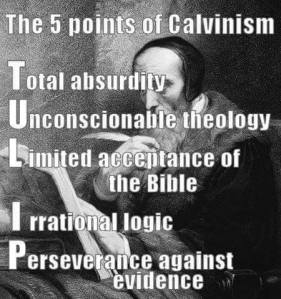
Calvinism is a confusing set of doctrines based on the five points of Calvinism in TULIP. Calvinists are famous for complicating the Bible, for reading Bible verses in a vacuum and for reading the Bible through the filter of some proof text verses with their own preferable interpretation.

Their unfortunate theology frequently leads to contradictions such as Jesus not dying for everyone and God causing people to sin, which they often disregard by stating “God’s ways are higher than your ways” or “who are you to argue against God?“. The very first church fathers (up until close to the advent of Augustine) did not teach anything close to Calvinism which is semi-gnostic in nature. Calvinism is therefore based on the tradition of men rather than on the Bible and the understanding of the very first apostles/saints (see Jude 3).

Col. 2:8 Beware lest anyone cheat you through philosophy and empty deceit, according to the tradition of men, according to the basic principles of the world, and not according to Christ.

If God’s will always happens and if he chooses people for salvation/damnation from the beginning of the world, then it follows that he forced wicked non-elect sinners into this world – who will end up in hell despite totally obeying God at all times. This applies IF you want to be consistent with Calvinism, which so far no Calvinist has ever succeeded to be. Hard core Calvinists are seldom interested in getting rid of their contradictions (such as painting a very dark picture of our Lord) which could easily come true if they only adopted the more Biblical “free will” alternative which does not in any way threaten God’s sovereignty. It is sad to see how they instead prefer to stick with their reformed teachers who make them believe that Jesus did not love everyone and did not die for the whole world.

Here are 10 of some common proof text verses (more details in the links)

1) John 6:39-44 argument about God drawing people, forcing them to be saved

Calvinists just love v. 44 and prefer not to let the other verses destroy their preferred understanding of this particular verse, which on the surface seems to say exactly what they want it to say – if you only ignore the rest of the verses. How would the outcome be if we read this verse in a vacuum?:

Matt. 6:6 But thou, when thou prayest, enter into thy closet, and when thou hast shut thy door, pray to thy Father which is in secret; and thy Father which seeth in secret shall reward thee openly.

Jesus draws ALL men in John 12:32, but even if we cannot come to him unless he draws us and enables us all to be saved, we must still meet the requirements for salvation which boil down to believe. Calvinists also love to quote v. 39, but not v. 40 which includes a condition for salvation – “— every one which SEETH the Son, and BELIEVETH on him, may have everlasting life: and I will raise him up at the last day”.

What is the point with all conditions listed in John 6, such as the requirements to learn, eat, drink, believe, see and come to him? Why not simplify it and say “whomsoever I choose and force to believe in me will be saved” if that is what John really wants to emphasize? In v. 66 we can read about some of his disciples who went back and walked no more with him, and in v. 70 we can read about a person who Jesus chose but who was still lost – Judas. In John 1:6-7 we can read that Jesus came so that “ALL through him might believe”. Why then do not all believe? Because they have chosen to not meet the requirements listed above. God created us TO SEEK HIM and FIND HIM:

Acts 17:26 And hath made of one blood all nations of men for to dwell on all the face of the earth, and hath determined the times before appointed, and the bounds of their habitation;27 THAT THEY SHOULD SEEK THE LORD, if haply they might feel after him, and FIND HIM, THOUGH HE BE NOT FAR FROM EVERY ONE OF US: 28 For in him we live, and move, and have our being; as certain also of your own poets have said, For we are also his offspring.29 Forasmuch then as we are the offspring of God, WE OUGHT NOT to think that the Godhead is like unto gold, or silver, or stone, graven by art and man’s device.30 And the times of this ignorance God winked at; but now COMMANDETH ALL MEN EVERY WHERE TO REPENT:31 Because he hath appointed a day, in the which he will judge the world in righteousness by that man whom he hath ordained; whereof HE HATH GIVEN ASSURANCE UNTO ALL MEN, in that he hath raised him from the dead.

No man can come except the Father draws him, John 6:44?

2) Rom. 8:29-30 argument where God predestines/forces certain individuals to be saved whereas he damns the rest

V. 28 makes it clear that the promises are linked only to those who LOVE GOD. We must have this information in mind when we proceed to v. 29 so that we know to whom the promises are meant. The body of Christ is foreknown and predestined to enter the kingdom of God and reach glorification. There WILL be a body of Christ (the church) entering heaven, and it consists of people who choose to love God. If anyone wants to be part of the body of Christ and the wonderful promises tied to it, he must love God above everything else and endure to the end. (See more under Eph. 2 below.) “Predestination” and “elect” are two Biblical words, but nowhere in the Bible will we see individuals chosen for salvation.

Whom he did predestinate, them he also called and justified and glorified – Rom. 8:29-30

3) Rom. 9 argument where absolutely everything turns out exactly as God wants since no one can resist his will – and where it is not even possible to talk back to God at any time

Calvinists absolutely adore Rom. 9 despite their interpretation that most people are born desperately doomed, but since they do not pay attention to the context they totally misunderstand what Paul is trying to get the Jews to understand. His point is that it is God’s prerogative to arrange the salvation plan in any way he wants, including making the salvation offer opened also for the gentiles – and as we have learned – based on faith rather than being born Jewish, or being “first” as God’s chosen people who were given the law of Moses. That is why he makes the comparison with Jacob and Esau (the first-born), which certainly does not tell us anything about God choosing individuals for salvation. God will show mercy on whomever he will show mercy, but it does not say that he does this unconditionally. This becomes even more clear when we realize that Paul is quoting scriptures, where God was having a dialogue with Moses during Exodus. Furthermore, in Rom. 11 we can read about the branches: “because of unbelief they were broken off”. 

Also Romans 9 shows man’s free will

Mercy on whom I will have mercy:

“I will have mercy on who I will have mercy”, but not unconditionally – Rom. 9:15

Jacob and Esau:

God did not hate Esau before he was born – Romans 9:13

In Jeremiah 18 we can read about the clay (a picture of Israel) being marred in the potter’s hands. Clearly no potter wants his clay marred, forcing him to start over again with the hope that it will turn better the next time. The chapter makes it clear that Israel has the opportunity to repent and to become obedient, and if they do God will not treat them harshly as he threatens to do. Rom. 9 does not say that God  is the one “fitting” individuals for destruction. If people are prepared for destruction, it is their own doing due to their way of living. Why would God have to “endure with much longsuffering” if people always obeyed him? There is a wonderful place prepared for the vessels of mercy, and anyone can reach that place. 2 Tim. 2:21 tells us that MAN is expected to PURGE HIMSELF from the vessels of dishonor, and if he does he will be a vessel unto HONOR. Needless to say that Calvinists do not appreciate that verse, and similar verses, at all.

The potter and the clay:

The potter acts depending on the clay – we have a free will – Romans 9

Pharaoh is said in the Bible to have hardened his own heart. If someone has the opportunity to do the right thing and obey the only true God and still chooses to disobey him, it is possible to phrase it as though “God hardened his heart”, because if God had not provided this particular opportunity to choose the right thing, Pharao could not have been expected to choose it. By presenting Pharaoh with this option, likely knowing he would not choose the right thing, “God hardened his heart”. Or Pharaoh hardened his heart, whatever you prefer since it boils down to the same thing. Since Pharaoh’s heart was hardened, it shows that it was not completely hard before this point. Yet, Calvinists often teach that the non-elects’ hearts are as hard as they could be. The Bible says that it is certainly possible for man to harden his heart – naturally against God’s will:

Ex. 9:17 AS YET EXALTEST THOU THYSELF AGAINST MY PEOPLE; THAT THOU WILT NOT LET THEM GO?

Ex 9:34 And when Pharaoh saw that the rain and the hail and the thunders were ceased, he sinned yet more, and hardened his heart, he and his servants. (Here we can read that Pharao SINNED by hardening his heart, so if we want to believe God is the one hardening it, then GOD is the one who forced Pharao to sin.)

Jer. 4:4 Circumcise yourselves to the LORD, and take away the foreskins of your heart,ye men of Judah and inhabitants of Jerusalem: lest my fury come forth like fire, and burn that none can quench it, because of the evil of your doings.

Hebr. 3:7 Wherefore as the Holy Ghost saith, To day if ye will hear his voice, 8 HARDEN NOT YOUR HEARTS, as in the provocation, in the day of temptation in the wilderness

Rom. 1:28 And even as they did not like to retain God in their knowledge, God GAVE THEM OVER TO A REPROBATE MIND, to do those things which are not convenient;—

Pharaoh’s heart:

JOSEPH was sold as slave by his BROTHERS – God meant EVIL for GOOD? – Gen. 50:20

4) Phil. 2:13 argument that God is the one making you do all the stuff that you do

If God is the one making us do good things, and actually also bad things since nothing happens against his will (if Calvinism is true), then naturally God alone must be blamed if we lack fruit in our lives. Apparently he did not place the “will” in us to show good fruit, and who can resist his will? So if we sin, we can certainly say “God made me do it”. Still, Paul is telling the Philippians how they should and should not do things, indicating that they might make mistakes. He even indicates that he himself might labor “in vain”, which would not make sense if God is the one making him do the things he does.

Phil. 2:12Wherefore, my beloved, as ye have always obeyed, not as in my presence only, but now much more in my absence, WORK OUT YOUR OWN SALVATION WITH FEAR AND TREMBLING.

14Do all things without murmurings and disputings:15THAT ye may be blameless and harmless, the sons of God, without rebuke, in the midst of a crooked and perverse nation, among whom ye shine as lights in the world;16Holding forth the word of life; that I may rejoice in the day of Christ, that I have not run in vain, neither laboured in vain.

If we draw near to God, he will draw near to us, and the holy Spirit will fill us with an improved strength to live holy lives and bear good fruit.

God works in you both to WILL and to DO as per Phil 2:13?

5) John. 10:28-29 argument about Jesus choosing his sheep and forcing them to stay with him

These two verses are popular, but seldom are they combined with the previous v. 27 which identifies WHO the sheep are in v. 28-29. They are the ones who HEAR his voice and FOLLOW him, wich are requirements. No MAN is able to pluck them out of Jesus’ hands, but the verses do not say that men cannot leave on their own accord – without being plucked out by someone else. We do not lose our free will when we decide to follow Jesus, and we are still able to choose to obey or disobey.

Jesus sheep: I give them eternal life and they shall never perish? – John 10:28

6) Eph. 4:30 argument that we are sealed until the day of redemption and once saved always saved

The verse does not say that we are sealed/saved until the day of redemption but we are sealed UNTO or FOR the day of redemption. On the day of redemption only those with the seal will be saved, and God can provide us with this type of seal provided that we do our part of the deal. Up until the time of redemption a seal can certainly be broken. To be sealed is to be marked, and if we have the holy Spirit and are led by him, we are certainly a unique group of people and sealed/marked and separate from the world. During the old testament it was the circumcision that was the seal (for men) demonstrating that a man belonged to God, but neither this seal indicated that the sealed/marked person could not choose to wander away from God. We do not lose our free will (to obey or disobey) only because we are marked with the seal.

Sealed UNTO the day of redemption, but a seal can be broken Eph. 4:30

7) Eph. 2:1-2 argument that individuals are chosen for salvation/damnation before they are even born

Ephesians 1-2 speaks about a corporate election. The body of Christ (the church) will be going to heaven, which was planned and known from the beginning of the world. Jesus knew that he would not die in vain, and that there would be a group of people who would choose to believe in him and endure to the end. Anyone is free to join this body of Christ which is predestined to go to heaven. Compare it with a bus that is going to a certain destination with a number of passengers  – which are those who choose to turn up, show their tickets and remain on the bus. Something that is frequently mentioned is that the wonderful promises are connected to those who are IN HIM. It is THROUGH HIM that we can reach the kingdom of God, so we must make sure to be IN CHRIST – or else the promises are not for us. To be “elect” is to be precious/special. Israel was also “elect” (and certain angels were as well) but this does not mean that all Israel will be saved. A ”guarantee receipt” can be a great value for you because it entitles you (if it has not expired) to certain rights, but if you throw it away or if you lose it, then it will not do you much good despite all the promises that are listed on it. Moreover, it is a very bad idea to be dead in trespasses and sins. Sins separate us from God and make us spiritually dead. And people are not born as children of wrath.

It’s a choice to be CHILDREN OF WRATH – Ephesians 2

8) Acts 4:26-28 argument that Judas was predestined to sin by betraying Jesus

There is no darkness in God. The Bible is clear that he does not tempt anyone, much less causes people to sin. If God has forced Judas to betray Jesus, Judas really should be awarded a place in paradise – as a thanks for obeying God to 100%. Yet we know that it would have been better if he had not been born. Judas SINNED by betraying Jesus.

Matt. 26:24 The Son of Man indeed goes just as it is written of Him, but woe to that man by whom the Son of Man is betrayed! It would have been good for that man if he had not been born.

Jesus death was predetermined but it was not necessary to cause Judas or anyone else to be involved in this plan. There was no shortage of people who wanted to betray and kill Jesus, so God did not have to influence anyone to do it. Jesus death was prophesied about, but prophesies normally entail something that is known (not predestined) to take place in the future. The one prophesying is not causing the prophesied events to take place. God can naturally cause things to take place if he wants, like he did with the global flood, the return of the son in the last days, etc, but those unique exceptions hardly mean that he causes all things to line up as he wants. Had Judas never betrayed Jesus, this event would not have been prophesied about unless we are talking about a false prophesy which is not from God. It was not GOD who placed the desire to harm Jesus inside Judas but SATAN.

Joh. 13:And supper being ended, the devil having now put into the heart of Judas Iscariot, Simon’s son, to betray him 

Acts 2:23 Him, being delivered by the determinate counsel and FOREKNOWLEDGE of God, YE have taken, and BY WICKED HANDS have crucified and slain? 

Judas was not predestined to betray Jesus, Acts 4:28

9) Acts 13:48 argument that God ordains (forces) individuals to believe in him, whereas the rest have no chance to do the same since God has not provided them with this opportunity

This verse alone does not mention the criteria for God’s choice to ordain individuals, unlike many other verses which clarify that it’s our FAITH that is the criteria. Neither does this verse suggest that God’s appointing is the CAUSE for people’s faith. According to Adam Clarke, the original Greek word ”includes no idea of preordination or predestination of any kind” (“Commentary on Acts 13:48”). The original Greek word simply means “disposed” (to set in position), and therefore the verse could be translated “as many as were disposed (or who set themselves in such a disposition) to eternal life believed”.  Their disposition to receive the gospel is contrasted with the disposition of the Jews just two verse before, and the Jews had chosen another path. So those who judge themselves unworthy of everlasting life did not believe, but those who disposed themselves to eternal life believed, and whether they believed or not depended on whether their heart rejected or accepted the Gospel which was preached to them.

Acts 13:46 Then Paul and Barnabas waxed bold, and said, It was necessary that the word of God should first have been spoken to you: but SEEING YE PUT IT FROM YOU, AND JUDGE YOURSELVES UNWORTHY of everlasting life, lo, we turn to the Gentiles.

As many as were ordained to eternal life believed, but they were not FORCED Acts 13:48

10) Eph 2:8-9 argument where faith is a gift offered to only a few lucky people, leaving the rest for damnation

If we are not able to have faith unless God enables us to have this faith, and if God chooses to prevent people from ever getting faith, then it follows that God alone must be blamed if we do not believe in him. Or do non-elect have the choice to have faith in him? If no, then they are innocent victims in the hands of a cruel God who created them for the sole reason to send them to hell – for not believing in him, which he himself prevented them from doing. Not much within Calvinism makes sense.

We are saved by grace (God’s kindness) but through FAITH – which is a requirement for salvation. The Bible also says that if we love God – which we do if we truly have faith in him – then we OBEY him. Eph. 2-8-9 does not say that faith is a gift but that SALVATION is a gift, and this is certainly true since we cannot cleanse and save ourselves. It is also true that we do not earn our salvation by anything we do (or believe), and that we are not saved by either works alone or faith alone (as Jam. 2:24 states). If we dare to continue to v. 10, we can read that we are created to good works that God has prepared that we should WALK in. What happens if we choose not to walk in those good works? Still saved no matter what?

FAITH is not the gift of God in Eph. 2:8-9, but SALVATION is

I might return with 10 more common proof text arguments

Jesus Christ holds the SCEPTER OF RIGHTEOUSNESS as God in flesh

Hebrews 1:8 But unto the Son he saith, Thy throne, O GOD, is for ever and ever: A SCEPTRE of righteousness is the SCEPTRE of thy kingdom (KJV)

“Scepter” in the New Testament is a translation from the Greek word rhabdos (Strong’s 4464) which could also be translated as rod or staff.

“Scepter” in the Old Testament is a translation from the Greek word shebet (Strong’s 7626), and can also be translated as per above or as “tribe” or “clan”. Other synonymous words for “rod” in the OT is matteh (Strong’s 4294) and choter (Strong’s 2415).

A scepter is a special staff/rod carried by a king or a high official, and in our past it was used as a token of authority and power of the king. Scepters are similar to a shepherd’s rod, except they are much fancier and way more valuable. Christ is told to have a kingdom, and his symbolic scepter is told to be of “righteousness”. Righteousness is doing what is right, just, pure and pleasing to God, and this means that the Lord Jesus will be totally fair and govern his kingdom righteously.

Below we can find some interesting verses where “scepter”, and also “rod” or “staff” are mentioned.

New Testament (KJV)

Aaron’s rod was one of a kind. It was a sign of authority and power:

Heb. 9:4 Which had the golden censer, and the ark of the covenant overlaid round about with gold, wherein was the golden pot that had manna, and Aaron’s rod that budded, and the tables of the covenant;

Compare the below verse with Jacob’s prophesy in Gen. 49:10, to which the author of Hebrews is referring. It’s interesting that Jacob is said to have been leaning upon the top of his staff when he prophesied about the scepter not leaving Judah until Shiloh comes;“The sceptre shall not depart from Judah—“:

Heb. 11:21 By faith Jacob, when he was a dying, blessed both the sons of Joseph; and worshipped, leaning upon the top of his staff

The disciple John saw an extended version of the vision of the future-coming scepter that both Jacob and Balaam saw much earlier in the OT (see further down below). The book of Revelations mentions a man-child who was to rule the nations with a rod of iron, and there are many more descriptions of Jesus Christ:

Rev. 2:25 But that which ye have already hold fast till I come.26 And he that overcometh, and keepeth my works unto the end, to him will I give power over the nations:27 And he shall rule them with a rod of iron; as the vessels of a potter shall they be broken to shivers: even as I received of my Father.28 And I will give him the morning star.

Rev. 11:1 And there was given me a reed like unto a rod: and the angel stood, saying, Rise, and measure the temple of God, and the altar, and them that worship therein.

Rev. 12:5 And she brought forth a man child, who was to rule all nations with a rod of iron: and her child was caught up unto God, and to his throne.

Rev. 19:11 And I saw heaven opened, and behold a white horse; and he that sat upon him was called Faithful and True, and in righteousness he doth judge and make war.12 His eyes were as a flame of fire, and on his head were many crowns; and he had a name written, that no man knew, but he himself.13 And he was clothed with a vesture dipped in blood: and his name is called The Word of God.14 And the armies which were in heaven followed him upon white horses, clothed in fine linen, white and clean.15 And out of his mouth goeth a sharp sword, that with it he should smite the nations: and he shall rule them with a rod of iron: and he treadeth the winepress of the fierceness and wrath of Almighty God.16 And he hath on his vesture and on his thigh a name written, King Of Kings, And Lord Of Lords.17 And I saw an angel standing in the sun; and he cried with a loud voice, saying to all the fowls that fly in the midst of heaven, Come and gather yourselves together unto the supper of the great God;

Old Testament (NKJV) – using the word shebet

Below is Jacob’s prophesy about the last days concerning Judah. Jacob (Israel) was prophesying over each of his twelve sons and he places the scepter in Judah’s hands. Jacob was speaking of the lineage from which the Messiah would come. The scepter, the sign of power and dominion shall not depart from Judah, Nor a lawgiver from between his feet, Until Shiloh (rest/peace) comes;  And to Him shall be the obedience of the people”. People were apparently supposed to be obedient to the one holding the scepter or this “Shiloh” who is understood to be the Messiah. The prophesy also suggests that people can trust that the scepter will at least remain in Judah until his arrival. (There is no mention of what will take place after his coming.) From David’s time until the exile, the scepter as always been in Judah. The Roman empire affected the area at the time of the birth of Jesus, and in him both the priesthood and the kingship would be synchronized. Around the time of his death the Jews suggested “We have no king but Caesar” (John 19:15).

We also recognize more descriptions of the son of man (Jesus Christ) from Revelations:

Gen. 49:“Judah, you are he whom your brothers shall praise; Your hand shall be on the neck of your enemies; Your father’s children shall bow down before you.9 Judah is a lion’s whelp; From the prey, my son, you have gone up. He bows down, he lies down as a lion; And as a lion, who shall rouse him?10 The scepter shall not depart from Judah, Nor a lawgiver from between his feet,Until Shiloh comes; And to Him shall be the obedience of the people.11 Binding his donkey to the vine, And his donkey’s colt to the choice vine, He washed his garments in wine, And his clothes in the blood of grapes.12 His eyes are darker than wine, And his teeth whiter than milk.

Balaam gave numerous prophesies about a star that would come out of Jacob who among other things would be brought out of Egypt.

Numbers 24:1 Now when Balaam saw that it pleased the Lord to bless Israel, he did not go as at other times, to seek to use sorcery, but he set his face toward the wilderness. 2 And Balaam raised his eyes, and saw Israel encamped according to their tribes; and the Spirit of God came upon him.3 Then he took up his oracle and said:“The utterance of Balaam the son of Beor,The utterance of the man whose eyes are opened,4 The utterance of him who hears the words of God,Who sees the vision of the Almighty,Who falls down, with eyes wide open:5 “How lovely are your tents, O Jacob! Your dwellings, O Israel!6 Like valleys that stretch out, Like gardens by the riverside, Like aloes planted by the Lord,Like cedars beside the waters.7 He shall pour water from his buckets, And his seed shall be in many waters.“His king shall be higher than Agag, And his kingdom shall be exalted.8 “God brings him out of Egypt; He has strength like a wild ox; He shall consume the nations, his enemies; He shall break their bones And pierce them with his arrows.9 ‘He bows down, he lies down as a lion; And as a lion, who shall rouse him?’“Blessed is he who blesses you, And cursed is he who curses you.”—17 “I see Him, but not now;I behold Him, but not near; A Star shall come out of Jacob; A Scepter shall rise out of Israel, And batter the brow of Moab, And destroy all the sons of tumult. 18 “And Edom shall be a possession; Seir also, his enemies, shall be a possession,While Israel does valiantly.19 Out of Jacob One shall have dominion, And destroy the remains of the city.”

Hosea 11:1 “When Israel was a child, I loved him, And out of Egypt I called My son.

Matt. 2:13 Now when they had departed, behold, an angel of the Lord appeared to Joseph in a dream, saying, “Arise, take the young Child and His mother, flee to Egypt, and stay there until I bring you word; for Herod will seek the young Child to destroy Him.”14 When he arose, he took the young Child and His mother by night and departed for Egypt,15 and was there until the death of Herod, that it might be fulfilled which was spoken by the Lord through the prophet, saying, “Out of Egypt I called My Son.

In the book of Esther we find an interesting story involving a king’s scepter. The queen Esther wanted to speak to the powerful king about an urgent matter and she hoped to find favor in his site so that she could continue to live, despite approaching him without first being asked for. The king chose to do his part, holding out his scepter, and Esther did her part by touching the top of it. This fortunate combination meant that Esther would get life instead of death. In comparison, we may all approach the throne of God without fear, because his son Jesus Christ always has his scepter extended to us. Our job is to repent from our sins to become cleansed and righteous:

Esther 4:11 “All the king’s servants and the people of the king’s provinces know that any man or woman who goes into the inner court to the king, who has not been called, he has but one law: put all to death, except the one to whom the king holds out the golden scepter, that he may live. Yet I myself have not been called to go in to the king these thirty days.”

Esther 5:2 So it was, when the king saw Queen Esther standing in the court, that she found favor in his sight, and the king held out to Esther the golden scepter that was in his hand. Then Esther went near and touched the top of the scepter.

Ps. 45 is introduced with this information: “The Glories of the Messiah and His Bride To the Chief Musician. Set to “The Lilies.”A Contemplation of the sons of Korah. A Song of Love”. Psalms/songs in the Bible do not contain any kind of falsehood, but we must be prepared for a certain extent of poetic expressions, comparisons, analogies and metaphors which are not supposed to be understood literally. This particular song seems to be talking about an earthly king, with comparisons with a heavenly king and God himself. V. 45:6 is the source of the famous expression in Heb. 1:8, where God (the Father) is talking to God (the son). Since the long and detailed expression is about God the son in Heb. 1, it is also about God in Ps. 45. We can see references to the Messiah also in Ps. 45 – someone being on the right hand side, a mighty one, being the most fair, riding with righteousness, being anointed with oil, being worshiped, praised, etc. (Read my article about Heb. 1:8 here.):

Ps. 45:1 My heart is overflowing with a good theme; I recite my composition concerning the King;
My tongue is the pen of a ready writer.2 You are fairer than the sons of men; Grace is poured upon Your lips; Therefore God has blessed You forever.3 Gird Your sword upon Your thigh, O MIGHTY ONE,With Your glory and Your majesty.4 And in Your majesty ride prosperously because of truth, humility, and righteousness; And Your right hand shall teach You awesome things.5 Your arrows are sharp in the heart of the King’s enemies; The peoples fall under You.6 Your throne, O God, is forever and ever; A scepter of righteousness is the scepter of Your kingdom.You love righteousness and hate wickedness; Therefore God, Your God, has anointed You With the oil of gladness more than Your companions.—11 So the King will greatly desire your beauty; Because He is your Lord, worship Him.—17 I will make Your name to be remembered in all generations; Therefore the people shall praise You forever and ever.

Note Ps. 45:7 about joy “Therefore God, Your God, has anointed You With the oil of JOY NASB, and compare with Hebrews again:

Heb. 12:2 Let us fix our eyes on Jesus, the author and perfecter of our faith, who for the JOY that was set before him endured the cross, scorning its shame, and sat down at the right hand of God

John 3:29 He who has the bride is the bridegroom; but the friend of thebridegroom, who stands and hears him, rejoices greatly because of the bridegroom’s voice. Therefore this joy of mine is fulfilled.

Is. 61:10 I will greatly rejoice in the Lord, My soul shall be joyful in my God; For He has clothed me with the garments of salvation, He has covered me with the robe of righteousness, As a bridegroom decks himself with ornaments, And as a bride adorns herself with her jewels.

“It despises the scepter of my son” according to a prophesy of Ezekiel:

Ez. 21:8 Again the word of the Lord came to me, saying, 9 “Son of man, prophesy and say, ‘Thus says the Lord!’ Say:A sword, a sword is sharpened And also polished!10 Sharpened to make a dreadful slaughter, Polished to flash like lightning! Should we then make mirth? It despises the scepter of My son, As it does all wood.—13 “Because it is a testing, And what if the sword despises even the scepter? The scepter shall be no more,”says the Lord God.14 “You therefore, son of man, prophesy, And strike your hands together. The third time let the sword do double damage. It is the sword that slays,The sword that slays the great men, That enters their private chambers.

Old Testament  (NKJV) – using the word matteh

There was a lot of focus on the rod that Moses (and Aaron) used during Exodus. Moses had great use for it when he showed others the power of God, and proved that he himself had been given authority to be the leader of the Israelites on their journey:

Ex. 4:1 Then Moses answered and said, “But suppose they will not believe me or listen to my voice; suppose they say, ‘The Lord has not appeared to you.’”2 So the Lord said to him, “What is that in your hand?”He said, “A rod.3 And He said, “Cast it on the ground.” So he cast it on the ground, and it became a serpent; and Moses fled from it. 4 Then the Lord said to Moses, “Reach out your hand and take it by the tail” (and he reached out his hand and caught it, and it became a rod in his hand),5 “that they may believe that the Lord God of their fathers, the God of Abraham, the God of Isaac, and the God of Jacob, has appeared to you.”8 “Then it will be, if they do not believe you, nor heed the message of the first sign, that they may believe the message of the latter sign. 9 And it shall be, if they do not believe even these two signs, or listen to your voice, that you shall take water from the river and pour it on the dry land. The water which you take from the river will become blood on the dry land.”

Ex. 7:19 Then the Lord spoke to Moses, “Say to Aaron, ‘Take your rod and stretch out your hand over the waters of Egypt, over their streams, over their rivers, over their ponds, and over all their pools of water, that they may become blood. And there shall be blood throughout all the land of Egypt, both in buckets of wood and pitchers of stone.

Ex. 14:16 But lift up your rod, and stretch out your hand over the sea and divide it. And the children of Israel shall go on dry ground through the midst of the sea.

Num. 20:Then the Lord spoke to Moses, saying, Take the rod; you and your brother Aaron gather the congregation together. Speak to the rock before their eyes, and it will yield its water; thus you shall bring water for them out of the rock, and give drink to the congregation and their animals.”So Moses took the rod from before the Lord as He commanded him.

Each tribe also had rods, but their rods cannot be compared with the rod that Moses possessed:

Num. 17:2“Speak to the children of Israel, and get from them a rod from each father’s house, all their leaders according to their fathers’ houses—twelve rods. Write each man’s name on his rod.

Jonathan was involved in a dramatic story where he dipped his rod into honey in order to eat from it:

1 Sa 14: 26 And when the people had come into the woods, there was the honey, dripping; but no one put his hand to his mouth, for the people feared the oath. 27 But Jonathan had not heard his father charge the people with the oath; therefore he stretched out the end of the rod that was in his hand and dipped it in a honeycomb, and put his hand to his mouth; and his countenance brightened. 28 Then one of the people said, “Your father strictly charged the people with an oath, saying, ‘Cursed is the man who eats food this day.’” And the people were faint.—42 And Saul said, “Cast lots between my son Jonathan and me.” So Jonathan was taken. 43 Then Saul said to Jonathan, “Tell me what you have done.”And Jonathan told him, and said, “I only tasted a little honey with the end of the rod that was in my hand. So now I must die!”

A psalm by David replete with references to the Messiah Jesus Christ, such as “The Lord said to my Lord”. Jesus Christ is called Lord of Lords and he is a priest forever, just like it says in Heb. 7:21-24. It is out of Zion from where the rod of strength will come. :

Ps. 110:1 The Lord said to my Lord, “Sit at My right hand, Till I make Your enemies Your footstool.”2 The Lord shall send the rod of Your strength out of Zion. Rule in the midst of Your enemies!3 Your people shall be volunteers In the day of Your power; In the beauties of holiness, from the womb of the morning, You have the dew of Your youth.4 The Lord has sworn And will not relent,“You are a priest forever According to the order of Melchizedek.”The Lord is at Your right hand; He shall execute kings in the day of His wrath.6 He shall judge among the nations, He shall fill the places with dead bodies, He shall execute the heads of many countries.

Heb. 7:21 (for they have become priests without an oath, but He with an oath by Him who said to Him: “The Lord has sworn And will not relent, ‘You are a priest forever According to the order of Melchizedek’”),—24 But He, because He continues forever, has an unchangeable priesthood.

Old Testament (NKJV) using the word choter 

A rod shall come forth out of the stem of Jesse (king David’s father), and a branch shall grow out of his roots. The Messiah would come from king David’s blood line:

Is. 11:1 There shall come forth a rod out of the stem of Jesse, and a branch shall grow out of his roots.

150 things we must DO to get saved, and the myth of salvation by FAITH ALONE

”Ye see then how that BY WORKS a man is JUSTIFIED, and NOT by faith only” – Ja. 2:24

You will sometimes hear that we do not need to do anything at all to be saved apart from just having faith in God, because Jesus did all the rest for us. Some will even tell you that the salvation formula is “Faith + nothing = salvation”.  The Bible, however, tells us that we must show our faith by doing good works – and without serving two masters. There is no salvation unless there is true REPENTANCE, which does not mean “oops!”, but is a total change of heart where you confess your sins, make a complete u-turn and start walking in the light with Jesus. Faith without works is dead. Below are not really 150 different things we must do, but at least 150 verses which describe things we must do. All can be wrapped up in the one commandment “love God with all your heart and your neighbor as yourself”. 

In order to be saved, the Bible tells you to … (NKJV if nothing else stated):

  1. ABIDE IN JESUS, to get eternal life – 1 John 2:24-25,28
  2. ABIDE IN JESUS, in order to not sin and to know him – 1 John 3:6
  3. ABIDE IN JESUS, so that he will abide in you, and you will not be thrown in the fire – John 15:4-7
  4. ABIDE IN THE DOCTRINE OF CHRIST and do not transgress it, in order to have God – 2 John 1:9
  5. ABSTAIN FROM FLESHLY LUSTS, which war against the soul – 1 Pet 2:11
  6. AGREE WITH YOUR ADVERSARY quickly, lest he delivers you to the judge – Matt. 5:25
  7. ACKNOWLEDGE THE SON, to have the Father – 1 John 2:23
  8. BE A DOER OF THE LAW, to be justified – Rom. 2:13-14
  9. BE A DOER OF THE WORD AND NOT A HEARER ONLY, to not deceive yourself – Ja. 1:22
  10. BE A FAITHFUL SERVANT OF THE LORD, in order to enter into the joy of the Lord and not be cast into the outer darkness – Matt. 25:23,30
  11. BE A HOLY AND UNDEFILED TEMPLE, in order to not be destroyed – 1 Cor. 3:16-17
  12. BE A PEACEMAKER, in order to be called a child of God – Matt. 5:9
  13. BE A SLAVE TO GOD, to be set free from sin, and to get everlasting life – Rom. 6:22
  14. BE CONVERTED AND BECOME LIKE LITTLE CHILDREN, in order to enter the kingdom of heaven – Matt. 18:3
  15. BE DILIGENT, to present yourself approved to God – 2 Tim. 2:15
  16. BE DILIGENT TO ENTER THE REST, lest you fall due to disobedience – Hebr. 4:11
  17. BE DILIGENT TO MAKE YOUR ELECTION SURE, to get an entrance into the everlasting kingdom – 2 Pet. 1:10-11
  18. BE GENTLE TO ALL, able to teach, patient, in humility correcting those who are in opposition, to be granted repentance and be a servant of the Lord – 2 Tim. 2:24-25
  19. BE HUMBLE, to get grace – Ja. 4:6
  20. BE LED BY THE SPIRIT, in order to not be under the law – Gal. 5:18
  21. BE OBEDIENT TO GOD, in order to be righteous and a slave to God instead of sin – Rom. 6:16
  22. BE PATIENT AND AVOID THE MARK OF THE BEAST, to keep your name in the book of life – Rev. 16:2, Rev. 13:8-10
  23. BEAR GOOD FRUIT, to not be cut down and thrown in the fire – Matt. 7:19
  24. BEAR FRUIT WORTHY OF REPENTANCE, to not be thrown into the fire – Matt. 3:8-10, John 15:2
  25. BEAR ONE ANOTHER’S BURDENS, to fulfill the law of Christ – Gal. 6:2
  26. BELIEVE THAT JESUS IS THE ”I AM”, to not die in your sins – John 8:24-25, 28, 58
  27. BEWARE, LEST YOU ALSO FALL FROM YOUR OWN STEADFASTNESS, being led away with the error of the wicked – 2 Pet. 3:17
  28. BRIDLE YOUR TONGUE, to not deceive your heart and be in a useless religion – Ja. 1:26
  29. CALL ON THE NAME OF THE LORD, to be saved – Rom. 10:13
  30. CLEANSE YOURSELF, in order to be a vessel of honor and sanctified – 2 Tim. 2:21
  31. CONTINUE IN THE HOLY SCRIPTURES, which enables you to be wise for salvation – 2 Tim. 3:14-15
  32. CONTINUE IN THE FAITH, GROUNDED AND STEADFAST, so that Jesus will present you as holy and blameless in his sight – Col. 1:22-23
  33. CONFESS JESUS BEFORE MEN – so that Jesus will confess you before the Father – Matt. 10:32
  34. CONFESS THAT JESUS IS CHRIST AND HAS COME IN THE FLESH, in order to not be of Antichrist’s spirit and be a deceiver – 1 John 4:2-3, 2 John 1:7
  35. CONFESS THAT JESUS IS THE SON OF GOD, in order to abide in God – 1 John 4:15
  36. CONFESS WITH YOUR MOUTH the Lord Jesus, in order to be saved – Rom. 10:9-10
  37. COME TO THE LIGHT and expose your deeds, to be a person who does the truth – John 3:21
  38. COMPETE FOR THE PRIZE, to obtain an imperishable crown – 1 Cor. 9:25
  39. COMPETE ACCORDING TO THE RULES, in order to be crowned, and BE FIRST in order to partake of the crops – 2 Tim. 2:5-6
  40. CONTINUE IN GOD’S GOODNESS, in order to not be cut off from the olive tree – Rom. 11:2
  41. DENY YOURSELF, TAKE UP YOUR CROSS AND FOLLOW JESUS, in order to come after him and be his disciple – Mark. 8:34, Luke 14:27
  42. DO ALL THINGS WITHOUT COMPLAINING AND DISPUTING, so that you may become blameless and a child of God without fault – Phil. 2:14-15
  43. DO NOT TAKE AWAY FROM THE BOOK OF THIS PROPHESY, or God will take away your part of the book of life and from the holy city – Rev. 22:18-19
  44. DO NOT LIVE IN AN UNRIGHTEOUS WAY, or you will be affected by God’s wrath – Rom. 1:18
  45. DO NOT TURN THE GRACE OF GOD INTO LEWDNESS, to not be condemned – Juda 1:4
  46. DO NOT BE a fornicator, an unclean person or covetous man, in order to inherit the kingdom of God – Eph. 5:5
  47. DO HIS COMMANDMENTS, to get the right to the tree of life and be able to enter through the gates into the city – Rev. 22:14
  48. DO GOOD, in order to be resurrected to life – John 5:29
  49. DO GOOD, be rich in good works, ready to give/share, that you may lay hold on eternal life – 1 Tim. 6:18-19
  50. DO GOOD DEEDS with patience, to get eternal life – Rom. 2:6-8
  51. DO GOOD WORKS, in order to be righteous/justified and not have a dead faith – Ja. 2:14-26
  52. DO GOOD WORKS and be righteous, in order to inherit the kingdom of God, like give food/drink, provide shelter for strangers, clothe the naked, visit the sick/prisoners, etc – Matt. 25:34-36
  53. DO THE THINGS THAT JESUS SAYS, in order to not fall – Matt. 7:24-27
  54. DO THE WILL OF GOD, to be Jesus’ brother, sister and mother – Matt. 12:50, Mark 3:35
  55. DO THE WILL OF THE FATHER, in order to enter the kingdom of heaven – Matt. 7:21
  56. DO THE WILL OF GOD, to receive the promise – Hebr. 10:36
  57. DO THE WILL OF GOD, in order to abide for ever – 1 John 2:17
  58. DO THE WILL OF GOD, in order to be heard by him – John 9:31
  59. DO TO OTHERS WHATEVER YOU WANT THEM TO DO TO YOU, in order to fulfill the Law – Matt. 7:12
  60. DO WHATEVER JESUS COMMANDS, in order to be his friend – John 15:14
  61. DISCIPLINE YOUR BODY AND BRING IT INTO SUBJECTION, lest you might become disqualified – 1 Cor. 9:27
  62. DEPART FROM INIQUITY, in order to be known by God – 2 Tim. 2:19
  63. DRINK OF THE WATER GIVEN BY JESUS, to store a fountain of water springing up into everlasting life – John 4:14
  64. EAT THE FLESH OF THE SON OF MAN AND DRINK HIS BLOOD, to be raised up at the last day and get eternal life – John 6:53-56
  65. ENDURE TO THE END, to be saved – Matt. 24:13, Matt. 10:22
  66. ENDURE, AND DO NOT DENY JESUS, in order to reign with him and to not be denied by him – 2 Tim. 2:12
  67. ENDURE TEMPTATION, in order to be approved and to get the crown of life – Ja. 1:12
  68. ENTER BY THE NARROW GATE , to avoid the way that leads to destruction – Matt. 7:13
  69. EXAMINE YOURSELF whether you are in the faith, in order to not be disqualified – 2 Cor. 13:5
  70. FEAR GOD AND WORK RIGHTEOUSNESS, in order to be accepted by him – Acts 10:35
  71. FEAR GOD AND DO NOT BE HAUGHTY, in order to be spared – Rom. 11:20-21
  72. FIGHT THE GOOD FIGHT, and lay hold on eternal life – 1 Tim. 6:12
  73. FIGHT THE GOOD FIGHT, FINISH THE RACE, KEEP THE FAITH and LOVE HIS APPEARING, to get the crown of righteousness – 2 Tim. 4:7-8
  74. FOLLOW JESUS, in order to get eternal life – John 10:27-28
  75. FORGIVE YOUR BROTHER, so that the Father will forgive you – Mark. 11:25, Matt. 6:14-15, Matt. 18:35
  76. GIVE THE MORE EARNEST HEED TO THE THINGS HEARD, lest you drift away – Hebr. 2:1
  77. HOLD STEADFAST TO THE END, to become partakers of Christ – Hebr. 3:14
  78. HOLD FAST TO THE WORD OF JESUS, in order to be saved and to not have believed in vain – 1 Cor. 15:2
  79. HOLD FAST WHAT YOU HAVE, so that no one may take your crown – Rev. 3:11
  80. HUMBLE YOURSELF IN THE SIGHT OF THE LORD, and he will lift you up – Ja. 4:10
  81. HUMBLE YOURSELF UNDER GOD, to get grace and so that he may exalt you in due time – 1 Pet. 5:5-6
  82. IMITATE THOSE WHO THROUGH FAITH AND PATIENCE inherit the promises – Hebr. 6:12
  83. KEEP THE COMMANDMENTS AND LOVE EACH OTHER, in order to abide in God – 1 John 3:23-24
  84. KEEP THE COMMANDMENTS, (Jesus lists 7), in order to enter into life – Matt. 19:16-19
  85. KEEP THE COMMANDMENTS, in order to be loved by the Father – John 14:21
  86. KEEP THE COMMANDMENTS, in order to abide in the love of Jesus – John 15:10
  87. KEEP THE COMMANDMENTS, in order to not be liars but be in the truth – 1 John 2:3-5
  88. KEEP HIS COMMANDMENTS, in order to truly love God and overcome the world – 1 John 5:3-5
  89. KEEP THE COMMANDMENTS, to show that you love Jesus – John 14:15
  90. KNOW the only true God and Jesus Christ who is sent, to get eternal life – John 17:3
  91. LABOUR FOR THE FOOD, which endures to everlasting life – John 6:27
  92. LAY ASIDE ALL FILTHINESS, and receive the implanted word which is able to save your soul – Ja. 1:21
  93. LAY ASIDE all malice, deceit, hypocrisy, envy, and all evil speaking, that you may grow in respect of salvation – 1 Pet. 2:1-2 NASB
  94. LET YOUR CONDUCT BE WORTHY THE GOSPEL OF CHRIST, to get salvation and avoid perdition – Phil. 1:27-29
  95. LET YOUR RIGHTEOUSNESS EXCEED THE RIGHTEOUSNESS OF THE PHARISEES, to enter the kingdom of heaven – Matt. 5:20
  96. LIVE IN HOLINESS and not uncleanness, because rejecting this is to reject God – 1 Thess. 4: 7-8
  97. LIVE RIGHTEOUSLY, in order to inherit the kingdom of God – 1 Cor. 6:9-11
  98. LIVE WITHOUT DEFILEMENT, or causing an abomination/lie, in order to have your name in the Lamb’s book of life – Rev. 21:27
  99. LOVE YOUR ENEMIES, do good to those who hate you, to be the Father’s son – Matt. 5:43-44
  100. LOVE JESUS MORE THAN FAMILY MEMBERS, to be worthy of Jesus – Matt. 10:37
  101. LOVE THE BRETHREN, to pass from death to life – 1 John 3:14
  102. LOVE IN DEED AND IN TRUTH, to remain in God’s love – 1 John 3:17-19, 1 John 2:10
  103. LOVE ONE ANOTHER, to be born of God and abide in him – 1 John 4:7-9, 12
  104. LOVE ONE ANOTHER, to fulfill the law (5 commandments listed summed up in 1) – Rom. 13:8-10
  105. LOVE YOUR BROTHER, in order to not be a liar and to obey God’s commandment – 1 John 4:20-21
  106. NOTE AND AVOID THOSE WHO CAUSE DIVISIONS AND OFFENSES contrary to the true doctrine, in order to not be deceived – Rom. 16:17-18
  107. OBEY JESUS, to get eternal salvation – Hebr. 5:9
  108. OBEY GOD IN FAITH, in order to enter the promised rest – Hebr. 3:18, Hebr. 11:8
  109. OBEY THE GOSPEL OF GOD, in order to be righteous and saved – 1 Pet. 4:17-18
  110. OBEY THE SON, in order to see life and avoid the wrath of God – John 3:36 NASB
  111. OBEY THE GOSPEL OF JESUS, in order to avoid everlasting destruction – 2 Thess. 1:8-9
  112. OBEY THE TRUTH, to not leaven the whole lump – Gal. 5:7-9
  113. OBEY THE TRUTH, in order to purify your soul – 1 Pet. 1:22
  114. OBEY THE TRUTH, in order to not be considered bewitched and having suffered things in vain – Gal. 3:1-4
  115. OPEN THE DOOR FOR JESUS WHEN HE KNOCKS, so that he will come in and dine with you – Rev. 3:20
  116. OVERCOME, in order to be dressed in white garments and not blotted out of the book of life – Rev. 3:5
  117. PRACTICE RIGHTEOUSNESS, to be considered born of Jesus – 1 John 2:29
  118. PRACTICE RIGHTEOUSNESS, to be righteous just like Jesus is righteous – 1 John 3:7
  119. PRACTICE RIGHTEOUSNESS, to be of God – 1 John 3:10
  120. PREACH THE UNPERVERTED GOSPEL, to not be accursed – Gal. 1:8-9
  121. PRESENT YOUR MEMBERS AS SLAVES OF RIGHTEOUSNESS, to be holy– Rom. 6:19
  122. PRESS TOWARD THE GOAL, for the prize of the upward call of God – Phil. 3:14
  123. PUT TO DEATH YOUR MEMBERS, like fornication, uncleanness, passion, evil desire, and covetousness in order to not be affected by the wrath of God which is coming upon the sons of disobedience – Col 3:5-6
  124. PURGE OUT THE OLD LEAVEN, that you may be a new lump and saved on the day of the Lord – 1 Cor. 5:5-7
  125. PURSUE PEACE WITH ALL PEOPLE, AND HOLINESS, without which no one will see the Lord – Hebr. 12:14
  126. PUT OFF THE OLD MAN concerning your former conduct, to not be corrupt through deceitful lusts – Eph. 4:22
  127. PUT TO DEATH THE DEEDS OF THE BODY, in order to live and be a son of God – Rom. 8:13-14
  128. REPENT FOR THE REMISSION OF SINS, to be forgiven and not perish – Luke 3:3, Luke 13:3, Acts 2:38, Acts 11:18
  129. REPENT through godly sorrow, leading to salvation – 2 Cor. 7:10
  130. RUN IN THE RACE, to get the prize – 1 Cor. 9:24
  131. SERVE IN THE NEWNESS OF THE SPIRIT, to not bear fruit to death – Rom. 7:5-6
  132. SERVE GOD ALONE AND NOT MAMMON, to be loyal to God – Matt. 6:24
  133. SERVE THE LORD JESUS HEARTILY, to receive the reward of the inheritance – Col. 3:23-24
  134. SHOW GOOD WORKS, in order to prove that you do not deny God but know him – Titus 1:16
  135. SHOW MERCY, to get mercy on judgment day – Ja. 2:13
  136. SHOW MERCY TO YOUR NEIGHBOR, to inherit eternal life – Luke 10:25-28, 36-37
  137. SOW TO THE SPIRIT, to reap everlasting life – Gal. 6:8
  138. STAND FAST, in order to not be entangled again with a yoke of bondage and Christ will profit you nothing – Gal. 5:1-2
  139. STRIVE TO ENTER THROUGH THE NARROW GATE, to be known by God and be saved – Luke 13:23-24
  140. TAKE HEED if you think you stand, lest you fall – 1 Cor. 10:12
  141. TAKE HEED TO YOURSELF, TO THE DOCTRINE AND CONTINUE IN THEM, for in doing this you will save both yourself and those who hear you – 1 Tim. 4:16
  142. TAKE YOUR CROSS AND FOLLOW JESUS, in order to be worthy – Matt. 10:38
  143. WAGE THE GOOD WARFARE with a good conscience, to not shipwreck your faith – 1 Tim. 1:18-19
  144. WAIT EAGERLY for the second return of Christ, for salvation – Hebr. 9:28
  145. WALK ACCORDING TO THE SPIRIT,  to be in Christ, to fulfill the law and to not be condemned – Rom. 8:1-2, 4-6
  146. WALK ACCORDING TO HIS COMMANDMENTS, to have love – 2 John 1:6
  147. WALK IN THE LIGHT, to be cleansed from your sins – 1 John 1:7
  148. WATCH AND BE SOBER, in order to be prepared and obtain salvation – 1 Thess. 5:6-9
  149. WATCH AND DO NOT FORGET YOUR OIL, or else the son of man will not know you – Matt. 25:12-13
  150. WORK OUT YOUR SALVATION, with fear and trembling – Phil. 2:1

So there is at least some effort involved in order to be a child of God, and you should not trust those who try to make the cross that you must carry light as a feather. Apart from the above examples there are even more verses which tell us what we cannot afford to do if we want to remain saved. In summary these 150 requirements tell us one thing only:

“You shall love the Lord your God with all your heart, with all your soul, with all your strength, and with all your mind, and your neighbor as yourself” (Luke 10:27)

If we believe in Jesus and truly love him, we also stay close to him and get help by the holy Spirit to overcome sin. God is merciful and will absolutely forgive you upon repentance, even if you are guilty of having disobeyed the entire list of requirements.

Micah 6:8 He has shown you, O man, what is good; And what does the Lord REQUIRE of you But to DO JUSTLY,To LOVE mercy, And to WALK HUMBLY with your God?

ADOPTION as a son in the Bible does not equal unconditional salvation

The Biblical “adoption” holds a spiritual meaning

When we hear about an adoption the year 2015, we normally think about a person who assumes the parenting role of a child instead of that child’s biological/legal parents, and in doing so makes the child a permanent family member with all the legal rights. (It’s not common that a parent to either a biological child or an adopted child will choose to disinherit a child, but it has happened.)

The prodigal son actually inherited much of his Father’s wealth while his Father was still alive, but he (the prodigal son) was lost and dead while being away living in sin. “Be glad: for this thy brother was dead, and is alive again; and was lost, and is found” – Luke. 15:32. The Father never stopped loving him or hoping he would repent and return, because God does not want anyone to perish.

The word “adoption” in the Bible is a translation from the Greek word huiothesia (Strong’s 5206). It could refer to the condition of a true follower in Christ who by receiving the Spirit of God becomes a son of God and therefore an heir to his kingdom. It could also refer to the blessed state looked for in the future life, or the relationship that God established with the Israelites. It’s used five times in the Bible, and none of the verses suggest that God unconditionally selects people for adoption/salvation:

Rom. 8:15; 23

The condition for being in Jesus Christ is to walk after the Spirit (obeying God). If a person bears bad fruit or no fruit, he will be cut off the vine (John 15). To be carnally minded is death, but to spiritually minded is LIFE. Paul recognizes that the Romans to whom he writes, are in the Spirit because they live righteous lives. IF the Spirit dwells in us, we also know that our mortal bodies will one day be quickened. “If ye live after the flesh, ye shall die: but if ye through the Spirit do mortify the deeds of the body, ye shall live”. Who are the sons of God, according to Paul? “As many as are led by the Spirit of God, they are the sons of God”. So the condition for being a son of God is to make sure to live by the Spirit, which should be something we can master because we have received the “Spirit of adoption”. IF we are his children (if we walk in the Spirit and live righteous lives), then we also live in the promise that we are HEIRS to the kingdom of God. If we endure in our sufferings, we will also be glorified.

Rom. 8:1 There is therefore now no condemnation to them which are in Christ Jesus, who walk not after the flesh, but after the Spirit.—4 That the righteousness of the law might be fulfilled in us, who walk not after the flesh, but after the Spirit.5 For they that are after the flesh do mind the things of the flesh; but they that are after the Spirit the things of the Spirit.6 For to be carnally minded is death; but to be spiritually minded is life and peace.—9 But ye are not in the flesh, but in the Spirit, if so be that the Spirit of God dwell in you. Now if any man have not the Spirit of Christ, he is none of his.10 And if Christ be in you, the body is dead because of sin; but the Spirit is life because of righteousness.11 But if the Spirit of him that raised up Jesus from the dead dwell in you, he that raised up Christ from the dead shall also quicken your mortal bodies by his Spirit that dwelleth in you.12 Therefore, brethren, we are debtors, not to the flesh, to live after the flesh.13 For if ye live after the flesh, ye shall die: but if ye through the Spirit do mortify the deeds of the body, ye shall live.14 For as many as are led by the Spirit of God, they are the sons of God.15 For ye have not received the spirit of bondage again to fear; but ye have received the Spirit of adoption, whereby we cry, Abba, Father.16 The Spirit itself beareth witness with our spirit, that we are the children of God:17 And IF children, then heirs; heirs of God, and joint-heirs with Christ; if so be that we suffer with him, that we may be also glorified together.—.23 And not only they, but ourselves also, which have the firstfruits of the Spirit, even we ourselves groan within ourselves, waiting for the adoption, to wit, the redemption of our body.28 And we know that all things work together for good to them that love God, to them who are the called according to his purpose.

Rom. 9:4

Here Paul is referring to Israel as a group of people who have the right to be adopted as sons (being God’s own people): “v. 4—who are Israelites, to whom belongs the adoption as sons” (NASB). We know that not all of Israel made it into the promised land, and we know that not all of Israel will eventually be saved/adopted. That is because some of Israel has stumbled on the stumbling stone, and others simply lack faith and live of the world. You can read more about Rom. 9 here and here.

Rom. 9:3 For I could wish that myself were accursed from Christ for my brethren, my kinsmen according to the flesh:4 Who are Israelites; to whom pertaineth the adoption, and the glory, and the covenants, and the giving of the law, and the service of God, and the promises;–24 Even us, whom he hath called, not of the Jews only, but also of the Gentiles?25 As he saith also in Osee, I will call them my people, which were not my people; and her beloved, which was not beloved.26 And it shall come to pass, that in the place where it was said unto them, Ye are not my people; there shall they be called the children of the living God.

Gal. 4:5

Paul viewed the Galatians as christians who had received the holy Spirit, and who therefore had the right to be regarded as God’s adopted sons.This also means that they had been given a guaranteed right to enter the kingdom of God due to being valid heirs. However, a christian must still read the fine print of his guarantee receipt, because he only has this right as long as he remains in faith and remains in the vine. A guarantee receipt is to no use of the holder if he throws it away or forgets where it is. Paul understood this too well, because he asked the Galatians how on earth they could think of turning back to the Jewish law after having known God (and also having been known by him). Paul feared that he might have labored for them in vain and that they might end up not inheriting the kingdom of God. He says (4:20) “I would like to be present with you now and to change my tone; for I have doubts about you” (NKJV). In other verses Paul makes it clear that the Galatians – despite having begun in the Spirit, and despite having been given all the wonderful promises that are tied to those who are in Christ – still risked to have suffered and worked in vain. Paul also told the Galatians that Christ will profit them nothing and that they had fallen from grace! They could of course be restored again if they repented and followed the christian way. A little leaven leavens the whole lump. (Note that Paul was not upset that the Galatians obeyed the moral law, but rather the Jewish law with focus on the ceremonial parts.) NKJV:

Gal. 3:1 O foolish Galatians! Who has bewitched you that you should not obey the truth, before whose eyes Jesus Christ was clearly portrayed among you as crucified?— 3Are you so foolish? Having begun in the Spirit, are you now being made perfect by the flesh?Have you suffered so many things in vain—if indeed it was in vain?”

Gal. 5:1 Stand fast therefore in the liberty by which Christ has made us free, and do not be entangled again with a yoke of bondage. 2 Indeed I, Paul, say to you that if you become circumcised, Christ will profit you nothing.—4 You have become estranged from Christ, you who attempt to be justified by law; you have fallen from grace.—“7 You ran well. Who hindered you from obeying the truth? 8 This persuasion does not come from Him who calls you. A little leaven leavens the whole lump.—15 But if you bite and devour one another, beware lest you be consumed by one another!—18 But if you are led by the Spirit, you are not under the law.19 Now the works of the flesh are evident, which are: adultery, fornication, uncleanness, lewdness, 20 idolatry, sorcery, hatred, contentions, jealousies, outbursts of wrath, selfish ambitions, dissensions, heresies, 21 envy, murders, drunkenness, revelries, and the like; of which I tell you beforehand, just as I also told you in time past, that those who practice such things will not inherit the kingdom of God.”

Gal. 2:26 For you are all sons of God through faith in Christ Jesus.—29 And if you are Christ’s, then you are Abraham’s seed, and heirs according to the promise.

Gal. 4:4 But when the fulness of the time was come, God sent forth his Son, made of a woman, made under the law,5 To redeem them that were under the law, that we might receive the adoption of sons.6 And because ye are sons, God hath sent forth the Spirit of his Son into your hearts, crying, Abba, Father.7 Wherefore thou art no more a servant, but a son; and if a son, then an heir of God through Christ.8 Howbeit then, when ye knew not God, ye did service unto them which by nature are no gods.9 But now, after that ye have known God, or rather are known of God, how turn ye again to the weak and beggarly elements, whereunto ye desire again to be in bondage?10 Ye observe days, and months, and times, and years.11 I am afraid of you, lest I have bestowed upon you labour in vain.12 Brethren, I beseech you, be as I am; for I am as ye are: ye have not injured me at all.—19 My little children, of whom I travail in birth again until Christ be formed in you,20 I desire to be present with you now, and to change my voice; for I stand in doubt of you.—31 So then, brethren, we are not children of the bondwoman, but of the free.

Eph. 1:5 

Just like in the verses above, we are heirs if we are in Jesus Christ. Eph. 1-2 concerns a corporate election where the body of Christ will definitely inherit the kingdom of God. The concept that those who are in HIM will be the ones saved was decided upon already from the foundation of the world. If we are in him, we are also predestined to be adopted. The order of events is something like this:

  1. You believe and trust in Jesus Christ, and you have repented for your sins and decided to walk in the light
  2. After having repented, you have become totally cleansed, righteous and justified
  3. You have therefore been given the holy Spirit (marked), and you are IN HIM, in the vine, in the body of Christ
  4. You are therefore born again, a child of God, an adopted son and therefore an heir to his kingdom
  5. As an heir you have wonderful things to look forward to upon the return of Jesus, where you will be glorified

However, if you’re defecting from Jesus Christ already in the first position, then of course the promises which are tied to all true christians no longer apply for you. They only apply to those who are IN HIM as Eph. 1 says. If the first point no longer applies for you (due to lack of faith, or due to sin which you won’t let go of) then neither do the following points.

Eph. 1:3 Blessed be the God and Father of our Lord Jesus Christ, who has blessed us with every spiritual blessing in the heavenly places in Christ, 4 just as He chose us IN HIM before the foundation of the world, that we should be holy and without blame before Him in love, 5 having predestined us to adoption as sons by Jesus Christ to Himself, according to the good pleasure of His will, 6 to the praise of the glory of His grace, by which He made us accepted IN THE BELOVED.IN HIM we have redemption through His blood, the forgiveness of sins, according to the riches of His grace —10 that in the dispensation of the fullness of the times He might gather together in one all things IN CHRIST, both which are in heaven and which are on earth—IN HIM. 11 IN HIM also we have obtained an inheritance, being predestined according to the purpose of Him who works all things according to the counsel of His will, 12 that we who first trusted IN CHRIST should be to the praise of His glory.13  IN HIM you also trusted, after you heard the word of truth, the gospel of your salvation; IN WHOM also, having believed, you were sealed with the Holy Spirit of promise, 14 who is the guarantee of our inheritance until the redemption of the purchased possession, to the praise of His glory. 15 Therefore I also, after I heard of your faith in the Lord Jesus and your love for all the saints,16 do not cease to give thanks for you, making mention of you in my prayers: 17 that the God of our Lord Jesus Christ, the Father of glory, may give to you the spirit of wisdom and revelation in the knowledge of Him, 18 the eyes of your understanding being enlightened; that you may know what is the hope of His calling, what are the riches of the glory of His inheritance in the saints,19 and what is the exceeding greatness of His power toward us who believe, according to the working of His mighty power (NKJV)

God’s will or man’s will? Bible verses showing clear FREE WILL examples

matt. 12

Verses used to suggest that God’s will always happens

The Bible is replete with verses that show how God is warning, begging, urging, persuading and pleading with people to do his will, and other verses which show his anger, disappointment, sadness, etc, when they do not. Man’s free will choices are very apparent in the Bible, and yet there are christians (like calvinists – if they want to be consistent with their doctrines) who believe that man is not able to act against God’s will at any time. The article would be too long to include all verses which show man’s free will (isn’t that close to 1/3 of the Bible?), but further down below are a few examples.

First a few verses which calvinists often use to support the idea that God’s will (whether people sin or not) always happens. For the most part they try to defend the bible contradictions they themselves produce by suggesting that God has two wills. (Just as though our Lord has conflicting wills, and just as though at least one of them wants man to sin and be evil…). If God’s will always happens – what is SIN? Surely not breaking the God’s commandments which can’t be broken?

Rom. 9:19 Thou wilt say then unto me, Why doth he yet find fault? For who hath resisted his will?

The topic is God’s prerogative to bring about salvation in any way he wants, and Paul is trying to make the jews understand that they are not saved only because they are born jews – Rom 9:2-9; 24-33. He mentions that he has grief in his heart due to being deeply concerned about his countrymen (something that should not bother him, had he trusted in that God’s will always happens), and that the blood line of Jacob will brought forth the Messiah. He also emphasizes that people are being saved due to God’s mercy – but certainly not unconditionally. God has the right to show mercy on those who choose to believe, and harden those who stubbornly sin like Pharaoh did. (The mere fact that God chooses to harden people shows that their hearts were not fully hardened to start with.) If God decides to arrange his salvation plan in this particular way, there is no way anyone can resist his will because it’s his exclusive right. That is the subject of  his “will” here, and it does not say that God can not change his mind and/or let man’s will happen in other areas. We already know from the Bible that God has changed his mind in numerous occasions due to man’s actions – like in response to man’s repentance.

Ps 115:3 But our God is in the heavens: he hath done whatsoever he hath pleased.

Ps 135:5 For I know that the Lord is great, and that our Lord is above all gods.6 Whatsoever the Lord pleased, that did he in heaven, and in earth, in the seas, and all deep places.7 He causeth the vapours to ascend from the ends of the earth; he maketh lightnings for the rain; he bringeth the wind out of his treasuries.8 Who smote the firstborn of Egypt, both of man and beast.

The above are psalms, and psalms can contain poetic language. That is why we should be careful to not use psalms and proverbs to start new doctrines. Yes, God has done whatsoever he pleases, but it does not say that he likes to micro manage human kind nor that he predestines every thing that happens. It could definitely have pleased God to create man with a free will. The point is that no one is like God, and it would not make sense to argue with him or try to find faults. God created man animals and the entire universe in exactly the way he pleased. It pleased God to create man with free will, despite knowing that man might use this will to disobey him. Israel often chose to do just that:

Psalm 81:11 But my people would not hearken to my voice; and Israel would none of me

More examples where God is described as the mighty one who has created everything exactly as he wants:

Is. 46:5 “To whom will you liken Me, and make Me equal And compare Me, that we should be alike?6 They lavish gold out of the bag, And weigh silver on the scales; They hire a goldsmith, and he makes it a god; They prostrate themselves, yes, they worship.—8“Remember this, and show yourselves men; Recall to mind, O you transgressors.9 Remember the former things of old, For I am God, and there is no other; I am God, and there is none like Me,10 Declaring the end from the beginning, And from ancient times things that are not yet done, Saying, ‘My counsel shall stand, And I will do all My pleasure,’—12 “Listen to Me, you stubborn-hearted, Who are far from righteousness: (NKJV)

Isaiah is referring to God’s creation in general terms. God may have created everything as he pleased (the foundation), but this does not mean that he programmed human beings to always obey him. A universe that works in that way (filled with programmed robots) would not please him. Above we can read that man can choose to worship false gods and be stubborn-hearted. They are referred to as transgressors. Transgressors of what? Surely the law of God? They are far from being those righteous people who God would have wanted.

Isaiah 14:21 Prepare slaughter for his children BECAUSE of the iniquity of their fathers, Lest they rise up and possess the land, And fill the face of the world with cities.”—24  The Lord of hosts has sworn, saying,“Surely, as I have thought, so it shall come to pass, And as I have purposed, so it shall stand:25 That I will break the Assyrian in My land, And on My mountains tread him underfoot.Then his yoke shall be removed from them, And his burden removed from their shoulders.26 This is the purpose that is purposed against the whole earth, And this is the hand that is stretched out over all the nations.27 For the Lord of hosts has purposed, And who will annul it? His hand is stretched out, And who will turn it back?” (NKJV)

The horrible events that Isaiah is warning about, are due to man’s actions. Isaiah suggests, that unless the children of the sinful fathers are not killed the same would grow up and act in the very same way as their parents and fill the world with cities (and their wickedness). Who else than a Creator could figure this out with certainty, and who else has the authority to do something about it? Apparently God is not pleased with either the fathers or how the bring up their children. What we can read “will come to pass” above, is not every single detail under the sun, but those things listed in this context.

Jer. 4:27 For thus says the Lord:“The whole land shall be desolate; Yet I will not make a full end.28 For this shall the earth mourn, And the heavens above be black, Because I have spoken. I have purposed and will not relent, Nor will I turn back from it.29 The whole city shall flee from the noise of the horsemen and bowmen.They shall go into thickets and climb up on the rocks.Every city shall be forsaken, And not a man shall dwell in it. (NKJV)

Job 42:2 I know that You can do everything, And that no purpose of Yours can be withheld from You. (NKJV)

Same thing here. It’s about showing that God can do anything he wants, and if he has truly decided to bring something about (like the global flood) it will happen. He might also choose to wait with his decisions depending on mans’ actions.

Eph. 1:7 IN HIM we have redemption through His blood, the forgiveness of sins, according to the riches of His grace 8 which He made to abound toward us in all wisdom and prudence, 9 having made known to us the mystery of His will, according to His good pleasure which He purposed in Himself, 10 that in the dispensation of the fullness of the times He might gather together in one all things IN CHRIST, both which are in heaven and which are on earth—IN HIM. 11 IN HIM also we have obtained an inheritance, being predestined according to the purpose of Him who works all things according to the counsel of His will, 12 that we who first trusted IN CHRIST should be to the praise of His glory.13  IN HIM you also trusted, after you heard the word of truth, the gospel of your salvation; IN WHOM also, having believed, you were sealed with the Holy Spirit of promise, 14 who is the guarantee of our inheritance until the redemption of the purchased possession, to the praise of His glory. (NKJV)

The promises in Eph 1-2 are only tied to those who are IN CHRIST, and we are in Christ only if we believe in him – and naturally show our faith with our deeds. As children of God we have been given the holy Spirit and the promise/guarantee that we will enter the kingdom of God because we belong to the body of Christ. However, this promise is still hinged on the condition of faith/loving God. If we no longer believe or bear fruit (see John 15), we are no longer in Christ. If you get a guarantee receipt you need to read the fine print, and you can’t expect to make use of your receipt if you throw it away. God “works all things according to the counsel of His will”, but this does not mean he has a desire to force salvation on someone, nor save someone who has turned to living in sin. It’s about his marvelous salvation plan, and the wonderful promises to those who are IN CHRIST.

Verses that show that God’s will does not always happenacts 17
Matt. 7:21 Not every one that saith unto me, Lord, Lord, shall enter into the kingdom of heaven; but HE THAT DOETH THE WILL OF MY FATHER which is in heaven.

“He that doeth the will of my Father”? Apparently the Father’s will does not always happen, since Jesus seems to separate those who do the will of his Father from those who do not. If everyone would always do the will of God – whether good or bad – then everyone would enter the kingdom of God, according to this verse.

Matt. 12.50 For WHOSOEVER SHALL DO THE WILL OF MY FATHER which is in heaven, the same is my brother, and sister, and mother. (Mark 3:35)

“Whosoever shall do the will of my Father”? If everyone would always do the will of God – whether good or bad – then the same would be Jesus “brother, and sister, and mother”. (Meaning universalism).

John 7:17 IF ANY MAN WILL DO HIS WILL, he shall know of the doctrine, whether it be of God, or whether I speak of myself.

“If any man will do his will?” Apparently Jesus does not believe that everyone always does the will of God.

John 9:31 Now we know that God heareth not sinners: but if any man be a worshipper of God, and DOETH HIS WILL, him he heareth.

“If any man—doeth his will”? Again, apparently Jesus does not side with the idea that God’s will always happens. Jesus separates those who worship God and obey him (doeth his will) with those who are SINNERS. This suggests that sinners are not doing the will of God (quite obviously since “sin” by definition is an action against God’s commandments).

1 John 2:16 For all that is in the world, the lust of the flesh, and the lust of the eyes, and the pride of life, is not of the Father, but is of the world.17 And the world passeth away, and the lust thereof: but HE THAT DOETH THE WILL OF GOD ABIDETH FOR EVER. 

“He that doeth the will of God abideth for ever”? If everyone would always do the will of God, then everyone would abide for ever. Since everyone does not get saved according to the Bible, it shows that some people are not doing the will of God, and God’s will does not always happen. Moreover, the previous verse tells us that “the lust of the flesh, and the lust of the eyes, and the pride of life, is not of the Father, but is of the world”. No wonder we can read that such things are not of the Father since the things listed are clear sins (of the world). If such worldly things take place, they are obviously against God’s will and “not of the Father” as John plainly states.

Hebr. 10: 36 For you have need of endurance, so that after you have done the will of God, you may receive the promise (NKJV)

Why must we have endurance/patience? What happens if we lack in patience? Would that result in a scenario where we do not always do the will of God? Would we still receive the promise if we failed to show endurance? The author does not seem to think so. Why would he warn us about something that could never take place?

Col. 4:12 Epaphras, who is one of you, a servant of Christ, saluteth you, always labouring fervently for you in prayers, that ye may stand perfect and complete in all the will of God.

Ok, and what would happen if Epaphras would not labor fervently for the Colossians in prayers with the aim to make them stand complete in the will of God? Would they stand perfect and complete in the will of God regardless of prayers? Why pray if everyone always performs the will of God at all times?

Mark 13:14“So when you see the ‘abomination of desolation,’ spoken of by Daniel the prophet, standing WHERE IT OUGHT NOT” (let the reader understand), “then let those who are in Judea flee to the mountains. (NKJV)

“Ought not” according to whom? God?

Luke 12:16 Then He spoke a parable to them, saying: “The ground of a certain rich man yielded plentifully.17 And he thought within himself, saying, ‘What shall I do, since I have no room to store my crops?’ 18 So he said, ‘I will do this: I will pull down my barns and build greater, and there I will store all my crops and my goods. 19 And I will say to my soul, “Soul, you have many goods laid up for many years; take your ease; eat, drink, and be merry.”’ 20 But God said to him, ‘Fool! This night your soul will be required of you; then whose will those things be which you have provided?’21 “So is he who lays up treasure for himself, and is not rich toward God.”

Why did God call the rich man “fool“? Surely it would not be foolish to accomplish God’s will perfectly? This parable seems to be there as a warning, but how could this be if it’s not possible to act in the foolish way that is described in the parable?

Rom. 12:2 And be not conformed to this world: but be ye transformed by the renewing of your mind, that ye may prove what is that good, and acceptable, and perfect, will of God.3 For I say, through the grace given unto me, to every man that is among you, not to think of himself more highly than he ought to think; but to think soberly, according as God hath dealt to every man the measure of faith.

Apparently Paul does not think it’s a good idea to be conformed to this world, and urges us to renew our minds so that we can learn what is the perfect will of God. This means it’s up to us to start this process. Paul continues to tell his readers what they “ought not”, which suggests that they might act in an opposite way which is not approved by God.

Luke 18:1 Then He spoke a parable to them, that men always ought to pray and not lose heart (NKJV)

Jesus does not suggest that only believers ought to pray, but “men” (can be translated all mankind, or men and women) should always pray and not lose heart. We know that not all men do this, so God’s will does not always happen.

1 Tim. 5:13 And besides they learn to be idle, wandering about from house to house, and not only idle but also gossips and busybodies, SAYING THINGS WHICH THEY OUGHT NOT. (NKJV)

So they were saying things which they ought not, according to Paul? Interesting.

Titus 1:10 For there are many insubordinate, both idle talkers and deceivers, especially those of the circumcision, 11 whose mouths must be stopped, who subvert whole households, teaching things which they OUGHT NOT, for the sake of dishonest gain. (NKJV)

More people who are saying things which they ought not.

Hebr. 5:12 For though by this time you OUGHT TO BE teachers, you need someone to teach you again the first principles of the oracles of God; and you have come to need milk and not solid food. (NKJV)

The author of Hebrews clearly does not believe God’s will always happens.

Jam. 3:Out of the same mouth proceed blessing and cursing. My brethren, these things ought not to be so.

If they ought not to be so, then clearly God’s will does not always happen.

Ephesians 6:6 Not with eyeservice, as menpleasers; but as the servants of Christ, doing the will of God from the heart;

Do we have any other option?

Col. 3:23 And whatever you do, do it heartily, as to the Lord and not to men, 24 knowing that from the Lord you will receive the reward of the inheritance; for you serve the Lord Christ. 25 But HE WHO DOES WRONG will be repaid for what he has done, and there is no partiality. (NKJV)

“He who does wrong”? In a world where God’s will always happens?

Acts 7:51 Ye stiffnecked and uncircumcised in heart and ears, ye do always resist the Holy Ghost: as your fathers did, so do ye.

Luke 7:30 But the Pharisees and lawyers rejected the will of God for themselves, not having been baptized by him. (NKJV)

Resisting the Holy Ghost is resisting God.


Acts 13:21 And afterward they desired a king: and God gave unto them Saul the son of Cis, a man of the tribe of Benjamin, by the space of forty years.22 And when he had removed him, he raised up unto them David to be their king; to whom also he gave their testimony, and said, I have found David the son of Jesse, a man after mine own heart, which shall fulfil all my will.

In 1 Sam. 8 we can read that God did not think it was a good idea to set up a king for Israel at this time. In fact, he thought it was a very bad idea and warned the Israelites against it. When they were still adamant about the project, God gave in to their wishes. Still, God ended up regretting making Saul to be a king (1 Sam. 15:11), and in 1 Sam. 13:14 we can even read the reason;  “thou hast not kept that which the Lord commanded thee, clearly showing that Saul did not act according to God’s will. King David did so much better as a King, and even though he did accomplish to be a faithful servant who obeyed God during all his life time we still know there was at least one exception in relation to the matter of Uriah and his wife (1 King. 15:5). That ordeal was evil in the eyes of God (2 Sam. 12:9) and therefore against his will.

Jer. 17:22 Neither carry forth a burden out of your houses on the sabbath day, neither do ye any work, but hallow ye the sabbath day, as I commanded your fathers.23 But they obeyed not, neither inclined their ear, but made their neck stiff, that they might not hear, nor receive instruction.24 And it shall come to pass, if ye diligently hearken unto me, saith the Lord, to bring in no burden through the gates of this city on the sabbath day, but hallow the sabbath day, to do no work therein

Deuteronomy 10:16 Circumcise therefore the foreskin of your heart, and be no more stiffnecked.

More stiff-necked people who refuse to do God’s will, and God is unsure if they will “hearken” to him.

Ez.  16:26 Thou hast also committed fornication with the Egyptians thy neighbours, great of flesh; and hast increased thy whoredoms, to provoke me to anger.27 Behold, therefore I have stretched out my hand over thee, and have diminished thine ordinary food, and delivered thee unto the will of them that hate thee, the daughters of the Philistines, which are ashamed of thy lewd way.

Why would God be angry at fornication and whoredoms if his will always come to pass? And why does God, due to man’s actions (Israel), deliver them “unto the will” of their enemy? Why would he separate the will of Israel’s enemy with his own will, as though they would not be one and the same? This procedure certainly sounds like a punishment against Israel for the only reason that they did not obey God.

Is. 48:17 Thus says the Lord, your Redeemer, The Holy One of Israel: “I am the Lord your God, Who teaches you to profit,Who leads you by the way you should go.18 Oh, that you had heeded My commandments! Then your peace would have been like a river, And your righteousness like the waves of the sea.19 Your descendants also would have been like the sand, And the offspring of your body like the grains of sand; His name would not have been cut off Nor destroyed from before Me.” (NKJV)

Why does God exclaim “Oh, that you had heeded my commandments”? Why all the “would have been”, had his people obeyed him?

Ps. 143:10 Teach me to do thy will; for thou art my God: thy spirit is good; lead me into the land of uprightness.

Why this urgent need? Does not God’s will happen if David is not sufficiently taught to do his will?

Lev. 4:22 When a ruler hath sinned, and done somewhat through ignorance against any of the commandments of the Lord his God concerning things which should not be done, and is guilty;23 Or if his sin, wherein he hath sinned, come to his knowledge; he shall bring his offering, a kid of the goats, a male without blemish:— .27 And if any one of the common people sin through ignorance, while he doeth somewhat against any of the commandments of the Lord concerning things which ought not to be done, and be guilty;28 Or if his sin, which he hath sinned, come to his knowledge: then he shall bring his offering, a kid of the goats, a female without blemish, for his sin which he hath sinned.

“Things which ought not to be done”? I did not think that was possible in a world where God’s will always happens?

Deuteronomy 8:20 As the nations which the Lord destroyeth before your face, so shall ye perish; BECAUSE ye would not be obedient unto the voice of the Lord your God.

“Because ye would not be obedient…” That is the reason for perishing.

Jer. 19:5 They have built also the high places of Baal, to burn their sons with fire for burnt offerings unto Baal, which I commanded not, nor spake it, neither came it into my mind:

Jer. 32:35 And they built the high places of Baal, which are in the valley of the son of Hinnom, to cause their sons and their daughters to pass through the fire unto Molech; which I commanded them not, neither came it into my mind, that they should do this abomination, to cause Judah to sin.

Those couple of verses speak for themselves. People sinned severely and caused others to sin, which naturally didn’t even enter God’s mind that they would do. Throwing children in the fire as an offering to Baal is naturally an abomination and why would God force people to commit such a horrible sin?

Jer. 26:13 Therefore now amend your ways and your doings, and obey the voice of the Lord your God; and the Lord will repent him of the evil that he hath pronounced against you.

Ez. 33:11 Say unto them, As I live, saith the Lord God, I have no pleasure in the death of the wicked; but that the wicked turn from his way and live: turn ye, turn ye from your evil ways; for why will ye die, O house of Israel?

If God’s will always happens, he would not be dependent on man’s actions.

1 Peter 2:15 For such is the will of God that by doing right you may silence the ignorance of foolish men. 16 Act as free men, and do not use your freedom as a covering for evil, but use it as bondslaves of God. (NASB)

We are asked to not use our freedom as a covering for evil. Peter does not believe God’s will automatically takes place.

1 Peter 3:17 For it is better, if it is the will of God, to suffer for doing good than for doing evil. (NKJV)

But surely doing evil would be equally acceptable if all things happen according to the will of God?

Matt. 23: 47 O Jerusalem, Jerusalem, thou that killest the prophets, and stonest them which are sent unto thee, how often would I have gathered thy children together, even as a hen gathereth her chickens under her wings, and ye would not! + Luke 13:34

Exactly.