Tag Archive | paul

It’s a choice to be CHILDREN OF WRATH – Ephesians 2

Children of wrath and God’s election in Ephesians 2

There are some who believe that God randomly selects people to be saved and ignore the rest, and they try to use Ephesians 1-2 as support for this theory. The truth is that God wants ALL people to be saved because he IS a merciful God and he wants us to take after HIM when it comes to showing mercy. (We shouldn’t strive to be merciful to SOME and ignore the majority.)

2 Peter 3:The Lord is not slack concerning his promise, as some men count slackness; but is longsuffering to us-ward, not willing that any should perish, but that ALL should come to repentance

Ezekiel 33:11 Say unto them, As I live, saith the Lord GOD, I have no pleasure in the death of the wicked; but that the wicked turn from his way and live: turn ye, turn ye from your evil ways; for why will ye die, O house of Israel?

Luke 6:36 Be ye therefore merciful, as your Father also is merciful.

In Ephesians we can read about a corporate election, and the body of Christ IS indeed chosen to inherit his kingdom. I believe God decided before the world began that true believers shall inherit his kingdom, but the question is if we as individuals would like to join the body of Christ (the Church) or not. IF we so choose, the wonderful promises are also tied to us. “Elect” is about value and can mean precious, and we are indeed precious if we choose to believe in our Savior and live holy and separate. The book of Ephesians concerns what BELIEVERS can look forward to in the future. Pay attention to how many times IN him, THROUGH him, etc, are mentioned in Ephesians 1-2. Being IN HIM is the condition for being one of the elect! Also pay attention to the warnings addressed to christians. Paulus starts out his letter by addressing FAITHFUL CHRISTIANS who therefore are HOLY and very special (elect):

Ephesians 1

When Paul talks about US he refers to both jews and gentiles who believe in Jesus ChristPaul puts a lot of emphasis on trying to get the jews to understand that they are not on the way to heaven just because they are born jews and are his chosen people. It’s through JESUS that we can be saved. It’s through his blood because only his precious blood can cleanse our sins. What God had decided from eternity past is NOT which individuals to provide faith and eventually save, but rather that whoever is IN HIM (“us” v. 4) are ELECT, and chosen to be holy and blameless before God thanks to the blood of Jesus! The condition is therefore that we must be IN HIM in order to reach the state where we have all the mentioned wonderful promises tied to us.  What is foreknown is that those who are IN HIM will through Jesus Christ be taken up as his holy children. Those who are not IN HIM are not forgiven for their sins and redeemed in his blood, resulting in that they are lost. We as believers have redemption through his blood, and that means we are on the safe side. We are therefore adopted as children and can expect an inheritance, but only as long as we’re not getting off the transportation going to heaven. (Let’s not forget that a son can be disinherited though.) Who is Paul addressing when he mentions all the wonderful promises? The saints. To the faithful in Jesus Christ. No one forced them to be saints and faithful, but they chose to be this by themselves. As such, the wonderful promises that Paul talks about, are theirs, provided of course that they continue on that path.

Eph. 1:1 Paul, an apostle of Jesus Christ by the will of God, TO THE SAINTS which are at Ephesus, and TO THE FAITFFUL in Christ Jesus

V. 5 below uses the word “adoption” but this word didn’t mean exactly the same thing 2000 years ago as it does today in our modern world. The Greek word “huiothesia” refers to the standing of someone who is ALREADY a son and Adoption is thus the inheritance or promise that the son can expect to receive as an heir. Huiothesia is not the same as salvation but it is the promise of God received by those who are believers in Christ Jesus (Gal 3:22-27).  The body of Christ is predestined to God’s kingdom and to receive the inheritance, and the question remains who would like to join and who will remain to the end. The body of Christ is heading there, but are YOU? Join the body-of-Christ-bus, but stay on the bus to the end station!

Eph. 1:Blessed be the God and Father of our Lord Jesus Christ, who hath blessed us with all spiritual blessings in heavenly places IN CHRIST:According as he hath chosen us IN HIM before the foundation of the world, that we should be holy and without blame BEFORE HIM in love:Having predestinated us unto the adoption of children by Jesus Christ to himself, according to the good pleasure of his will,To the praise of the glory of his grace, wherein he hath made us accepted IN THE BELOVED.7 IN WHOM we have redemption THROUGH HIS BLOOD, the forgiveness of sins, according to the riches of his grace

The Holy Spirit is like a  deposit for us christians (and all the spiritual gifts will one day pass away when we enter God’s kingdom), but just like in all legal contracts our particular “contract” with God can be broken (just like the old covenant was broken) if either of the party doesn’t follow the agreement. If you take a loan to buy a car and stop paying for this loan, the car will be seized despite that it was once in your possession. It’s also beneficial to keep your “guarantee receipt” because it entitles you (if it hasn’t expired) to certain rights, but if you throw it away or if you lose it, then it won’t do you much good despite all the promises that are listed on it.

Having the Holy Spirit is often likened with being “sealed”. This doesn’t mean anything unbreakable as shown here, but it means that we are “marked” as very special and holy people who can expect a great inheritance. (As long as we remain in Christ of course.) We are separate from all others who do not have this seal, due to their refusal to repent and believe. The sealing occurs AFTER that we believe, and we can read in Acts 5:32 that the Holy Spirit is given to all those who OBEY him, so belief and obedience must come before we get the Holy Spirit.

Acts 5:32 And we are his witnesses of these things; and so is also the Holy Ghost, whom God hath given to them that OBEY him.

We can also read that God works all things after the counsel of his own will. Does this will exclude the possibility that he might want to place conditions for salvation on us? No of course not, because God can do anything he wants and it’s clear that he require US to repent, believe and show good fruit. He is not going to do this for us. The mystery of his will is that he will one day gather all believers together and give them the inheritance – those who are IN CHRIST! And we can read that TRUST plays an important role in order to be one of the elect. God is not “trusting” for us. WE are supposed to trust in him and we can read that Paul says that trust comes AFTER hearing about the gospel of our salvation.

Eph. 1:Having made known unto us the mystery of his will, according to his good pleasure which he hath purposed in himself:10 That in the dispensation of the fulness of times he might gather together in one all things in Christ, both which are in heaven, and which are on earth; even in him:11 In whom also we have obtained an inheritance, being predestinated according to the purpose of him who worketh all things after the counsel of his own will:12 That we should be to the praise of his glory, who first TRUSTED in Christ.13 In whom ye also TRUSTED, after that ye heard the word of truth, the gospel of your salvation: in whom also after that ye BELIEVED, ye were sealed with that holy Spirit of promise,14 Which is the earnest of our inheritance until the redemption of the purchased possession, unto the praise of his glory.

Paul prayed a lot for the Ephesians, indicating that we can absolutely change the outcome of things with our prayers, and in this case Paul prayed for wisdom. Our prayers can influence others to be enlightened and to know what the HOPE is for God’s calling. We can read once again that it’s the SAINTS who get the benefit of the inheritance. We can also read that the CHURCH, which is the body of Christ will ultimately and once for all be under his feet. This is what the beginning of Ephesians is all about. HIS CHURCH – THE BODY OF CHRIST, consisting of BELIEVING SAINTS.

Eph. 1:16 Cease not to give thanks for you, making mention of you in my prayers;17 That the God of our Lord Jesus Christ, the Father of glory, may give unto you the spirit of wisdom and revelation in the knowledge of him:18 The eyes of your understanding being enlightened; that ye may know what is the HOPE of his calling, and what the riches of the glory of his inheritance in the SAINTS,19 And what is the exceeding greatness of his power to us-ward WHO BELIEVE, according to the working of his mighty power,20 Which he wrought in Christ, when he raised him from the dead, and set him at his own right hand in the heavenly places,21 Far above all principality, and power, and might, and dominion, and every name that is named, not only in this world, but also in that which is to come:22 And hath put all things under his feet, and gave him to be the head over all things to the CHURCH,23 Which is his BODY, the fulness of him that filleth all in all.

Ephesians 2

Ephesians 2 starts with Paul telling us that God has quickened us who were dead in trespasses and sins. I can only say that it’s a very bad choice to  be dead in trespasses and sins! When are we spiritually DEAD according to the Bible? That is when we SIN because this separates us from our holy God.

Isaiah 59:2 But your iniquities have separated between you and your God, and your sins have hid his face from you, that he will not hear.

Luke 15:(The prodigal son) 30 But as soon as this thy son was come, which hath devoured thy living with harlots, thou hast killed for him the fatted calf.—32 It was meet that we should make merry, and be glad: for this thy brother was DEAD, and is alive AGAIN; and was LOST, and is found.

Nowhere in the Bible does it suggest that spiritually “dead” people cannot make any good moral decisions or that they are unable to seek God. And nowhere does it say that we are totally depraved (words not even in the Bible), BORN as children of wrath or born with a sinful nature. On the contrary, even evil unbelievers can do much good, as can be seen here. How then do we become quickened/alive from the predicament that our sin has brought us into? We must of course REPENT for our sins and let the blood of Jesus cleanse us so that we can be born again and become righteous! Then we are no longer dead since we are alive in Christ and new persons. He removed all traces of sins on our account and we have left the old man behind. Paul explains that the Ephesians in time PAST walked in sin, but he doesn’t expect them to continue like that. Also note that in order to commit the sins that Paul lists, you must at least be an ADULT first. Babies are not aware of the law and they are unable to:

  • have a need or reason to be “quickened”
  • perform TRESPASSES and SINS and through them be dead
  • walk according to the world
  • walk according to Satan (the prince of the power of the air)
  • be disobedient through following Satan
  • walk in the lusts of their flesh
  • fulfill the desires of their flesh
  • fulfill the desires of their mind

So don’t get confused about the expression “children of wrath” because the description fits only grown ups , and we can be labelled either children of God or children of Satan depending on our life styles. We can also read that the “children of wrath” are also called  “children of disobedience” so it’s clear that in order to fit the bill you must be able to DISOBEY – something that babies cannot do. Does God want people to disobey him? Clearly not! Evidently Eph. 2 doesn’t suggest we are BORN as children of wrath, but it provides details for how we can BECOME children of wrath by the way we live. Even the Ephesians WERE dead due to their choice to sin, but thanks to the blood of Jesus, and through their own repentance of their sins, they were restored. Paul says “hath raised us up together”, but that is a picture of our future with Christ, because he continues the sentence with “in the ages to COME”. We haven’t been elevated yet.

Eph. 2:1 And you hath he quickened, who were dead in trespasses and sins;Wherein in time past ye walked according to the course of this world, according to the prince of the power of the air, the spirit that now worketh in the children of DISOBEDIENCEAmong whom also we all had our conversation in times past in the lusts of our flesh, fulfilling the desires of the flesh and of the mind; and were by nature the children of wrath, even as others.But God, who is rich in mercy, for his great love wherewith he loved us,Even when we WERE dead in sins, hath quickened us together with Christ, (by grace ye are saved;)And hath raised us up together, and made us sit together in heavenly places in Christ Jesus:That in the ages to come he might shew the exceeding riches of his grace in his kindness toward us through Christ Jesus.

And don’t get confused just because it says “by nature”, because 1) it still doesn’t indicate we are BORN that way, 2) we can see below in Rom 2:14 that people can by nature do the things contained in the law, and 3) those who by nature are the children of wrath are those who have made a habit out of sinning and hardened their hearts. (Read more in Romans 1 about how certain men hardened their hearts to the extent that God eventually gave them over to a reprobate mind.) A diligent alcoholic might feel that it’s totally natural for him to get drunk once in a while, and in combination with a refusal to repent his habits might turn him over to become a child of wrath/disobedience. 

Rom. 2:14 For when the Gentiles, which have not the law, do by nature the things contained in the law, these, having not the law, are a law unto themselves:15 Which shew the work of the law written in their hearts, their conscience also bearing witness, and their thoughts the mean while accusing or else excusing one another;)

Eph 2:8-9

Now we have arrived to the famous verses which are likely the most cited verses in the entire Bible. These couple of verses are often used as an attempt to show that we can be saved even if we don’t show any fruit, and even if we SIN. That’s not what the verses are saying though.The gift of God in these sentences is NOT “faith” but that we can be saved. You can read more why the Greek original text makes this clear here. We are either saved by the law OR by grace, and most of us can agree on that we haven’t chosen to obey the law to 100% so the only other option is GRACE (God’s mercy). To suddenly start to make good deeds will never cover for our PAST sins. It’s thanks to the blood of Jesus that we can be cleansed and saved. So does Eph. 2:8-9 suggest that it’s no longer damaging for our souls if we would sin and/or not provide any work? NO! It does not say that! It only informs us that salvation is by grace through FAITH. Nothing we do or believe can ever MERIT salvation, but there are still conditions. We must repent for our sins and believe. Breaking the moral law (the ten commandments) are just as important today as it was during the time of Moses, and as it was during the time of Cain and Abel. Sins always separate us from God whether we live in the old or new testament. Faith without works is dead, and works without faith is also dead.

Eph. 2:For by grace are ye saved THROUGH FAITH; and that not of yourselves: IT is the gift of God: Not of works, lest any man should boast.

Verse 10 is not nearly as popular and it’s rarely cited. This verse tells us that we are supposed to WALK unto good works.  Do you believe that God will accept us the way we are even if we would NOT walk with him and show good works? Hardly!  So this is a warning towards christians. Neither will God do the walking for us, because WE are created to do the walking. However, we can do nothing without Jesus so we have to be IN HIM. 

Eph. 2:10 For we are his workmanship, created in Christ Jesus unto good works, which God hath before ordained that we should walk in them.11 Wherefore remember, that ye being in time past Gentiles in the flesh, who are called Uncircumcision by that which is called the Circumcision in the flesh made by hands12 That at that time ye were without Christ, being aliens from the commonwealth of Israel, and strangers from the covenants of promise, having no hope, and without God in the world:13 But now in Christ Jesus ye who sometimes were far off are made nigh by the blood of Christ.

Paul continues to talk about the good news and what we can accomplish THROUGH Jesus, whether we are jews or gentiles – as long as we are believers. We are united together in one body through the power of the cross. Once again, Ephesians is about the Church and the body of Christ as in God’s family. Are you in or are you out? You decide and you know the conditions.

Eph. 2:14 For he is our peace, who hath made both one, and hath broken down the middle wall of partition between us;15 Having abolished in his flesh the enmity, even the law of commandments contained in ordinances; for to make in himself of twain one new man, so making peace;16 And that he might reconcile both unto God in ONE BODY by the cross, having slain the enmity thereby:17 And came and preached peace to you which were afar off, and to them that were nigh.18 For through him we both have access by one Spirit unto the Father.19 Now therefore ye are no more strangers and foreigners, but fellowcitizens with the saints, and of the household of God;20 And are built upon the foundation of the apostles and prophets, Jesus Christ himself being the chief corner stone;21 In whom all the building fitly framed together groweth unto an holy temple in the Lord:22 In whom ye also are builded together for an habitation of God through the Spirit.

Keep the parable in Matthew 22 in mind where we can read “many are called but few are chosen”. The “chosen” ones are those who freely accepted to go to the party, and who also went.  As opposed to others who were on the guest list and expected to come by the King himself, but who still declined to go. We can place ourselves among the chosen elect if we choose GOD and show it by our actions.

2 Thessalonians 2:10 And with all deceivableness of unrighteousness in them that perish; because they received not the love of the truth, that they might be saved.

Only in union with Christ do we become members of the elect, and God purposed from the creation of the world to form a people through Christ’s redemptive death on the cross. So election is grounded in Christ’s sacrificial death to save us from our sins (and we are only cleansed upon repentance), and election in Christ is primarily corporate (an election of a people). Therefore, election includes individual persons only as they associate themselves with the body of Christ, and there was a similar story for Israel, and those who identified themselves as the children of Abraham by having faith (leading to obedience) just like Abraham. The election to salvation and holiness of the body of Christ is always certain, but the certainty of election for individuals remains conditional on their personal living faith in Jesus Christ and perseverance in union with Him. God’s eternal purpose for the church is that we should be holy and without blame before him, and this refers both to forgiveness of sins and to the church’s purity as the bride of Christ. Fulfillment of this purpose for the corporate church is certain, but the fulfillment of this purpose for individuals is conditional. Christ will “present you holy and unblameable and unreprovable in his sight: IF ye continue in the faith grounded and settled, and be not moved away from the hope of the gospel”. 

At the point of faith, the believer is incorporated into Christ’s elect body by the Holy Spirit and thereby becoming one of the elect. Predestination concerns what will happen to God’s people (all genuine believers in Christ). So the church (of christians) is chosen by God to be his very own vessel, and all who desire to be a part of this elect vessel can do so through a living faith in Christ. As long as they are on the vessel they are among the elect, but if they choose to abandon the vessel, they cease to be part of the elect. because election is always only in union with the captain and his ship. Predestination tells us about the ship’s destination and what God has prepared for those remaining on it. God invites everyone to come aboard the elect ship through faith in Jesus Christ.

See also this article from Jarom.net about the uses for the word ”elect” (eklektos) in the NT (so not the Greek words eklegé, eklegó as per above), where it’s shown to have a meaning of quality, or being precious. If we have chosen to remain IN CHRIST, we are truly precious and of good quality. We are God’s holy and unique people
Paul was not the chief of sinners and holy, righteous and BLAMELESS at the same time

Paul said: 

Romans 7:14 But I am carnal, sold under sin

Romans 8:6 For to be carnally minded is DEATH 

Hmm, was Paul BOTH carnal and not carnal at the same time, or is he saying the he is carnal and therefore spiritually dead OR is he saying that he was FORMERLY carnal and sold under sin? I’d say the latter.  Paul also said:

 I Cor. 15:34 Awake to righteousness, and SIN NOT 

1 Thess. 2:10 Ye are witnesses, and God also, how HOLILY and JUSTLY and UNBLAMEABLY WE BEHAVED OURSELVES among you that believe:11 As ye know how we exhorted and comforted and charged every one of you, as a father doth his children,12 That ye would walk worthy of God, who hath called you unto his kingdom and glory

Romans 6:16 Know ye not, that to whom ye yield yourselves servants to obey, his servants ye are to whom ye obey; whether of SIN UNTO DEATH, or of obedience unto righteousness?

Paul is saying that if you obey sin it leads to DEATH (and naturally spiritual death since all people will die physically whether they sin or not). If Paul was the chief of sinners while writing Romans, it must mean he obeyed SIN and served two masters! The Bible is clear about that  sinning and serving two masters will send a person to hell. So Paul wasn’t saved while writing Romans? How can a person be the chief of sinners and BLAMELESS (which Paul says he is) at the same time? To me that is a Bible contradiction. Paul identified himself as a sinner but the context reveals he was talking about his life BEFORE he came to salvation.

1 Tim. 1:12 And I thank Christ Jesus our Lord, who hath enabled me, for that he counted me faithful, putting me into the ministry;13 Who was before a blasphemer, and a persecutor, and injurious: but I obtained mercy, because I did it ignorantly in unbelief.14 And the grace of our Lord was exceeding abundant with faith and love which is in Christ Jesus.15 This is a faithful saying, and worthy of all acceptation, that Christ Jesus came into the world to save sinners; of whom I am chief.16 Howbeit for this cause I obtained mercy, that in me first Jesus Christ might shew forth all longsuffering, for a pattern to them which should hereafter believe on him to life everlasting. (1 Tim. 1:12-16).

When Paul wrote “I was before a blasphemer and a persecutor” it shows he is writing about the time when he was unsaved in his past. He also said “I acted ignorantly in unbelief”. Paul is not speaking of the normal Christian life and when comparing with context it’s apparent that Paul didn’t keep on doing those sinful things, as he frequently taught against.

Just a few verses later Paul warned Timoty to have a GOOD CONSCIENCE. He said 18This charge I commit unto thee, son Timothy, according to the prophecies which went before on thee, that thou by them mightest war a good warfare;19 Holding faith, and a good conscience; which some having put away concerning faith have made shipwreck”. If Paul was the chief of sinners also as a born again christian, then how could he possibly have a good conscience, and how could he possibly expect Timothy to have a good conscience if he fails himself? Can someone be a chief of sinners with a good conscience before God?

Acts 23:1 And Paul, earnestly beholding the council, said, Men and brethren, I have lived in all good conscience before God until this day.

Acts. 24:16 And herein do I exercise myself, to have always a conscience void to offence toward God, and toward men.

Rom. 9:1 I say the truth in Christ, I lie not, my conscience also bearing me witness in the Holy Ghost

2 Cor. 1:12 For our rejoicing is this, the testimony of our conscience, that in simplicity and godly sincerity, not with fleshly wisdom, but by the grace of God, we have had our conversation in the world, and more abundantly to you-ward.

2 Tim. 1:3 I thank God, whom I serve from my forefathers with pure conscience, that without ceasing I have remembrance of thee in my prayers night and day

Would Paul exhort others to stop sinning when he himself was carnal and sold under sin? Paul says sin dwells in him (Romans 7:17, 20) and he says he is a wretched man (Romans 7:24). Can a person have sin dwelling in him at the same time as he is free of sin? Wouldn’t this be a clear contradiction? Did the chief of sinners write the major part of the NT and ask his readers to stop sinning and to not be hypocrites at the same time as HE was the biggest hypocrite? Paul’s desire is to find someone who can free him from his sins which lead to death (Rom 7:24), and he makes it clear in Rom. 8:2 that the fight he had in the flesh belonged to his former life.  Right after he describes his bondage to sin and the law before he was saved, he says, “There is therefore now no condemnation to them which are in Christ Jesus, who walk not after the flesh, but after the Spirit. For the law of the Spirit of life in Christ Jesus hath made me free from the law of sin and death.” He also said “IF YE LIVE AFTER THE FLESH YE SHALL DIE”. Based on Paul’s own words a person who sins is SPIRITUALLY DEAD, so clearly Paul could not have been the chief of sinners when saying this.

He is speaking in the present tense, but at which present time? Paul is using a mechanism of literature called, Past Perfect with Present Perfect tense. It is when you speak of past events as if it were present tense. There is a transition by first speaking of the past, transferring in present perfect tense, then shifting it back to the actual present.

Rom 6:1 What shall we say then? Shall we continue in sin, that grace may abound?God forbid. How shall we, that are dead to sin, live any longer therein?Knowing this, that our old man is crucified with him, that the body of sin might be destroyed, that henceforth we should not serve sin.

Rom 6:12 Let not sin therefore reign in your mortal body, that ye should obey it in the lusts thereof.13 Neither yield ye your members as instruments of unrighteousness unto sin: but yield yourselves unto God, as those that are alive from the dead, and your members as instruments of righteousness unto God.14 For sin shall not have dominion over you: for ye are not under the law, but under grace.15 What then? shall we sin, because we are not under the law, but under grace? God forbid.16 Know ye not, that to whom ye yield yourselves servants to obey, his servants ye are to whom ye obey; whether of sin unto death, or of obedience unto righteousness?17 But God be thanked, that ye were the servants of sin, but ye have obeyed from the heart that form of doctrine which was delivered you.18 Being then made free from sin, ye became the servants of righteousness.19 I speak after the manner of men because of the infirmity of your flesh: for as ye have yielded your members servants to uncleanness and to iniquity unto iniquity; even so now yield your members servants to righteousness unto holiness.20 For when ye were the servants of sin, ye were free from righteousness.21 What fruit had ye then in those things whereof ye are now ashamed? for the end of those things is death.

Rom 8:1 There is therefore now no condemnation to them which are in Christ Jesus, who walk not after the flesh, but after the Spirit.—:That the righteousness of the law might be fulfilled in us, who walk not after the flesh, but after the Spirit.For they that are after the flesh do mind the things of the flesh; but they that are after the Spirit the things of the Spirit.For to be carnally minded is death; but to be spiritually minded is life and peace.—12 Therefore, brethren, we are debtors, not to the flesh, to live after the flesh.13 For if ye live after the flesh, ye shall die: but if ye through the Spirit do mortify the deeds of the body, ye shall live.14 For as many as are led by the Spirit of God, they are the sons of God.

Paul says that we are either slaves to sin OR slaves to righteousness.  If Paul was a slave to sin (chief of sinners) then he would be spiritually DEAD by his own admission. We can’t serve two masters. So again, Paul was not describing himself from a christian perspective in Romans. 7. Paul’s behavior agreed with what he taught all the churches:

Eph. 5:3 But fornication, and all uncleanness, or covetousness, let it not be once named among you, as becometh saints;Neither filthiness, nor foolish talking, nor jesting, which are not convenient: but rather giving of thanks.For this ye know, that no whoremonger, nor unclean person, nor covetous man, who is an idolater, hath any inheritance in the kingdom of Christ and of God.Let no man deceive you with vain words: for because of these things cometh the wrath of God upon the children of disobedience.Be not ye therefore partakers with them.For ye were sometimes darkness, but now are ye light in the Lord: walk as children of light:(For the fruit of the Spirit is in all goodness and righteousness and truth;)10 Proving what is acceptable unto the Lord.11 And have no fellowship with the unfruitful works of darkness, but rather reprove them.

Col. 3:Mortify therefore your members which are upon the earth; fornication, uncleanness, inordinate affection, evil concupiscence, and covetousness, which is idolatry:For which things’ sake the wrath of God cometh on the children of disobedience:In the which ye also walked some time, when ye lived in them.But now ye also put off all these; anger, wrath, malice, blasphemy, filthy communication out of your mouth.Lie not one to another, seeing that ye have put off the old man with his deeds

1 Thess. 4:For this is the will of God, even your sanctification, that ye should abstain from fornication:That every one of you should know how to possess his vessel in sanctification and honour;Not in the lust of concupiscence, even as the Gentiles which know not God:That no man go beyond and defraud his brother in any matter: because that the Lord is the avenger of all such, as we also have forewarned you and testified.For God hath not called us unto uncleanness, but unto holiness.He therefore that despiseth, despiseth not man, but God, who hath also given unto us his holy Spirit.

1 Cor. 4:17 For this cause have I sent unto you Timotheus, who is my beloved son, and faithful in the Lord, who shall bring you into remembrance of my ways which be in Christ, as I teach every where in every church.

Phil. 4:9Those things, which ye have both learned, and received, and heard, and seen in me, DO: and the God of peace shall be with you.

1 Cor 9:27 But I keep under my body, and bring it into subjection: lest that by any means, when I have preached to others, I myself should be a castaway.

2 Cor 10:5Casting down imaginations, and every high thing that exalteth itself against the knowledge of God, and bringing into captivity every thought to the obedience of Christ 

So in conclusion, either Paul was exactly so holy, blameless, righteous and pure as he claimed to be or he was the biggest hypocrite in the Bible, and maybe in history. Make your choice but you can’t have it both ways.

Paul was also not chosen to believe, and no one is forced to believe and obey God. Paul however did believe and obey God:

So then, King Agrippa, I WAS NOT DISOBEDIENT to the vision from heaven (Acts 26:19)

Neither can we take Phil. 3:12-13 as support for that Paul couldn’t stop sinning. Also v. 10 must be taken into account.

Phil. 3:10 That I may know him, and the power of his resurrection, and the fellowship of his sufferings, being made conformable unto his death;11 If by any means I might attain unto the resurrection of the dead.12 Not as though I had already attained, either were already perfect: but I follow after, if that I may apprehend that for which also I am apprehended of Christ Jesus.13 Brethren, I count not myself to have apprehended: but this one thing I do, forgetting those things which are behind, and reaching forth unto those things which are before—20 For our conversation is in heaven; from whence also we look for the Saviour, the Lord Jesus Christ:21 Who shall change our vile body, that it may be fashioned like unto his glorious body, according to the working whereby he is able even to subdue all things unto himself.

Clearly the above concerns another type of perfection than the moral perfection since it talks about the resurrection when we will get new bodies and become perfect individuals in a physical sense. As long as we live on earth we will have to cope with our fragile bodies which sometimes give us pain. That’s another matter than being able to live obedient to God. Naturally Paul believed it was achievable to reach a moral perfection while on earth, before we die physically. He even speaks about “as many as are perfect” just a couple of verses later:

15 Let us therefore, as many as be perfect, be thus minded: and if in any thing ye be otherwise minded, God shall reveal even this unto you.

Not even Jesus was “perfected” before his resurrection:

Luk 13:32 And he said unto them, Go ye, and tell that fox, Behold, I cast out devils, and I do cures to day and to morrow, and the third day I shall be perfected

There is none righteous who seeks after God as per Romans 3:10?

Rom. 3:10 As it is written, There is none righteous, no, not one: 11 There is none that understandeth, there is none that seeketh after God.

Paul, who made the above statement that no one is righteous, called HIMSELF righteous, along with Silas and Timothy, and he constantly requested that people should avoid obeying their flesh.

1 Thess. 2:10 Ye are witnesses, and God also, how holily and justly and UNNBLAMEABLY we behaved ourselves among you that believe 

Acts. 23:1 And Paul, earnestly beholding the council, said, Men and brethren, I have lived in all good conscience before God until this day. (NASB: “perfectly good conscience”)

To make Romans 3:10-11 a blanket statement about all mankind in all ages is to make the Scriptures to be in contradiction. The Bible says that we are created precisely TO SEEK GOD.

Acts 17:26 And hath made of one blood all nations of men for to dwell on all the face of the earth, and hath determined the times before appointed, and the bounds of their habitation;27 THAT THEY SHOULD SEEK THE LORD, if haply they might feel after him, and find him, THOUGH HE BE NOT FAR FROM EVERY ONE OF US.  

Jer. 29:13 And ye shall seek me, and find me, when ye shall search for me with all your heart 

Matt. 6:33 But SEEK YE FIRST THE KINGDOM OF GOD, and his righteousness; and all these things shall be added unto you

Romans 3:10-11 is a reference to a few psalms, and they must be read in context. In those psalms you will find references of people who are righteous, as a contrast to those who are not (the foolish ones). Below is what Paul says in Romans 3, and note that he says “as it is written”, which means that we should check “what is written” so that we will understand his reason for quoting these psalms in that particular moment.

Rom. 3:What then? are we better than they? No, in no wise: for we have before proved both Jews and Gentiles, that they are all under sin; 10As it is written, There is none righteous, no, not one: 11There is none that understandeth, there is none that seeketh after God. 12They are all gone out of the way, they are together become unprofitable; there is none that doeth good, no, not one. 13Their throat is an open sepulchre; with their tongues they have used deceit; the poison of asps is under their lips: 14Whose mouth is full of cursing and bitterness: 15Their feet are swift to shed blood: 16Destruction and misery are in their ways: 17And the way of peace have they not known: 18There is no fear of God before their eyes.

With his comments Paul is referring to something that is written in the scriptures and below are the psalms he is quoting from. Notice that it is the FOOL who says in his heart that there is no God, and THEY (the fools) are corrupt. We can also read about RIGHTEOUS people, and they are the ones who use God as their refuge, who worship him and who desire to be led by him:

Psalm 14:THE FOOL hath said in his heart, There is no God. THEY are corrupt, THEY have done abominable works, there is none that doeth good2The LORD looked down from heaven upon the children of men, to see if there were any that did understand, and seek God. 3They are all gone aside, they are all together become filthy: there is none that doeth good, no, not one. 4Have all the workers of iniquity no knowledge? who eat up my people as they eat bread, and call not upon the LORD5There were they in great fear: for God is in the generation of the RIGHTEOUS. 6Ye have shamed the counsel of the poor, because the LORD is his refuge7Oh that the salvation of Israel were come out of Zion! when the LORD bringeth back the captivity of his people, Jacob shall rejoice, and Israel shall be glad. (See also Psalm 53)

Psalm 53:1 The fool hath said in his heart, There is no God. Corrupt are they, and have done abominable iniquity: there is none that doeth good.2 God looked down from heaven upon the children of men, to see if there were any that did understand, that did seek God.3 Every one of them is gone back: they are altogether become filthy; there is none that doeth good, no, not one.Have the workers of iniquity no knowledge? who eat up my people as they eat bread: they have not called upon God.5 There were they in great fear, where no fear was: for God hath scattered the bones of him that encampeth against thee: thou hast put them to shame, because God hath despised them. 

Another psalm of interest:

Psalm 5:For thou art not a God that hath pleasure in wickedness: neither shall evil dwell with thee. 5THE FOOLISH shall not stand in thy sight: thou hatest all WORKERS OF INIQUITY. 6Thou shalt destroy them that speak leasing: the LORD will abhor the bloody and deceitful man. 7But as for me, I will come into thy house in the multitude of thy mercy: and in thy fear will I worship toward thy holy temple8Lead me, O LORD, in thy righteousness because of mine enemies; make thy way straight before my face. 9For there is no faithfulness in their mouth; their inward part is very wickedness; their throat is an open sepulchre; they flatter with their tongue. 10Destroy thou them, O God; let them fall by their own counsels; cast them out in the multitude of their transgressions; for they have rebelled against thee11But let all THOSE THAT PUT THEIR TRUST IN THEE rejoice: let them ever shout for joy, because thou defendest them: let them also that love thy name be joyful in thee. 12For thou, LORD, wilt bless the RIGHTEOUS; with favour wilt thou compass him as with a shield.  

Examples of some righteous people, who were righteous because they showed their faith by their DEEDS

Gen 6:9 This is the account of Noah. Noah was a RIGHTEOUS man, blameless among the people of his time, and he walked with God

Hebr. 11:By faith Noah, being warned of God of things not seen as yet, moved with fear, prepared an ark to the saving of his house; by the which he condemned the world, and became heir of the righteousness which is by faith.

Ja. 2:21 Was not Abraham our father justified by works, when he had offered Isaac his son upon the altar?

Hebr. 7:By faith Abraham, when he was called to go out into a place which he should after receive for an inheritance, obeyed; and he went out, not knowing whither he went.

2 Peter 2:And delivered just Lot, vexed with the filthy conversation of the wicked:(For that righteous man dwelling among them, in seeing and hearing, vexed his righteous soul from day to day with their unlawful deeds;) 

Matt. 1:19 Because Joseph her husband was a RIGHTEOUS man and did not want to expose her to public disgrace, he had in mind to divorce her quietly.

Luke 2:25 Now there was a man in Jerusalem called Simeon, who was RIGHTEOUS and devout. He was waiting for the consolation of Israel, and the Holy Spirit was upon him.  

Matt. 23:35 And so upon you will come all the righteous blood that has been shed on earth, from the blood of RIGHTEOUS Abel to the blood of Zechariah son of Berekiah, whom you murdered between the temple and the altar.

Job 1:1 There was a man in the land of Uz, whose name was Job; and that man was perfect and upright, and one that feared God, and eschewed evil.

Unbelievers can DO good and are requested to BE good

Every time someone decides to not murder or steal, it is surely a good thing before the Lord. The Prodigal son was spiritually lost and DEAD, and yet he could still choose to act wisely, and he made a good moral decision to repent and to return to his Father.

Matt. 7:11 If ye then, being EVIL, know how to give GOOD gifts unto your children, how much more shall your Father which is in heaven give good things to them that ask him? 

Acts 28:And when they were escaped, then they knew that the island was called Melita.And the BARBAROUS PEOPLE shewed us no little kindness: for they kindled a fire, and received us every one, because of the present rain, and because of the cold.

1 Cor. 14:24 But if an UNBELIEVER or someone who does not understand comes in while everybody is prophesying, he will be convinced by all that he is a sinner and will be judged by all, 25and the secrets of his heart will be laid bare. So he will fall down and worship God, exclaiming,“GOD IS REALLY AMONG YOU!”

Ja. 4:17 Therefore to him that KNOWETH to do good, and doeth it not, to him it is sin.

Rom. 2:14 For when the Gentiles, which have not the law, do by nature the things contained in the law, these, having not the law, are a law unto themselves: 15Which shew the work of the law written in their hearts, their conscience also bearing witness, and their thoughts the mean while accusing or else excusing one another) 

The Bible is loaded with verses which show that we are expected to seek God

Deuteronomy 4:29 But if from thence thou shalt seek the LORD thy God, thou shalt find him, if thou seek him with all thy heart and with all thy soul.

1 Chronicles 22:19 Now set your heart and your soul to seek the LORD your God; arise therefore, and build ye the sanctuary of the LORD God, to bring the ark of the covenant of the LORD, and the holy vessels of God, into the house that is to be built to the name of the LORD.

1 Chronicles 28:9 And thou, Solomon my son, know thou the God of thy father, and serve him with a perfect heart and with a willing mind: for the LORD searcheth all hearts, and understandeth all the imaginations of the thoughts: if thou seek him, he will be found of thee; but if thou forsake him, he will cast thee off for ever.

2 Chronicles 11:16 And after them out of all the tribes of Israel such as set their hearts to seek the LORD God of Israel came to Jerusalem, to sacrifice unto the LORD God of their fathers.

2 Chronicles 14:4 And commanded Judah to seek the LORD God of their fathers, and to do the law and the commandment

2 Chronicles 15:4 But when they in their trouble did turn unto the LORD God of Israel, and sought him, he was found of them.

2 Chronicles 15:12-13 12 And they entered into a covenant to seek the LORD God of their fathers with all their heart and with all their soul; 13 That whosoever would not seek the LORD God of Israel should be put to death, whether small or great, whether man or woman.

2 Chronicles 19:3 Nevertheless there are good things found in thee, in that thou hast taken away the groves out of the land, and hast prepared thine heart to seek God.

2 Chronicles 30:19 That prepareth his heart to seek God, the LORD God of his fathers, though he be not cleansed according to the purification of the sanctuary.

2 Chronicles 31:21 And in every work that he began in the service of the house of God, and in the law, and in the commandments, to seek his God, he did it with all his heart, and prospered.

2 Chronicles 34:3 For in the eighth year of his reign, while he was yet young, he began to seek after the God of David his father: and in the twelfth year he began to purge Judah and Jerusalem from the high places, and the groves, and the carved images, and the molten images.

Ezra 6:21 And the children of Israel, which were come again out of captivity, and all such as had separated themselves unto them from the filthiness of the heathen of the land, to seek the LORD God of Israel, did eat,

Ezra 8:21-22 21 Then I proclaimed a fast there, at the river of Ahava, that we might afflict ourselves before our God, to seek of him a right way for us, and for our little ones, and for all our substance. 22 For I was ashamed to require of the king a band of soldiers and horsemen to help us against the enemy in the way: because we had spoken unto the king, saying, The hand of our God is upon all them for good that seek him; but his power and his wrath is against all them that forsake him.

Psalm 10:4 The WICKED, through the pride of his countenance, will not seek after God: God is not in all his thoughts.

Psalm 63:1 O God, thou art my God; early will I seek thee: my soul thirsteth for thee, my flesh longeth for thee in a dry and thirsty land, where no water is;

Psalm 69:6 Let not them that wait on thee, O Lord GOD of hosts, be ashamed for my sake: let not those that seek thee be confounded for my sake, O God of Israel.

Psalm 70:4 Let all those that seek thee rejoice and be glad in thee: and let such as love thy salvation say continually, LetGod be magnified.

Isaiah 55:6 Seek ye the LORD while he may be found, call ye upon him while he is near: Let the wicked forsake his way, and the unrighteous man his thoughts.

Isaiah 58:2 Yet they seek me daily, and delight to know my ways, as a nation that did righteousness, and forsook not the ordinance of their God: they ask of me the ordinances of justice; they take delight in approaching to God.

Daniel 9:3 And I set my face unto the Lord God, to seek by prayer and supplications, with fasting, and sackcloth, and ashes:

Hosea 3:5 Afterward shall the children of Israel return, and seek the LORD their God, and David their king; and shall fear the LORD and his goodness in the latter days.

Amos 5:14 Seek good, and not evil, that ye may live: and so the LORD, the God of hosts, shall be with you, as ye have spoken.

Hebrews 11:6 But without faith it is impossible to please him: for he that cometh to God must believe that he is, and that he is a rewarder of them that diligently seek him. 

Warnings, conditions and commands that we must cleanse ourselves

Jeremiah 4:14 Wash thine heart from wickedness, that thou mayest be saved

Ezekiel 18:31 Make you a new heart and a new spirit: for why will ye die… 

James 4:8 Draw nigh to God, and he will draw nigh to you. Cleanse your hands, ye sinners; and purify your hearts, ye double minded

Romans 12:And be not conformed to this world: but be ye transformed by the renewing of your mind, that ye may prove what is that good, and acceptable, and perfect, will of God.

Luke 12:35 Be dressed ready for service and keep your lamps burning

Hebrews 3:13 But exhort one another daily, while it is called To day; lest any of you be hardened through the deceitfulness of sin. Make every effort to live in peace with all men and to be holy; without HOLINESS no one will see the Lord

Philippians 2:12  Wherefore, my beloved, as ye have always obeyed, not as in my presence only, but now much more in my absence, work out your own salvation with fear and trembling. 

2 Peter 1:5And beside this, giving all diligence, add to your faith virtue; and to virtue knowledge6And to knowledge temperance; and to temperance patience; and to patience godliness; 7And to godliness brotherly kindness; and to brotherly kindness charity. 8For if these things be in you, and abound, they make you that ye shall neither be barren nor unfruitful in the knowledge of our Lord Jesus Christ. 9But he that lacketh these things is blind, and cannot see afar off, and hath forgotten that he was purged from his old sins. 10Wherefore the rather, brethren, give diligence to make your calling and election sure: for if ye do these things, ye shall never fall: 11For so an entrance shall be ministered unto you abundantly into the everlasting kingdom of our Lord and Saviour Jesus Christ. 

Matthew 16:24 Then Jesus said to his disciples, “If anyone would come after me, he must deny himself and take up his cross and FOLLOW me.”    

Being confident that he which has begun a good work will perform it to the end (Phil. 1:6)

phil. 1Being confident of this very thing, that he which hath begun a good work in you will perform it until the day of Jesus Christ. (Phil. 1:6)

There are loads of things we can say we are confident” about, due to past experiences and based on what we could reasonably expect to happen. I’m confident that I will get at least 250 hits on my blog today, because that’s the least amount of hits I normally get. I’m also confident that certain friends will continue to remain christians and work for the Lord throughout their lives, because they have shown enough good fruit to make me believe that. However, even if I’m confident about these things, there is no guarantee that what I’m confident about will absolutely take place.

Paul is addressing a certain group of believers in Philippi,  and not all christians in the whole world. He doesn’t know all christians under the sun intimately enough to make estimations about their future, but he was well acquainted with these particular believers in Philippi. Due to his past experiences and what he had witnessed, he feels confident that he which began a good work in them will perform it to the end. The verse doesn’t say that God, regardless of people’s own free will, predestines them to do good work (forcing them to do good works), because had it been up to God to make sure there is good works in us then of course God would make sure to do accomplish this at all times without failing even once.

Eph. 2:10 For we are his workmanship, created in Christ Jesus unto good works, which God hath before ordained that we should walk in them.

What will happen if we choose to not walk in them? Still on the right track and saved?

2 Tim. 2: 21 If a man therefore purge himself from these, he shall be a vessel unto honour, sanctified, and meet for the master’s use, and prepared unto every good work.

We are asked to purge/cleanse ourselves from vessels of dishonor (sin), in order to be of use for God and prepared unto every good work. It’s about our willingness to obey the holy Spirit who leads us away from sin and into a world where we can be useful tools for God.

1 Tim. 6:17 Command those who are rich in this present age not to be haughty, nor to trust in uncertain riches but in the living God, who gives us richly all things to enjoy. 18 Let them do good, that they be rich in good works, ready to give, willing to share, 19 storing up for themselves a good foundation for the time to come, that they may lay hold on eternal life. (NKJV)

Above we can see that good works can actually lead to eternal life. (Faith without works is dead.) It’s about giving God the honor because we are building good on him.

1 Cor. 3:6 I have planted, Apollos watered; but God gave the increase.7 So then neither is he that planteth any thing, neither he that watereth; but God that giveth the increase.8 Now he that planteth and he that watereth are one: and every man shall receive his own reward according to his own labour.9 For we are labourers together with God: ye are God’s husbandry, ye are God’s building.

This is the whole context of Phil. 1:

Phil. 1:1 Paul and Timotheus, the servants of Jesus Christ, to all the saints in Christ Jesus which are at Philippi, with the bishops and deacons: —3I thank my God upon every remembrance of you, 4Always in every prayer of mine for you all making request with joy, 5For your fellowship in the gospel from the first day until now; 6Being confident of this very thing, that he which hath begun a good work in you will perform it until the day of Jesus Christ: 7Even as it is meet for me to think this of you all, because I have you in my heart; inasmuch as both in my bonds, and in the defence and confirmation of the gospel, ye all are partakers of my grace. 8For God is my record, how greatly I long after you all in the bowels of Jesus Christ. 9And this I pray, that your love may abound yet more and more in knowledge and in all judgment; 10That ye may approve things that are excellent; that ye may be sincere and without offence till the day of Christ.

The reason Paul feels confident about this group of christians is because he has witnessed their godly lives and noticed that they have proved to be trustworthy workers. ”For your fellowship in the gospel from the first day until now”. That’s why Paul is convinced that God will continue to bless them and let the holy Spirit be a big part of their work. Paul will also continue to pray for them and keep them in his heart, which will also affect the outcome.  Praying for people will help influence them to know what is right and in the end to be without blemish until the day of Christ. With other words, there is no guarantee that born again christians will be without blemish on judgment day, because it depends on if they endure to the end or not – by living righteous lives. However, we know that we are in the vine if we follow the Spirit instead of our flesh.

The chapter mentions ”confident” yet again (actually twice…)

14And many of the brethren in the Lord, waxing confident by my bonds, are much more bold to speak the word without fear.15Some indeed preach Christ even of envy and strife; and some also of good will: 16The one preach Christ of contention, not sincerely, supposing to add affliction to my bonds: 17But the other of love, knowing that I am set for the defence of the gospel.

Paul suggests that his own imprisonment actually brings the good result that many brothers feel confident in God, perhaps due to Paul’s impeccable confidence. They are being helped to preach the word of God with no fear, albeit not everyone because Paul mentions that there are christians who preach about Jesus of contention and not through sincere concern for the lost. Maybe they were out to tear down what Paul had built up by introducing false doctrines that cause division among believers. Paul also warned about this precise situation:

Acts 20:28 Take heed therefore unto yourselves, and to all the flock, over the which the Holy Ghost hath made you overseers, to feed the church of God, which he hath purchased with his own blood.29 For I know this, that after my departing shall grievous wolves enter in among you, not sparing the flock.30 Also of your own selves shall men arise, speaking perverse things, to draw away disciples after them.31 Therefore watch, and remember, that by the space of three years I ceased not to warn every one night and day with tears.

Paul encourages his christian friends to continue to pray for him, and he says that their prayers and the supply of the Spirit will lead to his salvation. Naturally Paul’s own willingness to obey the holy Spirit is fundamental.

19For I know that this shall turn to my salvation through your prayer, and the supply of the Spirit of Jesus Christ,

Paul has the confidence that it’s best for him  to remain with them for yet a little time. He continues to encourage and warn his fellow christians to be strong in their faith and to strive together for the gospel.

25And having this confidence, I know that I shall abide and continue with you all for your furtherance and joy of faith;26That your rejoicing may be more abundant in Jesus Christ for me by my coming to you again.27Only let your conversation be as it becometh the gospel of Christ: that whether I come and see you, or else be absent, I may hear of your affairs, that ye stand fast in one spirit, with one mind striving together for the faith of the gospel;

In Phil. 2:12 below we can see that these believers are those who have “always obeyed.” This is more revelation as to why Paul was so confident about the christian Philippians.

Phil. 2:12 Wherefore, my beloved, as ye have always obeyed, not as in my presence only, but now much more in my absence, work out your own salvation with fear and trembling.13 For it is God which worketh in you both to will and to do of his good pleasure.14 Do all things without murmurings and disputings:15 That ye may be blameless and harmless, the sons of God, without rebuke, in the midst of a crooked and perverse nation, among whom ye shine as lights in the world;16 Holding forth the word of life; that I may rejoice in the day of Christ, that I have not run in vain, neither laboured in vain.

Paul reveals that these christians helped him financially (Phil. 4:10-19), which is yet another example of good fruit. There is no biblical promise of security given to those who are not grounded in Jesus, but throughout the New Testament Paul gives true believers many warnings, that they must not shipwreck their faith.

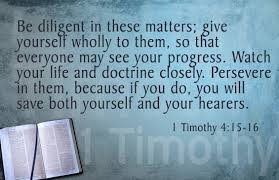
1 Tim. 41 Tim. 4: 16 Take heed unto thyself, and unto the doctrine; continue in them: for in doing this thou shalt both save thyself, and them that hear thee.

2 Tim. 2:15 Study to shew thyself approved unto God, a workman that needeth not to be ashamed, rightly dividing the word of truth.16 But shun profane and vain babblings: for they will increase unto more ungodliness.17 And their word will eat as doth a canker: of whom is Hymenaeus and Philetus;18 Who concerning the truth have erred, saying that the resurrection is past already; and overthrow the faith of some.19 Nevertheless the foundation of God standeth sure, having this seal, The Lord knoweth them that are his. And, let every one that nameth the name of Christ depart from iniquity.

Titus 2:6 Likewise, exhort the young men to be sober-minded, 7 in all things showing yourself to be a pattern of good works; in doctrine showing integrity, reverence, incorruptibility, 8 sound speech that cannot be condemned, that one who is an opponent may be ashamed, having nothing evil to say of you.—11 For the grace of God that brings salvation has appeared to all men, 12 teaching us that, denying ungodliness and worldly lusts, we should live soberly, righteously, and godly in the present age,13 looking for the blessed hope and glorious appearing of our great God and Savior Jesus Christ,14 who gave Himself for us, that He might redeem us from every lawless deed and purify for Himself His own special people, zealous for good works. (NKJV)

All are not teachers, and about submitting to elders and other authorities

We are to be present in the body of Christ – not just spiritually

As the body of Christ we are supposed to come together physically so that we can edify each other in various ways, like praying and prophesying for each other. (If we can of course, and if there is a decent assembly to join.) The Bible tells us that we are different members of the same body, and the body is likened with a human body. All are not an ear, an eye, a knee, etc. If all would be an ear, then something would be utterly wrong with the body of Christ. The Bible tells us for example that all are not teachers, so it’s wise to not let anyone rise up to teach in Church. The greatest risk to end up with false doctrines  would be if we let unqualified teachers do the teaching in a teaching situation within a christian assembly.

1 Cor.12:27Now ye are the body of Christ, and members in particular. 28And God hath set some in the church, first apostles, secondarily prophets, thirdly teachers, after that miracles, then gifts of healings, helps, governments, diversities of tongues. 29Are all apostles? are all prophets? are all TEACHERS? are all workers of miracles? 

Rom. 12:6Having then gifts differing according to the grace that is given to us, whether prophecy, let us prophesy according to the proportion of faith7Or ministry, let us wait on our ministering: or he that TEACHES, onTEACHING;

We should of course always be prepared to share the word of God and try to make disciples in various ways, but in an assembly we should let the teachers do the main teaching. This doesn’t exempt us from our responsibility to always act like the Bereans and compare all that we hear with scriptures (and test all things), and we must be prepared for that qualified teachers could still be wrong. Peter was an elder who exhorted other elders. Even if all of us are not teachers, we can still contribute in an assembly in many ways. We are encouraged to speak in tongues if there is a translation, make prophesies, share revelations, sing songs, pray for one another,  heal someone if we have this gift, etc. But all must be done in order!  Just because we are encouraged to share, it doesn’t mean we are allowed to jump off from our seats and burst out in a song or make a comment whenever we feel like it. That would be very annoying both for the teacher and for the listeners.

Some could be better used for teaching than serving tables. But also those who were appointed to serve tables in Acts. 6 must be qualified for it. They would have to be of honest report and full of the Holy Ghost and wisdom:

Acts 6:2Then the twelve called the multitude of the disciples unto them, and said, It is not reason that we should leave the word of God, and serve tables. 3Wherefore, brethren, look ye out among you seven men of honest report, full of the Holy Ghost and wisdom, whom we may appoint over this business. 4But we will give ourselves continually to prayer, and to the ministry of the word. 5And the saying pleased the whole multitude: and they chose Stephen, a man full of faith and of the Holy Ghost, and Philip, and Prochorus, and Nicanor, and Timon, and Parmenas, and Nicolas a proselyte of Antioch: 6Whom they set before the apostles: and when they had prayed, they laid their hands on them. 

Jesus himself gave some to apostles, prophets, evangelists, pastors and teachers:

Ephesians 4:10 He that descended is the same also that ascended up far above all heavens, that he might fill all things.) 11 And he gave some, apostles; and some, prophets; and some, evangelists; and some, pastors and teachers; 

And for what purpose?

12 For the perfecting of the saints, for the work of the ministry, for the edifying of the body of Christ: 

For how long?

13 Till we all come in the unity of the faith, and of the knowledge of the Son of God, unto a perfect man, unto the measure of the stature of the fulness of Christ

What would be the benefit of not allowing other people to be teachers?

14 That we henceforth be no more children, tossed to and fro, and carried about with every wind of doctrine 

2 Peter 2:1But there were false prophets also among the people, even as there shall be false teachers among you, who privily shall bring in damnable heresies, even denying the Lord that bought them, and bring upon themselves swift destruction.  

With other words there is a risk that we will be caught up with false doctrines if we let unqualified people teach. We should be on our guards! When listening to a teacher we should show him much respect. Most churches that I have attended have allowed people to say “amen” or “hallelujah”,  and making brief questions and comments even in the middle of the preaching. Thankfully the comments never got out of hand, but I’ve heard comments which should have been made after the sermon instead of in the middle of it.  We must always show respect both to the teacher and to other listeners so we won’t disturb anyone. Who would like to be constantly interrupted when having a little lecture? If there are 50 listeners and half of them have a question, then the teacher would be forced to deal with 25 questions and could easily lose his thread. That could very well lead to chaos and that is exactly what Paul warns us against. He even says:

1 Cor. 14:34Let your women keep silence in the churches: for it is not permitted unto them to speak; but they are commanded to be under obedience as also saith the law. 35And if they will learn any thing, let them ask their husbands at home:

James tells us to NOT be many masters (teachers, instructors), and when we are sick we are asked to call for the ELDERS so they can pray and put oil on the sick person:

James 3 1My brethren, be not many MASTERS, knowing that we shall receive the greater condemnation.

James 5:14Is any sick among you? let him call for the elders (presbyterous) of the church (ekklesias) ; and let them pray over him, anointing him with oil in the name of the Lord: 

There are special rules, compared to others, when it comes to accusing an elder for something, and if he is caught in a sin.

1 Tim. 5:19 Against an elder receive not an accusation, but before two or three witnesses. 20Them that sin rebuke before all, that others also may fear.

Peter seems to focus on exhorting the elders instead of exhorting the entire flock, since it’s the elders of a church who are supposed to be shepherding the flock in the right direction and feed it. The elders are compared with shepherds (so naming an elder “pastor” makes perfect sense) and in a Church we are NOT supposed to take turns to be the shepherd. The elder/shepherd must be qualified and confirmed for this position, and no others should be elders. It would be great if there were more than one elder per church, but if that isn’t achievable then we would have to settle with one. The younger are asked to submit to the elder:

1 Peter 5 :1 The elders which are among you I exhort, who am also an elder, and a witness of the sufferings of Christ, and also a partaker of the glory that shall be revealed: 2Feed the flock of God which is among you, taking the oversight thereof, not by constraint, but willingly; not for filthy lucre, but of a ready mind; 3Neither as being lords over God’s heritage, but being examples to the flock. 4And when the chief Shepherd shall appear, ye shall receive a crown of glory that fadeth not away. 5Likewise, ye younger, submit yourselves unto the elder

We don’t need to be qualified teachers in order to share something from the Bible also within an assembly, but I’m referring to the actual “teaching” here.  There are of course loads of examples of churches where the pastor is teaching falsehood, but this only means he should never have been confirmed as an elder in the first place. Thankfully ALL churches don’t work in the wrong way. It’s possible that people with an aim to be “democratic” would like to open up for others to do the teaching, but if we don’t follow Paul’s instructions about elders and teachers, there is a risk for deception and that is why many churches don’t work as they should:

Titus 1:10For there are many unruly and vain talkers and deceivers, specially they of the circumcision: 11Whose mouths must be stopped, who subvert whole houses, teaching things which they ought not, for filthy lucre’s sake. 

2 Tim. 4:2Preach the word; be instant in season, out of season; reprove, rebuke, exhort with all long suffering and doctrine. 3For the time will come when they will not endure sound doctrine; but after their own lusts shall they heap to themselves TEACHERS, having itching ears; 4And they shall turn away their ears from the truth, and shall be turned unto fables. 5But watch thou in all things, endure afflictions, do the work of an evangelist, make full proof of thy ministry

Hierarchies?

It’s possible that people are terrified for anything that might smell like hierarchies in Church, and while the NT does not support an assembly where people are of different levels of importance, we can’t get way from the fact that we are different parts of the same body, resulting in that not all are apostles, teachers, elders or shepherds. The shepherd is equal in value compared to the flock, but the shepherd is still supposed to guide the flock and not the other way around. This does not mean we should follow the shepherd blindly. All members of the flock have a free will and a responsibility to follow God (the Bible) more than man.

Below is an example of an issue which could not be settled in the local church but had to go “up” to the apostles and elders in Jerusalem so they could settle the matter. The apostles and the elders had the authority to give instructions, decrees, exhortations and confirmation of churches:

Acts 15:2When therefore Paul and Barnabas had no small dissension and disputation with them, they determined that Paul and Barnabas, and certain other of them, should go up to Jerusalem unto the apostles and elders (presbyterous) about this question. —6And the apostles and elders came togetherfor to consider of this matter.— 22Then pleased it the apostles and elders with the whole church, to send chosen men of their own company to Antioch with Paul and Barnabas; namely, Judas surnamed Barsabas and Silas, chief men among the brethren:—25It seemed good unto us, being assembled with one accord, to send chosen men unto you with our beloved Barnabas and Paul,— 30So when they were dismissed, they came to Antioch: and when they had gathered the multitude together, they delivered the epistle:—31Which when they had read, they rejoiced for the consolation. 32And Judas and Silas, being prophets also themselves, exhorted the brethren with many words, and confirmed them.

Paul and Silas delivered decrees for the assemblies to keep, which were ordained by the apostles and elders in Jerusalem. We are not able to read that the assemblies complained about this procedure, as though it would be unfair that some people can decide which rules others should keep. You might call this a “hierarchical system” and therefore something that should be forbidden, but we are to submit to authorities (if they are godly). If we had all obeyed those instructions at all times from the beginning, then the apostles would be able to teach a group of people and confirm them, who could teach another group of people and confirm them, and so on. Clearly we have not always obeyed the instructions concerning elders because today there are some assemblies where the elders have many shortcomings – in traditional churches and particularly in Home churches. Each one should make sure to “lay hands suddenly on no man” (confirming someone to be an elder) as Paul also instructed Timothy: 

Acts 16:4And as they went through the cities, they delivered them the decrees for to keep, that were ordained of the apostles and elders which were at Jerusalem. 5And so were the churches established in the faith, and increased in number daily.

1 Timothy 4:14Neglect not the gift that is in thee, which was given thee by prophecy, with the laying on of the HANDS of the presbytery.

1 Timothy 5:22 Lay HANDS suddenly on no man, neither be partaker of other men’s sins: keep thyself pure.

Paul gave Timothy instructions to make sure the assembly in Ephesus teach “no other doctrine”. Timothy should also make sure they would not give heed to fables. Hopefully the assembly in question accepted Timothy’s authority and didn’t tell him” Who do you think you are, trying to teach us all those things and exhorting us? Mind your own business because we can take care of ourselves, thank you. We don’t need anyone over us and we don’t believe in a hierarchical system”: 

1 Tim 1:2 Unto Timothy, my own son in the faith: Grace, mercy, and peace, from God our Father and Jesus Christ our Lord. 3As I besought thee to abide still at Ephesus, when I went into Macedonia, that thou mightest charge some that they teach no other doctrine, 4Neither give heed to fables and endless genealogies, which minister questions, rather than godly edifying which is in faith: so do. 6From which some having swerved have turned aside unto vain jangling; 7Desiring to be teachers of the law; understanding neither what they say, nor whereof they affirm.

Timothy was to reprove, rebuke and exhort, and the reason was the risk for false doctrines which might sneak in:

1 Tim. One that ruleth well his own house, having his children in subjection with all gravity; 5(For if a man know not how to rule his own house, how shall he take care of the church of God?)6Not a novice, lest being lifted up with pride he fall into the condemnation of the devil.

Read the above concerning some of the instructions for an elder. We are told that if his children don’t behave well, it’s doubtful he could keep the flock in the church of God. Being a pastor/elder in a church is likened with being the authoritative Father in a household. In a household a Father doesn’t take turns with his children to be the authority and the Head of the family. He should always be the authority! This of course does not give him the right to run his household in any way he wants, but he should always treat others the way he would like to be treated himself . Neither does it mean that he could not give his children a certain amount of liberty and responsibility. But it’s never the children who decides how much freedom and responsibility to give to their Father, but it’s always the other way around. 

The above verse is also yet another verse which confirms that a church gathering is often 1) away from home and 2) in a building and 3) RULED by someone. Here the church of God is CONTRASTED with a home, just like so many other verses.  We don’t always take the church with us, but we can GO to a church, and we can even be thrown out of a church by a person who is not even a true believer:

 3 John 1: 9I wrote unto the church: but Diotrephes, who loveth to have the preeminence among them, receiveth us not. 10Wherefore, if I come, I will remember his deeds which he doeth, prating against us with malicious words: and not content therewith, neither doth he himself receive the brethren, and forbiddeth them that would, and casteth them out of the church.

The Holy Ghost has made some people overseers over a flock, to feed the church of God. Paul knows that after his departure grievous wolves will enter in among “you” (the listeners here were the elders in the church of Ephesus, but this concerns all of us) and that’s why he wants them to take heed.

Acts 20:28Take heed therefore unto YOURSELVES, and to all the FLOCK, over the which the Holy Ghost hath made YOU OVERSEERS, to feed the CHURCH OF God, which he hath purchased with his own blood.29For I know this, that after my departing shall grievous wolves enter in AMONG YOU, not sparing the FLOCK.

The danger of misusing the misuse of tongues

Below I use the word “cessationist” (a person who believes speaking in tongues is not for today but a gift that has ceased) but I could address anyone who is skeptic about tongues and especially those who have produced “anti-tongue material” – like uploaded video clips on youtube. Sometimes I wonder if cessationists feel that if they can’t pray by the Spirit’s power, they assume that no one else can either and they therefore prefer to read the Bible accordingly.  I don’t wish to cause bad feelings with what I write, but would like to defend the gift of speaking in tongues, and to make some clarifications concerning some common misunderstandings.

Speaking in tongues does not mean that the language is always understood, but actually the exact opposite

It’s very common for cessationists to base their views about tongues on Acts 2 alone, with hardly no aid from 1 Cor. 11-14 where Paul quite extensively describes tongues and the way to use them. If the agenda is to show that speaking in tongues has either ceased or nothing to strive for,  people would likely try to ignore 1 Cor. 11-14 to avoid the clear information we can find there:

  • we should be eager to get this gift
  • tongues can edify YOU ALONE, which is something good
  • NO MAN understands the tongues (unless interpreted)
  • you’re not even addressing people with your tongues but you’re praying to GOD
  • you should pray in BOTH ways; 1) with the spirit and 2) with your understanding

Acts 2 of course doesn’t contradict 1 Cor. in any way, but it’s still not a good approach to avoid the larger passages about tongues and focus on the very first experience alone. What if the very first experience was totally unique and a bit different than the experiences which followed? The Greek word “dialectos” is used only in the original Pentecost of Acts 2. The other occurences of tongues-speaking (Acts 19, Acts 10) was not in earthly dialects and “dialectos” is not found in the text. All we know from Acts 2 is that “every man heard them speak in his own language”. Notice:

  • It does NOT say that each man understood ALL the languages spoken
  • It does NOT say that each man understood every single disciple
  • It does NOT say that no “gibberish” was uttered apart from the comprehensible languages

If tongues are always foreign languages, then there is no reason for anyone to ever do it alone (where no foreigners can hear) and yet we are told to pray privately:

1 Cor. 14:28 But if there be no interpreter, let him keep silence in the church; and LET HIM SPEAK TO HIMSELF, AND TO GOD

Also, there would have been no reason for the Ephesians (of Acts 19) or for Cornelius’ family (Acts 10) to speak in tongues since there were no foreigners there to understand it. If tongues were always understood, why is “interpreting tongues” a separate gift? And how come believers with the gift of speaking in tongues don’t automatically have the gift of interpreting? We are told to pray in two ways; 1) with the spirit (where we don’t understand what we are saying) and 2) with our own words (which we understand):

1 Cor. 14:19 I will pray with the spirit, and I will pray with the understanding ALSO: I will sing with the spirit, and I will sing with the understanding also.

1 Cor. 14:13 Wherefore let him who speaks in an unknown tongue pray that he may interpret (so clearly not a gift always combined with speaking in tongues)

1 Cor. 14:17 For you verily give thanks well,[in tongues] but the other is not edified (because he can’t understand)

Since the Bible says that no one understands a person who speaks in tongues, it means that “gibberish” fits this description rather well. That people sometimes understand the tongues is likely due to that they are interpreted.

Speaking in tongues is for praise, worship, edification and not for evangelism

Tongues are for praise and nowhere are we told they are meant for evangelism. The Ephesians in Acts 19 and the Romans in Acts 10 (Cornelius’ house) spoke in tongues but there were no foreigners around to hear in a foreign “known language”. What purpose would a foreign dialect serve as they all already spoke the same language? Two portions from the book of Acts show that tongues are for praise rather than for evangelism:

1) Acts 10:44-46 While Peter yet spake these words, the Holy Ghost fell on all them which heard the word. And they of the circumcision which believed were astonished, as many as came with Peter, because that on the Gentiles also was poured out the gift of the Holy Ghost. For they heard them speak with tongues, and magnify God

In Cornelius’ house there were no foreigners to hear what was spoken. “And Cornelius waited for them, and he called together his kinsmen and near friends.”Acts 10:24

2) Acts 19:5 When they heard this, they were baptized in the name of the Lord Jesus. And when Paul had laid his hands upon them, the Holy Ghost came on them; and they spake with tongues, and prophesied. And all the men were about twelve.

Paul met some faithful Jews who believed in John’s baptism and when Paul told them of Jesus and laid his hands on them they spoke in tongues. But not to evangelize foreigners but they where simply prophesying (and we have learned that prophesying is mainly for believers). No foreigners were present.

When a cessationist says that pentecostals over-emphasize tongues; he is basically saying that Pentecostals over-emphasize prayer and praise. A good church service shouldn’t contain all the important aspects of a church service; teaching, song, praise, edification, etc.

The tongues (interpreted) are not for the jews but for the CHURCH

1 Cor. 14: 3-4 He that speaketh in an unknown tongue edifieth himself; but he that prophesieth edifieth the church

Cessationists might say that tongues were only meant to judge the unbelieving Jews. This idea is proved false because there were no unbelieving Jews to hear the words of “judgment” at Cornelius’ house (Acts 10) or at Ephesus (Acts 19) as mentioned above. The Scriptures that cessationists use to support their idea is below (notice the absence of the word “judgment”):

1 Cor. 14:20-22 Brethren, be not children in understanding: howbeit in malice be ye children, but in understanding be men. In the Law it is written, With men of other tongues and other lips will I speak unto this people; and yet for all that will they not hear me, saith the Lord. Wherefore tongues are for a sign, not to them that believe, but to them that believe not: but prophesying serveth not for them that believe not, but for them which believe.

The OT quote within 1 Cor 14:20-22 (above) is from Isaiah 28, where God is telling Israel that they have been so wicked that He will allow them to be conquered by Assyria.

Isaiah 28:11 For with stammering lips and another tongue will he speak to this people.

Therefore cessationists have come to the conclusion that hearing a foreign language is a judgment. However, the judgment against Israel in Isaiah’s day was not a strange tongue but that they would be taken captive. The strange language was not a judgment, but a consequence of the judgment. The consequence of tongues-speaking is that unbelievers (Jew and Gentile) do not understand what is being spoken and therefore to them it is just a “sign.” The Greek word “semeion” means a “sign” as in a “wonder” or a “mystery” or “perplexity.” This same word is used in a similar way in Rev. 12:1, Rev. 12:3 and Rev. 15:1. Paul, wrote 1 Cor 14 to show that tongues without interpretation does not benefit anyone except the speaker; therefore, do not speak tongues loudly in the church service (without interpretation) because for others it is just a mystery/sign. And just as the OT Jews were perplexed by the Assyrian dialect, so they are perplexed today by tongues, and it will not help them.

Paul wants to show that the church is made up of believers, and prophecy is for believers in the church-service for their instruction, and that prophecy can also convict a stray unbeliever that happens to be there. Therefore prophecy is better than tongues in the church unless there is an interpretation:

1 Cor. 14:24 But if all prophesy, and there come in one that believeth not, or one unlearned, he is convinced of all, he is judged of all:25 And thus are the secrets of his heart made manifest; and so falling down on his face he will worship God, and report that God is in you of a truth.

Speaking in tongues is a sign that shall follow them that BELIEVE:

Mark 16:17 And these signs shall follow them that believe; In my name shall they cast out devils; they shall speak with new tongues

If speaking in tongues has ceased, then people who still speak in tongues would have to be faking them or being possessed by the devil. This would in turn lead to that a sure sign of an unsaved person would be if he spoke in tongues! That is the exact opposite of what Mark 16:17 is saying!

It is only during the portion of the church service that is set aside for prophetic speaking that the tongues-speakers should keep silence – if there is no interpreter. However, there are no verses which prohibit quiet tongues-speaking during the prayer/worship portion of the service. If you would normally pray quietly for yourselves in church, perhaps due to a common request from the pastor, then speaking in tongues would be one way to express yourself. There is a chance/risk that a person who sits beside you overhears your mumbling, but this is not against Paul’s teaching. Someone might also overhear another person praying in Spanish who sits beside him, and no one would be offended unless the prayers are inconveniently loud. It’s only when a person requests the attention of others that irritation can be the outcome. If a person stood up in an American church speaking in another language, then that would clearly violate Paul’s instructions, and it’s not hard to figure out why. A person who repeatedly shouts “Praise the LORD, Halleluyaaaa, Amen”…” etc, and jumps up and down, would equally disturb the church service and contribute to chaos. This could not be filed under “dangerous” but rather “silly” and “annoying”. Paul advised against speaking in tongues publically because no others would be edified, and outsiders would think you’re nuts. Not because it’s “dangerous”.

Yes, speaking in tongues is a GIFT freely provided by God

1 Cor. 12:11But all these worketh that one and the selfsame Spirit, dividing to every man severally as he will.

It’s nothing controversial about the fact that speaking in tongues is a GIFT freely offered by God and something that you can’t earn, because this is generally accepted both inside and outside of the Pentecostal church. Sadly people misunderstand this to mean that we should just forget about this subject altogether since it’s God’s business to intervene in our lives and give us any gift he wants us to have. How is this “covet earnestly the best gifts” which we are told to do? Although it’s true that we certainly can’t give ourselves any gifts, it doesn’t mean that we shouldn’t approach God and ask for them, and be EAGER to get them. Sometimes we don’t get because we don’t ask (it’s still a free gift), and if we on top of this doubt that we might be the lucky recipients of spiritual gifts, then this might hinder us to get them. It doesn’t matter if God is standing there handing out gifts if we don’t even look for them or stretch out our hands to get them.

Luke 11:9 And I say unto you, Ask, and it shall be given you; seek, and ye shall find; knock, and it shall be opened unto you.10 For every one that asketh receiveth; and he that seeketh findeth; and to him that knocketh it shall be opened.—13 If ye then, being evil, know how to give good gifts unto your children: how much more shall your heavenly Father give the Holy Spirit to them that ask him?

Speaking in tongues is not a “less important gift”

1 Cor. 12:8For to one is given by the Spirit the word of wisdom; to another the word of knowledge by the same Spirit;9To another faith by the same Spirit; to another the gifts of healing by the same Spirit; 10To another the working of miracles; to another prophecy; to another discerning of spirits; to another divers kinds of tongues; to another the interpretation of tongues: 11But all these worketh that one and the selfsame Spirit, dividing to every man severally as he will.12For as the body is one, and hath many members, and all the members of that one body, being many, are one body: so also is Christ.

Paul never says that he is listing the gifts of the Spirit in a descending ranking order. If that was his aim, we would have to conclude that the interpretation of tongues is not as important as tongues-speaking, because it is listed below “tongues”. Yet, the “best gifts,” according to Paul in 1 Cor. are “prophecy” and “interpretation” because more people can be edified. Paul goes on to explain right after the verse above that all parts of the body are necessary and equally important. Also:

1 Cor. 14:5 I would that ye all spake with tongues but rather that ye prophesied:For greater is he that prophesieth than he that speaketh with tongues, except he interpret, that the church may receive edifying

With other words, we are told to earnestly covet the best gifts, meaning that we should be eager to get gifts where as many people as possible can be edified. This means that we shouldn’t be satisified with only being able to speak in tongues, but we should also earnestly seek the gift of interpretation since this would lead to prophesying. Are you honestly seeking the gifts on Paul’s list as he tells you to, or have you brushed all these gifts aside? (Or even worse; are you spending your valuable time giving warnings to fellow christians to be aware of spiritual gifts, and hindering them as well from being eager to get them?)

A believer can be “filled” again by the Holy Ghost

Below we can see WHY the believing jews understood that certain gentiles had received the Holy Ghost. It was “FOR they heard them speak with tongues and magnify God”. We can trust that this reason is correct, maybe in combination with noticing good fruit. These gentiles had not yet been baptised in WATER but they had received the baptism of the HOLY GHOST. Also Peter was certain of that these gentiles were ready to be baptised also in water since he understood that they had been baptised in the Holy Ghost. No one involved seemed terrified that these gentiles maybe faked their tongues or that they were demon possessed. They didn’t feel it was “dangerous” at all, but they took what they heard as a sign for that the gentiles were true believers and ready to be water baptised since they had the Holy Ghost:

Acts 10:44While Peter yet spake these words, the Holy Ghost fell on all them whichheard the word. 45And they of the circumcision which believed were astonished, as many as came with Peter, because that on the Gentiles also was poured out the gift of the Holy Ghost. 46For they heard them speak with tongues, and magnify God. Then answered Peter, 47Can any man forbid water, that these should not be baptized, which have received the Holy Ghost as well as we? 

It is a spiritual power seen as manifestations of the Spirit which are demonstrated by the working of spiritual gifts. Acts 1:5, Acts 1:8 and Joel’s prophecy point to a filling of the Holy Spirit that is more than just a salvation experience.They speak of a “drenching, soaking” of the Spirit known as “baptizo”. The “baptizo” experience happening to someone who already has the Holy Spirit in him (because he is already saved) might be for him to attend a powerful prayer meeting, like the one in Acts 4:31, and this person would gain the power to prophesy through tongues, the word of wisdom etc. A power that the believers received when the Holy Spirit was poured out was the ability to praise God through the Holy Spirit. A true believer who has the Holy Spirit dwelling inside him can still be said to be “filled with the Holy Ghost/spirit/power” at a later stage in his life and on several different occasions. This can happen through prayers:

Acts 4:31 And when they had prayed, the place was shaken where they were assembled together; and they were all filled with the Holy Ghost, and they spake the word of God with boldness 

Luke. 24:48-49 ye are witnesses of these things. And, behold, I send the promise of my Father upon you: but tarry ye in the city of Jerusalem, until ye be endued with power from on high

Acts 2:16-17 But this is that which was spoken by the prophet Joel; And it shall come to pass in the last days, saith God, I will pour out of my Spirit upon all flesh: and your sons and your daughters shall prophesy”

Acts 1:5 For John truly baptized with water; but ye shall be baptized with the Holy Ghost not many days hence. But ye shall receive power after that the Holy Ghost has come upon you

Acts 1:8 But ye shall receive power, after that the Holy Ghost is come upon you: and ye shall be witnesses unto me both in Jerusalem, and in all Judaea, and in Samaria, and unto the uttermost part of the earth.

Eph 5:17 Wherefore be ye not unwise, but understanding what the will of the Lord is. 18And be not drunk with wine, wherein is excess; but be filled with the Spirit;19Speaking to yourselves in psalms and hymns and spiritual songs, singing and making melody in your heart to the Lord; 20Giving thanks always for all things unto God and the Father in the name of our Lord Jesus Christ;

John 7: 37-39 If any man thirst, let him come unto me, and drink. He that believeth on me, as the scripture hath said, out of his belly shall flow rivers of living water. (But this spake he of the Spirit, which they that believe on him should receive: for the Holy Ghost was not yet given because Jesus was not yet glorified.)

The Apostle Peter was filled with the Spirit when Jesus breathed on him. He was filled again on the Acts 2 Pentecost. After that, he was at a powerful prayer meeting where the whole house was shaken. John was “in the Spirit” (as opposed to just a normal day when he would not be considered as being “in the Spirit”) when he wrote the book of Revelation. Stephen was “filled” when he saw Jesus at the right hand of God. Even though the Ephesians were already saved, Paul still tells them to be “filled” with the Spirit. At the moment that someone prophecies he is filled with an extra anointing of the Holy Spirit for that occasion.

“Baptism” has a primary meaning which is “to drench”, but the proper definition of the word “baptizo” (“drenching”) is something that not all Christians receive. For instance, there are many Christians who have never been baptized in water yet they may be said to be “baptized” in a more general sense. When Bible writers use the word “baptism” to describe the Holy Spirit falling on someone causing him to speak in tongues, they are not speaking of “baptism” in a vague sense; rather they are speaking of a Holy Spirit drenching that is a spiritual equivalent of a water-baptism.

Why do people get so scared when it comes to speaking in tongues?

Maybe because they have come across some of the material from people who have an agenda to scare people away from the Pentecostal churches and from the spiritual gifts. This might even inspire them to produce their own material and continue spreading the rumour that pentecostal churches are dangerous and filled with unruly people who speak with fake tongues which we would do well to keep away from. Why is this not slander? What if we would start a campaign where we claimed that MOST baptist churches are like the Westboro Baptist Church?

A common denominator among those who fervently speak out against tongues (and others who have a negative attitude towards them) seems to be that they are not members of a charismatic church and possibly haven’t made many visits in one either (I know there are exceptions). There are some who spend their valuable time to produce video clips, audio clips and articles where they write warning upon warning about the misuse of tongues. Some of them are cessationists and some of them are “just against the misuse” of tongues as they say. But in the latter category you will find some starting out saying “I’m not a cessationist, BUT…” followed by several pages of warnings and examples of negative things about tongues. Why not doing the exact opposite? Why not start out saying “I’m aware of that there is a misuse of tongues in some odd churches, BUT…” followed by page upon page with encouragement to speak in tongues, and with wonderful examples across the world where people have been much edified by them? If the idea isn’t to scare people away from speaking in tongues, and to run away from Pentecostal churches, then what do they think such scare-tactics material will do to people? Why not at least spend 50% of a video clip with encouragement to use the spiritual gifts?  The risk is that viewers might believe the material and flee from tongues. This means that SATAN is the winner.

People who produce this type of warning-material, and compare the practice of pentecostals with pagans, might feel they are doing a good deed among christians. Instead they are causing a DIVISION about something that is neither common nor dangerous. Why not give warnings about doctrines or traditions which could harm your soul? There are plenty to choose from. (But maybe the same people refrain from doing this to “not cause a division”.) How “dangerous” would it be if I stood up in an American church and spoke in Swedish? It would be irritating at worst, and I would be wasting people’s time, but dangerous? Hardly. You might say that people wouldn’t know if I spoke with “demonic” tongues or not, but how many examples of “demonic” tongues do we really know from the western world, and how many examples inside a CHURCH? (Do give me a source with valid examples because it would be interesting reading.) Anyone could stand up in a church and say a curse in another language (not necessarily in tongues) but this isn’t very likely, and of course everyone would notice a person who is disturbing the church service. Besides, a “curse” wouldn’t make anyone lose his soul. Satan can’t touch a christian’s heart unless the christian person opens up for him. I’m saying this to show that it wouldn’t be “dangerous” to stand up speaking in tongues with no interpreter, but just dumb.

The anti-tongues videos can cause christians to be robbed of spiritual power

By scaring christians away from the spiritual gifts, Satan robs them of the many benefits of speaking in tongues and the power of the holy spirit. So instead of helping christians, this anti-tongue material is causing much harm and is a GREAT aid for Satan to diminish our strength. Keep this in mind if you think you’re doing something good by producing and/or endorsing such material.

Some pastors might feel that the subject of speaking in tongues is so controversial that  they won’t raise up this topic at all in church, to avoid being charged for influencing the members in either direction. But do they reason the same way when it comes to the subject of Creation or Evolution, or other touchy subjects? There are even pastors who WARN members against speaking in tongues. Why not making videos and warn people against churches which are negative towards tongues? By speaking in tongues, Christians would be edified and get much power,joy and confidence, and yet these pastors try to prevent them from getting these benefits! If you are in a church where the pastor is speaking about the spiritual gifts in negative terms, then I hope you will consider leaving this church. It’s rather serious (and dangerous) if a leader of a church warns people against something that Paul encourages. Paul gave instructions about tongues and seemed to take this gift for granted in churches, so he would likely be appalled if he lived today and realized that this gift is totally ABSENT in many churches! I believe he would like to have word with the church leaders if he realized they have tried to put a lid on the holy spirit:

1 Thess. 5:19Quench not the Spirit. 20Despise not prophesyings. 21Prove all things; hold fast that which is good.

You might hear cessationists say “MOST pentecostal churches misuse the tongues” and “the misuse of tongues is INCREASING” and “it’s dangerous” but they of course have no sources or statistics to back up their claims. By doing false generalizations like this, and painting with a broad brush, they just want to build up a scenario where they try to show that their warning-material is much-needed. Instead the misuse of tongues might not be common at all, and only tied to a small group of infamous preachers and their supporters.

I read on a thread on Facebook the other day: “Having been originally taught as a Baptist, tongues were not talked about hardly at all” and someone else said “As a Presbyterian growing up the Holy Spirit was never mentioned except in the doxology” and another person said “I would ask him why would we not believe the Bible on the issue of spiritual gifts, and his excuse was because some had abused the gifts”. No wonder that the gifts of the holy spirit is absent in so many churches!

People feel “pressured” to speak in tongues in Pentecostal churches?

One argument against the Pentecostal church that I’ve heard on several occasions, is that people might feel “pressured” and even “forced” to speak in tongues when they are in a Pentecostal church. I find this to be very strange considering that not all people inside the pentecostal church have this gift, which pentecostals are well aware of, and pentecostals are also aware of that you’re not supposed to speak in tongues with no interpreter. Do people feel bothered and pressured to speak in tongues because they overhear people who speak them? If my praise and worship to the Lord bothers someone else, then so be it. I shouldn’t have to feel pressured to reduce my time of praise in order to accommodate someone else. Naturally I shouldn’t be too loud, and I shouldn’t be disturbing the rest of the service by praising and praying in the wrong time. Not even misuse of tongues should have to cause a person to feel “pressured” to speak in tongues, unless he enters a church where pretty much everyone babbled in unknown tongues. Still, he shouldn’t be judging all Pentecostal churches based on one where they misuse tongues. What if a person enters a church and finds the members there sing beautifully, unlike him? Should the church members try to sing less beautifully, or reduce their singing, in order to not make the visiting person feel bad?

1 Cor 1: 4-7 I thank my God always on your behalf, for the grace of God which is given you by Jesus Christ; That in everything ye are enriched by him, in all utterance, and in all knowledge; Even as the testimony of Christ was confirmed in you: So that ye come behind in no gift; waiting for the coming of our Lord Jesus Christ 

Should women always submit to men?

Women submitting to men – What does the Bible say? 

The Bible speaks about the equality among men and women, but also that women should submit themselves to their husbands. Naturally a woman must obey GOD more than MAN in cases where her husband would be opposing God. That’s why it’s beneficial in all sorts of way for a christian woman to marry a Bible believing man. If both parties obey Paul’s instructions, it’s a good ground for a matrimony in harmony.

Eph. 5:21 Submitting yourselves one to another in the fear of God.22Wives, submit yourselves unto your own husbands, as unto the Lord. 23 For the husband is the head of the wife, even as Christ is the head of the church: and he is the saviour of the body.24Therefore as the church is subject unto Christ, so let the wives be to their own husbands in every thing.25 Husbands, love your wives, even as Christ also loved the church, and gave himself for it;

1 Cor 11:11 Nevertheless neither is the man without the woman, neither the woman without the man, in the Lord.12 For as the woman is of the man, even so is the man also by the woman; but all things of God.

1 Cor. 7:4 The wife hath not power of her own body, but the husband: and likewise also the husband hath not power of his own body, but the wife. 

Women in the Bible

Miriam, Deborah, Huldah, Anna, etc are named prophetess of the Lord…

Judges 4 & 5: Deborah, a prophet-judge, headed the army of ancient Israel.

2 Kings 22:14; 2 Chronicles 34:22 Huldah, a prophet, verified the authenticity of the “Book of the Law of the Lord given through Moses.”

Acts 9:36 f Luke refers to a female disciple by her Aramaic name Tabitha, who was also known by her Greek name Dorcas.

Romans 16:1: Paul refers to Phoebe as a minister (diakonos) of the church mistranslating it as “servant” or “helper”.

Romans 16:3: Paul refers to Priscilla as another of his “fellow workers in Christ Jesus” (NIV) Other translations refer to her as a “co-worker”. The original Greek word is “synergoi”, which literally means “fellow worker” or “colleague.”

Exodus 15:20-21 And Miriam the prophetess, the sister of Aaron, took a timbrel in her hand; and all the women went out after her with timbrels and with dances. 21 And Miriam answered them, Sing ye to the LORD, for he hath triumphed gloriously; the horse and his rider hath he thrown into the sea.’ 

Micah 6:4 I brought you up from the land of Egypt. I redeemed you from a life of slavery. I sent Moshe, Aharon and Miryam to lead you.

Isaiah 8:3 And I went unto the prophetess; and she conceived, and bare a son. Then said the LORD to me, Call his name Mahershalalhashbaz.

Luke 2:36 And there was one Anna, a prophetess, the daughter of Phanuel, of the tribe of Aser: she was of a great age, and had lived with a husband seven years from her virginity; 37And she was a widow of about fourscore and four years, which departed not from the temple, but served God with fastings and prayers night and day.38And she coming in that instant gave thanks likewise unto the Lord, and spake of him to all them that looked for redemption in Jerusalem.

Rom. 16:7 Salute Andronicus and Junia, my kinsmen, and my fellow-prisoners, who are of note among the apostles, who also were in Christ before me.

Phil. 4:2 I beseech Euodias, and beseech Syntyche, that they be of the same mind in the Lord.  3 And I intreat thee also, true yokefellow, help those women which laboured with me in the gospel, with Clement also, and with other my fellowlabourers, whose names are in the book of life.

Acts 21:8 And the next day we that were of Paul’s company departed, and came unto Caesarea: and we entered into the house of Philip the evangelist, which was one of the seven; and abode with him.9 And the same man had four daughters, virgins, which did prophesy.

Acts 2:17 And it shall come to pass in the last days, saith God, I will pour out of my Spirit upon all flesh: and your sons and your daughters shall prophesy, and your young men shall see visions, and your old men shall dream dreams. 18 “And on my servants and on my handmaidens I will pour out in those days of my Spirit; and they shall prophesy

Anthrópos and anér – two words for MAN

If God caused Balaam to be taught by a donkey (Numbers 22), why couldn’t He use women to teach men? If women are supposed to submit to men, what happens when christian men disagree among themselves?

There are 2 words for MAN in Greek “Anthrópos” and “anér” (genitive of “anér” is “andros”). In some languages the word for “man” and “woman” can mean either man/husband or woman/wife, depending on context. In English separate words are used. When it comes to the Greek NT, there is no other word for a husband but “anér”.

Jacques More says: In my research and look at every place where “anér” and “anthrópos” are found, and reproduced in the appendices, something became clear: “anér” is always used about a particular man so that in the plural it refers to a particular group of men whilst “anthrópos” is about any man, someone, and in plural can just mean “peoples”. This is well illustrated in John’s gospel and the feeding of the 5,000. “Then Jesus said, ‘Make the people (anthrópous)sit down. Now there was much grass in the place. So the men (andres) sat down, in number about five thousand’. John 6:10 (NKJV)

 Verses commonly used to support a general headship of man

1) 1 Cor. 11:3 But I would have you know, that the head of every man is Christ; and the head of the woman is the man; and the head of Christ is God.

Anér is here used for “the man” resulting in “head of woman the man/husband”. The definite article is present to indicate a certain man, and “anér” itself refers to a particular man. Again there is no other word for “husband” but “anér”A better translation would be: “and head of a woman THE HUSBAND” As found in the Amp.V, GNB, LB, RSV. 1 Cor. 11:3 cannot thereby be used for a general understanding of headship of men over women!

2) 1 Timothy 2:11 Let the woman learn in silence with all subjection.12 But I suffer not a woman to teach, nor to usurp authority over the man (andros which is from the Greek word anér), but to be in silence. 13 For Adam was first formed, then Eve.14 And Adam was not deceived, but the woman being deceived was in the transgression.

The man Paul is talking about is a particular man – namely the HUSBAND of the woman. There is no other word for “husband” than “anér“. But we already know that a husband is the head of the household and not the wife. So a woman must submit to her own man and she must not have authority over him. It doesn’t say that a woman must be submissive to ALL MEN, and that ALL MEN can be an authority over ALL women out there. No, Paul is comparing with Adam and Eve, and he doesn’t suggest that Eve must be submissive to any other man than her own husband. But Paul is not saying that a woman therefore should try to rule over other men in a church environment.

The context shows he is also talking about a church environment and  Paul is addressing the issue of church order and about the danger of deception. The concern seems to be speaking out of turn while the official leader is teaching. In other areas women are free to pray and prophesy publicly “every woman who prays or prophesies” (1 Cor.11:5 NKJV) and to share and teach “whenever you come together, each of you has a psalm, has a teaching, has a revelation, has an interpretation” (1 Cor.14:26 NKJV) which Paul here proceeded with “How is then, it brethren?” (NKJV) Brethren is meant in a generic sense as seen by Paul’s use of the term in regards to communion (1 Cor.11:33-34), the gifts of the Spirit (1 Cor.12:1),  to prophecy (1 Cor. 11:2-16) and the proper observance of the Lord’s Supper (1 Cor. 11:17-34). Then he gets into his main subject, the exercise of spiritual gifts (especially speaking in tongues), in chapters 12-14.

1 Cor. 11:5 But every woman that prayeth or prophesieth with her head uncovered dishonoureth her head: for that is even all one as if she were shaven.

If women were not allowed to pray and prophesy in church, it wouldn’t make sense to have rules for women how to go about when praying and prophesying. Paul nowhere says that women are to pray and prophesy only for women, and it would be a difficult task for a woman who feels a message coming from the Lord, to first try to make sure that no men are present risking to overhear her. A better translation of 1 Tim. 2:12 would be “nor to exercise authority of A HUSBAND”. The below verse seems to confirm that Paul wants to instruct his readers about order in church.

3) 1 Corinthians 14:34 Let your women keep silence in the churches: for it is not permitted unto them to speak; but they are commanded to be under obedience as also saith the law.35 And if they will learn any thing, let them ask their HUSBANDS at home: for it is a shame for women to speak in the church.

Also this shows that it concerns a church setting. Paul might have had good reasons for giving advice to the Corinthian church due to unruly women with low education (or none) who have many questions in relation to what is spoken about during a church gathering. These women might have disturbed the assembly due to questions, gossip and general talk why some instructions from Paul were needed. This still doesn’t mean that Paul’s advice was for this church alone but was an instruction for all churches to adhere to.

Another subject is women in leadership

There are views for and against women leadership and even if the below three verses seem to endorse only male leadership when it comes to bishops, deacons and elders, one of the arguments against (I’m not saying it’s right or wrong) is that there are verses such as Gen. 2:24 (Therefore shall a man leave his father and his mother, and shall cleave unto his wife: and they shall be one flesh),where the MAN is in focus and used as an example, even though BOTH men and women are inferred. Both men and women must equally leave their parents even though only the MAN is referred to.  Matt. 5:28 is another example of that the man’s perspective is in focus:

Matt. 5:28 But I say unto you, That whosoever looketh on a woman to lust after her hath committed adultery with her already in his heart.

This is very serious information and there is not a word about that it’s a sin for a WOMAN to look on a MAN to lust. This is something we just have to ADD or ASSUME, despite that we can’t read this in the text.  The argument is thus, that the below in the same way uses the MAN as an example, even though the same rule applies for both genders.

1 Timothy 3:2 A bishop (episkopon) then must be blameless, the husband of one wife, vigilant, sober, of good behaviour, given to hospitality, apt to teach;

1 Timothy 3:12 Let the deacons (diakonoi) be the husbands of one wife, ruling their children and their own houses well.

Titus 1:5 For this cause left I thee in Crete, that thou shouldest set in order the things that are wanting, and ordain elders (presbyterous) in every city, as I had appointed thee: 6 If any be blameless, the husband of one wife, having faithful children not accused of riot or unruly.

“The husband of one wife” is literally “a one-woman man” which is an idiom. If taken literally this requirement would rule out unmarried, widowed and divorced men and women from being church leaders; yet Paul says that being single and celibate enables people to serve God better (1 Cor 7:32-35). The phrase is essentially describing the moral quality of marital fidelity, and not primarily referring to marital status or gender. An interesting verse when in relation to Tim. 3:12 is:

1 Tim. 5:14I will therefore that the younger women marry, bear children, guide the house, give none occasion to the adversary to speak reproachfully.

So in conclusion a WIFE is not supposed to have authority over her HUSBAND, but what if her husband allows her to teach others about the gospel – whoever wants to listen? Then she is not going against the will of her husband even though she is teaching and spreading the word to others. She IS submitting to her husband. I hope women are allowed to teach their sons about the Bible and that there is no age limit for when they need to stop this due to the risk of teaching a person who is considered a “man” and not a “boy”.

With this background, it’s never a good idea for a man to dismiss a woman in a theology discussion for the reason that she is a woman teaching a man. Unless he is the HUSBAND of this particular woman. But this still doesn’t mean that all kinds of crazy theology views are correct just because a husband is claiming them before his wife or another woman. All men are supposed to be corrected by Jesus who is their Head, and Jesus words are found in the BIBLE which is our guidance. It’s rather evident that ALL christian men cannot ALWAYS be correct in a theology discussion with a woman. If that were the case, then a catholic man would automatically be correct for saying that christians should pray through Mary – if claiming this to a woman. If the woman objects, he can always say Who are YOU to teach a MAN? Works all the time…

(Check www.jarom.net to find more information from Jacques More about this subject and others)

Being carnally minded is DEATH but we can attain moral perfection NOW

Romans 7 is often used as support for that we can have our sins and our salvation too, but we must consider ALL of Romans 7 and particularly Romans 6 and 8.  Paul ends chapter 7 by telling us about the SOLUTION to his problem:

Rom. 7:224O wretched man that I am! who shall deliver me from the body of this death? 25I thank God through Jesus Christ our Lord. So then with the mind I myself serve the law of God; but with the flesh the law of sin.

He also says:

Rom. 6:18Being then made free from sin, ye became the servants of righteousness.19I speak after the manner of men because of the infirmity of your flesh: for as ye have yielded your members servants to uncleanness and to iniquity unto iniquity; even so now yield your members servants to righteousness unto holiness.20For when ye were the servants of sin, ye were free from righteousness. 21What fruit had ye then in those things whereof ye are now ashamed? for the end of those things is DEATH. 22But now being made free from sin, and become servants to God, ye have your fruit unto holiness, and the end everlasting life

Rom. 8:1There is therefore now no condemnation to them which are in Christ Jesus, who WALK not after the flesh, but after the Spirit.2For the law of the Spirit of life in Christ Jesus hath made me free from the law of sin and death.

1 Cor. 3:3 For ye are yet carnal: for whereas there is among you envying, and strife, and divisions, are ye not carnal, and walk as men? 4 For while one saith, I am of Paul; and another, I am of Apollos; are ye not carnal?

We can all see a distinction between these two claims coming from the same man – PAUL:

Rom. 7:14 but I am carnal, sold under sin.

Rom. 8:For to be carnally minded is death; (but to be spiritually minded is life and peace. 7 Because the carnal mind is enmity against God: for it is not subject to the law of God, neither indeed can be.)

Clearly Paul couldn’t be both carnal and NOT carnal at the same time. If we are sold under sin we are NOT spiritually alive but spiritually dead. Paul said that as a converted man he lived with a good  conscience void of offense

Acts 23:1And Paul, earnestly beholding the council, said, Men and brethren, I have lived in all good conscience before God until this day.

Acts 24: 16And herein do I exercise myself, to have always a conscience void to offence toward God, and toward men.

2 Tim. 1:3I thank God, whom I serve from my forefathers with pure conscience, that without ceasing I have remembrance of thee in my prayers night and day;

The description in Romans 7 is not of the converted life of  Paul, but a narration describing what happens when an unconverted sinner’s mind encounters the law of God and is convicted by it.

What does Paul mean with “perfection?

Php. 3:12Not as though I had already attained, either were already perfect: but I follow after, if that I may apprehend that for which also I am apprehended of Christ Jesus.

Paul was talking about being free from physical corruption and attaining physical perfection, so not the same as MORAL perfection.The verses right before make it clear that he is talking about the resurrection and our new glorified bodies which will not be corrupted:

Php. 3: 10That I may know him, and the power of his resurrection, and the fellowship of his sufferings, being made conformable unto his death; 11If by any means I might attain unto the resurrection of the dead.

Paul was certainly not saying that moral perfection is unattainable in this life since he continues to say that many have already attained perfection:

Phil. 3:14I press toward the mark for the prize of the high calling of God in Christ Jesus. 15Let us therefore, as many as be perfect, be thus minded: and if in any thing ye be otherwise minded, God shall reveal even this unto you. 16Nevertheless, whereto we have already attained, let us walk by the same rule, let us mind the same thing. 17Brethren, be followers together of me, and mark them which walk so as ye have us for an ensample.). 

Read also:

Rom. 8:12Therefore, brethren, we are debtors, not to the flesh, to live after the flesh13For if ye live after the flesh, ye shall die: but if ye through the Spirit do mortify the deeds of the body, ye shall live. 14For as many as are led by the Spirit of God, they are the sons of God. 15For ye have not received the spirit of bondage again to fear; but ye have received the Spirit of adoption, whereby we cry, Abba, Father.

1 Cor. 9:27But I keep under my body, and bring it into subjection: lest that by any means, when I have preached to others, I myself should be a castaway.

Not even Jesus was “perfected” until he was resurrected:

Luke 13:32 And he said unto them, Go ye, and tell that fox, Behold, I cast out devils, and I do cures to day and to morrow, and the third day I shall be perfected.

Eyes that should not see and ears that should not hear Romans 11:8

According as it is written, God hath given them the spirit of slumber, eyes that they should not see, and ears that they should not hear (Rom. 11:8)

God does not arbitrarily cause certain unfortunate people to be spiritually blind and deaf and neither does he turn around and punish them for not seeking him – which he prevented them to do in the first place. However, if PEOPLE reject him and rebel against him, he can give them over to a reprobate mind. IF God would be the one to  make people spiritually blind and deaf (for no reason at all), it must mean that they were NOT blind and deaf from the start – despite that they were adults and had been around for a while. (Something for reformed thinkers to think about, because they believe we were all blind and deaf before we are regenerated and able to believe and do good.)

When we check the passages in the Bible where we can read about God giving people over to blindness and deafness, we can see that this is their own fault due to hardening of their own hearts. We can also see that God EXPECTED Israel to see and hear due to the many miracles that he did before them, and he always has great anger towards people who refuse to give up their idols and other sins. In Romans 11:7-11 Paul is referring to Isaiah, so it’s essential that we study the context in Isaiah to understand why people’s eyes and ears have been shut.

Rom 11:What then? Israel hath not obtained that which he seeketh for; but the election hath obtained it, and the rest were blinded. 8(According as it is written, God hath given them the spirit of slumber, eyes that they should not see, and ears that they should not hear;) unto this day.9And David saith, Let their table be made a snare, and a trap, and a stumbling block, and a recompence unto them: 10Let their eyes be darkened, that they may not see, and bow down their back alway. 11I say then, Have they stumbled that they should fall? God forbid: but rather through their fall salvation is come unto the Gentiles, for to provoke them to jealousy.

Isaiah 29:Stay yourselves, and wonder; cry ye out, and cry: they are drunken, but not with wine; they stagger, but not with strong drink.10 For the Lord hath poured out upon you the spirit of deep sleep, and hath closed your eyes: the prophets and your rulers, the seers hath he covered.11 And the vision of all is become unto you as the words of a book that is sealed, which men deliver to one that is learned, saying, Read this, I pray thee: and he saith, I cannot; for it is sealed:12 And the book is delivered to him that is not learned, saying, Read this, I pray thee: and he saith, I am not learned.13 Wherefore the Lord said, Forasmuch as this people draw near me with their mouth, and with their lips do honour me, but have removed their heart far from me, and their fear toward me is taught by the precept of men:14 Therefore, behold, I will proceed to do a marvellous work among this people, even a marvellous work and a wonder: for the wisdom of their wise men shall perish, and the understanding of their prudent men shall be hid.15 Woe unto them that seek deep to hide their counsel from the Lord, and their works are in the dark, and they say, Who seeth us? and who knoweth us?

Isaiah 44:9They that make a graven image are all of them vanity; and their delectable things shall not profit; and they are their own witnesses; they see not, nor know; that they may be ashamed.—17And the residue thereof  he maketh a god, even his graven image: he falleth down unto it, and worshippeth it, and prayeth unto it, and saith, Deliver me; for thou art my god.18They have not known nor understood: for he hath shut their eyes, that they cannot see; and their hearts, that they cannot understand.  19 And none considereth in his heart, neither is there knowledge nor understanding to say, I have burned part of it in the fire; yea, also I have baked bread upon the coals thereof; I have roasted flesh, and eaten it: and shall I make the residue thereof an abomination? shall I fall down to the stock of a tree?20 He feedeth on ashes: a deceived heart hath turned him aside, that he cannot deliver his soul, nor say, Is there not a lie in my right hand?

Ps. 69:22 Let their table become a snare before them: and that which should have been for their welfare, let it become a trap.23 Let their eyes be darkened, that they see not; and make their loins continually to shake.24 Pour out thine indignation upon them, and let thy wrathful anger take hold of them.

Jesus encourages us to walk in the light, LEST darkness will come upon us. and IF we choose to believe in the light, we can become children of light. Despite that Jesus did many miracles, the pharisees still did not believe in him and that is because they had purposed in their hearts to not come to the light. A person who hates the light remains in darkness, and he is spiritually blind.

John 12:35 Then Jesus said unto them, Yet a little while is the light with you. Walk while ye have the light, lest darkness come upon you: for he that walketh in darkness knoweth not whither he goeth.36 While ye have light, believe in the light, that ye may be the children of light. These things spake Jesus, and departed, and did hide himself from them.37 But though he had done so many miracles before them, yet they believed not on him:38 That the saying of Esaias the prophet might be fulfilled, which he spake, Lord, who hath believed our report? and to whom hath the arm of the Lord been revealed?39 Therefore they could not believe, because that Esaias said again,40 He hath blinded their eyes, and hardened their heart; that they should not see with their eyes, nor understand with their heart, and be converted, and I should heal them.

John. 3:19 And this is the condemnation, that light is come into the world, and men loved darkness rather than light, because their deeds were evil.20 For every one that doeth evil hateth the light, neither cometh to the light, lest his deeds should be reproved.21 But he that doeth truth cometh to the light, that his deeds may be made manifest, that they are wrought in God.

John. 12:38 is a quote from this passage in the old testament:

Jesaja 6:And he said, Go, and tell this people, Hear ye indeed, but understand not; and see ye indeed, but perceive not.10 Make the heart of this people fat, and make their ears heavy, and shut their eyes; lest they see with their eyes, and hear with their ears, and understand with their heart, and convert, and be healed.11 Then said I, Lord, how long? And he answered, Until the cities be wasted without inhabitant, and the houses without man, and the land be utterly desolate,12 And the Lord have removed men far away, and there be a great forsaking in the midst of the land.

Compare with this passage where we can see that Paul is blaming people for not being able to see or hear. Paul did his utmost to persuade people to believe in Jesus, but if God is the one to make people spiritually blind and death, Paul would be wasting his time:

 Acts 28:23 And when they had appointed him a day, there came many to him into his lodging; to whom he expounded and testified the kingdom of God, persuading them concerning Jesus, both out of the law of Moses, and out of the prophets, from morning till evening.24 And some believed the things which were spoken, and some believed not.25And when they agreed not among themselves, they departed, after that Paul had spoken one word, Well spake the Holy Ghost by Esaias the prophet unto our fathers, 26Saying, Go unto this people, and say, Hearing ye shall hear, and shall not understand; and seeing ye shall see, and not perceive: 27For the heart of this people is waxed gross, and their ears are dull of hearing, and their eyes have THEY closed; lest they should see with their eyes, and hear with their ears, and understand with their heart, and should be converted, and I should heal them. 28Be it known therefore unto you, that the salvation of God is sent unto the Gentiles, and that they will hear it.

Other verses in the same chapter (John 12) show man’s free will and responsibility to seek and come to God. Clearly God would not predestine people to NOT believe in him, follow him, confess him, receive him, abide in him, etc. God would not close the door for people, only to ask the same people why they have not seeked him. We can see that there is an option to reject Jesus, and that is of course against God’s will.

John 12:25 He that loveth his life shall lose it; and he that hateth his life in this world shall keep it unto life eternal.26 If any man serve me, let him follow me; and where I am, there shall also my servant be: if any man serve me, him will my Father honour.42 Nevertheless among the chief rulers also many believed on him; but because of the Pharisees they did not confess him, lest they should be put out of the synagogue:43 For they loved the praise of men more than the praise of God.-46 I am come a light into the world, that whosoever believeth on me should not abide in darkness.—-48 He that rejecteth me, and receiveth not my words, hath one that judgeth him: the word that I have spoken, the same shall judge him in the last day.

Below we can read about people who forsake God and who have eyes that don’t see and ears that don’t hear, and they are considered foolish by God. Naturally he wouldn’t create people to revolt against him and to have rebellious hearts. We can read that it’s their INIQUITIES which have caused themselves to be withheld from the good things of God:

Jer 5:19And it shall come to pass, when ye shall say, Wherefore doeth the LORD our God all these things unto us? then shalt thou answer them, Like as ye have forsaken me, and served strange gods in your land, so shall ye serve strangers in a land that is not your’s. 20Declare this in the house of Jacob, and publish it in Judah, saying, 21Hear now this, O foolish people, and without understanding; which have eyes, and see not; which have ears, and hear not: —23But this people hath a revolting and a rebellious heart; they are revolted and gone. 24Neither say they in their heart, Let us now fear the LORD our God, that giveth rain, both the former and the latter, in his season: he reserveth unto us the appointed weeks of the harvest. 25Your iniquities have turned away these things, and your sins have withholden good things from you26For among my people are found wicked men: they lay wait, as he that setteth snares; they set a trap, they catch men. 27As a cage is full of birds, so are their houses full of deceit: therefore they are become great, and waxen rich. 28They are waxen fat, they shine: yea, they overpass the deeds of the wicked: they judge not the cause, the cause of the fatherless, yet they prosper; and the right of the needy do they not judge. 29Shall I not visit for these things? saith the LORD: shall not my soul be avenged on such a nation as this30A wonderful and horrible thing is committed in the land; 31The prophets prophesy falsely, and the priests bear rule by their means; and my people love to have it so: and what will ye do in the end thereof?

Other verses which show that people have eyes that do not see and ears that do not hear – due to their own doingsöga2

Hes. 12:Son of man, thou dwellest in the midst of a rebellious house, which have eyes to see, and see not; they have ears to hear, and hear not: for they are a rebellious house3Therefore, thou son of man, prepare thee stuff for removing, and remove by day in their sight; and thou shalt remove from thy place to another place in their sight: it may be they will consider, though they be a rebellious house.

Zechariah 7:10 And oppress not the widow, nor the fatherless, the stranger, nor the poor; and let none of you imagine evil against his brother in your heart.11 But they refused to hearken, and pulled away the shoulder, and stopped their ears, that they should not hear.12 Yea, they made their hearts as an adamant stone, lest they should hear the law, and the words which the Lord of hosts hath sent in his spirit by the former prophets: therefore came a great wrath from the Lord of hosts.13 Therefore it is come to pass, that as he cried, and they would not hear; so they cried, and I would not hear, saith the Lord of hosts:

Ps 135:15 The idols of the heathen are silver and gold, the work of men’s hands16They have mouths, but they speak not; eyes have they, but they see not; 17They have ears, but they hear not; neither is there any breath in their mouths. 18They that make them are like unto them: so is every one that trusteth in them.

Deut.29:2And Moses called unto all Israel, and said unto them, Ye have seen all that the LORD did before your eyes in the land of Egypt unto Pharaoh, and unto all his servants, and unto all his land; 3The great temptations which thine eyes have seen,the signs, and those great miracles: 4Yet the LORD hath not given you an heart to perceive, and eyes to see, and ears to hear, unto this day.-–20 The LORD will not spare him, but then the anger of the LORD and his jealousy shall smoke against that man, and all the curses that are written in this book shall lie upon him, and the LORD shall blot out his name from under heaven.— 24Even all nations shall say, Wherefore hath the LORD done thus unto this land? what meaneth the heat of thisgreat anger? 25Then men shall say, Because they have forsaken the covenant of the LORD God of their fathers, which he made with them when he brought them forth out of the land of Egypt: 26For they went and served other gods, and worshipped them, gods whom they knew not, and whom he had not given unto them:

Mark 8:17And when Jesus knew it, he saith unto them, Why reason ye, because ye have no bread? perceive ye not yet, neither understand? have ye your heart yet hardened? 18Having eyes, see ye not? and having ears, hear ye not? and do ye not remember? 19When I brake the five loaves among five thousand, how many baskets full of fragments took ye up? They say unto him, Twelve.

Verses that show that people can and should seek God in order to find him and get life

Jeremiah 29:13 And ye shall seek me, and find me, when ye shall search for me with all your heart.

Isaiah 55:Seek ye the Lord while he may be found, call ye upon him while he is near:Let the wicked forsake his way, and the unrighteous man his thoughts: and let him return unto the Lord, and he will have mercy upon him; and to our God, for he will abundantly pardon.

1 Chronicles 28:And thou, Solomon my son, know thou the God of thy father, and serve him with a perfect heart and with a willing mind: for the Lord searcheth all hearts, and understandeth all the imaginations of the thoughts: if thou seek him, he will be found of thee; but if thou forsake him, he will cast thee off for ever.

2 Chronicles 15:And he went out to meet Asa, and said unto him, Hear ye me, Asa, and all Judah and Benjamin; The Lord is with you, while ye be with him; and if ye seek him, he will be found of you; but if ye forsake him, he will forsake you.

Romans 10:16 But they have not all obeyed the gospel. For Esaias saith, Lord, who hath believed our report?17 So then faith cometh by hearing, and hearing by the word of God.18 But I say, Have they not heard? Yes verily, their sound went into all the earth, and their words unto the ends of the world.19 But I say, Did not Israel know? First Moses saith, I will provoke you to jealousy by them that are no people, and by a foolish nation I will anger you.20 But Esaias is very bold, and saith, I was found of them that sought me not; I was made manifest unto them that asked not after me.21 But to Israel he saith, All day long I have stretched forth my hands unto a disobedient and gainsaying people.

Isaiah 65:1 I am sought of them that asked not for me; I am found of them that sought me not: I said, Behold me, behold me, unto a nation that was not called by my name.2 I have spread out my hands all the day unto a rebellious people, which walketh in a way that was not good, after their own thoughts;A people that provoketh me to anger continually to my face; that sacrificeth in gardens, and burneth incense upon altars of brick

Isaiah 45:19 I have not spoken in secret, in a dark place of the earth: I said not unto the seed of Jacob, Seek ye me in vain: I the Lord speak righteousness, I declare things that are right.

It doesn’t say anywhere that God randomly selects people who he will cause to not see or hear. The reason why the farisees did not see or hear is that they chose not to follow Jesus to listen to his teaching and to get edified. Instead they came to him in order to mock him and/or find faults – if they even came to him at all. If people were chosen to be elect/non-elect before the world began, then of course Jesus wouldn’t have to speak in parables in order to hide his message, because the non-elect would be blind and deaf regardless.

Luke 8:10 — Unto you it is given to know the mysteries of the kingdom of God: but to others in parables; that seeing they might not see, and hearing they might not understand

Jesus warns his disciples in the same chapter that they must HEAR in the right way and also DO it, which shows there is a risk they won’t.

Luke 8:18Take heed therefore how ye hear: for whosoever hath, to him shall be given; and whosoever hath not, from him shall be taken even that which he seemeth to have. —21And he answered and said unto them, My mother and my brethren are these which hear the word of God, and do it.

The Bible doesn’t anywhere that we first must be “regenerated” before we can seek God. God calls us and we must respond, and if we do come to him we must believe that he is, and if we are willing to get to know him we will be revealed the DEEP things of God.

Hebr. 11:6 But without faith it is impossible to please him: for he that cometh to God MUST BELIEVE THAT HE IS, and that he is a rewarder of them that diligently SEEK him.

1 Corinthians 2:10 But God hath revealed them unto us by his Spirit: for the Spirit searcheth all things, yea, the DEEP things of God

Romans 1

There is no better passage than Romans 1:18-32 to show the reality of when people reject God even though they know better and have the opportunity to seek him and find him. For this reason God gives them over to reprobation.

Romans 1:18 For the wrath of God is revealed from heaven against all ungodliness and unrighteousness of men, who hold the truth in unrighteousness;19 Because that which may be known of God is manifest in them; for God hath shewed it unto them.20 For the invisible things of him from the creation of the world are clearly seen, being understood by the things that are made, even his eternal power and Godhead; so that they are without excuse:21 Because that, when they knew God, they glorified him not as God, neither were thankful; but became vain in their imaginations, and their foolish heart was darkened.22 Professing themselves to be wise, they became fools,23 And changed the glory of the uncorruptible God into an image made like to corruptible man, and to birds, and fourfooted beasts, and creeping things.24 Wherefore God also gave them up to uncleanness through the lusts of their own hearts, to dishonour their own bodies between themselves:25 Who changed the truth of God into a lie, and worshipped and served the creature more than the Creator, who is blessed for ever. Amen.26 For this cause God gave them up unto vile affections: for even their women did change the natural use into that which is against nature:27 And likewise also the men, leaving the natural use of the woman, burned in their lust one toward another; men with men working that which is unseemly, and receiving in themselves that recompence of their error which was meet.28 And even as they did not like to retain God in their knowledge, God gave them over to a reprobate mind, to do those things which are not convenient;29 Being filled with all unrighteousness, fornication, wickedness, covetousness, maliciousness; full of envy, murder, debate, deceit, malignity; whisperers,30 Backbiters, haters of God, despiteful, proud, boasters, inventors of evil things, disobedient to parents,31 Without understanding, covenantbreakers, without natural affection, implacable, unmerciful:32 Who knowing the judgment of God, that they which commit such things are worthy of death, not only do the same, but have pleasure in them that do them.

Speaking in tongues can edify both you and others and we are encouraged to use them

The Bible says that when we speak in tongues then NO MAN UNDERSTANDS and that we in the spirit speak MYSTERIES not unto men but unto GOD. This should settle the whole argument about tongues always being understood, because the Bible says they are not understood (unless they are interpreted).

1 Cor. 14:2For he that speaketh in an unknown tongue SPEAKETH NOT UNTO MEN; BUT UNTO GOD: for NO MAN UNDERSTANDETH HIM; howbeit in the spirit HE SPEAK MYSTERIES.

1 Cor. 14: 16 Else when thou shalt bless with the spirit, how shall he that occupieth the room of the unlearned say Amen at thy giving of thanks, seeing he understandeth not what thou sayest?

Nowhere in the Bible does it say speaking in tongues was ever used for spreading the gospel. Here is what Acts says about the very first encounter of the tongues:

Acts 2:1And when the day of Pentecost was fully come, they were all with one accord in one place. 2And suddenly there came a sound from heaven as of a rushing mighty wind, and it filled all the house where they were sitting. 3And there appeared unto them cloven tongues like as of fire, and it sat upon each of them. 4And they were all filled with the Holy Ghost, and began to speak with other tongues, as the Spirit gave them utterance.–-6Now when this was noised abroad, the multitude came together, and were confounded, because that every man heard them speak in his own language. 7And they were all amazed and marvelled, saying one to another, Behold, are not all these which speak Galilaeans? 8And how hear we every man in our own tongue, wherein we were born? 9Parthians, and Medes, and Elamites, and the dwellers in Mesopotamia, and in Judaea, and Cappadocia, in Pontus, and Asia, 10Phrygia, and Pamphylia, in Egypt, and in the parts of Libya about Cyrene, and strangers of Rome, Jews and proselytes, 11Cretes and Arabians, we do hear them speak in our tongues the wonderful works of God. 12And they were all amazed, and were in doubt, saying one to another, What meaneth this?13Others mocking said, These men are full of new wine. 14But Peter, standing up with the eleven, lifted up his voice, and said unto them, Ye men of Judaea, and all ye that dwell at Jerusalem, be this known unto you, and hearken to my words: 15For these are not drunken, as ye suppose, seeing it is but the third hour of the day. 16But this is that which was spoken by the prophet Joel; 17And it shall come to pass IN THE LAST DAYS, saith God, I will pour out of my Spirit UPON ALL FLESH: and your sons and your daughters shall prophesy, and your young men shall see visions, and your old men shall dream dreams: 18And on my servants and on my handmaidens I will pour out in those days of my Spirit; and they shall prophesy: 19And I will shew wonders in heaven above, and signs in the earth beneath; blood, and fire, and vapour of smoke: 20The sun shall be turned into darkness, and the moon into blood, before the great and notable day of the Lord come

Notice that is says THE LAST DAYS, and surely we are living in that last days even more today than 2,000 years ago?

We can read above that every man heard them speak in his own language” but does it say that every man understood ALL languages spoken by ALL disciples? No, it doesn’t say that. If a Cretan man heard his own language spoken by a disciple, is it certain that he also understood Arabic and other foreign languages spoken by OTHER disciples? It doesn’t sound likely that ALL those men who were present had knowledge enough to understand 10-20 languages. One can easily assume that for a Cretan person most other languages must have sounded like total gibberish to him – but we know that at least ONE disciple spoke in such a way that this Cretan person understood since “every man heard them speak in his own language”. It doesn’t say each person understood ALL languages spoken. The case could also be that the tongues that were spoken were already “interpreted” into worldly languages. (I’ve heard myself speaking in French and Finnish, and actually also in Swedish but when I did not use my own words.)

Acts 10:44While Peter yet spake these words, the Holy Ghost fell on all them which heard the word. 45And they of the circumcision which believed were astonished, as many as came with Peter, because that on the Gentiles also was poured out the gift of the Holy Ghost. 46For they heard them speak with tongues, and magnify God. Then answered Peter, 47Can any man forbid water, that these should not be baptized, which have received the Holy Ghost as well as we? 48And he commanded them to be baptized in the name of the Lord. Then prayed they him to tarry certain days.

Above we can read that these particular jews understood that the Gentiles in question had received the Holy Ghost for the reason that they spoke in tongues and magnified God. This was a SIGN to these people. Below we can read again that speaking in tongues, among other things, is one of the signs for a believer:

Mark 16:17And these signs shall follow them that believe; In my name shall they cast out devils; they shall speak with new tongues; 18They shall take up serpents; and if they drink any deadly thing, it shall not hurt them; they shall lay hands on the sick, and they shall recover.

Since Paul gives instruction about tongues within the christian church, it’s evident that tongues should be used among christians – and of course only if someone can interpret them. Speaking in tongues is naturally controllable just like any other language. You decide when to speak and when not to.

It’s in the book of Corinthians where we can read the most details about tongues (see further below)

The book of Corinthians tells us that the reason for speaking in tongues is that IT CAN EDIFY BOTH YOU AND (if you have the gift of interpreting) ALSO OTHERS. It is a BETTER deal if you can edify the church, but if you don’t have the gift if interpreting SPEAK TO YOURSELF AT HOME SO YOU CAN BE EDIFIED.

1 Cor. 14:4He that speaketh in an unknown tongue EDIFIETH HIMSELF; but he that prophesieth edifieth the church. 

1 Cor. 14:28 But if there be no interpreter, let him keep silence in the church; and LET HIM SPEAK TO HIMSELF, AND TO GOD

So speaking in tongues is not only for other ears, particularly not when we can read:

he that speaketh in an unknown tongue SPEAKETH NOT UNTO MEN; BUT UNTO GOD”

If, according to Paul, you don’t even speak to men but to GOD, then of course speaking in tongues is not only for others to hear. IF they are interpreted, then they could be for others to hear, if done in proper order. It’s not certain that a person who can speak in tongues also has the gift of interpretation, but he should be EAGER to get also this gift so even MORE people can be edified.

1 Cor 11:30Have all the gifts of healing? do all speak with tongues? do all interpret? 31But COVET EARNESTLY the best gifts: and yet shew I unto you a more excellent way.

1 Cor 14:1 Follow after charity, and DESIRE SPIRITUAL GIFTS, but rather that ye may prophesy. 2For he that speaketh in an unknown tongue SPEAKETH NOT UNTO MEN; BUT UNTO GOD: for NO MAN UNDERSTANDETH HIM; howbeit in the spirit HE SPEAK MYSTERIES.

We are to speak in both ways; 1) spirit (tongues) and 2) mind (our own understanding):

1 Cor. 14:19 I will pray with the spirit, and I will pray with the understanding ALSO: I will sing with the spirit, and I will sing with the understanding also.

If you’re honest; are you really eager to speak in both ways as Paul says you should? Take notice of that not ONCE does Paul discourage people to speak in tongues in any way but he ENCOURAGES them, and that is what I feel all pastors and evangelists should do. It’s just the disorder that Paul warns about. If tongues were supposed to cease shortly after the generation he was addressing, why are we not able to read information about this anywhere? It would have been so easy to add a little note about this to warn people about upcoming “fake” tongues or similar IF that were true. The question that needs to be answered by those who believe speaking tongues has ceased is this: Why haven’t they ceased? I can only see two reasons to why christians in MANY MILLIONS continue to speak in tongues (if they have indeed ceased)

1) The tongues spoken today are not real tongues but from Satan, so the people who speak in tongues are demon possessed.

2) Those who speak in tongues today make them up, i.e. those who use them are LYING since the speaking in tongues is fake.

Both these options result in that those who speak in tongues are not saved unless you believe that people who are demon possessed or unrepentant liars will be saved. So this means that the cessationists believe speaking in tongues is a sign for that they are UNBELIEVERS – contrary to what Mark 16:17 says.

Paul encouraged tongues and spent a considerable amount of time and words in the book of Corinthians to give instructions about them. It certainly doesn’t seem he believed they would shortly cease and that all those instructions were in vain. IF they would shortly cease, he should have spent some time to WARN about upcoming fake tongues, but he doesn’t say one word about it. Paul gives two cases where PUBLIC speaking of tongues is inappropriate:

1) Unbelievers would think you’re crazy if they ONLY hear gibberish from you

2) No one would understand you and thus it wouldn’t really benefit others. The case could be that you actually prayed for others BUT the thing is that they would still not UNDERSTAND that, so it would be totally useless if you stood up in church and spoke in tongues. Praying for others or yourself using other tongues is fine, but just not out loud in a church for obvious reasons.

Maybe the corinthians believed “the more tongues the better” since they really believed that tongues are from the Holy Spirit, but it still doesn’t mean it’s appropriate to babble them in any way you want. There must be a proper order. So Paul’s friendly instructions should not be viewed as rebuke, but just a help to sort out misunderstandings and to enable a better order in church. Public speaking in tongues would be a total waste of time if there is no interpreter.

1) The term “oudies” in 1 Cor. 14 rules out tongues being a known language.

2) The phrase “face to face” is a Judaic idiom expressing personal interaction with the presence of God and is the same Greek as the LXX in Moses “face to face” with God. This means that tongues will cease when we meet God face to face so clearly not NOW.

3) “The perfect” cannot be the Bible because the canon wasn’t even finished.

4) Tongues as a sign to unbelievers is only ONE of the uses of the gift. Acts 10 and 19 say that the sign is to believers, just as Mark 16:17.

5) Why is there a gift called “interpretor” if all tongues are languages that can be understood? Why are we asked to pray for the gift of interpretation of tongues? 

Rom. 8:26Likewise the Spirit also helpeth our infirmities: for we know not what we should pray for as we ought: but the Spirit itself maketh intercession for us with groanings which cannot be uttered.

It’s true that speaking in tongues is a free GIFT, but this doesn’t mean it’s wise to do nothing and wait for this gift to be handed to you. It’s called “free” because you can’t work for it, and it’s not given to those who have reached a higher level on the “holiness scale”. However, we are told to DESIRE this free gift and be EAGER to get it. If you’re not even seeking this gift or consider it valuable in your life, then there is a risk you’re quenching the power of the holy spirit. You’re risking to miss out on a wonderful and powerful gift.

1 Thess. 5:19Quench not the Spirit20Despise not prophesyings. 21Prove all things; hold fast that which is good.

Examples from real life

Do you obey the below instructions to the fullest?:

Matthew 6:6″But thou, when thou prayest, enter into thy closet, and when thou hast shut thy door, pray to thy Father which is in secret; and thy Father which seeth in secret shall reward thee openly.”

Do we always obey this exactly as it says? Of course we don’t. We check the context and try to understand the reasoning behind the words. Surely we sometimes get together with other christians and pray together with them and NOT in our closets? Paul wants order in church and gave this as a reason for his instructions about tongues. Let’s not add to his words.

Let’s take a private setting as in a Thursday night prayer meeting in church OR in someone’s home. Suppose 10 christians are present and the leader asks them to start off with prayers and thanksgiving to God. Everyone begins to pray quietly, and there is usually a person who is leading the prayers and speaks out loud (naturally so that all can understand) whereas the others might say “amen” or just continue in their own private prayers. Well, what if a few of these christians prefer to speak in tongues in his/her prayers? Only believers are present, and no one is standing up demanding other people’s attention. If you wouldn’t be upset if you heard Spanish beside you in a prayer meeting, why would you be upset about tongues that you happen to overhear? You weren’t supposed to listen anyway, and Paul’s instructions concerned PUBLIC speech. If you still feel this violates Paul’s instructions, then aren’t you also violating the instructions in Matt 6:6? You are supposed to pray SECRETLY inside your closet and you should shut the door, and not to be in a public prayer meeting praying together with others.

What if Charlie asked the others to pray for him? The others wouldn’t say that they preferred not to because it would violate Matt 6:6, but they would pray for Charlie who asked for it. Maybe one person would take the lead and pray so that Charlie can hear and understand, and maybe the rest would pray quietly at the same time – some in their own language and some in tongues. Charlie has no reason to be upset about other people praying for him in whatever way they like. The same people might later on return home and continue to pray for this person, and he won’t be able to hear, understand or say Amen to those prayers either. Again, the prayers are NOT for anyone to listen to but they are prayers from one person to GOD. When someone wants another person to understand, then naturally a foreign tongue is NOT a good idea since other people cannot say Amen.

Tongues in churches today

Ja. 5:13 Is any among you afflicted? let him pray. Is any merry? let him sing psalms.14 Is any sick among you? let him call for the elders of the church; and let them pray over him, anointing him with oil in the name of the Lord:15 And the prayer of faith shall save the sick, and the Lord shall raise him up; and if he have committed sins, they shall be forgiven him.16 Confess your faults one to another, and PRAY ONE FOR ANOTHER, THAT YE MAY BE HEALED. The effectual fervent prayer of a righteous man availeth much.17 Elias was a man subject to like passions as we are, and he prayed earnestly that it might not rain: and it rained not on the earth by the space of three years and six months.18 And he prayed again, and the heaven gave rain, and the earth brought forth her fruit.

People seem to be so freaked out about tongues that they decide to turn their backs on tongues altogether. Doesn’t this mean that Satan is the winner with this type of reasoning? Speaking in tongues is a very useful weapon against the darkness, so it’s a shame that we let Satan fool us by making us flee from this wonderful gift which could edify us. He would then have disarmed us of a weapon which could be used against him.

WHERE in the Bible can we read that pastors should discourage church members to speak in tongues and/or neglect to inform them about the benefit of them? Paul is definitely encouraging tongues. He said “I would like every one of you to speak in tongues”. Since Paul is highlighting the benefit of tongues I wouldn’t be comfortable in a church where the pastor doesn’t do his job to encourage them. The best way to avoid the misuse of tongues is not to avoid tongues all together, but to obey Paul’s instruction about them.   Speaking in tongues is supposed to be a sign that will accompany those who believe, so it’s rather essential. I therefore feel it’s a duty of a pastor to encourage the spiritual gifts such as driving out demons, healing people, speaking in tongues, etc.

Maybe there are people who get mightily upset if they are in a church where the pastor might be overheard speaking a few words in tongues quietly to himself when he walks from the pulpit (where he just had a sermon) back to his seat. They might jump up and say:

– “See?!! I heard him speak in tongues! That’s clearly unbiblical because tongues are supposed to be interpreted if made in public, and this was not the case here so this church must be really BAD!” etc

But what about other churches where the gifts of the spirit are not even in use? Why would THIS not be a cause for concern? Why don’t the same people jump up and say:

– “See?!! I have been to this church for weeks now and not ONCE have I heard a single whisper in tongues from anyone, nor seen anyone speaking in tongues in public (interpreted of course), nor seen any signs for ANY of the gifts of the holy spirit. This is clearly against the Bible so this means this church must be BAD!”, etc.

“Follow after charity, and desire spiritual gifts, but rather that ye may prophesy.” Some people interpret this as in “Forget about tongues, and rather desire to prophesy ONLY” but it doesn’t say that. It says “desire spiritual gifts”. That would include tongues. Of course it’s better to be able to prophesy since MORE people can be edified, but if you don’t have this gift then don’t neglect the desire to at least speak in tongues! Of course one gift is better than no gift at all!

Finally, here is what the book of Corinthians says about tongues

1 Cor. 1:8 For to one is given by the Spirit the word of wisdom; to another the word of knowledge by the same Spirit; 9To another faith by the same Spirit; to another the gifts of healing by the same Spirit; 10To another the working of miracles; to another prophecy; to another discerning of spirits; to another divers kinds of tongues; to another the interpretation of tongues: — 28And God hath set some in the church, first apostles, secondarily prophets, thirdly teachers, after that miracles, then gifts of healings, helps, governments, diversities of tongues. 29Are all apostles? are all prophets? are all teachers? are all workers of miracles? 30Have all the gifts of healing? do all speak with tongues? do all interpret? 31But COVET EARNESTLY the best gifts: and yet shew I unto you a more excellent way.

1 Cor. 13 8Charity never faileth: but whether there be prophecies, they shall fail; whether there be tongues, they shall cease; whether there be knowledge, it shall vanish away. 9For we know in part, and we prophesy in part. 10But when that which is perfect is come, then that which is in part shall be done away11When I was a child, I spake as a child, I understood as a child, I thought as a child: but when I became a man, I put away childish things. 12For now we see through a glass, darkly; but then face to face: now I know in part; but then shall I know even as also I am known. 

1 Cor 14:1 Follow after charity, and DESIRE SPIRITUAL GIFTS, but rather that ye may prophesy. 2For he that speaketh in an unknown tongue SPEAKETH NOT UNTO MEN; BUT UNTO GOD: for NO MAN UNDERSTANDETH HIM; howbeit in the spirit HE SPEAK MYSTERIES. 3But he that prophesieth speaketh unto men to edification, and exhortation, and comfort. 4He that speaketh in an unknown tongue EDIFIETH himself; but he that prophesieth edifieth the church. 5I would that ye all spake with tongues but rather that ye prophesied: for greater is he that prophesieth than he that speaketh with tongues, except he interpret, that the church may receive edifying. 6Now, brethren, if I come unto you speaking with tongues, what shall I profit you, except I shall speak to you either by revelation, or by knowledge, or by prophesying, or by doctrine?— 9So likewise ye, except ye utter by the tongue words easy to be understood, how shall it be known what is spoken? for ye shall speak into the air. 10There are, it may be, so many kinds of voices in the world, and none of them is without signification. 11Therefore if I know not the meaning of the voice, I shall be unto him that speaketh a barbarian, and he that speaketh shall be a barbarian unto me. 12Even so ye, forasmuch as ye are zealous of spiritual gifts, SEEK that ye may excel to the edifying of the church. 13Wherefore let him that speaketh in an unknown tongue PRAY THAT HE MAY INTERPRET14For if I pray in an unknown tongue, my spirit prayeth, but my understanding is unfruitful. 15What is it then? I will pray with the spirit, and I will pray with the understanding ALSO: I will sing with the spirit, and I will sing with the understanding also. 16Else when thou shalt bless with the spirit, how shall he that occupieth the room of the unlearned say Amen at thy giving of thanks, seeing he understandeth not what thou sayest? 17For thou verily givest thanks well, but the other is not edified. 18I thank my God, I speak with tongues more than ye all19Yet in the church I had rather speak five words with my understanding, that by my voice I might teach others also, than ten thousand words in an unknown tongue. —22Wherefore tongues are for a sign, not to them that believe, but to them that believe not: but prophesying serveth not for them that believe not, but for them which believe. 23If therefore the whole church be come together into one place, and all speak with tongues, and there come in those that are unlearned, or unbelievers, will they not say that ye are mad? 24But if all prophesy, and there come in one that believeth not, or one unlearned, he is convinced of all, he is judged of all: 25And thus are the secrets of his heart made manifest; and so falling down on his face he will worship God, and report that God is in you of a truth. 26How is it then, brethren? when ye come together, every one of you hath a psalm, hath a doctrine, hath a tongue, hath a revelation, hath an interpretation. Let all things be done unto edifying. 27If any man speak in an unknown tongue, let it be by two, or at the most by three, and that by course; and let one interpret. 28But if there be no interpreter, let him keep silence in the church; and LET HIM SPEAK TO HIMSELF, AND TO GOD. —39Wherefore, brethren, COVET to prophesy, and FORBID NOT to speak with tongues.