Archives

Ordaining elders and pastors by laying on of hands

Illegitimate & Legitimate Ministries

1 Timothy 5:22 Lay hands suddenly on no man, neither be partaker of other men’s sins: keep thyself pure.

1 Timothy 4:14 Neglect not the gift that is in thee, which was given thee by prophecy, with the laying on of the hands of the presbytery.

2 Timothy 1:6 Wherefore I put thee in remembrance that thou stir up the gift of God, which is in thee by the putting on of my hands.

The Laying On of Hands

All of the references in first and second Timothy that I have listed above have to do with ordaining someone to the ministry.  In two of the cases the references have to do with Timothy’s calling in particular while in 1 Timothy 5:22 with those that Timothy would one day ordain.

The laying on of hands was the process used to publicly ordain an individual into a legitimate ministry.  In each of these scriptures the Apostle Paul mentions this process.  Laying on of hands was a visible sign to the Church that someone had the approval of the elders in the Church and that this person should be afforded the same respect that the elders had been given.   We would do well to follow the New Testament pattern as set forth by the Holy Ghost.

No one can have a legitimate ministry in the Church without having been ordained by a legitimate ministry.  It is chain passed all the way down from Christ to this present day. Anyone that launches a ministry and bypasses this process will have an illegitimate ministry.  An illegitimate ministry may look successful to the world around but such a ministry will never be anointed by the Holy Ghost.  It is absolutely essential that each ministry be legitimized by a legitimate ministry.

Today the world is full of illegitimate ministries.  Some one wakes up one morning and decides, “I think I will be a preacher” or “I think I will start a Church.”  Folks, it just does not work this way!  God must do the calling!  And whoever is called of God is not going to mind submitting under those that are called by God until they are mature enough to launch out on their own.  Anyone that is so arrogant that they feel this is not needed is going to be illegitimate.  Even Jesus recognized this process.  Really, no many could ever legitimize His ministry but John the Baptist, representing the Old Covenant, did baptize Jesus in the Jordan River.  What legitimized Jesus ministry was the landing of the Holy Ghost and the voice of His Father from Heaven.  Here is another verse that says much about our standing before God and man:

Luke 2:52 And Jesus increased in wisdom and stature, and in favour with God and man. 

Paul reminded Timothy that his ministry was legitimized by the laying on of hands of the Presbytery.  The word, “Presbytery” means “order of elders” and “seasoned elders”.  These leaders had the wisdom to recognize the calling, and to ordain those that were qualified to a legitimate ministry. Without the ordination of the Presbytery these new ministries would not be legitimate.

Paul cautioned Timothy, now a Pastor, to lay hands on no man suddenly.  This is not an admonition, as so many wrongly think, to refrain from striking a person but rather an admonition to not ordain a person too quickly.  The Elders should be cautious about who they recognize as having a legitimate ministry.  These new candidates for the ministry must first prove themselves faithful and must grow up under the watchful eye of an elder minister.  The word elder does imply age but we know that age alone cannot be the criteria, for there are those that are late coming to the faith, while at the same time there are those that have grown up from birth in the Church.

To ordain someone for the ministry is so serious that it requires years of observation, training, and much prayer and fasting, hence Paul’s words, “Lay hands suddenly on no man”.  To do any less is to court certain disaster.

Paul later told Timothy in more detail not to ordain anyone that was too young and inexperienced into the office of a Pastor. The term novice does not necessarily refer to chronology but definitely refers to spirituality.  Look at these words:

1 Timothy 3:6 Not a novice, lest being lifted up with pride he fall into the condemnation of the devil.

The Precedent of the Old Testament

We find this precedent in the Old Testament: in order for a new ministry to be legitimate it had to be acknowledged by a seasoned ministry.  This precedent is observed in many different passages.  We will look at the two of the more prominent relationships in scripture:

1.  Moses and Joshua- The great leader Moses had a young man that followed him for many years.  When Moses was 120 years old, and Joshua was 80 years old, Moses legitimized Joshua’s ministry.  This was done publicly at the Tabernacle.  It was this process that alerted the people to the fact that Joshua was now someone that would hold a spiritual office.

Deuteronomy 31:14 And the LORD said unto Moses, Behold, thy days approach that thou must die: call Joshua, and present yourselves in the tabernacle of the congregation, that I may give him a charge. And Moses and Joshua went, and presented themselves in the tabernacle of the congregation.

2.  Elijah and Elisha- Who has not heard of the exploits of these two famous prophets?  Elijah chose Elisha years before and trained him, and upon his death, he passed the mantle on to Elisha.

2 Kings 2:9-10 9 And it came to pass, when they were gone over, that Elijah said unto Elisha, Ask what I shall do for thee, before I be taken away from thee. And Elisha said, I pray thee, let a double portion of thy spirit be upon me. 10 And he said, Thou hast asked a hard thing: nevertheless, if thou see me when I am taken from thee, it shall be so unto thee; but if not, it shall not be so.

When Elisha returned to the followers of Elijah bearing his master’s mantle this is what happened:

2 Kings 2:15 And when the sons of the prophets which were to view at Jericho saw him, they said, The spirit of Elijah doth rest on Elisha. And they came to meet him, and bowed themselves to the ground before him.

The Precedent of the New Testament

What is true in the Old Testament is also true in the New.  The same precedent is followed, though with emphasis on the “laying on of hands”.  Those wishing to embark on a ministry had to be ordained by the Elders or their ministry would not have been legitimate.

1.   Jesus and his Apostles- These Apostles were chosen and ordained by Christ to continue His ministry.  Jesus chose each one carefully and placed his blessing upon them.  They would be the ones after Jesus’ ascension to continue this apostolic succession (and no that is not a reference to the Pope).

John 20:21 Then said Jesus to them again, Peace be unto you: as my Father hath sent me, even so send I you. 22 And when he had said this, he breathed on them, and saith unto them, Receive ye the Holy Ghost:

2.  Choosing the Deacons- In the book of Acts seven Deacons were selected and ordained in the early church.  Notice that the Apostles “Laid hands on them” to legitimize their office and ministry.

Acts 6:5-6 5 And the saying pleased the whole multitude: and they chose Stephen, a man full of faith and of the Holy Ghost, and Philip, and Prochorus, and Nicanor, and Timon, and Parmenas, and Nicolas a proselyte of Antioch: 6 Whom they set before the apostles: and when they had prayed, they laid their hands on them.

3.  Paul and Barnabas chosen- Even Paul had to be ordained to a ministry that would spread the Gospel to the Gentiles.

Acts 9:27-30 27 But Barnabas took him, and brought him to the apostles, and declared unto them how he had seen the Lord in the way, and that he had spoken to him, and how he had preached boldly at Damascus in the name of Jesus. 28 And he was with them coming in and going out at Jerusalem. 29 And he spake boldly in the name of the Lord Jesus, and disputed against the Grecians: but they went about to slay him. 30 Which when the brethren knew, they brought him down to Caesarea, and sent him forth to Tarsus.

4.  Paul and Timothy- At the beginning of this article we read the Apostle’s words to Timothy, who Paul often referred to as his “son in the faith”.  Paul reminded Timothy of his ordination and “the laying on of hands”.  The legitimate ministry of the Apostle Paul passed on a legitimate ministry to Timothy.

2 Timothy 1:6 Wherefore I put thee in remembrance that thou stir up the gift of God, which is in thee by the putting on of my hands.

5.  Paul and Titus- Titus was another young man that came up under the tutelage of the Apostle Paul.  A specific reference to Titus’ calling is not recorded but there is very little doubt that Paul followed the same pattern set forth in the New Testament.  Paul, through his legitimate standing with God, had the authority to place Titus as the Pastor of the Church at Crete.

Titus 1:4-5 4 To Titus, mine own son after the common faith: Grace, mercy, and peace, from God the Father and the Lord Jesus Christ our Saviour. 5 For this cause left I thee in Crete, that thou shouldest set in order the things that are wanting, and ordain elders in every city, as I had appointed thee: 

Final Words

It is so important that we take note that God calls who He chooses.  Sometimes the choice of God may not be that choice we would have made.  Any person that has the call of God on their life should submit to a legitimate ministry for tutelage and growth.  If someone refuses to then they will become puffed up, arrogant, and could even backslide.  At the very worse they will continue in some capacity of ministry and most likely do damage to many.

As a Pastor for the last twenty-four years I have seen many a “hot-shot” pass through ready to set the world ablaze.  They had the fire but they really had no discipline.  Some planted their feet and grew and today they have a fruitful ministry (to date we have young ministers that grew up in our Church working in the ministry in four different states), while others were impatient and thought they knew more than everyone else.  Most of those today have not only fallen from the ministry but have also fallen from the faith with their lives completely in shambles.

No matter how much fire you feel burning on the inside, there is never any harm in learning how to keep the fire burning.  If you want a legitimate ministry then you need to seek out a Moses or a Paul.  Only a legitimate ministry can ordain you into a legitimate ministry.  There are no exceptions.

The original article by my friend Mark. Herridge Sr. can be found here

Why christians should go to Church, and not forsake the assembly

And let us consider one another to provoke unto love and to good works: Not forsaking the assembling of ourselves together, as the manner of some is; but exhorting one another: and so much the more, as ye see the day approaching (Hebrews 10:24-25)

When writing this I mainly have certain ghastly “anti-modern-Church-articles” in mind, where authors on page after page throw dirt on the entire Church system, making it sound like ALL churches are rotten to the core, and that whosoever attends a church service in a church building is supporting the Harlot, and/or Babylon and does something that God hates. The authors might protest and say that this is NOT their point, BUT in that case they have totally failed to get their message across. If you write page after page with one bad example after the other, describing the entire Church system (or “most” churches at best) as nothing but evil, not mentioning one single positive thing, then WHAT OTHER MESSAGE COULD THE READER POSSIBLY GET? The reader will NATURALLY get the impression he/she does something wrong simply by attending a church – any church.

The authors might very well scare readers into avoiding ALL churches, but sadly staying at home would be even MORE anti-Biblical and might very well cause weak christians to start living in the world. The problem with those anti-Church-authors (apart from being so one-sided and painting with a broad brush) is that they don’t provide a solution. Yes, some of them present a “better way” and how a church is supposed to be, but where is this perfect Church? Oh, WE are the Church? Yes that is true in part, but the reader is still ALONE! Where does he find other christians who can encourage him with words and through prophesies, who he can sing with, socialize with, breaking bread with, pray with and spreading the Word with? I wish all those anti-Church authors would understand how much harm they do when they like bulldozers run across the entire Church system and scare people away from something that would benefit them greatly to take part in. I can refer to them below as AMCP (Anti-Modern-Church-People). I might very well use “church” with the meaning of a certain building containing an assembly of christians.

If someone starts off a series of articles by writing “I’m not against Russians and I know all of them aren’t bad BUT….” and then writes page after page about his own bad experiences when it comes to Russians, and how evil he feels they are, how mean,  nasty, corrupt, unreliable, dangerous, etc, – and not a single word about GOOD Russians – then is it a surprise that the reader will get the message that Russians are people to stay away from? If someone starts off with “I’m not a cessationist, BUT…” and then writes page after page with examples of the misuse of tongues, then is it a surprise that the reader will get the idea that speaking in tongues is evil and something to avoid? Let’s not deceive ourselves.

For where two or three are gathered together in my name, there am I in the midst of them” (Matt 18:20)

Few christians are unaware of this verse but AMCP act as if this verse comes as a surprise to many. This verse doesn’t change the fact that the Bible shows that getting together with other christians (loads more than 2-3) is the norm, and something that is taken for granted. (Look in the end of this article for verses.)

Some feel that sitting in front of the computer alone and watching a church service online equals “not forsaking the assembling of ourselves together”, but could this be what Paul had in mind (even if internet was not invented during this time)? Some AMCP erect a strawman to battle, and they paint a picture of a REALLY poorly functioned church and either say that “most” churches are like that or the entire “church system”. Unfortunately people might believe them and run away from church and believe they can be home alone and still be spiritually fine. It’s a chance they will make it just fine, BUT it’s a huge risk they won’t. Especially if they are babes in Christ, if they have no others to be encouraged by on their walk, if they don’t have the discipline to pray and read the Bible and if they have “friends” who are influencing them to live in the world.

How about a little more balanced presentation of the Church? How about spending some time describing what MARVELLOUS transformations that have happened to people thanks to their experiences in a church? There are christians out there who do their utmost to get people IN to Church, but AMCP try to get people OUT of the Church whether this is their aim or not. “No, WE are the Church, you don’t have to go anywhere to get to church!” they might say, but we cannot be an assembly of christians all alone and I’m afraid the work of certain ambitious AMCP leads to very lonely christians. Make sure you’re not only spreading negative things about Church. Do add some positive things as well (and you don’t have to lie since there are loads of good churches out there) because all are not as strong as you are in the faith. Leaving Church might be the LAST thing babes in Christ need. And don’t say “I’m not asking them to leave a good Church but I’m just warning readers about bad churches” if the case is that you haven’t written anything but negative things about Church. Shouldn’t Jesus be enough? Say this to those who have lost their faith and/or who have started to live in the world due to tempting influences and too little christian support.

Sure, you might have reasons to remove yourself from church, like due to a general lack of churches in your area, due to disability or due to work – but why encouraging others to take the same route? Do you really feel you are doing something that God wants by leading people away from church rather than TO church? That might not be your aim, but this is what you’re doing if you paint with a broad brush.

The first churches were far from perfect

Some might believe the first churches were perfect and contained no errors, but that is far from the truth. They suffered from all kinds of minor or major problems, and that is why Paul sent out all those letters to them – to warn, exhort and correct. We can also read about bad behavior in the christian assembly in other letters, as well as in Acts. In Revelations we can see how Jesus exhorts most churches, and this was during a time when the apostle John was still living. The closest we can come to harmony in the early church is in the below verses, but it’s hard to forget what happened to Ananias and his wife Sapphira. As soon as people are involved, there is always a risk that individuals act against the will of God. Sometimes because they don’t know any better, and sometimes because they do know the proper behavior but still decide to be disobedient for selfish reasons. Notice while reading the verses:

1) Christians stayed together and had fellowship with each other. 2) 3000 people were saved and added to them this particular day. Naturally they could not all fit into one house to worship together, so the solution must be to use several houses and/or a large building. 3) Baptism and breaking bread with others couldn’t be possible unless christians stayed together. 4) Wonders and signs wouldn’t get a large impact unless they were seen by others. 5) They did not abandon the temple, even though they could of course meet up also in homes.

Acts 2:41Then they that gladly received his word were baptized: and the same day there were added unto them about three thousand souls42And they continued stedfastly in the apostles’ doctrine and FELLOWSHIP, and in breaking of bread, and in prayers. 43And fear came upon every soul: and many wonders and signs were done by the apostles44And all that believed WERE TOGETHER, and had all things COMMON; 45And sold their possessions and goods, and parted them to all men, as every man had need. 46And they, continuing daily with one accord in the TEMPLE, and breaking bread from house to house, did eat their meat with gladness and singleness of heart, 47Praising God, and having favour with all the people. And the Lord added to the church daily such as should be saved.

So “ekklesia” means “assembly of believers” or “called out ones” and not a building of believers. WHAT’S THE BIG DIFFERENCE?

Talk about splitting hairs and causing a division for the sake of causing a division! This is pure semantics. It’s not always wrong to cause a division, but then it better be about something important and worth while – like concerning a doctrine. It’s absolutely nothing wrong with saying “going to church”, and we can find similar expressions in the Bible.

1 Cor. 3:9 For we are labourers together with God: ye are God’s husbandry, ye are God’s building.

When we say “let’s go to church” we normally mean: meeting up with an assembly of christians who are inside a certain building, and together with them listening to one or more preachers teaching something from the Bible. We might also associate “church” with general worship, singing christian songs, receiving and giving edification in form of interpreted tongues and prophesies, as well as socializing with other christians. All this is very biblical, so don’t fear those who try to intimidate you when you say “go to church”. When you say “I will go to church now”, you wouldn’t normally mean to go to an empty church building, but rather to meet up with the assembly of christians. So the word “church” for this particular building is an EXCELLENT choice of word. I suspect AMCP ALSO express themselves with “he went to church this morning” and “look what a beautiful church!” and “what church do you go to?” even though they complain about others who do the same.

Biblical christians assembled together to almost 100% inside BUILDINGS for quite obvious reasons. They would have roof over their heads in case of bad weather, the preachers would be heard much better, they would be able to sit more comfortably and they would be closer to other important facilities.

James 2:2For if there come unto your assembly (synagogen) a man with a gold ring, in goodly apparel, and there come in also a poor man in vile raiment; 3And ye have respect to him that weareth the gay clothing, and say unto him, Sit thou here in a good place; and say to the poor, Stand thou there, or sit here under my footstool:

People might say they are “going to SCHOOL”, and by that they mean a certain building with both teachers and students. Without teachers and students it wouldn’t be much of a “school” but we could still call it a “school” also during those times they are empty. We could use the same reasoning when it comes to a gym, a library, a hairdresser  or a store. Remove some of the essential contents from those places and there wouldn’t be much of a gym, a library, a hairdresser or a store. The same applies to CHURCH. Many christians are well aware of what “ekklesia” means and they find no reason whatsoever to express themselves any differently about “going to church” than what they have always done. Has there really been much confusion about this so far? When a person says “I’m going to church this morning”, do you stand there with a puzzled look and ask “What on earth do you mean?”

The Bible doesn’t give much instructions about the proper way to meet up for worship, so I believe we have some freedom. Below are some verses which show that Paul and the other disciples in no way tried to boycott the temple/synagogues just because they were now Christians. If they wanted to show that the synagogues were “bad” in any way, then they could have settled to meet people outside the buildings, and also take the chance to explain why they do this. But instead they went to the temple/synagogues to pray, to preach/teach, to worship, to dispute, etc. They often kept track of times for the Sabbath day and/or prayer meetings, and they went through some jewish purification rituals. Jesus was constantly in the synagogues, and never can we read any negative statements about the synagogues themselves. Naturally you could find wicked rulers of the synagogues (and wicked doctrines), but you could also find the opposite, and people who accepted the new teaching. Just like synagogues, churches are merely buildings. They aren’t good or bad in themselves and they are what people make them to be. The first thing Paul did in Damascus after his conversion was to preach in the synagogues, so why couldn’t we today seek out churches and try to influence people in the same way? Is it really a better idea to sit at home and complain about the entire church system without providing a better alternative?

Godly people in the Bible erected altars (like Noah, Joshua, etc) and they did not sin by doing so. Neither is it a sin to build a synagogue or a church. Also wicked people could naturally erect altars and buildings for ungodly purposes. There is a synagogue of God and a synagogue of Satan:

Psalm 74:8 They said in their hearts, Let us destroy them together: they have burned up all the synagogues (meetings) of God in the land.

Rev. 2:9 I know thy works, and tribulation, and poverty, (but thou art rich) and I know the blasphemy of them which say they are Jews, and are not, but are the synagogue of Satan.

Nowhere in the Bible can we read that it’s wrong to build synagogues or churches in order to make more room for christians and their worship.

Luke 7:3And when he heard of Jesus, he sent the elders of the Jews unto Him, beseeching Him that He would come and heal his servant. 4And when they came to Jesus they besought Him earnestly, saying that the one for whom He should do this was worthy,5for he loveth our nation, and he hath built us a SYNAGOGUE.” 6And Jesus went with them. And when He was not far from the house, the centurion sent friends to Him, saying unto Him, “Lord, trouble not Thyself, for I am not worthy that Thou shouldest enter under my roof.

Below are more verses that show that going to the temple/synagogue was natural for believers, and many people got their lives totally changed for the better thanks to their visits and exhortations. Why don’t we do the same instead of remaining at home alone? Jesus and his disciples were constantly in the synagogues, regardless if they were good or bad, and we could have the same approach about Church today. In some places Paul and his company might not have been allowed to preach that much due to hostile leaders, but it seems like they succeeded most of time, and they could also continue to discuss outside of the synagogues. In other cases the rulers of synagogues were God-fearing people:.

Acts 3:1 Now Peter and John went up together into the TEMPLE at the hour of prayer, being the ninth hour.

Acts 4:1 And as they spake unto the people, the priests, and the captain of the TEMPLE, and the Sadducees, came upon them, 2Being grieved that they taught the people, and preached through Jesus the resurrection from the dead.

Here the angel of the Lord asked the men to stand up and speak in the temple, which they obeyed, in combination with also preaching in whatever synagogue they could find. The angel didn’t tell them to only preach in GOOD places:

Acts 4:19 But the angel of the Lord by night opened the prison doors, and brought them forth, and said, 20Go, stand and speak in the TEMPLE to the people all the words of this life.

Acts 4:42 And daily in the TEMPLE, and in every house, they ceased not to teach and preach Jesus Christ.

Acts 9:19 And when he had received meat, he was strengthened. Then was Saul certain days with the disciples which were at Damascus. 20And straightway he preached Christ in the SYNAGOGES, that he is the Son of God.— 26And when Saul was come to Jerusalem, he assayed to join himself to the disciples: but they were all afraid of him, and believed not that he was a disciple.— 27But Barnabas took him, and brought him to the apostles, and declared unto them how he had seen the Lord in the way, and that he had spoken to him, and how he had preached boldly at Damascus in the name of Jesus.— 30Which when the brethren knew, the fear of the Lord, and in the comfort of the Holy Ghost, were multiplied.

Acts 13:4So they, being sent forth by the Holy Ghost, departed unto Seleucia; and from thence they sailed to Cyprus. 5And when they were at Salamis, they preached the word of God in the SYNAGOGES of the Jews:and they had also JOHN TO THEIR MINISTER.-–14But when they departed from Perga, they came to Antioch in Pisidia, and went into the SYNAGOGUE on the sabbath day, and sat down. 15And after the reading of the law and the prophets the RULERS of the synagogue sent unto them, saying, Ye men and BRETHREN, if ye have any word of exhortation for the people, say on.–

Acts 13:42 And when the Jews were gone out of the SYNAGOGUE, the Gentiles besought that these words might be preached to them the next sabbath. 43Now when the congregation was broken up, many of the Jews and religious proselytes followed Paul and Barnabas: who, speaking to them, persuaded them to continue in the grace of God. 44And the next sabbath day came almost the whole city together to hear the word of God.

Acts 14:1And it came to pass in Iconium that together they both went into the SYNAGOGUE of the Jews, and so spoke that a great multitude of both the Jews and also of the GREEKS believed.

Acts 18:4 And he reasoned in the SYNAGOGUE every sabbath, and persuaded the Jews and the GREEKS.— 7And he departed thence, and entered into a certain man’s house, named Justus, one that worshipped God,whose house joined hard to the synagogue. 8And Crispus, the chief ruler of the synagogue, believed on the Lord with all his house; and many of the Corinthians hearing believed, and were baptized.

Acts 17:1 Now when they had passed through Amphipolis and Apollonia, they came to Thessalonica, where was a SYNAGOGUE of the Jews:2And Paul, as his manner was, went in unto them, and three sabbath days reasoned with them out of the scriptures,—10And the brethren immediately sent away Paul and Silas by night unto Berea: who coming thither went into the synagogue of the Jews.—-17Therefore disputed he in the synagogue with the Jews, and with the devout persons, and in the market daily with them that met with him.

Acts 18:17 Then all the Greeks took Sosthenes, the chief ruler of the synagogue, and beat him before the judgment seat.And Gallio cared for none of those things.18And Paul after this tarried there yet a good while, and then took his leave of the brethren, and sailed thence into Syria, and with him Priscilla and Aquila; having shorn his head in Cenchrea: for he had a vow. 19And he came to Ephesus, and left them there: but he himself entered into the SYNAGOGUE, and reasoned with the Jews. 20When they desired him to tarry longer time with them, he consented not; 21But bade them farewell, saying, I must by all means keep this feast that cometh in Jerusalem: but I will return again unto you, if God will. And he sailed from Ephesus. 22And when he had landed at Caesarea, and gone up, and saluted the church, he went down to Antioch. 23And after he had spent some time there, he departed, and went over all the country of Galatia and Phrygia in order, strengthening all the disciples.

Here is a man called Apollo which we should take after. Just like Paul, after his conversion, this man began to speak boldly in the synagogue. Aquila and Priscilla were God-fearing people who heard him (both good and bad people might attend a synagogue) and they  took him unto them and taught him even more. Apollo did the right thing, and Aquila and Priscilla as well, by hanging around in a synagogue. Thanks to Apollo’s actions he mightily convinced the jews. Would he have succeeded to do this if he would have chosen to sit at home, content with reading theology books and complain about the entire synagogue-system? I don’t think so:

Acts 18:24 And a certain Jew named Apollos, born at Alexandria, an eloquent man, and mighty in the scriptures, came to Ephesus..25This man was instructed in the way of the Lord; and being fervent in the spirit, he spake and taught diligently the things of the Lord, knowing only the baptism of John. 26And he began to speak boldly in the SYNAGOGUE: whom when Aquila and Priscilla had heard, they took him unto them, and expounded unto him the way of God more perfectly.27And when he was disposed to pass into Achaia, the brethren wrote, exhorting the disciples to receive him: who, when he was come, helped them much which had believed through grace: 28For he mightily convinced the Jews, and that publicly, shewing by the scriptures that Jesus was Christ.

Acts 19:1 And it came to pass, that, while Apollos was at Corinth, Paul having passed through the upper coasts came to Ephesus: and finding certain disciples,—8And he went into the SYNAGOGUE, and spake boldly for the space of three months, disputing and persuading the things concerning the kingdom of God. 9But when divers were hardened, and believed not, but spake evil of that way before the multitude, he departed from them, and separated the disciples, disputing daily in the school of one Tyrannus. 10And this continued by the space of two years; so that all they which dwelt in Asia heard the word of the Lord Jesus, both Jews and Greeks.—37For ye have brought hither these men, which are neither robbers of churches, nor yet blasphemers of your goddess.

Acts 21:26 Then Paul took the men, and the next day purifying himself with them entered into the TEMPLE, to signify the accomplishment of the days of purification, until that an offering should be offered for every one of them. 27And when the seven days were almost ended, the Jews which were of Asia, when they saw him in the TEMPLE, stirred up all the people, and laid hands on him,

Acts 22:17 And it came to pass, that, when I was come again to Jerusalem, even while I prayed in the TEMPLE, I was in a trance;18And saw him saying unto me, Make haste, and get thee quickly out of Jerusalem: for they will not receive thy testimony concerning me. 19And I said, Lord, they know that I imprisoned and beat in every SYNAGOGUE them that believed on thee:

Acts 24:11 Because that thou mayest understand, that there are yet but twelve days since I went up to Jerusalem for to worship. 12And they neither found me in the temple disputing with any man, neither raising up the people, neither in the synagogues, nor in the city:—18Whereupon certain Jews from Asia found me purified in the TEMPLE, neither with multitude, nor with tumult.

Church (ekklesia) is sometimes used in CONTRAST to a group of individual believers!

Paul gives instructions to the assembly of christians (Church) concerning the treatment of widows. He would prefer if widows could be taken care of by individuals rather than having the CHURCH providing for them. In this way the Church could focus on those widows who are really in need and who don’t have anyone else providing for them. The idea shouldn’t be “I let the Church provide for my elderly mother and/or aunt, and in that way my household won’t have to provide for them”.

1 Tim. 5:3 Honour widows that are widows indeed. 4But if any widow have children or nephews, let them learn first to shew piety at home, and to requite their parents: for that is good and acceptable before God. — 9Let not a widow be taken into the number under threescore years old, having been the wife of one man. 10Well reported of for good works; if she have brought up children, if she have lodged strangers, if she have washed the saints’ feet, if she have relieved the afflicted, if she have diligently followed every good work. 11But the younger widows refuse: for when they have begun to wax wanton against Christ, they will marry;—16If any man or woman that believeth have widows, let them relieve them, and let not the church (ekklesia) be charged; that it may relieve them that are widows indeed. 17Let the ELDERS (presbyteroi) that rule well be counted worthy of DOUBLE HONOUR, especially they who labour in the word and doctrine.—19Against an elder receive not an accusation, but before two or three witnesses. 20Them that sin rebuke before all, that others also may fear.

The man Diotrephes refused to receive the brethren and even cast them out of the CHURCH. So the true brethren are mentioned in contrast to the Church also in this case. The wicked person cast them out of the Church. Clearly “church” can sometimes be a place (place for the assembly of God) since the wicked person here casts true believers out of church:

3 John 1:6 Which have borne witness of thy charity before the church: whom if thou bring forward on their journey after a godly sort, thou shalt do well: — 9I wrote unto the church: but Diotrephes, who loveth to have the preeminence among them, receiveth us not. 10Wherefore, if I come, I will remember his deeds which he doeth, prating against us with malicious words: and not content therewith, neither doth he himself receive the brethren, and forbiddeth them that would, and casteth them out of the church.

If we can never say “I’m going to Church” because WE as christians are always the Church, then neither does the below verse make any sense. Here we can read that Paul, Barnabas etc were “received” by the Church. It’s a shame that Diotrephes (above) didn’t make the same choice. Of course it’s better to receive godly men into Church, instead of casting them out.

Acts 15:4And when they were come to Jerusalem, they were received of the church (ekklesian), and of the apostles and elders, and they declared all things that God had done with them.—

Paul contrasts “we” with “the Church” here below. He is also talking about “when ye come together in the Church”. This is a very close ring to “going to Church” which the AMCP so often complain about. Apparently Paul takes for granted that we are GOING AWAY when we “come together in the Church” because he complains about people who take the chance to eat a lot of food while being in the Church. Paul asks “have ye not houses to eat and to drink in?” and “if any man hunger, let him eat AT HOME”.

1 Cor. 11:1Be ye followers of me, even as I also am of Christ.2Now I praise you, brethren, that ye remember me in all things, and keep the ordinances, as I delivered them to you. 4Every man praying or prophesying, having his head covered, dishonoureth his head.—16But if any man seem to be contentious, WE have no such custom, NEITHER the churches of God. 17Now in this that I declare unto you I praise you not, that ye come together not for the better, but for the worse. 18For first of all, when ye come together in the church, I hear that there be divisions among you; and I partly believe it. 19For there must be also heresies among you, that they which are approved may be made manifest among you. 20When ye come together therefore into one place, this is not to eat the Lord’s supper. 21For in eating every one taketh before other his own supper: and one is hungry, and another is drunken. 22What? have ye not houses to eat and to drink in? or despise ye the church of God, and shame them that have not? what shall I say to you? shall I praise you in this? I praise you not.—30For this cause many are weak and sickly among you, and many sleep.—33Wherefore, my brethren, when ye come together to eat, tarry one for another. 34And if any man hunger, let him eat at home; that ye come not together unto condemnation. And the rest will I set in order when I come.

Paul says women should be silent in a teaching situation in Church and in this instance he is speaking of a place and not a metaphor for people because he then gives permission for them to speak at home.

1 Cor. 14:33For God is not the author of confusion, but of peace, as in all churches of the saints. 34Let your women keep silence in the churches: for it is not permitted unto them to speak; but they are commanded to be under obedience as also saith the law. 35And if they will learn any thing, let them ask their husbands at home: for it is a shame for women to speak in the church.

More examples of various churches:

1 Cor.16:1Now concerning the collection for the saints, as I have given order to the churches of Galatia, even so do ye. 2Upon the first day of the week let every one of you lay by him in store, as God hath prospered him, that there be no gatherings when I come.— 10Now if Timotheus come, see that he may be with you without fear: for he worketh the work of the Lord, as I also do. 11Let no man therefore despise him: but conduct him forth in peace, that he may come unto me: for I look for him with the brethren. 12As touching our brother Apollos, I greatly desired him to come unto you with the brethren: but his will was not at all to come at this time; but he will come when he shall have convenient time.—15I beseech you, brethren, (ye know the house of Stephanas, that it is the firstfruits of Achaia, and that they have addicted themselves to the ministry of the saints,) 16That ye submit yourselves unto such, and to every one that helpeth with us, and laboureth. 17I am glad of the coming of Stephanas and Fortunatus and Achaicus: for that which was lacking on your part they have supplied. 18For they have refreshed my spirit and yours: therefore acknowledge ye them that are such.19The churches of Asia salute you. Aquila and Priscilla salute you much in the Lord, with the church that is in their house. 

2 Cor. 2:1 Paul, an apostle of Jesus Christ by the will of God, and Timothy our brother, unto the church of God which is at Corinth, with all the saints which are in all Achaia:

2 Cor. 12:Have I committed an offence in abasing myself that ye might be exalted, because I have preached to you the gospel of God freely? 8I robbed other churches, taking wages of them, to do you service. 9And when I was present with you, and wanted, I was chargeable to no man: for that which was lacking to me the brethren which came from Macedonia supplied: and in all things I have kept myself from being burdensome unto you, and so will I keep myself.—12Truly the signs of an apostle were wrought among you in all patience, in signs, and wonders, and mighty deeds. 13For what is it wherein ye were inferior to other churches, except it be that I myself was not burdensome to you? forgive me this wrong.

2 Cor 8:1 Moreover, brethren, we do you to wit of the grace of God bestowed on the churches of Macedonia; 2How that in a great trial of affliction the abundance of their joy and their deep poverty abounded unto the riches of their liberality. 4Praying us with much intreaty that we would receive the gift, and take upon us the fellowship of the ministering to the saints.—14But by an equality, that now at this time your abundance may be a supply for their want, that their abundance also may be a supply for your want: that there may be equality: 15As it is written, He that had gathered much had nothing over; and he that had gathered little had no lack.17For indeed he accepted the exhortation; but being more forward, of his own accord he went unto you.18And we have sent with him the brother, whose praise is in the gospel throughout all the churches;19And not that only, but who was also chosen of the churches to travel with us with this grace, which is administered by us to the glory of the same Lord, and declaration of your ready mind:—23Whether any do enquire of Titus, he is my partner and fellowhelper concerning you: or our brethren be enquired of, they are the messengers of the churches, and the glory of Christ. 24Wherefore shew ye to them, and before the churches, the proof of your love, and of our boasting on your behalf.

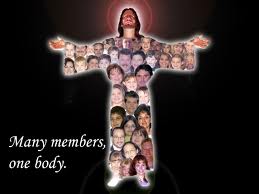
The church is pictured as the BODY OF CHRIST and christians are supposed to be physically TOGETHER in order to edify each other

Paul explains that each part of the body exists to meet the needs of other body parts. In the same way, God intends each of us to meet the needs of other believers, using our strengths to help in their areas of weakness.  A Christian cannot claim to have all the body parts himself, being self-sufficient. In the OT we can read about a few godly believers who are rather alone in their faithful walk with God, but we can never read that this is according to their own desires. They didn’t have much choice! Neither are they evidence of that we can be just as fine without other christians, because there might be OTHER single believers out there who have drifted away due to no support from others. We are to comfort one another (1 Thess. 4:18), build up one another ( 1 Thess. 5:11), confess our sins to one another (James 5:16) and pray for one another (James 5:16). Probably because we need it to stay strong and to not lose our faith. How can we obey these directives if we stay away from the gathering of believers?

The body of Christ has many members and as believers we are all in the same body even though we might feel we are not as important as other members because we are not the “arm”, or the “head”, etc. All are not apostles. All are not teachers. If we were all having the same task, who would do the other important tasks which are needed for the body of Christ? God has placed apostles, teachers, prophets, etc, in the CHURCH (assembly). If you’re at home alone, it’s impossible for you to have any of these roles, and it’s equally hard to make use of spiritual gifts, such as healings and prophesies for the edification of others. You need to be physically involved in an assembly of christians:

1 Cor. 12:11But all these worketh that one and the selfsame Spirit, dividing to every man severally as he will. 12For as the body is one, and hath many members, and all the members of that one body, being many, are one body: so also is Christ.14For the body is not one member, but many 15If the foot shall say, Because I am not the hand, I am not of the body; is it therefore not of the body?— 25That there should be no schism in the body; but that the members should have the same care one for another. 26And whether one member suffer, all the members suffer with it; or one member be honoured, all the members rejoice with it. 27Now ye are the body of Christ, and members in particular. 28And God hath set some in the church, first apostles, secondarily prophets, thirdly teachers, after that miracles, then gifts of healings, helps, governments, diversities of tongues. 29Are all apostles? are all prophets? are all TEACHERS? are all workers of miracles?

Romans 12:4For as we have many members in one body, and all members have not the same office: 5So we, being many, are one body in Christ, and every one members one of another6Having then gifts differing according to the grace that is given to us, whether prophecy, let us prophesy according to the proportion of faith7Or ministry, let us wait on our ministering: or he that TEACHES, on TEACHING8Or he that exhorteth, on exhortation: he that giveth, let him do it with simplicity; he that ruleth, with diligence; he that sheweth mercy, with cheerfulness. 9Let love be without dissimulation. Abhor that which is evil; cleave to that which is good. 10Be kindly affectioned one to another with brotherly love; in honour preferring one another;

Below we can read more about edification of the Church. Most of Paul’s instructions about behavior in the Church would be totally useless unless we are together with other christians. Paul says we should aim to edify the CHURCH by various spiritual gifts, and that is of course impossible for those who are home alone. Also Paul’s instructions about women being quiet in Church and instead asking questions to their husbands AT HOME, indicates he is talking about an environment with other christians, normally away from home.

 “When ye come together, every one of you hath a psalm, hath a doctrine, hath a tongue, hath a revelation, hath an interpretation”. Not IF you come together but WHEN you come together:

1 Cor. 14:3But he that prophesieth speaketh unto men to edification, and exhortation, and comfort. 4He that speaketh in an unknown tongue edifieth himself; but he that prophesieth edifieth the church.-–12Even so ye, forasmuch as ye are zealous of spiritual gifts, seek that ye may excel to the edifying of the church.—16Else when thou shalt bless with the spirit, how shall he that occupieth the room of the unlearned say Amen at thy giving of thanks, seeing he understandeth not what thou sayest? 17For thou verily givest thanks well, but the other is not edified.19Yet in the church I had rather speak five words with my understanding, that by my voice I might teach others also, than ten thousand words in an unknown tongue.—23If therefore the whole church be come together into one place, and all speak with tongues, and there come in those that are unlearned, or unbelievers, will they not say that ye are mad? 24But if all prophesy, and there come in one that believeth not, or one unlearned, he is convinced of all, he is judged of all:— 26How is it then, brethren? when ye come together, every one of you hath a psalm, hath a doctrine, hath a tongue, hath a revelation, hath an interpretation. Let all things be done unto edifying. 27If any man speak in an unknown tongue, let it be by two, or at the most by three, and that by course; and let one interpret. 28But if there be no interpreter, let him keep silence in the church; and let him speak to himself, and to God.—33For God is not the author of confusion, but of peace, as in all churches of the saints. 34Let your women keep silence in the churches: for it is not permitted unto them to speak; but they are commanded to be under obedience as also saith the law. 35And if they will learn any thing, let them ask their husbands at home: for it is a shame for women to speak in the church.

We are told that Jesus himself gave some to apostles, prophets, evangelists, pastors and teachers, and this was for perfecting of the saints, for the work of the ministry and for edifying of the BODY OF CHRIST. These different positions were to continue “Till we all come in the unity of the faith, and of the knowledge of the Son of God, unto a perfect man, unto the measure of the stature of the fulness of Christ”. This has not happened yet:.

Ephesians 4:10 He that descended is the same also that ascended up far above all heavens, that he might fill all things.) 11 And he gave some, apostles; and some, prophets; and some, evangelists; and some, pastors and teachers; 12 For the perfecting of the saints, for the work of the ministry, for the edifying of the body of Christ: 13 Till we all come in the unity of the faith, and of the knowledge of the Son of God, unto a perfect man, unto the measure of the stature of the fulness of Christ:14 That we henceforth be no more children, tossed to and fro, and carried about with every wind of doctrine, by the sleight of men, and cunning craftiness, whereby they lie in wait to deceive; 15 But speaking the truth in love, may grow up into him in all things, which is the head, even Christ:16 From whom the whole body fitly joined together and compacted by that which every joint supplieth, according to the effectual working in the measure of every part, maketh increase of the body unto the edifying of itself in love.
Conditions and tasks for an elder, and note that not ALL people qualify for this task. Elders MUST be professionally trained.

God designed the church as a place where spiritual leaders could watch out for our welfare, just like a shepherd who guards the sheep (1 Peter 5:1-4, Hebrews 13:17). A Christian who answers only to himself can easily rationalize sinful attitudes. Regular contact with other Christians can keep us sharp. In an assembly, it’s not right to let whosoever rise up to teach others. Christians are rather free to share witnesses, prophesies, songs and translating tongues (but we are still told to test all things), but the TEACHING should only be made by those who qualify. Read below about how elders are ordained and that not all people are to be trusted when it comes to teaching. The wrong person preaching could lead to doctrinal errors being spread, so be careful to NOT let people preach in your assembly just to be “kind”. Naturally we should all spread the gospel to unbelievers (we are all told to make disciples), but when it comes to a situation where the assembly of God is supposed to be taught the truth in order to build up others, then it better be from a qualified teacher. Obviously we should always act like the Bereans regardless of who are doing the teaching and compare what we hear with scriptures, but not all have the ability to read and/or cover that much text, why it’s important that our teachers are qualified for their task.

Below we can read that Titus has been appointed to ordain elders in every city. There are loads of restrictions and rules tied to an elder. The elders are responsible to exhort and to convince the gainsayers, because some mouths must be stopped. That is because they subvert whole houses, teaching things which they ought not:

Titus 1:4 To Titus, mine own son after the common faith: Grace, mercy, and peace, from God the Father and the Lord Jesus Christ our Saviour. 5For this cause left I thee in Crete, that thou shouldest set in order the things that are wanting, and ordain elders (presbyterous) in every city, as I had appointed thee6If any be blameless, the husband of one wife, having faithful children not accused of riot or unruly. 7For a bishop must be blameless, as the steward of God; not selfwilled, not soon angry, not given to wine, no striker, not given to filthy lucre; 8But a lover of hospitality, a lover of good men, sober, just, holy, temperate9Holding fast the faithful word as he hath been taught, that he may be able by sound doctrine both to exhort and to convince the gainsayers10For there are many unruly and vain talkers and deceivers, specially they of the circumcision: 11Whose mouths must be stopped, who subvert whole houses, teaching things which they ought not, for filthy lucre’s sake.

In Acts 6 we can read about the twelve disciples not feeling it was right for them to “serve tables” and they preferred that others took this responsibility so that they themselves could focus on spreading the word of God. They gathered the other disciples who chose seven faithful men to take care of the daily ministration. This doesn’t mean those who served tables were less important since we are ALL needed to advance God’s kingdom and we are all different parts of the same body. However, ALL are not supposed to do the preaching in an assembly. You can call this a “hierarchy” if you want, but that would be a negative word about a biblical solution:

Acts 6:1And in those days, when the number of the disciples was multiplied, there arose a murmuring of the Grecians against the Hebrews, because their widows were neglected in the daily ministration. 2Then the twelve called the multitude of the disciples unto them, and said, It is not reason that we should leave the word of God, and serve tables. 3Wherefore, brethren, look ye out among you seven men of honest report, full of the Holy Ghost and wisdom, whom we may appoint over this business. 4But we will give ourselves continually to prayer, and to the ministry of the word. 5And the saying pleased the whole multitude: and they chose Stephen, a man full of faith and of the Holy Ghost, and Philip, and Prochorus, and Nicanor, and Timon, and Parmenas, and Nicolas a proselyte of Antioch: 6Whom they set before the apostles: and when they had prayed, they laid their hands on them. 7And the word of God increased; and the number of the disciples multiplied in Jerusalem greatly; and a great company of the priests were obedient to the faith.

Here Barnabbas is exhorting the church of Antioch to cleave unto the Lord. Seems he was the man to do this type of exhorting:

Acts 11:22Then tidings of these things came unto the ears of the CHURCH which was in Jerusalem: and they sent forth Barnabas, that he should go as far as Antioch. 23Who, when he came, and had seen the grace of God, was glad, and exhorted them all, that with purpose of heart they would cleave unto the Lord. 24For he was a good man, and full of the Holy Ghost and of faith: and much people was added unto the Lord. 25Then departed Barnabas to Tarsus, for to seek Saul: 26And when he had found him, he brought him unto Antioch. And it came to pass, that a whole year they assembled themselves with the church, and taught much people. And the disciples were called Christians first in Antioch.

Here the apostles had ordained certain men to be elders in every church, and they prayed, fasted and commended them to the Lord. This shows the great importance involved.

Acts 14:1And it came to pass in Iconium, that they went both together into the SYNAGOGUE of the Jews, and so spake, that a great multitude both of the Jews and also of the Greeks believed.—4But the multitude of the city was divided: and part held with the Jews, and part with the apostles.—23And when they had ordained them ELDERS (presbyterous) in every church (ekklesian), and had prayed with fasting, they commended them to the Lord, on whom they believed.— 27And when they were come, and had gathered the church together, they rehearsed all that God had done with them, and how he had opened the door of faith unto the Gentiles. 28And there they abode long time with the disciples.

Hierarchy or not, but the church in Antioch brought Paul, Barnabas and certain others to Jerusalem to solve a certain question by the apostles and the elders there. Apparently they felt these men were more suitable to act in the matter. The church in Jerusalem “received” them AND the apostles and the elders did as well. They decided to send some chosen men – CHIEF MEN among the brethren – to Antioch. These chief men exhorted the brethren with many words, and confirmed them.

Acts 15:2When therefore Paul and Barnabas had no small dissension and disputation with them, they determined that Paul and Barnabas, and certain other of them, should go up to Jerusalem unto the apostles and elders (presbyterous) about this question. 3And being brought on their way by the church (ekklesias), they passed through Phenice and Samaria, declaring the conversion of the Gentiles: and they caused great joy unto all the brethren. 4And when they were come to Jerusalem, they were received of the church (ekklesian), and of the apostles and elders, and they declared all things that God had done with them.—6And the apostles and elders came together for to consider of this matter.—21For Moses of old time hath in every city them that preach him, being read in the synagogues every sabbath day. 22Then pleased it the apostles and elders with the whole church, to send chosen men of their own company to Antioch with Paul and Barnabas; namely, Judas surnamed Barsabas and Silas,chief men among the brethren:—23And they wrote letters by them after this manner; The apostles and elders and brethren send greeting unto the brethren which are of the Gentiles in Antioch and Syria and Cilicia.—25It seemed good unto us, being assembled with one accord, to send chosen men unto you with our beloved Barnabas and Paul,— 30So when they were dismissed, they came to Antioch: and when they had gathered the multitude together, they delivered the epistle:—31Which when they had read, they rejoiced for the consolation. 32And Judas and Silas, being prophets also themselves, exhorted the brethren with many words, and confirmed them.— 36And some days after Paul said unto Barnabas, Let us go again and visit our brethren in every city where we have preached the word of the LORD, and see how they do.—40And Paul chose Silas, and departed, being recommended by the brethren unto the grace of God. 41And he went through Syria and Cilicia, confirming the churches.

Here we can read about decrees being delivered for others to keep, and these decrees were ordained by apostles and elders in Jerusalem. We can’t read about anyone complaining about hierarchial systems. The churches increased in number:

Acts 16:1Then came he to Derbe and Lystra: and, behold, a certain disciple was there, named Timotheus, the son of a certain woman, which was a Jewess, and believed; but his father was a Greek: 2Which was well reported of by the brethren that were at Lystra and Iconium.—4And as they went through the cities, they delivered them the decrees for to keep, that were ordained of the apostles and elders which were at Jerusalem. 5And so were the churches established in the faith, and increased in number daily.

Timothy was sent out to make the churches remember the way of Christ, and also to make sure they teach no other doctrine, or give heed to fables and endless genealogies. Timothy was ordained to ministry by the laying on of hands by  Paul and the presbytery, and he was told to not lay on hands on others to soon. Not all people qualify to be elders :

1 Cor 4:17For this cause have I sent unto you Timotheus, who is my beloved son, and faithful in the Lord, who shall bring you into remembrance of my ways which be in Christ, as I teach every where in every church. 18Now some are puffed up, as though I would not come to you.

1 Tim 1:2Unto Timothy, my own son in the faith: Grace, mercy, and peace, from God our Father and Jesus Christ our Lord. 3As I besought thee to abide still at Ephesus, when I went into Macedonia, that thou mightest charge some that they teach no other doctrine, 4Neither give heed to fables and endless genealogies, which minister questions, rather than godly edifying which is in faith: so do. 6From which some having swerved have turned aside unto vain jangling; 7Desiring to be teachers of the law; understanding neither what they say, nor whereof they affirm.

2 Tim. 2 And the things that thou hast heard of me among many witnesses, the same commit thou to faithful men, who shall be able to teach others also.

1 Tim 4:6 If thou put the brethren in remembrance of these things, thou shalt be a good minister of Jesus Christ, nourished up in the words of faith and of good doctrine, whereunto thou hast attained. 7But refuse profane and old wives’ fables, and exercise thyself rather unto godliness.—13Till I come, give attendance to reading, to exhortation, to doctrine. 14Neglect not the gift that is in thee, which was given thee by prophecy, with the laying on of the HANDS of the presbytery.

1 Timothy 5:22 Lay HANDS suddenly on no man, neither be partaker of other men’s sins: keep thyself pure.

2 Timothy 1:6 Wherefore I put thee in remembrance that thou stir up the gift of God, which is in thee by the putting on of my HANDS.

Unfortunately christians will heap to themselves false teachers, and that’s why it’s so important to have qualified teachers around us, who have been trained and accepted by the presbytery before them, and who can reprove, rebuke and exhort based on the true doctrine:

2 Tim. 4:2Preach the word; be instant in season, out of season; reprove, rebuke, exhort with all long suffering and doctrine. 3For the time will come when they will not endure sound doctrine; but after their own lusts shall they heap to themselves TEACHERS, having itching ears; 4And they shall turn away their ears from the truth, and shall be turned unto fables. 5But watch thou in all things, endure afflictions, do the work of an evangelist, make full proof of thy ministry

1 Tim. 5:19 Against an elder receive not an accusation, but before two or three witnesses. 20Them that sin rebuke before all, that others also may fear.

Here are more rules for those who would like to become a bishop – for instance; a novice is not a good candidate. Also; “Let these also first be proved; then let them use the office of a deacon, being found blameless.” There are even rules for how the wives of the bishops should act:

1 Tim 3:1This is a true saying, if a man desire the office of a bishop (episkopes), he desireth a good work. 2A bishop (episkopon) then must be blameless, the husband of one wife, vigilant, sober, of good behaviour, given to hospitality, apt to teach; 3Not given to wine, no striker, not greedy of filthy lucre; but patient, not a brawler, not covetous; 4One that ruleth well his own house, having his children in subjection with all gravity; 5(For if a man know not how to rule his own house, how shall he take care of the church of God?)6Not a novice, lest being lifted up with pride he fall into the condemnation of the devil. 7Moreover he must have a good report of them which are without; lest he fall into reproach and the snare of the devil.—10And let these also first be proved; then let them use the office of a deacon, being found blameless.11Even so must their wives be grave, not slanderers, sober, faithful in all things. 12Let the deacons be the husbands of one wife, ruling their children and their own houses well.—15But if I tarry long, that thou mayest know how thou oughtest to behave thyself in the house of God, which is the church of the living God, the pillar and ground of the truth.

Authority…:

Titus 2:15These things speak, and exhort, and rebuke with all authority. Let no man despise thee.

When a person is sick, he should call for the elders of a church and let THEM pray over him and anoint him with oil. We are told to confess our faults to one another and pray for another that we may be healed. This is impossible to obey if you’re not among other believers:

James 5:13Is any among you afflicted? let him pray. Is any merry? let him sing psalms. 14Is any sick among you? let him call for the elders (presbyterous) of the church (ekklesias) ; and let them pray over him, anointing him with oil in the name of the Lord: 15And the prayer of faith shall save the sick, and the Lord shall raise him up; and if he have committed sins, they shall be forgiven him. 16Confess your faults one to another, and pray one for another, that ye may be healed. The effectual fervent prayer of a righteous man availeth much. —19Brethren, if any of you do err from the truth, and one convert him; 20Let him know, that he which converteth the sinner from the error of his way shall save a soul from death, and shall hide a multitude of sins.

Peter is an elder who exhorts other elders. Elders are supposed to feed the flock as shepherds and be good examples. When the chief shepherd shall appear (Jesus) they shall receive their crown. Peter says the younger should submit to the elders. Nothing is wrong with having shepherds and elders, or submitting to them. The problem arises when churches neglect the instructions for elders, and when they accept teachers who are not qualified and thereby welcome false doctrines in their midst:

1 Peter 5 :1 The elders which are among you I exhort, who am also an elder, and a witness of the sufferings of Christ, and also a partaker of the glory that shall be revealed: 2Feed the flock of God which is among you, taking the oversight thereof, not by constraint, but willingly; not for filthy lucre, but of a ready mind; 3Neither as being lords over God’s heritage, but being examples to the flock. 4And when the chief Shepherd shall appear, ye shall receive a crown of glory that fadeth not away. 5Likewise, ye younger, submit yourselves unto the elder. Yea, all of you be subject one to another, and be clothed with humility: for God resisteth the proud, and giveth grace to the humble.— 13The church that is at Babylon, elected together with you, saluteth you; and so doth Marcus my son. 14Greet ye one another with a kiss of charity. Peace be with you all that are in Christ Jesus. Amen.

2 Peter 2:1But there were false prophets also among the people, even as there shall be false teachers among you, who privily shall bring in damnable heresies, even denying the Lord that bought them, and bring upon themselves swift destruction. 

So apparently elders are referred to as shepherds, so what is so horrible about calling elders “pastors” today? How about warning about dangerous false doctrines instead of splitting hairs?

“didaskaloi” –  means a master, a teacher or an instructor acknowledged for their mastery in their field of learning. Not all meet the requirements.

The word is used below, and a similar word is used for the actual “teaching” of these “teachers”. Note how particular the task of being a teacher is:

James 3 1My brethren, be not many MASTERS, knowing that we shall receive the greater condemnation.

Acts 13 1Now there were in the church that was at Antioch certain prophets and TEACHERS; as Barnabas, and Simeon that was called Niger, and Lucius of Cyrene, and Manaen, which had been brought up with Herod the tetrarch, and Saul. 2As they ministered to the Lord, and fasted, the Holy Ghost said, Separate me Barnabas and Saul for the work whereunto I have called them. 3And when they had fasted and prayed, and laid their hands on them, they sent them away.

Eph. 4:11And he gave some, apostles; and some, prophets; and some, evangelists (euangelistas); and some, pastors (poimenas) and TEACHERS (didaskalous); 12For the perfecting of the saints, for the work of the ministry, for the edifying of the body of Christ: 13Till we all come in the unity of the faith, and of the knowledge of the Son of God, unto a perfect man, unto the measure of the stature of the fulness of Christ:

Hebrews. 5:12 For when for the time ye ought to be TEACHERS, ye have need that one teach you again which be the first principles of the oracles of God; and are become such as have need of milk, and not of strong meat.

Romans 12: 6Having then gifts differing according to the grace that is given to us, whether prophecy, let us prophesy according to the proportion of faith; 7Or ministry, let us wait on our ministering: or he that TEACHES, on TEACHING8Or he that exhorteth, on exhortation: he that giveth, let him do it with simplicity; he that ruleth, with diligence; he that sheweth mercy, with cheerfulness. 

1 Corinthians 12 28And God hath set some in the church, first apostles, secondarily prophets, thirdly TEACHERS, after that miracles, then gifts of healings, helps, governments, diversities of tongues. 29Are all apostles? are all prophets? are all TEACHERS? are all workers of miracles? 30Have all the gifts of healing? do all speak with tongues? do all interpret? 31But covet earnestly the best gifts: and yet shew I unto you a more excellent way.

1 Timothy 5 1Rebuke not an elder, but intreat him as a father; and the younger men as brethren; 2The elder women as mothers; the younger as sisters, with all purity. 3Honour widows that are widows indeed. 4But if any widow have children or nephews, let them learn first to shew piety at home, and to requite their parents: for that is good and acceptable before God. — 17Let the elders that rule well be counted worthy of double honour, especially they who labour in the word and DOCTRINE18For the scripture saith, thou shalt not muzzle the ox that treadeth out the corn. And, The labourer is worthy of his reward. 19Against an elder receive not an accusation, but before two or three witnesses. 20Them that sin rebuke before all, that others also may fear. 

Plurality of elders

Nowhere in the Bible will you see a verse which claims there must always be more than one “elder” in an assembly. Those who claim this have the burden of proof to show it. Paul says that not all are apostles, teachers, etc, and he is very clear about that not all are qualified to be an elder. Let’s go through some of the verses which are often used as “proof” for the idea that there must always be multiple elders in a church.

Acts 14:2 21And when they had preached the gospel to that city, and had taught many, they returned again to Lystra, and to Iconium, and Antioch, 22Confirming the souls of the DISCIPLES, and exhorting THEM to continue in the faith, and that we must through much tribulation enter into the kingdom of God. 23And when they had ordained THEM ELDERS in every church, and had prayed with fasting, they commended them to the Lord, on whom they believed.

Comment: Many places are spoken about and many disciples are mentioned. Those who were ordained elders were the disciples so the word should be in plural. It would be incorrect to say that they made them all “elder in every church”. One person can not be several elders.

Acts 20: 16For Paul had determined to sail by Ephesus, because he would not spend the time in Asia: for he hasted, if it were possible for him, to be at Jerusalem the day of Pentecost.17And from Miletus he sent to Ephesus, and called the ELDERS of the church.

Comment: There happened to be several elders in the church of Ephesus.

Acts 20:225And now, behold, I know that YE ALL, among whom I have gone preaching the kingdom of God, shall see my face no more.26Wherefore I take YOU to record this day, that I am pure from the blood of all men. 27For I have not shunned to declare unto YOU ALL the counsel of God.8Take heed therefore unto YOURSELVES, and to all the FLOCK, over the which the Holy Ghost hath made YOU OVERSEERS, to feed the CHURCH OF God, which he hath purchased with his own blood.29For I know this, that after my departing shall grievous wolves enter in among you, not sparing the flock.

Comment. These verses speak against those who say there are always multiple elders in each church. The text says nothing of the sort. Paul is talking to a certain group of people (disciples) and they have all been made overseers by the Holy Ghost. THEY are therefore responsible, much like shepherds, to feed the flock which is the church of God (all christians). Not all people are called to be shepherds. Most of us are in the “flock”. Paul also warns the disciples about grievous wolves which will enter in among them, not sparing the flock. This is exactly what might happen in churches that refuse to adhere to Paul’s rules about not letting whosoever become elders and teachers, and shepherds are responsible for not letting this happen. All are not apostles, teachers, prophets, and that means we should not allow people to be elders who are not qualified. Disobeying Paul’s instructions about this order will risk false teachers and teachings to enter in among us. In summary; don’t let anyone stand up and teach in your church!

Peter 5:1The elders which are among you I exhort, who am also an elder, and a witness of the sufferings of Christ, and also a partaker of the glory that shall be revealed:

Comment: Several elders are spoken about here too, so it should be plural.

Phil. 1:1 Paul and Timotheus, the servants of Jesus Christ, to all the saints in Christ Jesus which are at Philippi, with the bishops and deacons

Comment: Not sure how large Philippi was during this time (I’ve been there myself but about 2000 years later), and how many churches (assemblies) there were and how big each assembly was, but apparently the assemblies were big enough and blessed enough to have many bishops and deacons. It doesn’t say anywhere here either that there MUST be multiple bishops and deacons in each assembly.

Titus 1:5 For this cause left I thee in Crete, that thou shouldest set in order the things that are wanting, and ordain ELDERS in every city, as I had appointed thee

Comment: Paul didn’t restrict Titus to always settle with ONE elder per city. It would not make sense if Paul told Titus to make one single person an elder for multiple cities. Naturally then “elder” should be in plural. Titus of course had instructions to follow, and he couldn’t make people elders who did not qualify for this. The qualifications for an elder follow right after Titus 1:5. If multiple people qualified they could be elders (likely the case) but if only one person qualified in a city, then Titus had to settle with him in order to be obedient to Paul’s instructions.

 James 5:14Is any sick among you? let him call for the elders of the church; and let them pray over him, anointing him with oil in the name of the Lord:

Comment: What if Paul instead wrote that we should call for “the elder” of the church. That would make it sound like Paul takes for granted there is never more than one elder per church. But there could absolutely be more than one elder per church, and this might very well be the most common case. More than one person could be qualified to be an elder in one and the same church. Clearly then Paul must use “elder” in plural and not singular.

In summary; there are no verses in the Bible which say there can never be only one elder in a church. The best scenario would be if there were more than one, but if people did not meet the standards, apart from just one, then this one person would be the only elder. Paul in Acts 7  is the only one mentioned doing the talking for several hours, until daybreak, and that didn’t seem to be a problem.

Finally a few verses with “elder” in singular (just because there are those who claim there are none):

1 Timothy 5 1Rebuke not an elder, but intreat him as a father; and the younger men as brethren; 

1 Timothy 5:19 Against an elder receive not an accusation, but before two or three witnesses.

1 Peter 5:1 The elders which are among you I exhort, who am also an elder, and a witness of the sufferings of Christ, and also a partaker of the glory that shall be revealed

1  Peter 5:5  Likewise, ye younger, submit yourselves unto the elder. Yea, all of you be subject one to another, and be clothed with humility: for God resisteth the proud, and giveth grace to the humble.

2 John 1:1 The elder unto the elect lady and her children, whom I love in the truth; and not I only, but also all they that have known the truth;

Not all churches are lead by one (despotic) pastor, so please do not paint with a broad brush

Not all churches are run by ONE pastor who is teaching a bunch of falsehood before a crazy crowd of people who only go to church for the wrong reasons. There ARE godly pastors out there who feel the calling and the responsibility to keep the assembly clean from falsehood, and there are pastors who do NOT want to be idolized in any way. In some small areas there might not be enough christians who qualify to be preachers/elders, and Paul puts a lot of emphasize on how important it is for a teacher to meet the requirements. Having an assembly in a church building or in a home with only one elder is FAR better than not having any assemblies at all. I’m glad there are no “church inspectors” who come knocking on doors just to check that there are at least 2-3 elders present, or else the assembly must be dissolved. I’d rather have one good qualified pastor/elder/shepherd/bishop/presbytery (or whatever you would like to call him) than multiple elders who are not qualified when it comes to teaching. However, a church could of course have multiple administrators/helpers (some call them elders) who might not be qualified as teachers but qualified when it comes to other tasks. This is very common in our churches

Below we can read about Paul who alone did all the preaching when the disciples joined together. They apparently gathered in a large house because Eutychus fell down from the third loft. Paul also explains to the elders of the church how important it is that they keep the flock together. Unfortunately Paul also knows that there will be men of their own, speaking perverse things to draw away disciples after them. This is always the risk when leaders of a church in an attempt to be “democratic” allow various people to rise up and preach even though they are not qualified. Preaching to others in a christian assembly is a great responsibility. Single pastors don’t equal selfish monsters with the only aim to spread falsehood around them. Paul spoke for hours upon hours in the below verses, and no one suggested it was selfish or unfair.

Acts 20:1And after the uproar was ceased, Paul called unto him the disciples, and embraced them, and departed for to go into Macedonia.— 7And upon the first day of the week, when the disciples came together to break bread, Paul preached unto them, ready to depart on the morrow; and continued his speech until midnight. 8And there were many lights in the upper chamber, where they were gathered together. 9And there sat in a window a certain young man named Eutychus, being fallen into a deep sleep: and as Paul was long preaching, he sunk down with sleep, and fell down from the third loft, and was taken up dead. 10And Paul went down, and fell on him, and embracing him said, Trouble not yourselves; for his life is in him. 11When he therefore was come up again, and had broken bread, and eaten, and talked a long while, even till break of day, so he departed.— 17And from Miletus he sent to Ephesus, and called the elders of the church. 18And when they were come to him, he said unto them, Ye know, from the first day that I came into Asia, after what manner I have been with you at all seasons,—20And how I kept back nothing that was profitable unto you, but have shewed you, and have taught you publicly, and from house to house,—28Take heed therefore unto yourselves, and to all the flock, over the which the Holy Ghost hath made you overseers (episkopous), to feed (poimainein) the church (ekklesian) of God, which he hath purchased with his own blood. 29For I know this, that after my departing shall grievous wolves enter in among you, not sparing the flock. 30Also of your own selves shall men arise, speaking perverse things, to draw away disciples after them.

Are there any Bible verses against paying pastors – if this is what a group of believers would prefer?

Temples couldn’t have been totally free to run, and we know that the Levites got help from the other tribes when it comes to food and other products in order to work full-time in the tabernacle/temple. If some preachers were paid in the NT – perhaps if they accepted some collected money during their visits – we don’t know. We DO know that the bible nowhere forbids it. We must keep in mind that things were much different in the beginning when it comes to persecution, ability to work and get money, and the general culture. Changes don’t have to be wrong (except if they are against the Bible). What’s wrong with paying those who serve full time and put their entire lives into the ministry? Where is the sin? What is the better alternative knowing the culture of today?

Today the normal situation for a family is that both the man and the woman have to work full-time to make ends meet, and that means you’re away from home most of the day since you also have to commute to and from work. An hour in each direction is not uncommon. When you get home around 6 pm you have to get the kids from the kindergarten, fix dinner, do some laundry and spend the little time you have left with your kids even though you’re TIRED and just want to go to bed. With other words, forget about doing any preaching or evangelization Monday-Friday. Now we have the weekend left. On Saturday you really need to do some major grocery shopping so you won’t have to do that during the rest of the week when you’re too busy. This might also be the only day of the week when you actually have time to do something together as a family, like going to the park and maybe the kids are doing some sport activities. You also have some cleaning to do, more laundry to handle, and a large pile of clothes to iron. You might also need to visit some relatives. So only SUNDAY is left. Of course you can try to fill it with preaching and evangelization, but you also need some time in prayers and private Bible studies, and you always have your family that requires your attention. Of course the situation will be easier once the kids grow up, but we’re still down to SOME hours during the weekend. Maybe it’s a better idea to PAY a person who is qualified for preaching? He could do this FULL TIME. If preachers, eager to spread the gospel, had to settle with Sundays, there is a risk that their fire might be quenched.

The world has changed also in other ways. 2000 years ago people took care of their own elderly parents and handicapped family members but today people are getting paid for it. This system is hard to change over night, and if someone still wants to change it, I’d like to hear how this could be achievable.

1 Corinthians 9:13Do ye not know that they which minister about holy things live of the things of the temple? and they which wait at the altar are partakers with the altar?14Even so hath the Lord ordained that they which preach the gospel should live of the gospel.15But I have used none of these things: neither have I written these things, that it should be so done unto me: for it were better for me to die, than that any man should make my glorying void.

Paul brings out how the Levitical method of provision for Priests carries over to the Ministers of the gospel. He says “The LORD ordained it”. A priest could not effectively do what he was called to do if he worked a secular job as well. Why should we expect anything different for ministers of the gospel? Paul also brought out how that even though he had all right to receive money, he chose not to. He DID NOT say that it was wrong for others to do so. This would have been wrong of him, since his situation was different from theirs, as he was a traveling evangelist who was single, whereas others had families and homes. He clearly states that a man who preaches the gospel should also live of the gospel. As it says in other versions, “the Lord has commanded that those who preach the gospel should receive their living from the gospel”. Unlike Paul, Peter had a family to take care of so some of his time and money must have been required to meet some of their needs.

The fact that we’re not able to read much in the Bible how preachers made a living could signify that we have some freedom to settle this matter ourselves. Or do you have a verse where it says we do not have this type of freedom? To label innocent pastors as a bunch of greedy, lazy parasites just because they live on salaries is beyond rude. Many pastors/preachers sacrifice secular jobs with good salaries just for the sake of making others disciples of God. I repeat from another section about Double Honor:

1 Tim. 5:16If any man or woman that believeth have widows, let them relieve them, and let not the church (ekklesia) be charged; that it may relieve them that are widows indeed. 17Let the ELDERS (presbyteroi) that rule well be counted worthy of DOUBLE HONOUR, especially they who labour in the word and doctrine.18 For the scripture saith, thou shalt not muzzle the ox that treadeth out the corn. And, The labourer is worthy of his reward.19Against an elder receive not an accusation, but before two or three witnesses. 20Them that sin rebuke before all, that others also may fear.

Above, we can see that Paul would prefer if widows could be taken care of by individuals rather than having the CHURCH providing for them. Continuing in the same subject of providing for others, Paul also says that ELDERS should be given DOUBLE HONOR and especially those who are doing it well (consistent with doctrine, etc). This goes together well with verses such as

And sold their possessions and goods, and parted them to all men, as every man had need”.

“And the multitude of them that believed were of one heart and of one soul: neither said any of them that ought of the things which he possessed was his own; but they had all things common”

“and distribution was made unto every man according as he had need”

An elder with a family to provide for, and who spends a lot of time keeping the flock together, handles the administration, shares the true doctrine to others, makes other people disciples and even new ELDERS, would be in great need of some financial help, even though he would naturally do whatever he could to NOT be a burden to the Church. It should be a common interest for all of us to not be a burden to the Church, but to take all opportunities to make money.

Things don’t have to be wrong just because they are not mentioned in the Bible

There are numerous ways to spread the word of God, and we don’t have to fear that we are doing the wrong things just because they are not explicitly mentioned in the Bible. We might make performances like skits or dramas in open air, sing christian songs in parks or outside shopping malls, take part in worship teams, participate in choirs and make concerts to the public, march around cities proclaiming Jesus and announce church meetings, make ads in newspapers/radio/TV, do street preaching and hand out leaflets and church invitations, place evangelist material in mail boxes, write christian books, start christian newspapers/magazines, show christian films on huge outdoor TV screens, make christian websites, write christian blogs, etc. Some things could not be mentioned in the Bible because they were not invented yet. We get GREAT help from copy machines, computers, cameras, video-players, DVD-players, CD-players, MP3, streaming, microphones, cell phones, amplifiers and credit cards, because we can reach many more people thanks to them and our work goes so much faster and easier. PRAISE GOD for new technology now when time is getting near for the return of Jesus Christ. Thanks to new technology also translating Bibles into foreign languages goes so much faster.

The bible doesn’t say it’s a sin to view people as “church members”, and it doesn’t say it’s wrong to have conditions for being a member. After all, we are told to not even eat with people who call themselves christians but who live unrighteously, so we certainly wouldn’t want anyone to be a “member” among us. Today a matrix with members makes a lot of sense since you could use it to send out newsletters and other information.

A meeting doesn’t have to be in a building (even though this was most common) and there are no specific rules how the interior of the building must look like. We can read about not giving the “better seats” to someone just because he appears rich and has nice clothes. To have an “altar”, or “podium”, or a little high “table” where the speaker could stand with his notes, a microphone and a glass of water makes perfect sense.

Neither are there rules for how much you should decorate the church building or a home for these meetings. The tabernacle and the temple in Jerusalem were really costly and beautiful, but it doesn’t mean we have to have luxurious buildings for our meetings. One positive aspect of going away for a church meeting into a specific building for this purpose (just like the temples were used) would be to get away from your regular every-day-life in your home and feel particular in a special environment which is linked to GOD. Of course we can pray, sing and worship anywhere, but for certain regular church meetings it might not be a bad idea to do this in a certain building away from home. Moreover, today you might live in an area where people live in small apartments, and if ten people are gathered together the apartment might be full! Actually, there are usually limited space also in a house, because apart from multiple bed rooms there might only be one room left, and if you gather 10-15 people there, it’s packed! So if you feel there should be no meetings unless there are at least 2-3 elders present, then this might result in 3 elders, your family of 5, and 2 more friends before you run out of room. The case could be that none of them has the gift of prophesy or other gifts. Perhaps a church building would therefore be a better option, and part of this building could also be used as a resident for an elder with his family. This is in fact not uncommon. Then this elder might be able to pay for his part of the building, reducing the burden for the assembly.

Are Anti-Church-People poor victims?

No, they are the ones attacking the church system, which could indirectly mean they are criticizing also those who attend church services. I hope it won’t lead to persecutions. When church-goers defend themselves, the AMCP might feel attacked, and some might even be offended that all christians won’t boycott the church system and stay at home alone as THEY do.

Are Anti-Church-People hypocrites?

Why would God call people out of a system for the reason that it’s unbiblical, just so they can live in an even MORE unbiblical way? That doesn’t make any sense at all. Why being so alarmed over people who live in an unbiblical environment when they themselves live in more unbiblical way? If a person complains about people who say “go to church” and/or “What a pretty church” and use the same expressions themselves, then they are hypocrites. It must be tiresome to always use quotation marks when saying “going to church” even though the rest of the world understands perfectly well what they mean even without quotation marks.

Jesus Christ should be enough, so we don’t need to go to Church?

Can we really afford this mentality when it comes to babes in Christ? What if you go knocking on doors and succeed to make a person a christian by telling him about Jesus. Is it really enough to give him a Bible and some evangelist material and then leave, hoping he will continue on the narrow road? Isn’t it more likely he will remain on the right path if he hangs around with other believers, like in a church?

Spreading legalism

By making church goers feel bad by condemning the entire church system and denying  believers any freedom to arrange assemblies in their own way – even though they are not against any Biblical instructions – the AMCP are spreading legalistic influences. There ARE indeed multiple churches which are not according to Biblical instructions, but AMCP let these poorly functioned churches represent the entire church system.

When should we leave Church? 

Jesus often spoke in the temple and in the synagogues, and a rule came up, that if any man confesses that Jesus is Christ, he should be put out of the synagogue. This was clearly an ungodly rule, but this didn’t cause Jesus to start boycotting the synagogues due to ungodly rules and leaders.

John 9:22 These words spoke his parents, because they feared the Jews; for the Jews had agreed already that if any man confessed that He was Christ, he should be put out of the synagogue.

John 18:20 Jesus answered him, “I spoke openly to the world; I ever taught in the synagogue and in the temple whither the Jews always resort, and in secret have I said nothing.

When the man in 1 Cor. 5 acted in the wrong way, then HE was supposed to be eliminated from among them. Not the others. There are indeed churches out there which are not working very well, but what if there are no other churches to join? Maybe it would be a good idea to stick to one “ok” church than no church at all, just so you can influence others and make friends? We are supposed to make disciples and encourage one another in the truth. Not turn our backs on people we know are misinformed and deceived. Paul always tracked down churches during his trips, and if they didn’t work that well he tried to exhort and correct them. It’s true that we are not apostles like him, but the point is that we might be better off being in a church (at least once in a while) than in no church at all. The latter option would be MORE unbiblical than the former. And of course God would know that you have issues with various elements in the church because you feel they are unbiblical. God knows it’s not YOUR fault so he isn’t going to hold you accountable for them, but maybe you would be in his will if you tried to influence elders or some church members in the right direction (without being too self-righteous about it).

Verses about coming together as an assembly (apart from verses above)

Paul made numerous trips, and if there were christian colonies in those places where he went, he always managed to track them down. He also knew that his letters would reach the christians, because they stayed together and could share the content. Acts 20:7 reveals the practice of the early church: “And upon the first day of the week, when the disciples came together to break bread, Paul preached to them.” For Christians in every location, regular gathering was a part of life. Wherever Christians are within range of each other in the New Testament, they meet.

Acts 1:13 And when they were come in, they went up into an upper room, where abode both Peter, and James, and John, and Andrew, Philip, and Thomas, Bartholomew, and Matthew, James the son of Alphaeus, and Simon Zelotes, and Judas the brother of James. 14These all continued with one accord in prayer and supplication, with the women, and Mary the mother of Jesus, and with his brethren.

Acts 2:1And when the day of Pentecost was fully come, they were all with one accord in one place. 2And suddenly there came a sound from heaven as of a rushing mighty wind, and it filled all the house where they were sitting.

Acts 4:31And when they had prayed, the place was shaken where they were assembled together; and they were all filled with the Holy Ghost, and they spake the word of God with boldness. 32And the multitude of them that believed were of one heart and of one soul: neither said any of them that ought of the things which he possessed was his own; but they had all things common.—33And with great power gave the apostles witness of the resurrection of the Lord Jesus: and great grace was upon them all. 34Neither was there any among them that lacked: for as many as were possessors of lands or houses sold them, and brought the prices of the things that were sold, 35And laid them down at the apostles’ feet: and distribution was made unto every man according as he had need.—11And great fear came upon all the church, and upon as many as heard these things.— 14And believers were the more added to the Lord, multitudes both of men and women.)

Acts 12:12And when he had considered the thing, he came to the house of Mary the mother of John, whose surname was Mark; where many were gathered together praying. 13And as Peter knocked at the door of the gate, a damsel came to hearken, named Rhoda.

Acts 21:3Now when we had discovered Cyprus, we left it on the left hand, and sailed into Syria, and landed at Tyre: for there the ship was to unlade her burden. 4And finding disciples, we tarried there seven days: who said to Paul through the Spirit, that he should not go up to Jerusalem. 5And when we had accomplished those days, we departed and went our way; and they all brought us on our way, with wives and children, till we were out of the city: and we kneeled down on the shore, and prayed. 6And when we had taken our leave one of another, we took ship; and they returned home again. 7And when we had finished our course from Tyre, we came to Ptolemais, and saluted the brethren, and abode with them one day.—17And when we were come to Jerusalem, the brethren received us gladly. 18And the day following Paul went in with us unto James; and all the elders were present.

Acts 28:30And Paul dwelt two whole years in his own hired house, and received all that came in unto him, 31Preaching the kingdom of God, and teaching those things which concern the Lord Jesus Christ, with all confidence, no man forbidding him.

1 Cor.2 Unto the church of God which is at Corinth, to them that are sanctified in Christ Jesus, called to be saints, with all that in every place call upon the name of Jesus Christ our Lord, both their’s and our’s:—10Now I beseech you, brethren, by the name of our Lord Jesus Christ, that ye all speak the same thing, and that there be no divisions among you; but that ye be perfectly joined together in the same mind and in the same judgment.11For it hath been declared unto me of you, my brethren, by them which are of the house of Chloe, that there are contentions among you.

1 Cor.3:3For ye are yet carnal: for whereas there is among you envying, and strife, and divisions, are ye not carnal, and walk as men?—4For while one saith, I am of Paul; and another, I am of Apollos; are ye not carnal? 5Who then is Paul, and who is Apollos, but ministers by whom ye believed, even as the Lord gave to every man? 6I have planted, Apollos watered; but God gave the increase. — 9For we are labourers together with God: ye are God’s husbandry, ye are God’s building.

1 Cor, 5:1It is reported commonly that there is fornication among you, and such fornication as is not so much as named among the Gentiles, that one should have his father’s wife. 2And ye are puffed up, and have not rather mourned, that he that hath done this deed might be taken away from among you.—6Your glorying is not good. Know ye not that a little leaven leaveneth the whole lump? 7Purge out therefore the old leaven, that ye may be a new lump, as ye are unleavened. For even Christ our passover is sacrificed for us:

1 Cor 6:1Dare any of you, having a matter against another, go to law before the unjust, and not before the saints? 2Do ye not know that the saints shall judge the world? and if the world shall be judged by you, are ye unworthy to judge the smallest matters?—7Now therefore there is utterly a fault among you, because ye go to law one with another. Why do ye not rather take wrong? why do ye not rather suffer yourselves to be defrauded?

1 Cor 7:17But as God hath distributed to every man, as the Lord hath called every one, so let him walk. And so ordain I in all churches.

2 Cor 7:14For if I have boasted any thing to him of you, I am not ashamed; but as we spake all things to you in truth, even so our boasting, which I made before Titus, is found a truth. 15And his inward affection is more abundant toward you, whilst he remembereth the obedience of you all, how with fear and trembling ye received him.

2 Cor.11:4For if he that cometh preacheth another Jesus, whom we have not preached, or if ye receive another spirit, which ye have not received, or another gospel, which ye have not accepted, ye might well bear with him. 5For I suppose I was not a whit behind the very chiefest apostles.— 8I robbed other churches, taking wages of them, to do you service. 9And when I was present with you, and wanted, I was chargeable to no man: for that which was lacking to me the brethren which came from Macedonia supplied: and in all things I have kept myself from being burdensome unto you, and so will I keep myself.

2 Cor. 12:12Truly the signs of an apostle were wrought among you in all patience, in signs, and wonders, and mighty deeds. 13For what is it wherein ye were inferior to other churches, except it be that I myself was not burdensome to you? forgive me this wrong. 14Behold, the third time I am ready to come to you; and I will not be burdensome to you: for I seek not yours but you: for the children ought not to lay up for the parents, but the parents for the children.—19Again, think ye that we excuse ourselves unto you? we speak before God in Christ: but we do all things, dearly beloved, for your edifying. 20For I fear, lest, when I come, I shall not find you such as I would, and that I shall be found unto you such as ye would not: lest there be debates, envyings, wraths, strifes, backbitings, whisperings, swellings, tumults: 21And lest, when I come again, my God will humble me among you, and that I shall bewail many which have sinned already, and have not repented of the uncleanness and fornication and lasciviousness which they have committed.

Phil 1:5Hearing of thy love and faith, which thou hast toward the Lord Jesus, and toward all saints;— 7For we have great joy and consolation in thy love, because the bowels of the saints are refreshed by thee, brother.

2 Corinthians 13:1This is the third time I am coming to you. In the mouth of two or three witnesses shall every word be established.

Heb  3:13But exhort one another daily, while it is called To day; lest any of you be hardened through the deceitfulness of sin.

1 Peter 4:8And above all things have fervent charity among yourselves: for charity shall cover the multitude of sins. 9Use hospitality one to another without grudging. 10As every man hath received the gift, even so minister the same one to another, as good stewards of the manifold grace of God. 11If any man speak, let him speak as the oracles of God; if any man minister, let him do it as of the ability which God giveth: that God in all things may be glorified through Jesus Christ, to whom be praise and dominion for ever and ever. Amen.

1 John 1:3That which we have seen and heard declare we unto you, that ye also may have fellowship with us: and truly our fellowship is with the Father, and with his Son Jesus Christ.

1 John 2:19They went out from us, but they were not of us; for if they had been of us, they would no doubt have continued with us: but they went out, that they might be made manifest that they were not all of us.

Jude 1:3Beloved, when I gave all diligence to write unto you of the common salvation, it was needful for me to write unto you, and exhort you that ye should earnestly contend for the faith which was once delivered unto the saints. 4For there are certain men crept in unawares, who were before of old ordained to this condemnation, ungodly men, turning the grace of our God into lasciviousness, and denying the only Lord God, and our Lord Jesus Christ.

The difference between the Sheep and the Goats in the parable, is what they DID and DIDN’T DO

Jesus says in John 5:29 that at the resurrection those who have done good will get LIFE and those who have done evil will get damnation. James, Paul, John and Peter say the same thing.

John. 5:28 Marvel not at this: for the hour is coming, in the which all that are in the graves shall hear his voice, 29And shall come forth; they that have done good, unto the resurrection of life; and they that have done evil, unto the resurrection of damnation.

James. 2:13 For he shall have judgment without mercy, that hath shewed no mercy; and mercy rejoiceth against judgment.

Rom 8:13 For if ye live after the flesh, ye shall die: but if ye through the Spirit do mortify the deeds of the body, ye shall live.

John 14:23 Jesus answered and said unto him, If a man love me, he will keep my words: and my Father will love him, and we will come unto him, and make our abode with him 24 He that loveth me not keepeth not my sayings: and the word which ye hear is not mine, but the Father’s which sent me.

1 Pet 2:11 Dearly beloved, I beseech you as strangers and pilgrims, abstain from fleshly lusts, which war against the SOUL;

What we DO makes the difference whether we will be able to enter God’s kingdom or not (even if we of course must believe that Jesus is God who has come in the flesh and that he has died as a sin offering and cleansed us from our sins with his blood). The Bible is filled with commands that we must DO things to be saved (not lose salt, go through the narrow gate, endure to the end, carry our cross daily, etc) and this might be surprising for us in Scandinavia, because we have been influenced by Martin Luther to a great deal. He was a person who didn’t take much delight in the book of James (according to his own words) where he could read things such as:

James. 2:20But wilt thou know, O vain man, that faith without works is dead? 21Was not Abraham our fathered by faith alone” even though the Bible says we’re not saved by faith alone. 

We tend to believe that if we must DO anything at all to be saved, then it is “works salvation” and the biggest theological error under the sun (and a sin). Naturally we can’t save ourselves, because we are all in need of cleansing in the blood of Jesus, and we can’t earn our salvation by anything we do or believe, but there are still conditions for our salvation and that is to believe, repent and obey God. This is something that we must DO. Matthew 25 contains three parables that all have the point that what we DO affect our final destination – heaven or hell. This might be referred to as heresy in the Church today, but the Bible disagrees. Read the parable between the sheep and the goats. Both the sheep and the goats believed in the one they communicated with – Jesus – and also demons accept that Jesus is the son of God and even confess this out loud! This won’t save them, which is James’ point. (Not that demons are angels and can’t be saved, because the subject in James 2 is “Deeds”.) Faith without deeds is dead. 

The final judgment 

Matthew 25:31When the Son of man shall come in his glory, and all the holy angels with him, then shall he sit upon the throne of his glory: 32And before him shall be gathered all nations: and he shall separate them one from another, as a shepherd divideth his sheep from the goats: 33And he shall set the sheep on his right hand, but the goats on the left. 34Then shall the King say unto them on his right hand, Come, ye blessed of my Father, inherit the kingdom prepared for you from the foundation of the world: 35For I was an hungred, and ye gave me meat: I was thirsty, and ye gave me drink: I was a stranger, and ye took me in: 36Naked, and ye clothed me: I was sick, and ye visited me: I was in prison, and ye came unto me. 37Then shall the righteous answer him, saying, Lord, when saw we thee an hungred, and fed thee? or thirsty, and gave thee drink? 38When saw we thee a stranger, and took thee in? or naked, and clothed thee? 39Or when saw we thee sick, or in prison, and came unto thee? 40And the King shall answer and say unto them, Verily I say unto you, Inasmuch as ye have done it unto one of the least of these my brethren, ye have done it unto me.

41Then shall he say also unto them on the left hand, Depart from me, ye cursed, into everlasting fire, prepared for the devil and his angels: 42For I was an hungred, andye gave me no meat: I was thirsty, and ye gave me no drink: 43I was a stranger, andye took me not in: naked, and ye clothed me not: sick, and in prison, and ye visited me not. 44Then shall they also answer him, saying, Lord, when saw we thee an hungred, or athirst, or a stranger, or naked, or sick, or in prison, and did not minister unto thee? 45Then shall he answer them, saying, Verily I say unto you, Inasmuch as ye did it not to one of the least of these, ye did it not to me. 46And these shall go away into everlasting punishment: but the righteous into life eternal. 

The difference between the sheep and the goats is therefore what they DO. The sheep end up on the right side, and they are the ones that have done something good (righteousness), and the goats end up on the left side, and they are the ones that have neglected to do something good. They have NOT shown compassion and mercy. Lack of fruit can hinder us from entering the kingdom of God. We can read this in John 15 where the branches are cut off and thrown in the fire due to lack of fruit. We are not  saved by merely believing in a “package”. We could compare with the angels in the beginning of the creation. I don’t believe they had a problem to “believe in God”, or to accept him as their Creator. Still, we can read that 1/3 of them fell when they followed Lucifer on his wicked ways. It was once again what they DID which affected the continuation of the story – in the future they will be thrown in the lake of fire which was prepared for them from the beginning of the world, due to their deeds.

The other parables in Matthew 25 are the well known parables of the ten virgins and the one about the talents. All the ten virgins “believed” in the bride groom and waited for his arrival. What they DID and DIDN’T DO made all the difference for what happened next. They all had lamps, but half of the girls had chosen to not bring any extra oil even though this might be needed. We can see that it probably concerned spare oil since the foolish girls said the lamps are “gone out”. This means the lamps had previously given light, but they did not endure to the end due to lack of oil. We are told by Jesus that we must endure to the end to be saved! The wise girls had chosen to bring some spare oil with them which was a good choice. Our choices make the difference! Also the parable with the Talents shows that our choices and our actions affect the outcome of things, and also here we can see that it concerns eternal life (with various rewards) or eternal damnation.

I know that I write a lot about repentance and righteousness in my blog, and that is because these topics are neither that common, nor popular, despite that they are very important subjects because they concern our SOULS. The devil’s only goal is to make us SIN so that we won’t be able to enter God’s kingdom. He tempts us and tries to provide us with excuses to sin. I believe the devil wants to reassure us that we can be saved by faith alone with no deeds, and that sin will not separate us from God. Wouldn’t it be horrible if he managed to deceive us into thinking “What a relief that God loves me just the way I am, and that he views me as righteous despite that I live unrighteously at times, and that it’s enough to BELIEVE in him to be saved” IF this is not true? Just imagine if we on Judgment Day would have to say…“Oops!”

1 Peter 4:18 And if the righteous scarcely be saved, where shall the ungodly and the sinner appear?

Are DINOSAURS mentioned in the BIBLE, like in the Book of Job?

If the BOOK OF JOB doesn’t describe dinosaurs, what animals are being referred to?

Not all animals are mentioned by name in the Bible (cats, tigers, elephants, etc), but if God created the dinosaurs on Day six of the creation week, it’s possible that hey might be mentioned somewhere in the Bible and I believe this is also the case. However, “dinosaur” is a modern word invented by Sir Richard Owen in 1841 inspired by a Greek word meaning “terrible lizard”, and the word Behemoth is literally a plural form of a Hebrew word meaning “beast”. If the below is NOT a dinosaur, what is it?

Job 40:15Behold now behemoth, which I made with thee; he eateth grass as an ox. 16Lo now, his strength is in his loins, and his force is in  the navel of his belly. 17He moveth his tail like a cedar: the sinews of his stones are wrapped together18His bones are as strong pieces of brass; his bones are like bars of iron. 19He is the chief of the ways of God: he that made him can make his sword to approach unto him. 20Surely the mountains bring him forth food, where all the beasts of the field play. 21He lieth under the shady trees, in the covert of the reed, and fens. 22The shady trees cover him with their shadow; the willows of the brook compass him about. 23Behold, he drinketh up a river, and hasteth not: he trusteth that he can draw up Jordan into his mouth. 24He taketh it with his eyes: his nose pierceth through snares.

Elephant and hippopotamus are sometimes suggested as candidates for the Behemot, but they have ridiculously small tails, and far from having tails “like a cedar”. They don’t move their tails like a cedar tree either. We can read that this creature is “the chief” of the ways of God, so this would exclude at least the hippopotamus, which isn’t the greatest of all animals, but neither does the rest of the description sound like an elephant. Leviathan is another unknown creature, and it sounds a bit like a dragon considering that it’s large and a fire-breathing animal. Many of the dragons that we can read about in fairy tales are fire-breathing and they do look like certain dinosaurs. What other type of animal could cause smoke and fire coming out of his nose or mouth? In the below description we can read about an animal that seems to be totally impossible to catch and subdue. Filling his skin with barbed irons is impossible, likely due to the hard skin surface and his scales. You can’t use a spear against his head, and just the sight of him can make a person tremble. His teeth are terrible, and swords, spears and arrows cannot touch him. The sight of a spear just makes him laugh, and for him iron is as straw. He can look at all HIGH things, etc. Interestingly, the “dinosaur” in the story of “Beowulf” had to be killed by using a spear through the stomach – the only place on a dinosaur which is soft enough. But how do you thrust a spear into the stomach of a large dinosaur without getting killed? The hero hid himself in a large hole he had dug in the ground, which he covered with material heavy enough to hold the weight of this particular dinosaur – but still with the possibility to stick a spear through it and reach the stomach of the dinosaur. Meat was placed on top of the trap to lure the dinosaur to come.

Job 41 1Canst thou draw out leviathan with an hook? or his tongue with a cord which thou lettest down? 2Canst thou put an hook into his nose? or bore his jaw through with a thorn? 3Will he make many supplications unto thee? will he speak soft words unto thee? 4Will he make a covenant with thee? wilt thou take him for a servant for ever? 5Wilt thou play with him as with a bird? or wilt thou bind him for thy maidens? 6Shall the companions make a banquet of him? shall they part him among the merchants? 7Canst thou fill his skin with barbed irons? or his head with fish spears? 8Lay thine hand upon him, remember the battle, do no more9Behold, the hope of him is in vain: shall not one be cast down even at the sight of him? 10None is so fierce that dare stir him up: who then is able to stand before me? 11Who hath prevented me, that I should repay him? whatsoever is under the whole heaven is mine. 12I will not conceal his parts, nor his power, nor his comely proportion. 13Who can discover the face of his garment? or who can come to him with his double bridle? 14Who can open the doors of his face? his teeth are terrible round about15His scales are his pride, shut up together as with a close seal. 16One is so near to another, that no air can come between them. 17They are joined one to another, they stick together, that they cannot be sundered. 18By his neesings a light doth shine, and his eyes are like the eyelids of the morning. 19Out of his mouth go burning lamps, and sparks of fire leap out. 20Out of his nostrils goeth smoke, as out of a seething pot or caldron. 21His breath kindleth coals, and a flame goeth out of his mouth. 22In his neck remaineth strength, and sorrow is turned into joy before him. 23The flakes of his flesh are joined together: they are firm in themselves; they cannot be moved. 24His heart is as firm as a stone; yea, as hard as a piece of the nether millstone. 25When he raiseth up himself, the mighty are afraid: by reason of breakings they purify themselves. 26The sword of him that layeth at him cannot hold: the spear, the dart, nor the habergeon. 27He esteemeth iron as straw, and brass as rotten wood. 28The arrow cannot make him flee: slingstones are turned with him into stubble. 29Darts are counted as stubble: he laugheth at the shaking of a spear. 30Sharp stones are under him: he spreadeth sharp pointed things upon the mire. 31He maketh the deep to boil like a pot: he maketh the sea like a pot of ointment32He maketh a path to shine after him; one would think the deep to be hoary. 33Upon earth there is not his like, who is made without fear. 34He beholdeth all high things: he is a king over all the children of pride.

If God created the land animals, including dinosaurs, on Day six, there should be stories of dinosaurs in the folklore of many nations because people after the Flood would have co-existed with them, and there are many such stories from all over the world. One of the oldest is of Gilgamesh – a hero of an ancient Babylonian epic who killed a huge reptile-like creature in a cedar forest. The early Britons tell us about reptilian monsters, one of which killed and devoured King Morvidus of Wales, c. 336BC. Another monarch, King Peredur, managed to slay his monster at a place called Llyn Llion, in Wales. The epic Anglo-Saxon poem Beowulf mentions how Beowulf (c. AD 495-583) of Denmark killed a monster named Grendel and its supposed mother. The description of the monster is that he had been known for 12 years, he was bipedal, and he had two small forelimbs – one of which Beowulf tore off. His skin was impervious to swordblows. Other well-known dragon stories include Siegfried of the ancient Teutons (possibly the same person as Sigurd of Old Norse who slew a monster named Fafnir),Tristan, King Arthur, and Sir Lancelot, of Britain, and St George (Örjan in Swedish) who became the patron saint of England.

Brass engravings dating from the 1400s at Carlisle Cathedral in Britain depict creatures that any 21st century child would instantly recognize as dinosaurs, along with depictions of various fish, a dog, apig, a bird and other familiar animals. How could the person engraving those depictions have known what dinosaurs looked like, given that he/she lived over three centuries before the fossil bones of such creatures were systematically dug up, described and named?

If the Bible is correct, dinosaur fossils would be expected to appear suddenly in the fossil record, i e, without ancestors and intermediate forms., and this is what is observed. We can also see in the fossil record that some dinosaurs have died from cancerous tumours, and others that were cannibalized. Did the dinosaurs die such a terrible death in a “very good” world before Adam sinned? That couldn’t have been the case because there was no cancer in the pre-Fall world. Death is an enemy that must be conquered according to the Bible, and God would never have caused an enemy to roam around on earth for no reason at all. AFTER the fall on the other hand, death became a necessary outcome because the wages of sin is death. This means that dinosaurs must have been alive after the fall of Adam and he lived rather recently. Land animals were created on Day 6th just like man, and according to calculations of the genealogies, Adam was created about 6,000 years ago. Dinosaurs must have been onboard the Ark, but naturally Noah wouldn’t have to select large kinds of dinosaurs but juveniles. Since then, many creatures have gone extinct, not just dinosaurs,

Some dinosaur fossils are not completely mineralized. In fact, dinosaur bones with blood cells, hemoglobin and soft tissue such as blood vessels have been found! This is a problem for evolutionists, because how could such bones possibly be 65 million years old as they believe they are? Dr Mary Schweitzer is one of the researchers involved in the discovery of dinosaur blood cells, and she said: “If you take a blood sample, and you stick it on a shelf, you have nothing recognizable in about a week. So why would there be anything left in dinosaurs?” But so entrenched is the evolutionary paradigm in the scientific community, that it soon became known that Dr Schweitzer was having a hard time trying to get her results published in scientific journals. “I had one reviewer tell me that he didn’t care what the data said, he knew that what I was finding wasn’t possible” says Schweitzer. “I wrote back and said, ‘Well, what data would convince you?’ And he said, ‘None’.” Schweitzer recounts how she noticed that a T. rex skeleton (from Hell Creek, Montana) had a distinctly cadaverous odour. When she mentioned this to long-time paleontologist Jack Horner), he said “Oh yeah, all Hell Creek bones smell”. So ingrained is the notion among paleontologists that dinosaur bones must be millions of years old that the “smell of death” didn’t even register with them, despite the evidence being right under their noses. We are indoctrinated from early age to believe that life on earth must be millions of years old, and it’s sometimes difficult to reconsider this view.

Read more on www.creation.com

If thy hand or thy foot offend thee, cut them off (Matt. 18:8)

Did Jesus exaggerate when he asked us to cut off body parts which cause us to sin? 

Jesus wasn’t joking in the below listed verses in Matt. 18:1-9. One could say he was using a “hyperbole” (Greek hyperbole “exaggeration”) which means to exaggerate to create emphasis or effect as a rhetorical device or figure of speech, or one could also suggest he meant exactly what he said.

Matt 18:1 1At the same time came the disciples unto Jesus, saying, Who is the greatest in the kingdom of heaven? 2And Jesus called a little child unto him, and set him in the midst of them, 3And said, Verily I say unto you, Except ye be converted, and become as little children, ye shall not enter into the kingdom of heaven. 4Whosoever therefore shall humble himself as this little child, the same is greatest in the kingdom of heaven. 5And whoso shall receive one such little child in my name receiveth me. 6But whoso shall offend one of these little ones which believe in me, it were better for him that a millstone were hanged about his neck, and that he were drowned in the depth of the sea. 7Woe unto the world because of offences! for it must needs be that offences come; but woe to that man by whom the offence cometh! 8Wherefore if thy hand or thy foot offend thee, cut them off, and cast them from thee: it is better for thee to enter into life halt or maimed, rather than having two hands or two feet to be cast into everlasting fire. 9And if thine eye offend thee, pluck it out, and cast it from thee: it is better for thee to enter into life with one eye, rather than having two eyes to be cast into hell fire.

Mark 9:42–48 describes Jesus’ words in a similar way, and Gehenna is described “Where their worm dieth not, and the fire is not quenched”.

Jesus speaks to his own believing disciples. He doesn’t say that sinning results in reduced gifts in heaven but rather that we are risking to end up in hell which is rather serious. Maybe we prefer a Jesus who turns a blind eye to our sins, but this only works IF we repent from them (and thereafter live in righteousness). Only then are the past sins removed. It’s amazing that God has arranged so that we can be completely cleansed from our sins and get access to his Kingdom! Jesus went through a lot of suffering to make this possible. So, does Jesus suggest that we should cut off body parts if they make us sin? Yes, I believe he does, but think about it…When we stand there ready to chop off a hand with an ax, wouldn’t we rather CONFESS our sins, REPENT and avoid sinning?! Wouldn’t that be a much better alternative? This is an offer provided to us by Jesus. John says:

1 John 1:9 If we confess our sins, he is faithful and just to forgive us our sins, and to cleanse us from all unrighteousness.

Now, THAT is a much better alternative and it doesn’t contradict what Jesus says in Matt 18:8. Note that Jesus doesn’t say “If you have sinned you must as a punishment cut off that body part that made you sin”. We shouldn’t think that Jesus wants us to cut off body parts when we have sinned because that is not what he is saying. That wouldn’t make the sin be undone. He rather means that there are no acceptable excuses to sin IN THE FUTURE. Whether we are talking about kleptomania, mythomania, pyromania, gluttony, fraud, adultery, outlived homosexuality or alcoholism, there are no valid excuses to continue with those sins, and we can’t blame our sins on anyone or anything. We can never excuse our sins with “I’m born this way” or that we don’t have a choice because we just obeyed our bodies. Paul says:

1 Kor 9:27 But I keep under my body, and bring it into subjection: lest that by any means, when I have preached to others, I myself should be a castaway.

Who in their right mind would say “I know I could confess my sins and repent and I would be cleansed from all my sins BUT I prefer to chop my hands off to make absolutely sure I won’t sin with them again”? That would be rather foolish. It’s not certain that it will always be easy to avoid living in the flesh, but all things are possible for Jesus. Without the aid from the Holy Spirit it might be difficult to bring our bodies into subjection, but if we let ourselves be guided by Him we can make it. Prayers, fasting, persistence and support from other christians might very well be needed.

Matt 5:27 Ye have heard that it was said by them of old time, Thou shalt not commit adultery: 28But I say unto you, That whosoever looketh on a woman to lust after her hath committed adultery with her already in his heart. 29And if thy right eye offend thee, pluck it out, and cast it from thee: for it is profitable for thee that one of thy members should perish, and not that thy whole body should be cast into hell. 30And if thy right hand offend thee, cut it off, and cast it from thee: for it is profitable for thee that one of thy members should perish, and not that thy whole body should be cast into hell.

Notice that it’s a sin “to lust” after a woman. It’s not a sin to accidentally meet a woman and find her amazingly attractive, and you might be forced to be around pretty girls on a daily basis at work or somewhere else. It’s a sin to look at a woman in reality or on pictures/films with the aim “to lust”, and it’s a sin to intentionally seek situations that can make you be tempted and which can lead to sin. Even if we avoid clear traps and tempting situations, Satan might still present them to us. We can’t escape from living in this world. A tempting thought doesn’t have to be a sin in itself. Jesus was tempted by the devil in the desert and I’m sure he desired to get something to eat and had such pictures in his head when the devil brought up the topic. It would have been a sin for Jesus to eat during a time when eating was not allowed, but despite the tempting thought he still chose to not give in for it and sin. God sees our hearts and he knows very well what we do or don’t do to avoid tempting situations, and also what we do to get out of difficult situations that we are already in and which we never even asked for.  God doesn’t ask for the impossible.

The danger of misusing the misuse of tongues

Below I use the word “cessationist” (a person who believes speaking in tongues is not for today but a gift that has ceased) but I could address anyone who is skeptic about tongues and especially those who have produced “anti-tongue material” – like uploaded video clips on youtube. Sometimes I wonder if cessationists feel that if they can’t pray by the Spirit’s power, they assume that no one else can either and they therefore prefer to read the Bible accordingly.  I don’t wish to cause bad feelings with what I write, but would like to defend the gift of speaking in tongues, and to make some clarifications concerning some common misunderstandings.

Speaking in tongues does not mean that the language is always understood, but actually the exact opposite

It’s very common for cessationists to base their views about tongues on Acts 2 alone, with hardly no aid from 1 Cor. 11-14 where Paul quite extensively describes tongues and the way to use them. If the agenda is to show that speaking in tongues has either ceased or nothing to strive for,  people would likely try to ignore 1 Cor. 11-14 to avoid the clear information we can find there:

  • we should be eager to get this gift
  • tongues can edify YOU ALONE, which is something good
  • NO MAN understands the tongues (unless interpreted)
  • you’re not even addressing people with your tongues but you’re praying to GOD
  • you should pray in BOTH ways; 1) with the spirit and 2) with your understanding

Acts 2 of course doesn’t contradict 1 Cor. in any way, but it’s still not a good approach to avoid the larger passages about tongues and focus on the very first experience alone. What if the very first experience was totally unique and a bit different than the experiences which followed? The Greek word “dialectos” is used only in the original Pentecost of Acts 2. The other occurences of tongues-speaking (Acts 19, Acts 10) was not in earthly dialects and “dialectos” is not found in the text. All we know from Acts 2 is that “every man heard them speak in his own language”. Notice:

  • It does NOT say that each man understood ALL the languages spoken
  • It does NOT say that each man understood every single disciple
  • It does NOT say that no “gibberish” was uttered apart from the comprehensible languages

If tongues are always foreign languages, then there is no reason for anyone to ever do it alone (where no foreigners can hear) and yet we are told to pray privately:

1 Cor. 14:28 But if there be no interpreter, let him keep silence in the church; and LET HIM SPEAK TO HIMSELF, AND TO GOD

Also, there would have been no reason for the Ephesians (of Acts 19) or for Cornelius’ family (Acts 10) to speak in tongues since there were no foreigners there to understand it. If tongues were always understood, why is “interpreting tongues” a separate gift? And how come believers with the gift of speaking in tongues don’t automatically have the gift of interpreting? We are told to pray in two ways; 1) with the spirit (where we don’t understand what we are saying) and 2) with our own words (which we understand):

1 Cor. 14:19 I will pray with the spirit, and I will pray with the understanding ALSO: I will sing with the spirit, and I will sing with the understanding also.

1 Cor. 14:13 Wherefore let him who speaks in an unknown tongue pray that he may interpret (so clearly not a gift always combined with speaking in tongues)

1 Cor. 14:17 For you verily give thanks well,[in tongues] but the other is not edified (because he can’t understand)

Since the Bible says that no one understands a person who speaks in tongues, it means that “gibberish” fits this description rather well. That people sometimes understand the tongues is likely due to that they are interpreted.

Speaking in tongues is for praise, worship, edification and not for evangelism

Tongues are for praise and nowhere are we told they are meant for evangelism. The Ephesians in Acts 19 and the Romans in Acts 10 (Cornelius’ house) spoke in tongues but there were no foreigners around to hear in a foreign “known language”. What purpose would a foreign dialect serve as they all already spoke the same language? Two portions from the book of Acts show that tongues are for praise rather than for evangelism:

1) Acts 10:44-46 While Peter yet spake these words, the Holy Ghost fell on all them which heard the word. And they of the circumcision which believed were astonished, as many as came with Peter, because that on the Gentiles also was poured out the gift of the Holy Ghost. For they heard them speak with tongues, and magnify God

In Cornelius’ house there were no foreigners to hear what was spoken. “And Cornelius waited for them, and he called together his kinsmen and near friends.”Acts 10:24

2) Acts 19:5 When they heard this, they were baptized in the name of the Lord Jesus. And when Paul had laid his hands upon them, the Holy Ghost came on them; and they spake with tongues, and prophesied. And all the men were about twelve.

Paul met some faithful Jews who believed in John’s baptism and when Paul told them of Jesus and laid his hands on them they spoke in tongues. But not to evangelize foreigners but they where simply prophesying (and we have learned that prophesying is mainly for believers). No foreigners were present.

When a cessationist says that pentecostals over-emphasize tongues; he is basically saying that Pentecostals over-emphasize prayer and praise. A good church service shouldn’t contain all the important aspects of a church service; teaching, song, praise, edification, etc.

The tongues (interpreted) are not for the jews but for the CHURCH

1 Cor. 14: 3-4 He that speaketh in an unknown tongue edifieth himself; but he that prophesieth edifieth the church

Cessationists might say that tongues were only meant to judge the unbelieving Jews. This idea is proved false because there were no unbelieving Jews to hear the words of “judgment” at Cornelius’ house (Acts 10) or at Ephesus (Acts 19) as mentioned above. The Scriptures that cessationists use to support their idea is below (notice the absence of the word “judgment”):

1 Cor. 14:20-22 Brethren, be not children in understanding: howbeit in malice be ye children, but in understanding be men. In the Law it is written, With men of other tongues and other lips will I speak unto this people; and yet for all that will they not hear me, saith the Lord. Wherefore tongues are for a sign, not to them that believe, but to them that believe not: but prophesying serveth not for them that believe not, but for them which believe.

The OT quote within 1 Cor 14:20-22 (above) is from Isaiah 28, where God is telling Israel that they have been so wicked that He will allow them to be conquered by Assyria.

Isaiah 28:11 For with stammering lips and another tongue will he speak to this people.

Therefore cessationists have come to the conclusion that hearing a foreign language is a judgment. However, the judgment against Israel in Isaiah’s day was not a strange tongue but that they would be taken captive. The strange language was not a judgment, but a consequence of the judgment. The consequence of tongues-speaking is that unbelievers (Jew and Gentile) do not understand what is being spoken and therefore to them it is just a “sign.” The Greek word “semeion” means a “sign” as in a “wonder” or a “mystery” or “perplexity.” This same word is used in a similar way in Rev. 12:1, Rev. 12:3 and Rev. 15:1. Paul, wrote 1 Cor 14 to show that tongues without interpretation does not benefit anyone except the speaker; therefore, do not speak tongues loudly in the church service (without interpretation) because for others it is just a mystery/sign. And just as the OT Jews were perplexed by the Assyrian dialect, so they are perplexed today by tongues, and it will not help them.

Paul wants to show that the church is made up of believers, and prophecy is for believers in the church-service for their instruction, and that prophecy can also convict a stray unbeliever that happens to be there. Therefore prophecy is better than tongues in the church unless there is an interpretation:

1 Cor. 14:24 But if all prophesy, and there come in one that believeth not, or one unlearned, he is convinced of all, he is judged of all:25 And thus are the secrets of his heart made manifest; and so falling down on his face he will worship God, and report that God is in you of a truth.

Speaking in tongues is a sign that shall follow them that BELIEVE:

Mark 16:17 And these signs shall follow them that believe; In my name shall they cast out devils; they shall speak with new tongues

If speaking in tongues has ceased, then people who still speak in tongues would have to be faking them or being possessed by the devil. This would in turn lead to that a sure sign of an unsaved person would be if he spoke in tongues! That is the exact opposite of what Mark 16:17 is saying!

It is only during the portion of the church service that is set aside for prophetic speaking that the tongues-speakers should keep silence – if there is no interpreter. However, there are no verses which prohibit quiet tongues-speaking during the prayer/worship portion of the service. If you would normally pray quietly for yourselves in church, perhaps due to a common request from the pastor, then speaking in tongues would be one way to express yourself. There is a chance/risk that a person who sits beside you overhears your mumbling, but this is not against Paul’s teaching. Someone might also overhear another person praying in Spanish who sits beside him, and no one would be offended unless the prayers are inconveniently loud. It’s only when a person requests the attention of others that irritation can be the outcome. If a person stood up in an American church speaking in another language, then that would clearly violate Paul’s instructions, and it’s not hard to figure out why. A person who repeatedly shouts “Praise the LORD, Halleluyaaaa, Amen”…” etc, and jumps up and down, would equally disturb the church service and contribute to chaos. This could not be filed under “dangerous” but rather “silly” and “annoying”. Paul advised against speaking in tongues publically because no others would be edified, and outsiders would think you’re nuts. Not because it’s “dangerous”.

Yes, speaking in tongues is a GIFT freely provided by God

1 Cor. 12:11But all these worketh that one and the selfsame Spirit, dividing to every man severally as he will.

It’s nothing controversial about the fact that speaking in tongues is a GIFT freely offered by God and something that you can’t earn, because this is generally accepted both inside and outside of the Pentecostal church. Sadly people misunderstand this to mean that we should just forget about this subject altogether since it’s God’s business to intervene in our lives and give us any gift he wants us to have. How is this “covet earnestly the best gifts” which we are told to do? Although it’s true that we certainly can’t give ourselves any gifts, it doesn’t mean that we shouldn’t approach God and ask for them, and be EAGER to get them. Sometimes we don’t get because we don’t ask (it’s still a free gift), and if we on top of this doubt that we might be the lucky recipients of spiritual gifts, then this might hinder us to get them. It doesn’t matter if God is standing there handing out gifts if we don’t even look for them or stretch out our hands to get them.

Luke 11:9 And I say unto you, Ask, and it shall be given you; seek, and ye shall find; knock, and it shall be opened unto you.10 For every one that asketh receiveth; and he that seeketh findeth; and to him that knocketh it shall be opened.—13 If ye then, being evil, know how to give good gifts unto your children: how much more shall your heavenly Father give the Holy Spirit to them that ask him?

Speaking in tongues is not a “less important gift”

1 Cor. 12:8For to one is given by the Spirit the word of wisdom; to another the word of knowledge by the same Spirit;9To another faith by the same Spirit; to another the gifts of healing by the same Spirit; 10To another the working of miracles; to another prophecy; to another discerning of spirits; to another divers kinds of tongues; to another the interpretation of tongues: 11But all these worketh that one and the selfsame Spirit, dividing to every man severally as he will.12For as the body is one, and hath many members, and all the members of that one body, being many, are one body: so also is Christ.

Paul never says that he is listing the gifts of the Spirit in a descending ranking order. If that was his aim, we would have to conclude that the interpretation of tongues is not as important as tongues-speaking, because it is listed below “tongues”. Yet, the “best gifts,” according to Paul in 1 Cor. are “prophecy” and “interpretation” because more people can be edified. Paul goes on to explain right after the verse above that all parts of the body are necessary and equally important. Also:

1 Cor. 14:5 I would that ye all spake with tongues but rather that ye prophesied:For greater is he that prophesieth than he that speaketh with tongues, except he interpret, that the church may receive edifying

With other words, we are told to earnestly covet the best gifts, meaning that we should be eager to get gifts where as many people as possible can be edified. This means that we shouldn’t be satisified with only being able to speak in tongues, but we should also earnestly seek the gift of interpretation since this would lead to prophesying. Are you honestly seeking the gifts on Paul’s list as he tells you to, or have you brushed all these gifts aside? (Or even worse; are you spending your valuable time giving warnings to fellow christians to be aware of spiritual gifts, and hindering them as well from being eager to get them?)

A believer can be “filled” again by the Holy Ghost

Below we can see WHY the believing jews understood that certain gentiles had received the Holy Ghost. It was “FOR they heard them speak with tongues and magnify God”. We can trust that this reason is correct, maybe in combination with noticing good fruit. These gentiles had not yet been baptised in WATER but they had received the baptism of the HOLY GHOST. Also Peter was certain of that these gentiles were ready to be baptised also in water since he understood that they had been baptised in the Holy Ghost. No one involved seemed terrified that these gentiles maybe faked their tongues or that they were demon possessed. They didn’t feel it was “dangerous” at all, but they took what they heard as a sign for that the gentiles were true believers and ready to be water baptised since they had the Holy Ghost:

Acts 10:44While Peter yet spake these words, the Holy Ghost fell on all them whichheard the word. 45And they of the circumcision which believed were astonished, as many as came with Peter, because that on the Gentiles also was poured out the gift of the Holy Ghost. 46For they heard them speak with tongues, and magnify God. Then answered Peter, 47Can any man forbid water, that these should not be baptized, which have received the Holy Ghost as well as we? 

It is a spiritual power seen as manifestations of the Spirit which are demonstrated by the working of spiritual gifts. Acts 1:5, Acts 1:8 and Joel’s prophecy point to a filling of the Holy Spirit that is more than just a salvation experience.They speak of a “drenching, soaking” of the Spirit known as “baptizo”. The “baptizo” experience happening to someone who already has the Holy Spirit in him (because he is already saved) might be for him to attend a powerful prayer meeting, like the one in Acts 4:31, and this person would gain the power to prophesy through tongues, the word of wisdom etc. A power that the believers received when the Holy Spirit was poured out was the ability to praise God through the Holy Spirit. A true believer who has the Holy Spirit dwelling inside him can still be said to be “filled with the Holy Ghost/spirit/power” at a later stage in his life and on several different occasions. This can happen through prayers:

Acts 4:31 And when they had prayed, the place was shaken where they were assembled together; and they were all filled with the Holy Ghost, and they spake the word of God with boldness 

Luke. 24:48-49 ye are witnesses of these things. And, behold, I send the promise of my Father upon you: but tarry ye in the city of Jerusalem, until ye be endued with power from on high

Acts 2:16-17 But this is that which was spoken by the prophet Joel; And it shall come to pass in the last days, saith God, I will pour out of my Spirit upon all flesh: and your sons and your daughters shall prophesy”

Acts 1:5 For John truly baptized with water; but ye shall be baptized with the Holy Ghost not many days hence. But ye shall receive power after that the Holy Ghost has come upon you

Acts 1:8 But ye shall receive power, after that the Holy Ghost is come upon you: and ye shall be witnesses unto me both in Jerusalem, and in all Judaea, and in Samaria, and unto the uttermost part of the earth.

Eph 5:17 Wherefore be ye not unwise, but understanding what the will of the Lord is. 18And be not drunk with wine, wherein is excess; but be filled with the Spirit;19Speaking to yourselves in psalms and hymns and spiritual songs, singing and making melody in your heart to the Lord; 20Giving thanks always for all things unto God and the Father in the name of our Lord Jesus Christ;

John 7: 37-39 If any man thirst, let him come unto me, and drink. He that believeth on me, as the scripture hath said, out of his belly shall flow rivers of living water. (But this spake he of the Spirit, which they that believe on him should receive: for the Holy Ghost was not yet given because Jesus was not yet glorified.)

The Apostle Peter was filled with the Spirit when Jesus breathed on him. He was filled again on the Acts 2 Pentecost. After that, he was at a powerful prayer meeting where the whole house was shaken. John was “in the Spirit” (as opposed to just a normal day when he would not be considered as being “in the Spirit”) when he wrote the book of Revelation. Stephen was “filled” when he saw Jesus at the right hand of God. Even though the Ephesians were already saved, Paul still tells them to be “filled” with the Spirit. At the moment that someone prophecies he is filled with an extra anointing of the Holy Spirit for that occasion.

“Baptism” has a primary meaning which is “to drench”, but the proper definition of the word “baptizo” (“drenching”) is something that not all Christians receive. For instance, there are many Christians who have never been baptized in water yet they may be said to be “baptized” in a more general sense. When Bible writers use the word “baptism” to describe the Holy Spirit falling on someone causing him to speak in tongues, they are not speaking of “baptism” in a vague sense; rather they are speaking of a Holy Spirit drenching that is a spiritual equivalent of a water-baptism.

Why do people get so scared when it comes to speaking in tongues?

Maybe because they have come across some of the material from people who have an agenda to scare people away from the Pentecostal churches and from the spiritual gifts. This might even inspire them to produce their own material and continue spreading the rumour that pentecostal churches are dangerous and filled with unruly people who speak with fake tongues which we would do well to keep away from. Why is this not slander? What if we would start a campaign where we claimed that MOST baptist churches are like the Westboro Baptist Church?

A common denominator among those who fervently speak out against tongues (and others who have a negative attitude towards them) seems to be that they are not members of a charismatic church and possibly haven’t made many visits in one either (I know there are exceptions). There are some who spend their valuable time to produce video clips, audio clips and articles where they write warning upon warning about the misuse of tongues. Some of them are cessationists and some of them are “just against the misuse” of tongues as they say. But in the latter category you will find some starting out saying “I’m not a cessationist, BUT…” followed by several pages of warnings and examples of negative things about tongues. Why not doing the exact opposite? Why not start out saying “I’m aware of that there is a misuse of tongues in some odd churches, BUT…” followed by page upon page with encouragement to speak in tongues, and with wonderful examples across the world where people have been much edified by them? If the idea isn’t to scare people away from speaking in tongues, and to run away from Pentecostal churches, then what do they think such scare-tactics material will do to people? Why not at least spend 50% of a video clip with encouragement to use the spiritual gifts?  The risk is that viewers might believe the material and flee from tongues. This means that SATAN is the winner.

People who produce this type of warning-material, and compare the practice of pentecostals with pagans, might feel they are doing a good deed among christians. Instead they are causing a DIVISION about something that is neither common nor dangerous. Why not give warnings about doctrines or traditions which could harm your soul? There are plenty to choose from. (But maybe the same people refrain from doing this to “not cause a division”.) How “dangerous” would it be if I stood up in an American church and spoke in Swedish? It would be irritating at worst, and I would be wasting people’s time, but dangerous? Hardly. You might say that people wouldn’t know if I spoke with “demonic” tongues or not, but how many examples of “demonic” tongues do we really know from the western world, and how many examples inside a CHURCH? (Do give me a source with valid examples because it would be interesting reading.) Anyone could stand up in a church and say a curse in another language (not necessarily in tongues) but this isn’t very likely, and of course everyone would notice a person who is disturbing the church service. Besides, a “curse” wouldn’t make anyone lose his soul. Satan can’t touch a christian’s heart unless the christian person opens up for him. I’m saying this to show that it wouldn’t be “dangerous” to stand up speaking in tongues with no interpreter, but just dumb.

The anti-tongues videos can cause christians to be robbed of spiritual power

By scaring christians away from the spiritual gifts, Satan robs them of the many benefits of speaking in tongues and the power of the holy spirit. So instead of helping christians, this anti-tongue material is causing much harm and is a GREAT aid for Satan to diminish our strength. Keep this in mind if you think you’re doing something good by producing and/or endorsing such material.

Some pastors might feel that the subject of speaking in tongues is so controversial that  they won’t raise up this topic at all in church, to avoid being charged for influencing the members in either direction. But do they reason the same way when it comes to the subject of Creation or Evolution, or other touchy subjects? There are even pastors who WARN members against speaking in tongues. Why not making videos and warn people against churches which are negative towards tongues? By speaking in tongues, Christians would be edified and get much power,joy and confidence, and yet these pastors try to prevent them from getting these benefits! If you are in a church where the pastor is speaking about the spiritual gifts in negative terms, then I hope you will consider leaving this church. It’s rather serious (and dangerous) if a leader of a church warns people against something that Paul encourages. Paul gave instructions about tongues and seemed to take this gift for granted in churches, so he would likely be appalled if he lived today and realized that this gift is totally ABSENT in many churches! I believe he would like to have word with the church leaders if he realized they have tried to put a lid on the holy spirit:

1 Thess. 5:19Quench not the Spirit. 20Despise not prophesyings. 21Prove all things; hold fast that which is good.

You might hear cessationists say “MOST pentecostal churches misuse the tongues” and “the misuse of tongues is INCREASING” and “it’s dangerous” but they of course have no sources or statistics to back up their claims. By doing false generalizations like this, and painting with a broad brush, they just want to build up a scenario where they try to show that their warning-material is much-needed. Instead the misuse of tongues might not be common at all, and only tied to a small group of infamous preachers and their supporters.

I read on a thread on Facebook the other day: “Having been originally taught as a Baptist, tongues were not talked about hardly at all” and someone else said “As a Presbyterian growing up the Holy Spirit was never mentioned except in the doxology” and another person said “I would ask him why would we not believe the Bible on the issue of spiritual gifts, and his excuse was because some had abused the gifts”. No wonder that the gifts of the holy spirit is absent in so many churches!

People feel “pressured” to speak in tongues in Pentecostal churches?

One argument against the Pentecostal church that I’ve heard on several occasions, is that people might feel “pressured” and even “forced” to speak in tongues when they are in a Pentecostal church. I find this to be very strange considering that not all people inside the pentecostal church have this gift, which pentecostals are well aware of, and pentecostals are also aware of that you’re not supposed to speak in tongues with no interpreter. Do people feel bothered and pressured to speak in tongues because they overhear people who speak them? If my praise and worship to the Lord bothers someone else, then so be it. I shouldn’t have to feel pressured to reduce my time of praise in order to accommodate someone else. Naturally I shouldn’t be too loud, and I shouldn’t be disturbing the rest of the service by praising and praying in the wrong time. Not even misuse of tongues should have to cause a person to feel “pressured” to speak in tongues, unless he enters a church where pretty much everyone babbled in unknown tongues. Still, he shouldn’t be judging all Pentecostal churches based on one where they misuse tongues. What if a person enters a church and finds the members there sing beautifully, unlike him? Should the church members try to sing less beautifully, or reduce their singing, in order to not make the visiting person feel bad?

1 Cor 1: 4-7 I thank my God always on your behalf, for the grace of God which is given you by Jesus Christ; That in everything ye are enriched by him, in all utterance, and in all knowledge; Even as the testimony of Christ was confirmed in you: So that ye come behind in no gift; waiting for the coming of our Lord Jesus Christ 

Penalty fee of USD 26,450 for home schooling their kids

Jonas and Tamara Himmelstrand home schooled their first child since he had chronic  learning difficulties and had problems to attend the public school. Both Jonas and Tamara are both teachers/educators so well qualified for a job to home school children. They have had a very good experience with home schooling their son and wanted to do the same for their other two children, aged 13 and 7. But the municipality of Uppsala has given them a penalty fee of USD 26,450 (SEK 180,000) for home schooling their children without permission and neglecting to bring their children to the public school.

It has always been difficult for parents to legally home school children in Sweden, but since June 23rd 2010 it has been totally prohibited to do so, unless there are extremely valid reasons involved – such as the child being severely sick or both parents travelling – and then only for brief periods of time.

Jonas believes that the situation in Sweden is partly due to fear that parents will influence their children in  certain extreme religious directions. That parents and/or children are not satisfied with the public school is not a valid reason to be allowed to home schools children. Jonas says that the only country with similar rules is Germany, and they have had their present system since 1938. According to a worker in the UN, it’s wrong with mandatory school attendance tied to schools alone.

Cecilia Fors is the Head of the Youth Department in Uppsala kommun, and says that the penalty fee is set high in order to make the parents reevaluate their attempt to home school their children. When asked why parents are not allowed to home school their own children, she says :

It’s not considered acceptable in Sweden. It hasn’t been possible ever since the mid 1800’s and it has been a success. We have progressed from a country in poverty to a rich country, much thanks to the school law enforcement.

(Based on an article in Dagen, January 25th, 2012)

Should women always submit to men?

Women submitting to men – What does the Bible say? 

The Bible speaks about the equality among men and women, but also that women should submit themselves to their husbands. Naturally a woman must obey GOD more than MAN in cases where her husband would be opposing God. That’s why it’s beneficial in all sorts of way for a christian woman to marry a Bible believing man. If both parties obey Paul’s instructions, it’s a good ground for a matrimony in harmony.

Eph. 5:21 Submitting yourselves one to another in the fear of God.22Wives, submit yourselves unto your own husbands, as unto the Lord. 23 For the husband is the head of the wife, even as Christ is the head of the church: and he is the saviour of the body.24Therefore as the church is subject unto Christ, so let the wives be to their own husbands in every thing.25 Husbands, love your wives, even as Christ also loved the church, and gave himself for it;

1 Cor 11:11 Nevertheless neither is the man without the woman, neither the woman without the man, in the Lord.12 For as the woman is of the man, even so is the man also by the woman; but all things of God.

1 Cor. 7:4 The wife hath not power of her own body, but the husband: and likewise also the husband hath not power of his own body, but the wife. 

Women in the Bible

Miriam, Deborah, Huldah, Anna, etc are named prophetess of the Lord…

Judges 4 & 5: Deborah, a prophet-judge, headed the army of ancient Israel.

2 Kings 22:14; 2 Chronicles 34:22 Huldah, a prophet, verified the authenticity of the “Book of the Law of the Lord given through Moses.”

Acts 9:36 f Luke refers to a female disciple by her Aramaic name Tabitha, who was also known by her Greek name Dorcas.

Romans 16:1: Paul refers to Phoebe as a minister (diakonos) of the church mistranslating it as “servant” or “helper”.

Romans 16:3: Paul refers to Priscilla as another of his “fellow workers in Christ Jesus” (NIV) Other translations refer to her as a “co-worker”. The original Greek word is “synergoi”, which literally means “fellow worker” or “colleague.”

Exodus 15:20-21 And Miriam the prophetess, the sister of Aaron, took a timbrel in her hand; and all the women went out after her with timbrels and with dances. 21 And Miriam answered them, Sing ye to the LORD, for he hath triumphed gloriously; the horse and his rider hath he thrown into the sea.’ 

Micah 6:4 I brought you up from the land of Egypt. I redeemed you from a life of slavery. I sent Moshe, Aharon and Miryam to lead you.

Isaiah 8:3 And I went unto the prophetess; and she conceived, and bare a son. Then said the LORD to me, Call his name Mahershalalhashbaz.

Luke 2:36 And there was one Anna, a prophetess, the daughter of Phanuel, of the tribe of Aser: she was of a great age, and had lived with a husband seven years from her virginity; 37And she was a widow of about fourscore and four years, which departed not from the temple, but served God with fastings and prayers night and day.38And she coming in that instant gave thanks likewise unto the Lord, and spake of him to all them that looked for redemption in Jerusalem.

Rom. 16:7 Salute Andronicus and Junia, my kinsmen, and my fellow-prisoners, who are of note among the apostles, who also were in Christ before me.

Phil. 4:2 I beseech Euodias, and beseech Syntyche, that they be of the same mind in the Lord.  3 And I intreat thee also, true yokefellow, help those women which laboured with me in the gospel, with Clement also, and with other my fellowlabourers, whose names are in the book of life.

Acts 21:8 And the next day we that were of Paul’s company departed, and came unto Caesarea: and we entered into the house of Philip the evangelist, which was one of the seven; and abode with him.9 And the same man had four daughters, virgins, which did prophesy.

Acts 2:17 And it shall come to pass in the last days, saith God, I will pour out of my Spirit upon all flesh: and your sons and your daughters shall prophesy, and your young men shall see visions, and your old men shall dream dreams. 18 “And on my servants and on my handmaidens I will pour out in those days of my Spirit; and they shall prophesy

Anthrópos and anér – two words for MAN

If God caused Balaam to be taught by a donkey (Numbers 22), why couldn’t He use women to teach men? If women are supposed to submit to men, what happens when christian men disagree among themselves?

There are 2 words for MAN in Greek “Anthrópos” and “anér” (genitive of “anér” is “andros”). In some languages the word for “man” and “woman” can mean either man/husband or woman/wife, depending on context. In English separate words are used. When it comes to the Greek NT, there is no other word for a husband but “anér”.

Jacques More says: In my research and look at every place where “anér” and “anthrópos” are found, and reproduced in the appendices, something became clear: “anér” is always used about a particular man so that in the plural it refers to a particular group of men whilst “anthrópos” is about any man, someone, and in plural can just mean “peoples”. This is well illustrated in John’s gospel and the feeding of the 5,000. “Then Jesus said, ‘Make the people (anthrópous)sit down. Now there was much grass in the place. So the men (andres) sat down, in number about five thousand’. John 6:10 (NKJV)

 Verses commonly used to support a general headship of man

1) 1 Cor. 11:3 But I would have you know, that the head of every man is Christ; and the head of the woman is the man; and the head of Christ is God.

Anér is here used for “the man” resulting in “head of woman the man/husband”. The definite article is present to indicate a certain man, and “anér” itself refers to a particular man. Again there is no other word for “husband” but “anér”A better translation would be: “and head of a woman THE HUSBAND” As found in the Amp.V, GNB, LB, RSV. 1 Cor. 11:3 cannot thereby be used for a general understanding of headship of men over women!

2) 1 Timothy 2:11 Let the woman learn in silence with all subjection.12 But I suffer not a woman to teach, nor to usurp authority over the man (andros which is from the Greek word anér), but to be in silence. 13 For Adam was first formed, then Eve.14 And Adam was not deceived, but the woman being deceived was in the transgression.

The man Paul is talking about is a particular man – namely the HUSBAND of the woman. There is no other word for “husband” than “anér“. But we already know that a husband is the head of the household and not the wife. So a woman must submit to her own man and she must not have authority over him. It doesn’t say that a woman must be submissive to ALL MEN, and that ALL MEN can be an authority over ALL women out there. No, Paul is comparing with Adam and Eve, and he doesn’t suggest that Eve must be submissive to any other man than her own husband. But Paul is not saying that a woman therefore should try to rule over other men in a church environment.

The context shows he is also talking about a church environment and  Paul is addressing the issue of church order and about the danger of deception. The concern seems to be speaking out of turn while the official leader is teaching. In other areas women are free to pray and prophesy publicly “every woman who prays or prophesies” (1 Cor.11:5 NKJV) and to share and teach “whenever you come together, each of you has a psalm, has a teaching, has a revelation, has an interpretation” (1 Cor.14:26 NKJV) which Paul here proceeded with “How is then, it brethren?” (NKJV) Brethren is meant in a generic sense as seen by Paul’s use of the term in regards to communion (1 Cor.11:33-34), the gifts of the Spirit (1 Cor.12:1),  to prophecy (1 Cor. 11:2-16) and the proper observance of the Lord’s Supper (1 Cor. 11:17-34). Then he gets into his main subject, the exercise of spiritual gifts (especially speaking in tongues), in chapters 12-14.

1 Cor. 11:5 But every woman that prayeth or prophesieth with her head uncovered dishonoureth her head: for that is even all one as if she were shaven.

If women were not allowed to pray and prophesy in church, it wouldn’t make sense to have rules for women how to go about when praying and prophesying. Paul nowhere says that women are to pray and prophesy only for women, and it would be a difficult task for a woman who feels a message coming from the Lord, to first try to make sure that no men are present risking to overhear her. A better translation of 1 Tim. 2:12 would be “nor to exercise authority of A HUSBAND”. The below verse seems to confirm that Paul wants to instruct his readers about order in church.

3) 1 Corinthians 14:34 Let your women keep silence in the churches: for it is not permitted unto them to speak; but they are commanded to be under obedience as also saith the law.35 And if they will learn any thing, let them ask their HUSBANDS at home: for it is a shame for women to speak in the church.

Also this shows that it concerns a church setting. Paul might have had good reasons for giving advice to the Corinthian church due to unruly women with low education (or none) who have many questions in relation to what is spoken about during a church gathering. These women might have disturbed the assembly due to questions, gossip and general talk why some instructions from Paul were needed. This still doesn’t mean that Paul’s advice was for this church alone but was an instruction for all churches to adhere to.

Another subject is women in leadership

There are views for and against women leadership and even if the below three verses seem to endorse only male leadership when it comes to bishops, deacons and elders, one of the arguments against (I’m not saying it’s right or wrong) is that there are verses such as Gen. 2:24 (Therefore shall a man leave his father and his mother, and shall cleave unto his wife: and they shall be one flesh),where the MAN is in focus and used as an example, even though BOTH men and women are inferred. Both men and women must equally leave their parents even though only the MAN is referred to.  Matt. 5:28 is another example of that the man’s perspective is in focus:

Matt. 5:28 But I say unto you, That whosoever looketh on a woman to lust after her hath committed adultery with her already in his heart.

This is very serious information and there is not a word about that it’s a sin for a WOMAN to look on a MAN to lust. This is something we just have to ADD or ASSUME, despite that we can’t read this in the text.  The argument is thus, that the below in the same way uses the MAN as an example, even though the same rule applies for both genders.

1 Timothy 3:2 A bishop (episkopon) then must be blameless, the husband of one wife, vigilant, sober, of good behaviour, given to hospitality, apt to teach;

1 Timothy 3:12 Let the deacons (diakonoi) be the husbands of one wife, ruling their children and their own houses well.

Titus 1:5 For this cause left I thee in Crete, that thou shouldest set in order the things that are wanting, and ordain elders (presbyterous) in every city, as I had appointed thee: 6 If any be blameless, the husband of one wife, having faithful children not accused of riot or unruly.

“The husband of one wife” is literally “a one-woman man” which is an idiom. If taken literally this requirement would rule out unmarried, widowed and divorced men and women from being church leaders; yet Paul says that being single and celibate enables people to serve God better (1 Cor 7:32-35). The phrase is essentially describing the moral quality of marital fidelity, and not primarily referring to marital status or gender. An interesting verse when in relation to Tim. 3:12 is:

1 Tim. 5:14I will therefore that the younger women marry, bear children, guide the house, give none occasion to the adversary to speak reproachfully.

So in conclusion a WIFE is not supposed to have authority over her HUSBAND, but what if her husband allows her to teach others about the gospel – whoever wants to listen? Then she is not going against the will of her husband even though she is teaching and spreading the word to others. She IS submitting to her husband. I hope women are allowed to teach their sons about the Bible and that there is no age limit for when they need to stop this due to the risk of teaching a person who is considered a “man” and not a “boy”.

With this background, it’s never a good idea for a man to dismiss a woman in a theology discussion for the reason that she is a woman teaching a man. Unless he is the HUSBAND of this particular woman. But this still doesn’t mean that all kinds of crazy theology views are correct just because a husband is claiming them before his wife or another woman. All men are supposed to be corrected by Jesus who is their Head, and Jesus words are found in the BIBLE which is our guidance. It’s rather evident that ALL christian men cannot ALWAYS be correct in a theology discussion with a woman. If that were the case, then a catholic man would automatically be correct for saying that christians should pray through Mary – if claiming this to a woman. If the woman objects, he can always say Who are YOU to teach a MAN? Works all the time…

(Check www.jarom.net to find more information from Jacques More about this subject and others)

Free will is Biblical, and the same as moral ability

MAN’S MORAL ABILITY AND THE RELATION IT HAS TO THE MORAL LAW
By Jesse Morrell (A section from the booklet “Free Will & Conscience”)

Moral ability and free will are synonymous terms, being identical in nature and meaning. Inability and free will are antonymous terms, being contrary in nature and meaning. Free will is the power of contrary choice. A man is able to do only what a man is free to do; and a man is free to do only what a man is able to do. Freedom speaks of the contingent, not of the necessitated, of that which was voluntarily chosen under liberty, and not that forced by necessity. A freewill choice is a choice that did not have to be chosen, but that was voluntarily chosen when the person could have chosen the opposite.

To be required or obligated to do better, and to be accountable or judged for failure to do better, one must be capable of doing better. To be capable of doing better, one must be free, or able, to do better. What a man is free to do, a man is capable, or able, of doing. If a man is not capable, then a man is not able or free, and if a man is not a free agent, then he is a necessitated agent who can no more have moral character than a puppet or a machine can have moral character. Moral character relates to voluntary or intentional choices commanded or condemned by the God-given intelligence, knowledge, revelation, or conscience, and moral accountability relates to moral character. Therefore, what a man is accountable for, he must not have been necessitated to do, but must have voluntarily committed.

A man is responsible only for that which he is intentionally the cause of, and a man is only the intentional cause of that which is voluntary, since what is voluntary is intentional, and what is intentional is voluntary. And since moral character consists only in free, voluntary, intentional choices, and moral accountability is according to moral character, a man is only accountable for his free, voluntary, intentional choices.

Thomas Chalmers said, “The morality of any act is with its willfulness.” And then again, “That an action then be the rightful object, either of moral censure, or approval, it must have had the consent of the will to go along with it. It must be the fruit of volition – else it is utterly beyond the scope, either of praise for its virtuousness or of blame for its criminality. If an action be involuntary, it is as unfit a subject for any moral reckoning, as are the pulsations of the wrist.”1

Respecting the moral government of God (Isa. 9:6-7), or the ruling and reigning of God in the realm of morality over moral agents (Lk. 17:21), in which God is the Governor (Matt. 2:6), the moral commandments of God never exceed the moral ability of men. The commands of God are directed to the ability of man, being instructions as to how a man is to use the liberty of his will, or how a man is to properly use his ability.

Since God’s moral commandments are directions for man’s moral ability, as to how to use this God-given ability, God’s moral requirements never exceed this God-given moral 3ability. Since God’s Moral Government is the governing of man’s moral agency (through persuasion and influence, not through force or necessity), God’s moral commandments never can, never do, and never will exceed man’s moral ability or moral agency. Because God’s commandments are directions to man, as to how a man is to use his ability, God’s commandments are in fact a declaration or a revelation of what man can do and what man should do.

The moral law of God’s Moral Government is: “Thou shalt love the Lord thy God with all thy heart, and with all thy soul, and with all thy mind” (Matt. 22:37) and “love thy neighbor as thyself” (Matt. 22:39). The moral law of God, in essence, is the law of love, love being the total and complete fulfillment of the whole of the law (Rom. 13:8, 10; Gal. 5:14; Jas. 2:8).

The law of love, or the life of love, is commanded, and the law of selfishness, or the life of selfishness, is condemned. Love is not an involuntary emotion or feeling, but it is a voluntary, impartial committal of the will towards the highest well-being of all (Jn. 3:16; 15:13); it is the intention of the heart, and is synonymous with “good will” (Lk.2:14; Eph. 6:7; Php. 1:15), and is the same as benevolence.

If love is truly love, it must of necessity manifest itself into action and conduct whenever possible and whenever necessary, performing the required means to secure the end of the well-being of others. The “readiness to will” results in the performance” or in the “doing” (2 Cor. 8:11). If the inside of the cup (inward intention) is first clean, then the outside of the cup (outward actions) will be clean as well (Matt. 23:26), because what is inside will manifest in what is outside whenever possible. A good tree can only produce good fruit, while a bad tree can only produce bad fruit (Matt. 7:17), because the heart, or intention, determines the outward life (Matt. 12:35; Lk. 6:45).

Love, good will, or benevolence satisfies the whole of the law (Rom. 13:8, 10; Gal. 5:14; Jas. 2:8), but selfishness or self-centeredness is a total and complete violation of the whole of the law (Jas. 2:10). To break one letter of the law is to break the whole spirit of the law; which the entire letter of the law is derived from. The letter of the law is derived from the spirit of the law; therefore, to break one letter of the law is to break the whole spirit of the law. He that breaks the one breaks the whole. Therefore, to “offend in one point” is to be “guilty of all” (Jas. 2:10).

Notice that God does not command that we love Him with faculties that we do not possess, but rather that we love Him with all that we currently possess, “with all thy,” as opposed to with that which is not currently yours. The commandments are  directions to man as to how he is to use his ability. The commandments of God are not impossible, demanding that we love Him with a heart, soul, mind and strength that we do not have. Rather, it is possible to keep the law of God, which demands that we love Him with all of what we do have, with all that we are capable of, to the very highest of our ability, no more and no less. It is possible to keep the law because we are capable, and we are capable because it is possible to keep the law; our God-given commandments and our God-given ability directly correspond with each other. The command of God is that we 4love to the very highest of our ability, no more and no less, and therefore we are able to keep the law of love; we are able to keep the commandments of Jesus (1 Jn. 2:3; 3:22; 5:2-3; Rev. 12:17; 14:12; 22:14). Obedience is always possible, and disobedience is never necessary or unavoidable. The highest that our ability is capable of is all that the law of God commands, no more and no less. The law of God is the law of our ability, to love Him supremely and our neighbor equally, according to our ability, with all of our ability, “with all thy.”

Clemens of Alexandrinus said that the call of “the Divine word – requireth but that which is according to the ability and strength of every one.”2 Gordon Olson said, “The words -all thy’ express our obligation. It is the exertion of -thy’ personality and ability that is required – all’ this ability.”3 Charles Finney said, “Entire obedience is the entire consecration of the powers, as they are, to God. It does not imply any change in them, but simply the right use of them.”4 Again Finney said that the law “simply requires us to use what strength we have. They very wording of the law is proof conclusive, that it extents its demands only to the full amount of what strength we have. And this is true of every moral being, however great or small.”5 And Asa Mahan said, “the law, addressing men -requires them to love God with all their – mind and strength,’ that is -with the power they now actually possess.”6

God commands that you use “thy heart” and “thy soul” and “thy mind.” Clement of Alexandria said, “What the commandments direct are in our own power”7 The command of God is directed towards our current faculties, and it does not exceed the limits of those faculties. We are to love him with “all” of these faculties, not with less or with more than those faculties are capable of. Man is not responsible for more than he can perform, and so man is not accountable for more than he can perform. Man’s responsibility is in accordance with all of his ability, and man’s accountability is according to his responsibility. Therefore, man will not be accountable for that which was beyond his power because man is not accountable beyond his responsibility, and his responsibility is never beyond his ability.

Man’s moral ability is naturally and obviously limited by moral possibilities; therefore, God’s moral commandments never require moral impossibilities, for that which is morally impossible cannot be morally commanded. God cannot morally demand a moral impossibility. Augustine said, “God does not demand impossibilities.”8  Charles Finney said, “The law of God requires nothing more of any human being, than that which he is at present naturally able to perform, under the present circumstances of his being.”9

The extent of God’s commandments is the exact extent of man’s ability, and the extent of man’s ability is the extent of God’s commandments; each one establishes and determines the limitations and boundaries of the other, and since man will be judged by the commandments, the extent of man’s accountability will be the extent of man’s ability. A man will not be accountable for that which he was not capable of; he will not be judged for that which was outside of the realm of his control. 5

The law of God is therefore the law of our ability: to love Him supremely and our neighbor equally, according to our ability, with all of our ability, to the highest of our ability, no more and no less. There is, then, no inability in which a sinner can hide behind as an excuse, no commandment that a sinner can point to as tyrannical, since all the commandments of God can be kept, without exception.

All sin is, therefore, inexcusable since all sin is voluntary and avoidable; that which brings moral guilt is always voluntary and avoidable. What is unavoidable is excusable, but what is inexcusable must be avoidable. What is punishable must voluntary, and what is voluntary must be avoidable. What is punishable must be vice, and what is vice must be voluntary. Only sin can be punishable, and only what is voluntary and avoidable can be sin. Therefore, sin is inexcusable and punishable because sin is voluntary and avoidable, and it is voluntary and avoidable because God has given man free will.

Justin the Martyr said, “We have learned from the prophets, and we hold it to be true, that punishment, chastisement, and rewards are rendered according to the merit of each man’s actions. Otherwise, if all things happen by fate, then nothing is ur own power. For if it is predestined that one man be good and another man evil, then the first is not deserving of praise and the other to be blamed. Unless humans have the power of avoiding evil and choosing good by free choice, they are not accountable for their actions – whatever they may be – for neither would a man be worthy of praise if he did not himself choose the good, but was merely created for that end. Likewise, if a man were evil, he would not deserve punishment, since he was not evil of himself, being unable to do anything else than what he was made for.”10

Charles Finney said, “Moral agency implies the possession of free-will. By freewill it is intended the power of choosing or refusing to choose, in every instance, in compliance with moral obligation. Free-will implies the power of originating and
deciding our own choices, and of exercising our own sovereignty, in every instance of choice upon moral questions, of deciding or choosing in conformity with duty or otherwise in all cases of moral obligation . . . unless the will is free, man has no freedom; and if he has no freedom he is not a moral agent, that is, he is incapable of moral action and also of moral character. Free-will then, in the above defined sense, must be a condition of moral agency, and, of course, of moral obligation.”11

Miner Raymond said, “It is axiomatic that that for which any agent is morally responsible must be within his control. If man be responsible for obedience or disobedience to the divine commands, then obedience and disobedience are both equally
within his power. Which of them shall result is not determined by any thing external to him. His own power of choice selects the one, it being at the same time a power equally adequate to select the other. That for which an agent is morally responsible must be an election; that is, a selection with an alternative.”12 L. D. McCabe said, “Accountability necessitates the origination of choice between obedience and disobedience.”13 And again, “A free, original, independent, conscious choice between good and evil, is the sine qua non [condition] of every act that involves morality.”14

A man is only accountable for his moral character. His moral character is his heart or intention (which necessarily manifests into action whenever possible). A man’s intention is within the realm of his control (or else it cannot be his). Intention must be voluntary, and what is voluntary must be avoidable.  Therefore, a man is only accountable for his intentional, voluntary, avoidable choices or intentions.

God holds men accountable to their responsibility. What God requires of man God expects from men, what God expects from men is possible for men, and what is possible for men is the same as what men are capable of. Accountability implies requirement, requirement implies expectation, expectation implies possibility, and possibility implies capability. Man is accountable for choosing sin only because he is capable of choosing righteousness over sin. A man is accountable for choosing darkness over the light onlybecause he is capable of choosing the light over darkness. A man is accountable for disobedience because he is capable of choosing obedience over disobedience.

A man is accountable for rejecting Jesus only because he is capable of following Jesus. A man is responsible and accountable according to that which is within his realm of control, according to that which is within his power. A man will be judged by his ability, no more and no less, since the commands of God require nothing more then that which is within man’s moral ability, that which is within the realm of moral possibilities.

Consider the great disappointment of God over mankind (Gen. 6:5-6, Ps. 81:13, Eze. 6:9). Now consider the logical implications of disappointment. Disappointment requires expectation, and reasonable expectation requires capabilities or potential.
Disappointment arises when failed expectations, which were based upon potential possibilities, occur. God’s great  disappointment with mankind is rooted in mankind’s great potential, moral capabilities, or open possibilities, which were given to mankind by God Himself. And if God’s disappointment comes from God’s expectations, and if God legislates according to His expectations, that is, if God’s requirements are the same thing as His expectations, then all of God’s requirements are perfectly matched by mankind’s capabilities or potential because God’s expectations are according to man’s capabilities or potential. Once again we clearly see that God’s requirements never exceed man’s capabilities. What God genuinely requires God must genuinely desire. And if God genuinely desires it, then God will enable man to do it.

Irenaeus said, “God made man free from the beginning, possessing his own power, even as he does his own soul, to obey the commandments of God voluntarily.”15 If God does not grant man the genuine ability to obey it must be because God does not
genuinely want man to obey. But if God genuinely wants to be obeyed it must be understood that God grants man the ability to genuinely obey. If God wants man to voluntarily obey, God must make it possible for man to voluntarily obey since it is in His
power to make this ability available to man. That which He requires He supplies the ability to achieve. If God commands the parting of the red sea, God will supply the power to do it (Ex. 14:26-27). If God commands moral perfection of heart from men (Gen. 17:1, 7Deut. 18:13, Matt. 5:48) God supplies the ability for it to be achieved (1 Cor. 10:13). Those whom God holds morally responsible and morally accountable are those whom God has made or created morally free, morally capable, or morally able with open possibilities and natural potential.

So man has a free will because man was made with one, because man was made in the image of God. Winkie Pratney said, “Free choice is a reality with man because it is a reality in God.”16 Gordon Olson said, “God designed man’s constitution, with its
profound abilities and reactions, to enable him to achieve great heights of comprehension and moral nobility in the imitation of his Creator.”17

*1 Thomas Chalmers; The Bridgewater Treatise by T. Chalmers, 1835 Edition, p. 272,
273, published by Corie, Lea, & Blanchard
*2 Clemens of Alexandrinus; An Equal Check to Pharisaism and Antinomianism by John
Fletcher, Volume Two, p. 204, published by Carlton & Porter
*3 Gordon Olson; The Kindness of God Our Savior, p. 10, published by Revival
Theology Promotion
*4 Charles Finney; Finney’s Systematic Theology, 1878 Edition, p. 129, published by
Bethany House
*5 Charles Finney; Finney’s Systematic Theology, 1878 Edition, p. 134, published by
Bethany House
*6 Asa Mahan; The Doctrine of the Will by Asa Mahan, p. 118, published by Truth in
Heart
*7 Clement of Alexandria; A Dictionary of Early Christian Beliefs by David Bercot, p.
295, published by Hendrickson Publishers
*8 Augustine; Joy and Strength, 1929 Edition, p. 192, published by Grosset & Dunlap
*9 Charles G. Finney; Lectures on Systematic Theology, 1851 Edition, p. 35
*10 Justin the Martyr, First Apology Chap. 43
*11 Charles G. Finney; Lectures on Systematic Theology, 1851 Edition, p. 46-47
*12 Miner Raymond; Systematic Theology, Volume One, 1877 Edition, p. 520-521,
published by Granston & Stowe
*13 L. D. McCabe; Divine Nescience of Future Contingencies a Necessity, p. 67
*14 L. D. McCabe; Divine Nescience of Future Contingencies a Necessity, p. 74
*15 Irenaeus; A Dictionary of Early Christian Beliefs by David Bercot, p. 286, published
by Hendrickson Publishers
*16 Winkie Pratney; The Nature and Character of God, 1988, p. 205, Bethany House
Publishing
17 Gordon Olson; The Kindness of God Our Savior, p. 61, published by Revival
Theology Promotion


Jesus Christ died for the whole WORLD and God doesn’t want anyone to perish

“Have I any pleasure at all that the wicked should die? saith the Lord God: and not that he should return from his ways, and live?” Ez. 18:23

In 1, 2 and 3 Book of John the word “world” is used liberally and it is not used only for believers but for the whole world and/or all people who live in the world.

1 John 4:9 In this was manifested the love of God toward us, because that God sent his only begotten Son into the world, that we might live through him. 

Jesus is the bread of the world and if ANY MAN (anyone) eats of it, he shall live for ever.

John 6:51 I am the living bread which came down from heaven: if any man eat of this bread, he shall live for ever: and the bread that I will give is my flesh, which I will give for the life of the world.

John 8:45 They shall be ALL taught of God. Every man therefore that hath heard, and hath learned of the Father cometh unto me. 

It is just like in a classroom where everyone is taught the same thing, but not everyone pays attention and learns. It is our responsibility to listen and learn. If Jesus did not enable all to get life through his death and his blood on the cross then the only alternative would be that God does not want all people to be saved. Some people would then be doomed from the start because Jesus did not die for them. The good news is that God is totally fair and the son of man died for everyone. In a way the atonement is still limited, because only those who repent for their sins and walk in the light with Jesus will get saved.

Below you can see some verses (but far from all that are available) where we can clearly see that Jesus died for all people in the whole world and also that God does not want anyone to perish. Either we can believe this clear description (which also results in a fair and loving God) or we can believe the opposite which makes our Lord and Creator a God of confusion, rather than fair and logical.

Rom. 11:32 For God hath concluded them all in unbelief, that he might have mercy upon all 

Acts 17:30 And the times of this ignorance God winked at; but now commandeth all men every where to repent:31Because he hath appointed a day, in the which he will judge the world in righteousness by that man whom he hath ordained; whereof he hath given assurance unto all men, in that he hath raised him from the dead.

2 Pet. 3:9 The Lord is not slack concerning his promise, as some men count slackness; but is longsuffering to us-ward, not willing that any should perish, but that all should come to repentance.

1 Tim. 2:For this is good and acceptable in the sight of God our Saviour;Who will have all men to be saved, and to come unto the knowledge of the truth.For there is one God, and one mediator between God and men, the man Christ Jesus;6 Who gave himself a ransom for all, to be testified in due time.

1 Tim 4:10 For therefore we both labour and suffer reproach, because we trust in the living God, who is the Saviour of all men, specially of those that believe.

John 1:9 That was the true light which lighteth every man that cometh into the world

Luke 19:10 For the Son of man is come to seek and to save that which was lost

Rom. 5:6 For when we were yet without strength, in due time Christ died for the ungodly.7For scarcely for a righteous man will one die: yet peradventure for a good man some would even dare to die. 8But God commendeth his love toward us, in that, while we were yet sinners, Christ died for us.

John 12:46 I am come a light into the world, that whosoever believeth on me should not abide in darkness.47And if any man hear my words, and believe not, I judge him not: for I came not to judge the world, but to save the world48He that rejecteth me, and receiveth not my words, hath one that judgeth him: the word that I have spoken, the same shall judge him in the last day.

John 3:14 And as Moses lifted up the serpent in the wilderness, even so must the Son of man be lifted up:15 That whosoever believeth in him should not perish, but have eternal life.16 For God so loved the world, that he gave his only begotten Son, that whosoever believeth in him should not perish, but have everlasting life.17 For God sent not his Son into the world to condemn the world; but that the world through him might be saved.18 He that believeth on him is not condemned: but he that believeth not is condemned already, because he hath not believed in the name of the only begotten Son of God.

1 John 2:2 He is the propitiation for our sins, and not for ours only but also for the sins of the whole world.

John 12:32 And I, if I be lifted up from the earth, will draw all men unto me.

Rom 1:19 Because that which may be known of God is manifest in them; for God hath shewed it unto them20For the invisible things of him from the creation of the world are clearly seen, being understood by the things that are made, even his eternal power and Godhead; so that they are without excuse:

John 6:33 For the bread of God is he which cometh down from heaven, and giveth life unto the world. 35And Jesus said unto them, I am the bread of life: he that cometh to me shall never hunger; and he that believeth on me shall never thirst.—   40And this is the will of him that sent me, that every one which seeth the Son, and believeth on him, may have everlasting life: and I will raise him up at the last day— 51I am the living bread which came down from heaven: if any man eat of this bread, he shall live for ever: and the bread that I will give is my flesh, which I will give for the life of the world.

John 10:49 And one of them, named Caiaphas, being the high priest that same year, said unto them, Ye know nothing at all,50 Nor consider that it is expedient for us, that one man should die for the people, and that the whole nation perish not.51 And this spake he not of himself: but being high priest that year, he prophesied that Jesus should die for that nation

Is. 53:6 All of us like sheep have wandered, Each to his own way we have turned, And Jehovah hath caused to meet on him, The punishment of us all. (Young’s literal – compare also with NASB)

2 Cor. 5:14 For the love of Christ constraineth us; because we thus judge, that if one died for all, then were all dead:15 And that he died for all, that they which live should not henceforth live unto themselves, but unto him which died for them, and rose again.

Heb. 2:But we see Jesus, who was made a little lower than the angels for the suffering of death, crowned with glory and honour; that he by the grace of God should taste death for every man.

Ez. 18:32 For I have no pleasure in the death of him that dieth, saith the Lord God: wherefore turn yourselves, and live ye.

He died for ALL (1 Tim. 2:6).
He died for ALL MEN (Rom. 5:18; 1 Tim. 4:10).
He died for US ALL, for ALL OF US (Isa. 53:6).
He died for the UNGODLY (Rom. 5:6).
He died for CHRIST-DENIERS (2 Peter 2:1).
He died for SINNERS (Rom. 5:8).
He died for EVERY MAN (Heb. 2:9).
He died for MANY (Matthew 20:28).
He died for the WORLD (John 6:33,51; John 1:29 and John 3:16).
He died for the WHOLE WORLD (1 John 2:2).
He died for the WHOLE NATION of Israel (John 11:50-51).
He died for the CHURCH (Eph. 5:25).
He died for His SHEEP (John 10:11).
He died for ME (Gal. 2:20)