Archives

Jesus became no SIN for us but he was made a SIN OFFERING as per 2 Cor. 5:21

It’s a better option to say that Jesus died as a “sin offering” for us, instead of saying that Jesus was made SIN for us, because the latter option might make it sound like Jesus as some point became sinful and filthy. Yet, the offer Jesus made for us was sweet-smelling before his Father and nothing was filthy about it.

Eph. 5:2 And walk in love, as Christ also hath loved us, and hath given himself for us an offering and a sacrifice to God for a sweetsmelling savour.

1 John 3:5 And ye know that he was manifested to take away our sins; and IN HIM IS NO SIN.

But what about 2 Cor. 5:21?

2 Cor. 5:21 For he hath made him [to be] sin for us, who knew no sin

Sin is translated from the Greek word hamartia (Strong’s 266). The above phrase can also be translated as ”to be a SIN OFFERING for us” (or “an offering for sin”), just like the below verse indicates.

Hebr. 10:8 Above when he said, Sacrifice and offering and burnt offerings and [offering] for SIN thou wouldest not, neither hadst pleasure therein; which are offered by the law

Notice that the words in italics are not present in the original Greek language but are inserted in English. It’s not unusual to translate the original word for ”sin” as ”sin offering” and the same is true in Hebrews 10:8 above, which is a quotation from Psalm 40:6 below. In this Psalm the Septuagint (a Greek translation of the Hebrew text) also does not have the word ”offering” (sacrifice) in the text, despite that we can see this word in English.

Ps.40:6 Sacrifice and offering thou didst not desire; mine ears hast thou opened: burnt offering and SIN offering hast thou not required.

The Hebrew word for “sin” above is chata’ah Strong’s 2401 and can be translated as “sin” or “sin offering”.

Also the Hebrew word chatta’ath Strong’s 2403, can be translated as either “sin” or “sin offering”. The KJV translates 2403 in the following manner: sin (182x), sin offering (116x), punishment (3x), purification for sin (2x), purifying (1x), sinful (1x),sinner (1x). Examples of “sin offering”:

Ex. 29:36 And thou shalt offer every day a bullock for a sin offering for atonement: and thou shalt cleanse the altar, when thou hast made an atonement for it, and thou shalt anoint it, to sanctify it.

Lev. 5:12 Then shall he bring it to the priest, and the priest shall take his handful of it, even a memorial thereof, and burn it on the altar, according to the offerings made by fire unto the Lord: it is a sin offering.

You can read more about the meaning of the verb “bear” (as in “bear our sins”) in this article. (It can actually be translated as “remove our sins”, which other verses show). God the Father did not forsake Jesus on the cross which you can read about here.

Our sins are REMOVED! Our sins did not take a detour inside Jesus body before they were removed!paid

What would be the reason for making our sins first make a detour inside Jesus before they are finally removed? When Jesus removed sickness and demons from people, this is also a picture of Jesus removing sin, as per Matt. 8:17. The illnesses and the demons didn’t first end up inside Jesus before they finally disappeared. Let’s not believe in the penal substitution theory (satisfaction theory).

  • Jesus died as a sin offering for us on the cross.
  • Jesus did not become sin, and he did not literally bear our sins.
  • Jesus did not “pay for our sins”, but he did pay a big price for us since he gave his only life. (Compare with the statement to the right.)

John 1:29 The next day John seeth Jesus coming unto him, and saith, Behold the Lamb of God, which taketh away the sin of the world.

Hebr. 9:26 For then must he often have suffered since the foundation of the world: but now once in the end of the world hath he appeared to put away sin by the sacrifice of himself.—28 So Christ was once offered to bear the sins of many; and unto them that look for him shall he appear the second time without sin unto salvation.

1 John 3:5 And ye know that he was manifested to take away our sins; and in him is no sin.

Rom. 11:26 And so all Israel shall be saved: as it is written, There shall come out of Sion the Deliverer, and shall turn away ungodliness from Jacob:27 For this is my covenant unto them, when I shall take away their sins.

Matt. 18:26 The servant therefore fell down, and worshipped him, saying, Lord, have patience with me, and I will pay thee all.27 Then the lord of that servant was moved with compassion, and loosed him, and forgave him the debt.

Seek ye first the kingdom of God! Jesus kingdom or his Father’s kingdom?

Seeking the kingdom of God should be our highest priority

We are not supposed to be careless about our needs and do nothing while we expect God to provide for us by letting someone regularly knock on our door and hand over money and a few bags of groceries. The general idea is that if we don’t work in order to provide for ourselves and our families, then neither should we expect to get something to eat. In Matt. 6:31-34 Jesus point is that miracles can indeed happen (we can get food, clothes or a sum of money) if we end up in severe circumstances and if we seek the kingdom of God first. If we seek the kingdom of God first, it results in us having the main goal to stay faithful to God, and also to be eager to keep a close contact with him and spread the gospel to others.

Matt. 6:31 Therefore take no thought, saying, What shall we eat? or, What shall we drink? or, Wherewithal shall we be clothed?32 (For after all these things do the Gentiles seek:) for your heavenly Father knoweth that ye have need of all these things.33 But seek ye first the kingdom of God, and his righteousness; and all these things shall be added unto you.34 Take therefore no thought for the morrow: for the morrow shall take thought for the things of itself. Sufficient unto the day is the evil thereof.

2 Thess. 3:10 For even when we were with you, this we commanded you, that if any would not work, neither should he eat.

Jesus reason for making his statement (to not worry about what to eat or drink), is to warn us from serving two masters. In this day and age it’s a risk that we live too much in the world and think about worldly agendas and problems instead of focusing on God and his kingdom. We can’t serve both God and mammon and still survive.

Matt. 6:24 No man can serve two masters: for either he will hate the one, and love the other; or else he will hold to the one, and despise the other. Ye cannot serve God and mammon.25 Therefore I say unto you, Take no thought for your life, what ye shall eat, or what ye shall drink; nor yet for your body, what ye shall put on. Is not the life more than meat, and the body than raiment?

The final return of Jesus will definitely be apparent for everyone, but when it comes to the kingdom of God it can be said to be within us and will not be able to be observed in the same way. It’s also something that we can look forward to in the future. Thanks to the holy Spirit who is within us, we can get a foretaste of the love that we can expect in God’s kingdom.

Luke 17:20 And when he was demanded of the Pharisees, when the kingdom of God should come, he answered them and said, The kingdom of God cometh not with observation:21 Neither shall they say, Lo here! or, lo there! for, behold, the kingdom of God is within you.22 And he said unto the disciples, The days will come, when ye shall desire to see one of the days of the Son of man, and ye shall not see it.23 And they shall say to you, See here; or, see there: go not after them, nor follow them.24 For as the lightning, that lighteneth out of the one part under heaven, shineth unto the other part under heaven; so shall also the Son of man be in his day.

The kingdom of God is of course GOD’s kingdom, so why does Jesus often say it’s his (Jesus) kingdom? 

The above question must of course be addressed to anti-Trinitarian. Jesus talks about “MY table in MY kingdom”, and why does he do that if the kingdom belongs to his Father alone? Isn’t it particularly unfortunate to express oneself in such a way that takes honor away from his Father, and to confuse so many honest readers to believe that Jesus has a kingdom of his own as though he would be God? Anti-trinitarians would of course respond that the only reason for Jesus to have a kingdom is because his Father had given it to him, which would be further evidence for the Father’s superiority (they say). I’ve already addressed Jesus free will subordination here, but on top of this it would make more sense if Jesus made sure to always give all honor to his Father (who doesn’t share his honor with anyone according to Isaiah) by always referring to his kingdom as “my Father’s kingdom” or just “God’s kingdom”. Surely the kingdom doesn’t cease to be God’s kingdom also after having given it to Jesus? So it would never be wrong to consistently use the terms “my Father’s kingdom” or “God’s kingdom”, but Jesus often calls it his own.

Luke 22:28 Ye are they which have continued with me in my temptations.29 And I appoint unto you a kingdom, as my Father hath appointed unto me;30 That ye may eat and drink at MY TABLE IN MY KINGDOM, and sit on thrones judging the twelve tribes of Israel.

Matt. 20 20 Then came to him the mother of Zebedees children with her sons, worshipping him, and desiring a certain thing of him.21 And he said unto her, What wilt thou? She saith unto him, Grant that these my two sons may sit, the one on thy right hand, and the other on the left, in THY kingdom. 22 But Jesus answered and said, Ye know not what ye ask. Are ye able to drink of the cup that I shall drink of, and to be baptized with the baptism that I am baptized with? They say unto him, We are able.23 And he saith unto them, Ye shall drink indeed of my cup, and be baptized with the baptism that I am baptized with: but to sit on my right hand, and on my left, is not mine to give, but it shall be given to them for whom it is prepared of my Father.

Matt. 26:29 But I say unto you, I will not drink henceforth of this fruit of the vine, until that day when I drink it new with you in my Father’s kingdom.

John 18:36 Jesus answered, MY kingdom is not of this world: if MY kingdom were of this world, then would my servants fight, that I should not be delivered to the Jews: but now is MY kingdom not from hence.

Ps. 45:6 Thy throne, O God, is for ever and ever: the sceptre of THY kingdom is a right sceptre.

Acts 20:25 And now, behold, I know that ye all, among whom I have gone preaching the kingdom of God, shall see my face no more.

The kingdom of God and the Kingdom of heaven are the same

Example concerning the rich young man who sought eternal life.

Matt. 19:16 And, behold, one came and said unto him, Good Master, what good thing shall I do, that I may have eternal life?17 And he said unto him, Why callest thou me good? there is none good but one, that is, God: but if thou wilt enter into life, keep the commandments.18 He saith unto him, Which? Jesus said, Thou shalt do no murder, Thou shalt not commit adultery, Thou shalt not steal, Thou shalt not bear false witness,19 Honour thy father and thy mother: and, Thou shalt love thy neighbour as thyself.20 The young man saith unto him, All these things have I kept from my youth up: what lack I yet?21 Jesus said unto him, If thou wilt be perfect, go and sell that thou hast, and give to the poor, and thou shalt have treasure in heaven: and come and follow me.22 But when the young man heard that saying, he went away sorrowful: for he had great possessions.23 Then said Jesus unto his disciples, Verily I say unto you, That a rich man shall hardly enter into the kingdom of heaven.24 And again I say unto you, It is easier for a camel to go through the eye of a needle, than for a rich man to enter into the kingdom of God.

Example, when Jesus explained to his disciples why he spoke in parables

Matt. 13:10 And the disciples came, and said unto him, Why speakest thou unto them in parables?11 He answered and said unto them, Because it is given unto you to know the mysteries of the kingdom of heaven, but to them it is not given.

Mark 4:9 And he said unto them, He that hath ears to hear, let him hear.10 And when he was alone, they that were about him with the twelve asked of him the parable.11 And he said unto them, Unto you it is given to know the mystery of the kingdom of God: but unto them that are without, all these things are done in parables:12 That seeing they may see, and not perceive; and hearing they may hear, and not understand; lest at any time they should be converted, and their sins should be forgiven them.13 And he said unto them, Know ye not this parable? and how then will ye know all parables?

Luke 8:9 And his disciples asked him, saying, What might this parable be?10 And he said, Unto you it is given to know the mysteries of the kingdom of God: but to others in parables; that seeing they might not see, and hearing they might not understand.11 Now the parable is this: The seed is the word of God.12 Those by the way side are they that hear; then cometh the devil, and taketh away the word out of their hearts, lest they should believe and be saved.13 They on the rock are they, which, when they hear, receive the word with joy; and these have no root, which for a while believe, and in time of temptation fall away.

Example, when Jesus explained the parable about the mustard seed

Matt. 13:31 Another parable put he forth unto them, saying, The kingdom of heaven is like to a grain of mustard seed, which a man took, and sowed in his field:32 Which indeed is the least of all seeds: but when it is grown, it is the greatest among herbs, and becometh a tree, so that the birds of the air come and lodge in the branches thereof.

Mark. 4:30 And he said, Whereunto shall we liken the kingdom of God? or with what comparison shall we compare it?31 It is like a grain of mustard seed, which, when it is sown in the earth, is less than all the seeds that be in the earth:

Luke 13:18 Then said he, Unto what is the kingdom of God like? and whereunto shall I resemble it?19 It is like a grain of mustard seed, which a man took, and cast into his garden; and it grew, and waxed a great tree; and the fowls of the air lodged in the branches of it.

Example, when John the Baptist and Jesus urged people to repent in order to be saved

Matt. 3:1 In those days came John the Baptist, preaching in the wilderness of Judaea,2 And saying, Repent ye: for the kingdom of heaven is at hand. Matt. 4:17 From that time Jesus began to preach, and to say, Repent: for the kingdom of heaven is at hand.18 And Jesus, walking by the sea of Galilee, saw two brethren, Simon called Peter, and Andrew his brother, casting a net into the sea: for they were fishers.

Mark. 1:14 Now after that John was put in prison, Jesus came into Galilee, preaching the gospel of the kingdom of God,15 And saying, The time is fulfilled, and the kingdom of God is at hand: repent ye, and believe the gospel.16 Now as he walked by the sea of Galilee, he saw Simon and Andrew his brother casting a net into the sea: for they were fishers.

See more examples by reading Matt, 5:3 + 10 Luke 6:20-22, and by reading Matt. 11:11 + Luke 7:28, and by reading  Matt. 19:14 + Mark. 10:14

 The famous THRONE of God that is in heaven is sometimes referred to as Jesus throne

Unless we’re talking about the twelve thrones of the patriarchs in the new Jerusalem, the throne of God in heaven is always stated in singular form. God sits on this throne, but Jesus is often depicted as sitting on his right hand side. Both the Father and the son are capable of being in several places at the same time (Jesus is for instance able to be in the midst of groups of 2-3 people who pray in his name) so nothing is out of line with the idea that they are separate individuals on this particular throne. (The trinity contains three “persons” in one and the same God.) Sometimes the throne in heaven is referred to as being Jesus’ throne.

The four beasts around the throne called the one sitting on the throne “God almighty”, and they declare that the reason for him to be worthy and to receive glory, honor and power is because he has created all things. As we will remember, both God the Father and Jesus are referred to as having created all things, which indicates that they are one and the same God. Similar expressions, and more, are attributed to the lamb (Jesus) “Worthy is the Lamb that was slain to receive power, and riches, and wisdom, and strength, and honour, and glory, and blessing”, and they all worshiped him.

Rev. 4:1 After this I looked, and, behold, a door was opened in heaven: and the first voice which I heard was as it were of a trumpet talking with me; which said, Come up hither, and I will shew thee things which must be hereafter.2 And immediately I was in the spirit: and, behold, a throne was set in heaven, and one sat on the throne.3 And he that sat was to look upon like a jasper and a sardine stone: and there was a rainbow round about the throne, in sight like unto an emerald.4 And round about the throne were four and twenty seats: and upon the seats I saw four and twenty elders sitting, clothed in white raiment; and they had on their heads crowns of gold.5 And out of the throne proceeded lightnings and thunderings and voices: and there were seven lamps of fire burning before the throne, which are the seven Spirits of God.6 And before the throne there was a sea of glass like unto crystal: and in the midst of the throne, and round about the throne, were four beasts full of eyes before and behind.7 And the first beast was like a lion, and the second beast like a calf, and the third beast had a face as a man, and the fourth beast was like a flying eagle.8 And the four beasts had each of them six wings about him; and they were full of eyes within: and they rest not day and night, saying, Holy, holy, holy, Lord God Almighty, which was, and is, and is to come.9 And when those beasts give glory and honour and thanks to him that sat on the throne, who liveth for ever and ever,10 The four and twenty elders fall down before him that sat on the throne, and worship him that liveth for ever and ever, and cast their crowns before the throne, saying,11 Thou art worthy, O Lord, to receive glory and honour and power: FOR thou hast created all things, and for thy pleasure they are and were created.

Rev. 5:1 And I saw in the right hand of him that sat on the throne a book written within and on the backside, sealed with seven seals. —5 And one of the elders saith unto me, Weep not: behold, the Lion of the tribe of Judah, the Root of David, hath prevailed to open the book, and to loose the seven seals thereof.6 And I beheld, and, lo, in the midst of the throne and of the four beasts, and in the midst of the elders, stood a Lamb as it had been slain, having seven horns and seven eyes, which are the seven Spirits of God sent forth into all the earth.7 And he came and took the book out of the right hand of him that sat upon the throne.8 And when he had taken the book, the four beasts and four and twenty elders fell down before the Lamb, having every one of them harps, and golden vials full of odours, which are the prayers of saints.9 And they sung a new song, saying, Thou art worthy to take the book, and to open the seals thereof: for thou wast slain, and hast redeemed us to God by thy blood out of every kindred, and tongue, and people, and nation;—11 And I beheld, and I heard the voice of many angels round about the throne and the beasts and the elders: and the number of them was ten thousand times ten thousand, and thousands of thousands;12 Saying with a loud voice, Worthy is the Lamb that was slain to receive power, and riches, and wisdom, and strength, and honour, and glory, and blessing.13 And every creature which is in heaven, and on the earth, and under the earth, and such as are in the sea, and all that are in them, heard I saying, Blessing, and honour, and glory, and power, be unto him that sitteth upon the throne, and unto the Lamb for ever and ever.14 And the four beasts said, Amen. And the four and twenty elders fell down andworshipped him that liveth for ever and ever.

Daniel 7:9 I beheld till the thrones were cast down, and the Ancient of days did sit, whose garment was white as snow, and the hair of his head like the pure wool: his throne was like the fiery flame, and his wheels as burning fire.

It’s a common Biblical expression that “the throne of David” shall endure for ever, even though everyone naturally understands that King David’s reign naturally won’t last for ever in a literal sense. Jesus Christ, however, is from the seed of David and his throne is promised to be established for ever. “His throne” can be applied to both God the Father and Jesus Christ.

1 King. 2:45 And king Solomon shall be blessed, and the throne of David shall be established before the Lord for ever.

2 Chron. 18:18 Again he said, Therefore hear the word of the Lord; I saw the Lord sitting upon his throne, and all the host of heaven standing on his right hand and on his left.

Ps. 9:7 But the Lord shall endure for ever: he hath prepared his throne for judgment.

Ps. 45:6 Thy throne, O God, is for ever and ever: the sceptre of thy kingdom is a right sceptre.

Hebr. 1:8 But unto the Son he saith, Thy throne, O God, is for ever and ever: a sceptre of righteousness is the sceptre of thy kingdom.9 Thou hast loved righteousness, and hated iniquity; therefore God, even thy God, hath anointed thee with the oil of gladness above thy fellows.

Ps. 89:3 I have made a covenant with my chosen, I have sworn unto David my servant,4 Thy seed will I establish for ever, and build up thy throne to all generations. Selah.5 And the heavens shall praise thy wonders, O Lord: thy faithfulness also in the congregation of the saints.6 For who in the heaven can be compared unto the Lord? who among the sons of the mighty can be likened unto the Lord?7 God is greatly to be feared in the assembly of the saints, and to be had in reverence of all them that are about him.—13 Thou hast a mighty arm: strong is thy hand, and high is thy right hand.14 Justice and judgment are the habitation of thy throne: mercy and truth shall go before thy face.—28 My mercy will I keep for him for evermore, and my covenant shall stand fast with him.29 His seed also will I make to endure for ever, and his throne as the days of heaven.-–35 Once have I sworn by my holiness that I will not lie unto David.36 His seed shall endure for ever, and his throne as the sun before me.37 It shall be established for ever as the moon, and as a faithful witness in heaven. Selah.

Ps. 103:19 The Lord hath prepared his throne in the heavens; and his kingdom ruleth over all.

Matt. 25:31 When the Son of man shall come in his glory, and all the holy angels with him, then shall he sit upon the throne of his glory:  

Luke 1:32 He shall be great, and shall be called the Son of the Highest: and the Lord God shall give unto him the throne of his father David:

Acts 2:30 Therefore being a prophet, and knowing that God had sworn with an oath to him, that of the fruit of his loins, according to the flesh, he would raise up Christ to sit on his throne;

Hebr. 8:1 Now of the things which we have spoken this is the sum: We have such an high priest, who is set on the right hand of the throne of the Majesty in the heavens;

The “thrones” in plural seem to be related to the thrones in the new Jerusalem – the thrones of judgment. More specifically, the twelve tribes of Judah who will be judged from twelve thrones belonging to the apostles. But we can also read a psalm about thrones prepared for those who keep God’s covenant.


Ps.132:12 If thy children will keep my covenant and my testimony that I shall teach them, their children shall also sit upon thy throne for evermore.

Ps. 122:5 For there are set thrones of judgment, the thrones of the house of David.6 Pray for the peace of Jerusalem: they shall prosper that love thee.

Jer. 1:15 For, lo, I will call all the families of the kingdoms of the north, saith theLord; and they shall come, and they shall set every one his throne at the entering of the gates of Jerusalem, and against all the walls thereof round about, and against all the cities of Judah.

Jer. 17:25 Then shall there enter into the gates of this city kings and princes sitting upon the throne of David, riding in chariots and on horses, they, and their princes, the men of Judah, and the inhabitants of Jerusalem: and this city shall remain for ever.

Matt. 19:28 And Jesus said unto them, Verily I say unto you, That ye which have followed me, in the regeneration when the Son of man shall sit in the throne of his glory, ye also shall sit upon twelve thrones, judging the twelve tribes of Israel.

Rev. 3:20 Behold, I stand at the door, and knock: if any man hear my voice, and open the door, I will come in to him, and will sup with him, and he with me.21 To him that overcometh will I grant to sit with me in my throne, even as I also overcame, and am set down with my Father in his throne. 

Paul makes it clear that nothing and no one was before Jesus since he created “all things” in heaven and on earth. Whether we’re talking about visible or invisible things, or whether we’re talking about THRONES, dominions, principalities, powers, etc. NOTHING existed before Jesus Christ since he was absolutely FIRST. This means that God the Father couldn’t have existed one single second prior to Jesus existence, but he could certainly have existed simultaneously as him. God is eternal, and God the Father and Jesus Christ both belong to the eternal Godhead.

Col. 1:16 For by him were all things created, that are in heaven, and that are in earth, visible and invisible, whether they be thrones, or dominions, or principalities, or powers: all things were created by him, and for him

Jesus free will “subordination” to the Father doesn’t contradict the TRINITY

Jesus lived in another shape long before his start as a human being in Mary’s womb

We know that Jesus Christ didn’t start to exist only some 2000 years ago when he by his own free will was placed as a seed inside Mary, but he existed long before then – from all eternity – albeit not in flesh.

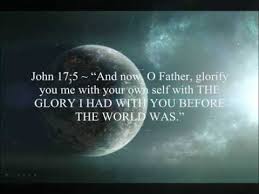
John. 17:5 And now, O Father, glorify thou me with thine own self with the glory which I had with thee BEFORE the world was.— 24 Father, I will that they also, whom thou hast given me, be with me where I am; that they may behold my glory, which thou hast given me: for thou lovedst me BEFORE the foundation of the world.

John 1:1 In the beginning was the Word, and the Word was with God, and the Word was God.—14 And the Word was made flesh, and dwelt among us, (and we beheld his glory, the glory as of the only begotten of the Father,) full of grace and truth.

He was also together with the Israelites during the Exodus, probably in the form of the Angel of the Lord (not a created angel). This also occurred long before he was born in flesh.

1 Cor. 10:1 Moreover, brethren, I would not that ye should be ignorant, how that all our fathers were under the cloud, and all passed through the sea;—4 And did all drink the same spiritual drink: for they drank of that spiritual Rock that followed them: and THAT ROCK WAS CHRIST. — Neither let us tempt Christ, as some of them also tempted, and were destroyed of serpents.

We also know that there is ONE GOD alone, and we know that 1) the Father, 2) Jesus Christ the son, and 3) the holy Spirit, have each been referred to as GOD in the Bible. The only way to combine these truths is to use the concept of the Trinity, and this is also what the early church Fathers did as can be seen here. It’s hard to know exactly how the Godhead functions since it’s the Almighty GOD we are talking about (and we are not required to know exactly how our Creator GOD works as long as we don’t believe in contradictions), but at least we know that Jesus is fully GOD – which is also confirmed by his own Father in Hebr. 1:8.

Col. 2:9 For in him dwelleth all the fulness of the GODHEAD bodily.

The fact that Jesus always chose to do the Father’s will doesn’t contradict the Trinity, nor does it mean Jesus is of another nature than his Father 

Wouldn’t it be more strange if Jesus did NOT do the Father’s will? God the Father remained in heaven when Jesus chose to be born as a baby on earth, and as a man Jesus was lower in rank than the angels – which means that during this time Jesus must have been lower in rank than his Father. However, that’s certainly not the position that Jesus held prior to being born in flesh.

If Jesus would have claimed that he always spoke on his own initiative, there would be reasons to doubt his shared life with the Father, but Jesus often claimed to do the works of his Father – just a he also claimed to have a will of his own.  This means that every “he sent me”, and “I only do as told” and “I speak not from myself” should not be construed as evidence against the Trinity, because these expressions are statements of continuity with the Father, rather than indications of their discontinuity. Jesus had no personal agenda to carry out, and he wanted his audience to understand this. That’s why he constantly spoke to them about “God’s kingdom” and “my Father”, in order to highlight that he didn’t come to preach about a new religion or a new God.  Jesus emphasized that he always chose to act according to his Father’s will, because he wanted his audience to realize that his words were trustworthy – being completely those of God the Father – the God that the israelites had worshiped all along.

What would his audience think if Jesus would have said: “I have come to do MY will, not the Father’s will! I have come without being sent by the Father–but on my own initiative. The gospel that I preach is my own, and NOT that of the Father. I have come in my own name, and not in the name of the Father”? The son would never take any actions that would interfere with the will of the Father, or in any way place himself over the Father. If the son is capable of choosing to do whatever the Father does, he must be as divine as the Father since he obviously has the power to obey or disobey GOD himself!

Jesus chose to give his own life for us, which means that he had the power to choose to do otherwise

If Jesus wouldn’t be able to choose to lay down his own life, it would be dishonest to claim that this is exactly what he did for us. Either he had this free will capability to make this decision, or he was forced to lay down his life by his Father, having no choice in the matter. Even if the Father first had to make him “willing”, it would still be filed under “Forced” since it would involve a manipulation of the will.

John. 10:17 Therefore doth my Father love me, because I lay down my life, that I might take it again.18 No man taketh it from me, but I lay it down of myself. I have power to lay it down, and I have power to take it again. This commandment have I received of my Father.

Gal. 2:20 I am crucified with Christ: nevertheless I live; yet not I, but Christ liveth in me: and the life which I now live in the flesh I live by the faith of the Son of God, who loved me, and gave himself for me.

Matt. 20:28 Even as the Son of man came not to be ministered unto, but to minister, and to give his life a ransom for many.

John 15:13 Greater love hath no man than this, that a man lay down his life for his friends

Let’s also remember that both God and Jesus are referred to as having created the heavens and the earth “with his own hands” (see for instance Hebr. 1).

god SENT by someone doesn’t indicate that you’re of another nature than the Sender

Human messengers sent by human rulers, are certainly not LESS human themselves, and if someone by free will places himself in a lower rank than another person, neither does this humble free will decision make him any less human. It’s absolutely possible that the persons in the Godhead made a joint decision to carry out the creation in a certain way that they felt pleased about, and also to carry out the salvation plan in their own preferred way. Such a decision would mean that the Father and the son couldn’t BOTH be born as babies on earth, and the Father and the son couldn’t BOTH remain in heaven while none of them stepped down to earth to live as a man in flesh.

It’s a good thing for us that the persons in the Godhead decided to adopt separate roles within their own nature. “The Father is greater than I” should not be taken to mean that Jesus is not God.  Neither would anyone assume that a statement like “the prime minister is greater than I“, would indicate that he is more human than the speaker, nor that he is greater than all others in ALL areas of life. On top of this, a prime minister isn’t a prime minister for eternity, and he can choose to step down and take on a much less authoritative position.

A Managing Director is “greater” in authority than all his employees at work, but off duty he might be a Board member in a Boat club where he is “only” a secretary, and one of his employees (from work) might be the Head of the Board with greater authority when it concerns the Boat club. Maybe this particular Managing Director even had the opportunity to be the Head of the Board for this Boat club but declined, or maybe he even used to be the Head of the Board but stepped down by free will to offer his position to this other person – despite that he had the chance to continue in the highest position. Moreover, this Managing Director – particularly if it’s a female – might not be the top authority in her own home but only at work. Just because you’re in the highest position at work doesn’t mean you’re in the highest position at home. It’s absolutely possible to voluntarily grant another person the authority over oneself – at least in part. As soon as we accept a job position, we will likely have a boss as an authority over us who is much greater in rank at work (and not outside of work).

Let’s say that three friends would like to start a business together, where all three individuals would not be able to fill all job positions in the company. It’s a lot smarter to split the duties to make the company work so much better, and this method wouldn’t change the fact that they are all equal co-owners of the company that they founded together (equal shareholders). Maybe one of them by free will offers to be the one who travels across the world to meet new customers, and he must therefore leave the daily administration of the company to his colleagues, and maybe also all the fancy titles. Again, this doesn’t mean that he is of an another nature than his partners, and neither does it mean that he is inferior to them. They just have a mutual goal to make the company work fantastic, and that’s why every single one of them can’t hold the highest position of the company. Splitting the duties and the titles would be beneficial for all of them and for the entire company. It’s also possible to make an arrangement where they take turns holding the various positions and job titles, or they could decide to keep their positions until the very end, and let only one of them do the hard work away from the office (but also make the decision to reward this particular person abundantly when the final goal has been achieved).

The point is that it’s not possible to use statements such as “the Father is greater than I”, or “I will put everything under his feet”, as evidence for the idea that Jesus is not God. That would be like comparing apples with oranges, because Jesus nature doesn’t have anything to do with the free will arrangement within the Godhead (whether in short-term or long-term). Jesus was in the form of GOD but decided to step down from his position in heaven to become a servant and in the likeness of men. This means that Jesus would start to exist in a completely new form and under totally different circumstances compared with before – by his own free will. Suddenly he lived as a man just like other human beings, and he started out as a little baby just like the rest of us. I don’t think he reasoned and behaved like a 30-year-old man trapped in the body of a little baby, but I truly believe he was like any other human baby with corresponding mental limitations. He still grew up without sin, and probably started to realize exactly who he was when he matured. Luckily God the Father didn’t have to go through the same stages, and God wouldn’t have the ultimate control of this universe if the entire Godhead would suddenly end up as a little baby and could only reason as a baby.

If Jesus wouldn’t be God (which the Father says he is), then it’s strange that the Father wants every knee to bow down before Jesus rather than himself? Is it only to confuse us into believing that Jesus is God?

Phil. 2:5 Let this mind be in you, which was also in Christ Jesus:6 Who, being in the form of God, thought it not robbery to be equal with God:7 But MADE HIMSELF of no reputation, and TOOK UPON HIM THE FORM OF A SERVANT, and was made in the likeness of men:8 And being found in fashion as a man, he humbled himself, and became obedient unto death, even the death of the cross.9 Wherefore God also hath highly exalted him, and given him a name which is above every name:10 That at the name of Jesus every knee should bow, of things in heaven, and things in earth, and things under the earth;11 And that every tongue should confess that Jesus Christ is Lord, to the glory of God the Father.

When Jesus lowered himself and washed the feet of the disciples, this was a voluntary action and doesn’t mean that he therefore was a lesser human being than his disciples and inferior to them. In Romans 15:8 Paul says “For I tell you that Christ has become a servant of the Jews on behalf of God’s truth”, but this doesn’t necessarily mean that Jesus was inferior to the Jews. There is a non-correlation between “submission” and “inferiority”. The Holy Spirit is said to be sent by the Father, and also said to be sent by the Son. Does this in any way make inferiority-assertions about the Spirit of God? No, since it’s only a matter of free will roles within the Trinity.

Jesus speaks of “my Father” and “your Father”,  but never “our Father” 

Suggesting that God is “our” Father might simply mean that he is our God, but Jesus often spoke in such a way that his audience understood that he made more serious claims than that. Jesus made himself EQUAL with God and he made himself GOD. (If you’re called God you’re either the creator-God or a false god which you can read more about here and here). The jews didn’t understand his words to express subordination to God, but to full equality and being no one else but God. That is the reason they wanted to kill Jesus – due to blasphemy. It can’t be more clear than that.

John 5:18 Therefore the Jews sought the more to kill him, because he not only had broken the sabbath, but said also that God was his Father, making himself equal with God.

John 10:33 The Jews answered him, saying, For a good work we stone thee not; but for blasphemy; and because that thou, being a man, makest thyself God. 

Phil. 2:6 Who, being in the form of God, thought it not robbery to be equal with God

John 1:18 No one has seen God at any time; the only begotten God who is in the bosom of the Father, He has explained Him. (NASB) (KJV “only begotten son”)

It’s also well-known that Jesus used God’s own name on himself (IAM, and the alpha and omega) and constantly allowed people to worship him.

The Shekinah glory of the OT is the very presence of God – in the form of a cloud

Jesus is called “the glory of the Father” alluding to the Shekinah glory which was the very presence of God in the tabernacle/temple – not just a representation or manifestation.

When God in form of the angel of the Lord (probably Jesus as can be seen here) appeared to Moses in a burning bush, surely the heaven was not devoid of a GOD? If God was in the burning bush, does this mean that he was unable to appear also before other people at the same time, or does it mean that he was unable to behold each person’s activities on earth because he was too occupied with the conversation that he had with Moses? Is it hard to imagine that our holy Creator can be in multiple places at the same time, and that this divine power doesn’t turn him into several gods?

Ex. 3:2 And the angel of the Lord appeared unto him in a flame of fire out of the midst of a bush: and he looked, and, behold, the bush burned with fire, and the bush was not consumed.3 And Moses said, I will now turn aside, and see this great sight, why the bush is not burnt.4 And when the Lord saw that he turned aside to see, God called unto him out of the midst of the bush, and said, Moses, Moses. And he said, Here am I.5 And he said, Draw not nigh hither: put off thy shoes from off thy feet, for the place whereon thou standest is holy ground.6 Moreover he said, I am the God of thy father, the God of Abraham, the God of Isaac, and the God of Jacob. And Moses hid his face; for he was afraid to look upon God.7 And the Lord said, I have surely seen the affliction of my people which are in Egypt, and have heard their cry by reason of their taskmasters; for I know their sorrows;

In Exodus God also appeared in the form of a cloud during the day and as fire during the night. In some verses GOD is said to have done it, in other places the angel of the Lord is said to have done it and in 1 Cor. 10 even Jesus Christ is said to have done it. Either the Bible is confusing (and we have several gods) or the cloud can be explained by the Trinity-God.

Ex. 40:38 For the cloud of the Lord was upon the tabernacle by day, and fire was on it by night, in the sight of all the house of Israel, throughout all their journeys.

1 Cor. 10:1 Moreover, brethren, I would not that ye should be ignorant, how that all our fathers were under the cloud, and all passed through the sea;—4 And did all drink the same spiritual drink: for they drank of that spiritual Rock that followed them: and THAT ROCK WAS CHRIST. — Neither let us tempt Christ, as some of them also tempted, and were destroyed of serpents.

We can also read about the real presence of God in form of a cloud, being in the midst of the priests in the house/temple of the Lord. God was in this cloud (just like he was in the fire in the burning bush) and spoke to those who were present in the form of the Almighty God. The same questions can be asked here. Surely the heavens and the rest of the earth were not devoid of a God, when God was in the form of this holy cloud? Surely God can be in several places at the same time without being accused of being several gods? Surely the God in the burning bush and in the holy cloud was not a lesser God than God in heaven or of another nature? Would we consider the God in the burning bush or in the cloud to be subordinate to God in heaven? Or would we consider the God in the cloud to be inferior to God in heaven only because the former was “sent down”?

2 Chron. 5:13 It came even to pass, as the trumpeters and singers were as one, to make one sound to be heard in praising and thanking the Lord; and when they lifted up their voice with the trumpets and cymbals and instruments of musick, and praised the Lord, saying, For he is good; for his mercy endureth for ever: that then the house was filled with a cloud, even the house of the Lord;14 So that the priests could not stand to minister by reason of the cloud: for the glory of the Lord had filled the house of God. (+ 1 King 8:10-11)

Ez. 10:3 Now the cherubims stood on the right side of the house, when the man went in; and the cloud filled the inner court.4 Then the glory of the Lord went up from the cherub, and stood over the threshold of the house; and the house was filled with the cloud, and the court was full of the brightness of the Lord’s glory.5 And the sound of the cherubims’ wings was heard even to the outer court, as the voice of the Almighty God when he speaketh.18 Then the glory of the Lord departed from off the threshold of the house, and stood over the cherubims.19 And the cherubims lifted up their wings, and mounted up from the earth in my sight: when they went out, the wheels also were beside them, and every one stood at the door of the east gate of the Lord’s house; and the glory of the God of Israel was over them above.

Ez. 43:2 And, behold, the glory of the God of Israel came from the way of the east: and his voice was like a noise of many waters: —4 And the glory of the Lord came into the house by the way of the gate whose prospect is toward the east.5 So the spirit took me up, and brought me into the inner court; and, behold, the glory of the Lord filled the house.6 And I heard him speaking unto me out of the house; and the man stood by me.7 And he said unto me, Son of man, the place of my throne, and the place of the soles of my feet, where I will dwell in the midst of the children of Israel for ever, and my holy name, shall the house of Israel no more defile, neither they, nor their kings, by their whoredom, nor by the carcases of their kings in their high places.

Jesus is able to be in the midst of two or three persons who gather in his name, but what happens if more than one group of people gather in his name? Is Jesus only able to visit one group at a time? OR, does he have the power to attend several meetings at the same time and still not be charged of being several “sons”?

Matt. 18:20 For where two or three are gathered together in my name, there am I in the midst of them.

He has put all things under his feet?

Jesus has gone through several stages in his life time, and certain stages are yet to come in the future. Jesus never stopped being God throughout these stages but it has been necessary to say no to some of his divine powers, like when he was in the stage as a human being – and especially as a little baby with reduced mental capabilities. As a human being he was lower than the angels, but before and after this stage the angels were inferior to him and were supposed to worship him (no one should worship anyone else but GOD). Jesus….

  1. He is the Creator of the world and absolutely nothing was before him (1 Col. 1:16, 1 Hebr. 1:8, etc)
  2. He has lived in the form of the angel of the Lord (called Jahve) and communicated with Jahve in heaven
  3. He has by free will been placed as a human seed inside Mary
  4. He has been a baby, a little boy and a full grown man
  5. He has proved to be the promised Messiah
  6. He has shared the gospel of God on earth
  7. He has died a physical death
  8. He has resurrected from the dead
  9. He has been glorified
  10. He will return once again to earth and destroy Antichrist and bring home his Bride
  11. He will reign in the new Jerusalem, where no sun is needed because the LAMB will be the source of light

Much has been made of 1 Cor. 15:27, and people are ready to ditch all sorts of clear verses about the deity of Christ due to this verse which they prefer to interpret in the wrong way.

1 Cor. 15:22 For as in Adam all die, even so in Christ shall all be made alive.23 But every man in his own order: Christ the firstfruits; afterward they that are Christ’s at his coming.24 Then cometh the end, when he [Jesus) shall have delivered up the kingdom to God, even the Father; when he shall have put down all rule and all authority and power.25 For he must reign, till he hath put all enemies under his feet.26 The last enemy that shall be destroyed is death.27 For he hath put all things under his feet. But when he saith all things are put under him, it is manifest that he is excepted, which did put all things under him.28 And when all things shall be subdued unto him, then shall the Son also himself be subject unto him that put all things under him, that God may be all in all.

Remember again, that Jesus chose to be born as a baby on earth to carry out a mission, which means that he left his secure place in heaven and some of his divine powers and became even lower than the angels in rank. This means that he must be restored once again when he has completed his task, and who else can restore him but God the Father in the same Godhead? At no time did God the Father lower himself from his highest position that he had together with his son, but always had all the power in the world. As a mediator Jesus will lay down his office at the feet of the Father when he (Jesus) has completed his work to the very end, because the dominion of Christ will one day terminate. Jesus will finally reclaim his divine sovereignty when he has overthrown his enemies – including Antichrist himself (2 Thess. 2:8). Submission can be a voluntary act, and Jesus life on earth was also meant to serve as a model for believers to follow.

The last verse above might tell us that Jesus is actually not subject to his Father at this particular point but later “when all things shall be subdued unto him, THEN SHALL the Son also himself be subject unto him that put all things under him”. This looks like the redemptive post-resurrection son is currently not under the subjection of the Father. This means that Jesus is not and has not been eternally subordinate to his Father, but that his redemptive work has something to do with it. The fact that the son is said to become subject unto the Father in the very end of this stage is because “God may be all in all”. It probably means that they will no longer be separate with a need for one of them to be in the form of an angel of the Lord or as a human being, but they will be united in one permanent role in the Godhead.

Jesus has been given the authority to judge, not because he is the son of God but because he is the son of man who has successfully accomplished what he has purposed to do for mankind. (John 5.27). It looks like Jesus can create, forgive sins, judge, give eternal life, be worshiped, be called IAM just like God the Father, despite that God clearly states that he shares his glory with NO ONE. Only the Trinity can solve this puzzle.

Jn 5.20 For the Father loveth the Son, and sheweth him all things that himself doeth: and he will shew him greater works than these, that ye may marvel.21 For as the Father raiseth up the dead, and quickeneth them; even so the Son quickeneth whom he will.22 For the Father judgeth no man, but hath committed all judgment unto the Son:23 That all men should honour the Son, even as they honour the Father. He that honoureth not the Son honoureth not the Father which hath sent him.—27 And hath given him authority to execute judgment also, because he is the Son of man.

Rev. 21:23 And the city had no need of the sun, neither of the moon, to shine in it: for the glory of God did lighten it, and the Lamb is the light thereof.

The Father and the son are ONE in a totally different way than the body of Christ is ONE

We can be “one” in various ways and the context of  “I and my Father are one” in John 10:30 is entirely different from John 17:21-22. In the latter the context is about having the same goal and attitude (as in not having divisions among christians), but in the former passage it’s about being one with the same authority, spirit and nature. The jews understood this too well since they immediately picked up stones to kill him after having made this statement. No one deserves a death sentence for claiming that believers should have the same goals and attitudes, but it’s certainly a death sentence for claiming to be equal with God. God is not the author of confusion, and he is able to express himself in a way that listeners and readers can understand.

John 10:25 Jesus answered them, I told you, and ye believed not: the works that I do in my Father’s name, they bear witness of me.—28 And I give unto them eternal life; and they shall never perish, neither shall any man pluck them out of my hand.29 My Father, which gave them me, is greater than all; and no man is able to pluck them out of my Father’s hand.30 I and my Father are one.31 Then the Jews took up stones again to stone him.32 Jesus answered them, Many good works have I shewed you from my Father; for which of those works do ye stone me?33 The Jews answered him, saying, For a good work we stone thee not; but for blasphemy; and because that thou, being a man, makest thyself God.

John 17:17 Sanctify them through thy truth: thy word is truth.18 As thou hast sent me into the world, even so have I also sent them into the world.19 And for their sakes I sanctify myself, that they also might be sanctified through the truth.20 Neither pray I for these alone, but for them also which shall believe on me through their word;21 That they all may be one; as thou, Father, art in me, and I in thee, that they also may be one in us: that the world may believe that thou hast sent me.22 And the glory which thou gavest me I have given them; that they may be one, even as we are one:23 I in them, and thou in me, that they may be made perfect in one; and that the world may know that thou hast sent me, and hast loved them, as thou hast loved me.24 Father, I will that they also, whom thou hast given me, be with me where I am; that they may behold my glory, which thou hast given me: for thou lovedst me before the foundation of the world.25 O righteous Father, the world hath not known thee: but I have known thee, and these have known that thou hast sent me.26 And I have declared unto them thy name, and will declare it: that the love wherewith thou hast loved me may be in them, and I in them.

Calvinist Dictionary

Kevin Jackson's avatarWesleyan Arminian

A dictionary to help Arminians better understand Calvinist terminology.
(Don’t take this too seriously, this is meant in good fun)

All: The elect

Altar Call: An insult to God

Arminianism:
Man centered theology

Assurance:
hoping that you’re elect

Augustine:
The first church father.

Calvinism:
The gospel

Call (effectual):
to be irresistibly dragged

Call (general):
God’s justification to condemn the reprobate.

Catholicism: What Arminianism leads to.

Compatiblism:
We are free to do whatever the Potter decrees us to do.

Contradiction:
a mystery

Doctrines of Grace:
Term that helps illustrate how God has given us Calvinists superior insight. Usage example: “I was an Arminian before being illuminated by the Doctrines of Grace.”

Doris Day:
Singer of truth

To Draw:
To drag

Easy believism:
The false idea that you can believe in Jesus Christ and be saved. Can a rotten corpse believe? Nope, neither can you.

Eisegesis
: Any Arminian interpretation…

View original post 506 more words

The HOLY SPIRIT is also GOD and part of the TRINITY and the Godhead

The holy Spirit in the New Testament is a translation of  hagios pneuma (Strong’s 40 and 4151, respectively), and He is sent to us by the Father and the son, to be our Helper and to reprove the world of sin. He dwells in the hearts of christians, and he is also big help for us to live holy lives and gives us wisdom and strength. He helps us to understand the scriptures and the deeper things of God, and also gives us spiritual gifts so that we can edify each other in the body of Christ. The holy Spirit is described as someone who has emotions, wisdom and who has a will of his own which he uses to do the will of God the Father. He is referred to as “he” (and not “it“), he can hear and speak and he has fellowship with us. The Bible came about when holy men of God wrote down their texts under the inspiration of the holy Spirit.

We receive the holy Spirit when we come to God and repent for our sins.

Acts. 2:38 Then Peter said unto them, Repent, and be baptized every one of you in the name of Jesus Christ for the remission of sins, and ye shall receive the gift of the Holy Ghost.39 For the promise is unto you, and to your children, and to all that are afar off, even as many as the Lord our God shall call.

It’s not necessary to declare that we believe in a Trinity in order to be saved because it’s not a Biblical word, but it seems to be of great importance to at least accept that Jesus is the IAM (the Creator God) based on John 8:24. According to the scriptures, we also learn that the spirit of God is divine, and I personally believe that we are risking our souls if we deny this fact – IF we have the chance to reach this kind of knowledge. This means that children or people who don’t have much access to a Bible, might not be able to understand all the details about the Godhead, and I believe that God will judge them accordingly. In a similar way it’s not necessary to understand how a car engine works in order to drive a car, but of course it’s of great help to know the basics so that we know how to maintain the engine the best way, and so that we learn the signs of malfunctions.

There is a theory, with support from the apocrypha,that suggests that demons/evil spirits have their original source in the fallen angels that we can read about in Genesis (the sons of God), who came down to earth and had children – the gigantic nephilim – together with human females. These fallen angels finally died, but the evil spirits continued to cause mayhem when they entered willing human hearts. If this is true, and if the holy Spirit functions in a similar way  – but naturally having a source in God  – it might explain why Jesus had to be glorified and depart from earth before the holy Spirit could make an entrance in another form than Jesus. If demons/evil spirits can be called Satan because of their source in him, then maybe the holy Spirit can be called God because he is God and has his source in the Godhead. These are of course only speculations about the spiritual world, and it’s not a salvation matter – as long as we understand which God we are worshiping.

If Jesus and the holy Spirit would be one and the same person, it’s difficult to understand the need for Jesus’ departure before the holy Spirit could make an entrance. The holy Spirit is also said to come to glorify JESUS, and if Jesus isn’t God it would make more sense if the holy Spirit came to glorify GOD and no one else. Especially considering that God doesn’t share his glory with anyone (Is. 42:8). The holy Spirit speaks what he hears, which is an indication of that he has a free will and is separate from the one that he listens to:

John 16:5 But now I go my way to him that sent me; and none of you asketh me, Whither goest thou?6 But because I have said these things unto you, sorrow hath filled your heart.7 Nevertheless I tell you the truth; It is expedient for you that I go away: for if I go not away, the Comforter will not come unto you; but if I depart, I will send him unto you.8 And when he is come, he will reprove the world of sin, and of righteousness, and of judgment:9 Of sin, because they believe not on me;10 Of righteousness, because I go to my Father, and ye see me no more;11 Of judgment, because the prince of this world is judged.12 I have yet many things to say unto you, but ye cannot bear them now.13 Howbeit when he, the Spirit of truth, is come, he will guide you into all truth: for he shall not speak of himself; but whatsoever he shall hear, that shall he speak: and he will shew you things to come.14 He shall glorify me: for he shall receive of mine, and shall shew it unto you.15 All things that the Father hath are mine: therefore said I, that he shall take of mine, and shall shew it unto you.

John 15:26 But when the Comforter is come, whom I will send unto you from the Father, even the Spirit of truth, which proceedeth from the Father, he shall testify of me:

Acts 1: 1 The former treatise have I made, O Theophilus, of all that Jesus began both to do and teach,2 Until the day in which he was taken up, after that he through the Holy Ghost had given commandments unto the apostles whom he had chosen:3 To whom also he shewed himself alive after his passion by many infallible proofs, being seen of them forty days, and speaking of the things pertaining to the kingdom of God:4 And, being assembled together with them, commanded them that they should not depart from Jerusalem, but wait for the promise of the Father, which, saith he, ye have heard of me.5 For John truly baptized with water; but ye shall be baptized with the Holy Ghost not many days hence.—8 But ye shall receive power, after that the Holy Ghost is come upon you: and ye shall be witnesses unto me both in Jerusalem, and in all Judaea, and in Samaria, and unto the uttermost part of the earth.

GOD created the heavens and the earth, but the SPIRIT OF GOD moved upon the face of the waters. The spirit of God seems to be more than just a thought or a power, because he moved over the waters – and water is something physical. God and the spirit of God seem to be separate:

Gen 1:1 In the beginning God created the heaven and the earth.2 And the earth was without form, and void; and darkness was upon the face of the deep. And the Spirit of God moved upon the face of the waters.

We are to have fellowship with the Father and the son, but also with the Spirit:

1 John 1:3 That which we have seen and heard declare we unto you, that ye also may have fellowship with us: and truly our fellowship is with the Father, and with his Son Jesus Christ.

Phil. 2:1 If there be therefore any consolation in Christ, if any comfort of love, if any fellowship of the Spirit, if any bowels and mercies, 2 Fulfil ye my joy, that ye be likeminded, having the same love, being of one accord, of one mind.

If the holy Spirit is just some kind of a force or if he is the same as the Father or the son, then it doesn’t make sense that he can be offended more than them. Neither does it make sense that speaking against Jesus is a much less serious crime compared to blaspheming the holy Spirit – where the latter offence will lead to the inability of being forgiven:

Luk. 12:10 And whosoever shall speak a word against the Son of man, it shall be forgiven him: but unto him that blasphemeth against the Holy Ghost it shall not be forgiven.

Mark 3:28 Verily I say unto you, All sins shall be forgiven unto the sons of men, and blasphemies wherewith soever they shall blaspheme:29 But he that shall blaspheme against the Holy Ghost hath never forgiveness, but is in danger of eternal damnation.

Eph. 4:29 Let no corrupt communication proceed out of your mouth, but that which is good to the use of edifying, that it may minister grace unto the hearers.30 And grieve not the holy Spirit of God, whereby ye are sealed unto the day of redemption.

Isaiah 63:10 But they rebelled, and vexed his holy Spirit: therefore he was turned to be their enemy, and he fought against them.

When Jesus got baptized, also the Father and the holy Spirit were present – all three of them together. The voice came from God the Father in heaven, and the holy Spirit descended upon Jesus like a dove. Right after this moment, the holy Spirit drove Jesus off to the wilderness – showing they were separate :

Mark 1:9 And it came to pass in those days, that Jesus came from Nazareth of Galilee, and was baptized of John in Jordan.10 And straightway coming up out of the water, he saw the heavens opened, and the Spirit like a dove descending upon him:11 And there came a voice from heaven, saying, Thou art my beloved Son, in whom I am well pleased.12 And immediately the spirit driveth him into the wilderness.

The holy Spirit bears witness with our spirit that we are the children of God.  Just like Jesus, the Spirit chooses to do the will of God (God is often the same as God the Father). If the Spirit can choose to obey someone, it shows that he is separate from the one he obeys – since one is obeying the other. If the reality is that only God the Father, or Jesus are in action, why isn’t Paul simply saying so?:

Rom. 8:16 The Spirit itself beareth witness with our spirit, that we are the children of God:

Rom. 8:26 Likewise the Spirit also helpeth our infirmities: for we know not what we should pray for as we ought: but the Spirit itself maketh intercession for us with groanings which cannot be uttered.27 And he that searcheth the hearts knoweth what is the mind of the Spirit, because he maketh intercession for the saints according to the will of God.

Below we can see further evidence of that the holy Spirit is the same as the Spirit of God, but yet separate from God the Father since we can all get the holy Spirit inside us as our Helper. At the same time, God the Father can still remain in his heaven or in other places:

1 Cor. 2:8 Which none of the princes of this world knew: for had they known it, they would not have crucified the Lord of glory.9 But as it is written, Eye hath not seen, nor ear heard, neither have entered into the heart of man, the things which God hath prepared for them that love him.10 But God hath revealed them unto us by his Spirit: for the Spirit searcheth all things, yea, the deep things of God.11 For what man knoweth the things of a man, save the spirit of man which is in him? even so the things of God knoweth no man, but the Spirit of God.12 Now we have received, not the spirit of the world, but the spirit which is of God; that we might know the things that are freely given to us of God.13 Which things also we speak, not in the words which man’s wisdom teacheth, but which the Holy Ghost teacheth; comparing spiritual things with spiritual.14 But the natural man receiveth not the things of the Spirit of God: for they are foolishness unto him: neither can he know them, because they are spiritually discerned.

The Lord is that Spirit, says Paul, and both God the Father and the son are called the Lord of Lords:

2 Cor. 3:17 Now the Lord is that Spirit: and where the Spirit of the Lord is, there is liberty.18 But we all, with open face beholding as in a glass the glory of the Lord, are changed into the same image from glory to glory, even as by the Spirit of the Lord.

The holy Spirit is the one who brings us spiritual gifts, and enables us to speak in tongues and to heal people.  If it’s rather God the Father or Jesus who are doing this, why is not Paul simply saying so? “By one Spirit are we all baptized into one body” = there is only one Spirit of God, which is the holy Spirit:

Acts 2:3 And there appeared unto them cloven tongues like as of fire, and it sat upon each of them.4 And they were all filled with the Holy Ghost, and began to speak with other tongues, as the Spirit gave them utterance.

1 Cor. 12:3 Wherefore I give you to understand, that no man speaking by the Spirit of God calleth Jesus accursed: and that no man can say that Jesus is the Lord, but by the Holy Ghost.4 Now there are diversities of gifts, but the same Spirit.5 And there are differences of administrations, but the same Lord.6 And there are diversities of operations, but it is the same God which worketh all in all.7 But the manifestation of the Spirit is given to every man to profit withal.8 For to one is given by the Spirit the word of wisdom; to another the word of knowledge by the same Spirit;9 To another faith by the same Spirit; to another the gifts of healing by the same Spirit;10 To another the working of miracles; to another prophecy; to another discerning of spirits; to another divers kinds of tongues; to another the interpretation of tongues:11 But all these worketh that one and the selfsame Spirit, dividing to every man severally as he will.12 For as the body is one, and hath many members, and all the members of that one body, being many, are one body: so also is Christ.13 For by one Spirit are we all baptized into one body, whether we be Jews or Gentiles, whether we be bond or free; and have been all made to drink into one Spirit.14 For the body is not one member, but many.

Ananias and his wife chose to let Satan fill their hearts, resulting in that they TEMPTED the holy Spirit, and lied to him – which is the same as lying to GOD. If there would only be one side of God with no other dimensions, perhaps it would be more clear to simply say that they lied to God with no further mention of the holy Spirit?:

Acts 5:3 But Peter said, Ananias, why hath Satan filled thine heart to lie to the Holy Ghost, and to keep back part of the price of the land?4 Whiles it remained, was it not thine own? and after it was sold, was it not in thine own power? why hast thou conceived this thing in thine heart? thou hast not lied unto men, but unto GOD.—9 Then Peter said unto her, How is it that ye have agreed together to tempt the Spirit of the Lord? behold, the feet of them which have buried thy husband are at the door, and shall carry thee out.

Peter says that it’s the holy Spirit who moved holy men to speak out divine prophesies, and  Paul says that all scripture is given by the inspiration of God. They seem to be talking about separate persons and yet the same:


2 Peter 1:21 For the prophecy came not in old time by the will of man: but holy men of God spake as they were moved by the Holy Ghost.

2 Tim. 3:16 All scripture is given by inspiration of God, and is profitable for doctrine, for reproof, for correction, for instruction in righteousness:

The holy Spirit can also speak and give instructions.  Again, if it’s God and/or Jesus who are the ones doing this, why doesn’t it say so?:

Acts 8:29 Then the Spirit said unto Philip, Go near, and join thyself to this chariot.

Acts 11:11 And, behold, immediately there were three men already come unto the house where I was, sent from Caesarea unto me.12 And the Spirit bade me go with them, nothing doubting. Moreover these six brethren accompanied me, and we entered into the man’s house:

Acts 13:2 As they ministered to the Lord, and fasted, the Holy Ghost said, Separate me Barnabas and Saul for the work whereunto I have called them.

We have a free will and we are not forced to obey the holy Spirit, but the better choice is to not resist him and to pay attention to where and how he wants to direct us. This is hard to do if we don’t spend time with prayers to God.

Acts 7:51 Ye stiffnecked and uncircumcised in heart and ears, ye do always resist the Holy Ghost: as your fathers did, so do ye.

Acts 16:6 Now when they had gone throughout Phrygia and the region of Galatia, and were forbidden of the Holy Ghost to preach the word in Asia

Apparently, we are to baptize each other in three names (not one or two), and what would be the reason for this if there is only one person in the Godhead?

Matt. 28:19 Go ye therefore, and teach all nations, baptizing them in the name of the Father, and of the Son, and of the Holy Ghost:20 Teaching them to observe all things whatsoever I have commanded you: and, lo, I am with you always, even unto the end of the world. Amen.

1 John 5:6 This is he that came by water and blood, even Jesus Christ; not by water only, but by water and blood. And it is the Spirit that beareth witness, because the Spirit is truth.7 For there are three that bear record in heaven, the Father, the Word, and the Holy Ghost: and these three are one.8 And there are three that bear witness in earth, the Spirit, and the water, and the blood: and these three agree in one.

The Godhead – Strong’s 2320 theotés

Col. 2:8 Beware lest any man spoil you through philosophy and vain deceit, after the tradition of men, after the rudiments of the world, and not after Christ.9 For in him dwelleth all the fulness of the GODHEAD bodily.

(Acts 17:29 and Rom. 1:20 make use of other Greek words – Strong’s 2304 and 2305)

Below we can see the same situation in three different versions from Mark, Matthew and Luke, and it will be the following person who will speak through us in times of distress and trouble in the future – depending on which version we are referring to: 1) the holy Spirit/Ghost, 2) the spirit of the Father, 3) JESUS. So which one is it? Since it concerns the same account, it seems like these persons can be used somewhat interchangeably because they each represent the Godhead.

Markus 13:11 But when they shall lead you, and deliver you up, take no thought beforehand what ye shall speak, neither do ye premeditate: but whatsoever shall be given you in that hour, that speak ye: for it is not ye that speak, but THE HOLY GHOST.

Matt. 10:19 But when they deliver you up, take no thought how or what ye shall speak: for it shall be given you in that same hour what ye shall speak.20 For it is not ye that speak, but THE SPIRIT OF YOUR FATHER which speaketh in you.

Lukas 21:14 Settle it therefore in your hearts, not to meditate before what ye shall answer:15 For I WILL give you a mouth and wisdom, which all your adversaries shall not be able to gainsay nor resist.

The holy Spirit, the Spirit of God or the Spirit of Christ? – How many divine Spirits are there?

Each person has a spirit and even Antichrist has a spirit, but when we are talking about the holy Spirit which is promised to us as the Comforter, surely there is only one? We can see from 1 Cor. 3:16 and 1 Tim. 1:14 that the Spirit of God and the holy Spirit/Ghost are the same person/entity, but it also seems like the Spirit of Christ is also this same person. 2 Cor. 3:17 says that Jesus Christ is that Spirit (the Spirit of the Lord). God is in three persons, and these three persons form one Godhead…

Since each person has a spirit and Jesus Christ lived as a man like us, it follows that he too had a spirit, but it doesn’t end there. The Bible tells us that the Spirit of Christ is what we should have inside us today, or else we are not one of his. Things can go well for us thanks to prayers and the supply of the Spirit of Christ. Jesus says ” I will not leave you comfortlessI will come to you”, to his disciples, when he promises them the Comforter.

It seems like the Comforter that dwells in us, can be stated as the holy Spirit, God or Jesus Christ.

According to John 14:23, we are to keep the word of Jesus and if we do, the Father and the son will come to us and make their abode with us. If we get filled with the holy Spirit, we are being filled with GOD.

Eph. 5:17 Wherefore be ye not unwise, but understanding what the will of the Lord is.18 And be not drunk with wine, wherein is excess; but be filled with the Spirit;

1 Cor. 6:19 What? know ye not that your body is the temple of the Holy Ghost which is in you, which ye have of God, and ye are not your own?20 For ye are bought with a price: therefore glorify God in your body, and in your spirit, which are God’s.

Rom. 8:9 But ye are not in the flesh, but in the Spirit, if so be that the Spirit of God dwell in you. Now if any man have not the Spirit of Christ, he is none of his.10 And if Christ be in you, the body is dead because of sin; but the Spirit is life because of righteousness.11 But if the Spirit of him that raised up Jesus from the dead dwell in you, he that raised up Christ from the dead shall also quicken your mortal bodies by his Spirit that dwelleth in you.

Phil. 1:19 For I know that this shall turn to my salvation through your prayer, and the supply of the Spirit of Jesus Christ,20 According to my earnest expectation and my hope, that in nothing I shall be ashamed, but that with all boldness, as always, so now also Christ shall be magnified in my body, whether it be by life, or by death.

2 Cor. 3:3 Forasmuch as ye are manifestly declared to be the epistle of Christ ministered by us, written not with ink, but with the Spirit of the living God; not in tables of stone, but in fleshy tables of the heart.

2 Cor. 3:15 But even unto this day, when Moses is read, the vail is upon their heart.16 Nevertheless when it shall turn to the Lord, the vail shall be taken away.17 Now THE LORD IS THAT SPIRIT: and where the Spirit of the Lord is, there is liberty.18 But we all, with open face beholding as in a glass the glory of the Lord, are changed into the same image from glory to glory, even as by the Spirit of the Lord.

Hebr. 9:14 How much more shall the blood of Christ, who through the eternal Spirit offered himself without spot to God, purge your conscience from dead works to serve the living God?

1 Pet. 1:10 Of which salvation the prophets have enquired and searched diligently, who prophesied of the grace that should come unto you:11 Searching what, or what manner of time the Spirit of Christ (pneuma Christos) which was in them did signify, when it testified beforehand the sufferings of Christ, and the glory that should follow.12 Unto whom it was revealed, that not unto themselves, but unto us they did minister the things, which are now reported unto you by them that have preached the gospel unto you with the Holy Ghost (hagios pneuma) sent down from heaven; which things the angels desire to look into.

1 Pet. 4:14 If ye be reproached for the name of Christ, happy are ye; for the spirit of glory and of God resteth upon you: on their part he is evil spoken of, but on your part he is glorified.

1 John 4:2 Hereby know ye the Spirit of God: Every spirit that confesseth that Jesus Christ is come in the flesh is of God:3 And every spirit that confesseth not that Jesus Christ is come in the flesh is not of God: and this is that spirit of antichrist, whereof ye have heard that it should come; and even now already is it in the world.

Col. 3:16 Let the word of Christ DWELL in you richly in all wisdom; teaching and admonishing one another in psalms and hymns and spiritual songs, singing with grace in your hearts to the Lord.

1 Cor.3:16 Know ye not that ye are the temple of God, and that the Spirit of God DWELLETH in you?

2 Tim. 1:14 That good thing which was committed unto thee keep by the Holy Ghost (hagios pneuma) which DWELLETH in us.

John 14:13 And whatsoever ye shall ask in my name, that will I do, that the Father may be glorified in the Son.14 If ye shall ask any thing in my name, I will do it.15 If ye love me, keep my commandments.16 And I will pray the Father, and he shall give you another Comforter, that he may abide with you for ever;17 Even the Spirit of truth; whom the world cannot receive, because it seeth him not, neither knoweth him: but ye know him; for he DWELLETH with you, and shall be in you.18 I will not leave you comfortless: I will come to you.19 Yet a little while, and the world seeth me no more; but ye see me: because I live, ye shall live also.— 23 Jesus answered and said unto him, If a man love me, he will keep my words: and my Father will love him, and we will come unto him, and make our abode with him.

1 John 4:12 No man hath seen God at any time. If we love one another, God DWELLETH in us, and his love is perfected in us.13 Hereby know we that we dwell in him, and he in us, because he hath given us of his Spirit.

Eph. 3:14 For this cause I bow my knees unto the Father of our Lord Jesus Christ,—16 That he would grant you, according to the riches of his glory, to be strengthened with might by his Spirit in the inner man;17 THAT CHRIST MAY DWELL in your hearts by faith; that ye, being rooted and grounded in love,18 May be able to comprehend with all saints what is the breadth, and length, and depth, and height;19 And to know the love of Christ, which passeth knowledge, that ye might be filled with all the fulness of God.20 Now unto him that is able to do exceeding abundantly above all that we ask or think, according to the power that worketh in us,21 Unto him be glory in the church by Christ Jesus throughout all ages, world without end. Amen.

1 Cor. 10:4 And did all drink the same spiritual drink: for they drank of that spiritual Rock that followed them: and that Rock was Christ.

FREE WILL is in the Bible, as well as CHOOSE

It’s interesting that words such as sovereign, sovereignty, depraved and depravity are not mentioned in the Bible (KJV), but free will, and choose are used several times – in relation to man’s ability to choose between two or more options. These words must not be present in the Bible for them to be true, because the Bible is replete with people who make choices – and often very bad choices against God’s will. We certainly can’t accomplish all the things we want in this world, but free will is often labeled as the ability to make contrary choices.

The lack of a word in the Bible is of course not necessarily evidence for that the concept of this word is non-existent in the Bible, because most christians believe in both monotheism and the trinity without the actual presence of these words. However, if the words themselves are not present in the Bible, then at least the concept of them must be there – just as the case is with monotheism and trinity. Problems start to arise when people change meanings of words, or add ideas into the Bible that simply aren’t there.

God is “sovereign” but certainly not in the way that reformed believers suggest. A sovereign God can do whatever he wants, including creating man with free will.

Matt. 7:21 Not every one that saith unto me, Lord, Lord, shall enter into thekingdom of heaven; but he that doeth the will of my Father which is in heaven.

1 John 2:17 And the world passeth away, and the lust thereof: but he that doeth the will of God abideth for ever.

He who does the will of God the Father? I thought 100% of all people always did his will – in the calvinistic world?

Free will in the Bible

The following verses are mainly about man’s free will offerings, but if all of our offers are based on God’s decree and predestination, why even using expressions such as “and of every one that willingly offered a free will offering unto the Lord” as though there is a free will and an actual choice involved? In the reformed view, are not 100% of all offers based on God’s will alone? So why all these confusing “free will” terms? Isn’t it also strange that words must change meanings in order to fit with a preferred doctrine? It seems like some words have one meaning outside of the Bible, and another meaning inside the Bible – such as the term Free Will. It doesn’t have to be that way.

Leviticus 22:18 Speak unto Aaron, and to his sons, and unto all the children of Israel, and say unto them, Whatsoever he be of the house of Israel, or of the strangers in Israel, that will offer his oblation for all his vows, and for all his freewill offerings, which they will offer unto the Lord for a burnt offering;

Numbers 15:3 And will make an offering by fire unto the Lord, a burnt offering, or a sacrifice in performing a vow, or in a freewill offering, or in your solemn feasts, to make a sweet savour unto the Lord, of the herd or of the flock

Ezra 3:5 And afterward offered the continual burnt offering, both of the new moons, and of all the set feasts of the Lord that were consecrated, and of every one that willingly offered a freewill offering unto the Lord.

Ezra 7:16 And all the silver and gold that thou canst find in all the province of Babylon, with the freewill offering of the people, and of the priests, offering willingly for the house of their God which is in Jerusalem:

Psalm 54:6 I will freely sacrifice unto thee: I will praise thy name, O Lord; for it is good.

Hosea 14:4 I will heal their backsliding, I will love them freely: for mine anger is turned away from him

Revelation 22:17 And the Spirit and the bride say, Come. And let him that heareth say, Come. And let him that is athirst come. And whosoever will, let him take the water of life freely.

“Choose” – Examples where God is asking man to choose between options, and/or indications of that man can choose the wrong path

Deut. 30:10 If thou shalt hearken unto the voice of the Lord thy God, to keep his commandments and his statutes which are written in this book of the law, and if thou turn unto the Lord thy God with all thine heart, and with all thy soul.11 For this commandment which I command thee this day, it is not hidden from thee, neither is it far off.—14 But the word is very nigh unto thee, in thy mouth, and in thy heart, that thou mayest do it.15 See, I have set before thee this day life and good, and death and evil;16 In that I command thee this day to love the Lord thy God, to walk in his ways, and to keep his commandments and his statutes and his judgments, that thou mayest live and multiply: and the Lord thy God shall bless thee in the land whither thou goest to possess it.17 But if thine heart turn away, so that thou wilt not hear, but shalt be drawn away, and worship other gods, and serve them;18 I denounce unto you this day, that ye shall surely perish, and that ye shall not prolong your days upon the land, whither thou passest over Jordan to go to possess it.19 I call heaven and earth to record this day against you, that I have set before you life and death, blessing and cursing: therefore choose life, that both thou and thy seed may live:20 That thou mayest love the Lord thy God, and that thou mayest obey his voice, and that thou mayest cleave unto him: for he is thy life, and the length of thy days: that thou mayest dwell in the land which the Lord sware unto thy fathers, to Abraham, to Isaac, and to Jacob, to give them.

Joshua 24:14 Now therefore fear the Lord, and serve him in sincerity and in truth: and put away the gods which your fathers served on the other side of the flood, and in Egypt; and serve ye the Lord.15 And if it seem evil unto you to serve the Lord, choose you this day whom ye will serve; whether the gods which your fathers served that were on the other side of the flood, or the gods of the Amorites, in whose land ye dwell: but as for me and my house, we will serve the Lord.—19 And Joshua said unto the people, Ye cannot serve the Lord: for he is an holy God; he is a jealous God; he will not forgive your transgressions nor your sins.20 If ye forsake the Lord, and serve strange gods, then he will turn and do you hurt, and consume you, after that he hath done you good.21 And the people said unto Joshua, Nay; but we will serve the Lord.22 And Joshua said unto the people, Ye are witnesses against yourselves that ye have chosen you the Lord, to serve him. And they said, We are witnesses.23 Now therefore put away, said he, the strange gods which are among you, and incline your heart unto the Lord God of Israel.—27 And Joshua said unto all the people, Behold, this stone shall be a witness unto us; for it hath heard all the words of the Lord which he spake unto us: it shall be therefore a witness unto you, lest ye deny your God.

2 Sam. 24:10 And David’s heart smote him after that he had numbered the people. And David said unto the Lord, I have sinned greatly in that I have done: and now, I beseech thee, O Lord, take away the iniquity of thy servant; for I have done very foolishly.11 For when David was up in the morning, the word of the Lord came unto the prophet Gad, David’s seer, saying,12 Go and say unto David, Thus saith the Lord, I offer thee three things; choose thee one of them, that I may do it unto thee.13 So Gad came to David, and told him, and said unto him, Shall seven years of famine come unto thee in thy land? or wilt thou flee three months before thine enemies, while they pursue thee? or that there be three days’ pestilence in thy land? now advise, and see what answer I shall return to him that sent me. (+ 1 Chron. 21:10-11)

Prov. 1:28 Then shall they call upon me, but I will not answer; they shall seek me early, but they shall not find me:29 For that they hated knowledge, and did not choose the fear of the Lord:30 They would none of my counsel: they despised all my reproof.31 Therefore shall they eat of the fruit of their own way, and be filled with their own devices.32 For the turning away of the simple shall slay them, and the prosperity of fools shall destroy them.33 But whoso hearkeneth unto me shall dwell safely, and shall be quiet from fear of evil.

Prov. 3:31 Envy thou not the oppressor, and choose none of his ways.

Is. 41:23 Shew the things that are to come hereafter, that we may know that ye are gods: yea, do good, or do evil, that we may be dismayed, and behold it together.24 Behold, ye are of nothing, and your work of nought: an abomination is he that chooseth you.

Is. 56:4 For thus saith the Lord unto the eunuchs that keep my sabbaths, and choose the things that please me, and take hold of my covenant;5 Even unto them will I give in mine house and within my walls a place and a name better than of sons and of daughters: I will give them an everlasting name, that shall not be cut off.

Is. 65:12 Therefore will I number you to the sword, and ye shall all bow down to the slaughter: because when I called, ye did not answer; when I spake, ye did not hear; but did evil before mine eyes, and did choose that wherein I delighted not.

Is. 66:4 I also will choose their delusions, and will bring their fears upon them; because when I called, none did answer; when I spake, they did not hear: but they did evil before mine eyes, and chose that in which I delighted not.

Ez. 21:18 The word of the Lord came unto me again, saying,19 Also, thou son of man, appoint thee two ways, that the sword of the king of Babylon may come: both twain shall come forth out of one land: and choose thou a place, choose it at the head of the way to the city

Phil. 1: 21 For to me, to live is Christ, and to die is gain. 22 But if I live on in the flesh, this will mean fruit from my labor; yet what I shall choose I cannot tell. 23 For I am hard-pressed between the two, having a desire to depart and be with Christ, which isfar better. 24 Nevertheless to remain in the flesh is more needful for you.25 And being confident of this, I know that I shall remain and continue with you all for your progress and joy of faith, (NKJV)

“Chose” and “chosen” – Examples in past tense, where God is asking man to choose between options, and/or indications of that man can choose the wrong pathcalvinism 4

 Gen. 6:2 That the sons of God saw the daughters of men that they were fair; and they took them wives of all which they chose.

Gen. 13:11 Then Lot chose him all the plain of Jordan; and Lot journeyed east: and they separated themselves the one from the other

Jud. 10:13 Yet ye have forsaken me, and served other gods: wherefore I will deliver you no more.14 Go and cry unto the gods which ye have chosen; let them deliver you in the time of your tribulation

1 Sam. 8:6 But the thing displeased Samuel, when they said, Give us a king to judge us. And Samuel prayed unto the Lord.7 And the Lord said unto Samuel, Hearken unto the voice of the people in all that they say unto thee: for they have not rejected thee, but they have rejected me, that I should not reign over them.8 According to all the works which they have done since the day that I brought them up out of Egypt even unto this day, wherewith they have forsaken me, and served other gods, so do they also unto thee.9 Now therefore hearken unto their voice: howbeit yet protest solemnly unto them, and shew them the manner of the king that shall reign over them.10 And Samuel told all the words of the Lord unto the people that asked of him a king.—18 And ye shall cry out in that day because of your king which ye shall have chosen you; and the Lord will not hear you in that day.19 Nevertheless the people refused to obey the voice of Samuel; and they said, Nay; but we will have a king over us; (1 Sam. 12:13)

Ps. 119:173 Let thine hand help me; for I have chosen thy precepts.

Is. 66:3 He that killeth an ox is as if he slew a man; he that sacrificeth a lamb, as if he cut off a dog’s neck; he that offereth an oblation, as if he offered swine’s blood; he that burneth incense, as if he blessed an idol. Yea, they have chosen their own ways, and their soul delighteth in their abominations. 4 I also will choose their delusions, and will bring their fears upon them; because when I called, none did answer; when I spake, they did not hear: but they did evil before mine eyes, and chose that in which I delighted not.

Jer. 8:1 At that time, saith the Lord, they shall bring out the bones of the kings of Judah, and the bones of his princes, and the bones of the priests, and the bones of the prophets, and the bones of the inhabitants of Jerusalem, out of their graves:—3 And death shall be chosen rather than life by all the residue of them that remain of this evil family, which remain in all the places whither I have driven them, saith the Lord of hosts.—5 Why then is this people of Jerusalem slidden back by a perpetual backsliding? they hold fast deceit, they refuse to return.6 I hearkened and heard, but they spake not aright: no man repented him of his wickedness, saying, What have I done? every one turned to his course, as the horse rusheth into the battle.

Luke 10:41 And Jesus answered and said unto her, Martha, Martha, thou art careful and troubled about many things:42 But one thing is needful: and Mary hath chosen that good part, which shall not be taken away from her.

Luke 14:7 So He told a parable to those who were invited, when He noted how they chose the best places, saying to them: 8 “When you are invited by anyone to a wedding feast, do not sit down in the best place, lest one more honorable than you be invited by him; 9 and he who invited you and him come and say to you, ‘Give place to this man,’ and then you begin with shame to take the lowest place. (NKJV)

Acts 6:5 And the saying pleased the whole multitude: and they chose Stephen, a man full of faith and of the Holy Ghost, and Philip, and Prochorus, and Nicanor, and Timon, and Parmenas, and Nicolas a proselyte of Antioch:

Acts 15:40 And Paul chose Silas, and departed, being recommended by the brethren unto the grace of God.

Moses was supposed to be LIKE A GOD to Aaron, unlike Jesus who IS God (Hebr. 1:8)

If someone is called GOD, he is either the supreme Creator or a false god – so which category applies to Jesus? 

The only way for anti-Trinitarians to make an attempt to solve the problem that Jesus is called God in Hebr. 1:8, John 20:28, etc, is to try to make an inflation out of the word “God”, with the hope that it will lead to a position where it’s not a big deal to be called God since people are called God left and right. They are incorrect, however, since the Bible shows that there are only two alternatives that could apply to Jesus – the true God or a false god, and false gods are no gods at all.

The only verse that they could possibly use as support is a psalm (82:6), which POETRY naturally couldn’t make the case that other beings than the true God can be called God – unless we’re talking about false gods. Godly judges or priests wouldn’t dream about being called God by anyone. (See further down below.) So if someone tells you that judges, priests and angels are also called gods (outside poetry) they are greatly mistaken. The only angel that was called God (even JAHVE) was the Angel of the Lord, and he was not a created angel but actually a manifestation of God himself – probably Jesus,who was with the Israelites during the Exodus – 1 Cor. 10:4. Read more about the Angel of the Lord here.

False gods are no gods at all

244 times in the KJV, Elohyim is translated as “god” instead of “God”, indicating that it’s not the true God that is referred to but a false god (or just an idea of god, such as when Satan told Adam and Eve that they would be as gods if they ate of the forbidden fruit).

Ex. 20:3 Thou shalt have no other gods before me.

Please note, that oftentimes people (and sometimes even Jahve himself) might refer to other things as gods even though they don’t actually believe there exist more gods than GOD. When people worship idols, those idols are called gods also by those who don’t really view those idols as anything else but stone, wood or hay. Demons are of course real, and they are at times also called gods since they are idols that are being worshiped. Again, by referring to these idols as gods is by no means a confirmation of that these created things or demons are in actuality real gods of any kind!

Gen. 35:2 Then Jacob said unto his household, and to all that were with him, Put away the strange gods that are among you, and be clean, and change your garments:

2 Chron. 32:19 And they spake against the God of Jerusalem, as against the gods of the people of the earth, which were the work of the hands of man.

Ps. 95:6 FOR ALL THE GODS OF THE NATIONS ARE IDOLS: but the Lord made the heavens.

Ps. 97:7 Confounded be all they that serve graven images, that boast themselves of idols: worship him, all ye gods.

Deut. 32:17 They sacrificed unto devils, not to God; to gods whom they knew not, to new gods that came newly up, whom your fathers feared not.

Ex. 12: 12 For I will pass through the land of Egypt this night, and will smite all the firstborn in the land of Egypt, both man and beast; and against all the gods of Egypt I will execute judgment: I am the Lord.

Ex. 23:24 Thou shalt not bow down to their gods, nor serve them, nor do after their works: but thou shalt utterly overthrow them, and quite break down their images.

Deut. 10:17 For the Lord your God is God of gods, and Lord of lords, a great God, a mighty, and a terrible, which regardeth not persons, nor taketh reward:18 He doth execute the judgment of the fatherless and widow, and loveth the stranger, in giving him food and raiment.19 Love ye therefore the stranger: for ye were strangers in the land of Egypt.20 Thou shalt fear the Lord thy God; him shalt thou serve, and to him shalt thou cleave, and swear by his name.

Take special notice of the last few verses where God is called God of gods in order to make a statement about the many gods that the strangers in Egypt were worshiping. Jahve is the true God of all! Which god are you worshiping? God is the God of that god, because there is only one real God and he is over ALL.

1 Cor. 8:4 Therefore concerning the eating of things offered to idols, we know that an idol is NOTHING in the world, and that there is no other God but one.5 For even if there are so-called gods, whether in heaven or on earth (as there are many gods and many lords), 6 yet for us there is one God, the Father, of whom are all things, and we for Him; and one Lord Jesus Christ, through whom are all things, and through whom we live. (NKJV)

(Also read this article where we can read that God alone is, or is doing something … and yet Jesus is also, just as we can read that Jesus alone is, or is doing something… and yet God is also.)

Moses was told to be LIKE A GOD (or instead of God) to Aaron and Pharao 

Both Ex. 4:16 and Ex. 7:1 use the word Elohiym, and most Bible translators have translated the below highlighted passages to ”as God”, and others “instead of God”. The fact that words such as “as”, and “instead of” are not in use in Hebrew, doesn’t mean that prepositions should neither be used in other languages – where such words indeed are in use. If Bible texts would be handled in that way, the end result would not be grammatically correct and extremely confusing to read. It’s simply not possible to always translate a language word for word into another language, and sometimes words can hold a number of alternate meanings. I believe we have no reason to doubt that the world’s translators, and experts in Hebrew have done a good job, or is there any particular reason to not trust them? Because we don’t like the outcome?

Note below that Moses is never called God according to these verses, but he was to be AS God for Aaron (and Pharao). Moses was supposed to be his spiritual leader, and he were supposed to turn to him since Moses was acting on Gods behalf.  Whenever the translators have phrased themselves as “instead of God”, they of course don’t suggest that Aaron was supposed to drop the real God (Jahve) altogether and instead put Moses there in his place and start to worship him, but rather that Moses was the mediator between God and man. This is an entirely different story than Hebr. 1:8, where Jesus is directly CALLED God by his own Father.

1) Ex. 4:16 So he shall be your spokesman to the people. And he himself shall be as a mouth for you, and you shall be to him AS GOD. (NKJV) 

Ex. 4:16 Moreover, he shall speak for you to the people; and he will be as a mouth for you and you will be AS GOD to him. (NASB)

Ex. 4:16 And he shall be thy spokesman unto the people: and he shall be, even he shall be to thee instead of a mouth, and thou shalt be to him instead of God. (KJV)

16 Y él hablará por ti al pueblo; él te será a ti en lugar de boca, y tú serás para él en lugar de Dios. (Reina -Valera, 1960)

16 Il sera ton porte-parole devant le peuple, il te servira de bouche, et tu seras pour lui comme le dieu qui parle à son prophète. (La Bible du Semeur)

16 Und er soll für dich zum Volk reden und soll dein Mund sein, und du sollst für ihn an Gottes Statt sein. (Schlachter, 1951)

2) Ex. 7:1 So the Lord said to Moses: “See, I have made you AS GOD to Pharaoh, and Aaron your brother shall be your prophet. (NKJV) 

Ex. 7: 1 Then the Lord said to Moses, “See, I make you AS GOD to Pharaoh, and your brother Aaron shall be your prophet. (NASB)

Ex. 7:1  And the Lord said to Moses, “See, I have made you like God to Pharaoh, and your brother Aaron shall be your prophet. (ESV)

Ex. 7:1 But Adonai said to Moshe, “I have put you in the place of God to Pharaoh, and Aharon your brother will be your prophet. (Complete Jewish Bible)

Ex. 7:1 And the Lord said unto Moses, See, I have made thee a god to Pharaoh: and Aaron thy brother shall be thy prophet (KJV)

Elohiym (Strong’s 430) 

KJV translates the word : God (2,346x), god (244x), judge (5x), GOD (1x), goddess (2x), great (2x), mighty (2x), angels (1x), exceeding (1x), God-ward (with H4136) (1x), godly (1x).

When we check these options, we can see that Jesus (who was not called by a description/adjective, but was addressed with THEOS = GOD in Hebr. 1:8) was either called a TRUE God or a FALSE god. It’s one or the other. Isn’t the most likely option that Jesus was called a TRUE God, considering that all the angels were supposed to worship him and that Jesus was often also worshiped by men?

Hebr. 1:6 And again, when he bringeth in the firstbegotten into the world, he saith, And let all the angels of God worship him.7 And of the angels he saith, Who maketh his angels spirits, and his ministers a flame of fire.8 But unto the Son he saith, Thy throne, O God, is for ever and ever: a sceptre of righteousness is the sceptre of thy kingdom.9 Thou hast loved righteousness, and hated iniquity; therefore God, even thy God, hath anointed thee with the oil of gladness above thy fellows.

John 20:27 Then saith he to Thomas, Reach hither thy finger, and behold my hands; and reach hither thy hand, and thrust it into my side: and be not faithless, but believing.28 And Thomas answered and said unto him, My Lord and MY GOD.29 Jesus saith unto him, Thomas, because thou hast seen me, thou hast believed: blessed are they that have not seen, and yet have believed.

Let’s check all KJV options for GOD:

goddess (2x) – there are no female Gods so this is evidently about false gods  as well (Ashtoreth to be exact)

great (2x), mighty (2x) – 

Gen. 30:8 and Rachel saith, `With wrestlings of God I have wrestled with my sister, yea, I have prevailed;’ and she calleth his name Napthali. (Young’s Literal)

1 Sa. 14:15 and there is a trembling in the camp, in the field, and among all the people, the station and the destroyers have trembled — even they, and the earth shaketh, and it becometh a trembling of God. (Young’s literal)

Gen. 23:6 `Hear us, my lord; a prince of God [art] thou in our midst; in the choice of our burying-places bury thy dead: none of us his burying-place doth withhold from thee, from burying thy dead.’ (Young’s Literal)

Ex. 9:28 make ye supplication unto Jehovah, and plead that there be no voices of God and hail, and I send you away, and ye add not to remain.’ (Young’s Literal)

Evidently Jesus wasn’t called any of the above descriptions in Hebr. 1:8. He was plainly called GOD.

exceeding (1x) 

Jon. 3:3 and Jonah riseth, and he goeth unto Nineveh, according to the word of Jehovah. And Nineveh hath been a great city before God, a journey of three days. (Young’s Literal)

Jesus wasn’t called this description either.

God-ward (1x) (with H4136)  – only with the combination of H4136. 

godly (1x) – 

Mal 2:10 Have we not all one father? hath not one God created us? why do we deal treacherously every man against his brother, by profaning the covenant of our fathers?11 Judah hath dealt treacherously, and an abomination is committed in Israel and in Jerusalem; for Judah hath profaned the holiness of the Lordwhich he loved, and hath married the daughter of a strange god.— 15 And did not he make one? Yet had he the residue of the spirit. And wherefore one? That he might seek a godly seed. Therefore take heed to your spirit, and let none deal treacherously against the wife of his youth.16 For the Lord, the God of Israel, saith that he hateth putting away: for one covereth violence with his garment, saith the Lord of hosts: therefore take heed to your spirit, that ye deal not treacherously. (KJV)

It’s the seed that is “godly”, and neither this verse is suggesting that other people/beings than God is a God.

angels (1x) – 

When Jesus walked as a man on earth, he was made lower than the angels, and if you’re lower than the angels you’re naturally lower than GOD because God the Father certainly isn’t lower than his own created angels.  Gen. 8:12 and Gen. 32:1 both translate ”Malak Elohiym” with “the angels of God”, and it makes sense to also translate Elohiym in Ps. 8:5/6 here below with ”God”, to prevent the text from saying “God’s gods”. This is also what we will see in many Bible versions across the world. Young’s Literal is interesting since “Godhead” is used, and it’s certainly true that Jesus left the Godhead (the trinity) in order to be born as a baby boy on earth and become one of us. He didn’t cease to be God, but he left his first estate. Also the German version concedes that the name is in plural.

Psalm 8:4 What is man that You take thought of him, And the son of man that You care for him?5 Yet You have made him a little lower than GodAnd You crown him with glory and majesty!6 You make him to rule over the works of Your hands; You have put all things under his feet (NASB)

Psalm 8:5 And causest him to lack a little of Godhead, And with honour and majesty compassest him.6 Thou dost cause him to rule Over the works of Thy hands, All Thou hast placed under his feet. (Young’s literal)

Psalm 8:5 je me dis: Qu’est-ce que l’homme, pour que tu en prennes soin, et qu’est-ce qu’un être humain pour qu’à lui tu t’intéresses? 6 Pourtant, tu l’as fait de peu inférieur à Dieu, tu l’as couronné d’honneur et de gloire. (La Bible du Semeur)

Psalm 8:5 Hiciste al hombre poco menor que un diosy lo colmaste de gloria y de honra. (Reina Valera Contemporánea)

Psalm 8:5 Was ist der Mensch, daß du seiner gedenkst, und des Menschen Sohn, daß du auf ihn achtest? 6 Du hast ihn ein wenig Gottes entbehren lassen; aber mit Ehre und Schmuck hast du ihn gekrönt; (Schlachter 1951) 

(Gottes, hebr. Elohim, ein Name in Mehrzahl zur Bezeichnung Gottes (LS)

judge (5x) –

The KJV translators have translated Elohiym to ”judges”, unlike many other Bible versions where they have consistently translated Elohiym to God (in their own respective languages) also here. KJV is usually a very good translation, but it would have made more sense to translate Elohiym to God, as it’s done in more than 2.346 other times in the Bible. The translators were likely referring to the fact that God doesn’t actually come down to earth himself to sort out disputes between men, and when for instance the servant/slave is to be brought before God he is actually brought before the judges who are acting on behalf of God. However, the judges were definitely NOT gods and neither were they called gods by anyone else (unless we’re speaking about a certain poetic verse…). So when people are asked to stand up before God to sort out an errand and/or to get a judgment, where do they go now when it’s impossible to actually stand right before the living God? Do they stand before the rest of the family? Before a tree? Before a house? No, naturally it makes sense to stand before those individuals who are supposed to give them the verdict, and those are the judges/priests. That’s why it’s not wrong to say that the Israelites were supposed to “come before the judges” to sort out a problem, because this is what was actually done – as long as we understand that the original text doesn’t actually say “judges” but GOD, and judges and priests never referred to themselves as god and neither were they called god by anyone else.

1) Ex. 21:then his master shall bring him to GOD, then he shall bring him to the door or the doorpost. And his master shall pierce his ear with an awl; and he shall serve him permanently. (NASB)

Ex. 21: 6 then his master is to bring him before God; and there at the door or doorpost, his master is to pierce his ear with an awl; and the man will be his slave for life. (Contemporary Jewish Bible)

Ex. 21:6 then hath his lord brought him nigh unto God, and hath brought him nigh unto the door, or unto the side-post, and his lord hath bored his ear with an awl, and he hath served him — to the age. (Young’s literal)

Ex. 21:6 entonces su amo lo traerá a Dios y lo traerá a la puerta o al quicial. Y su amo le horadará la oreja con una lezna, y él le servirá para siempre. (La Biblia de las Américas)

Ex. 21:6 ich will nicht freigelassen werden, so bringe ihn sein Herr vor Gott und stelle ihn an die Tür oder den Pfosten und durchbohre ihm seine Ohren mit einem Pfriem, daß er ihm diene ewiglich. (Schlachter 1951)

2) Ex. 22:8 If the thief is not found, the owner of the house shall come near to GOD to show whether or not he has put his hand to his neighbor’s property. 9 For every breach of trust, whether it is for an ox, for a donkey, for a sheep, for a cloak, or for any kind of lost thing, of which one says, ‘This is it,’ the case of both parties shall come before GOD. The one whom GOD condemns shall pay double to his neighbor. (ESV)

Ex. 22:(8) But if the thief is not found, then the trustee must state before GOD that he did not take the person’s goods himself. (9) In every case of dispute over ownership, whether of an ox, a donkey, a sheep, clothing, or any missing property, where one person says, ‘This is mine,’ both parties are to come before GOD; and the one whom GOD condemns must pay the other one double. (Contemporary Jewish Bible)

Ex. 22:8 `If the thief is not found, then the master of the house hath been brought near unto God, whether he hath not put forth his hand against the work of his neighbour;9 for every matter of transgression, for ox, for ass, for sheep, for raiment, for any lost thing of which it is said that it is his; unto God cometh the matter of them both; he whom God doth condemn, he repayeth double to his neighbour. (Young’s literal)

Ex. 22:8 Dans toute affaire frauduleuse, qu’il s’agisse d’un bœuf, d’un âne, d’un mouton, d’un vêtement ou de n’importe quel objet perdu dont deux personnes revendiqueront la propriété, les deux parties porteront leur litige devant Dieu; celui que Dieu déclarera coupable restituera le double à l’autre.9 Si un homme confie en garde à son prochain un âne, un bœuf, un mouton ou tout autre animal, et que celui-ci meurt, se casse une patte ou se fait capturer par des voleurs sans qu’il y ait de témoin,(La Bible due Semeur)

Ex. 22: 8 Ist aber der Dieb nicht zu finden, so soll man den Hausherrn vor Gott bringen [und ihn darüber verhören], ob er sich nicht vergriffen habe an seines Nächsten Gut.9 Wird irgend etwas gestohlen, sei es ein Ochs, ein Esel, ein Schaf, ein Kleid, oder was sonst abhanden gekommen sein mag, wovon einer behauptet: Der hat’s! so soll beider Aussage vor Gott gelangen; wen Gott schuldig spricht, der soll es seinem Nächsten doppelt ersetzen. (Schlachter, 1951)

3) 1 Sam. 2:25 If one man sins against another, God will judge him. But if a man sins against the Lord, who will intercede for him?” Nevertheless they did not heed the voice of their father, because the Lord desired to kill them. (NKJV)

1 Sam. 2:25 If one man sins against another, God will mediate for him; but if a man sins against the Lord, who can intercede for him?” But they would not listen to the voice of their father, for the Lord desired to put them to death. (NASB)

1 Sam. 2:25 If someone sins against a man, God will mediate for him, but if someone sins against the Lord, who can intercede for him?” But they would not listen to the voice of their father, for it was the will of the Lordto put them to death. (ESV)

1 Sam. 2:25 If a man sin against a man, then hath God judged him; but if against Jehovah a man sin, who doth pray for him?’ and they hearken not to the voice of their father, though Jehovah hath delighted to put them to death. (Young’s literal)

1 Sam. 2:25 Wenn jemand wider einen Menschen sündigt, so wird Gott Schiedsrichter sein; wenn aber jemand wider den Herrn sündigt, wer will sich für ihn ins Mittel legen? Aber sie folgten der Stimme ihres Vaters nicht; denn der Herr wollte sie töten. (Schlachter 1951)

1 Sam. 2:Si un homme pèche contre un autre, Dieu est là pour arbitrer, mais si quelqu’un pèche contre l’Eternel lui-même, qui interviendra en sa faveur? Mais les fils ne tinrent aucun compte de l’avertissement de leur père, car l’Eternel voulait les faire mourir. (La Bible due Semeur)

Satan is out to fool us into believing that Jesus has NOT come into flesh and that he is NOT God

Satan is doing what he can to deceive the people of the earth, and he is grateful to get help from false teachers. Some christians might not be aware of their errors (much like Peter, when Jesus said “Get thee behind me, Satan”), but others are more actively serving Satan by purposely seeking out false teachers who can serve them the false doctrines that they are looking for. They are not interested to amend their ways and be corrected by the Bible, but they have much energy to twist the Bible in such a way that it serves their purpose. They are only interested in feeding themselves with food from these false teachers in order to find more tasty arguments for their falsehood, and they are not interested to be fed by other teachers who are presenting simple Biblical truth. They also love to look around for disciples, who can learn about these falsehoods and hopefully continue to spread them to more and more people. We are living in the last days, and Satan is doing what he can to destroy us. Be prepared, and question yourself which teacher you allow to get the last word? Often we let that particular teacher get the final word, who teach us what we want to hear – according to our itching ears.

2 Tim. 4:3 For the time will come when they will not endure sound doctrine; but after their own lusts shall they heap to themselves teachers, having itching ears

There are mainly two lies that Satan is presenting to us. 1) We are NOT going to die even if we sin, and 2) Jesus Christ is not God who has come in the flesh and lived as a man

Satan doesn’t have any problems with accepting that Jesus Christ is the Messiah, the holy one of God, the son of God or that God is ONE,  (see Mark 1:23-24, Ja 2:19, Luke 4:41), but he does not confess that Jesus Christ has started out with God the Father (often called just GOD), and humbled himself and BECAME man in the flesh, and died on the cross for mankind.

1 John 4:1 Beloved, believe not every spirit, but try the spirits whether they are of God: because many false prophets are gone out into the world.HEREBY KNOW YE the Spirit of God: Every spirit that confesseth that Jesus Christ is come in the flesh is of God:3 And every spirit that confesseth not that Jesus Christ is come in the flesh is not of God: and this is that spirit of antichrist, whereof ye have heard that it should come; and even now already is it in the world.

1 John 1:7 For many deceivers are entered into the world, who confess not that Jesus Christ is come in the flesh. This is a deceiver and an antichrist.8 Look to yourselves, that we lose not those things which we have wrought, but that we receive a full reward.9 Whosoever transgresseth, and abideth not in the doctrine of Christ, hath not God. He that abideth in the doctrine of Christ, he hath both the Father and the Son.10 If there come any unto you, and bring not this doctrine, receive him not into your house, neither bid him God speed:11 For he that biddeth him God speed is partaker of his evil deeds.

Isaiah 7:13 And he said, Hear ye now, O house of David; Is it a small thing for you to weary men, but will ye weary my God also?14 Therefore the Lord himself shall give you a sign; Behold, a virgin shall conceive, and bear a son, and shall call his name Immanuel.

Isaiah 9:6 For unto us a child is born, unto us a son is given: and the government shall be upon his shoulder: and his name shall be called Wonderful, Counsellor, The mighty God, The everlasting Father, The Prince of Peace.

Matt. 1:23 Behold, a virgin shall be with child, and shall bring forth a son, and they shall call his name Emmanuel, which being interpreted is, God with us.

John 1:1  In the beginning was the Word, and the Word was with God, and the Word was God.2 The same was in the beginning with God.3 All things were made by him; and without him was not any thing made that was made.4 In him was life; and the life was the light of men.5 And the light shineth in darkness; and the darkness comprehended it not.—14 And THE WORD WAS MADE FLESH, AND DWELT AMONG US, (and we beheld his glory, the glory as of the only begotten of the Father,) full of grace and truth.15 John bare witness of him, and cried, saying, This was he of whom I spake, He that cometh after me is preferred before me: for he was before me.

John. 17:And now, O Father, glorify thou me with thine own self with the glory which I had with thee BEFORE the world was.—Father, I will that they also, whom thou hast given me, be with me where I am; that they may behold my glory, which thou hast given me: for thou lovedst me BEFORE the foundation of the world.

Phil. 2:5 Let this mind be in you, which was also in Christ Jesus:6 Who, being in the form of God, thought it not robbery to be equal with God:7 But made himself of no reputation, and took upon him the form of a servant, and was made in the likeness of men:8 And being found in fashion as a man, he humbled himself, and became obedient unto death, even the death of the cross.9 Wherefore God also hath highly exalted him, and given him a name which is above every name:10 That at the name of Jesus every knee should bow, of things in heaven, and things in earth, and things under the earth;

It’s no mystery why Satan wants to spread the word that Jesus is NOT the IAM (the true God – the alpha and the omega), because if people have a chance to accept him as such and still refuse, it certainly looks like they will die in their sins. I’m not talking about innocent people who might live in an area where it’s hard to find a Bible, and who consequently might not understand all details about who Jesus really is (but according to Romans 2, we do have a conscience when it comes to our life styles), but I’m talking about those who have all the chances in the world to understand the basics of the Bible, but still choose to feed themselves with falsehood which they also spread to others. God can see our hearts.

Joh. 8:24 I said, therefore, to you, that ye shall die in your sins, for if ye may not believe that I AM [he],c) ye shall die in your sins.’25 They said, therefore, to him, `Thou — who art thou?’ and Jesus said to them, `Even what I did speak of to you at the beginning;26 many things I have to speak concerning you and to judge, but He who sent me is true, and I — what things I heard from Him — these I say to the world.’27 They knew not that of the Father he spake to them;28 Jesus, therefore, said to them, `When ye may lift up the Son of Man then ye will know that I am [he]; and of myself I do nothing, but according as my Father did teach me, these things I speak;29 and He who sent me is with me; the Father did not leave me alone, because I, the things pleasing to Him, do always.’30 As he is speaking these things, many believed in him; (Young’s Literal)

From Bible Gateway under c) (translation from Swedish) Read more about the IAM here.

c) The I Am term is referring to Ex. 3:14, where it’s used for God himself.  It’s connected to the most supreme and divine name, JHVH, which is a never pronounced out of respect for God, but was substituted with ”Adonai”, which means the Lord.

You can read in this article about Jesus reference to “gods” in John 10:34-35, which is a quote from a poetic POEM from Ps. 82:6. The Jews who wanted to kill Jesus naturally knew about that psalm, and when Jesus made a reference to it they again picked up stones to kill him.

John. 10:33 The Jews answered him, saying, For a good work we stone thee not; but for blasphemy; and because that thou, being a man, makest thyself GOD.

Did they miss the inflation that has happened to the word GOD, and that loads of people can be called this name?

Also the early church fathers believed in the deity of Jesus, as can be seen here. (Quotes in English)

A Quiz for Your Calvinist Friends

Kevin Jackson's avatarWesleyan Arminian

A little quiz for your Calvinist Friends. Inspired by the ever resourceful JC Thibodaux and by a Calvinist dude named Jay Banks. Enjoy.

Genesis 25:23 The LORD said to [Rebekah], “Two nations are in your womb, and two peoples from within you will be separated; one people will be stronger than the other, and the older will serve the younger.”

Q: What was in Rebekah’s womb?

A. Two nations and two peoples.
B. One elect person and one reprobate person.
C. Don’t even try to refer to the Old Testament for your exegesis of Romans 9. Heretic.

Ezekiel 18:23 Do I take any pleasure in the death of the wicked? declares the Sovereign LORD. Rather, am I not pleased when they turn from their ways and live?

Q: How much pleasure does the Sovereign Lord take in the death of the wicked?

A. No pleasure
B. Much pleasure

View original post 824 more words

Who is he that saith, and IT COMETH TO PASS, when the Lord commandeth it not? Lam. 3:37

Who is he who speaks and it comes to pass, When the Lord has not commanded it?Is it not from the mouth of the Most High That WOE and well-being proceed? Lam 3:37-38 NKJV

The Book of Lamentations  in the Bible is a collection of poetic laments for the destruction of Jerusalem, and it  consists of five distinct poems divided into five chapters. It’s not known if the author is Jeremiah, or maybe one or more other authors. The first four poems are written as acrostics – chapters 1, 2, and 4 have 22 verses each, corresponding to the 22 letters of the Hebrew alphabet, where the first lines begin with the first letter of the alphabet, the second with the second letter, etc. The fifth poem is not acrostic but still has 22 lines. According to wikipedia an acrostic can be used as means to aid memory, and a famous acrostic was made in Greek for the saying “JESUS CHRIST, SON OF GOD, SAVIOUR” (Ιησούς Χριστός, Θεού Υιός, Σωτήρ; Iesous CHristos, THeou Yios, Soter—ch and th being each one letter in Greek). The initials spell ICHTHYS (ΙΧΘΥΣ) which is Greek for fish.

It’s evident that we shouldn’t make doctrines out of poems, since poems normally mirror the truth in a poetic way. Poems must be read through the filter of more clear non-poetic texts.

What else does the same chapter say?

My flesh and my skin hath he made old; he hath broken my bones.—12 He hath bent his bow, and set me as a mark for the arrow.13 He hath caused the arrows of his quiver to enter into my reins.—16 He hath also broken my teeth with gravel stones, he hath covered me with ashes. (KJV)

Hardly something we should understand literally.

21 This I recall to my mind, therefore have I hope.22 It is of the Lord‘s mercies that we are not consumed, because his compassions fail not.

The jews in exile could very well have been consumed by their enemies, but God is full of grace and listens to earnest prayers. Since God is compassionate, he is hardly the guy who predestines people (before the creation of the world) to be tortured in hell for the only reason that they ended up as the non-elect group of people that God had always wanted them to be (if we should try to be consistent with TULIP).

25 The Lord is good unto them that wait for him, to the soul that seeketh him.

It doesn’t say here that God decides to be good to only SOME random people, and that he makes them wait for him and seek him. No, it says that God is good unto those who wait for him and seek him, and the normal reading would be that people use their own free will to make this choice to wait for him and seek him.

29 He putteth his mouth in the dust; if so be there may be hope.

Another example of something that can’t be understood literally.

32 But though he cause grief, yet will he have compassion according to the multitude of his mercies.33 For he doth not afflict willingly nor grieve the children of men. 34 To crush under his feet all the prisoners of the earth.

God doesn’t literally crush under his feet all the prisoners of the earth, but he does allow afflictions to occur (sometimes he even causes them directly, as he did with the global flood) and mostly due to the need to punish his people (Israel) for their rebellion and wickedness. It’s not always pleasant for a Father to discipline his children, but sometimes it’s necessary, and hopefully (albeit not certain) it might produce something good – depending on how those affected will react. God is always willing to forgive a truly repentant heart.

35 To turn aside the right of a man before the face of the most High,36 To subvert a man in his cause, the Lord approveth not.

God does not approve of people who turn aside the right of a man and who subvert his cause. This means that neither would God deny anyone the chance to be ELECT and saved (which those are who believe in Christ), and to be able to seek him and repent for past sins that have been committed. A God who does not subvert a man’s cause would not predestine him to be a wicked non-elect, and send him to hell for being this wicked non-elect person. That would be contrary to being a just and compassionate God, who makes sure that each person has a chance to get his soul saved.

37 Who is he that saith, and IT cometh to pass, when the Lord commandeth it not?38 Out of the mouth of the most High proceedeth not evil and good?39 Wherefore doth a living man complain, a man for the punishment of his sins?

(v. 38 Is it not from the mouth of the Most High That woe and well-being proceed? NKJV)

V. 37 is a common “proof text verse”, because taken out of context (and ignoring the fact that it’s from a poetic book), it might sound as though nothing happens that God hasn’t approved of and even predestined. It’s important to understand what “it” refers to in relation to “who is he that has said”. The verses right before speak about being fair and to not subvert a man’s cause, and the verses right after talk about God’s PUNISHMENT FOR SINS. There wouldn’t be a need for God to punish people for doing his exact will, so the only reason for punishing people would be because they acted against his will. If they acted according to his will (by rebelling against him and by worshiping false gods), they would rather deserve rewards and much praise. Out of the mouth of God proceeds both woe (calamity) and well-being, and that means that God is able to show mercy and to answer earnest prayers, just as he is able to punish people for being rebellious. It’s on judgment day when we are really supposed to be judged based on our deeds, and receive both punishments and rewards, but God can also interfere here on earth. Not as in predestining people to sin (God doesn’t even tempt anyone, much less cause anyone to sin) but as in allowing things to take place which could be used for discipline in relation to his chosen people Israel. Sinners ALWAYS act against the will of God with no exception, and that would even include Judas Iscariot.

40 Let us search and try our ways, and turn again to the Lord.41 Let us lift up our heart with our hands unto God in the heavens.42 We have transgressed and have rebelled: thou hast not pardoned.—47 Fear and a snare is come upon us, desolation and destructions of those that rose up against me, and their device against me all the day.

The text doesn’t suggest that we should search and try GOD and the manner that he has predestined us and our ways. If God has predestined each one of our steps, then there is no need to investigate the way he has ordained things because we can always trust that he has done a proper job. In reality God has not at all predestined our actions, and that’s why it makes sense to be asked to search and try our ways – if perhaps we have sins to confess and if we can amend our ways. The author admits that they (the Israelites) indeed have transgressed and rebelled against God, and he also feels that God has not pardoned (due to the physical pain that had affected them in such a severe way). However, in other verses in the same chapter, the author still feels there is much hope and that God eventually will listen to their earnest prayers and come to their aid.

61 Thou hast heard their reproach, O Lord, and all their imaginations against me; 62 The lips of my enemies And their whispering against me all the day. 64 Repay them, O LordAccording to the work of their hands.

Notice that the author feels that it’s about their reproach, their imaginations, they who rise up against him and their device against him. He feels it’s the lips of his enemies which are at fault, and hopes that God will repay them according to the work of their hands. If God is the one who has merely used Israel’s enemy as a tool in his hands and caused them to act the way they did, it wouldn’t make sense to turn around and repay them for those exact deeds.

Common proof texts: PROVERBS 16:9, 16:33, 19:21, 20:24 – about God directing our steps

Proverbs contain many poetical expressions that mirror the truth, and that’s why we must be careful to not lift out verses out of Proverbs (or Psalms), and make doctrines out of them. That could take us into all sorts of strange directions.

A couple of  guide lines to think about when reading Proverbs and Psalms, would be to 1) Make sure to not interpret the verses in such a way that we make God to be the author of sin, and 2) Make sure to not interpret the verses in such a way that they result in contradictions when compared with other more clear, non-poetic verses.

Proverbs 1:To understand a proverb, and the interpretation; the words of the wise, and their dark sayings.The fear of the Lord is the beginning of knowledge: but fools despise wisdom and instruction.

You will find many GENERAL instructions and promises in Proverbs, and below you will find some examples of this, with evidence of that the promises involved couldn’t possibly be understood as 100% valid for all people under the sun with no exception. When a person submits their plans to God, the Lord is faithful to ensure  that  his purpose will stand in his/her life – however, there is still a risk for physical pain even for true believers.

Proverbs 20

Proverbs 20:24 Man’s goings are of the Lord; how can a man then understand his own way?

The above verse doesn’t need not be interpreted in such a way so that God causes men to be wicked sinners. If every person’s steps are ultimately due to God’s predestination, then what do we do with the multitudes of verses that advise people from departing from the path of evil? Man’s life here on this planet might be beyond our grasp, and even if we believe we have a great understanding and know it all, we will still not see things as clearly as God does. What else is Proverbs 20 saying?

The fear of a king is as the roaring of a lion: whoso provoketh him to anger sinneth against his own soul.

So we’re sinning against our SOULS if we would happen to provoke a mere man – which a king is?

The just man walketh in his integrity: his children are blessed after him.

Is it always true that children are blessed if their father walks in integrity? Has there never been one exception in our life time?

A king that sitteth in the throne of judgment scattereth away all evil with his eyes.

Is this always true with no exception?

Who can say, I have made my heart clean, I am pure from my sin?

Do we always sin? Is there not one minute during a day when we don’t sin? Do we sin even one minute after that we have repented for our sins? If that is so, what is the point with repenting?

10 Divers weights, and divers measures, both of them are alike abomination to the Lord.

If God predestines all things, why does he cause abominations to occur? Does God want people to do abominable things since he forces them to do them?

13 Love not sleep, lest thou come to poverty; open thine eyes, and thou shalt be satisfied with bread.

Is it always certain that people will end up in poverty if they like to sleep a lot? Is there not one single exception under the sun?

17 Bread of deceit is sweet to a man; but afterwards his mouth shall be filled with gravel.

Boy would it be strange if this was taken literally.

23 Divers weights are an abomination unto the Lord; and a false balance is not good.

Again, if things exist which are abominations before the Lord, is it according to his will?

25 It is a snare to the man who devoureth that which is holy, and after vows to make enquiry.

Would God predestine people to devour what is holy? What would be his reasons for doing that?

26 A wise king scattereth the wicked, and bringeth the wheel over them.

Is this always true, with no exception?

Proverbs 19

Proverbs 19:21 does not say that all the plans in the mind of a man are always predestined by God, but rather that when there is a confrontation between man’s plans and God having purposed something else, God’s way will always win.

Proverbs 19:21 There are many devices in a man’s heart; nevertheless the counsel of the Lord, that shall stand.

God can sometimes exploit even evil choices that people make, but this doesn’t mean he does this all the time or even often. I’d rather believe he does this very rarely, because he has set a time in the FUTURE to judge man’s heart, and to both punish individuals and give rewards to others.  What else is Proverbs 19 saying?

2 Also, that the soul be without knowledge, it is not good; and he that hasteth with his feet sinneth.

So it’s a SIN to hurry? Is it also a sin to run? No exception?

4 Wealth maketh many friends; but the poor is separated from his neighbour.

Is it always true that the poor is separated from his neighbor? No exception?

6 Many will intreat the favour of the prince: and every man is a friend to him that giveth gifts.

Is every man a friend to him who gives gifts? No exception?

7 All the brethren of the poor do hate him: how much more do his friends go far from him? he pursueth them with words, yet they are wanting to him.

Do all the brethren of the poor always hate him? No exception? And do his friends also go far from him – always with no exception?

15 Slothfulness casteth into a deep sleep; and an idle soul shall suffer hunger.

Is it always true that an idel soul shall suffer hunger? No exception?

16 He that keepeth the commandment keepeth his own soul; but he that despiseth his ways shall die.

It looks like it’s a choice to keep the commandments in order for us to keep our souls, unless we choose to despise God’s ways and therefore die.

18 Chasten thy son while there is hope, and let not thy soul spare for his crying.

Do you always beat your son physically, and do you always make sure to keep on doing so even if he cries and beg for mercy? No exception? This is what righteous people always do with no exception?

20 Hear counsel, and receive instruction, that thou mayest be wise in thy latter end.

Sounds like there is an option to hear and receive instructions, and that it always leads to being wise.

23 The fear of the Lord tendeth to life: and he that hath it shall abide satisfied; he shall not be visited with evil.

Is is always true that the fear of the Lord prevents evil from happening to him? No exception under the sun?

24 A slothful man hideth his hand in his bosom, and will not so much as bring it to his mouth again.

Is this to be taken literally?

Proverbs 16 – 16:33 and 16:9 (See Proverbs 16:4 in separate article)

Proverbs 16:33

Proverbs 16:33 The lot is cast into the lap; but the whole disposing thereof is of the Lord.

God is capable of determining the outcome of any casted lot, but this doesn’t mean God predestines every single throw of a dice under the sun in every single monopoly game. Many scholars think that the Ephod, Urim and Thummim were objects of divination like flat coins or dice in which the priest or king prayed for God manipulate the objects to reveal his will, but this doesn’t mean that every roll of the dice and every lot cast in every gambling game are manipulated and determined by God. God has an ability to intervene into random lots cast (or in man’s life in general) but such intervention is connected to situations where God has a specific course in mind.

Proverbs 16:9

Proverbs 16:9 A man’s heart deviseth his way: but the Lord directeth his steps.

Compare with this verse which is prior to v. 9 and which contains an important CONDITION for the general promise::

Proverbs 16:3 COMMIT THY WORKS UNTO THE LORD, and thy thoughts shall be established.

Compare also with these verses which show conditions for being helped on the true path:

Proverbs 3:Trust in the Lord with all thine heart; and lean not unto thine own understanding.6 IN ALL THY WAYS ACKNOWLEDGE HIM, and he shall direct thy paths.Be not wise in thine own eyes: fear the Lord, and DEPART FROM EVIL.

Proverbs 4:10 Hear, O my son, and receive my sayings; and the years of thy life shall be many.11 I have taught thee in the way of wisdom; I have led thee in right paths.12 When thou goest, thy steps shall not be straitened; and when thou runnest, thou shalt not stumble.13 TAKE FAST HOLD OF INSTRUCTION ; let her not go: keep her; for she is thy life.14 Enter not into the path of the wicked, and go not in the way of evil men.15 Avoid it, pass not by it, turn from it, and pass away.

Psalms 37:23 The steps of a GOOD MAN are ordered by the Lord: and he delighteth in his way.—30 The mouth of the righteous speaketh wisdom, and his tongue talketh of judgment.31 The law of his God is in his heart; none of his steps shall slide. 

Man has desires and can plan the means to achieve them, but we are dependent on God. We should seek him so he can lead us right. We can’t take Proverbs 16:9 to mean that God dictates each of our actions, because that would make him the author of sin. We would then be able to blame each of our sins on GOD ALONE. That is not the God of the Bible. Abraham devised a way to seek a wife for Isaac, and the servant met Rebekah. Jacob devised a way to flee from Esau, and the Lord blessed him to become rich with a large family. Joseph chose to be righteous, and the Lord directed his steps to Egypt’s throne. Jesse devised a way to send food to his sons in the army, by his youngest son David, not knowing that God was directing David’s steps for a showdown with Goliath.

The fact that God can direct our steps, doesn’t mean that we don’t have a free will. The fact that God is always in control, doesn’t mean that he doesn’t allow us the freedom to accept/reject and obey/disobey.  This is applicable also for Proverbs 16:33. We simply should not take a poetic verse out of context and make a doctrine out of it, contrary to the rest of the Scripture. God does not predestine us to sin, and that’s that.

Prov. 16:12 It is an abomination to kings to commit wickedness: for the throne is established by righteousness. 13Righteous lips are the delight of kings; and they love him that speaketh right. — 17The highway of the upright is to depart from evil: he that keepeth his way preserveth his soul. 18Pride goeth before destruction, and an haughty spirit before a fall. — 20He that handleth a matter wisely shall find good: and whoso trusteth in the LORD, happy is he.— 23The heart of the wise teacheth his mouth, and addeth learning to his lips. —25There is a way that seemeth right unto a man, but the end thereof are the ways of death.— 27An ungodly man diggeth up evil: and in his lips there is as a burning fire. 28A froward man soweth strife: and a whisperer separateth chief friends. 29A violent man enticeth his neighbour, and leadeth him into the way that is not good. 30He shutteth his eyes to devise froward things: moving his lips he bringeth evil to pass.— 32He that is slow to anger is better than the mighty; and he that ruleth his spirit than he that taketh a city. 33The lot is cast into the lap; but the whole disposing thereof is of the LORD.

What else is Proverbs 16 saying?

5 Every one that is proud in heart is an abomination to the Lord: though hand join in hand, he shall not be unpunished.

If all thing are predestined by God, why would he predestine something that is an abomination before him? And why punish a person who is engaged in an abomination, if it’s caused by God only because he wanted it to happen?

6 By mercy and truth iniquity is purged: and by the fear of the Lord men depart from evil.

It looks like fear of the Lord can make a person depart from evil, rather than being predestined by God to be a non-elect before the creation of the world.

7 When a man’s ways please the Lord, he maketh even his enemies to be at peace with him.

Is it always true that walking in the light will make even his enemies to be at peace with him?

12 It is an abomination to kings to commit wickedness: for the throne is established by righteousness.

Why would God predestine wickedness and abominations? Surely they happen against his will? Is it always true that kings reach their thrones due to being righteous?

17 The highway of the upright is to depart from evil: he that keepeth his way preserveth his soul.

It looks like it’s in our hands to preserve our souls, by means of living righteously.

18 Pride goeth before destruction, and an haughty spirit before a fall.

Would God predestine people to be proud and to have haughty spirits? What would be his reasons?

19 Better it is to be of an humble spirit with the lowly, than to divide the spoil with the proud.

If something is considered “better” than surely God would enable this “better” to happen, rather than closing the door for it?

26 He that laboureth laboureth for himself; for his mouth craveth it of him.

Is it always true that we work for ourselves? No exception?

28 A froward man soweth strife: and a whisperer separateth chief friends.

Is it always true that whisper separate chief friends? Is the solution to never ever whisper?

29 A violent man enticeth his neighbour, and leadeth him into the way that is not good.

Is it always true that a violent man entices his neighbor and leads him into bad ways? No exceptions?

You can read more about Proverbs 16 here.

A very popular Calvinist proof text is Proverbs 21:1 about the king whose heart is moved like the waters. Read my blog post about it here.

More examples of Proverbs which are only GENERALLY true, but not without plenty of exceptions

Proverbs 1:17 Surely in vain the net is spread in the sight of any bird.18 And they lay wait for their own blood; they lurk privily for their own lives.19 So are the ways of every one that is greedy of gain; which taketh away the life of the owners thereof.

It’s not always true that such is the way of those who are greedy. Loads of people are greedy and also prosperous.

Proverbs 1:32 For the turning away of the simple shall slay them, and the prosperity of fools shall destroy them.33 But whoso hearkeneth unto me shall dwell safely, and shall be quiet from fear of evil.

It’s not always true that he who listens to God and walk in his ways will always dwell safely and see no evil. On the contrary, many christians are persecuted for their faith and they risk death where they live.

Proverbs 3:1 My son, forget not my law; but let thine heart keep my commandments:For length of days, and long life, and peace, shall they add to thee.

It’s not always true that keeping God’s commandment is certain to produce long life on earth.

Proverbs 9:10 The fear of the Lord is the beginning of wisdom: and the knowledge of the holy is understanding.11 For by me thy days shall be multiplied, and the years of thy life shall be increased.

It’s not always certain that a wise and pure soul will have his days multiplied and live for a long time. On the contrary, many christians are being persecuted and killed due to their faith.

Proverbs 10:The Lord will not suffer the soul of the righteous to famish: but he casteth away the substance of the wicked.

It’s not always certain that a righteous soul will never go hungry.

Proverbs 15:1 A soft answer turneth away wrath: but grievous words stir up anger.

A soft answer does not always turn away wrath

Proverbs 22:Train up a child in the way he should go: and when he is old, he will not depart from it.

Training up a child in the way of the Lord does not guarantee that he won’t depart from it. For instance; Salomon’s own son departed from the right way.

Proverbs. 22:11 He that loveth pureness of heart, for the grace of his lips the king shall be his friend.

It’s not certain that the King will be his friend despite having a pure heart.

Proverbs 22:29 Seest thou a man diligent in his business? he shall stand before kings; he shall not stand before mean men.

Not all pure and hard working men will stand before kings, and not before evil men.

Alvin Plantinga:

“Now God can create free creatures, but He can’t cause or determine them to do only what is right. For if He does so, then they aren’t significantly free after all; they do not do what is right freely. To create creatures capable of moral good, therefore, He must create creatures capable of moral evil; and He can’t give these creatures the freedom to perform evil and at the same time prevent them from doing so…The fact that free creatures sometimes go wrong, however, counts neither against God’s omnipotence nor against His goodness; for He could have forestalled the occurrence of moral evil only by removing the possibility of moral good.” (God, Freedom and Evil, p.30)

Poetry reflects the truth and should not always be understood literally

Psalms and proverbs often contain poetry, songs and hyperboles, so we should be careful to not use various statements as  universal truths applicable for all people everywhere at all times. It’s better to read the verses as general principles described poetically. Do you believe the following information can be applied universally? Can we really say that the below ALWAYS happens at all times with no exception?

Proverbs 13:21Evil pursueth sinners: but to the righteous good shall be repayed.22Agood man leaveth an inheritance to his children’s children: and the wealth of the sinner is laid up for the just.—25The righteous eateth to the satisfying of his soul: but the belly of the wicked shall want. 

Proverbs 22:6 Train up a child in the way he should go: and when he is old, he will not depart from it.