Tag Archive | calvinism

Does God send a delusion so that people must believe a lie?

God is glorified when we bear much fruit

If God is glorified when we bear fruit, he clearly would not send a delusion on innocent people so that they will believe a lie and live in darkness. If he would do something like that, it would be his fault that they believe in a lie instead of their own fault.

The God of the Bible does not trick people into believing lies. The following Bible text explains why people believe in a lie:

2 Thess. 2:3 Let no man deceive you by any means: for that day shall not come, except there come a falling away first, and that man of sin be revealed, the son of perdition;–10 And with all deceivableness of unrighteousness in them that perish; BECAUSE they received not the love of the truth, that they might be saved.11 And FOR THIS CAUSE God shall send them strong delusion, that they should believe a lie:12 That they all might be damned who believed not the truth, but had pleasure in unrighteousness.

Above we can see that God “shall send them strong delusion, that they should believe a lie”, but it also explains why this happens. In Young’s literal translation it says “and in all deceitfulness of the unrighteousness in those perishing, because the love of the truth they did not receive for their being saved, and because of this shall God send to them a working of delusion, for their believing the lie”.

It explains that those who are perishing are those who are unrighteous and who had no love for the truth. That is a bad choice on their part (they knew better), and due to their refusal to seek the truth and come to God, he will send them a delusion. Paul repeats, that those who eventually will be damned are those who do not believe the truth (indicating they could have and should have), and who had pleasure in unrighteousness. If people would not have chosen to dismiss God, they would not have ended up being totally comfortable in their false delusions. This happens to be the exact same message as Paul gives in Rom. 1:18-32. 

Rom. 1:18 For the wrath of God is revealed from heaven against all ungodliness and unrighteousness of men, who suppress the truth in unrighteousness. 19 because what may be known of God is manifest in them, for God has shown it to them. 20 For since the creation of the world His invisible attributes are clearly seen, being understood by the things that are made, even His eternal power and Godhead, SO THAT THEY ARE WITHOUT EXCUSE21 because, although they knew God, they did not glorify Him as God, nor were thankful, but became futile in their thoughts, and their foolish hearts were darkened22 Professing to be wise, they became fools, 23 and changed the glory of the incorruptible God into an image made like corruptible man—and birds and four-footed animals and creeping things.24 THEREFORE God also gave them up to uncleanness, in the lusts of their hearts, to dishonor their bodies among themselves, 25 who EXCHANGED THE TRUTH OF GOD FOR THE LIE, and worshiped and served the creature rather than the Creator, who is blessed forever. Amen.26 FOR THIS REASON God gave them up to vile passions. For even their women exchanged the natural use for what is against nature27 Likewise also the men, leaving the natural use of the woman, burned in their lust for one another, men with men committing what is shameful, and receiving in themselves the penalty of their error which was due.28 And even as they did not like to retain God in their knowledge, God gave them over to a debased mind, to do those things which are not fitting29 being filled with all unrighteousness, sexual immorality, wickedness, covetousness, maliciousness; full of envy, murder, strife, deceit, evil-mindedness; they are whisperers, 30 backbiters, haters of God, violent, proud, boasters, inventors of evil things, disobedient to parents, 31 undiscerning, untrustworthy, unloving, unforgiving unmerciful; 32 who, knowing the righteous judgment of God, that those who practice such things are deserving of death, not only do the same but also approve of those who practice them. (NKJV)

God gave them over to a reprobate mind (KJV), due to their choice to turn their backs on God, despite that he could be clearly seen and understood by them. Those who deserve death, according to Paul, are those who practice such sins which he listed. This means that these people must exist (have physical bodies) in order to perform such things, which further means that they were not chosen to be non-elect from the foundation of the world, the way Calvinists think. People end up in hell due to their sins which they refuse to get rid of, and not due to being chosen as non-elect before they are even born.

Is. 66:3 —He who burns incense, as if he blesses an idol. Just as they have chosen their own ways, And their soul delights in their abominations, 4 So will I choose their delusionsAnd bring their fears on them; Because, when I called, no one answered, When I spoke they did not hear; But they did evil before My eyes, And chose that in which I do not delight.” (NKJV)

It is the same story in Isaiah above. The message is that people have chosen their own ways, and they delight in their abominations. For this reason God will “choose their delusions”, and bring their fears on them. They should rather have come to God when he called for them to do so. Instead they did evil before his eyes, and committed sins against his will.

More verses about people who believe in falsehood against God’s willosas 10
Man must be blamed for believing in deceptions, and not God.

Is. 28:15 Because ye have said, We have made a covenant with death, and with hell are we at agreement; when the overflowing scourge shall pass through, it shall not come unto us: for we have made lies our refuge, and under falsehood have we hid ourselves

Above,  the people of Jerusalem had chosen to make LIES their refuge. Something that naturally does not please God. Deceit comes from their own hearts.

Is. 59:13 In transgressing and lying against the Lord, and departing away from our God, speaking oppression and revolt, conceiving and uttering from the heart words of falsehood.

Jer. 8:5 Why then is this people of Jerusalem slidden back by a perpetual backsliding? they hold fast deceit, they refuse to return.

Jer. 9:6 Thine habitation is in the midst of deceit; through deceit they refuse to know me, saith the Lord.

Jer 13:25 This is thy lot, the portion of thy measures from me, saith the Lord; because thou hast forgotten me, and trusted in falsehood.

Jer. 14:14 Then the Lord said unto me, The prophets prophesy lies in my name: I sent them not, neither have I commanded them, neither spake unto them: they prophesy unto you a false vision and divination, and a thing of nought, and the deceit of their heart.

Jer. 23:26 How long shall this be in the heart of the prophets that prophesy lies? yea, they are prophets of the deceit of their own heart;

Ps. 119:118 Thou hast trodden down all them that err from thy statutes: for their deceit is falsehood.

Prov. 12:20 Deceit is in the heart of them that imagine evil: but to the counsellors of peace is joy.

Prov. 26:24 He that hateth dissembleth with his lips, and layeth up deceit within him;

Prov. 29:13 The poor and the deceitful man meet together: the Lord lighteneth both their eyes.

Above verses clearly show that man causes his own deceit, and believes in falsehood and lies despite having a better alternative.

Jer. 17:9 The heart is deceitful above all things, and desperately wicked: who can know it?

The above is a well-known verse often used by people who would like to find support for maintaining a sinful life style. However, this verse is just a general statement in relation to the sins of Judah – speaking about sinners – and does not say that all people are bound to live in sin whether they want to or not. We can even read in the same chapter “5. Cursed is the man who trusts in man And makes flesh his strength, Whose heart departs from the Lord”, indicating that Judah has the ability to remain faithful to the Lord and his commandments. It goes on to say “6. Blessed is the man who trusts in the LordAnd whose hope is the Lord”, showing that no man’s heart has to be deceitful. Instead this type of man will not cease yielding much fruit (v. 8) . Clearly no one has to depart from the Lord and forsake him. They are warned if they do:

Jer. 17:13 O Lord, the hope of Israel, All who forsake You shall be ashamed.
Those who depart from Me Shall be written in the earth, Because they have forsaken the Lord, The fountain of living waters.”

When it comes to Ahab and the “lying spirit” in 1 Kings 22 and 2 Chr. 18 you can read this article.

There is no darkness in God and we are told that we should not accuse him of tempting us since he tempts no one, much less causes anyone to sin.

Ja. 1:13 Let no one say when he is tempted, “I am tempted by God”; for God cannot be tempted by evil, nor does He Himself tempt anyone14 But each one is tempted when he is drawn away by his own desires and enticed. 15 Then, when desire has conceived, it gives birth to sin; and sin, when it is full-grown, brings forth death.16 Do not be deceived, my beloved brethren.

Above we can also see James warning his beloved brethren to not be deceived, indicating there is a risk that they will. More of the same warnings below. Notice that the deception spoken about does not only concern temporary disadvantages on earth, but our souls are at risk (Gal. 6:7-8).

Deut. 11:16 Take heed to yourselves, that your heart be not deceived, and ye turn aside, and serve other gods, and worship them

Job 15:31 Let not him that is deceived trust in vanity: for vanity shall be his recompence.

Luke 21:8 And he said, Take heed that ye be not deceived: for many shall come in my name, saying, I am Christ; and the time draweth near: go ye not therefore after them.

1 Cor. 6:9 Know ye not that the unrighteous shall not inherit the kingdom of God? Be not deceived: neither fornicators, nor idolaters, nor adulterers, nor effeminate, nor abusers of themselves with mankind

1 Cor. 15:33 Be not deceived: evil communications corrupt good manners.

Gal. 6:7 Be not deceived; God is not mocked: for whatsoever a man soweth, that shall he also reap. 8 For he that soweth to his flesh shall of the flesh reap corruption; but he that soweth to the Spirit shall of the Spirit reap life everlasting.

2 Tim 3:13 But evil men and seducers shall wax worse and worse, deceiving, and being deceived.

Rev. 18:23 And the light of a candle shall shine no more at all in thee; and the voice of the bridegroom and of the bride shall be heard no more at all in thee: for thy merchants were the great men of the earth; for by thy sorceries were all nations deceived.

Rev 19:20 And the beast was taken, and with him the false prophet that wrought miracles before him, with which he deceived them that had received the mark of the beast, and them that worshipped his image. These both were cast alive into a lake of fire burning with brimstone.

Let us pray and encourage each other to not deviate from God’s word.

Hebr. 3:13 But exhort one another daily, while it is called To day; lest any of you be hardened through the deceitfulness of sin.

Why the need for Jesus to UPBRAID people if God’s will always happens?

Matt 11.jpgWhy UPBRAID someone who possesses no ability to disobey you?


“Upbraid” is a translation from the Greek verb ὀνειδίζω (oneidizō Strong’s 3579) and apart from upbraid it could hold the meaning of reproach, suffer reproach and revile. The verb occurs 11 times in the KJV, and it derives from the noun ὄνειδος (G3681). Examples of usage:

Matt. 11:19 The Son of man came eating and drinking, and they say, Behold a man gluttonous, and a winebibber, a friend of publicans and sinners. But wisdom is justified of her children.20 Then began he to upbraid the cities wherein most of his mighty works were done, because they repented not:21 Woe unto thee, Chorazin! woe unto thee, Bethsaida! for if the mighty works, which were done in you, had been done in Tyre and Sidon, they would have repented long ago in sackcloth and ashes.22 But I say unto you, It shall be more tolerable for Tyre and Sidon at the day of judgment, than for you.23 And thou, Capernaum, which art exalted unto heaven, shalt be brought down to hell: for if the mighty works, which have been done in thee, had been done in Sodom, it would have remained until this day.24 But I say unto you, That it shall be more tolerable for the land of Sodom in the day of judgment, than for thee.

Above we can see a clear example of people and entire cities acting contrary to God’s will. Jesus upbraided people due to their refusal to repent! Jesus wanted them to repent and provided them ample opportunities to do so (showed them many miracles) and yet they chose not to. Sinning IS breaking the law, which means that sinning is acting against God’s will. This should be self-evident, but when it comes to our reformed friends, this is not always so. Calvinists normally have a problem with a God who is not sovereign in such a way that he predestines ALL things and ALL actions of men. Or else, they say, he is not sovereign. (“Sovereign” is not even a Biblical word in the KJV, so of course the term must be interpreted.) These verses suggest that things would have (and could have) turned out differently, if the people involved acted in a different way. This is evidence of that things do not take place because they are predestined by God. We can affect our future depending on our choices and actions, but why even pray if we can affect nothing?

Mark. 16:9 Now when Jesus was risen early the first day of the week, he appeared first to Mary Magdalene, out of whom he had cast seven devils.10 And she went and told them that had been with him, as they mourned and wept.11 And they, when they had heard that he was alive, and had been seen of her, believed not.12 After that he appeared in another form unto two of them, as they walked, and went into the country.13 And they went and told it unto the residue: neither believed they them.14 Afterward he appeared unto the eleven as they sat at meat, and upbraided them with their unbelief and hardness of heart, because they believed not them which had seen him after he was risen.

Above we can yet again see Jesus upbraiding people, and this time due to their refusal to believe the message about him and due to their hardened hearts. This means it certainly was not Jesus (as God) who hardened their hearts so that they could not believe, because then Jesus would not need to upbraid them. They had the choice to believe in the testimonies of those who had seen Jesus risen (as he told them he would), and they also had the chance to believe that Jesus was the one the Scriptures were telling them about, but they choice to harden their hearts.

A few more examples:

Mark 15:32 Let Christ the King of Israel descend now from the cross, that we may see and believe. And they that were crucified with him reviled him.

Matt. 5:11 Blessed are ye, when men shall revile you, and persecute you, and shall say all manner of evil against you falsely, for my sake.

Matt. 27:44 The thieves also, which were crucified with him, cast the same in his teeth. 

Rom. 15:3 For even Christ pleased not himself; but, as it is written, The reproaches of them that reproached thee fell on me.

James 1:4 But let patience have her perfect work, that ye may be perfect and entire, wanting nothing.5 If any of you lack wisdom, let him ask of God, that giveth to all men liberally, and upbraideth not; and it shall be given him.6 But let him ask in faith, nothing wavering. For he that wavereth is like a wave of the sea driven with the wind and tossed. (the NIV translates “without finding fault”)

Believe in Jesus for the very works’ sake – healing can cause faith, John 14:11

“Believe in me for the very work’s sake”, says Jesus

John 14:11 Believe me that I am in the Father, and the Father in me: or else believe me for the very works’ sake.12 Verily, verily, I say unto you, He that believeth on me, the works that I do shall he do also; and greater works than these shall he do; because I go unto my Father.

We are created to seek God and find him (Acts 17), but it also appears as though we can be even more influenced to do so by witnessing or experiencing the works of Jesus (or any Christian who uses this gift), such as healing and miracles. However, being healed will not automatically produce a change of mind and a decision to start following Jesus. The story of the ten lepers in Luke 17:11-19 shows this very clearly. For one of the lepers being healed also caused him to give glory to God and seek the advice of Jesus, but the others did not take this chance but went on with their current lives. In just about all other healing stories in the Bible the miracles caused a huge difference in people’s spiritual lives. Probably because those who seek to be healed by Jesus are also dispositioned to follow him because they believe he is divine, has all the power to heal the sick and will be the great Judge in the end of days.

Hebr. 11:6 But without faith it is impossible to please him: for he that cometh to God must believe that he is, and that he is a rewarder of them that diligently seek him.

It works both ways; witnessing/experiencing the works of Jesus might produce faith (or greater faith), but great faith can also cause an openness to be healed – which in turn can produce even greater faith:

Acts 14:8 And there sat a certain man at Lystra, impotent in his feet, being a cripple from his mother’s womb, who never had walked:9 The same heard Paul speak: who stedfastly beholding him, and perceiving that he had faith to be healed,10 Said with a loud voice, Stand upright on thy feet. And he leaped and walked.

Matt. 8:13 And Jesus said unto the centurion, Go thy way; and as thou hast believed, so be it done unto thee. And his servant was healed in the selfsame hour.

Mark. 6:5 And he could there do no mighty work, save that he laid his hands upon a few sick folk, and healed them.And he marvelled because of their unbelief. And he went round about the villages, teaching.

Lazarus who was a friend and a believer in Jesus (so spiritually alive) went from physical death to physical life thanks to being healed by Jesus. Jesus encourages us to believe in order to see the glory of God, and here we can also see that many Jews started to believe in Jesus precisely because of the things they had seen him doing:

John 11:40 Jesus saith unto her, Said I not unto thee, that, if thou wouldest believe, thou shouldest see the glory of God?-–45 Then many of the Jews which came to Mary, and had seen the things which Jesus did, believed on him.

Thomas had a hard time believing Jesus was Lord and God, but after a meeting with Jesus he started to believe. It was of course something positive that Thomas changed his mind and started to believe, but Jesus also explains there are people who believe without this type of miraculous meeting – and they are therefore very blessed. It is not the normal process that each individual must first have a physical encounter with Jesus before they can believe he is the IAM and our Savior. This is how it worked for Thomas, but the word of God makes it clear we can seek him and find him without these types of meetings:

John 20:24 But Thomas, one of the twelve, called Didymus, was not with them when Jesus came.25 The other disciples therefore said unto him, We have seen the Lord. But he said unto them, Except I shall see in his hands the print of the nails, and put my finger into the print of the nails, and thrust my hand into his side, I will not believe.26 And after eight days again his disciples were within, and Thomas with them: then came Jesus, the doors being shut, and stood in the midst, and said, Peace be unto you.27 Then saith he to Thomas, Reach hither thy finger, and behold my hands; and reach hither thy hand, and thrust it into my side: and be not faithless, but believing.28 And Thomas answered and said unto him, My Lord and my God.29 Jesus saith unto him, Thomas, because thou hast seen me, thou hast believed: blessed are they that have not seen, and yet have believed.30 And many other signs truly did Jesus in the presence of his disciples, which are not written in this book:31 But these are written, that ye might believe that Jesus is the Christ, the Son of God; and that believing ye might have life through his name.

Below we can clearly see Jesus upbraiding cities due to the lack of faith within them. Mighty works were done in them, and people still did not believe! Jesus makes a comparison with Tyre and Sidon, because if such mighty works would have been done in their cities, they would have repented long ago. True repentance leads to life. Miracles such as casting out demons, and healing the sick, can therefore be very important tools to reach the lost. Not just regarding the temporary physical blessings here on earth, but for people’s eternal future – which is way more important.

Matt. 11:20 Then began he to upbraid the cities wherein most of his mighty works were done, because they repented not:21 Woe unto thee, Chorazin! woe unto thee, Bethsaida! for if the mighty works, which were done in you, had been done in Tyre and Sidon, they would have repented long ago in sackcloth and ashes.22 But I say unto you, It shall be more tolerable for Tyre and Sidon at the day of judgment, than for you.23 And thou, Capernaum, which art exalted unto heaven, shalt be brought down to hell: for if the mighty works, which have been done in thee, had been done in Sodom, it would have remained until this day.24 But I say unto you, That it shall be more tolerable for the land of Sodom in the day of judgment, than for thee.

+ Luke 10:13-37

People near Jesus realized that it is not likely that a devil would open the eyes of the blind. At least this is nothing that they had experienced before, and they started to believe that Jesus was truly divine. Also Jesus confirmed that the works that he performs in his Father’s name also bear witness of him. Due to the skeptics’ choice to doubt Jesus, they did not qualify to be his sheep. Because, who are the sheep of Jesus? They are the ones who choose to FOLLOW him according to John 10:27. Jesus explained that people had the chance here to believe in Jesus precisely due to the miraculous works he made – in combination with prophesies and the good fruit he displayed. Despite that the Jewish Torah should have made it clear for the Jews that Jesus is the one that the Scriptures talk about, and despite that John the Baptist spoke about Jesus as divine, the Jews still looked for reasons to not believe.

John 10:21 Others said, These are not the words of him that hath a devil. Can a devil open the eyes of the blind?24 Then came the Jews round about him, and said unto him, How long dost thou make us to doubt? If thou be the Christ, tell us plainly.25 Jesus answered them, I told you, and ye believed not: the works that I do in my Father’s name, they bear witness of me.26 But ye believe not, because ye are not of my sheep, as I said unto you.27 My sheep hear my voice, and I know them, and they follow me:37 If I do not the works of my Father, believe me not.38 But if I do, though ye believe not me, BELIEVE THE WORKS: that ye may know, and BELIEVE, that the Father is in me, and I in him.41 And many resorted unto him, and said, John did no miracle: but all things that John spake of this man were true.42 And many believed on him there.

It is a sad fact that people had the chance to be believers in Jesus but despite that he performed many miracles among them and influenced them to do so, they still did not believe:

John 12:36 While ye have light, believe in the light, that ye may be the children of light. These things spake Jesus, and departed, and did hide himself from them.37 But though he had done so many miracles before them, yet they believed not on him:

More examples of healing which can cause much faith

Below are some more examples of where Jesus miracles caused people to believe that he is the one he has always claimed to be – being one with his Father, the son of God, God in flesh, etc. On the one hand Jesus definitely expects people to believe in him due to combination of the many prophesies being fulfilled in him, due to the good fruit he displays and due to the many miracles he performs (casting out demons, healing the sick, etc) thanks to power from above. On the other hand Jesus dislikes when people approach him with total lack of faith and place the burden of proof on him – or else he has failed to win them over. Our attitude should not be “I give you a chance right here and right now to show me signs so that I can believe. If not, you have failed to persuade me which means you lost and I won”. We are the ones who can gain by coming to Jesus in faith.

The fact that the Bible tells us about many people who started to believe when they witnessed the miracles performed by Jesus and his apostles, is of course evidence for that people were not predestined to be elect and non-elect from the foundation of the world.

John 2:11 This beginning of miracles did Jesus in Cana of Galilee, and manifested forth his glory; and his disciples believed on him.

John 2:23 Now when he was in Jerusalem at the passover, in the feast day, many believed in his name, WHEN they saw the miracles which he did.

John 7:31 And many of the people believed on him, and said, When Christ cometh, will he do more miracles than these which this man hath done?

John 1:47 Jesus saw Nathanael coming to him, and saith of him, Behold an Israelite indeed, in whom is no guile!48 Nathanael saith unto him, Whence knowest thou me? Jesus answered and said unto him, Before that Philip called thee, when thou wast under the fig tree, I saw thee.49 Nathanael answered and saith unto him, Rabbi, thou art the Son of God; thou art the King of Israel.50 Jesus answered and said unto him, Because I said unto thee, I saw thee under the fig tree, believest thou? thou shalt see greater things than these.

John 4:46 So Jesus came again into Cana of Galilee, where he made the water wine. And there was a certain nobleman, whose son was sick at Capernaum.47 When he heard that Jesus was come out of Judaea into Galilee, he went unto him, and besought him that he would come down, and heal his son: for he was at the point of death.48 Then said Jesus unto him, Except ye see signs and wonders, ye will not believe.49 The nobleman saith unto him, Sir, come down ere my child die.50 Jesus saith unto him, Go thy way; thy son liveth. And the man believed the word that Jesus had spoken unto him, and he went his way.51 And as he was now going down, his servants met him, and told him, saying, Thy son liveth.

John 6:30 They said therefore unto him, What sign shewest thou then, that we may see, and believe thee? what dost thou work?31 Our fathers did eat manna in the desert; as it is written, He gave them bread from heaven to eat.32 Then Jesus said unto them, Verily, verily, I say unto you, Moses gave you not that bread from heaven; but my Father giveth you the true bread from heaven.33 For the bread of God is he which cometh down from heaven, and giveth life unto the world.34 Then said they unto him, Lord, evermore give us this bread.35 And Jesus said unto them, I am the bread of life: he that cometh to me shall never hunger; and he that believeth on me shall never thirst.

Acts 13:8 But Elymas the sorcerer (for so is his name by interpretation) withstood them, seeking to turn away the deputy from the faith.9 Then Saul, (who also is called Paul,) filled with the Holy Ghost, set his eyes on him.10 And said, O full of all subtilty and all mischief, thou child of the devil, thou enemy of all righteousness, wilt thou not cease to pervert the right ways of the Lord?11 And now, behold, the hand of the Lord is upon thee, and thou shalt be blind, not seeing the sun for a season. And immediately there fell on him a mist and a darkness; and he went about seeking some to lead him by the hand.12 Then the deputy, WHEN he saw what was done, BELIEVED, being astonished at the doctrine of the Lord.

Mark 15:32 Let Christ the King of Israel descend now from the cross, that we may see and believe. And they that were crucified with him reviled him.

We are asked to continue on Jesus path. Casting out demons and healing the sick are still helpful tools to us. Below James is talking about the church settings, but we are also asked to go out in the world to evangalize to the lost and in such circumstances it is possible to perform the great works that Jesus has promised we would be able to do in his name.

Ja. 5:14 Is any sick among you? let him call for the elders of the church; and let them pray over him, anointing him with oil in the name of the Lord 15 And the prayer of faith shall save the sick, and the Lord shall raise him up; and if he have committed sins, they shall be forgiven him.16 Confess your faults one to another, and pray one for another, that ye may be healed. The effectual fervent prayer of a righteous man availeth much.

Mark. 16:15 And he said unto them, Go ye into all the world, and preach the gospel to every creature.16 He that believeth and is baptized shall be saved; but he that believeth not shall be damned.17 And these signs shall follow them that believe; In my name shall they cast out devils; they shall speak with new tongues;18 They shall take up serpents; and if they drink any deadly thing, it shall not hurt them; they shall lay hands on the sick, and they shall recover.

If such miracles and possibilities are supposed to have ceased after the time of the apostles, the word of God certainly forgot to mention it. Instead Christians all over the world have accepted the wonderful promises tied to believers and as a consequence people have been set free from demons and have become healed. A good preacher will encourage Christians to make use of the spiritual gifts which are for today. Praise you Lord!

Here you can read about speaking in tongues.

The philosophy of Calvinism more important than GOD for Calvinists?

Why is it so important for Calvinists to believe in Calvinism, and that God predestined people to be elect and non-elect before they were even born?

Do they LIKE this story and the way it turns God out to be?

Is it because Calvinism is taught in the Bible? Or is it because Calvinism COULD be taught in the Bible if we ignore certain verses and read other verses in a vacuum to make the text conform to Calvinism? MUST we read the Bible as though Calvinism is taught in it, or is it possible that we can get another outcome (more flattering to God) without having to ignore or twist any verses at all? I would of course vote for the latter. Below are the options as I see it, and the absolutely most negative aspect of Calvinism is that it makes God out to be the author of sin, turning him into a tyrant who prevents most people from being saved. Or maybe there is something even worse – namely the idea that he does this FOR HIS GLORY! The mere thought should make a Christian cringe.

The Calvinistic option 

Note that I do not believe there are any Calvinists who are able to be consistent with their own doctrines, and consequently I do not believe they strictly believe what I write below. I believe they are way smarter than their own doctrines and that they more or less choose to be non-consistent Calvinists. Some try to be more consistent than others and openly admit that they believe God predestines even child molesters to commit their crimes, whereas others do all kind of gymnastics in order to avoid the absurd outcome that Calvinism demands.

  • This alternative makes God responsible for our actions, including our sins. Bringing up the topic of compatibilism does not help, because we cannot make mutually exclusive ideas become true just by describing an invented process with fancy words.
  • The idea is that nothing comes to pass against the will of God (at least if Westminster Confession of Faith is valid). Meaning that sin therefore (if we want to be consistent) happens according to his will. This God apparently also has at least two opposing wills, and one of his wills is attributed to his desire that get people to sin in order to accomplish his purposes.
  • Since God is the author of sin, he is someone who sadly does not make sense and is therefore difficult to approach with a sincere heart. How is it possible to love someone above everything else, knowing that he has predestined most people to be wicked non-elect sinners before they were even born, and even gets so mad at them for being what he created them to be that he sends them to hell?
  • Jesus did not die for everybody but only a select few, indicating that God never intended to offer salvation to all in the first place.
  • A Calvinist has good reason to be boasting, considering that God chose them to be the bright wise stars in the world and not others.
  • Ja. 1:13 must be ignored since it says that God does not tempt any man. Calvinists takes a step further since Calvinism teaches that God not only tempts people but makes them sin.
  • Why Jesus had to die on the cross is a complete mystery is Calvinism is true. Could the elect not remain elect unless Jesus died on the cross? Did Jesus die because something went wrong? Something against God’s plans? Exactly what went wrong, and against God’s will?
  • Hell is a place replete with people who have obeyed God to 100% (by being the wicked non-elect sinners that God predestined them to be.)
  • The word “sovereign” is added to the Bible (in relation to KJV), which is not a problem per se, but the Calvinistic interpretation of this non-Biblical word is. By excluding the possibility that God could very well have created man with free will, this word must then by necessity mean that only God’s will could be in force on earth, leading yet again to that sin happens according to his will.
  • Preaching and praying do not make any sense if Calvinism is true. The elect cannot perish, and the non-elect can never be saved. Must we do these things because God has told us to? What will then be the horrible outcome if we do not obey?
  • Why all the fuss about sin, if Calvinism is true? If the idea is that nothing comes to pass against his will?

The free will option.

  • This alternative makes MAN responsible for his own actions, which means that sin must be blamed on man and not on God.
  • God does not want anyone to perish and there is much joy in heaven each time a person repents and can get his life restored. God’s sovereignty is not disturbed just because he chose to create man with free will and responsibility for his own actions. God does not have contradictory wills, and every single time a persons sins it is always against his will.
  • Man sins according to his own will and against the will of God. This means that the God makes perfect sense when he constantly persuades people to avoid sin. God is holy and therefore disobedience separate us from him. We are created to seek him and find him (Acts. 17).
  • Jesus died for everyone, showing his true love for every man. We are told to be merciful just like he is.
  • We have no reason to be boasting about our salvation since we are 100% lost without God. We have no authority to forgive ourselves our own sins, but we are completely dependent on the mercy of God. He expects us to repent for our sins, and doing so is not “boasting” since all has been given this ability.
  • Freewillers totally trust the Biblical information that God does not tempt any man and does NOT make people sin.
  • Jesus death on the cross makes perfect sense. Something went terribly wrong and against God’s plans (sin), and there is no forgiveness without sacrificed blood. God was not surprised that Adam and Eve disobeyed him since he created them with the ability to love/hate and obey/disobey, and naturally then disobedience was a possible outcome. This is why it also makes sense that God made sure to warn Adam and Eve ahead of time about sinning, telling them that sin produces death. He told them NOT to eat, and they ate.
  • Hell is a place for disobedient people who have acted against God’s commandments. They had the opportunity to be sent to heaven but due to their pride and their choice to not be followers of God, they deserve hell.
  • Freewillers do not believe anything is too difficult for God, which means he is capable of creating man with free will and making man responsible for his own actions.
  • Preaching and praying make perfect sense, since by doing so we can make influences on the spiritual world and the outcome of things.

Why is not the Freewill option above the better one, and the only option that saves us from having to blaspheme God by suggesting that he somehow orchestrates sin?calvinism-41

I have spoken to many Calvinists and I sense that most of them do not even want the Freewill option to be true because then they would have to give up Calvinism. It seems like saving Calvinism is much more important than God himself. They have all chances in the world to study on apologetic sites that could help them overcome their Calvinistic hurdles and help them to see the Bible in  a different light, but they decline. They prefer to stick with their Calvinistic teachers and books, and whenever they run into a contradiction they choose to go to such sources to see if there is a solution. They would not consider going to freewill sources, since their goal is to save Calvinism. Saving the character of God from being attacked is not important? It is as though they already have their mind made up. They might ask me if they same does not apply to me – maybe I have also made up my mind beforehand? OK, but does it not make more sense to start off checking those sources that save God from being a selfish tyrant, and where there are no mutually exclusive contradictions that I have to battle?

Many Calvinists commonly ask why it would be a better alternative if God created
people knowing that there would be people denying him. It would be a better alternative since it would place the responsibility and culpability with man and not on God. Knowing something is a possibility ahead of time is not the same thing as predestining it to take place. Instead of “God made me do it”, a person must face the consequences for his own choices.

Even if it is not a perfect example, I often compare it with a Christian parent living in a secular country (much like my own) and where she/he “knows” that not all of his/her children will grow up to be believers, or even good respectful citizens, due to the agnostic/atheistic propaganda taught in school, among friends, in the media, and everywhere. Even if the Bible would be taught at home, and even if the parents would spend a lot of time encouraging their children to maintain their Christian faith, it is also close to a certainty that not all their children will make the better choice. So would the parent therefore decide to not have any children at all due to this sad reality? I have not met one person yet with this approach. Even if the parent would be told through a prophesy that not all his/her children would be saved, the parent might still decide to have children. If some of the children would turn out to be agnostics as adults, it would not be the parent’s fault. Each person must be responsible for his own actions and choices in life.

There are Calvinists who admit that there are contradictions in Calvinism, but then they often try to excuse their hopeless situation with this verse:

Is. 55:8 For my thoughts are not your thoughts, neither are your ways my ways, saith the Lord. 9 For as the heavens are higher than the earth, so are my ways higher than your ways, and my thoughts than your thoughts.

For them this verse means that even if they have no idea how to solve their theological contradictions now, they expect to do so when they get to heaven. A freewiller, however, does not have to wait until heaven before the Bible makes sense, because there are no verses which must be ignored or twisted.

Does God give us GRACE and mercy upon certain conditions?

rom-8

God resists the proud and gives grace to the humble

The Bible says that God does not want anyone to perish (2 Pet. 3:9), that Jesus has given light to all men (John 1:9) and that we have no excuse for rejecting him (Rom. 1:20-21) since we are created for the precise purpose to seek him and find him (Acts 17:26-27). In this way God shows mercy to all, and Jesus also died for ALL (or else people would definitely perish, which God does not want).

Grace, favor, kindness, thanks, pleasure and benefit are some possible translations of the Greek feminine noun χάρις (charis, Strong’s 5485) used 157 times in the KJV, and we also have the Greek neuter noun χάρισμα (charisma, Strong’s 5486) meaning something like a divine favor, used 17 times in the KJV.

John 12:32 And I, if I be lifted up from the earth, will draw ALL MEN unto me.

Jesus Christ died for the whole world (John 3:15-17), so all are offered mercy/grace and must therefore not necessarily perish. We also know that not all people will choose to take the chance to be saved and rather prefer to live in darkness. The grace of God that brings salvation has been offered to ALL people, and the grace of God teaches us to stay away from sin here and now. We must not wait until death before we can stay faithful to God:

Titus 2:11 For the grace of God that bringeth salvation hath appeared to ALL MEN,12 Teaching us that, denying ungodliness and worldly lusts, we should live soberly, righteously, and godly, in this present world

Both in the Old and the New Testament the teaching is that we must forsake our old way of living and start living a holy live, in order to be given mercy.:

Isaiah 55:7 says “Let the wicked forsake his way, and the unrighteous man his thoughts and let him return unto the Lord, and He will have mercy upon him, and to our God, for He will abundantly pardon.”

So even if all people have been provided a way to God’s kingdom, God still chooses to resist the proud (those who refuse to believe, and/or those who refuse to follow him and serve him only). In this sense God gives grace only to the humble, because only the humble will benefit from the grace that God has offered to all:

Ja. 4:6 But he giveth more grace (χάρις). Wherefore he saith, God resisteth the proud, but giveth grace (χάρις) unto the humble.

1 Pet. 5:5 Likewise, ye younger, submit yourselves unto the elder. Yea, all of you be subject one to another, and be clothed with humility: for God resisteth the proud, and giveth grace to the humble.

Matt. 7:13 Enter ye in at the strait gate: for wide is the gate, and broad is the way, that leadeth to destruction, and many there be which go in thereat:14 Because strait is the gate, and narrow is the way, which leadeth unto life, and few there be that find it.

The Bible does not teach “once declared righteous, always righteous“. We will never be considered righteous unless we live righteous lives, and that goes for believers as well (see also Ez. 33). We are not “free” to disobey God either in the old or the new testament:

Ezekiel 18:4 Behold, all souls are mine; as the soul of the father, so also the soul of the son is mine: the soul that sinneth, it shall die.5 But if a man be just, and do that which is lawful and right, 9 Hath walked in my statutes, and hath kept my judgments, to deal truly; he is just, he shall surely live, saith the Lord God. 20 The soul that sinneth, it shall die. The son shall not bear the iniquity of the father, neither shall the father bear the iniquity of the son: the righteousness of the righteous shall be upon him, and the wickedness of the wicked shall be upon him.21 But if the wicked will turn from all his sins that he hath committed, and keep all my statutes, and do that which is lawful and right, he shall surely live, he shall not die.22 All his transgressions that he hath committed, they shall not be mentioned unto him: in his righteousness that he hath done he shall live.23 Have I any pleasure at all that the wicked should die? saith the Lord God: and not that he should return from his ways, and live?24 But when the righteous turneth away from his righteousness, and committeth iniquity, and doeth according to all the abominations that the wicked man doeth, shall he live? All his righteousness that he hath done shall not be mentioned: in his trespass that he hath trespassed, and in his sin that he hath sinned, in them shall he die.25 Yet ye say, The way of the Lord is not equal. Hear now, O house of Israel; Is not my way equal? are not your ways unequal?26 When a righteous man turneth away from his righteousness, and committeth iniquity, and dieth in them; for his iniquity that he hath done shall he die.27 Again, when the wicked man turneth away from his wickedness that he hath committed, and doeth that which is lawful and right, he shall save his soul alive.28 Because he considereth, and turneth away from all his transgressions that he hath committed, he shall surely live, he shall not die.29 Yet saith the house of Israel, The way of the Lord is not equal. O house of Israel, are not my ways equal? are not your ways unequal?30 Therefore I will judge you, O house of Israel, every one according to his ways, saith the Lord God. Repent, and turn yourselves from all your transgressions; so iniquity shall not be your ruin.31 Cast away from you all your transgressions, whereby ye have transgressed; and make you a new heart and a new spirit: for why will ye die, O house of Israel?32 For I have no pleasure in the death of him that dieth, saith the Lord God: wherefore turn yourselves, and live ye.

1 Pet. 4:17 For the time is come that judgment must begin at the house of God: and if it first begin at us, what shall the end be of them that obey not the gospel of God?18 And if the righteous scarcely be saved, where shall the ungodly and the sinner appear?

In Romans 9 (the Calvinists’ favorite) we can read about God’s mercy, which is a translation from the Greek verb ἐλεέω (eleeō, Strong’s 1653), and the term to have compassion which is a translation from the Greek verb οἰκτίρω (oiktirō, Strong’s 3627). Naturally God can choose to have mercy and compassion to whoever he wants, like those who have repented for their sins and who continue to follow him. You can read more about Rom. 9 in this article and this.

Rom. 9:15 For he saith to Moses, I will have mercy on whom I will have mercy, and I will have compassion on whom I will have compassion.—15 For he saith to Moses, I will have mercy on whom I will have mercy, and I will have compassion on whom I will have compassion.

We can also fall from grace, as you can read more about here. Examples:

Gal 1:6 I marvel that ye are so soon removed from him that called you into the grace of Christ unto another gospel

Gal. 5:4 Christ is become of no effect unto you, whosoever of you are justified by the law; ye are fallen from grace

Hebr. 12:15 Looking diligently lest any man fail of the grace of God; lest any root of bitterness springing up trouble you, and thereby many be defiled

The holy Spirit is given after faith and repentance – not before

acts-10Repent, and be baptized every one of you in the name of Jesus Christ for the remission of sins, and ye shall receive the gift of the Holy Ghost” (Acts 2:38)

Some Calvinist friends are of the opinion that God is the one selecting whom to save and provides the holy Spirit to the chosen individuals – and in this fashion enables them to believe (while he shows no courtesy to the others who are chosen to be non-elect before they are even born). The Bible, however, teaches that God does not want anyone to perish and that the holy Spirit is given to a person after he/she has repented (after having come to Christ and confessed his/her sins). You can read my article about regeneration (being born again after having been cleansed from sins) here.

Based on the Bible we can deduce that the presence of the holy Spirit (the holy Ghost) operates in different ways between the old and the new testaments (this deserves an article of its own). Suffice is to say that one could of course be saved also during the time of the old testament, before the time of Jesus Christ who later died, was resurrected and provided the holy Ghost as our individual Helper. Before his time, there was a lot of focus on the prophets of God who could provide extra light on the Torah. Faith leading to righteousness has always been required for salvation ever since the time of Adam.

2 Pet. 1:21 For the prophecy came not in old time by the will of man: but holy men of God spake as they were moved by the Holy Ghost.

John 16:7 Nevertheless I tell you the truth; It is expedient for you that I go away: for if I go not away, the Comforter will not come unto you; but if I depart, I will send him unto you.8 And when he is come, he will reprove the world of sin, and of righteousness, and of judgment:.13 Howbeit when he, the Spirit of truth, is come, he will guide you into all truth: for he shall not speak of himself; but whatsoever he shall hear, that shall he speak: and he will shew you things to come.

Acts 1:8 But ye shall receive power, after that the Holy Ghost is come upon you: and ye shall be witnesses unto me both in Jerusalem, and in all Judaea, and in Samaria, and unto the uttermost part of the earth.

Acts 2:4 And they were all filled with the Holy Ghost, and began to speak with other tongues, as the Spirit gave them utterance.

Cornelius – faith and righteousness before the indwelling of the holy Spirit

The apostle Peter describes the truth about salvation “in every nation he that feareth him, and worketh righteousness, is accepted with him”. The ability to do this was available both in the old and the new testament, even if the holy Spirit operates in a different way today compared to the old times. One difference is that people did not speak in tongues in the old times, and miracles and healing were primarily connected to the prophets and holy men of God.

The story about Cornelius (Acts 10) is enough for us to understand that a person can believe in God, do many good works – before having been baptized in the holy Spirit.

Acts 10:1 There was a certain man in Caesarea called Cornelius, a centurion of the band called the Italian band,2 A devout man, and one that feared God with all his house, which gave much alms to the people, and prayed to God alway.3 He saw in a vision evidently about the ninth hour of the day an angel of God coming in to him, and saying unto him, Cornelius.4 And when he looked on him, he was afraid, and said, What is it, Lord? And he said unto him, Thy prayers and thine alms are come up for a memorial before God.—22 And they said, Cornelius the centurion, a just man, and one that feareth God, and of good report among all the nation of the Jews, was warned from God by an holy angel to send for thee into his house, and to hear words of thee.—33 Immediately therefore I sent to thee; and thou hast well done that thou art come. Now therefore are we all here present before God, to hear all things that are commanded thee of God.34 Then Peter opened his mouth, and said, Of a truth I perceive that God is no respecter of persons:35 But in every nation he that feareth him, and worketh righteousness, is accepted with him.—44 While Peter yet spake these words, the Holy Ghost fell on all them which heard the word.45 And they of the circumcision which believed were astonished, as many as came with Peter, because that on the Gentiles also was poured out the gift of the Holy Ghost.46 For they heard them speak with tongues, and magnify God. Then answered Peter,47 Can any man forbid water, that these should not be baptized, which have received the Holy Ghost as well as we?48 And he commanded them to be baptized in the name of the Lord. Then prayed they him to tarry certain days.

Here is more evidence that faith precedes the indwelling of the holy Ghost:

Acts 19:1 And it came to pass, that, while Apollos was at Corinth, Paul having passed through the upper coasts came to Ephesus: and finding certain disciples,2 He said unto them, Have ye received the Holy Ghost since ye believed? And they said unto him, We have not so much as heard whether there be any Holy Ghost.3 And he said unto them, Unto what then were ye baptized? And they said, Unto John’s baptism.4 Then said Paul, John verily baptized with the baptism of repentance, saying unto the people, that they should believe on him which should come after him, that is, on Christ Jesus.5 When they heard this, they were baptized in the name of the Lord Jesus.6 And when Paul had laid his hands upon them, the Holy Ghost came on them; and they spake with tongues, and prophesied.

John 7:37 In the last day, that great day of the feast, Jesus stood and cried, saying, If any man thirst, let him come unto me, and drink.38 He that believeth on me, as the scripture hath said, out of his belly shall flow rivers of living water.39 (But this spake he of the Spirit, WHICH THEY THAT BELIEVE ON HIM SHOULD RECEIVE: for the Holy Ghost was not yet given; because that Jesus was not yet glorified.)

Acts 2:38 Then Peter said unto them, Repent, and be baptized every one of you in the name of Jesus Christ for the remission of sins, and ye shall receive the gift of the Holy Ghost.

Heb. 11 he that cometh to God must believe that he is, and that he is a rewarder of them that diligently SEEK him.

Acts 17:26 And hath made of one blood all nations of men for to dwell on all the face of the earth, and hath determined the times before appointed, and the bounds of their habitation;27 That they should seek the Lord, if haply they might feel after him, and find him, though he be not far from every one of us. —30 And the times of this ignorance God winked at; but now commandeth all men every where to repent

Acts 8:22 Repent therefore of this thy wickedness and pray God if perhaps the thought of thine heart may be forgiven thee

2 Tim 2:20 But in a great house there are not only vessels of gold and of silver, but also of wood and of earth; and some to honour, and some to dishonour.21 IF a man therefore purges himself from these, he shall be a vessel unto honour, sanctified, and meet for the master’s use, and prepared unto every good work.

Romans 12:2And be not conformed to this world: but be ye transformed by the renewing of your mind, that ye may prove what is that good, and acceptable, and perfect, will of God.

James 4:8 Draw nigh to God, and he will draw nigh to you. Cleanse your hands, ye sinners; and purify your hearts, ye double minded

Jeremiah 4:14 Wash thine heart from wickedness, that thou mayest be saved

Ezekiel 18:31 Make you a new heart and a new spirit: for why will ye die… 

Rev. 2:21 And I gave her SPACE TO REPENT of her fornication and she repented not. 22 Behold I will cast her into a bed and them that commit adultery with her into great tribulation except they repent of their DEEDS

Notice below that the order of events is 1) enlightenment to every man who comes into John 1.jpgthe world, 2) reception and belief in Jesus Christ, 3) resulting in becoming the sons of God (thanks to being cleansed and pardoned):


John 1:9 That was the true Light, which lighteth every man that cometh into the world.10 He was in the world, and the world was made by him, and the world knew him not.11 He came unto his own, and his own received him not.12 But as many as received him, to them gave he power to become the sons of God, even to them that believe on his name

Notice also that “his own” did not receive him. If that would signify the chosen elect, it is strange why God did not enable them (predestine them) to believe in him. It rather seems like it is our own responsibility – to react on God’s calling. This is not the same as “saving ourselves” without God. We do not have the authority to forgive ourselves for our own sins, and we cannot be born again without the grace of God and unless he provides the opportunity for us to have all of our sins erased.

Can you be born again AGAIN? – John 3:3,7


Being born again, or “born from above”

When a sinner for the first time comes to Jesus, confesses his sins, repents, becomes forgiven/cleansed/regenerated and decides to leave his old sinful life style behind him to live a new life with Jesus Christ, this can be expressed with being “born again”. He has put off the old man and put on the new. If a person has gone from spiritual death to spiritual life, being born again is truly a good description and expression – because the person has been given his life back and can start a brand new life together with the holy Spirit given to those who first repent (Acts 2:38). He has been given the key to the kingdom of God.

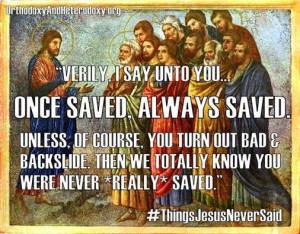
Sometimes you will hear the question “Can you be born again AGAIN?” from particularly reformed believers who are convinced that it is only possible to make the transfer from spiritual death to spiritual life one time only (without ever reverting back to spiritual death) and that a person who is born again WILL endure to the end and inherit the kingdom of God as a certainty. They believe that if a person does seem to revert back to deep sin and spiritual death, then he was not saved to begin with. This is commonly believed by the “once saved always saved” camp as well as the “perseverance of the saints” camp. The question, however, should be rephrased in order to avoid misunderstandings. There is a risk that the person asking the question might interpret the expression in one way, and the person answering might understand it in a different way. “Born again” might be only two words but the expression has a deep meaning.

We can agree that a sinner can only once be “totally converted for the first time” (when he repents, becomes forgiven, gets baptized and becomes a completely new cleansed person and a child of God). However, it is possible for the same sinner to go back to one or more of his old sins because he does not lose his free will in the process. Even Jesus Christ had the ability to sin (something he never did), so naturally we too could still make this choice. The serious part is that an unrepentant sinner is always lost, and people who were previously born again are not excepted from this danger. The devil is always on the hunt to tempt Christians with the hope to ensnare them in sin, and sometimes he succeeds when Christians give in for temptations. Some Christians repent at once, some do not repent until after months or years, and some Christians never repent but have truly reverted back to their own vomit and remain there. People can go from life, to death to life again:

The prodigal son: Luke 15:24 For this my son was dead, and is alive AGAIN; he was lost, and is found. And they began to be merry.-32 It was meet that we should make merry, and be glad: for this thy brother was dead, and is alive AGAIN; and was lost, and is found.

The debt which was cancelled by the Lord, and later reinstated again: Matt. 18:23 Therefore is the kingdom of heaven likened unto a certain king, which would take account of his servants. 27 Then the lord of that servant was moved with compassion, and loosed him, and FORGAVE HIM THE DEBT.32 Then his lord, after that he had called him, said unto him, O thou wicked servant, I forgave thee all that debt, because thou desiredst me:33 Shouldest not thou also have had compassion on thy fellowservant, even as I had pity on thee?34 And his lord was wroth, and delivered him to the tormentors, till he should pay all that was due unto him.35 So likewise shall my heavenly Father do also unto you, if ye from your hearts forgive not every one his brother their trespasses.d

2 Pet. 2:20 For if after they have escaped the pollutions of the world through the knowledge of the Lord and Saviour Jesus Christ, they are AGAIN entangled therein, and overcome, the latter end is worse with them than the beginning.21 For it had been better for them not to have known the way of righteousness, than, after they have known it, to turn from the holy commandment delivered unto them.22 But it is happened unto them accor—ding to the true proverb, The dog is turned to his own vomit AGAIN; and the sow that was washed to her wallowing in the mire.

So the question should rather be if a born again child of God can still choose to sin, and yes he can. Even King David, a man of God’s own heart, chose to sin quite severely – through murder, adultery and lies – and did not repent until after about a year. What does the Bible say about a righteous man who sins like King David?

Ez. 18:24 But when the righteous turneth away from his righteousness, and committeth iniquity, and doeth according to all the abominations that the wicked man doeth, shall he live? All his righteousness that he hath done shall not be mentioned: in his trespass that he hath trespassed, and in his sin that he hath sinned, in them shall he die.—26 When a righteous man turneth away from his righteousness, and committeth iniquity, and dieth in them; for his iniquity that he hath done shall he die.

Ever since the time of Adam, the truth remains that the wages of sin is death and that Satan lied when he taught the opposite. Sins still separate us from God.

Being born again (1 Pet. 1:23)

Being born again is a translation from the Greek verb anagennaō (Strong’s 313). According to the Blueletter Bible, it could mean (apart from being born again) to be born anew, to produce again or to have one’s mind changed so that he lives a new life conformed to God’s will (so unlike before). From Strong’s 303 and 1080; to beget or (by extension) bear (again):—beget, (bear) × (again). We can read about being born again (313) in 1 Pet. 1:3 (twice) and in. v. 23.

1 Pet. 1:3 Blessed be the God and Father of our Lord Jesus Christ, which according to his abundant mercy hath begotten us again unto a lively hope by the resurrection of Jesus Christ from the dead,—13 Wherefore gird up the loins of your mind, be sober, and hope to the end for the grace that is to be brought unto you at the revelation of Jesus Christ;14 As obedient children, not fashioning yourselves according to the former lusts in your ignorance:15 But as he which hath called you is holy, so be ye holy in all manner of conversation;16 Because it is written, Be ye holy; for I am holy.17 And if ye call on the Father, who without respect of persons judgeth according to every man’s work, pass the time of your sojourning here in fear:—22 Seeing ye have purified your souls in obeying the truth through the Spirit unto unfeigned love of the brethren, see that ye love one another with a pure heart fervently:23 Being born again, not of corruptible seed, but of incorruptible, by the word of God, which liveth and abideth for ever

Ye must be born again”, says Jesus (John 3:3,7)

“Be born” is here a translation of the verb gennaō (Strong’s 1080) and is a variation of genós (Strong’s 1085). In the KJV it is translated: begat, be born, bear, gender, bring forth, be delivered. “Again” is a translation of the adverb anōthen (Strong’s 509) and can be translated again, anew, from above, from a higher place, top, from the first and from the beginning.

We are all born physically from water (in our mother’s womb), but we also need to be spiritually reborn in order to become heirs to God’s kingdom, and that is when we are forgiven and cleansed from our past sins. No wonder Jesus taught “Repent, for the kingdom of heaven is at hand”! 

Luke 15:7 I say unto you, that likewise joy shall be in heaven over one sinner that repenteth, more than over ninety and nine just persons, which need no repentance.

From the below text we learn that Jesus seemed surprised about Nicodemus’ failure to understand him, indicating that Jesus was no Calvinist (Calvinists believe God is the one who enables and prevents people to believe). Jesus also compares himself with the serpent in the wilderness during the time of Moses, and people had to walk up to this serpent to behold it in order to be cleansed from their wounds. They had to make their own choice to do it, and similarly we need to make our own choice to approach Jesus in order to be cleansed from our “spiritual wounds” (our sins). Whosoever believes in Jesus will get eternal life, showing that it is a universal offer for everyone. God loved the WORLD, and sent his son not to condemn THE WORLD but to save it. Parts of the world will still be condemned,  but this does not change the fact that Jesus was sent to enable salvation to the world. We can see in v. 18-20, that the reason why people are still being condemned is because they do not believe in Jesus and do not come to the light due to their evil ways (they love darkness rather than light). If you do evil deeds you hate the light and do not come to the light. In v. 36 we can see that a person risks the wrath of God if he does not believe (and obey) the son of God (Jesus, God in flesh). God has no reason to be angry at someone who acts according to his will, which means that he is only angry at those who do NOT do his will but walk their own ways.

John 3:2 The same came to Jesus by night, and said unto him, Rabbi, we know that thou art a teacher come from God: for no man can do these miracles that thou doest, except God be with him.3 Jesus answered and said unto him, Verily, verily, I say unto thee, Except a man be born again, he cannot see the kingdom of God.4 Nicodemus saith unto him, How can a man be born when he is old? can he enter the second time into his mother’s womb, and be born?5 Jesus answered, Verily, verily, I say unto thee, Except a man be born of water and of the Spirit, he cannot enter into the kingdom of God.6 That which is born of the flesh is flesh; and that which is born of the Spirit is spirit.7 Marvel not that I said unto thee, Ye must be born again.8 The wind bloweth where it listeth, and thou hearest the sound thereof, but canst not tell whence it cometh, and whither it goeth: so is every one that is born of the Spirit.9 Nicodemus answered and said unto him, How can these things be?10 Jesus answered and said unto him, Art thou a master of Israel, and knowest not these things?11 Verily, verily, I say unto thee, We speak that we do know, and testify that we have seen; and ye receive not our witness.12 If I have told you earthly things, and ye believe not, how shall ye believe, if I tell you of heavenly things?13 And no man hath ascended up to heaven, but he that came down from heaven, even the Son of man which is in heaven.14 And as Moses lifted up the serpent in the wilderness, even so must the Son of man be lifted up:15 That whosoever believeth in him should not perish, but have eternal life.16 For God so loved the world, that he gave his only begotten Son, that whosoever believeth in him should not perish, but have everlasting life.17 For God sent not his Son into the world to condemn the world; but that the world through him might be saved.18 He that believeth on him is not condemned: but he that believeth not is condemned already, because he hath not believed in the name of the only begotten Son of God.19 And this is the condemnation, that light is come into the world, and men loved darkness rather than light, because their deeds were evil.20 For every one that doeth evil hateth the light, neither cometh to the light, lest his deeds should be reproved.21 But he that doeth truth cometh to the light, that his deeds may be made manifest, that they are wrought in God —31 He that cometh from above is above all: he that is of the earth is earthly, and speaketh of the earth: he that cometh from heaven is above all.32 And what he hath seen and heard, that he testifieth; and no man receiveth his testimony.33 He that hath received his testimony hath set to his seal that God is true.36 He that believeth on the Son hath everlasting life: and he that believeth not the Son shall not see life; but the wrath of God abideth on him.

The new man who is born againjohn piper

Do not trust reformed Mr Piper (see picture right), but trust in the Bible which says that Jesus did not come to condemn the world but was sent so that the world through him (the condition) could be saved. We must therefore remain in the vine (Jesus) so that we will not be cut off (John 15). Below we can see various descriptions about how a new person in Christ is expected to live his life. We can read about THE OLD MAN being put off:

Colossians 3:Mortify therefore your members which are upon the earth; fornication, uncleanness, inordinate affection, evil concupiscence, and covetousness, which is idolatry:6 For which things’ sake the wrath of God cometh on the children of disobedience:7 In the which ye also walked some time, when ye lived in them.But now ye also put off all these; anger, wrath, malice, blasphemy, filthy communication out of your mouth.9 Lie not one to another, seeing that ye have PUT OFF THE OLD MAN WITH HIS DEEDS;10 AND HAVE PUT ON THE NEW MAN, which is renewed in knowledge after the image of him that created him:11 Where there is neither Greek nor Jew, circumcision nor uncircumcision, Barbarian, Scythian, bond nor free: but Christ is all, and in all.12 Put on therefore, as the elect of God, holy and beloved, bowels of mercies, kindness, humbleness of mind, meekness, longsuffering;

2 Cor. 5:9 Wherefore we labour, that, whether present or absent, we may be accepted of him.—17 Therefore if any man be in Christ, HE IS A NEW CREATURE: OLD THINGS ARE PASSED AWAY; behold, all things are become new.

Rom. 6:6 Knowing this, that OUR OLD MAN is crucified with him, that the body of sin might be destroyed, that henceforth we should not serve sin.12 Let not sin therefore reign in your mortal body, that ye should obey it in the lusts thereof.13 Neither yield ye your members as instruments of unrighteousness unto sin: but yield yourselves unto God, as those that are alive from the dead, and your members as instruments of righteousness unto God.–-16 Know ye not, that to whom ye yield yourselves servants to obey, his servants ye are to whom ye obey; whether of sin unto death, or of obedience unto righteousness?

Eph. 4:17 This I say, therefore, and testify in the Lord, that you should no longer walk as the rest of the Gentiles walk, in the futility of their mind, 18 having their understanding darkened, being alienated from the life of God, because of the ignorance that is in them, because of the blindness of their heart;  2 22 that you put off, concerning your former conduct, THE OLD MAN which grows corrupt according to the deceitful lusts, 23 and be renewed in the spirit of your mind, 24 and that you PUT ON THE NEW MAN which was created according to God, in true righteousness and holiness.25 Therefore, putting away lying, “Let each one of you speak truth with his neighbor,” for we are members of one another. 26 “Be angry, and DO NOT SIN”:do not let the sun go down on your wrath,27 nor give place to the devil. 28 Let him who stole steal no longer, but rather let him labor, working with his hands what is good, that he may have something to give him who has need. 29 Let no corrupt word proceed out of your mouth, but what is good for necessary edification, that it may impart grace to the hearers. 30 And do not grieve the Holy Spirit of God, by whom you were sealed for the day of redemption. 31 Let all bitterness, wrath, anger, clamor, and evil speaking be put away from you, with all malice. (NKJV)

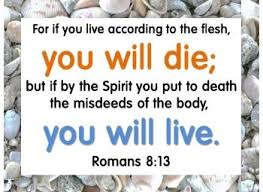
Romans 8:12 Therefore, brethren, we are debtors, not to the flesh, to live after the flesh.13 For if ye live after the flesh, ye shall die: but if ye through the Spirit do mortify the deeds of the body, ye shall live.14 For as many as are led by the Spirit of God, they are the sons of God.

1 John 1:If we say that we have fellowship with him, and walk in darkness, we lie, and do not the truth:7 But if we walk in the light, as he is in the light, we have fellowship one with another, and the blood of Jesus Christ his Son cleanseth us from all sin.

Galatians 5:16 This I say then, Walk in the Spirit, and ye shall not fulfil the lust of the flesh.17 For the flesh lusteth against the Spirit, and the Spirit against the flesh: and these are contrary the one to the other: so that ye cannot do the things that ye would.18 But if ye be led of the Spirit, ye are not under the law.19 Now the works of the flesh are manifest, which are these; Adultery, fornication, uncleanness, lasciviousness,20 Idolatry, witchcraft, hatred, variance, emulations, wrath, strife, seditions, heresies,21 Envyings, murders, drunkenness, revellings, and such like: of the which I tell you before, as I have also told you in time past, that they which do such things shall not inherit the kingdom of God.22 But the fruit of the Spirit is love, joy, peace, longsuffering, gentleness, goodness, faith,23 Meekness, temperance: against such there is no law.24 And they that are Christ’s have crucified the flesh with the affections and lusts.25 If we live in the Spirit, let us also walk in the Spirit.

Titus 2:11 For the grace of God that bringeth salvation hath appeared to all men,12 Teaching us that, denying ungodliness and worldly lusts, we should live soberly, righteously, and godly, in this present world;

Matthew 9:17 Neither do men put new wine into old bottles: else the bottles break, and the wine runneth out, and the bottles perish: but they put new wine into new bottles, and both are preserved.

1 Cor. 5:6 Your glorying is not good. Know ye not that a little leaven leaveneth the whole lump?

Jesse Morell winner in DEBATE with Calvinist Matt Slick from CARM

Matt Slick (1)

Jesse Morell demolished Matt Slick due to a more Biblical theology view as well as superior debate ethics 

The entire debate can be found here, together with an outline of Jesse’s presentation in case you missed it.

I do not believe there will ever be a debate with a Calvinist who does not charge the other for misunderstanding or misrepresenting Calvinism. My views are as follows.

Best theology (regardless of presentation) – Winner is Jesse, but he had an easy task before him since it is definitely not hard to find scriptures which contradict Calvinism and support free will. The teaching of free will (as in the logical and traditional understanding of the word – as in being able to make contrary choices) is taught throughout the Bible, and the Bible is actually a book describing people who constantly act against the will of God (all of his multiple wills, if you will). Man’s free will is so obvious that the only way to get around it is to change the meaning of the word as well as twisting a lot of verses, and that is a common skill among Calvinists. (Those who have attended reformed Bible schools are particularly gifted in this area.) The only other option to free will is that God has created most of us to believe we have free will even though we do not.

So it looks like people who “falsely” believe in free will still act according to God’s will since nothing happens against his will. Calvinism is contradictory to its core, and the amount of Calvinists who are able to be consistent with their own doctrines is zero. Matt Slick did not change this number. Most Calvinists constantly express themselves as though we have free will (a libertarian free will), and they often criticize others and urge them to repent – as though the unrepentant could make this decision of his own and as though a mere person could influence someone to repent even though God has already made his decrees. Matt repeatedly warned Jesse to correct his ways and views as though Jesse has made the wrong theological choices contrary to God’s desires. Apparently God’s irresistible decrees do not always come about, if people believe in heresy against his will? How hard it is for Calvinists do be consistent with their semi-gnostic philosophy. Also the old church fathers before Augustine (who brought so many heresies into church) believed in man’s (libertarian) free will, and none believed in a depraved/ruined nature as can be seen here.

Best presentation and ability to stay on topic – Winner is Jesse who demolished Matt Slick. Jesse showed way more confidence and calmness in his speech despite that Matt sat beside him repeatedly flipping though his papers, adjusting his computer, rearranging stuff on his desk, making shoulder gymnastics, etc. While both naturally provided lots of scriptures and showed great Biblical knowledge, Jesse managed to squeeze in more scriptures without being boring, and selected clear verses which stood as great examples for man’s free will, synergism, and that God’s will does not always happen. Most importantly, he broke apart the verses that Matt provided for his case and when including the entire context the verses in no way confirm the Calvinistic stance but the exact opposite. Jesse spoke with authority without insulting the other person’s character, but rather explained why the teachings of Gnosticism and Calvinism are unbiblical heresies which also the early church fathers fought against. Jesse was way more organized also in his appearance, and unlike Slick he did not desperately search through his notes, folders or a computer. Jesse did not even bring a computer (he had his phone if needed) but trusted solely on his written material as well his book. He seemed to know his material as well as Bible verses by heart and acted as a real pro.

The fact that Matt Slick brought up the topic of open theism shows his desperation, because the topic was rather free will vs election (of human beings). Discussing open theism takes a lot of time and deserves a debate of its own. If Jesse would have spent time responding to Matt’s attempt to go down that rabbit hole, then it is a good guess that Matt would respond back and the debate would set off in a direction which was not intended. A skilled and polite debater knows how to stay on topic rather than getting off the track. It is common that debaters bring up other topics when they cannot refute the current ones on the table.

Most humble attitude and ability to present criticism without insults – Winner is Jesse who was far from being arrogant. “You shall know them by their fruit”, and it is quite obvious who showed good fruit and who has more to learn. Matt revealed a lot about himself when he made so many faces during his opponent’s speech. I prefer to believe he was nervous rather than purposely trying to disturb his opponent, but it definitely looked disrespectful. The more time that passed, the more faces Matt made and I even saw him forming words with his mouth during Jesse’s later talks (hopefully not saying the words out loud). Maybe Matt reacted in this way because he is so used to his own Calvinistic environment where he does not get a lot of opposition like he did now.

Matt said something about seeing himself as the worst of sinners (listen to the debate to hear his exact phrase), and some people in the audience reacted on that during the Q & A section. Matt sighed about their questions and asked if they would like to know what he meant by that statement. It appears that he disapproved of people who took him by his words, rather than understanding there might be an underlying meaning. It is true that false accusations and misrepresentations should best be avoided, but Matt is pretty good at it himself (and I have listened to his radio shows so I know what I am talking about). When he later asked a girl if she was perfect and she said yes, then he replied something like “Oh, so you’re divine!”, which she of course never claimed to be. Naturally Matt did not believe it either, but would he like to know what she meant by her affirmation? Could there be an underlying meaning? The fact is that it is possible to be perfect without being divine, so Matt did not need to make this accusation. She did not even claim to never having sinned. Jesus told us to be perfect as our Father in heaven is perfect, which means that we can. The question is rather what it MEANS, and it is quite clear that Matt feels that he has the right definition.

Some people in the audience could have sounded friendlier, focusing on formulating the question rather than “telling” the debaters things, but then it is important to criticize the individuals it concerns rather than judging the entire audience as a group. In Matt’s case he should of course take it up with God if he believes that nothing comes to pass against his will. A consistent Calvinist should know that criticism about anything or anyone is criticism against God himself.

OUR good works will glorify God

If good works will glorify God, then it is hard to understand why God would force people to be wicked non-elect from the foundation of the world and send them to hell because of it (as though they could have made another option contrary to his decrees). Matt would likely protest against this description about forcing, but that is exactly what his doctrines about total depravity and predestination suggest and what Calvin and Calvinistic scholars have admitted (Jesse quoted some of them, but there are plenty more).

The idea that Jesus can transfer HIS righteousness into us is not a Biblical idea. We can of course read about “imputed righteousness”, and it means to be regarded/reckoned as righteous because we ARE. We are, because we have been totally cleansed in the blood of Jesus and left our old sinful man behind.

Matt. 5:16 Let your light so shine before men, that they may see YOUR GOOD WORKS, and GLORIFY your Father which is in heaven.1—19 Whosoever therefore shall break one of these least commandments, AND SHALL TEACH MEN SO, he shall be called the least in the kingdom of heaven: but whosoever shall DO AND TEACH THEM, the same shall be called great in the kingdom of heaven.20 For I say unto you, That EXCEPT YOUR RIGHTEOUSNESS SHALL EXCEED the righteousness of the scribes and Pharisees, ye shall in no case enter into the kingdom of heaven.

Who would Matt Slick side with in Matt 5:16-20? The one who does the commandments (obeys them) and teach others that it is possible to do so? That is not the impression I got from the debate. He rather warned Jesse about the teaching that it is possible to refrain from all sin and that we are the ones who must live holy lives rather than leaning on someone else’s righteousness and continue sinning. Jesse is apparently in deep trouble for teaching the importance of being victorious over sin and being able to be completely faithful to Jesus by the way we are living (rather than relying on someone else’s righteousness being transferred into us). Is God particularly mad at those who live holy lives and teach others to do the same? If this is not what Matt meant, then maybe he should not have complained about Jesse’s holiness-teaching but rather supported him. Righteous people will go to heaven and sinners will go to hell. Not the other way around! The Bible provides a warning about teachers who tell others that it is not possible to be totally faithful to God, and that it is not a big deal for Christians since we are unconditionally and eternally saved anyway:

1 John 3:7 Little children, let no man deceive you: HE THAT DOETH RIGHTEOUSNESS is righteous, even as he is righteous.

If Calvinism is right, people who have obeyed God to 100% will end up in hell, and Jesus death on the cross is a complete puzzle. Did something go wrong which necessitated Jesus death on the cross? Exactly what went wrong, and could not God have predestined people to live holy lives without the need for Jesus atonement? I cannot think of a religion/philosophy which maligns the character of God the way Calvinism does. Not even mormonism, JW or Catholicism. Many freewillers do what they can to protect God from all attacks by Calvinists, and we must continue to pray for people like Jesse who defends God’s pure character which is far from darkness and sin – and naturally for Matt Slick!

For Calvinists Calvinism is important. Their doctrines require that they blame God for all sin either directly or indirectly, but they must wrap this message in a lot of sweet words so that they can trick more people into falling for Calvinism.

15 Bible verses Calvinists misinterpret in relation to God’s SOVEREIGN WILL

Ye stiffnecked and uncircumcised in heart and ears, YE DO ALWAYS RESIST THE HOLY GHOST: as your fathers did, so do ye. Acts 7:51 

15 examples of failed attempts to show that God’s will always happens below, but first this…

The best way to avoid misunderstandings, such as the preposterous idea that God decrees absolutely all things, is to read the context! Anyone can take a Bible verse here and there and build any doctrine at all, but it is a lot safer to read the entire chapter to see the intent of the author. It is particularly important to not build a new doctrine based on poetry or proverbs, since such wordings might be vague and oftentimes should not be taken literally. Also books like Job contains large amount of poetic expressions, such as this example:

Job 1:21 And said, Naked came I out of my mother’s womb, and NAKED SHALL I RETURN THITHER: the Lord gave, and the Lord hath taken away; blessed be the name of the Lord.

We might also be able to find intentional hyperboles or intentional exaggerations to make a point:

Matt. 6:6 But thou, when thou prayest, enter into thy closet, and when thou hast shut thy door, pray to thy Father which is in secret; and thy Father which seeth in secret shall reward thee openly.

It is clear that God’s will does not always come about in this world:

1 John 2:16 For all that is in the world, the lust of the flesh, and the lust of the eyes, and the pride of life, IS NOT OF THE FATHER, but is of the world.17 And the world passeth away, and the lust thereof: but HE THAT DOETH THE WILL OF GOD abideth for ever.

Notice that John writes “he that doeth the will of God abideth for ever”. If all people everywhere and at all times did the will of God, then all people would abide for ever. Clearly all people will not be saved, and that is due to their disobedience – due to acting contrary to God’s will.

This is the filter we should use when reading the Bible:

Ja. 1:13 Let no man say when he is tempted, I am tempted of God: for God cannot be tempted with evil, NEITHER TEMPTETH HE ANY MAN:14 But every man is tempted, when he is drawn away of his own lust, and enticed.15 Then when lust hath conceived, it bringeth forth sin: and sin, when it is finished, bringeth forth death.16 Do not err, my beloved brethren.

God does not tempt anyone, much less causes people to sin. We should never blame man’s sins on God at any time. In order to be consistent with TULIP, Calvinists must disagree with all verses which tell us that sin happens against God’s will. For example, Calvinist R.C. Sproul says:

“If there is one single molecule in this universe running around loose, totally free of God’s sovereignty, then we have no guarantee that a single promise of God will ever be fulfilled.” (R.C. Sproul, Chosen By God: Know God’s Perfect Plan for His Glory and His Children)

“Sovereign” and “sovereignty” are words not included in the Bible (KJV), which means they must be defined. Free-willers do not have a problem with a sovereign God, but they certainly do not agree with the Calvinistic interpretation of this word. Calvinists normally understand this word to mean something like “God decrees ALL THINGS at all times, resulting in that every single action taken by man always turns out exactly as God wants. He can do anything at all and nothing is too difficult for him – except from creating man with free will”.

Some favorite verses by those who prefer blaming God for man’s sin

Example 1:calvinsm 49

Rom. 9:18 Therefore hath he mercy on whom he will have mercy, and whom he will he hardeneth. 19 Thou wilt say then unto me, Why doth he yet find fault? For who hath resisted his will?

My comment: Has it ever happened throughout history that someone has found fault in God and his actions? Yes, right? The Bible is replete with examples of people who refuse to obey him, rebel against him and cause him to be angry. So this verse is not what man cannot do but should not do. If God’s will is to offer salvation also for the gentiles (showing mercy also to them) and make faith the condition for salvation rather than being born a Jew under the Mosaic law, then who is able to resist this decision? No one. Who can resist his will? The context and the rest of the Bible render it impossible to interpret Rom. 9:18 as “Therefore he makes salvation possible for only some individuals, whereas he blocks the rest from ever being able to seek him or find him.” Such an interpretation would make God alone guilty of man’s unbelief, and hell would be a place where innocent and rejected people would end up who had no chance to be saved (since God successfully prevented them from believing in him). Does that sound like the God of the Bible? You can read more about Romans 9 and Pharao’s heart here, here and here.

Example 2:

Eph. 1:5 Having predestinated us unto the adoption of children by Jesus Christ to himself, according to the good pleasure of his will,— 11 IN HIM also we have obtained an inheritance, being predestined according to the purpose of Him who works all things according to the counsel of His will

My comment: The promises in Eph. 1-2 are tied to those who are IN CHRIST, and being IN HIM is an essential foundation and the condition for salvation. From the creation of the world God knew there would be a “body of Christ” (the church, consisting of believers), and a special place is prepared for them in God’s kingdom where this body of Christ is predestined to go. So the “salvation bus” is certainly going there, but who will be the passengers on the bus and who will endure to the very end? That is up to us. If we are in Christ we know that we are heading for God’s kingdom if we remain in the bus. The “us” spoken about in the verse are true believers and therefore “adopted” as God’s children. (This type of adoption should not be compared to what we call “adoption” today, where parents are being promised a baby who they later legally adopt as their legal child.)

Compare also with this verse:

“John 1:12 But as many as received Him, to them He gave the right to become children of God, to those who believe in His name

So the order of even is 1) receive and believe in him, and then 2) become children of God. You can read more about Eph. 2 here.

Example 3:

Hebrews 12:2 Looking unto Jesus the author and finisher of our faith; who for the joy that was set before him endured the cross, despising the shame, and is set down at the right hand of the throne of God.

My comment: We are totally lost without Jesus who is our Savior, so he is rightfully the author and finisher of our faith. He made the wonderful salvation plan possible for us (he died for us on the cross), and he has promised to never cast us out but rather give us a crown of life if we endure to the end. It is Jesus from start to finish. Hebr. 12:2 should not be interpreted as “Jesus causes certain people to have faith and is responsible for guarding their faith to the very end, whereas the rest are doomed from birth since Jesus never died for them or enabled them to get saved”.  Read more here.

Example 4

Isaiah 46:10 Declaring the end from the beginning, and from ancient times the things that are not yet done, saying, My counsel shall stand, and I will do all my pleasure

My comment:

The verses surrounding the above verse are:

“Isaiah 46:9 Remember the former things of old: for I am God, and there is none else; I am God, and there is none like me, 12 Hearken unto me, ye stouthearted, that are far from righteousness”

Also this passage focuses on God’s mighty power, and that there is no one like him. Knowing things in advance is not the same as predestining things in advance. Calvinists make a hen out of a feather when it comes to the word “declaring”, as though this would mean that God predestines all things. According to v. 12 there are apparently people who are stouthearted and far from righteous, which is normally something God does not approve of. It is a silly idea that God would predestine people to be stouthearted. “My councel shall stand, and I will do all my pleasure”. Does this include creating man with free will and making man responsible for his actions, and sometimes even punish man for his sins?

Example 5:

Dan. 4:35 And all the inhabitants of the earth are reputed as nothing: and he doeth according to his will in the army of heaven, and among the inhabitants of the earth: and none can stay his hand, or say unto him, What doest thou?

Comment:

Yes God does according to this will, and since he is our Creator and knows best. It would not make sense to argue with him or suggest that he should not have done things the way he did. Unfortunately, people have indeed complained to God and continued to question his motives (and sometimes his mere existence), so this verse is not about what man cannot do but should not do. Could it be God’s will to punish the fallen angels (who acted contrary to his will), and to create man with free will? Or is this outside his capabilities?

Example 6:

Job 42:2 I know that thou canst do every thing, and that no thought can be withholden from thee.3 Who is he that hideth counsel without knowledge? therefore have I uttered that I understood not; things too wonderful for me, which I knew not.

Comment: The above verses are from KJV, just like the rest of the verses. There are other Bible versions which Calvinists might prefer because of other expressions, but John 42:2 only confirms that God knows everything there is to know.

Example 7:

Lam. 3:37 Who is he that saith, and it cometh to pass, when the Lord commandeth it not?38 Out of the mouth of the most High proceedeth not evil and good?

Comment: This is also about a general statement about God’s magnificent power rather than a teaching that God predestines all of our steps (including sin). We can continue reading in the same context:

“39 Wherefore doth a living man complain, a man for the punishment of his sins?40 Let us search and try our ways, and turn again to the Lord.41 Let us lift up our heart with our hands unto God in the heavens.42 We have transgressed and have rebelled: thou hast not pardoned.43 Thou hast covered with anger, and persecuted us: thou hast slain, thou hast not pitied.”

Here we read about man complaining about the punishments for his sins (apparently it is possible to complain to God after all), and “sins” would be activities against God’s will. The advice to “turn again to the Lord” means that people previously turned their backs on God. The fact that people “transgressed and have rebelled” yet again means that we are able to act contrary to God’s will. Furthermore, we can read about God being “angry” and have “persecuted” people due to their actions (transgressions and rebellion), which is more evidence of man’s free will.

Example 8:

Exodus 4:11 And the Lord said unto him, Who hath made man’s mouth? or who maketh the dumb, or deaf, or the seeing, or the blind? have not I the Lord?

Comment: The context concerns Moses’ reluctance to becoming Israel’s leader due to his (Moses) shortcomings in relation to his ability to public speaking. Moses said: “O my Lord, I am not eloquent, neither heretofore, nor since thou hast spoken unto thy servant: but I am slow of speech, and of a slow tongue.” God can accomplish things despite our shortcomings, and he can even heal people. If he asks us to do something, we can totally trust that he will help us overcome our weaknesses. That seems to be the gist of what God wanted to express when Moses argued against God about his shortcomings. Moses had to be persuaded, and he finally gave in after a conversation with God. God is not suggesting that he is the one who forces people to be deaf, blind, poor, etc, but he rather explains that he is the author of all Creation and he can be trusted.

Example 9:

1 Sam. 2:6 The Lord killeth, and maketh alive: he bringeth down to the grave, and bringeth up.The Lord maketh poor, and maketh rich: he bringeth low, and lifteth up.

Comment: The surrounding verses are these:

6 The Lord killeth, and maketh alive: he bringeth down to the grave, and bringeth up.— 8 He raiseth up the poor out of the dust, and lifteth up the beggar from the dunghill, to set them among princes, and to make them inherit the throne of glory: for the pillars of the earth are the Lord’s, and he hath set the world upon them.9 He will keep the feet of his saints, and the wicked shall be silent in darkness; for by strength shall no man prevail.”

This is a description with poetic expressions describing God’s power and his future judgment of mankind. Depending on how we choose to live our live, based on our situation and opportunities, we will be punished or rewarded. Read what the author says about the poor. Will God always lift up the beggar and set him among princes here on earth? No, this is not a universal promise for the present dimension but for the future.

calvinism 40Example 10:

Isaiah 45: 7 I form the light, and create darkness: I make peace, and create evil: I the Lord do all these things.

Comment: The above is in the KJV, but in the NKJV and in many other Bible versions it is rather “calamity” instead of “evil”. The Hebrew word could mean both, as well as a few other alternatives. God can indeed cause physical calamity just like he did when he caused a global flood to hit the earth. Physical pain or punishments caused by God does not mean that he causes people to sin. There is no darkness in God.

Example 11:

2 Chron. 25:20 But Amaziah would not hear; for it came of God, that he might deliver them into the hand of their enemies, because they sought after the gods of Edom.

Comment: Apparently the reason that “it came of God” that Amaziah would not hear – resulting in that he and his people were delivered into the hand of their enemies – was because they turned to other gods in Edom. There you have the reason. Did God want them to turn to false gods? Hardly. The most important commandment is to have no other gods but God. Compare with Romans 1 where we can read about God giving up people to a reprobate mind due to their ungodly attitudes. At one point Amaziah followed the Lord, but he later turned away.

“27 Now after the time that Amaziah did turn away from following the Lord they made a conspiracy against him in Jerusalem; and he fled to Lachish: but they sent to Lachish after him, and slew him there.”

Example 12

Jer. 10:23 O Lord, I know that the way of man is not in himself: it is not in man that walketh to DIRECT HIS STEPS

The context is this:

“21 For the pastors are become brutish, and have not sought the Lord: therefore they shall not prosper, and all their flocks shall be scattered.Behold, the noise of the report has come, And a great commotion out of the north country, To make the cities of Judah desolate, a den of jackals.—25 Pour out thy fury upon the heathen that know thee not, and upon the families that call not on thy name: for they have eaten up Jacob, and devoured him, and consumed him, and have made his habitation desolate.”

Comment: Notice above that that there are people who have not sought God, like heathens or families that did not call on the name of the Lord. Clearly this is not according to God’s will. A man is not supposed to turn his back on God by not seeking his guidance, and walk on his own ways. If a man does not seek God, he will not be guided on the right path. Read more here.

Example 13

1 Sam. 2:25 If one man sins against another, God will judge him. But if a man sins against the Lord, who will intercede for him?” Nevertheless they did not heed the voice of their father, because the Lord desired to kill them.

Comment: According to Adam Clarke the particle ki, translated “because”, is better translated “therefore” just like it does in many other parts of the Bible. (Young’s literal translation reads “though”.) This means that God wanted to kill the individuals in the story due to their refusal to listen to their father’s voice. This is a more logical translation than rendering the passage as though God wants to kill certain people for no reason, and manipulates them into not listening to their father and then proceeds to take this as an excuse for killing them. That would be circular reasoning and would turn God into an unrighteous criminal. Sadly many Calvinists would rather turn God into a monster than letting go with their precious philosophy of Calvinism.

Example 14 – Psalms

Psalm 115:3 But our God is in the heavens: he hath done whatsoever he hath pleased.

Psalm 135:6 Whatsoever the Lord pleased, that did he in heaven, and in earth, in the seas, and all deep places.

Psalm 33:10 The Lord bringeth the counsel of the heathen to nought: he maketh the devices of the people of none effect.11 The counsel of the Lord standeth for ever, the thoughts of his heart to all generations.

My comment: Psalms often contain poetry which mirrors the reality in many ways, so we must approach the verses with this in mind. Yes, God has always done whatever he has pleases, but naturally this could include creating man with free will. What the context of these psalms has in common is the declaration that God is the great and magnificent Creator, and that false gods (which are no gods) cannot compete with his wonderful powers.

Psalm 33:15 says “He fashioneth their hearts alike; he considereth all their works”, which is a description of how God has originally made man and also judges their work. It does not say that God micromanages every single step that man takes, nor that man does not have a will of his own. If you think “The Lord bringeth the counsel of the heathen to nought” means that God first manipulates the heathens to come up with various evil schemes, and then turns around and “heroically” halts these plans that he himself initiated, then you are mistaken. It is just a poetic description of God’s power which the heathens cannot interfere with. The verse does not say that God either prevents people from sinning, or predestines their sin. During Jesus’ second coming, he will only have to breathe on the son of perdition to destroy him completely (2 Thess. 2:8), so the power of God is indeed great.

Example 15 – Proverbs

Prov. 16:4 The Lord has made all for Himself, Yes, even the wicked for the day of doom. (NKJV)

Prov. 16:33 The lot is cast into the lap; but the whole disposing thereof is of the Lord.

Prov. 21:1 The king’s heart is in the hand of the Lord, as the rivers of water: he turneth it whithersoever he will.

My comment: Also proverbs contains poetry, so we must keep this in mind. Instead of having to ignore loads of verses which show that God is angry with sin and where he desires all men to obey his commandments, it is better to read the more vague proverbs and psalms in context and not superimpose them over clear verses. The first verse just shows God’s right to handle all judgment of mankind, whether people are righteous or unrighteous. Read more about these verses here. Neither of these verses contains promises that God predestines every all things. That would put all the blame on God.

If God’s will always happens, then why does the Bible say the opposite?

Mark 3:35  For whoever does the will of God, he is my brother and sister and mother.

I thought all people did the will of God? Are all people his brothers, sisters and mothers?

Matt. 7:21 Not every one that saith unto me, Lord, Lord, shall enter into the kingdom of heaven; but HE THAT DOETH THE WILL OF MY FATHER which is in heaven.

”He that doeth the will of my Father”? If everyone would always do the will of God then everyone would enter the kingdom of God.

John 9:31 Now we know that God heareth not sinners: but if any man be a worshipper of God, and DOETH HIS WILL, him he heareth.

”If any man—doeth his will”? Jesus separates those who worship God and obey him (doeth his will) with those who are sinners. This suggests that sinners are not doing the will of God, unless sinning is according to his will.

1 Timothy 2:1 Therefore I exhort first of all that supplications, prayers, intercessions, and giving of thanks be made for all men, 2 for kings and all who are in authority, that we may lead a quiet and peaceable life in all godliness and reverence. 3 For this is good and acceptable in the sight of God our Savior, who desires all men to be saved and to come to the knowledge of the truth.

God desires all men to be saved and come to the knowledge of the truth. Has this so far happened?

Heb. 3:7 Wherefore (as the Holy Ghost saith, To day if ye will hear his voice,8 Harden not your hearts, as in the provocation, in the day of temptation in the wilderness:9 When your fathers tempted me, proved me, and saw my works forty years.10 Wherefore I was grieved with that generation, and said, They do alway err in their heart; and they have not known my ways.11 So I sware in my wrath, They shall not enter into my rest.)12 Take heed, brethren, lest there be in any of you an evil heart of unbelief, in departing from the living God.

Clearly people constantly act against the will of God. Today and in the past.

He that COMETH to God must BELIEVE that he is – Hebr. 11:16

But without FAITH it is impossible to please him: for he that COMETH to God must believe that he is, and that he is a rewarder of them that diligently seek him. Hebrews 11:6

It is rather clear that God requires us to have faith in him and believe in him before we come to him (we would not come to him unless we believed in him). We must carry faith/belief with us when we come. Calvinists, however, believe in Total inability (as in T in TULIP), so they believe that all people are born with a natural inability to believe in God, and that God consequently must “open their eyes” in order to make them believe. This results in God actually choosing whom to save and whom to damn (before we are even born), because God does not enable all to believe in him. Hebr. 11:6 does not suggest that God starts out making some of us believe. It is rather we who must make sure to believe and come to him. If we do, we have wonderful things in store for us! The Bible does not teach anything close to Calvinism. We are ALL given light when we come into this world and we are requested to believe and to follow him in order to not walk in darkness:

John. 1:4 In him was life; and the life was THE LIGHT OF MEN.—9 That was the true Light, WHICH LIGHTETH EVERY MAN THAT COMETH INTO THE WORLD.10 He was in the world, and the world was made by him, and the world knew him not.11 He came unto his own, and his own received him not.12 But AS MANY AS RECEIVED HIM, TO THEM GAVE HE THE POWER TO BECOME THE SONS OF GODeven to them that BELIEVE on his name

John 9:5 As long as I am in the world, I am THE LIGHT OF THE WORLD.

John 12:46 I am come a light into the world, that WHOSOEVER BELIEVETH ON ME should not abide in darkness.

John 8:12 Then spake Jesus again unto them, saying, I am the light OF THE WORLD: he that FOLLOWETH ME shall not walk in darkness, but shall have the light of life.

John 3:21 But he that DOETH truth cometh to the light, that his deeds may be made manifest, that they are wrought in God.

2 Cor. 4:4 In whom the god of this world hath blinded the minds of them WHICH BELIEVE NOT, lest the light of the glorious gospel of Christ, who is the image of God, should shine unto them.

Notice above that God chooses to blind the minds of them WHICH BELIEVE NOT. That is a similar story as in Rom. 1:18-32, where God in v. 28 is told to give people up to a reprobate mind because of their refusal to retain God in their knowledge.

Pay special attention to John 1:12 which says:

“But AS MANY AS RECEIVED HIM, TO THEM GAVE HE THE POWER TO BECOME THE SONS OF GODeven to them that BELIEVE on his name”

The order of events is 1) believe/receive him, leading to 2) becoming the sons of God. Not the other way around.

People who COME must believe, and they might not always DO the things of God or remain with him

Jesus asks:

Luke 6:46 And why call ye me, Lord, Lord, and DO NOT the things which I say?

According to Calvinism I thought it was not even possible to NOT do the things which the Lord says? So why does Jesus imply that it is possible to act contrary to his requests? He continues:

47 Whosoever cometh to me, and heareth my sayings, and DOETH them, I will shew you to whom he is like: 48 He is like a man which built an house, and digged deep, and laid the foundation on a rock: and when the flood arose, the stream beat vehemently upon that house, and could not shake it: for it was founded upon a rock.49 But he that heareth, and DOETH NOT, is like a man that without a foundation built an house upon the earth; against which the stream did beat vehemently, and immediately it fell; and the ruin of that house was great.

I thought all people everywhere always did the sayings of the Lord? Yet here we can see that some people COME to the Lord, HEAR his sayings and yet choose to NOT do the sayings of the Lord. It certainly does not seem like we always act as God would want us to act. The blame for “not doing” is further on man and not on God. Notice that the parable is about men who builds something – their own houses – which means that their own choice of building construction will depend on

Ja. 1:22 But be ye doers of the word, and not hearers only, deceiving your own selves.

John 6:35 And Jesus said unto them, I am the bread of life: he that cometh to me shall never hunger; and he that believeth on me shall never thirst.–40 And this is the will of him that sent me, that every one which seeth the Son, and BELIEVETH ON HIM, may have everlasting life: and I will raise him up at the last day.—51 I am the living bread which came down from heaven: if ANY MAN EAT of this bread, he shall live for ever: and the bread that I will give is my flesh, which I will give for the life of the world.

Luke 9:23 And he said to them all, If any man will come after me, let him deny himself, and take up his cross daily, and follow me.24 For whosoever will save his life shall lose it: but whosoever will lose his life for my sake, the same shall save it.25 For what is a man advantaged, if he gain the whole world, and lose himself, or be cast away?26 For whosoever shall be ashamed of me and of my words, of him shall the Son of man be ashamed, when he shall come in his own glory, and in his Father’s, and of the holy angels.

Parable of the great banquet – where people are requested to COME and yet they do not

Below we can see that the Master of the house asked his servant to go out and bid many to a great supper. The servant was asked to say to those who were bidden to “COME, for all things are now ready”. The Master in this parable could be likened to God the Father, and as we can see in the parable people who were initially invited to come found excuses for not coming!

The servant was then asked to “bring in hither the poor, and the maimed, and the halt, and the blind”, which is something the servant had already done. It seems like these groups of people (rather unfortunate people here on earth due to their poverty and physical shortcomings) had an advantage here because they were singled out as specifically welcomed, but we are not told that every single one of them chose to come. Just that there was still room left also after these groups had been invited. (The case could also be that people who are poor and maimed have a higher tendency to seek God compared to people who have always lived in comfort and luxury.)

The Master became ANGRY when those who were initially bidden declined to come. The blame for not coming must be placed on them and not on the Master (God) because the Master truly wanted all invited to come – yet they did not. The Master said of those who declined to come: “none of those men which were bidden shall taste of my supper”.

Luke 14:16 Then said he unto him, A certain man made a great supper, and bade many:17 And sent his servant at supper time to say to them that were bidden, Come; for all things are now ready.18 And they all with one consent began to make excuse. The first said unto him, I have bought a piece of ground, and I must needs go and see it: I pray thee have me excused.19 And another said, I have bought five yoke of oxen, and I go to prove them: I pray thee have me excused.20 And another said, I have married a wife, and therefore I cannot come.21 So that servant came, and shewed his lord these things. Then the master of the house being angry said to his servant, Go out quickly into the streets and lanes of the city, and bring in hither the poor, and the maimed, and the halt, and the blind.22 And the servant said, Lord, it is done as thou hast commanded, and yet there is room.23 And the lord said unto the servant, Go out into the highways and hedges, and compel them to come in, that my house may be filled.24 For I say unto you, That none of those men which were bidden shall taste of my supper.

After having told the parable, Jesus continues to explain that if we do come to him we must “hate” our father and mother, which means that we should not act like the unwise people in the parable who offered up various excuses for not coming to the Supper, such as marriage, when they were compelled to come. Nothing should prevent us from coming to God if he calls us! Not even if it is about our father and mother. Naturally marriages,   parents, newly bought land, etc are important matters, but compared to God and his calling we must still prioritize correctly and place all other things in second place. A condition for being a disciple is to bear our cross and follow Jesus. He does not say that he will do this for us and instead of us so that we will not have to.

He goes on to explain that it is our job to count the cost before we choose to come! Do we have sufficient motivation to be his disciples? Will we be able to love God before anything/anyone else and carry our cross? If not, coming to Jesus will not save us if we are not prepared to forsake other things which might be in the way when we become his disciples. We must be eager to follow him and obey his commandments, which will truly show that we love him. It might seem like a difficult task, but we are not asked to cease living in this world or to avoid having families and possessions. We are just asked to be prepared to place God before anything else – and if we love him we obey him. The holy Spirit is our helper! Salt is good but even salt can lose its’ savor, which indicates that we are not unconditionally saved:

26 If any man come to me, and hate not his father, and mother, and wife, and children, and brethren, and sisters, yea, and his own life also, he cannot be my disciple.27 And whosoever doth not bear his cross, and come after me, cannot be my disciple.28 For which of you, intending to build a tower, sitteth not down first, and counteth the cost, whether he have sufficient to finish it?29 Lest haply, after he hath laid the foundation, and is not able to finish it, all that behold it begin to mock him,30 Saying, This man began to build, and was not able to finish.31 Or what king, going to make war against another king, sitteth not down first, and consulteth whether he be able with ten thousand to meet him that cometh against him with twenty thousand?32 Or else, while the other is yet a great way off, he sendeth an ambassage, and desireth conditions of peace.33 So likewise, whosoever he be of you that forsaketh not all that he hath, he cannot be my disciple.34 Salt is good: but if the salt have lost his savour, wherewith shall it be seasoned?35 It is neither fit for the land, nor yet for the dunghill; but men cast it out. He that hath ears to hear, let him hear.

Parable of the wedding banquet – where people on the wedding invitation refuse to come

 There is one verse in the below parable which Calvinists often quote, and that is “For many are called, but few are chosen”. This verse read in a vacuum might sound like God is the one choosing whom to save, but not only does the verse not say this, but the context shows that those who are called “chosen” are those who accept to come to the King’s wedding feast for his son! This means that we can all end up in the great wedding feast if we choose to accept the invitation and also make sure to show up – dressed in proper clothes. It is our responsibility to go to the party that we have been invited to, and if we decline and/or do not show up it is our fault and certainly not God’s fault for not “choosing” us. We can all be among the chosen, and God should not be blamed if we find ourselves on the outside.

Let us also remember that Israel was “chosen”, but not all Israel will be saved. When we read about groups of people or individuals being “chosen”, it does not necessarily mean “chosen to believe”. In fact, there is not one such case in the Bible. This parable clearly shows that many people who had their names on the guest list for the wedding feast chose not to come, even though the King expected them to come and was angry when they gave excuses for not coming! God would want all people to be saved, but man has a free will and is responsible for his own decisions and actions. Good and bad people are invited to come, which means that also unrighteous people have a chance to enter the kingdom of God. The condition, however, is repentance in order to be forgiven and cleansed, and if we repent we will also get the proper wedding garments. 

Matt. 22:1 And Jesus answered and spake unto them again by parables, and said,2 The kingdom of heaven is like unto a certain king, which made a marriage for his son,3 And sent forth his servants to call them that were bidden to the wedding: and THEY WOULD NOT COME.4 Again, he sent forth other servants, saying, Tell them which are bidden, Behold, I have prepared my dinner: my oxen and my fatlings are killed, and all things are ready: come unto the marriage.But they made light of it, and went their ways, one to his farm, another to his merchandise:6 And the remnant took his servants, and entreated them spitefully, and slew them.7 But when the king heard thereof, he was wroth: and he sent forth his armies, and destroyed those murderers, and burned up their city.8 Then saith he to his servants, The wedding is ready, but they which were bidden were not worthy.Go ye therefore into the highways, and as many as ye shall find, bid to the marriage.10 So those servants went out into the highways, and gathered together all as many as they found, both bad and good: and the wedding was furnished with guests.11 And when the king came in to see the guests, he saw there a man which had not on a wedding garment:12 And he saith unto him, Friend, how camest thou in hither not having a wedding garment? And he was speechless.13 Then said the king to the servants, Bind him hand and foot, and take him away, and cast him into outer darkness, there shall be weeping and gnashing of teeth.14 For many are called, but few are chosen.