Tag Archive | Free will

Jesse Morell winner in DEBATE with Calvinist Matt Slick from CARM

Matt Slick (1)

Jesse Morell demolished Matt Slick due to a more Biblical theology view as well as superior debate ethics 

The entire debate can be found here, together with an outline of Jesse’s presentation in case you missed it.

I do not believe there will ever be a debate with a Calvinist who does not charge the other for misunderstanding or misrepresenting Calvinism. My views are as follows.

Best theology (regardless of presentation) – Winner is Jesse, but he had an easy task before him since it is definitely not hard to find scriptures which contradict Calvinism and support free will. The teaching of free will (as in the logical and traditional understanding of the word – as in being able to make contrary choices) is taught throughout the Bible, and the Bible is actually a book describing people who constantly act against the will of God (all of his multiple wills, if you will). Man’s free will is so obvious that the only way to get around it is to change the meaning of the word as well as twisting a lot of verses, and that is a common skill among Calvinists. (Those who have attended reformed Bible schools are particularly gifted in this area.) The only other option to free will is that God has created most of us to believe we have free will even though we do not.

So it looks like people who “falsely” believe in free will still act according to God’s will since nothing happens against his will. Calvinism is contradictory to its core, and the amount of Calvinists who are able to be consistent with their own doctrines is zero. Matt Slick did not change this number. Most Calvinists constantly express themselves as though we have free will (a libertarian free will), and they often criticize others and urge them to repent – as though the unrepentant could make this decision of his own and as though a mere person could influence someone to repent even though God has already made his decrees. Matt repeatedly warned Jesse to correct his ways and views as though Jesse has made the wrong theological choices contrary to God’s desires. Apparently God’s irresistible decrees do not always come about, if people believe in heresy against his will? How hard it is for Calvinists do be consistent with their semi-gnostic philosophy. Also the old church fathers before Augustine (who brought so many heresies into church) believed in man’s (libertarian) free will, and none believed in a depraved/ruined nature as can be seen here.

Best presentation and ability to stay on topic – Winner is Jesse who demolished Matt Slick. Jesse showed way more confidence and calmness in his speech despite that Matt sat beside him repeatedly flipping though his papers, adjusting his computer, rearranging stuff on his desk, making shoulder gymnastics, etc. While both naturally provided lots of scriptures and showed great Biblical knowledge, Jesse managed to squeeze in more scriptures without being boring, and selected clear verses which stood as great examples for man’s free will, synergism, and that God’s will does not always happen. Most importantly, he broke apart the verses that Matt provided for his case and when including the entire context the verses in no way confirm the Calvinistic stance but the exact opposite. Jesse spoke with authority without insulting the other person’s character, but rather explained why the teachings of Gnosticism and Calvinism are unbiblical heresies which also the early church fathers fought against. Jesse was way more organized also in his appearance, and unlike Slick he did not desperately search through his notes, folders or a computer. Jesse did not even bring a computer (he had his phone if needed) but trusted solely on his written material as well his book. He seemed to know his material as well as Bible verses by heart and acted as a real pro.

The fact that Matt Slick brought up the topic of open theism shows his desperation, because the topic was rather free will vs election (of human beings). Discussing open theism takes a lot of time and deserves a debate of its own. If Jesse would have spent time responding to Matt’s attempt to go down that rabbit hole, then it is a good guess that Matt would respond back and the debate would set off in a direction which was not intended. A skilled and polite debater knows how to stay on topic rather than getting off the track. It is common that debaters bring up other topics when they cannot refute the current ones on the table.

Most humble attitude and ability to present criticism without insults – Winner is Jesse who was far from being arrogant. “You shall know them by their fruit”, and it is quite obvious who showed good fruit and who has more to learn. Matt revealed a lot about himself when he made so many faces during his opponent’s speech. I prefer to believe he was nervous rather than purposely trying to disturb his opponent, but it definitely looked disrespectful. The more time that passed, the more faces Matt made and I even saw him forming words with his mouth during Jesse’s later talks (hopefully not saying the words out loud). Maybe Matt reacted in this way because he is so used to his own Calvinistic environment where he does not get a lot of opposition like he did now.

Matt said something about seeing himself as the worst of sinners (listen to the debate to hear his exact phrase), and some people in the audience reacted on that during the Q & A section. Matt sighed about their questions and asked if they would like to know what he meant by that statement. It appears that he disapproved of people who took him by his words, rather than understanding there might be an underlying meaning. It is true that false accusations and misrepresentations should best be avoided, but Matt is pretty good at it himself (and I have listened to his radio shows so I know what I am talking about). When he later asked a girl if she was perfect and she said yes, then he replied something like “Oh, so you’re divine!”, which she of course never claimed to be. Naturally Matt did not believe it either, but would he like to know what she meant by her affirmation? Could there be an underlying meaning? The fact is that it is possible to be perfect without being divine, so Matt did not need to make this accusation. She did not even claim to never having sinned. Jesus told us to be perfect as our Father in heaven is perfect, which means that we can. The question is rather what it MEANS, and it is quite clear that Matt feels that he has the right definition.

Some people in the audience could have sounded friendlier, focusing on formulating the question rather than “telling” the debaters things, but then it is important to criticize the individuals it concerns rather than judging the entire audience as a group. In Matt’s case he should of course take it up with God if he believes that nothing comes to pass against his will. A consistent Calvinist should know that criticism about anything or anyone is criticism against God himself.

OUR good works will glorify God

If good works will glorify God, then it is hard to understand why God would force people to be wicked non-elect from the foundation of the world and send them to hell because of it (as though they could have made another option contrary to his decrees). Matt would likely protest against this description about forcing, but that is exactly what his doctrines about total depravity and predestination suggest and what Calvin and Calvinistic scholars have admitted (Jesse quoted some of them, but there are plenty more).

The idea that Jesus can transfer HIS righteousness into us is not a Biblical idea. We can of course read about “imputed righteousness”, and it means to be regarded/reckoned as righteous because we ARE. We are, because we have been totally cleansed in the blood of Jesus and left our old sinful man behind.

Matt. 5:16 Let your light so shine before men, that they may see YOUR GOOD WORKS, and GLORIFY your Father which is in heaven.1—19 Whosoever therefore shall break one of these least commandments, AND SHALL TEACH MEN SO, he shall be called the least in the kingdom of heaven: but whosoever shall DO AND TEACH THEM, the same shall be called great in the kingdom of heaven.20 For I say unto you, That EXCEPT YOUR RIGHTEOUSNESS SHALL EXCEED the righteousness of the scribes and Pharisees, ye shall in no case enter into the kingdom of heaven.

Who would Matt Slick side with in Matt 5:16-20? The one who does the commandments (obeys them) and teach others that it is possible to do so? That is not the impression I got from the debate. He rather warned Jesse about the teaching that it is possible to refrain from all sin and that we are the ones who must live holy lives rather than leaning on someone else’s righteousness and continue sinning. Jesse is apparently in deep trouble for teaching the importance of being victorious over sin and being able to be completely faithful to Jesus by the way we are living (rather than relying on someone else’s righteousness being transferred into us). Is God particularly mad at those who live holy lives and teach others to do the same? If this is not what Matt meant, then maybe he should not have complained about Jesse’s holiness-teaching but rather supported him. Righteous people will go to heaven and sinners will go to hell. Not the other way around! The Bible provides a warning about teachers who tell others that it is not possible to be totally faithful to God, and that it is not a big deal for Christians since we are unconditionally and eternally saved anyway:

1 John 3:7 Little children, let no man deceive you: HE THAT DOETH RIGHTEOUSNESS is righteous, even as he is righteous.

If Calvinism is right, people who have obeyed God to 100% will end up in hell, and Jesus death on the cross is a complete puzzle. Did something go wrong which necessitated Jesus death on the cross? Exactly what went wrong, and could not God have predestined people to live holy lives without the need for Jesus atonement? I cannot think of a religion/philosophy which maligns the character of God the way Calvinism does. Not even mormonism, JW or Catholicism. Many freewillers do what they can to protect God from all attacks by Calvinists, and we must continue to pray for people like Jesse who defends God’s pure character which is far from darkness and sin – and naturally for Matt Slick!

For Calvinists Calvinism is important. Their doctrines require that they blame God for all sin either directly or indirectly, but they must wrap this message in a lot of sweet words so that they can trick more people into falling for Calvinism.

15 Bible verses Calvinists misinterpret in relation to God’s SOVEREIGN WILL

Ye stiffnecked and uncircumcised in heart and ears, YE DO ALWAYS RESIST THE HOLY GHOST: as your fathers did, so do ye. Acts 7:51 

15 examples of failed attempts to show that God’s will always happens below, but first this…

The best way to avoid misunderstandings, such as the preposterous idea that God decrees absolutely all things, is to read the context! Anyone can take a Bible verse here and there and build any doctrine at all, but it is a lot safer to read the entire chapter to see the intent of the author. It is particularly important to not build a new doctrine based on poetry or proverbs, since such wordings might be vague and oftentimes should not be taken literally. Also books like Job contains large amount of poetic expressions, such as this example:

Job 1:21 And said, Naked came I out of my mother’s womb, and NAKED SHALL I RETURN THITHER: the Lord gave, and the Lord hath taken away; blessed be the name of the Lord.

We might also be able to find intentional hyperboles or intentional exaggerations to make a point:

Matt. 6:6 But thou, when thou prayest, enter into thy closet, and when thou hast shut thy door, pray to thy Father which is in secret; and thy Father which seeth in secret shall reward thee openly.

It is clear that God’s will does not always come about in this world:

1 John 2:16 For all that is in the world, the lust of the flesh, and the lust of the eyes, and the pride of life, IS NOT OF THE FATHER, but is of the world.17 And the world passeth away, and the lust thereof: but HE THAT DOETH THE WILL OF GOD abideth for ever.

Notice that John writes “he that doeth the will of God abideth for ever”. If all people everywhere and at all times did the will of God, then all people would abide for ever. Clearly all people will not be saved, and that is due to their disobedience – due to acting contrary to God’s will.

This is the filter we should use when reading the Bible:

Ja. 1:13 Let no man say when he is tempted, I am tempted of God: for God cannot be tempted with evil, NEITHER TEMPTETH HE ANY MAN:14 But every man is tempted, when he is drawn away of his own lust, and enticed.15 Then when lust hath conceived, it bringeth forth sin: and sin, when it is finished, bringeth forth death.16 Do not err, my beloved brethren.

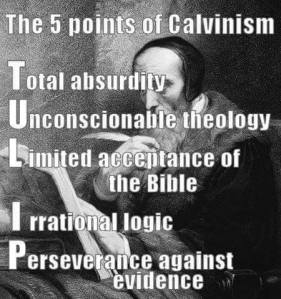
God does not tempt anyone, much less causes people to sin. We should never blame man’s sins on God at any time. In order to be consistent with TULIP, Calvinists must disagree with all verses which tell us that sin happens against God’s will. For example, Calvinist R.C. Sproul says:

“If there is one single molecule in this universe running around loose, totally free of God’s sovereignty, then we have no guarantee that a single promise of God will ever be fulfilled.” (R.C. Sproul, Chosen By God: Know God’s Perfect Plan for His Glory and His Children)

“Sovereign” and “sovereignty” are words not included in the Bible (KJV), which means they must be defined. Free-willers do not have a problem with a sovereign God, but they certainly do not agree with the Calvinistic interpretation of this word. Calvinists normally understand this word to mean something like “God decrees ALL THINGS at all times, resulting in that every single action taken by man always turns out exactly as God wants. He can do anything at all and nothing is too difficult for him – except from creating man with free will”.

Some favorite verses by those who prefer blaming God for man’s sin

Example 1:calvinsm 49

Rom. 9:18 Therefore hath he mercy on whom he will have mercy, and whom he will he hardeneth. 19 Thou wilt say then unto me, Why doth he yet find fault? For who hath resisted his will?

My comment: Has it ever happened throughout history that someone has found fault in God and his actions? Yes, right? The Bible is replete with examples of people who refuse to obey him, rebel against him and cause him to be angry. So this verse is not what man cannot do but should not do. If God’s will is to offer salvation also for the gentiles (showing mercy also to them) and make faith the condition for salvation rather than being born a Jew under the Mosaic law, then who is able to resist this decision? No one. Who can resist his will? The context and the rest of the Bible render it impossible to interpret Rom. 9:18 as “Therefore he makes salvation possible for only some individuals, whereas he blocks the rest from ever being able to seek him or find him.” Such an interpretation would make God alone guilty of man’s unbelief, and hell would be a place where innocent and rejected people would end up who had no chance to be saved (since God successfully prevented them from believing in him). Does that sound like the God of the Bible? You can read more about Romans 9 and Pharao’s heart here, here and here.

Example 2:

Eph. 1:5 Having predestinated us unto the adoption of children by Jesus Christ to himself, according to the good pleasure of his will,— 11 IN HIM also we have obtained an inheritance, being predestined according to the purpose of Him who works all things according to the counsel of His will

My comment: The promises in Eph. 1-2 are tied to those who are IN CHRIST, and being IN HIM is an essential foundation and the condition for salvation. From the creation of the world God knew there would be a “body of Christ” (the church, consisting of believers), and a special place is prepared for them in God’s kingdom where this body of Christ is predestined to go. So the “salvation bus” is certainly going there, but who will be the passengers on the bus and who will endure to the very end? That is up to us. If we are in Christ we know that we are heading for God’s kingdom if we remain in the bus. The “us” spoken about in the verse are true believers and therefore “adopted” as God’s children. (This type of adoption should not be compared to what we call “adoption” today, where parents are being promised a baby who they later legally adopt as their legal child.)

Compare also with this verse:

“John 1:12 But as many as received Him, to them He gave the right to become children of God, to those who believe in His name

So the order of even is 1) receive and believe in him, and then 2) become children of God. You can read more about Eph. 2 here.

Example 3:

Hebrews 12:2 Looking unto Jesus the author and finisher of our faith; who for the joy that was set before him endured the cross, despising the shame, and is set down at the right hand of the throne of God.

My comment: We are totally lost without Jesus who is our Savior, so he is rightfully the author and finisher of our faith. He made the wonderful salvation plan possible for us (he died for us on the cross), and he has promised to never cast us out but rather give us a crown of life if we endure to the end. It is Jesus from start to finish. Hebr. 12:2 should not be interpreted as “Jesus causes certain people to have faith and is responsible for guarding their faith to the very end, whereas the rest are doomed from birth since Jesus never died for them or enabled them to get saved”.  Read more here.

Example 4

Isaiah 46:10 Declaring the end from the beginning, and from ancient times the things that are not yet done, saying, My counsel shall stand, and I will do all my pleasure

My comment:

The verses surrounding the above verse are:

“Isaiah 46:9 Remember the former things of old: for I am God, and there is none else; I am God, and there is none like me, 12 Hearken unto me, ye stouthearted, that are far from righteousness”

Also this passage focuses on God’s mighty power, and that there is no one like him. Knowing things in advance is not the same as predestining things in advance. Calvinists make a hen out of a feather when it comes to the word “declaring”, as though this would mean that God predestines all things. According to v. 12 there are apparently people who are stouthearted and far from righteous, which is normally something God does not approve of. It is a silly idea that God would predestine people to be stouthearted. “My councel shall stand, and I will do all my pleasure”. Does this include creating man with free will and making man responsible for his actions, and sometimes even punish man for his sins?

Example 5:

Dan. 4:35 And all the inhabitants of the earth are reputed as nothing: and he doeth according to his will in the army of heaven, and among the inhabitants of the earth: and none can stay his hand, or say unto him, What doest thou?

Comment:

Yes God does according to this will, and since he is our Creator and knows best. It would not make sense to argue with him or suggest that he should not have done things the way he did. Unfortunately, people have indeed complained to God and continued to question his motives (and sometimes his mere existence), so this verse is not about what man cannot do but should not do. Could it be God’s will to punish the fallen angels (who acted contrary to his will), and to create man with free will? Or is this outside his capabilities?

Example 6:

Job 42:2 I know that thou canst do every thing, and that no thought can be withholden from thee.3 Who is he that hideth counsel without knowledge? therefore have I uttered that I understood not; things too wonderful for me, which I knew not.

Comment: The above verses are from KJV, just like the rest of the verses. There are other Bible versions which Calvinists might prefer because of other expressions, but John 42:2 only confirms that God knows everything there is to know.

Example 7:

Lam. 3:37 Who is he that saith, and it cometh to pass, when the Lord commandeth it not?38 Out of the mouth of the most High proceedeth not evil and good?

Comment: This is also about a general statement about God’s magnificent power rather than a teaching that God predestines all of our steps (including sin). We can continue reading in the same context:

“39 Wherefore doth a living man complain, a man for the punishment of his sins?40 Let us search and try our ways, and turn again to the Lord.41 Let us lift up our heart with our hands unto God in the heavens.42 We have transgressed and have rebelled: thou hast not pardoned.43 Thou hast covered with anger, and persecuted us: thou hast slain, thou hast not pitied.”

Here we read about man complaining about the punishments for his sins (apparently it is possible to complain to God after all), and “sins” would be activities against God’s will. The advice to “turn again to the Lord” means that people previously turned their backs on God. The fact that people “transgressed and have rebelled” yet again means that we are able to act contrary to God’s will. Furthermore, we can read about God being “angry” and have “persecuted” people due to their actions (transgressions and rebellion), which is more evidence of man’s free will.

Example 8:

Exodus 4:11 And the Lord said unto him, Who hath made man’s mouth? or who maketh the dumb, or deaf, or the seeing, or the blind? have not I the Lord?

Comment: The context concerns Moses’ reluctance to becoming Israel’s leader due to his (Moses) shortcomings in relation to his ability to public speaking. Moses said: “O my Lord, I am not eloquent, neither heretofore, nor since thou hast spoken unto thy servant: but I am slow of speech, and of a slow tongue.” God can accomplish things despite our shortcomings, and he can even heal people. If he asks us to do something, we can totally trust that he will help us overcome our weaknesses. That seems to be the gist of what God wanted to express when Moses argued against God about his shortcomings. Moses had to be persuaded, and he finally gave in after a conversation with God. God is not suggesting that he is the one who forces people to be deaf, blind, poor, etc, but he rather explains that he is the author of all Creation and he can be trusted.

Example 9:

1 Sam. 2:6 The Lord killeth, and maketh alive: he bringeth down to the grave, and bringeth up.The Lord maketh poor, and maketh rich: he bringeth low, and lifteth up.

Comment: The surrounding verses are these:

6 The Lord killeth, and maketh alive: he bringeth down to the grave, and bringeth up.— 8 He raiseth up the poor out of the dust, and lifteth up the beggar from the dunghill, to set them among princes, and to make them inherit the throne of glory: for the pillars of the earth are the Lord’s, and he hath set the world upon them.9 He will keep the feet of his saints, and the wicked shall be silent in darkness; for by strength shall no man prevail.”

This is a description with poetic expressions describing God’s power and his future judgment of mankind. Depending on how we choose to live our live, based on our situation and opportunities, we will be punished or rewarded. Read what the author says about the poor. Will God always lift up the beggar and set him among princes here on earth? No, this is not a universal promise for the present dimension but for the future.

calvinism 40Example 10:

Isaiah 45: 7 I form the light, and create darkness: I make peace, and create evil: I the Lord do all these things.

Comment: The above is in the KJV, but in the NKJV and in many other Bible versions it is rather “calamity” instead of “evil”. The Hebrew word could mean both, as well as a few other alternatives. God can indeed cause physical calamity just like he did when he caused a global flood to hit the earth. Physical pain or punishments caused by God does not mean that he causes people to sin. There is no darkness in God.

Example 11:

2 Chron. 25:20 But Amaziah would not hear; for it came of God, that he might deliver them into the hand of their enemies, because they sought after the gods of Edom.

Comment: Apparently the reason that “it came of God” that Amaziah would not hear – resulting in that he and his people were delivered into the hand of their enemies – was because they turned to other gods in Edom. There you have the reason. Did God want them to turn to false gods? Hardly. The most important commandment is to have no other gods but God. Compare with Romans 1 where we can read about God giving up people to a reprobate mind due to their ungodly attitudes. At one point Amaziah followed the Lord, but he later turned away.

“27 Now after the time that Amaziah did turn away from following the Lord they made a conspiracy against him in Jerusalem; and he fled to Lachish: but they sent to Lachish after him, and slew him there.”

Example 12

Jer. 10:23 O Lord, I know that the way of man is not in himself: it is not in man that walketh to DIRECT HIS STEPS

The context is this:

“21 For the pastors are become brutish, and have not sought the Lord: therefore they shall not prosper, and all their flocks shall be scattered.Behold, the noise of the report has come, And a great commotion out of the north country, To make the cities of Judah desolate, a den of jackals.—25 Pour out thy fury upon the heathen that know thee not, and upon the families that call not on thy name: for they have eaten up Jacob, and devoured him, and consumed him, and have made his habitation desolate.”

Comment: Notice above that that there are people who have not sought God, like heathens or families that did not call on the name of the Lord. Clearly this is not according to God’s will. A man is not supposed to turn his back on God by not seeking his guidance, and walk on his own ways. If a man does not seek God, he will not be guided on the right path. Read more here.

Example 13

1 Sam. 2:25 If one man sins against another, God will judge him. But if a man sins against the Lord, who will intercede for him?” Nevertheless they did not heed the voice of their father, because the Lord desired to kill them.

Comment: According to Adam Clarke the particle ki, translated “because”, is better translated “therefore” just like it does in many other parts of the Bible. (Young’s literal translation reads “though”.) This means that God wanted to kill the individuals in the story due to their refusal to listen to their father’s voice. This is a more logical translation than rendering the passage as though God wants to kill certain people for no reason, and manipulates them into not listening to their father and then proceeds to take this as an excuse for killing them. That would be circular reasoning and would turn God into an unrighteous criminal. Sadly many Calvinists would rather turn God into a monster than letting go with their precious philosophy of Calvinism.

Example 14 – Psalms

Psalm 115:3 But our God is in the heavens: he hath done whatsoever he hath pleased.

Psalm 135:6 Whatsoever the Lord pleased, that did he in heaven, and in earth, in the seas, and all deep places.

Psalm 33:10 The Lord bringeth the counsel of the heathen to nought: he maketh the devices of the people of none effect.11 The counsel of the Lord standeth for ever, the thoughts of his heart to all generations.

My comment: Psalms often contain poetry which mirrors the reality in many ways, so we must approach the verses with this in mind. Yes, God has always done whatever he has pleases, but naturally this could include creating man with free will. What the context of these psalms has in common is the declaration that God is the great and magnificent Creator, and that false gods (which are no gods) cannot compete with his wonderful powers.

Psalm 33:15 says “He fashioneth their hearts alike; he considereth all their works”, which is a description of how God has originally made man and also judges their work. It does not say that God micromanages every single step that man takes, nor that man does not have a will of his own. If you think “The Lord bringeth the counsel of the heathen to nought” means that God first manipulates the heathens to come up with various evil schemes, and then turns around and “heroically” halts these plans that he himself initiated, then you are mistaken. It is just a poetic description of God’s power which the heathens cannot interfere with. The verse does not say that God either prevents people from sinning, or predestines their sin. During Jesus’ second coming, he will only have to breathe on the son of perdition to destroy him completely (2 Thess. 2:8), so the power of God is indeed great.

Example 15 – Proverbs

Prov. 16:4 The Lord has made all for Himself, Yes, even the wicked for the day of doom. (NKJV)

Prov. 16:33 The lot is cast into the lap; but the whole disposing thereof is of the Lord.

Prov. 21:1 The king’s heart is in the hand of the Lord, as the rivers of water: he turneth it whithersoever he will.

My comment: Also proverbs contains poetry, so we must keep this in mind. Instead of having to ignore loads of verses which show that God is angry with sin and where he desires all men to obey his commandments, it is better to read the more vague proverbs and psalms in context and not superimpose them over clear verses. The first verse just shows God’s right to handle all judgment of mankind, whether people are righteous or unrighteous. Read more about these verses here. Neither of these verses contains promises that God predestines every all things. That would put all the blame on God.

If God’s will always happens, then why does the Bible say the opposite?

Mark 3:35  For whoever does the will of God, he is my brother and sister and mother.

I thought all people did the will of God? Are all people his brothers, sisters and mothers?

Matt. 7:21 Not every one that saith unto me, Lord, Lord, shall enter into the kingdom of heaven; but HE THAT DOETH THE WILL OF MY FATHER which is in heaven.

”He that doeth the will of my Father”? If everyone would always do the will of God then everyone would enter the kingdom of God.

John 9:31 Now we know that God heareth not sinners: but if any man be a worshipper of God, and DOETH HIS WILL, him he heareth.

”If any man—doeth his will”? Jesus separates those who worship God and obey him (doeth his will) with those who are sinners. This suggests that sinners are not doing the will of God, unless sinning is according to his will.

1 Timothy 2:1 Therefore I exhort first of all that supplications, prayers, intercessions, and giving of thanks be made for all men, 2 for kings and all who are in authority, that we may lead a quiet and peaceable life in all godliness and reverence. 3 For this is good and acceptable in the sight of God our Savior, who desires all men to be saved and to come to the knowledge of the truth.

God desires all men to be saved and come to the knowledge of the truth. Has this so far happened?

Heb. 3:7 Wherefore (as the Holy Ghost saith, To day if ye will hear his voice,8 Harden not your hearts, as in the provocation, in the day of temptation in the wilderness:9 When your fathers tempted me, proved me, and saw my works forty years.10 Wherefore I was grieved with that generation, and said, They do alway err in their heart; and they have not known my ways.11 So I sware in my wrath, They shall not enter into my rest.)12 Take heed, brethren, lest there be in any of you an evil heart of unbelief, in departing from the living God.

Clearly people constantly act against the will of God. Today and in the past.

The NATURAL MAN receives not the things of the Spirit of God? – 1 Cor. 2:14


But the natural man receiveth not the things of the Spirit of God: for they are foolishness unto him: neither can he know them, because they are spiritually discerned (1 Cor. 2:14) 

It is a choice to be a “natural man” as no one is born a sinner. It is rather an adopted nature just as the context indicates. An alcoholic might suggest that he has inherited genes that makes him an alcoholic out of necessity just like his parents, but even though genetics can partly explain certain similar weaknesses/attitudes/traits we still cannot blame our actions – like repeatedly pouring liquor into a glass and drink – on our parents. “Natural” in 1 Cor. 2:14 is a translation from the Greek adjective psychikos (Strong’s 5591) and can be translated as natural or sensual. The word is used 6 times in the New Testament. In 1 Cor. 15 we have a slightly different perspective of the word, because the passage talks about the resurrection when we will get rid of our fleshly bodies to get new spiritual bodies prior to entering the kingdom of God:

1 Cor. 15:33 Be not deceived: evil communications corrupt good manners.34 Awake to righteousness, and sin not; for some have not the knowledge of God: I speak this to your shame.—44 It is sown a natural body; it is raised a spiritual body. There is a natural body, and there is a spiritual body.45 And so it is written, The first man Adam was made a living soul; the last Adam was made a quickening spirit.46 Howbeit that was not first which is spiritual, but that which is natural; and afterward that which is spiritual.

James makes it clear that we should not mix righteous deeds with unrighteous deeds. Just like Paul he urges his readers to stop sinning:

Ja. 3:10 Out of the same mouth proceedeth blessing and cursing. My brethren, these things ought not so to be.11 Doth a fountain send forth at the same place sweet water and bitter?—14 But if ye have bitter envying and strife in your hearts, glory not, and lie not against the truth.15 This wisdom descendeth not from above, but is earthly, sensual, devilish.16 For where envying and strife is, there is confusion and every evil work.

We can see that those who are “natural” are those who choose to walk after their own lusts instead of having an interest to be led by the Spirit. It usually concerns those who have no desire to seek God (as per Rom. 1:18-32) and who are therefore atheists/agnostics, but it could also apply to anyone (also Christians) who chooses to walk after his/her own lusts. They separate themselves from God by following their ungodly lusts:

Jude 1:16 These are murmurers, complainers, walking after their own lusts; and their mouth speaketh great swelling words, having men’s persons in admiration because of advantage.17 But, beloved, remember ye the words which were spoken before of the apostles of our Lord Jesus Christ;18 How that they told you there should be mockers in the last time, who should walk after their own ungodly lusts.19 These be they who separate themselves, sensual, having not the Spirit.20 But ye, beloved, building up yourselves on your most holy faith, praying in the Holy Ghost,21 Keep yourselves in the love of God, looking for the mercy of our Lord Jesus Christ unto eternal life.22 And of some have compassion, making a difference:23 And others save with fear, pulling them out of the fire; hating even the garment spotted by the flesh.

A natural man is again someone who chooses to live after the flesh and not after the Spirit. The context below shows that Paul speaks highly of the power of the holy Spirit which is given to Christians (after repentance), and through this magnificent power it is certainly easier to come closer to God and know all the details of his will. We are able to be victorious over sin if we choose to be led by the Spirit, but it takes a will of our own. Also agnostics are able to avoid sin, but if they decide to repent and start living with Jesus Christ they will get a new power thanks to the new Helper – the holy Spirit. The holy Spirit does not force a person to obey him:

1 Cor. 2:12 Now we have received, not the spirit of the world, but the spirit which is of God; that we might know the things that are freely given to us of God.13 Which things also we speak, not in the words which man’s wisdom teacheth, but which the Holy Ghost teacheth; comparing spiritual things with spiritual.14 But the natural man receiveth not the things of the Spirit of God: for they are foolishness unto him: neither can he know them, because they are spiritually discerned.15 But he that is spiritual judgeth all things, yet he himself is judged of no man.

The promise given to us in Gal. 5 is that if we decide to walk in the Spirit, we are automatically not fulfilling the lust of the flesh because of our righteous lives. If we instead live after the flesh, we automatically do not walk in the Spirit since the flesh is contrary to the Spirit. It is one or the other. The Spirit would never lead us unto the road of destruction. Paul assures us that if we do live after the flesh (and he gives examples of what that means) we can forget about inheriting the kingdom of God. He does not say that Christians are exempted from this danger. He also says “If we live in the Spirit, let us also walk in the Spirit”, showing that this is nothing that happens automatically without our participation. It is the responsibility of each individual to live a holy life, and we cannot blame God for preventing us from obeying his commandments:

Gal. 5:16 This I say then, WALK IN THE SPIRIT, AND YE SHALL NOT FULFIL THE LUST OF THE FLESH.17 For the flesh lusteth against the Spirit, and the Spirit against the flesh: and these are contrary the one to the other: so that ye cannot do the things that ye would.18 But if ye be led of the Spirit, ye are not under the law.19 Now the works of the flesh are manifest, which are these; Adultery, fornication, uncleanness, lasciviousness,20 Idolatry, witchcraft, hatred, variance, emulations, wrath, strife, seditions, heresies,21 Envyings, murders, drunkenness, revellings, and such like: of the which I tell you before, as I have also told you in time past, that they which do such things shall not inherit the kingdom of God.22 But the fruit of the Spirit is love, joy, peace, longsuffering, gentleness, goodness, faith,23 Meekness, temperance: against such there is no law.24 And they that are Christ’s have crucified the flesh with the affections and lusts.25 If we live in the Spirit, let us also walk in the Spirit.

Below we can more clearly see what happens to someone who God gives up to a reprobate mind due to the individual’s decision to walk after his own lusts (and become a natural man). Such a person is without excuse because he could have reached out to God and live according to his will, but chose not to. THAT is the reason for deserving a spot in hell. Not because God chose someone to be a wicked non-elect before he was even born, but because the person had all the chances in the world to seek and believe in God (the very purpose for God to create us in the first place as per Acts 17:26-30) but instead turned his back on him and lived a rebellious life.

Rom. 1:18 For the wrath of God is revealed from heaven against all ungodliness and unrighteousness of men, who hold the truth in unrighteousness;19 Because that which may be known of God is manifest in them; for God hath shewed it unto them.20 For the invisible things of him from the creation of the world are clearly seen, being understood by the things that are made, even his eternal power and Godhead; so that they are without excuse:21 Because that, when they knew God, they glorified him not as God, neither were thankful; but became vain in their imaginations, and their foolish heart was darkened.22 Professing themselves to be wise, they became fools,23 And changed the glory of the uncorruptible God into an image made like to corruptible man, and to birds, and fourfooted beasts, and creeping things.24 Wherefore God also gave them up to uncleanness through the lusts of their own hearts, to dishonour their own bodies between themselves:25 Who changed the truth of God into a lie, and worshipped and served the creature more than the Creator, who is blessed for ever. Amen.26 FOR THIS CAUSE God gave them up unto vile affections: for even their women did change the natural use into that which is against nature:27 And likewise also the men, leaving the natural use of the woman, burned in their lust one toward another; men with men working that which is unseemly, and receiving in themselves that recompence of their error which was meet.28 And even as they did not like to retain God in their knowledge, God GAVE THEM OVER TO A REPROBATE MIND, to do those things which are not convenient;29 Being filled with all unrighteousness, fornication, wickedness, covetousness, maliciousness; full of envy, murder, debate, deceit, malignity; whisperers,30 Backbiters, haters of God, despiteful, proud, boasters, inventors of evil things, disobedient to parents,31 Without understanding, covenantbreakers, without natural affection, implacable, unmerciful:32 Who knowing the judgment of God, that they which commit such things are worthy of death, not only do the same, but have pleasure in them that do them.

If we live according to the flesh, we CANNOT please Godflesh

It is not a good idea to be a natural man with a carnal mind, because then we simply cannot please God. A person who has his mind set on maintaining his sins cannot at the same time live according to God’s commandments.

Rom. 8:7 Because the carnal mind is enmity against God: for it is not subject to the law of God, neither indeed can be.

We can learn from Paul who those are who “are after the flesh”. They are the ones who walk not after the Spirit but after the flesh. This means that their wicked actions cause them to be carnally minded/natural men. Fortunately there is a solution provided by Paul in that same chapter, and that is to walk after the Spirit which is a much better choice.

Rom. 8:1 There is therefore now no condemnation to them which are in Christ Jesus, WHO WALK NOT AFTER THE FLESH, BUT AFTER THE SPIRIT.—4 That the righteousness of the law might be fulfilled in us, WHO WALK NOT AFTER THE FLESH, BUT AFTER THE SPIRIT.5 For they that are after the flesh do mind the things of the flesh; but they that are after the Spirit the things of the Spirit.6 For to be carnally minded is death; but to be spiritually minded is life and peace.

Paul explains this also in Rom. 6, where he assures us that we can successfully start living according to the Spirit instead of obeying sin. Note that we are slaves to the one we choose to obey, so if we choose to obey sin we are slaves to sin and not free. Paul is writing to the Christians in Rome, so Christians are clearly not freed from the risk of landing in spiritual death – which would happen to anyone who decides to obey sin and who does not repent:

Rom. 6:6 Knowing this, that our old man is crucified with him, that the body of sin might be destroyed, that henceforth we should not serve sin. 12 Let not sin therefore reign in your mortal body, that ye should obey it in the lusts thereof.13 Neither yield ye your members as instruments of unrighteousness unto sin: but yield yourselves unto God, as those that are alive from the dead, and your members as instruments of righteousness unto God.14 For sin shall not have dominion over you: for ye are not under the law, but under grace.15 What then? shall we sin, because we are not under the law, but under grace? God forbid.16 Know ye not, that to whom ye yield yourselves servants to obey, his servants ye are to whom ye obey; whether of sin unto death, or of obedience unto righteousness?17 But God be thanked, that ye were the servants of sin, but ye have obeyed from the heart that form of doctrine which was delivered you.18 Being then made free from sin, ye became the servants of righteousness.19 I speak after the manner of men because of the infirmity of your flesh: for as ye have yielded your members servants to uncleanness and to iniquity unto iniquity; even so now yield your members servants to righteousness unto holiness.20 For when ye were the servants of sin, ye were free from righteousness.21 What fruit had ye then in those things whereof ye are now ashamed? for the end of those things is death.22 But now being made free from sin, and become servants to God, ye have your fruit unto holiness, and the end everlasting life.23 For the wages of sin is death; but the gift of God is eternal life through Jesus Christ our Lord.

Paul refers to a passage in Isaiah 29 when it talks about hidden wisdom. The reason for people living in darkness is due to their decision to remove their hearts from him:

1 Cor. 1:18 For the preaching of the cross is to them that perish foolishness; but unto us which are saved it is the power of God.19 For it is written, I will destroy the wisdom of the wise, and will bring to nothing the understanding of the prudent.*) 

*) Isaiah 29:13 Wherefore the Lord said, Forasmuch as this people draw near me with their mouth, and with their lips do honour me, but have removed their heart far from me, and their fear toward me is taught by the precept of men:14 Therefore, behold, I will proceed to do a marvellous work among this people, even a marvellous work and a wonder: for the wisdom of their wise men shall perish, and the understanding of their prudent men shall be hid.15 Woe unto them that seek deep to hide their counsel from the Lord, and their works are in the dark, and they say, Who seeth us? and who knoweth us?

God loves us and wishes that we all would come to the knowledge of the truth:

1 Tim. 2:3 For this is good and acceptable in the sight of God our Saviour;Who will have all men to be saved, and to come unto the knowledge of the truth.

You can read about Eph. 2 here, where you will see that it is a choice to be “children of wrath” (individuals who are subject to God’s wrath due to their sins) and that the chapter nowhere suggests that anyone is born that way. It is rather, yet again, about people who choose to walk after their own lusts.

How should Calvinists live to PLEASE God?

Here is another thought for Calvinists – who believe that God is micromanaging all of our steps.

The Bible tells us what is pleasing to God and what is not pleasing to him, and surely a behavior that is not pleasing to God is also against his will? Or why would God predestine things to take place which he does not even like happening? The problem here is of course the Calvinistic idea that nothing comes to pass against the will of God, and in order to be consistent with the Calvinistic doctrines it is not enough to suggest that God merely “allows”  evil things to happen because that is rather the free-will approach. Calvinists do not believe that man has a will apart from God’s will, so they must believe that all things are predestined to happen precisely as they pan out (again – in order to be consistent with Calvinism). Therefore Calvinists are not really entitled to criticize anything or anyone, because that would be the same as criticizing God himself.

What is NOT pleasing to God?

1 Cor. 10:1 Moreover, brethren, I would not that ye should be ignorant, how that all our fathers were under the cloud, and all passed through the sea;2 And were all baptized unto Moses in the cloud and in the sea;3 And did all eat the same spiritual meat;4 And did all drink the same spiritual drink: for they drank of that spiritual Rock that followed them: and that Rock was Christ.But with many of them God was not well pleased: for they were overthrown in the wilderness.6 Now these things were our examples, to the intent we should not lust after evil things, as they also lusted.Neither be ye idolaters, as were some of them; as it is written, The people sat down to eat and drink, and rose up to play.Neither let us commit fornication, as some of them committed, and fell in one day three and twenty thousand.Neither let us tempt Christ, as some of them also tempted, and were destroyed of serpents.

Seems like God was not pleased with all of Israel’s behavior during the Exodus (despite that Israel was “chosen”), due to their idolatry, fornication, tempting God, etc. Neither did they enter the land of Canaan due to their unrighteous behavior, and this punishment could serve as a warning to us – so that we will maybe learn to not act in the way they did. Paul is listing things we simply should not do, and his warnings would be in vain if we were unable to act against the will of God. If Paul were a Calvinist, he would not need to spend time warning us about various matters but he would rather relax and remind himself of that God is behind whatever happens (which is fatalism). Unless of course people do evil things against the will of God, but that thought is not allowed for consistent Calvinists due to their understanding of God’s sovereignty (an unbiblical word that is much highlighted).

1 Thess. 2:14 For ye, brethren, became followers of the churches of God which in Judaea are in Christ Jesus: for ye also have suffered like things of your own countrymen, even as they have of the Jews:15 Who both killed the Lord Jesus, and their own prophets, and have persecuted us; and they please not God, and are contrary to all men:16 Forbidding us to speak to the Gentiles that they might be saved, to fill up their sins alway: for the wrath is come upon them to the uttermost.17 But we, brethren, being taken from you for a short time in presence, not in heart, endeavoured the more abundantly to see your face with great desire.18 Wherefore we would have come unto you, even I Paul, once and again; but Satan hindered us.

Above we can read about some Jews who were guilty of having killed Jesus Christ, killed God’s prophets, persecuted Christians as well as forbidding them to speak to Gentiles about salvation. It is not surprising to learn that they did not please God due to these sins, and that they had to expect God’s wrath due to their evil behavior. So was is Satan or God who caused them to act in a way that did not please God?

Rom. 8:5 For they that are after the flesh do mind the things of the flesh; but they that are after the Spirit the things of the Spirit.6 For to be carnally minded is death; but to be spiritually minded is life and peace.7 Because the carnal mind is enmity against God: for it is not subject to the law of God, neither indeed can be.8 So then they that are in the flesh cannot please God.

They that are in the flesh cannot please God, so the solution is to not be in the flesh but to live after the Spirit. Paul is clearly laying out the options for us – obeying sin or righteousness and if we obey the former we will be slaves to sin and not free. To be carnally minded is the same as enmity against God, and why would God cause anyone to have a carnal mind? Some Calvinists might suggest that God did not cause such things at all but that it is rather in some people’s own nature to be carnally minded. But were they carnally minded against God’s will? Did they have an option to not be born as wicked non-elect individuals with carnal minds? Did Jesus die for them? The answer would have to be No to all those questions in order to be consistent with Calvinism.

calvinsm 49 IS pleasing to God?

Hebr. 13:15 By him therefore let us offer the sacrifice of praise to God continually, that is, the fruit of our lips giving thanks to his name.16 But to do good and to communicate forget not: for with such sacrifices God is well pleased.17 Obey them that have the rule over you, and submit yourselves: for they watch for your souls, as they that must give account, that they may do it with joy, and not with grief: for that is unprofitable for you.

Apparently God is well pleased when we praise him continually, give thanks to his name and do good. Should we conclude that God is only pleased when the elect do such things, but not when it comes to the non-elect? Why would God prevent certain people (those who are born as non-elect, and for whom Jesus did not die) from behaving in a way that is pleasing to him?

Hebr. 11:5 By faith Enoch was translated that he should not see death; and was notfound, because God had translated him: for before his translation he had this testimony, that he pleased God.6 But without faith it is impossible to please him: for he that cometh to God must believe that he is, and that he is a rewarder of them that diligently seek him.

Without faith it is impossible to please God (and already when we come to God we must believe that he is), so would not this mean that God wants people to believe in him so that he will be pleased? It is easy to understand why God is pleased each time a person believes and repents for his sins, because that would mean yet another saved soul. There is joy in heaven each time a person repents. In the Calvinistic world, however, the only way to try to save their doctrines would be to somehow suggest that God does not want all people to repent, believe and do good (the non-elect).

Luke 15:7 I say unto you, that likewise joy shall be in heaven over one sinner that repenteth, more than over ninety and nine just persons, which need no repentance

How is God glorified?

John 15:8 Herein is my Father glorified, that ye bear much fruit; so shall ye be my disciples.9 As the Father hath loved me, so have I loved you: continue ye in my love.10 If ye keep my commandments, ye shall abide in my love; even as I have kept my Father’s commandments, and abide in his love.

Surely it is good for man to glorify God, or is it the same thing here that God only wants some people to glorify him? Above, Jesus is talking to his disciples (and all of us) and tells them that his Father is glorified when they bear much fruit so that they can be his disciples. Jesus continues to say that IF they keep his commandments, they shall abide in his love. Why would God prevent some people from glorifying him, bearing much fruit and keep his commandments? Did those unfortunate people who were chosen to be wicked non-elect sinners from the foundation of the world have a chance to do good deeds which could glorify the Father? Hardly if they were born as the non-elect natural sinners they were chosen to be long before birth. Salvation would be out of their reach due to being doomed from the very start.

1 Pet. 4:11 If any man speak, let him speak as the oracles of God; if any man minister, let him do it as of the ability which God giveth: that God in all things may be glorified through Jesus Christ, to whom be praise and dominion for ever and ever. Amen.

Seems rather clear that it is pleasing for God to in all things be glorified, because he certainly deserves it and because we need to focus on our Creator and Savior. Yet, we are supposed to believe that God would not enable all people to do this? And he would still send people to hell for refusing to glorify him – which he prevented them from doing?

Rom. 1:18 For the wrath of God is revealed from heaven against all ungodliness and unrighteousness of men, who hold the truth in unrighteousness;19 Because that which may be known of God is manifest in them; for God hath shewed it unto them.20 For the invisible things of him from the creation of the world are clearly seen, being understood by the things that are made, even his eternal power and Godhead; so that they are without excuse:21 Because that, when they knew God, they glorified him not as God, neither were thankful; but became vain in their imaginations, and their foolish heart was darkened.22 Professing themselves to be wise, they became fools,

Above we can read about people who choose not to glorify God despite that they have been shown all about God and his creation by God himself. So despite having the opportunity to accept the Creator, they still refuse to glorify him or being thankful for what he has done for them (of course, if Calvinism is true there would not be anything for the non-elect to be thankful for). Due to their failure to do so, God’s wrath is revealed from heaven over all ungodliness and unrighteousness of men. It certainly looks like all forms of unrighteousness is detested by God, so it is hard to believe he would not only tempt people but cause them to perform evil deeds.

A new heart which will cause us to perfectly walk in God’s statutes? Ezekiel 36:26-27

Ez. 36:26 A new heart also will I give you, and a new spirit will I put within you: and I will take away the stony heart out of your flesh, and I will give you an heart of flesh.27 And I will put my spirit within you, and cause you to walk in my statutes, and ye shall keep my judgments, and do them.

Calvinists normally love the idea that God randomly chooses some individuals out of a crowd of people and give the former a new heart, a new Spirit, which will enable them to have faith in God and to be able to follow him. (Who cares about the rest, right?) Unfortunately they run into problems within the same verse when we can read about being caused to walk in God’s statutes. In NIV it reads “move you to follow my decrees and be careful to keep my laws”. So if Calvinists are among those who have been given a new heart as per Ez. 36:26-27, does this mean that they always obey God’s decrees without failing even once? Have they completely stopped sinning? It is a relevant question because Calvinists are usually more keen than others to teach that all men “always sin in thoughts, words and deeds”.  Or can we conclude that God fails at times when he tries to cause his elect to walk in his statutes, knowing that also Calvinists can choose to sin at times?

I think the better solution is to side with the Free-will option which suggests that it is the holy Spirit which is referred to here as the great Helper which can guide us (move us) on the right path, but not necessarily unconditionally or without our participation. Hebr. 10 phrases it as “I will put my laws into their hearts, and in their minds will I write them”. “Causing” could signify “forcing” but it could also mean “influencing” which would here make a lot more sense. That would also help the Calvinists who must try to explain why God fails to “force” people to always obey him, as they suggest the verse says. On the other hand, loads of Calvinists confess that they believe God also causes people to sin (since nothing happens against his will) so whether people avoid sin or not, God would still be the one who makes them behave the way they do. This leads to another question:

If some people are given a particular heart that suddenly makes them obey God and walk in his statutes (which would here include sin), does this mean that prior to this moment they were not forced to walk in his statutes and in whatever way God wants them to walk? If they were forced to obey God also prior to the new heart, what difference did the new heart really make? If God chooses some people (his elect) to always walk in his statutes, will the rest (the non-elect) be able to deviate from God’s preferred path and walk their own ways?

The promise of a new heart is by faith, and concerns the holy Spirit in our hearts

The promise of a new purified heart is by faith as can be seen in the verses below and it can be cleansed in the blood of Jesus. The new heart is in reference to a heart that is dedicated to God and the holy Spirit indwelling in our hearts as well as through participation of a the covenant which Paul describes in Rom. 8. It is through the power of the Spirit that the believer can put to death the misdeeds of the flesh and live according to the Spirit. This is the fulfillment of the promise given in Ezekiel 36:26-27, but we can also read about other prophesies in the same chapter (concerning the promise that the dispersed Israel will be able to come home). The passage is in harmony with the Bible’s teaching that the promises and benefits of the new covenant are by faith (not being born as a Jew under the law of Moses) and include a new heart and the holy Spirit which we will get in response to our true repentance.

The author of Hebrews encourages us to draw near to God with a true heart in full assurance of faith. How do we get a true heart? By having our hearts sprinkled from an evil conscience. How can this be achieved? By repenting of our sins which God expects us all to do (Acts. 17:30):

Hebr. 10:16 This is the covenant that I will make with them after those days, saith the Lord I will put my laws into their hearts, and in their minds will I write them;17 And their sins and iniquities will I remember no more.18 Now where remission of these is, there is no more offering for sin.19 Having therefore, brethren, boldness to enter into the holiest by the blood of Jesus,20 By a new and living way, which he hath consecrated for us, through the veil, that is to say, his flesh;21 And having an high priest over the house of God;22 Let us draw near with a true heart in full assurance of faith, having our hearts sprinkled from an evil conscience, and our bodies washed with pure water.23 Let us hold fast the profession of our faith without wavering; (for he is faithful that promised;)

The covenant referred to above is the one mentioned in Jer. 31. Here we can read about a former covenant which Israel broke:

Jer. 31:30 But every one shall die for his own iniquity: every man that eateth the sour grape, his teeth shall be set on edge.31 Behold, the days come, saith the Lord, that I will make a new covenant with the house of Israel, and with the house of Judah:32 Not according to the covenant that I made with their fathers in the day that I took them by the hand to bring them out of the land of Egypt; which my covenant they brake, although I was an husband unto them, saith the Lord:33 But this shall be the covenant that I will make with the house of Israel; After those days, saith the Lord, I will put my law in their inward parts, and write it in their hearts; and will be their God, and they shall be my people.34 And they shall teach no more every man his neighbour, and every man his brother, saying, Know the Lord: for they shall all know me, from the least of them unto the greatest of them, saith the Lord: for I will forgive their iniquity, and I will remember their sin no more.35 Thus saith the Lord, which giveth the sun for a light by day, and the ordinances of the moon and of the stars for a light by night, which divideth the sea when the waves thereof roar; The Lord of hosts is his name:36 If those ordinances depart from before me, saith the Lord, then the seed of Israel also shall cease from being a nation before me for ever.

We are also asked to cleanse our hands and purify our own hearts

Ja. 4:8 Draw nigh to God, and he will draw nigh to you. CLEANSE your hands, ye sinners; and PURIFY YOUR HEARTS, ye double minded.

So how our WE going to cleanse our hands and purify our hearts? By standing on faith and by confessing sins, repenting and thus become cleansed in the blood of Jesus. We do not have the authority to forgive ourselves for breaking God’s law, but it is up to us to repent and start living a holy life with the help of the holy Spirit given to us after our conversion.

Peter speaks about the heathens and their possibility to also receive the Holy Ghost (without having to go through a circumcision of the flesh) and explains that our hearts are purified BY FAITH:

Acts 15:8 And God, which knoweth the hearts, bare them witness, giving them the Holy Ghost, even as he did unto us;9 And put no difference between us and them, purifying their hearts BY FAITH.10 Now therefore why tempt ye God, to put a yoke upon the neck of the disciples, which neither our fathers nor we were able to bear?

Through the mercy of Christ we can be forgiven for our past iniquities and thus be cleansed from our sins and be complete. Sinning will always cause spiritual death, but we can be quickened (becoming spiritually alive) if we decide to repent from our sins. We can be risen with him “through faith”!:

Col. 2:10 And ye are complete in him, which is the head of all principality and power:11 In whom also ye are circumcised with the circumcision made without hands, in putting off the body of the sins of the flesh by the circumcision of Christ:12 Buried with him in baptism, wherein also ye are risen with him through the faith of the operation of God, who hath raised him from the dead.13 And you, being dead in your sins and the uncircumcision of your flesh, hath he quickened together with him, having forgiven you all trespasses;14 Blotting out the handwriting of ordinances that was against us, which was contrary to us, and took it out of the way, nailing it to his cross;

The order of salvation: pursuing faith, confessing sins, repenting, being cleansed (regeneration), being born again, getting the holy Spirit and becoming a child of God

Peter makes it clear that the order of salvation is 1) having faith, 2) repenting, 3) resulting in cleansing/washing (=regeneration), 4) resulting in being born again, 5) resulting in getting the holy Ghost and becoming a child of God. God will certainly not declare us cleansed and righteous while we are still living in sin:

Acts 2:38 Then Peter said unto them, Repent, and be baptized every one of you in the name of Jesus Christ for the remission of sins, and ye shall receive the gift of the Holy Ghost.

Acts 3:19 Repent ye therefore, and be converted, that your sins may be blotted out, when the times of refreshing shall come from the presence of the Lord.20 And he shall send Jesus Christ, which before was preached unto you:

Also John says that we must confess our sins (repent) in order to be cleansed from them:

1 John 1:9 If we CONFESS our sins, he is faithful and just to FORGIVE us our sins, and to cleanse us from all unrighteousness.

And below we can read that his own received him not (strange if people are chosen to be chosen elect from the foundation of the world) but that those who a) received him were given the power to b) become the sons of God (those who believe in his name). It does not say the other way around that the sons of God were given the power to believe and receive him:

John 1:11 He came unto his own, and his own received him not.12 But as many as received him, to them gave he power to become the sons of God, even to them that believe on his name:

Below we can read about Paul’s disappointment concerning some Galatians (for whom Jesus was crucified) who risked to believe in vain despite having begun in the Spirit. He asks “who has bewitched you?“, and if Paul was a Calvinist he should have known that the answer must be “God did, because he directs all of our steps” if nothing happens against God’s will. Paul also asks if they received the Spirit by works of the law (the law of Moses) or by the hearing of FAITH, indicating that they were not first given the Spirit and afterwards given faith. No, naturally faith is first and then we are provided with the Spirit:

Gal. 3:1 O foolish Galatians, who hath bewitched you, that ye should not obey the truth, before whose eyes Jesus Christ hath been evidently set forth, crucified among you?2 This only would I learn of you, Received ye the Spirit by the works of the law, or by the hearing of faith?3 Are ye so foolish? having begun in the Spirit, are ye now made perfect by the flesh?4 Have ye suffered so many things in vain? if it be yet in vain.

Other information in the same chapter – Ez. 36

Hes. 36:5 Therefore thus saith the Lord God; Surely in the fire of my jealousy have I spoken against the residue of the heathen, and against all Idumea, which have appointed my land into their possession with the joy of all their heart, with despiteful minds, to cast it out for a prey.

What would be the reason for God’s jealousy if all things turn out God’s way?

17 Son of man, when the house of Israel dwelt in their own land, they defiled it by their own way and by their doings: their way was before me as the uncleanness of a removed woman.18 Wherefore I poured my fury upon them for the blood that they had shed upon the land, and for their idols wherewith they had polluted it:19 And I scattered them among the heathen, and they were dispersed through the countries: according to their way and according to their doings I judged them.20 And when they entered unto the heathen, whither they went, they profaned my holy name, when they said to them, These are the people of the Lord, and are gone forth out of his land.21 But I had pity for mine holy name, which the house of Israel had profaned among the heathen, whither they went.22 Therefore say unto the house of Israel, thus saith the Lord God; I do not this for your sakes, O house of Israel, but for mine holy name’s sake, which ye have profaned among the heathen, whither ye went.23 And I will sanctify my great name, which was profaned among the heathen, which ye have profaned in the midst of them; and the heathen shall know that I am the Lord, saith the Lord God, when I shall be sanctified in you before their eyes.

Wow, above we read about Israel (God’s elect) defiling land, worshiping false gods, profaning God’s name, and this naturally cause God’s fury. Why would God be furious about things that turned out the way God wanted? We can read “according to their way and according to their doings I judged them”. I thought it was always God’s doing if nothing ever happens against his will? And why judge people who constantly obey God whether they avoid sin or not?

25 Then will I sprinkle clean water upon you, and ye shall be clean: from all your filthiness, and from all your idols, will I cleanse you.26 A new heart also will I give you, and a new spirit will I put within you: and I will take away the stony heart out of your flesh, and I will give you an heart of flesh.27 And I will put my spirit within you, and cause you to walk in my statutes, and ye shall keep my judgments, and do them.28 And ye shall dwell in the land that I gave to your fathers; and ye shall be my people, and I will be your God.

Also above we can read about Israel turning to filthiness and idols which they must be cleansed from. After the washing of sins, the holy Spirit is the great Helper.

31 Then shall ye remember your own evil ways, and your doings that were not good, and shall lothe yourselves in your own sight for your iniquities and for your abominations.32 Not for your sakes do I this, saith the Lord God, be it known unto you: be ashamed and confounded for your own ways, O house of Israel.33 Thus saith the Lord God; In the day that I shall have cleansed you from all your iniquities I will also cause you to dwell in the cities, and the wastes shall be builded.

Above we can read about “your own evil ways” and their doings that were “not good”. Why were they not good if God made them act the way they did? No, here we can once again read about people who have walked on their own ways, against God’s will. They have been guilty of iniquities and abominations before God, and obviously a righteous God would not cause anyone (must less Israel) to perform wicked abominations. Why does God suggest they should be ashamed and confounded for their own ways, if their ways always lined up with God’s way?

Examples of hardening of a heart

Deut. 10:16 Circumcise therefore the foreskin of your heart, and be no more stiffnecked. 17For the LORD your God is God of gods, and Lord of lords, a great God, a mighty, and a terrible, which regardeth not persons, nor taketh reward

Jer. 4:4 Circumcise yourselves to the LORD, and take away the foreskins of your heart, ye men of Judah and inhabitants of Jerusalem: lest my fury come forth like fire, and burn that none can quench it, because of the evil of your doings.

Hebr. 3:7 Wherefore as the Holy Ghost saith, To day if ye will hear his voice, 8 HARDEN NOT YOUR HEARTS, as in the provocation, in the day of temptation in the wilderness

Ps 95:7 For he is our God; and we are the people of his pasture, and the sheep of his hand.To day if ye will hear his voice, 8 HARDEN NOT YOUR HEART, as in the provocation, and as in the day of temptation in the wilderness:

Pro 28:13He that covereth his sins shall not prosper: but whoso confesseth and forsaketh them shall have mercy.14 Happy is the man that feareth always: but he that hardeneth his heart shall fall into mischief.

2 Chron 36:11 Zedekiah was one and twenty years old when he began to reign, and reigned eleven years in Jerusalem. 12 And he did that which was evil in the sight of the LORDhis God, and humbled not himself before Jeremiah the prophet speaking from the mouth of the LORD.13 And he also rebelled against king Nebuchadnezzar, who had made him swear by God: but he stiffened his neck, and hardened his heart from turning unto the LORD God of Israel.

Deut 15:7 If there be among you a poor man of one of thy brethren within any of thy gates in thy land which the LORD thy God giveth thee, thou shalt not harden thine heart, nor shut thine hand from thy poor brother:8 But thou shalt open thine hand wide unto him, and shalt surely lend him sufficient for his need, in that which he wanteth.9 Beware that there be not a thought in thy wicked heart, saying, The seventh year, the year of release, is at hand; and thine eye be evil against thy poor brother, and thou givest him nought; and he cry unto the LORD against thee, and it be sin unto thee.

Deut 30:1 And it shall come to pass, when all these things are come upon thee, the blessing and the curse, which I have set before thee, and thou shalt call them to mind among all the nations, whither the LORD thy God hath driven thee,2 And shalt return unto the LORD thy God, and shalt obey his voice according to all that I command thee this day, thou and thy children, with all thine heart, and with all thy soul; 3That then the LORD thy God will turn thy captivity, and have compassion upon thee, and will return and gather thee from all the nations, whither the LORD thy God hath scattered thee. 4If any of thine be driven out unto the outmost parts of heaven, from thence will the LORD thy God gather thee, and from thence will he fetch thee: 5And the LORD thy God will bring thee into the land which thy fathers possessed, and thou shalt possess it; and he will do thee good, and multiply thee above thy fathers. 6And the LORD thy God will circumcise thine heart, and the heart of thy seed, to love the LORD thy God with all thine heart, and with all thy soul, that thou mayest live. (Notice that God will circumcise their hearts AFTER they return to Him which is a condition.)

1 King. 8:58 That he may incline our hearts unto him, to walk in all his ways, and to keep his commandments, and his statutes, and his judgments, which he commanded our fathers.—61 Let your heart therefore be perfect with the LORD our God, to walk in his statutes, and to keep his commandments, as at this day.

2 Chron. 12:14 And he did evil, because he prepared not his heart to seek the Lord.

Read about Pharao’s rebellious heart here.

ADOPTION as a son in the Bible does not equal unconditional salvation

The Biblical “adoption” holds a spiritual meaning

When we hear about an adoption the year 2015, we normally think about a person who assumes the parenting role of a child instead of that child’s biological/legal parents, and in doing so makes the child a permanent family member with all the legal rights. (It’s not common that a parent to either a biological child or an adopted child will choose to disinherit a child, but it has happened.)

The prodigal son actually inherited much of his Father’s wealth while his Father was still alive, but he (the prodigal son) was lost and dead while being away living in sin. “Be glad: for this thy brother was dead, and is alive again; and was lost, and is found” – Luke. 15:32. The Father never stopped loving him or hoping he would repent and return, because God does not want anyone to perish.

The word “adoption” in the Bible is a translation from the Greek word huiothesia (Strong’s 5206). It could refer to the condition of a true follower in Christ who by receiving the Spirit of God becomes a son of God and therefore an heir to his kingdom. It could also refer to the blessed state looked for in the future life, or the relationship that God established with the Israelites. It’s used five times in the Bible, and none of the verses suggest that God unconditionally selects people for adoption/salvation:

Rom. 8:15; 23

The condition for being in Jesus Christ is to walk after the Spirit (obeying God). If a person bears bad fruit or no fruit, he will be cut off the vine (John 15). To be carnally minded is death, but to spiritually minded is LIFE. Paul recognizes that the Romans to whom he writes, are in the Spirit because they live righteous lives. IF the Spirit dwells in us, we also know that our mortal bodies will one day be quickened. “If ye live after the flesh, ye shall die: but if ye through the Spirit do mortify the deeds of the body, ye shall live”. Who are the sons of God, according to Paul? “As many as are led by the Spirit of God, they are the sons of God”. So the condition for being a son of God is to make sure to live by the Spirit, which should be something we can master because we have received the “Spirit of adoption”. IF we are his children (if we walk in the Spirit and live righteous lives), then we also live in the promise that we are HEIRS to the kingdom of God. If we endure in our sufferings, we will also be glorified.

Rom. 8:1 There is therefore now no condemnation to them which are in Christ Jesus, who walk not after the flesh, but after the Spirit.—4 That the righteousness of the law might be fulfilled in us, who walk not after the flesh, but after the Spirit.5 For they that are after the flesh do mind the things of the flesh; but they that are after the Spirit the things of the Spirit.6 For to be carnally minded is death; but to be spiritually minded is life and peace.—9 But ye are not in the flesh, but in the Spirit, if so be that the Spirit of God dwell in you. Now if any man have not the Spirit of Christ, he is none of his.10 And if Christ be in you, the body is dead because of sin; but the Spirit is life because of righteousness.11 But if the Spirit of him that raised up Jesus from the dead dwell in you, he that raised up Christ from the dead shall also quicken your mortal bodies by his Spirit that dwelleth in you.12 Therefore, brethren, we are debtors, not to the flesh, to live after the flesh.13 For if ye live after the flesh, ye shall die: but if ye through the Spirit do mortify the deeds of the body, ye shall live.14 For as many as are led by the Spirit of God, they are the sons of God.15 For ye have not received the spirit of bondage again to fear; but ye have received the Spirit of adoption, whereby we cry, Abba, Father.16 The Spirit itself beareth witness with our spirit, that we are the children of God:17 And IF children, then heirs; heirs of God, and joint-heirs with Christ; if so be that we suffer with him, that we may be also glorified together.—.23 And not only they, but ourselves also, which have the firstfruits of the Spirit, even we ourselves groan within ourselves, waiting for the adoption, to wit, the redemption of our body.28 And we know that all things work together for good to them that love God, to them who are the called according to his purpose.

Rom. 9:4

Here Paul is referring to Israel as a group of people who have the right to be adopted as sons (being God’s own people): “v. 4—who are Israelites, to whom belongs the adoption as sons” (NASB). We know that not all of Israel made it into the promised land, and we know that not all of Israel will eventually be saved/adopted. That is because some of Israel has stumbled on the stumbling stone, and others simply lack faith and live of the world. You can read more about Rom. 9 here and here.

Rom. 9:3 For I could wish that myself were accursed from Christ for my brethren, my kinsmen according to the flesh:4 Who are Israelites; to whom pertaineth the adoption, and the glory, and the covenants, and the giving of the law, and the service of God, and the promises;–24 Even us, whom he hath called, not of the Jews only, but also of the Gentiles?25 As he saith also in Osee, I will call them my people, which were not my people; and her beloved, which was not beloved.26 And it shall come to pass, that in the place where it was said unto them, Ye are not my people; there shall they be called the children of the living God.

Gal. 4:5

Paul viewed the Galatians as christians who had received the holy Spirit, and who therefore had the right to be regarded as God’s adopted sons.This also means that they had been given a guaranteed right to enter the kingdom of God due to being valid heirs. However, a christian must still read the fine print of his guarantee receipt, because he only has this right as long as he remains in faith and remains in the vine. A guarantee receipt is to no use of the holder if he throws it away or forgets where it is. Paul understood this too well, because he asked the Galatians how on earth they could think of turning back to the Jewish law after having known God (and also having been known by him). Paul feared that he might have labored for them in vain and that they might end up not inheriting the kingdom of God. He says (4:20) “I would like to be present with you now and to change my tone; for I have doubts about you” (NKJV). In other verses Paul makes it clear that the Galatians – despite having begun in the Spirit, and despite having been given all the wonderful promises that are tied to those who are in Christ – still risked to have suffered and worked in vain. Paul also told the Galatians that Christ will profit them nothing and that they had fallen from grace! They could of course be restored again if they repented and followed the christian way. A little leaven leavens the whole lump. (Note that Paul was not upset that the Galatians obeyed the moral law, but rather the Jewish law with focus on the ceremonial parts.) NKJV:

Gal. 3:1 O foolish Galatians! Who has bewitched you that you should not obey the truth, before whose eyes Jesus Christ was clearly portrayed among you as crucified?— 3Are you so foolish? Having begun in the Spirit, are you now being made perfect by the flesh?Have you suffered so many things in vain—if indeed it was in vain?”

Gal. 5:1 Stand fast therefore in the liberty by which Christ has made us free, and do not be entangled again with a yoke of bondage. 2 Indeed I, Paul, say to you that if you become circumcised, Christ will profit you nothing.—4 You have become estranged from Christ, you who attempt to be justified by law; you have fallen from grace.—“7 You ran well. Who hindered you from obeying the truth? 8 This persuasion does not come from Him who calls you. A little leaven leavens the whole lump.—15 But if you bite and devour one another, beware lest you be consumed by one another!—18 But if you are led by the Spirit, you are not under the law.19 Now the works of the flesh are evident, which are: adultery, fornication, uncleanness, lewdness, 20 idolatry, sorcery, hatred, contentions, jealousies, outbursts of wrath, selfish ambitions, dissensions, heresies, 21 envy, murders, drunkenness, revelries, and the like; of which I tell you beforehand, just as I also told you in time past, that those who practice such things will not inherit the kingdom of God.”

Gal. 2:26 For you are all sons of God through faith in Christ Jesus.—29 And if you are Christ’s, then you are Abraham’s seed, and heirs according to the promise.

Gal. 4:4 But when the fulness of the time was come, God sent forth his Son, made of a woman, made under the law,5 To redeem them that were under the law, that we might receive the adoption of sons.6 And because ye are sons, God hath sent forth the Spirit of his Son into your hearts, crying, Abba, Father.7 Wherefore thou art no more a servant, but a son; and if a son, then an heir of God through Christ.8 Howbeit then, when ye knew not God, ye did service unto them which by nature are no gods.9 But now, after that ye have known God, or rather are known of God, how turn ye again to the weak and beggarly elements, whereunto ye desire again to be in bondage?10 Ye observe days, and months, and times, and years.11 I am afraid of you, lest I have bestowed upon you labour in vain.12 Brethren, I beseech you, be as I am; for I am as ye are: ye have not injured me at all.—19 My little children, of whom I travail in birth again until Christ be formed in you,20 I desire to be present with you now, and to change my voice; for I stand in doubt of you.—31 So then, brethren, we are not children of the bondwoman, but of the free.

Eph. 1:5 

Just like in the verses above, we are heirs if we are in Jesus Christ. Eph. 1-2 concerns a corporate election where the body of Christ will definitely inherit the kingdom of God. The concept that those who are in HIM will be the ones saved was decided upon already from the foundation of the world. If we are in him, we are also predestined to be adopted. The order of events is something like this:

  1. You believe and trust in Jesus Christ, and you have repented for your sins and decided to walk in the light
  2. After having repented, you have become totally cleansed, righteous and justified
  3. You have therefore been given the holy Spirit (marked), and you are IN HIM, in the vine, in the body of Christ
  4. You are therefore born again, a child of God, an adopted son and therefore an heir to his kingdom
  5. As an heir you have wonderful things to look forward to upon the return of Jesus, where you will be glorified

However, if you’re defecting from Jesus Christ already in the first position, then of course the promises which are tied to all true christians no longer apply for you. They only apply to those who are IN HIM as Eph. 1 says. If the first point no longer applies for you (due to lack of faith, or due to sin which you won’t let go of) then neither do the following points.

Eph. 1:3 Blessed be the God and Father of our Lord Jesus Christ, who has blessed us with every spiritual blessing in the heavenly places in Christ, 4 just as He chose us IN HIM before the foundation of the world, that we should be holy and without blame before Him in love, 5 having predestined us to adoption as sons by Jesus Christ to Himself, according to the good pleasure of His will, 6 to the praise of the glory of His grace, by which He made us accepted IN THE BELOVED.IN HIM we have redemption through His blood, the forgiveness of sins, according to the riches of His grace —10 that in the dispensation of the fullness of the times He might gather together in one all things IN CHRIST, both which are in heaven and which are on earth—IN HIM. 11 IN HIM also we have obtained an inheritance, being predestined according to the purpose of Him who works all things according to the counsel of His will, 12 that we who first trusted IN CHRIST should be to the praise of His glory.13  IN HIM you also trusted, after you heard the word of truth, the gospel of your salvation; IN WHOM also, having believed, you were sealed with the Holy Spirit of promise, 14 who is the guarantee of our inheritance until the redemption of the purchased possession, to the praise of His glory. 15 Therefore I also, after I heard of your faith in the Lord Jesus and your love for all the saints,16 do not cease to give thanks for you, making mention of you in my prayers: 17 that the God of our Lord Jesus Christ, the Father of glory, may give to you the spirit of wisdom and revelation in the knowledge of Him, 18 the eyes of your understanding being enlightened; that you may know what is the hope of His calling, what are the riches of the glory of His inheritance in the saints,19 and what is the exceeding greatness of His power toward us who believe, according to the working of His mighty power (NKJV)

God’s will or man’s will? Bible verses showing clear FREE WILL examples

matt. 12

Verses used to suggest that God’s will always happens

The Bible is replete with verses that show how God is warning, begging, urging, persuading and pleading with people to do his will, and other verses which show his anger, disappointment, sadness, etc, when they do not. Man’s free will choices are very apparent in the Bible, and yet there are christians (like calvinists – if they want to be consistent with their doctrines) who believe that man is not able to act against God’s will at any time. The article would be too long to include all verses which show man’s free will (isn’t that close to 1/3 of the Bible?), but further down below are a few examples.

First a few verses which calvinists often use to support the idea that God’s will (whether people sin or not) always happens. For the most part they try to defend the bible contradictions they themselves produce by suggesting that God has two wills. (Just as though our Lord has conflicting wills, and just as though at least one of them wants man to sin and be evil…). If God’s will always happens – what is SIN? Surely not breaking the God’s commandments which can’t be broken?

Rom. 9:19 Thou wilt say then unto me, Why doth he yet find fault? For who hath resisted his will?

The topic is God’s prerogative to bring about salvation in any way he wants, and Paul is trying to make the jews understand that they are not saved only because they are born jews – Rom 9:2-9; 24-33. He mentions that he has grief in his heart due to being deeply concerned about his countrymen (something that should not bother him, had he trusted in that God’s will always happens), and that the blood line of Jacob will brought forth the Messiah. He also emphasizes that people are being saved due to God’s mercy – but certainly not unconditionally. God has the right to show mercy on those who choose to believe, and harden those who stubbornly sin like Pharaoh did. (The mere fact that God chooses to harden people shows that their hearts were not fully hardened to start with.) If God decides to arrange his salvation plan in this particular way, there is no way anyone can resist his will because it’s his exclusive right. That is the subject of  his “will” here, and it does not say that God can not change his mind and/or let man’s will happen in other areas. We already know from the Bible that God has changed his mind in numerous occasions due to man’s actions – like in response to man’s repentance.

Ps 115:3 But our God is in the heavens: he hath done whatsoever he hath pleased.

Ps 135:5 For I know that the Lord is great, and that our Lord is above all gods.6 Whatsoever the Lord pleased, that did he in heaven, and in earth, in the seas, and all deep places.7 He causeth the vapours to ascend from the ends of the earth; he maketh lightnings for the rain; he bringeth the wind out of his treasuries.8 Who smote the firstborn of Egypt, both of man and beast.

The above are psalms, and psalms can contain poetic language. That is why we should be careful to not use psalms and proverbs to start new doctrines. Yes, God has done whatsoever he pleases, but it does not say that he likes to micro manage human kind nor that he predestines every thing that happens. It could definitely have pleased God to create man with a free will. The point is that no one is like God, and it would not make sense to argue with him or try to find faults. God created man animals and the entire universe in exactly the way he pleased. It pleased God to create man with free will, despite knowing that man might use this will to disobey him. Israel often chose to do just that:

Psalm 81:11 But my people would not hearken to my voice; and Israel would none of me

More examples where God is described as the mighty one who has created everything exactly as he wants:

Is. 46:5 “To whom will you liken Me, and make Me equal And compare Me, that we should be alike?6 They lavish gold out of the bag, And weigh silver on the scales; They hire a goldsmith, and he makes it a god; They prostrate themselves, yes, they worship.—8“Remember this, and show yourselves men; Recall to mind, O you transgressors.9 Remember the former things of old, For I am God, and there is no other; I am God, and there is none like Me,10 Declaring the end from the beginning, And from ancient times things that are not yet done, Saying, ‘My counsel shall stand, And I will do all My pleasure,’—12 “Listen to Me, you stubborn-hearted, Who are far from righteousness: (NKJV)

Isaiah is referring to God’s creation in general terms. God may have created everything as he pleased (the foundation), but this does not mean that he programmed human beings to always obey him. A universe that works in that way (filled with programmed robots) would not please him. Above we can read that man can choose to worship false gods and be stubborn-hearted. They are referred to as transgressors. Transgressors of what? Surely the law of God? They are far from being those righteous people who God would have wanted.

Isaiah 14:21 Prepare slaughter for his children BECAUSE of the iniquity of their fathers, Lest they rise up and possess the land, And fill the face of the world with cities.”—24  The Lord of hosts has sworn, saying,“Surely, as I have thought, so it shall come to pass, And as I have purposed, so it shall stand:25 That I will break the Assyrian in My land, And on My mountains tread him underfoot.Then his yoke shall be removed from them, And his burden removed from their shoulders.26 This is the purpose that is purposed against the whole earth, And this is the hand that is stretched out over all the nations.27 For the Lord of hosts has purposed, And who will annul it? His hand is stretched out, And who will turn it back?” (NKJV)

The horrible events that Isaiah is warning about, are due to man’s actions. Isaiah suggests, that unless the children of the sinful fathers are not killed the same would grow up and act in the very same way as their parents and fill the world with cities (and their wickedness). Who else than a Creator could figure this out with certainty, and who else has the authority to do something about it? Apparently God is not pleased with either the fathers or how the bring up their children. What we can read “will come to pass” above, is not every single detail under the sun, but those things listed in this context.

Jer. 4:27 For thus says the Lord:“The whole land shall be desolate; Yet I will not make a full end.28 For this shall the earth mourn, And the heavens above be black, Because I have spoken. I have purposed and will not relent, Nor will I turn back from it.29 The whole city shall flee from the noise of the horsemen and bowmen.They shall go into thickets and climb up on the rocks.Every city shall be forsaken, And not a man shall dwell in it. (NKJV)

Job 42:2 I know that You can do everything, And that no purpose of Yours can be withheld from You. (NKJV)

Same thing here. It’s about showing that God can do anything he wants, and if he has truly decided to bring something about (like the global flood) it will happen. He might also choose to wait with his decisions depending on mans’ actions.

Eph. 1:7 IN HIM we have redemption through His blood, the forgiveness of sins, according to the riches of His grace 8 which He made to abound toward us in all wisdom and prudence, 9 having made known to us the mystery of His will, according to His good pleasure which He purposed in Himself, 10 that in the dispensation of the fullness of the times He might gather together in one all things IN CHRIST, both which are in heaven and which are on earth—IN HIM. 11 IN HIM also we have obtained an inheritance, being predestined according to the purpose of Him who works all things according to the counsel of His will, 12 that we who first trusted IN CHRIST should be to the praise of His glory.13  IN HIM you also trusted, after you heard the word of truth, the gospel of your salvation; IN WHOM also, having believed, you were sealed with the Holy Spirit of promise, 14 who is the guarantee of our inheritance until the redemption of the purchased possession, to the praise of His glory. (NKJV)

The promises in Eph 1-2 are only tied to those who are IN CHRIST, and we are in Christ only if we believe in him – and naturally show our faith with our deeds. As children of God we have been given the holy Spirit and the promise/guarantee that we will enter the kingdom of God because we belong to the body of Christ. However, this promise is still hinged on the condition of faith/loving God. If we no longer believe or bear fruit (see John 15), we are no longer in Christ. If you get a guarantee receipt you need to read the fine print, and you can’t expect to make use of your receipt if you throw it away. God “works all things according to the counsel of His will”, but this does not mean he has a desire to force salvation on someone, nor save someone who has turned to living in sin. It’s about his marvelous salvation plan, and the wonderful promises to those who are IN CHRIST.

Verses that show that God’s will does not always happenacts 17
Matt. 7:21 Not every one that saith unto me, Lord, Lord, shall enter into the kingdom of heaven; but HE THAT DOETH THE WILL OF MY FATHER which is in heaven.

“He that doeth the will of my Father”? Apparently the Father’s will does not always happen, since Jesus seems to separate those who do the will of his Father from those who do not. If everyone would always do the will of God – whether good or bad – then everyone would enter the kingdom of God, according to this verse.

Matt. 12.50 For WHOSOEVER SHALL DO THE WILL OF MY FATHER which is in heaven, the same is my brother, and sister, and mother. (Mark 3:35)

“Whosoever shall do the will of my Father”? If everyone would always do the will of God – whether good or bad – then the same would be Jesus “brother, and sister, and mother”. (Meaning universalism).

John 7:17 IF ANY MAN WILL DO HIS WILL, he shall know of the doctrine, whether it be of God, or whether I speak of myself.

“If any man will do his will?” Apparently Jesus does not believe that everyone always does the will of God.

John 9:31 Now we know that God heareth not sinners: but if any man be a worshipper of God, and DOETH HIS WILL, him he heareth.

“If any man—doeth his will”? Again, apparently Jesus does not side with the idea that God’s will always happens. Jesus separates those who worship God and obey him (doeth his will) with those who are SINNERS. This suggests that sinners are not doing the will of God (quite obviously since “sin” by definition is an action against God’s commandments).

1 John 2:16 For all that is in the world, the lust of the flesh, and the lust of the eyes, and the pride of life, is not of the Father, but is of the world.17 And the world passeth away, and the lust thereof: but HE THAT DOETH THE WILL OF GOD ABIDETH FOR EVER. 

“He that doeth the will of God abideth for ever”? If everyone would always do the will of God, then everyone would abide for ever. Since everyone does not get saved according to the Bible, it shows that some people are not doing the will of God, and God’s will does not always happen. Moreover, the previous verse tells us that “the lust of the flesh, and the lust of the eyes, and the pride of life, is not of the Father, but is of the world”. No wonder we can read that such things are not of the Father since the things listed are clear sins (of the world). If such worldly things take place, they are obviously against God’s will and “not of the Father” as John plainly states.

Hebr. 10: 36 For you have need of endurance, so that after you have done the will of God, you may receive the promise (NKJV)

Why must we have endurance/patience? What happens if we lack in patience? Would that result in a scenario where we do not always do the will of God? Would we still receive the promise if we failed to show endurance? The author does not seem to think so. Why would he warn us about something that could never take place?

Col. 4:12 Epaphras, who is one of you, a servant of Christ, saluteth you, always labouring fervently for you in prayers, that ye may stand perfect and complete in all the will of God.

Ok, and what would happen if Epaphras would not labor fervently for the Colossians in prayers with the aim to make them stand complete in the will of God? Would they stand perfect and complete in the will of God regardless of prayers? Why pray if everyone always performs the will of God at all times?

Mark 13:14“So when you see the ‘abomination of desolation,’ spoken of by Daniel the prophet, standing WHERE IT OUGHT NOT” (let the reader understand), “then let those who are in Judea flee to the mountains. (NKJV)

“Ought not” according to whom? God?

Luke 12:16 Then He spoke a parable to them, saying: “The ground of a certain rich man yielded plentifully.17 And he thought within himself, saying, ‘What shall I do, since I have no room to store my crops?’ 18 So he said, ‘I will do this: I will pull down my barns and build greater, and there I will store all my crops and my goods. 19 And I will say to my soul, “Soul, you have many goods laid up for many years; take your ease; eat, drink, and be merry.”’ 20 But God said to him, ‘Fool! This night your soul will be required of you; then whose will those things be which you have provided?’21 “So is he who lays up treasure for himself, and is not rich toward God.”

Why did God call the rich man “fool“? Surely it would not be foolish to accomplish God’s will perfectly? This parable seems to be there as a warning, but how could this be if it’s not possible to act in the foolish way that is described in the parable?

Rom. 12:2 And be not conformed to this world: but be ye transformed by the renewing of your mind, that ye may prove what is that good, and acceptable, and perfect, will of God.3 For I say, through the grace given unto me, to every man that is among you, not to think of himself more highly than he ought to think; but to think soberly, according as God hath dealt to every man the measure of faith.

Apparently Paul does not think it’s a good idea to be conformed to this world, and urges us to renew our minds so that we can learn what is the perfect will of God. This means it’s up to us to start this process. Paul continues to tell his readers what they “ought not”, which suggests that they might act in an opposite way which is not approved by God.

Luke 18:1 Then He spoke a parable to them, that men always ought to pray and not lose heart (NKJV)

Jesus does not suggest that only believers ought to pray, but “men” (can be translated all mankind, or men and women) should always pray and not lose heart. We know that not all men do this, so God’s will does not always happen.

1 Tim. 5:13 And besides they learn to be idle, wandering about from house to house, and not only idle but also gossips and busybodies, SAYING THINGS WHICH THEY OUGHT NOT. (NKJV)

So they were saying things which they ought not, according to Paul? Interesting.

Titus 1:10 For there are many insubordinate, both idle talkers and deceivers, especially those of the circumcision, 11 whose mouths must be stopped, who subvert whole households, teaching things which they OUGHT NOT, for the sake of dishonest gain. (NKJV)

More people who are saying things which they ought not.

Hebr. 5:12 For though by this time you OUGHT TO BE teachers, you need someone to teach you again the first principles of the oracles of God; and you have come to need milk and not solid food. (NKJV)

The author of Hebrews clearly does not believe God’s will always happens.

Jam. 3:Out of the same mouth proceed blessing and cursing. My brethren, these things ought not to be so.

If they ought not to be so, then clearly God’s will does not always happen.

Ephesians 6:6 Not with eyeservice, as menpleasers; but as the servants of Christ, doing the will of God from the heart;

Do we have any other option?

Col. 3:23 And whatever you do, do it heartily, as to the Lord and not to men, 24 knowing that from the Lord you will receive the reward of the inheritance; for you serve the Lord Christ. 25 But HE WHO DOES WRONG will be repaid for what he has done, and there is no partiality. (NKJV)

“He who does wrong”? In a world where God’s will always happens?

Acts 7:51 Ye stiffnecked and uncircumcised in heart and ears, ye do always resist the Holy Ghost: as your fathers did, so do ye.

Luke 7:30 But the Pharisees and lawyers rejected the will of God for themselves, not having been baptized by him. (NKJV)

Resisting the Holy Ghost is resisting God.


Acts 13:21 And afterward they desired a king: and God gave unto them Saul the son of Cis, a man of the tribe of Benjamin, by the space of forty years.22 And when he had removed him, he raised up unto them David to be their king; to whom also he gave their testimony, and said, I have found David the son of Jesse, a man after mine own heart, which shall fulfil all my will.

In 1 Sam. 8 we can read that God did not think it was a good idea to set up a king for Israel at this time. In fact, he thought it was a very bad idea and warned the Israelites against it. When they were still adamant about the project, God gave in to their wishes. Still, God ended up regretting making Saul to be a king (1 Sam. 15:11), and in 1 Sam. 13:14 we can even read the reason;  “thou hast not kept that which the Lord commanded thee, clearly showing that Saul did not act according to God’s will. King David did so much better as a King, and even though he did accomplish to be a faithful servant who obeyed God during all his life time we still know there was at least one exception in relation to the matter of Uriah and his wife (1 King. 15:5). That ordeal was evil in the eyes of God (2 Sam. 12:9) and therefore against his will.

Jer. 17:22 Neither carry forth a burden out of your houses on the sabbath day, neither do ye any work, but hallow ye the sabbath day, as I commanded your fathers.23 But they obeyed not, neither inclined their ear, but made their neck stiff, that they might not hear, nor receive instruction.24 And it shall come to pass, if ye diligently hearken unto me, saith the Lord, to bring in no burden through the gates of this city on the sabbath day, but hallow the sabbath day, to do no work therein

Deuteronomy 10:16 Circumcise therefore the foreskin of your heart, and be no more stiffnecked.

More stiff-necked people who refuse to do God’s will, and God is unsure if they will “hearken” to him.

Ez.  16:26 Thou hast also committed fornication with the Egyptians thy neighbours, great of flesh; and hast increased thy whoredoms, to provoke me to anger.27 Behold, therefore I have stretched out my hand over thee, and have diminished thine ordinary food, and delivered thee unto the will of them that hate thee, the daughters of the Philistines, which are ashamed of thy lewd way.

Why would God be angry at fornication and whoredoms if his will always come to pass? And why does God, due to man’s actions (Israel), deliver them “unto the will” of their enemy? Why would he separate the will of Israel’s enemy with his own will, as though they would not be one and the same? This procedure certainly sounds like a punishment against Israel for the only reason that they did not obey God.

Is. 48:17 Thus says the Lord, your Redeemer, The Holy One of Israel: “I am the Lord your God, Who teaches you to profit,Who leads you by the way you should go.18 Oh, that you had heeded My commandments! Then your peace would have been like a river, And your righteousness like the waves of the sea.19 Your descendants also would have been like the sand, And the offspring of your body like the grains of sand; His name would not have been cut off Nor destroyed from before Me.” (NKJV)

Why does God exclaim “Oh, that you had heeded my commandments”? Why all the “would have been”, had his people obeyed him?

Ps. 143:10 Teach me to do thy will; for thou art my God: thy spirit is good; lead me into the land of uprightness.

Why this urgent need? Does not God’s will happen if David is not sufficiently taught to do his will?

Lev. 4:22 When a ruler hath sinned, and done somewhat through ignorance against any of the commandments of the Lord his God concerning things which should not be done, and is guilty;23 Or if his sin, wherein he hath sinned, come to his knowledge; he shall bring his offering, a kid of the goats, a male without blemish:— .27 And if any one of the common people sin through ignorance, while he doeth somewhat against any of the commandments of the Lord concerning things which ought not to be done, and be guilty;28 Or if his sin, which he hath sinned, come to his knowledge: then he shall bring his offering, a kid of the goats, a female without blemish, for his sin which he hath sinned.

“Things which ought not to be done”? I did not think that was possible in a world where God’s will always happens?

Deuteronomy 8:20 As the nations which the Lord destroyeth before your face, so shall ye perish; BECAUSE ye would not be obedient unto the voice of the Lord your God.

“Because ye would not be obedient…” That is the reason for perishing.

Jer. 19:5 They have built also the high places of Baal, to burn their sons with fire for burnt offerings unto Baal, which I commanded not, nor spake it, neither came it into my mind:

Jer. 32:35 And they built the high places of Baal, which are in the valley of the son of Hinnom, to cause their sons and their daughters to pass through the fire unto Molech; which I commanded them not, neither came it into my mind, that they should do this abomination, to cause Judah to sin.

Those couple of verses speak for themselves. People sinned severely and caused others to sin, which naturally didn’t even enter God’s mind that they would do. Throwing children in the fire as an offering to Baal is naturally an abomination and why would God force people to commit such a horrible sin?

Jer. 26:13 Therefore now amend your ways and your doings, and obey the voice of the Lord your God; and the Lord will repent him of the evil that he hath pronounced against you.

Ez. 33:11 Say unto them, As I live, saith the Lord God, I have no pleasure in the death of the wicked; but that the wicked turn from his way and live: turn ye, turn ye from your evil ways; for why will ye die, O house of Israel?

If God’s will always happens, he would not be dependent on man’s actions.

1 Peter 2:15 For such is the will of God that by doing right you may silence the ignorance of foolish men. 16 Act as free men, and do not use your freedom as a covering for evil, but use it as bondslaves of God. (NASB)

We are asked to not use our freedom as a covering for evil. Peter does not believe God’s will automatically takes place.

1 Peter 3:17 For it is better, if it is the will of God, to suffer for doing good than for doing evil. (NKJV)

But surely doing evil would be equally acceptable if all things happen according to the will of God?

Matt. 23: 47 O Jerusalem, Jerusalem, thou that killest the prophets, and stonest them which are sent unto thee, how often would I have gathered thy children together, even as a hen gathereth her chickens under her wings, and ye would not! + Luke 13:34

Exactly.

JOSEPH was sold as slave by his BROTHERS – God meant EVIL for GOOD? – Gen. 50:20

Gen. 50:20 But as for you, ye thought EVIL against me; but God meant it unto GOOD, to bring to pass, as it is this day, to save much people alive.

Joseph’s brothers evil intention was to kill Joseph (which wasn’t God’s intention) but conveniently a caravan passed by in the right moment and Joseph’s life was spared when he was SOLD as a slave and brought to Egypt – and thus being a blessing for Israel. Thus, “ye thought EVIL against me; but God meant it unto GOOD”.

Just because God allows man to sin, and on a few occasions even uses man’s evil schemes for something useful in the end – like punishing Israel physically by not preventing their enemies from attacking them – it doesn’t mean that everything under the sun happens for a reason. If that were the case, we’re making God out to be the author of sin. Allowing people to sin is not the same as endorsing evil. The truth is that each time a sin occurs, it always happens against God’s will with no exception.

God has created us with free will, and this means that he normally doesn’t step in and prevents us from sinning (or else we wouldn’t have free will). I say “normally” because I’m thinking of the global flood where God put an end to much wickedness by eliminating all people from the earth apart from Noah and his family.) If God would be the type who always prevented sin, his first measures would be to prevent Adam and Eve from eating of the forbidden fruit – something he never did. Neither did God prevent Joseph’s brothers from sinning, particularly not when God saw a way to let their ideas (even if they were wicked and against his will) be the means to use Joseph in a good way and save his people. God could naturally use other means, but he chose to make use of these particular events that Joseph’s brothers planned in their hearts. God certainly didn’t place any evil intentions in their hearts, because there is no darkness in God.

Naturally it would be even better if the evil plans did not take place at all (it’s always better if people do NOT sin) but he is still able to respond to man’s actions and use them as he deems appropriate. If God knows that certain men plan X to occur, then naturally God can purpose to use it to his own advantage and even thwart their plans. This doesn’t mean that God always acts in this way. God decided to overrule the intended evil by Joseph’s brothers and rather use the events for something good (saving Israel) which was not intended by the brothers! It’s in this sense that we can read that  the brothers meant it for evil, but God meant it for good.

If God purposed a man like Joseph to end up in Egypt, why would he prevent his brothers from selling him to people who he knew would take him there? God doesn’t sin by purposing Joseph to end up in Egypt, and allowing his brothers to sin by selling him as a slave. God also knew the heart of Joseph and would naturally hear his prayers and help him out both where he was in the pit, where he screamed for help, and later on in Egypt. If, however, God would cause Joseph’s brothers to be jealous, hateful, selfish and end up being murderers and liars, God alone must also be blamed for their sin. It’s God’s prerogative to let a man like Joseph be subject to his brothers, but it’s all about allowing and not about causing/decreeing.

In having Joseph be sold as a slave God actually saves Joseph’s life because his brothers originally MEANT to kill him

It’s actually Judah (who would later on produce the Messiah in his blood line) who suggests that the brothers would not let Joseph die there in the pit where they had just thrown him, but that they would rather sell him for a price to the Ishmaelites. This idea actually saves Joseph’s life, but it certainly doesn’t pardon any of the evil actions committed by his brothers. God could easily have arranged circumstances, such as a caravan on route to Egypt to pass the area in the right time, knowing full well that the character of Joseph’s brothers would trigger them to act in the way they did. Selling Joseph rather than killing him would be a better solution for the brothers since they 1) did not have to get rid of Joseph by killing him, which is a serious step to take for most people, and 2) they would instead get money. The arrival of the caravan in that moment changed the whole story. Joseph would end up with much authority over the food supply in Egypt, resulting in that he would be able to spare his own people from the worldwide famine.

If on the other hand God decreed and rendered certain the wicked intentions of the brothers as the means to bring about a good purpose, then again, God not only tempts people to sin but forces them to sin. When it comes to Joseph in Egypt and Jesus Christ being crucified, God has acted in a unique way to bring about a divine saving purpose for all humanity, but this doesn’t mean we should add to the Bible and suggest that God’s will always happens or that God wants people to sin so that he can bring about certain events.

There is seldom a shortage of people who want to harm good people like Joseph Jacob’s son and Jesus Christ, so God certainly doesn’t need to cause anyone to do it. It’s sometimes enough to just remove a protecting hand from certain individuals, and their enemy might be able to hurt them. However, our prayers and our actions can naturally influence the outcome. Why else pray?

Gen. 37:24 And they took him, and cast him into a pit: and the pit was empty, there was no water in it.25 And they sat down to eat bread: and they lifted up their eyes and looked, and, behold, a company of Ishmeelites came from Gilead with their camels bearing spicery and balm and myrrh, going to carry it down to Egypt.26 And Judah said unto his brethren, What profit is it if we slay our brother, and conceal his blood?27 Come, and let us sell him to the Ishmeelites, and let not our hand be upon him; for he is our brother and our flesh. And his brethren were content.28 Then there passed by Midianites merchantmen; and they drew and lifted up Joseph out of the pit, and sold Joseph to the Ishmeelites for twenty pieces of silver: and they brought Joseph into Egypt.29 And Reuben returned unto the pit; and, behold, Joseph was not in the pit; and he rent his clothes.

Here is the rest of the story a few chapters later:

Gen 50:15 And when Joseph’s brethren saw that their father was dead, they said, Joseph will peradventure hate us, and will certainly requite us all the EVIL which we did unto him.16 And they sent a messenger unto Joseph, saying, Thy father did command before he died, saying,17 So shall ye say unto Joseph, Forgive, I pray thee now, the trespass of thy brethren, and their sin; for they did unto thee evil: and now, we pray thee, forgive the trespass of the servants of the God of thy father. And Joseph wept when they spake unto him.18 And his brethren also went and fell down before his face; and they said, Behold, we be thy servants.19 And Joseph said unto them, Fear not: for am I in the place of God?20 But as for you, ye thought EVIL against me; but God meant it unto good, to bring to pass, as it is this day, to save much people alive.21 Now therefore fear ye not: I will nourish you, and your little ones. And he comforted them, and spake kindly unto them.

The brothers wanted to ask for forgiveness, and Joseph did not correct them and say that they had not sinned. However, he did inform them that something good came out of the whole story – something that their brothers did not intended or had in mind. They initially intended to kill Joseph but ended up selling him.

We can also read about Joseph’s fate in The book of Jasher (or The book of the just which is a translation from the Hebrew sēfer ha yāšār). This book is mentioned in 2 Sam. 1:8 and Joshua 10:13, as well as quoted by Paul in 2 Tim. 3:8 . This “lost book” is best viewed as secular Jewish history rather than necessarily being divinely inspired by God, but also secular history might contain the truth. (There is at least one falsification of The book of Jasher, so don’t read the version from 1750.) This book sometimes reveals lots of extra details of Biblical events, and despite these details they line up perfectly well with the Bible and sometimes even provides extra light. Nevertheless, if we would end up with contradictions the Bible is the source to trust since we know that the content is inspired by God and accurate. According to The book of Jasher, it was Simeon who brought forth the idea to have Joseph killed, and it was Judah who suggested that Joseph should rather be sold (and thus saved his life). In the meantime, God heard Joseph’s anguish in the pit, and saved him from being killed by scorpions and snakes. In both the Bible and The book of Jasher, Reuben seems to be one of the most innocent of the brothers. However, apparently he went along with the lies afterwards, and never told their father what really happened to Joseph.


Jasher 41:9 And Joseph was seventeen years old, and he was still magnifying himself above his brethren, and thought of raising himself above them.—21 And Jacob sent his son Joseph to the valley of Hebron, and Joseph came for his brothers to Shechem, and could not find them, and Joseph went about the field which was near Shechem, to see where his brothers had turned, and he missed his road in the wilderness, and knew not which way he should go.—25 And Simeon said to his brethren, Behold the man of dreams is coming unto us this day, and now therefore come and let us kill him and cast him in one of the pits that are in the wilderness, and when his father shall seek him from us, we will say an evil beast has devoured him.—28 And they took him and cast him into a pit, and in the pit there was no water, but serpents and scorpions. And Joseph was afraid of the serpents and scorpions that were in the pit. And Joseph cried out with a loud voice, and the Lord hid the serpents and scorpions in the sides of the pit, and they did no harm unto Joseph.

Below we can read that the Lord was pleased to have Joseph sold, because he didn’t want Joseph to be killed as his brothers intended. This means that the arrangement that the brothers had in mind (killing Joseph), was overturned when the caravans passed by and Judah proposed to have Joseph sold.

Jasher 42:1 And they went and sat on the opposite side, about the distance of a bow-shot, andthey sat there to eat bread, and whilst they were eating, they held counsel together what was to be done with him, whether to slay him or to bring him back to his father. 2 They were holding the counsel, when they lifted up their eyes, and saw, and behold there was a company of Ishmaelites coming at a distance by the road of Gilead, going down to Egypt.3 And Judah said unto them, What gain will it be to us if we slay our brother? peradventure God will require him from us; this then is the counsel proposed concerning him, which you shall do unto him: Behold this company of Ishmaelites going down to Egypt, 4 Now therefore, come let us dispose of him to them, and let not our hand be upon him, and they will lead him along with them, and he will be lost amongst the people of the land, and we will not put him to death with our own hands. And the proposal pleased his brethren and they did according to the word of Judah. 5 And whilst they were discoursing about this matter, and before the company of Ishmaelites had come up to them, seven trading men of Midian passed by them, and as they passed they were thirsty, and they lifted up their eyes and saw the pit in which Joseph was immured, and they looked, and behold every species of bird was upon him. 6 And these Midianites ran to the pit to drink water, for they thought that it contained water, and on coming before the pit they heard the voice of Joseph crying and weeping in the pit, and they looked down into the pit, and they saw and behold there was a youth of comely appearance and well favored. 7 And they called unto him and said, Who art thou and who brought thee hither, and who placed thee in this pit, in the wilderness? and they all assisted to raise up Joseph and they drew him out, and brought him up from the pit, and took him and went away on their journey and passed by his brethren. 8 And these said unto them, Why do you do this, to take our servant from us and to go away? surely we placed this youth in the pit because he rebelled against us, and you come and bring him up and lead him away; now then give us back our servant. 9 And the Midianites answered and said unto the sons of Jacob, Is this your servant, or does this man attend you? peradventure you are all his servants, for he is more comely and well favored than any of you, and why do you all speak falsely unto us? 10 Now therefore we will not listen to your words, nor attend to you, for we found the youth in the pit in the wilderness, and we took him; we will therefore go on. 11 And all the sons of Jacob approached them and rose up to them and said unto them, Give us back our servant, and why will you all die by the edge of the sword? And the Midianites cried out against them, and they drew their swords, and approached to fight with the sons of Jacob. — 17 Surely you have said that the young man is your servant, and that he rebelled against you, and therefore you placed him in the pit; what then will you do with a servant who rebels against his master? Now therefore sell him unto us, and we will give you all that you require for him; and THE LORD WAS PLEASED TO DO THIS IN ORDER THAT THE SONS OF JACOB SHOULD NOT SLAY THEIR BROTHER.  18 And the Midianites saw that Joseph was of a comely appearance and well-favored; they desired him in their hearts and were urgent to purchase him from his brethren. 19 And the sons of Jacob hearkened to the Midianites and they sold their brother Joseph to them for twenty pieces of silver, and Reuben their brother was not with them, and the Midianites took Joseph and continued their journey to Gilead. 20 They were going along the road, and the Midianites repented of what they had done, in having purchased the young man, and one said to the other, What is this thing that we have done, in taking this youth from the Hebrews, who is of comely appearance and well favored.

Joseph was sold twice…

Jasher 42: 23 And whilst they were thus discoursing together, they looked, and behold the company of Ishmaelites which was coming at first, and which the sons of Jacob saw, was advancing toward the Midianites, and the Midianites said to each other,Come let us sell this youth to the company of Ishmaelites who are coming toward us, and we will take for him the little that we gave for him, and we will be delivered from his evil. 24 And they did so, and they reached the Ishmaelites, and the Midianites sold Joseph to the Ishmaelites for twenty pieces of silver which they had given for him to his brethren. 25 And the Midianites went on their road to Gilead, and the Ishmaelites took Joseph and they let him ride upon one of the camels, and they were leading him to Egypt.

If God only loves SOME – his elect – why cannot also we love SOME people?

Why not loving only SOME people if our God only loves SOME people?

We are told to love one another because God loved us and to be merciful as him, but if the truth is rather that God only loved SOME of us – his elect – then why would it be wrong for us to act in a similar way by loving and being merciful to only a select few?

1 John 4:7 Beloved, let us love one another: for love is of God; and every one that loveth is born of God, and knoweth God—11 Beloved, if God so loved us, we ought also to love one another.

Luke 6:36 Be ye therefore merciful, as your Father also is merciful.

The calvinistic view is that God chose some to be elect and others to be non-elect (ending up to be wicked sinners unwilling to repent) from the creation of the world, and surely it wouldn’t be accurate to say that God “loved” the non-elect since he predestined them to be damned? Some calvinists might insist on that “he maketh his sun to rise on the evil and on the good, and sendeth rain on the just and on the unjust” (Matt. 5:45) means that God pours out his love and blessings also on the non-elect. However, that’s like saying it’s true “love” to invite someone out for a delightful picnic with lots of wonderful treats, just to push the same person off a cliff when the dinner is over. (It’s a better choice to trust the Bible which says that God doesn’t want anyone to perish and whose only son died for everyone.)

The Bible says that “IF God so loved us, we ought to love each other”, but what if he did not love us? Wouldn’t this give us a logical reason to not love everyone? It certainly sounds as though we are only expected to love God if he loves us, and if God fails to do his part (loving us) then we are not bound to do our part either (loving one another). So the point remains the same however you turn it. If it’s “love” for God to show mercy and good intentions only on some people (creating most people for hell), then why would it be wrong for us humans to act in a similar way by being selective about which ones to love?

Calvinists might protest and say that unlike God we don’t know who is elect or non-elect and therefore we should be merciful and loving to everyone, but wouldn’t this at least show that you would not be speaking the truth if you told non-christians that you (or God) love them? There is a huge risk that they might remain non-christians throughout their lives, and if they died as non-believers it would prove (if we want to be consistent with the “God-loves-some-doctrine”) that God in fact did not love them but predestined them to be fuel in the fire. So why would you have concern for their souls and love them if God doesn’t love them? Do you have a greater heart than God?

The Bible tells us that there will be few people who find the narrow way that leads to life (Matt. 7:14), and that means that there is a greater chance that God does not love a person than that he loves him/her (again, if we want to be consistent with this doctrine). The Bible however, tells us repeatedly that God “loves” Israel, despite that some Israelites were later destroyed by God due to being disobedient. Apparently it’s possible to love people who will later perish.

What if we truly behaved just like the calvinistic God – and showed the same kind of “love” and “mercy” as he does – and selected some unfortunate individuals to torture and even kill. We would still not reach the same horrible type of love and mercy as the calvinistic God, because he turns people in to non-elect sinners (with no choice whatsoever) and sends them to suffer for eternity. Note, that they won’t suffer due to their sins, but due to having the nerve to be born as the non-elect wicked sinners as God predestined them to be.

Greater love has no man than the one who lays down his life for his friends says John. 15:13, and there are even agnostic/atheistic soldiers who have done this both for friends and for others despite not really knowing them well at all. Many atheists would gladly die for anyone of their children, regardless if the children were good kids or not. Do agnostics have a greater love than Jesus who apparently didn’t lay down his life for all people even though he could? What if a father treated some of his children really well and left the rest to suffer, and defended his case with “I’m just showing the same type of love as God does”? 

The question is; if God can be selective about the ones he decides to love and be merciful to (by making a certain amount of people elect and much-loved), then why can’t we do the same? Why would it be wrong for us to select certain individuals that we decide to pour out our love on, while turning our backs on the rest? Are we not told to be merciful as God, to be perfect like him, and to love one another just the way God does?

Some verses to study

1 John 3:16 Hereby perceive we the love of God, because he laid down his life for us: and we ought to lay down our lives for the brethren.

John 15:13 Greater love hath no man than this, that a man lay down his life for his friends.

Suffice to say that the loving and merciful God of the Bible is completely different from the made-up calvinistic God, whose “love” is both frightful and harmful.

Mark 12:31 And the second is like, namely this, Thou shalt love thy neighbour as thyself. There is none other commandment greater than these.—33 And to love him with all the heart, and with all the understanding, and with all the soul, and with all the strength, 

Our neighbors might be both believers or unbelievers, but Jesus tells us to love them period.

Ezek. 18:23 Have I any pleasure at all that the wicked should die? saith the Lord God: and not that he should return from his ways, and live?—32 For I have no pleasure in the death of him that dieth, saith the Lord God: wherefore turn yourselves, and live ye.

Matt. 5:48 Be ye therefore perfect, even as your Father which is in heaven is perfect.

John 14:15 If ye love me, keep my commandments.—21 He that hath my commandments, and keepeth them, he it is that loveth me: and he that loveth me shall be loved of my Father, and I will love him, and will manifest myself to him.22 Judas saith unto him, not Iscariot, Lord, how is it that thou wilt manifest thyself unto us, and not unto the world?23 Jesus answered and said unto him, If a man love me, he will keep my words: and my Father will love him, and we will come unto him, and make our abode with him.24 He that loveth me not keepeth not my sayings: and the word which ye hear is not mine, but the Father’s which sent me.

1 John 2:5 But whoso keepeth his word, in him verily is the love of God perfected: hereby know we that we are in him.He that saith he abideth in him ought himself also so to walk, even as he walked.

1 John 3:17 But whoso hath this world’s good, and seeth his brother have need, and shutteth up his bowels of compassion from him, how dwelleth the love of God in him?

1 John 4:7 Beloved, let us love one another: for love is of God; and every one that loveth is born of God, and knoweth God.He that loveth not knoweth not God; for God is love.—11 Beloved, if God so loved us, we ought also to love one another.12 No man hath seen God at any time. If we love one another, God dwelleth in us, and his love is perfected in us.—18 There is no fear in love; but perfect love casteth out fear: because fear hath torment. He that feareth is not made perfect in love.19 We love him, because he first loved us.20 If a man say, I love God, and hateth his brother, he is a liar: for he that loveth not his brother whom he hath seen, how can he love God whom he hath not seen?

Jude 20 But ye, beloved, building up yourselves on your most holy faith, praying in the Holy Ghost,21 Keep yourselves in the love of God, looking for the mercy of our Lord Jesus Christ unto eternal life.

1 King. 10:9 Blessed be the Lord thy God, which delighted in thee, to set thee on the throne of Israel: because the Lord loved Israel for ever, therefore made he thee king, to do judgment and justice.

1 Chron. 28:9 And thou, Solomon my son, know thou the God of thy father, and serve him with a perfect heart and with a willing mind: for the Lord searcheth all hearts, and understandeth all the imaginations of the thoughts: if thou seek him, he will be found of thee; but if thou forsake him, he will cast thee off for ever.

“God has dealt to every man a measure of faith” – concerns spiritual gifts – Rom. 12:3

We are created with the ability to seek and find God

To start with we know from the Bible that God has created us with the ability to SEEK him and FIND him, even though he is not far from any one of us. It’s for this purpose that he has formed us. There is much joy in heaven for each person who repents, because this means that a person has gone from death to life and God doesn’t want anyone to perish.

Acts 17:26 And He has made from one blood every nation of men to dwell on all the face of the earth, and has determined their preappointed times and the boundaries of their dwellings, 27 SO THAT THEY SHOULD SEEK THE LORD, in the hope that they might grope for Him and find Him, though He is not far from each one of us;30 Truly, these timso that they should seek the Lord,es of ignorance God overlooked, but now commands ALL MEN EVERYWHERE to repent, 31 because He has appointed a day on which He will judge the world in righteousness by the Man whom He has ordained. He has given assurance of this TO ALL by raising Him from the dead.” (NKJV)

John 1:8 He was not that Light, but was sent to bear witness of that Light. 9 That was the true Light which gives light to every man coming into the world

Ez. 33:11 Say to them: ‘As I live,’ says the Lord God, ‘I have no pleasure in the death of the wicked, but that the wicked turn from his way and live. Turn, turn from your evil ways! For why should you die, O house of Israel?’

2 Pet. 3:9 The Lord is not slack concerning His promise, as some count slackness, but is longsuffering toward us, not willing that any should perish but that all should come to repentance.

If we preach that “faith is a gift”, there is a risk that people will understand this to mean that God gives “faith” (faith to believe in God) to some and not to others, since all people evidently don’t have faith in God. This logically results in that people who don’t believe in God are innocent victims, because God did not provide them with enough “faith” to repent and believe in him. They would have good reasons to be disappointed with God who prevented them from believing. Therefore it’s best to not express ourselves in a way that can easily be misunderstood. (Nevertheless, calvinists do believe that God predestines some to be saved and others to not be saved so they wouldn’t have any reasons to suggest they are misunderstood.)

Many people get healed thanks to THEIR faith

Some christians erroneously believe that the “gift” spoken about in Eph. 2:8-9 is “faith”, but in reality the Greek shows that it’s “salvation” that is the gift as can be seen here. It’s certainly true that we don’t have to pay for our salvation, or that we can merit salvation by anything we do (or believe), because we would be hopelessly lost without the gift offered to us even though we don’t deserve it in the least. Some christians suggest that Rom. 12:3 indicates that God hands out the gift of faith (the ability to believe in God) to SOME people, leaving the rest in darkness, but if that were the case God alone must be blamed for people’s “choice” to not believe in him since they in reality wouldn’t have any choice in the matter. Rom. 12: 3 actually says that God has dealt to “every man” the measure of faith:

Rom. 12:3For I say, through the grace given unto me, to every man that is among you, not to think of himself more highly than he ought to think; but to think soberly, according as God hath dealt to every man the measure of faith. (KJV)

Note that not all “faith” spoken about in the Bible is in relation to belief in God but it could also be in relation to a person’s faith in one or more of the spiritual gifts, and that is the topic of Rom. 12. Not all christians have a strong faith in that they can be healed (sometimes they get healed anyway), or that they can prophesy, speak in tongues, etc. Fortunately our faith can grow in this area. Here are some examples of where people’s faith plays an important role when it comes to healing (KJV and NKJV):

Mark 5:24 And He said to her, “Daughter, your faith has made you well. Go in peace, and be healed of your affliction.

Acts 14:9 This man heard Paul speaking. Paul, observing him intently and seeing that he had faith to be healed, 10 said with a loud voice, “Stand up straight on your feet!” And he leaped and walked.

Luke 17:.17 And Jesus answering said, Were there not ten cleansed? but where are the nine?18 There are not found that returned to give glory to God, save this stranger.19 And he said unto him, Arise, go thy way: THY FAITH HATH MADE THEE WHOLE.

Matthew 15:28 Then Jesus answered and said unto her, O woman, GREAT IS THY FAITH: be it unto thee even as thou wilt. And her daughter was made whole from that very hour.

Mark. 5:34 And he said unto her, Daughter, THY FAITH HATH MADE THEE WHOLE; go in peace, and be whole of thy plague.

Luke 18:41 Saying, What wilt thou that I shall do unto thee? And he said, Lord, that I may receive my sight.42 And Jesus said unto him, Receive thy sight: THY FAITH HATH SAVED THEE.43 And immediately he received his sight, and followed him, glorifying God: and all the people, when they saw it, gave praise unto God.

Mark 6:4 But Jesus said to them, “A prophet is not without honor except in his own country, among his own relatives, and in his own house.” 5 Now HE COULD DO NO MIGHTY WORK THERE, EXCEPT THAT HE LAID HIS HANDS ON A FEW SICK PEOPLE AND HEALED THEM. 6 And He marveled because of their UNBELIEF. Then He went about the villages in a circuit, teaching. 

Matthew 8:8 The centurion answered and said, Lord, I am not worthy that thou shouldest come under my roof: but speak the word only, and my servant shall be healed. —13 And Jesus said unto the centurion, Go thy way; and AS THOU HAST BELIEVED, SO BE IT DONE UNTO THEE. And his servant was healed in the selfsame hour.

Matt. 17:14 And when they were come to the multitude, there came to him a certain man, kneeling down to him, and saying,15 Lord, have mercy on my son: for he is lunatick, and sore vexed: for ofttimes he falleth into the fire, and oft into the water.16 And I brought him to thy disciples, and they could not cure him.17 Then Jesus answered and said, O FAITHLESS AND PERVERSE GENERATION, how long shall I be with you? how long shall I suffer you? bring him hither to me.18 And Jesus rebuked the devil; and he departed out of him: and the child was cured from that very hour.19 Then came the disciples to Jesus apart, and said, Why could not we cast him out?20 And Jesus said unto them, BECAUSE OF YOUR UNEBELIEF: for verily I say unto you, If ye have faith as a grain of mustard seed, ye shall say unto this mountain, Remove hence to yonder place; and it shall remove; and nothing shall be impossible unto you.21 Howbeit this kind goeth not out but by prayer and fasting.

Also 1 Corinthians 12-14 concerns the spiritual gifts. Paul says “There are diversities of gifts, but the same Spirit“. He says that the Spirit is distributing these gifts to each one has he wills, but he also tells us to COVET EARNESTLY the best gifts. Too many christians are of the opinion that the spiritual gifts have ceased, but some of them still concede that “Sure, if God one day hits me with some of these gifts out of the blue, then who am I to object”? Meaning, they wait for God to take action despite of their disinterest and objections to the spiritual gifts, and by being so reluctant they disobey Paul who tells us to EARNESTLY DESIRE the best gifts. Instead of earnestly desire these gifts, they might choose to discourage others from having this type of desire by telling them that the gifts have passed and are not for today. Flee from a pastor who warns you and discourages you from seeking the gifts. Satan is thrilled each time he can disarm a christian person and make him weaker.

If healing, prophesying and speaking in tongues have ceased, then so have faith, wisdom, knowledge and “discerning of the spirits”, which can be found on the same list. “Faith” is here listed separately, and it could for instance concern the hopes and expectations that we have when we take the time to pray. If we believe that praying is a more or less a waste of time and that God either doesn’t hear our prayers or that everything is predetermined, then it’s a risk that become weak when we pray (if we pray at all). It could also concern our faith in relation to prophesies and dreams – that God is able to express himself through such means (this could be combined with discerning the spirits) – and that we are able to find ourselves in “divine appointments” with other individuals in our daily lives which we should make use of. Another example could be when we are trusting in God for providing financial aid in a difficult situation, and there are numerous testimonies from christians who give account of miracles that they have experienced when they are being provided money precisely when needed in a very urgent situation which they have prayed about. If we have a strong faith in that God is able to lead us in our daily life, we have accomplished much and our faith can grow even further. We will understand the power of prayers and that we can be useful tools for others, just like other people can be used by God to enlighten and encourage us.

1 Cor. 12:8 for to one is given the word of wisdom through the Spirit, to another the word of knowledge through the same Spirit, 9 to another faith by the same Spirit, to another gifts of healings by the same Spirit, 10 to another the working of miracles, to another prophecy, to another discerning of spirits, to another different kinds of tongues, to another the interpretation of tongues. 11 But one and the same Spirit works all these things, distributing to each one individually as He wills.

1 Cor. 12:30 Do all have gifts of healings? Do all speak with tongues? Do all interpret? 31 But EARNESTLY DESIRE the best gifts. And yet I show you a more excellent way.

The context of Romans 12 – having faith in spiritual gifts

Romans 12 shows us how Paul beseeches the christians in Rome, and all of us, to live holy lives in order to be acceptable to God, and to be transformed by the renewing of our mind.

Rom. 12:1 I beseech you therefore, brethren, by the mercies of God, that you present your bodies a living sacrifice, holy, acceptable to God, which is your reasonable service. 2 And do not be conformed to this world, but be transformed by the renewing of your mind, that you may prove what is that good and acceptable and perfect will of God.3 For I say, through the grace given to me, to everyone who is among you, not to think of himself more highly than he ought to think, but to think soberly, as God has dealt to each one a measure of faith.

Right after v. 3, where Paul mentioned “as God has dealt to each one a measure of faith”, he explains further what he means by that:

FOR as we have many members in one body, but all the members do not have the same function, 5 so we, being many, are one body in Christ, and individually members of one another.Having then gifts differing according to the grace that is given to us, let us use them: if prophecy, let us prophesy in proportion to our faith; 7 or ministry, let us use it in our ministering; he who teaches, in teaching; 8 he who exhorts, in exhortation; he who gives, with liberality; he who leads, with diligence; he who shows mercy, with cheerfulness.

As we can see, Paul has spiritual gifts in mind when he speaks about “faith” in v. 3 (the previous verse). He says in v. 4  “let us prophesy in proportion to our faith“, because the truth is that not everyone has the gift of prophesying – often because they don’t even believe in the spiritual gifts . Paul says “Let us use them”, indicating that some of us are not using our gifts even though they are provided to us, and one reason might be lack of boldness. Which gifts we possess are dependent on our willingness to seek the gifts (as we are told) and which gifts the Spirit provides us (God’s grace). Apart from using faith in relation to prophesy, Paul also mentions ministering, teaching exhorting, giving, leading and being merciful. These are all areas where a strong faith is very useful, and the more we see what God can do, the more our faith can grow and we become more bold – fervent in spirit, serving the Lord. Not all of us are for instance teachers, but we can all do something for the Kingdom of God, depending on our personalities, talents, gifts and faith. We are all different members of the same body.

9 Let love be without hypocrisy. Abhor what is evil. Cling to what is good. 10 Be kindly affectionate to one another with brotherly love, in honor giving preference to one another; 11 not lagging in diligence, fervent in spirit, serving the Lord; 12 rejoicing in hope, patient in tribulation, continuing steadfastly in prayer; 13 distributing to the needs of the saints, given to hospitality.14 Bless those who persecute you; bless and do not curse. 15 Rejoice with those who rejoice, and weep with those who weep. 

We will be judged by a righteous God – and he knows what we know…

A person can be healed through faith in his name (either from the one who heals, or the one getting healed, or both). The following verse is both about believing in Jesus, and believing in the power that extends from him  – so that we are able to expect a person getting healed.

Acts 3:16 And His name, through faith in His name, has made this man strong, whom you see and know. Yes, the faith which comes through Him has given him this perfect soundness in the presence of you all.

If we have a strong faith, we can better endure persecutions and tribulations, and we can better learn the power of a prayer. There is a risk that we might habitually pray but still lack faith in that God will respond. It’s like going in to a store and by the counter ask for a certain product, and when the salesperson says “Sure, one moment please” and leaves the counter in order to get what you ask for, you stand there with doubts if this person is actually going to return with your product. “Maybe the product is out of stock, or maybe the salesperson forgot about me or went for lunch?” So you just leave the store without getting the product that you asked for, even though you had the chance and should have endured. We can learn to grow in faith.

2 Thes. 1:3 We are bound to thank God always for you, brethren, as it is fitting, because your faith grows exceedingly, and the love of every one of you all abounds toward each other, 4 so that we ourselves boast of you among the churches of God for your patience and faith in all your persecutions and tribulations that you endure, 5 which is manifest evidence of the righteous judgment of God, that you may be counted worthy of the kingdom of God, for which you also suffer; 6 since it is a righteous thing with God to repay with tribulation those who trouble you,7 and to give you who are troubled rest with us when the Lord Jesus is revealed from heaven with His mighty angels, 8 in flaming fire taking vengeance on those who do not know God, and on those who do not obey the gospel of our Lord Jesus Christ. 9 These shall be punished with everlasting destruction from the presence of the Lord and from the glory of His power, 10 when He comes, in that Day, to be glorified in His saints and to be admired among all those who believe, because our testimony among you was believed.

If God would hand out various amounts of “faith” to us , as an ability to even believe in him, it wouldn’t make sense for Jesus to request us to believe in him if he is aware of that some of us lack the faith to do it.

 John 10:37 If I do not the works of my Father, believe me not.38 But if I do, though ye believe not me, BELIEVE THE WORKS: that ye may know, and believe, that the Father is in me, and I in him.

Matt. 14:28 And Peter answered Him and said, “Lord, if it is You, command me to come to You on the water.”29 So He said, “Come.” And when Peter had come down out of the boat, he walked on the water to go to Jesus. 30 But when he saw that the wind was boisterous, he was afraid; and beginning to sink he cried out, saying, “Lord, save me!”31 And immediately Jesus stretched out His hand and caught him, and said to him, “O you of little faith, why did you doubt?”

It’s not biblically sound to answer Jesus “because you didn’t provide us with enough faith”. What must we do to be saved?

Acts 16:30 And he brought them out and said, “Sirs, what must I DO to be saved?”31 So they said, “BELIEVE on the Lord Jesus Christ, and you will be saved, you and your household.”

Paul and Silas didn’t answer “There is nothing you can do to get saved, apart from hoping that God has given you enough faith to believe in him. Just wait and see“.

We will be judged based on our faith, what we know and learn, if we seek God’s wisdom, our fruit and our conscience:

Rom. 10:14 How then shall they call on Him in whom they have not believed? And how shall they believe in Him of whom they have not heard? And how shall they hear without a preacher?—17 So then faith comes by hearing, and hearing by the word of God.

Rom. 2: 14 for when Gentiles, who do not have the law, by nature do the things in the law, these, although not having the law, are a law to themselves,15 who show the work of the law written in their hearts, their conscience also bearing witness, and between themselves their thoughts accusing or else excusing them) 16 in the day when God will judge the secrets of men by Jesus Christ, according to my gospel.

Luke 10:13 “Woe to you, Chorazin! Woe to you, Bethsaida! For if the mighty works which were done in you had been done in Tyre and Sidon, they would have repented long ago, sitting in sackcloth and ashes.