Tag Archive | predestine

Before I formed you in the belly I knew you, says God to Jeremiah, Jer. 1:5

MageBefore I formed thee in the belly I knew thee; and before thou camest forth out of the womb I sanctified thee, and I ordained thee a prophet unto the nations (Jeremiah 1:5)

This verse shows God’s plans for Jeremiah before he was born, and it doesn’t imply that Jeremiah could not have resisted God’s purpose for him. The case could also be that God foreknew that Jeremiah would accept the ordination, and therefore expressed himself the way he did. Also Paul was appointed for a certain service, and he chose to not be disobedient to it.

Acts 26: 19Whereupon, O king Agrippa, I was not disobedient unto the heavenly vision20But shewed first unto them of Damascus, and at Jerusalem, and throughout all the coasts of Judaea, and then to the Gentiles, that they should repent and turn to God, and do works meet for repentance.

There are other verses in the book of Jeremiah that show that people can act in total contrast to God’s will.

Jeremiah 7:31 And they have built the high places of Tophet, which is in the valley of the son of Hinnom, to burn their sons and their daughters in the fire; which I commanded them not, NEITHER CAME IT INTO MY HEART.

Jeremiah 19:5 They have built also the high places of Baal, to burn their sons with fire for burnt offerings unto Baal, which I commanded not, nor spake it, NEITHER CAME IT INTO MY MIND.

The book of Jeremiah also contains many poetic and prophetic descriptions and analogies. There are many verses we can’t take literally. Just look at the rest of the text in the very same chapter; Jeremiah 1.

6Then said I, Ah, Lord GOD! behold, I cannot speak: for I am a child.

But children CAN speak if they are old enough, and surely Jeremiah wasn’t a child when he spoke to God?

8Be not afraid of their faces: for I am with thee to deliver thee, saith the LORD.

If God predestines everything that comes to pass, then God should really have said “I will make sure you will not be afraid of their faces” instead of warning/advising Jeremiah for not being afraid of their faces.

9Then the LORD put forth his hand, and touched my mouth. And the LORD said unto me, Behold, I have put my words in thy mouth.

Surely God didn’t literally use his hand of flesh and blood to touch Jeremiah’s mouth.

10See, I have this day set thee over the nations and over the kingdoms, to root out, and to pull down, and to destroy, and to throw down, to build, and to plant.

Is the idea that Jeremiah was supposed to literally do all those things, as in literally build something (buildings?) and PLANT something (seeds?) I don’t believe God’s words are hard to understand as long as we recognize the poetic and prophetic descriptions involved.

15For, lo, I will call all the families of the kingdoms of the north, saith the LORD; and they shall come, and they shall set every one his throne at the entering of the gates of Jerusalem, and against all the walls thereof round about, and against all the cities of Judah.

Are we supposed to believe that ALL families (100%) of the kingdoms of the north will come and set their thrones (literally?) at the entering of the gates of Jerusalem?

16And I will utter my judgments against them touching all their wickedness, who have forsaken me, and have burned incense unto other gods, and worshipped the works of their own hands.

Here we can read that God will judge those who have FORSAKEN him, burned incense to other gods and worshiped the works of their hands. Did God WANT them to forsake him, burn incense to other gods and worship the created things instead of their true Creator? Clearly not! Those things are nothing but SINS and God doesn’t want us to sin but to OBEY him. Since the people spoken of were disobedient, it shows man’s free will in action.

17Thou therefore gird up thy loins, and arise, and speak unto them all that I command thee: be not dismayed at their faces, lest I confound thee before them.

“Gird up thy loins” is a well-known idiom, and once more we can read here that God advises Jeremiah to NOT be dismayed at their faces. IF he would still choose to do this (LEST) God would in his turn confound Jeremiah before them. So whether God would confound Jeremiah or not depended on Jeremiah’s actions.

18For, behold, I have made thee this day a defenced city, and an iron pillar, and brasen walls against the whole land, against the kings of Judah, against the princes thereof, against the priests thereof, and against the people of the land.

God didn’t literally do all those things that particular day.

19And they shall fight against thee; but they shall not prevail against thee; for I am with thee, saith the LORD, to deliver thee.2Go and cry in the ears of Jerusalem, saying, Thus saith the LORD; I remember thee, the kindness of thy youth, the love of thine espousals, when thou wentest after me in the wilderness, in a land that was not sown.

In the next chapter Jeremiah 2, we can see more evidence of people acting against the will of God. 

5Thus saith the LORD, What iniquity have your fathers found in me, that they are gone far from me, and have walked after vanity, and are become vain?6Neither said they, Where is the LORD that brought us up out of the land of Egypt—7And I brought you into a plentiful country, to eat the fruit thereof and the goodness thereof; but when ye entered, ye defiled my land, and made mine heritage an abomination. 8The priests said not, Where is the LORD? and they that handle the law knew me not: the pastors also transgressed against me, and the prophets prophesied by Baal, and walked after things that do not profit.9Wherefore I will yet plead with you, saith the LORD, and with your children’s children will I plead.10For pass over the isles of Chittim, and see; and send unto Kedar, and consider diligently, and see if there be such a thing.11Hath a nation changed their gods, which are yet no gods? but my people have changed their glory for that which doth not profit.12Be astonished, O ye heavens, at this, and be horribly afraid, be ye very desolate, saith the LORD.13For my people have committed two evils; they have forsaken me the fountain of living waters, and hewed them out cisterns, broken cisterns, that can hold no water.—16Also the children of Noph and Tahapanes have broken the crown of thy head.17Hast thou not procured this unto thyself, in that thou hast forsaken the LORD thy God, when he led thee by the way?19Thine own wickedness shall correct thee, and thy backslidings shall reprove thee: know therefore and see that it is an evil thing and bitter, that thou hast forsaken the LORD thy God, and that my fear is not in thee, saith the Lord GOD of hosts.20For of old time I have broken thy yoke, and burst thy bands; and thou saidst, I will not transgress; when upon every high hill and under every green tree thou wanderest, playing the harlot.21Yet I had planted thee a noble vine, wholly a right seed: how then art thou turned into the degenerate plant of a strange vine unto me?22For though thou wash thee with nitre, and take thee much soap, yet thine iniquity is marked before me, saith the Lord GOD.23How canst thou say, I am not polluted, I have not gone after Baalim? see thy way in the valley, know what thou hast done: thou art a swift dromedary traversing her ways;—27Saying to a stock, Thou art my father; and to a stone, Thou hast brought me forth: for they have turned their back unto me, and not their face: but in the time of their trouble they will say, Arise, and save us.28But where are thy gods that thou hast made thee? let them arise, if they can save thee in the time of thy trouble: for according to the number of thy cities are thy gods, O Judah.29Wherefore will ye plead with me? ye all have transgressed against me, saith the LORD.30In vain have I smitten your children; they received no correction: your own sword hath devoured your prophets, like a destroying lion.31O generation, see ye the word of the LORD. Have I been a wilderness unto Israel? a land of darkness? wherefore say my people, We are lords; we will come no more unto thee? 32Can a maid forget her ornaments, or a bride her attire? yet my people have forgotten me days without number.—35Yet thou sayest, Because I am innocent, surely his anger shall turn from me. Behold, I will plead with thee, because thou sayest, I have not sinned.

It’s rather silly to ignore all the above examples of man thwarting God’s hopes and plans, as well as God pleading with man  (just like the rest of Jeremiah, and the rest of the BIBLE) and select one verse out of context just to support a certain doctrine. God could have created us with NO free will if he wanted, but seeing this would make us into robots, he apparently created us with Free Will and THAT would be a godly decision we could NOT change even if we wanted.

As many as were ordained to eternal life believed, but they were not FORCED Acts 13:48


ArkenAnd when the Gentiles heard this, they were glad, and glorified the word of the Lord: and as many as were ordained to eternal life believed (Acts 13:48)
This verse alone  doesn’t mention the criteria for God’s choice to ordain individuals, unlike many other verses which clarify that it’s our FAITH that is the criteria – which is something that is requested from us. Neither does this verse suggest that God’s appointing is the CAUSE for people’s faith. IF God is the one who chooses who will believe, then he is also the one we should blame each time a person does NOT believe – because lack of faith wouldn’t be anyone’s fault but God’s. If people are not able to believe unless God makes them believe, then God is guilty of preventing people from believing, and also for being in the same team as the devil – who is overjoyed when people don’t believe in God.

The word “ordain” is a translation from the Greek verb tasso (Strong’s 5021) – and the middle voice of this word is tetagmenoi (it’s not necessary to view this word as a perfect passive participle) – and “includes no idea of preordination or predestination of any kind” according to Adam Clark (Commentary on Acts 13:48). The word simply means “disposed” (to set in position), and therefore the verse could be translated “as many as were disposed (or who set themselves in such a disposition)to eternal life believed”.  Their disposition to receive the gospel is contrasted with the disposition of the Jews just two verse before, and the Jews had chosen another path.

Acts 13:46Then Paul and Barnabas waxed bold, and said, It was necessary that the word of God should first have been spoken to you: but seeing ye put it from you, and judge yourselves unworthy of everlasting life, lo, we turn to the Gentiles.

So those who judge themselves unworthy of everlasting life did not believe, but those who disposed themselves to eternal life believed, and whether they believed or not depended on whether their heart rejected or accepted the Gospel which was preached to them. Those who hardened their hearts did not believe, but those who softened their hearts did believe, and what made the difference was the disposition which they choose to have to the good tidings. If we won’t accept the offer of salvation, we are sending ourselves to hell and that is of course a very bad choice. God himself doesn’t want anyone to perish and he would like that we ALL should repent. This is the same story that we can read in Romans 1 and in the rest of the Bible.

Below we can read about a sorcerer who WITHSTOOD Paul and Barnabas and who apparently perverted the right ways of the Lord. With other words; God’s will doesn’t always happen.  

Acts 13:8But Elyma the sorcerer (for so is his name by interpretation) withstood them, seeking to turn away the deputy from the faith. 9Then Saul, (who also is called Paul,) filled with the Holy Ghost, set his eyes on him. 10And said, O full of all subtilty and all mischief, thou child of the devil, thou enemy of all righteousness, wilt thou not cease to pervert the right ways of the Lord?— 12Then the deputy, when he saw what was done, believed, being astonished at the doctrine of the Lord.

What would have happened if Paul and Barnabas would not be present to prevent the sorcerer from perverting God’s ways? Paul’s statements make is sound like this wasn’t the first time this sorcerer had perverted the right ways of the Lord. We can also read that the deputy started to believe due to what he saw. If men are elected to believe before the creation of the world, why did the deputy’s faith coincide with what he heard and saw? The Bible says faith comes from hearing the Word of God and we are expected to believe – particularly if we can see God’s works in actions.

Joh. 14:11Believe me that I am in the Father, and the Father in me: or else believe me for the very works’ sake.

We can read that the Word is sent to men and brethren, children of the stock of Abraham., and we can read that the Word is sent to “WHOSOEVER among you feareth God”. To fear is something we do and if God would have chosen a lucky few to believe in him, wouldn’t we rather be reading something like “And God will make sure he places godly fear in you so that you can believe”?

Acts 13:26Men and brethren, children of the stock of Abraham, and whosoever among you feareth God, to you is the word of this salvation sent.

GLAD TIDINGS are declared “unto you” and why would not “you” be those mentioned in the verse above and in the rest of verses in the same chapter?

Acts 13:32And we declare unto you glad tidings, how that the promise which was made unto the fathers33God hath fulfilled the same unto us their children, in that he hath raised up Jesus again; as it is also written in the second psalm, Thou art my Son, this day have I begotten thee.

Paul continues to address “men and brethren” and that the forgiveness of sins is preached unto them. We can also read that “ALL THAT BELIEVE are justified from all things”. This is an offer to all who believe. We are also warned “BEWARE THEREFORE, lest that come UPON YOU, which is spoken of in the prophets”. So even if Paul is making a wonderful promise to his listeners, there is also a condition for this promise because the risk is always that we can fall away if we don’t walk in the light:

Acts 13:38Be it known unto you therefore, men and brethren, that through this man is preached unto you the forgiveness of sins:39And by him all that believe are justified from all things, from which ye could not be justified by the law of Moses. 40Beware therefore, lest that come upon you, which is spoken of in the prophets;

Paul is telling us about despisers, who are those that perish. Does God want people to despise Him and to NOT believe in Him? No of course God wouldn’t want anyone to reject him or rebel against Him.  Moreover, we can read about further warnings from Paul and Barnabas who persuaded people to CONTINUE in the grace of God, which is not so certain they will:

Acts 13:41Behold, ye despisers, and wonder, and perish: for I work a work in your days, a work which ye shall in no wise believe, though a man declare it unto you.—43Now when the congregation was broken up, many of the Jews and religious proselytes followed Paul and Barnabas: who, speaking to them, persuaded them to continue in the grace of God.

Here again we can read that salvation is offered also to the gentiles and unto the ends of the earth. Not just a limited amount of people:

Acts 13:47For so hath the Lord commanded us, saying, I have set thee to be a light of the Gentiles, that thou shouldest be for salvation unto the ends of the earth.

Comments from various Bible scholars/teachers

The phrase “as many as were ordained to eternal life believed “can be compared with a statement such as “As many as were set for the test passed it”.  Friberg’s lexicon suggests it could mean “as many as had become disposed toward eternal life” , and Max Zerwick  “who had been set (in the way)” in Zerwick and Grosvenor’s  A Grammatical Analysis of the Greek New Testament. The NT lexicon BDAG suggests it means “to put in place”, and Henry Alford suggests it means “as many as were disposed” in  The Greek Testament. Thayer’s and Strong’s defines “τάσσω” as determined or disposed and not predetermined or predisposed.  Also John Wesley agrees with this idea.

Adam Clarke:calvinism2

“Acts 13:48: As many as were ordained to eternal life believed – This text has been most pitifully misunderstood. Many suppose that it simply means that those in that assembly who were fore-ordained; or predestinated by God’s decree, to eternal life, believed under the influence of that decree. Now, we should be careful to examine what a word means, before we attempt to fix its meaning. Whatever τεταγμενοι may mean, which is the word we translate ordained, it is neither προτεταγμενοι nor προορισμενοι which the apostle uses, but simply τεταγμενοι, which includes no idea of pre-ordination or pre-destination of any kind. And if it even did, it would be rather hazardous to say that all those who believed at this time were such as actually persevered unto the end, and were saved unto eternal life. But, leaving all these precarious matters, what does the word τεταγμενος mean? The verb ταττω or τασσω signifies to place, set, order, appoint, dispose; hence it has been considered here as implying the disposition or readiness of mind of several persons in the congregation, such as the religious proselytes mentioned Acts 13:43, who possessed the reverse of the disposition of those Jews who spake against those things, contradicting and blaspheming, Acts 13:45. Though the word in this place has been variously translated, yet, of all the meanings ever put on it, none agrees worse with its nature and known signification than that which represents it as intending those who were predestinated to eternal life: this is no meaning of the term, and should never be applied to it. Let us, without prejudice, consider the scope of the place: the Jews contradicted and blasphemed; the religious proselytes heard attentively, and received the word of life: the one party were utterly indisposed, through their own stubbornness, to receive the Gospel; the others, destitute of prejudice and prepossession, were glad to hear that, in the order of God, the Gentiles were included in the covenant of salvation through Christ Jesus; they, therefore, in this good state and order of mind, believed. Those who seek for the plain meaning of the word will find it here: those who wish to make out a sense, not from the Greek word, its use among the best Greek writers, and the obvious sense of the evangelist, but from their own creed, may continue to puzzle themselves and others; kindle their own fire, compass themselves with sparks, and walk in the light of their own fire, and of the sparks which they have kindled; and, in consequence, lie down in sorrow, having bidden adieu to the true meaning of a passage so very simple, taken in its connection, that one must wonder how it ever came to be misunderstood and misapplied. Those who wish to see more on this verse may consult Hammond, Whitby, Schoettgen, Rosenmuller, Pearce, Sir Norton Knatchbull, and Dodd.”

The LORD makes even the wicked for the day of atonement? – Proverbs 16:4

The LORD hath made all things for himself: yea, even the wicked for the day of evil (Prov. 16:4)

Some Christians (reformed belivers) actually think that God created wickedness, and that he has made some people into sinners just so he can punish them on the day of evil. That is not the God of the Bible. The NKJV renders it:

Prov. 16:4 The Lord has made all for Himself, Yes, even the wicked for the day of
doom. (NKJV)

At first glance perhaps this verse seem to contradict other verses:

The LORD is good to all: and his tender mercies are over all his works. Psalms 145:9

For God so loved the world, that he gave his only begotten Son, that whosoever believeth in him should not perish, but have everlasting life. John 3:16

The Lord is not slack concerning his promise, as some men count slackness; but is longsuffering to us-ward, not willing that any should perish, but that all should come to repentance. 2 Peter 3:9

In Proverbs 16:4 the phrase, “things for Himself” is a translation from the Hebrew word maaneh which means “to answer to“, or “to give a reply to”, and what is being said in this verse is, “The Lord hath made all things to answer or give an account unto him”.   Sinners eventually reap what they sow.

This makes more sense and goes together well with the rest of the Bible where we can see that God EXPECTS us to be obedient to His commands. We would end up with huge contradiction if we read Proverbs 16:4 as though God creates people to be wicked.

The day of evil  

“The day of evil” is indeed the day of doom. That is when all must give account onto God.

Deut. 31:29 For I know that after my death ye will utterly corrupt yourselves, and turn aside from the way which I have commanded you; and evil will befall you in the latter days; because ye will do evil in the sight of the Lord, to provoke him to anger through the work of your hands.

2 Sam. 3:39 And I am this day weak, though anointed king; and these men the sons  of Zeruiah be too hard for me: the Lord shall reward the doer of evil according to his wickedness.

Jer. 17:18 Let them be confounded that persecute me, but let not me be confounded: let them be dismayed, but let not me be dismayed: bring upon them the day of evil, and destroy them with double destruction.

More verses from Proverbs 16

The context of Proverbs 16:4 is here below and we can read that a proud heart is an ABOMINATION to God, so clearly He wouldn’t predestine people to be wicked. Why would God even consider forcing us to perform abominable things before His eyes and then turn around and punish us for it?

Proverbs 16:2 All the ways of a man are clean in his own eyes; but the LORD weigheth the spirits.3 Commit thy works unto the LORD, and thy thoughts shall be established. [The LORD hath made all things to give account unto Him: yea, even the wicked, who think they are off His hook, have to give an account unto Him on the day of judgment.]5 Every one that is proud in heart is an abomination to the LORD: though hand join in hand, he shall not be unpunished.6By mercy and truth iniquity is purged: and by the fear of the LORD men depart from evil.

The text tells us that people can depart from evil if they FEAR God, which is something THEY must do. God created all things to give an account unto Him, even those who think they are getting away with their sins now. God sets up His creation where good is (eventually) rewarded, and evil is (eventually) punished. In this sense the “purpose” for the wicked is found in the “day of trouble” that shall come upon them. The verb translated in the NRSV as “made” (paw-al’) can be translated as “works out”.

Being confident that he which has begun a good work will perform it to the end (Phil. 1:6)

phil. 1Being confident of this very thing, that he which hath begun a good work in you will perform it until the day of Jesus Christ. (Phil. 1:6)

There are loads of things we can say we are confident” about, due to past experiences and based on what we could reasonably expect to happen. I’m confident that I will get at least 250 hits on my blog today, because that’s the least amount of hits I normally get. I’m also confident that certain friends will continue to remain christians and work for the Lord throughout their lives, because they have shown enough good fruit to make me believe that. However, even if I’m confident about these things, there is no guarantee that what I’m confident about will absolutely take place.

Paul is addressing a certain group of believers in Philippi,  and not all christians in the whole world. He doesn’t know all christians under the sun intimately enough to make estimations about their future, but he was well acquainted with these particular believers in Philippi. Due to his past experiences and what he had witnessed, he feels confident that he which began a good work in them will perform it to the end. The verse doesn’t say that God, regardless of people’s own free will, predestines them to do good work (forcing them to do good works), because had it been up to God to make sure there is good works in us then of course God would make sure to do accomplish this at all times without failing even once.

Eph. 2:10 For we are his workmanship, created in Christ Jesus unto good works, which God hath before ordained that we should walk in them.

What will happen if we choose to not walk in them? Still on the right track and saved?

2 Tim. 2: 21 If a man therefore purge himself from these, he shall be a vessel unto honour, sanctified, and meet for the master’s use, and prepared unto every good work.

We are asked to purge/cleanse ourselves from vessels of dishonor (sin), in order to be of use for God and prepared unto every good work. It’s about our willingness to obey the holy Spirit who leads us away from sin and into a world where we can be useful tools for God.

1 Tim. 6:17 Command those who are rich in this present age not to be haughty, nor to trust in uncertain riches but in the living God, who gives us richly all things to enjoy. 18 Let them do good, that they be rich in good works, ready to give, willing to share, 19 storing up for themselves a good foundation for the time to come, that they may lay hold on eternal life. (NKJV)

Above we can see that good works can actually lead to eternal life. (Faith without works is dead.) It’s about giving God the honor because we are building good on him.

1 Cor. 3:6 I have planted, Apollos watered; but God gave the increase.7 So then neither is he that planteth any thing, neither he that watereth; but God that giveth the increase.8 Now he that planteth and he that watereth are one: and every man shall receive his own reward according to his own labour.9 For we are labourers together with God: ye are God’s husbandry, ye are God’s building.

This is the whole context of Phil. 1:

Phil. 1:1 Paul and Timotheus, the servants of Jesus Christ, to all the saints in Christ Jesus which are at Philippi, with the bishops and deacons: —3I thank my God upon every remembrance of you, 4Always in every prayer of mine for you all making request with joy, 5For your fellowship in the gospel from the first day until now; 6Being confident of this very thing, that he which hath begun a good work in you will perform it until the day of Jesus Christ: 7Even as it is meet for me to think this of you all, because I have you in my heart; inasmuch as both in my bonds, and in the defence and confirmation of the gospel, ye all are partakers of my grace. 8For God is my record, how greatly I long after you all in the bowels of Jesus Christ. 9And this I pray, that your love may abound yet more and more in knowledge and in all judgment; 10That ye may approve things that are excellent; that ye may be sincere and without offence till the day of Christ.

The reason Paul feels confident about this group of christians is because he has witnessed their godly lives and noticed that they have proved to be trustworthy workers. ”For your fellowship in the gospel from the first day until now”. That’s why Paul is convinced that God will continue to bless them and let the holy Spirit be a big part of their work. Paul will also continue to pray for them and keep them in his heart, which will also affect the outcome.  Praying for people will help influence them to know what is right and in the end to be without blemish until the day of Christ. With other words, there is no guarantee that born again christians will be without blemish on judgment day, because it depends on if they endure to the end or not – by living righteous lives. However, we know that we are in the vine if we follow the Spirit instead of our flesh.

The chapter mentions ”confident” yet again (actually twice…)

14And many of the brethren in the Lord, waxing confident by my bonds, are much more bold to speak the word without fear.15Some indeed preach Christ even of envy and strife; and some also of good will: 16The one preach Christ of contention, not sincerely, supposing to add affliction to my bonds: 17But the other of love, knowing that I am set for the defence of the gospel.

Paul suggests that his own imprisonment actually brings the good result that many brothers feel confident in God, perhaps due to Paul’s impeccable confidence. They are being helped to preach the word of God with no fear, albeit not everyone because Paul mentions that there are christians who preach about Jesus of contention and not through sincere concern for the lost. Maybe they were out to tear down what Paul had built up by introducing false doctrines that cause division among believers. Paul also warned about this precise situation:

Acts 20:28 Take heed therefore unto yourselves, and to all the flock, over the which the Holy Ghost hath made you overseers, to feed the church of God, which he hath purchased with his own blood.29 For I know this, that after my departing shall grievous wolves enter in among you, not sparing the flock.30 Also of your own selves shall men arise, speaking perverse things, to draw away disciples after them.31 Therefore watch, and remember, that by the space of three years I ceased not to warn every one night and day with tears.

Paul encourages his christian friends to continue to pray for him, and he says that their prayers and the supply of the Spirit will lead to his salvation. Naturally Paul’s own willingness to obey the holy Spirit is fundamental.

19For I know that this shall turn to my salvation through your prayer, and the supply of the Spirit of Jesus Christ,

Paul has the confidence that it’s best for him  to remain with them for yet a little time. He continues to encourage and warn his fellow christians to be strong in their faith and to strive together for the gospel.

25And having this confidence, I know that I shall abide and continue with you all for your furtherance and joy of faith;26That your rejoicing may be more abundant in Jesus Christ for me by my coming to you again.27Only let your conversation be as it becometh the gospel of Christ: that whether I come and see you, or else be absent, I may hear of your affairs, that ye stand fast in one spirit, with one mind striving together for the faith of the gospel;

In Phil. 2:12 below we can see that these believers are those who have “always obeyed.” This is more revelation as to why Paul was so confident about the christian Philippians.

Phil. 2:12 Wherefore, my beloved, as ye have always obeyed, not as in my presence only, but now much more in my absence, work out your own salvation with fear and trembling.13 For it is God which worketh in you both to will and to do of his good pleasure.14 Do all things without murmurings and disputings:15 That ye may be blameless and harmless, the sons of God, without rebuke, in the midst of a crooked and perverse nation, among whom ye shine as lights in the world;16 Holding forth the word of life; that I may rejoice in the day of Christ, that I have not run in vain, neither laboured in vain.

Paul reveals that these christians helped him financially (Phil. 4:10-19), which is yet another example of good fruit. There is no biblical promise of security given to those who are not grounded in Jesus, but throughout the New Testament Paul gives true believers many warnings, that they must not shipwreck their faith.

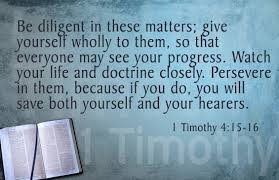
1 Tim. 41 Tim. 4: 16 Take heed unto thyself, and unto the doctrine; continue in them: for in doing this thou shalt both save thyself, and them that hear thee.

2 Tim. 2:15 Study to shew thyself approved unto God, a workman that needeth not to be ashamed, rightly dividing the word of truth.16 But shun profane and vain babblings: for they will increase unto more ungodliness.17 And their word will eat as doth a canker: of whom is Hymenaeus and Philetus;18 Who concerning the truth have erred, saying that the resurrection is past already; and overthrow the faith of some.19 Nevertheless the foundation of God standeth sure, having this seal, The Lord knoweth them that are his. And, let every one that nameth the name of Christ depart from iniquity.

Titus 2:6 Likewise, exhort the young men to be sober-minded, 7 in all things showing yourself to be a pattern of good works; in doctrine showing integrity, reverence, incorruptibility, 8 sound speech that cannot be condemned, that one who is an opponent may be ashamed, having nothing evil to say of you.—11 For the grace of God that brings salvation has appeared to all men, 12 teaching us that, denying ungodliness and worldly lusts, we should live soberly, righteously, and godly in the present age,13 looking for the blessed hope and glorious appearing of our great God and Savior Jesus Christ,14 who gave Himself for us, that He might redeem us from every lawless deed and purify for Himself His own special people, zealous for good works. (NKJV)

A question that calvinists cannot answer – because it’s a paradox

CHALLENGE to CALVINISTS to please explain the contradiction of Westminster Confession of Faith 3.1:

A Calvinist writes:  “[God] does not actively work unbelief into the non-elect. All are already under sin. God is not responsible for the sin of Adam, or the fall of mankind. God is not the author of evil. “

Q. Who then *is* the author of evil? Who did work unbelief into the heart of men? If all men are under sin, what was God doing when it happened – did it occur behind his back / outside his sovereign causality? Calvin wrote: (quote): 

“..the will of God is the supreme and primary cause of everything…” (The Institutes of Christian Religion, Book I, Ch. 16, Sect.

 “We also note that we should consider the creation of the world so that we may realise that everything is subject to God and ruled by his will and that when the world has done what it may, nothing happens other than what God decrees.” (Acts: Calvin, The Crossway Classic Commentaries, p.66)

“…the devil and all the ungodly are reined in by God, so that they cannot conceive, plan or carry out any crime, unless God allows it, indeed commands it. They are not only in bondage to him, but are forced to serve him. It is the Lord’s prerogative to enable the enemy’s rage and to control it at will, and it is in his power to decide how far and how long it may last, so that wicked men cannot break free and do exactly what they want….” (The Institutes of Christian Religion, Book I, Ch.17, Sect. 10)

= And again. WCF3.1 says God ordains EVERYTHING that happens.

Q. How then, having asserted this position, can Calvinism claim God is not authoring these things – THAT’S WHAT AUTHORING MEANS – (to conceive a plot, and via third parties cause a narrative to come into being, and then to publish it via secondary agents, for the world to experience it’s reality.) i.e. by the normal definition of the words, Authoring IS ordaining / decreeing / causing / predetermining, by creative design.

I really hope you guys can take this challenge on – because it lies at the heart of Calvinism’s claims of sovereignty. These are not complex questions, and are based on what Calvinism clearly states. I’m not pulling a clever trick on you here, but asking how you reconcile this contradiction: To quote Calvin again:

“First, it must be observed that the will of God is the cause of all things that happen in the world; and yet God is not the author of evil.” (Concerning the Eternal Predestination of God, p.169)

“Whatever things are done wrongly and unjustly by man, these very things are the right and just works of God. This may seem paradoxical at first sight to some….” (Concerning the Eternal Predestination of God, p.169)

Too right it seems paradoxical!….. It IS. Again. My questions have not been answered -I’ve received lots of references to God being “passive” while people go do things that God is not *actively* in control of, whilst simultaneously claiming God is in control of everything.

PROBLEM 1.) If God stands back and lets a man do something that God himself has not actively caused to be, then you are opening up space *outside his sovereign will* by claiming he stands by and lets things happen he did not cause.

PROBLEM 2.) Calvinists seem to also be claiming God IS in fact in TOTAL control of every atom in this universe etc. Thus you cannot claim God is in total control and at the same time shelve the effective causailty onto someone else… This question is normally responded to by Calvinists by stating “you do not understand Calvinism – go back and relearn”. I am – I have – I am taking you at your word and asking questions about it – please dont refer to charts or other material – I need to know how you square this circle personally. Or do you switch your mind off and accept mutually exclusive opposites as compatible truth… ie ‘A = NotA’

Sovereignty = total control / causality (predestination = ordination).
Soveriengty = active causality to salvation
Sovereignty does not = active causality to sin
Sovereignty does not = total control / causality

(Thanks to Stephen Thomas. Also read his long list of verses which show that TULIP is incorrect here)